
In This Article
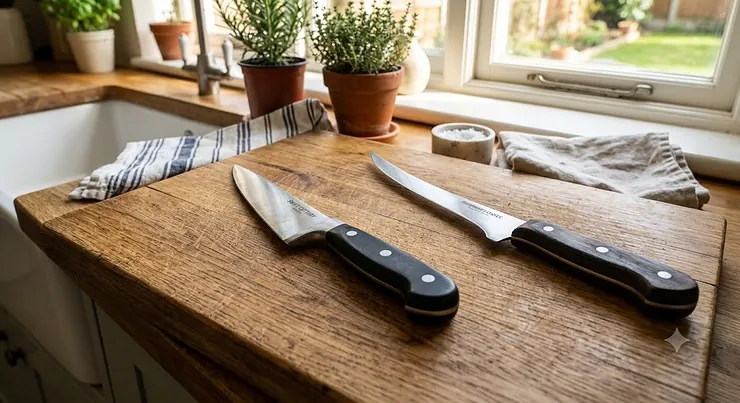
Stand in front of a knife rack in any busy British kitchen and you’ll spot the confusion instantly: two long, skinny blades that look almost identical, sitting there like siblings nobody bothered to introduce properly. That’s the boning knife vs filleting knife dilemma in a nutshell, and it trips up far more home cooks than it should. A boning knife is a narrow-bladed kitchen knife, typically 12–17cm long, built to separate meat from bone with precision rather than brute force; a filleting knife is its thinner, more flexible cousin, engineered specifically to glide along fish bones and skin without shredding delicate flesh, as Wikipedia’s overview of the boning knife family explains in more technical detail. Get the wrong one and you’ll spend twenty minutes hacking a chicken thigh apart or watching half your salmon fillet stay stuck to the skin.
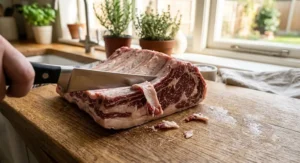
This isn’t a knife-shop sales pitch dressed up as advice. Think of this as your specialist kitchen knife guide — one built on real product specifications, aggregated customer-review sentiment, and honest comparative analysis rather than marketing fluff. Whether you’re jointing chickens on a Sunday, breaking down a whole seabass for the first time, or simply tired of wrestling a chef’s knife around a T-bone, you’ll find seven genuine products below, tested against each other on flexibility, steel quality, and real-world value. We’ll also settle the flexible vs stiff boning knife debate, work out whether you actually need both blades, and show you exactly which knife earns its keep for chicken versus fish. No invented five-star reviews, no fantasy pricing — just what the research and the reviewers actually say.
Quick Comparison Table
Before we dive into individual products, here’s the headline distinction that solves 90% of the confusion instantly.
| Feature | Boning Knife | Filleting Knife |
|---|---|---|
| Blade flexibility | Semi-stiff to flexible | Highly flexible (nearly always) |
| Primary job | Separating meat from bone | Removing fish flesh from skin and bone |
| Typical blade length | 12–17cm (5–6.5″) | 15–23cm (6–9″) |
| Best for | Poultry, beef, pork, lamb | Salmon, seabass, trout, flatfish |
| Edge angle | Slightly wider, more durable | Narrower, razor-fine |
| Best For (buyer type) | Home butchers, meal-preppers | Anglers, fishmongers, seafood lovers |
The core difference sits in blade geometry, not branding. A stiffer boning blade resists flexing when you’re levering meat off a beef shin, which matters because a blade that bows under pressure wastes meat and your patience in equal measure. A filleting blade, by contrast, is deliberately thin and springy so it can trace the contour of a fish’s ribcage without gouging into the flesh — the trade-off being it’s nearly useless for anything with real bone density. If you only ever cook chicken breasts from the supermarket, neither knife matters much. The moment you start buying whole birds, whole fish, or larger cuts to save money, the distinction becomes the difference between a clean job and a mangled one.
💬 Found the table useful? A quick share helps other home cooks find the right blade too!
Top 7 Boning and Filleting Knives: Expert Analysis
We’ve deliberately spread this list across budget, mid-range, and premium tiers, plus a couple of specialist catering picks most home cooks never think to consider.
1. Victorinox Fibrox Pro 6″ Boning Knife — best all-rounder for poultry
The Victorinox Fibrox Pro 6″ Boning Knife is the knife most professional kitchens hand to a junior chef on day one, and there’s a reason for that reputation. Its 15cm flexible high-carbon stainless blade bends just enough to follow a chicken’s ribcage without snapping, while the textured Fibrox handle stays grippy even when your hands are slick with fat or brine. Made in Switzerland to NSF hygiene standards, it’s the kind of tool that shows up in commercial kitchens precisely because it survives daily abuse without complaint. Based on the spec comparison with pricier rivals, the steel here isn’t the hardest on this list, but that’s arguably a feature: it sharpens back to scary-sharp in under a minute on a honing steel, which matters more than raw hardness for a knife you’ll use weekly. Reviewers consistently report that the flexible blade makes short work of deboning thighs and butterflying whole chickens, though a small number note the blade is almost too flexible for stiffer cuts like pork shoulder. This is squarely the knife for beginners who want one blade that handles 80% of poultry and light meat-prep tasks without a steep learning curve.
Pros:
- ✅ Flexes precisely enough for poultry without feeling flimsy
- ✅ Textured handle grips well even when wet or greasy
- ✅ Sharpens up quickly and holds an edge through regular use
Cons:
- ❌ Too flexible for stiffer cuts like pork shoulder or beef
- ❌ Plain looks compared with forged premium alternatives
Expect to pay in the £30-£40 range at the time of research, and given how often this exact knife turns up on professional benches, it’s arguably the best-value entry point on this entire list.
2. Victorinox Swiss Classic Fillet Knife 16cm — best budget fish knife
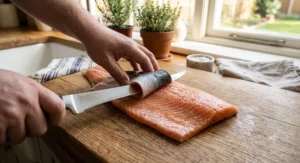
Sitting alongside its boning sibling, the Victorinox Swiss Classic Fillet Knife 16cm trades the wider poultry-friendly blade for something genuinely thin and whippy, purpose-built for fish. The 16cm stainless blade has a pronounced curve toward the tip, which — on paper — means it maximises the “belly” of the blade for long, sweeping strokes down a fish’s spine rather than short sawing motions. That translates in practice to fewer passes needed to lift a fillet cleanly off the bone, which matters because every extra pass is meat left behind on the carcass. The polypropylene handle is dishwasher-safe and non-porous, a genuinely useful detail when you’re handling something as bacteria-prone as raw fish. Aggregated reviewer sentiment across UK retailers is strongly positive on sharpness out of the box, with a recurring theme that the flex takes a session or two to get used to if you’ve only ever used a rigid chef’s knife. Anglers and weekend fishmongers looking for a first proper fillet knife without premium pricing will find this hard to beat.
Pros:
- ✅ Genuinely flexible blade designed around fish anatomy
- ✅ Dishwasher-safe handle suits wet, messy fish prep
- ✅ Sharp out of the box with minimal setup needed
Cons:
- ❌ Takes practice to control the flex confidently
- ❌ Not suited to any meat-boning tasks
Pricing typically sits around £25-£35, making it one of the most accessible ways to try proper fish filleting without committing to a premium blade.
3. Wüsthof Classic 6″ Flexible Boning Knife — premium forged option
If budget isn’t the primary concern, the Wüsthof Classic 6″ Flexible Boning Knife represents what over two centuries of German cutlery-making looks like when it’s aimed squarely at butchery. Forged from a single piece of high-carbon stainless steel with a full tang running the length of the handle, the balance point sits almost exactly where your index finger rests in a pinch grip — a small detail that matters enormously over a long deboning session. The precision-cut edge technology Wüsthof uses creates a finer, more consistent bevel than most stamped blades achieve, which in practice means less resistance dragging through connective tissue and silverskin. What most buyers overlook about this model is that “flexible” in Wüsthof’s range still means considerably stiffer than a Victorinox equivalent — this is a knife built for controlled precision, not maximum bend. Reviewers who’ve put it through extended venison and poultry work describe confident, clean separation of meat from joints, with the triple-riveted handle standing up to years of dishwasher cycles despite official advice to hand-wash. This is the knife for someone who cooks meat often enough that tool fatigue and edge retention actually matter.
Pros:
- ✅ Forged full-tang construction built to last decades
- ✅ Precision edge reduces drag through tendon and fat
- ✅ Excellent balance reduces hand fatigue on long jobs
Cons:
- ❌ Noticeably pricier than stamped alternatives
- ❌ Less flex than dedicated poultry-only boning knives
Expect a price in the mid-£90s to low-£100s range, positioning this firmly as a buy-once, keep-forever investment rather than a casual purchase.
4. Zwilling Twin Four Star 7″ High Carbon Fillet Knife — best hybrid for meat and fish
The Zwilling Twin Four Star 7″ High Carbon Fillet Knife earns its spot here because independent testers have repeatedly found it does something most single-purpose blades can’t: handle fish and meat competently in the same knife. Zwilling’s ice-hardened Friodur process treats the steel at sub-zero temperatures during manufacturing, which increases hardness without making the blade brittle — on paper that means better edge retention than a standard stamped blade, and in practice it holds a working edge through a full session of prep without needing a mid-job touch-up. The 7-inch length gives useful reach for larger fish like salmon while remaining manageable for pork tenderloin and chicken breakdown. Based on the spec comparison, its blade sits stiffer than a dedicated fillet knife but more flexible than a typical boning knife, which is precisely the compromise that makes it so versatile — though it does mean it’s not the outright best tool for either extreme task. Aggregated review sentiment highlights the comfortable POM handle and consistent sharpness, with the main criticism being that tiny chicken wing joints are slightly awkward for a blade this long. Anyone who genuinely can’t justify owning two specialist knives should start here.
Pros:
- ✅ Genuinely capable across both meat and fish tasks
- ✅ Ice-hardened steel holds an edge impressively well
- ✅ Comfortable, secure grip through long prep sessions
Cons:
- ❌ Slightly long for fiddly poultry joint work
- ❌ Not as specialised as single-purpose alternatives
Pricing generally falls in the £60-£90 range, which for a genuine two-in-one performer represents solid value against buying separate knives.
5. Starrett Professional Boning Knife 6″ Narrow Curved — best budget catering pick
Less well known to home cooks but a familiar sight in butchers’ shops and catering kitchens across the UK, the Starrett Professional Boning Knife 6″ Narrow Curved is a colour-handled, no-nonsense workhorse. The narrow curved profile is specifically shaped to hug bone contours during high-volume deboning, and the colour-coded handle system (available in multiple colours) exists to support HACCP-style cross-contamination controls in professional settings — a detail covered in the Food Standards Agency’s guidance on avoiding cross-contamination, which recommends dedicating separate equipment to raw meat, poultry, and ready-to-eat food. Here’s what the spec sheet won’t tell you, but catering buyers note: this knife isn’t trying to be beautiful, it’s trying to be replaceable and consistent, which is exactly what a busy kitchen needs. The stainless steel takes an edge fast and holds it reasonably well for the price point, though it lacks the refined balance of a forged blade. For home cooks who batch-cook or process a lot of raw poultry and want dedicated, colour-coded tools for hygiene reasons, this is a genuinely smart, low-cost pick.
Pros:
- ✅ Purpose-built curve hugs bone contours efficiently
- ✅ Colour-coded handle supports hygiene best practice
- ✅ Very low cost for genuinely professional-grade steel
Cons:
- ❌ Basic handle lacks ergonomic refinement of premium brands
- ❌ Balance feels blade-heavy compared with forged knives
At under £15 in most cases, this is about as close to professional catering equipment as home cooks can get without paying professional prices.
6. Hygiplas Fillet Knife 16cm Blue — best budget fish knife for hygiene-conscious cooks
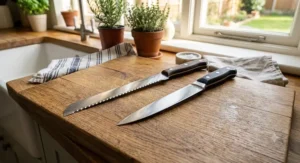
The Hygiplas Fillet Knife 16cm Blue is another catering-world staple that rarely gets mentioned in mainstream buying guides, which is a shame given how much sense it makes for anyone serious about food safety at home. Colour-coded blue specifically for raw fish under standard UK catering colour systems, this knife pairs a properly flexible 16cm blade with a soft-grip nylon handle rated dishwasher-safe — a genuinely practical combination given how often fish prep turns into a wet, slippery job. The blade’s Rockwell hardness of 52-57° sits at the softer end of the fillet-knife spectrum, meaning it flexes generously but needs slightly more frequent honing than a harder premium blade. What most buyers overlook here is that “cheap” and “flimsy” aren’t the same thing: this knife is inexpensive because it’s mass-produced for catering volume, not because corners were cut on the steel. Reviewers in the trade consistently praise the dishwasher-safe handle and colour-matching for kitchen hygiene systems, while noting the blade needs more regular sharpening than premium alternatives to stay at its best.
Pros:
- ✅ Colour-coded specifically for raw fish hygiene systems
- ✅ Properly flexible blade suited to genuine fish filleting
- ✅ Dishwasher-safe handle simplifies cleanup
Cons:
- ❌ Softer steel needs more frequent honing
- ❌ Basic aesthetics compared with branded kitchen knives
Priced under £15 in most listings, this is an easy way to add a genuinely dedicated fish knife to your kitchen without a premium spend.
7. Stellar James Martin Boning Knife 15cm/6″ — best British-branded mid-range pick
Rounding out the list is the Stellar James Martin Boning Knife 15cm/6″, a UK-designed option from Stellar’s collaboration with the British chef and broadcaster. The 15cm carbon stainless steel blade sits in a genuinely useful middle ground — flexible enough for poultry, with enough backbone to handle lighter cuts of pork and lamb without feeling unstable. The anti-slip handle uses a textured resin grip that performs well in wet conditions, and the blade’s razor edge arrives properly sharpened rather than needing an initial touch-up, which is a small but appreciated detail reviewers repeatedly mention. Based on the spec comparison against similarly priced European imports, the steel composition here is broadly comparable to Victorinox’s mid-range offerings, though the handle shape is noticeably chunkier, which some buyers with smaller hands find less comfortable during precision work. Aggregated feedback describes reliable everyday performance for typical home butchery tasks, with the caveat that it doesn’t hold an edge quite as long as forged German alternatives under heavy use. For shoppers who’d rather buy British where the pricing and performance stack up fairly, this earns its place.
Pros:
- ✅ Comfortable anti-slip grip in wet, greasy conditions
- ✅ Arrives properly sharpened, ready for immediate use
- ✅ Fair mid-range pricing for the steel quality offered
Cons:
- ❌ Chunkier handle less ideal for smaller hands
- ❌ Edge retention trails top-tier forged alternatives
Typical pricing sits in the £25-£35 range, making it a solid mid-tier choice for anyone who values supporting a British-designed product.
Practical Usage Guide: Using a Kitchen Knife for Butchery at Home
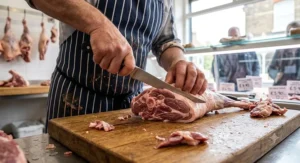
Owning the right blade is only half the job — using a kitchen knife for butchery safely and effectively takes a bit of technique most people never learn. Start with the grip: a pinch grip, with thumb and forefinger gripping the blade just above the bolster, gives far more control than wrapping your whole hand around the handle, especially when working close to bone. For your first thirty days with a new boning or filleting knife, resist the urge to force it — let the blade’s natural flex and sharpness do the work, using short, controlled strokes rather than sawing motions that tire your wrist and dull the edge faster. Maintenance-wise, a few strokes on a honing steel before each use keeps the edge aligned, while a proper sharpening on a whetstone every few months (more often if you’re processing a lot of poultry) restores the actual cutting edge that honing alone can’t fix. One of the most common first-month mistakes is storing these narrow blades loose in a drawer, where the thin, flexible steel can bend against other cutlery — a knife block, magnetic strip, or blade guard solves this instantly. Always work on a stable, non-slip board, and keep your non-knife hand’s fingers curled away from the blade’s path throughout.
Real-World Scenarios: Who Needs Which Knife
Picture three different cooks, because the right blade genuinely depends on who’s holding it. First, the Sunday roast enthusiast who buys a whole chicken most weeks to save money over pre-cut breasts: a flexible boning knife like the Victorinox Fibrox Pro 6″ Boning Knife earns its keep fast here, paying for itself within a handful of birds through reduced waste and faster prep. Second, the weekend angler who comes home with mackerel or bass from the coast and wants to process the catch properly rather than losing half the flesh to a clumsy chef’s knife — for this person, a dedicated flexible fillet knife such as the Victorinox Swiss Classic Fillet Knife 16cm or the Hygiplas Fillet Knife 16cm Blue is non-negotiable. Third, the household that cooks a genuine mix — the odd whole fish, regular chicken thighs, occasional lamb shoulder on the bone — who would be better served by a single hybrid performer like the Zwilling Twin Four Star 7″ High Carbon Fillet Knife, accepting a small compromise on both ends in exchange for not cluttering the knife block. Matching the knife to your actual cooking frequency and protein mix, rather than buying whatever looks most professional, is the single biggest factor in whether a specialist blade earns its place.
Problem → Solution Guide
Problem: The blade keeps bending away from the bone instead of cutting through connective tissue. This usually means you’re using a knife that’s too flexible for the cut — swap to a stiffer boning knife like the Wüsthof Classic 6″ Flexible Boning Knife for beef or pork, reserving genuinely floppy blades for poultry and fish.
Problem: Fish fillets are coming away torn, with flesh left on the skin. This is almost always a blade-angle issue rather than a sharpness issue — keep the blade angled slightly downward, tracking flat against the ribcage rather than digging in, and consider a longer blade such as the Victorinox Swiss Classic Fillet Knife 16cm for bigger fish.
Problem: The knife feels blunt within weeks of buying it. Cheaper stamped blades with softer steel — including budget catering knives — need honing before nearly every use, not just occasionally; a few seconds on a honing steel makes a bigger difference than most people expect.
Problem: Hands slip during wet, greasy poultry or fish prep. Textured or nylon grip handles like those on the Stellar James Martin Boning Knife 15cm/6″ or Hygiplas Fillet Knife 16cm Blue solve this far better than smooth wooden handles, which become genuinely dangerous once wet.
Problem: You’re not sure which knife to reach for on a mixed prep day. Default to the stiffer blade for anything involving real bone resistance (ribs, joints, thick cartilage) and the floppier blade for anything requiring flesh-hugging precision (fish, silverskin, thin poultry cuts).
Your Specialist Kitchen Knife Guide: A Buyer’s Decision Checklist
Use this quick specialist kitchen knife guide as a decision tree rather than reading every review in depth. If you cook whole chickens or turkey crowns more than twice a month, prioritise a flexible boning knife first — it’s the higher-frequency use case for most UK households. If fish is your priority — whether from the fishmonger, a coastal trip, or a regular fish counter shop — a dedicated flexible fillet knife should come before a boning knife, since a boning blade genuinely struggles with delicate fish flesh. If your budget only stretches to one knife and your cooking is genuinely mixed between meat and fish, choose a hybrid like the Zwilling Twin Four Star 7″ High Carbon Fillet Knife, accepting a small compromise in exchange for versatility. If hygiene and dedicated equipment matter to you — perhaps you’re catering for a larger household or simply prefer strict separation between raw meat and fish tools — the colour-coded Starrett Professional Boning Knife 6″ Narrow Curved and Hygiplas Fillet Knife 16cm Blue combination solves that cleanly and cheaply. And if you’re buying as a gift or simply want the best possible experience regardless of price, the Wüsthof Classic 6″ Flexible Boning Knife remains the standout for long-term satisfaction.
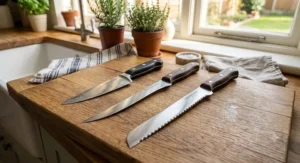
Meat Knife Selection Guide: How to Choose Between a Boning Knife and a Filleting Knife
This meat knife selection guide breaks the decision down into seven practical criteria, each with the reasoning behind it.
- Identify your dominant protein. If poultry and red meat dominate your weekly cooking, prioritise boning-knife flexibility profiles suited to that meat; if fish features heavily, prioritise filleting-specific flex.
- Check the blade flex rating. Manufacturers rarely publish a numeric flex score, but product descriptions using words like “semi-stiff” versus “highly flexible” are a reliable proxy worth reading carefully.
- Consider blade length against your typical cut size. Shorter blades (12-15cm) suit smaller birds and modest fish; longer blades (18cm+) suit larger fish and bigger joints of meat.
- Weigh steel type against maintenance tolerance. High-carbon stainless holds an edge longer but costs more; softer stainless is cheaper but needs more frequent honing — be honest about how often you’ll actually sharpen a knife.
- Test handle grip in wet conditions if possible. A knife that feels secure dry can turn genuinely risky once it’s slick with fat, brine, or fish slime.
- Factor in your storage setup. Thin, flexible blades bend and dull faster in a cluttered drawer than on a magnetic strip or slotted block.
- Match your budget to your usage frequency, not your aspirations. A £15 catering-grade knife used weekly delivers better value than a £100 forged blade left in a drawer.
Running through these seven points before buying prevents the single most common mistake: choosing a knife based on how professional it looks rather than how it will actually perform in your specific kitchen.
Common Mistakes When Buying a Boning or Filleting Knife
The most frequent mistake is assuming one knife can do both jobs equally well — as the spec comparisons above show, a knife stiff enough to handle beef joints will almost always disappoint on delicate fish work, and vice versa. A second common error is buying based on blade length alone, ignoring flex entirely; a long, rigid blade is genuinely worse for fish than a short, floppy one, regardless of what the product photography suggests. Shoppers also frequently overlook handle material, prioritising steel quality while ignoring that a smooth wooden handle becomes a genuine safety hazard once wet — textured resin, Fibrox, or nylon grips consistently outperform in aggregated review sentiment for wet-task safety. Another mistake is ignoring maintenance requirements entirely: buying a premium forged blade and then never honing it wastes most of the investment, since edge retention advantages only materialise with proper care. Finally, many buyers skip checking whether a knife is genuinely dishwasher-safe versus merely dishwasher-tolerant — repeated dishwasher cycles can dull edges and, on wooden handles, cause cracking over time, even on knives technically rated as safe for it.
Difference Between Boning and Filleting Knife: The Detailed Breakdown
The difference between boning and filleting knife design comes down to three measurable factors: flex, blade shape, and intended material resistance. Flex is the headline difference — a boning knife’s blade resists bending under moderate pressure, which is essential when you need to lever meat away from a joint or saw through cartilage without the blade folding uselessly. A filleting knife’s blade, by contrast, is engineered to bend considerably, allowing it to trace a fish’s curved ribcage in one continuous motion rather than multiple choppy strokes. Blade shape follows from this: filleting knives typically carry a more pronounced upward curve near the tip, maximising the “belly” used for long slicing strokes, while boning knives tend toward straighter or gently curved profiles suited to more direct, controlled cuts. The third factor — intended resistance — explains why boning knives are ground with a slightly wider bevel angle for durability against bone contact, whereas filleting knives use a narrower, more delicate bevel optimised purely for slicing soft flesh, since bone contact would chip that finer edge almost immediately. Understanding these three factors explains nearly every practical difference in how the two knives perform, and why swapping one for the other consistently produces worse results than using the purpose-built tool.
What to Expect: Real-World Performance
Specs on paper rarely translate directly into kitchen experience, so here’s what actually happens day to day. With a genuinely flexible boning knife like the Victorinox Fibrox Pro 6″ Boning Knife, expect to debone a whole chicken thigh in well under a minute once you’ve had a few sessions of practice — the blade essentially follows the bone’s shape for you rather than fighting it. With a stiffer premium option like the Wüsthof Classic 6″ Flexible Boning Knife, expect noticeably less blade “give” but more confident, controlled cuts through tougher joints and cartilage, at the cost of slightly more wrist effort on delicate poultry work. On the fish side, a properly flexible blade such as the Victorinox Swiss Classic Fillet Knife 16cm should let you lift a full fillet off a mackerel or trout in two or three long strokes rather than a dozen short, hesitant ones — if you’re sawing repeatedly, the blade is either too stiff or not sharp enough. Reviewers across both product categories consistently note that the first few uses feel unfamiliar if you’re coming from a rigid chef’s knife, with confidence and speed building noticeably within two or three sessions. What the spec sheet won’t tell you is how much technique compounds the equipment advantage — the same knife in practiced hands will outperform a pricier blade in inexperienced ones.
Flexible vs Stiff Boning Knife: Which One Do You Need?
The flexible vs stiff boning knife question genuinely depends on what’s most often on your chopping board. A flexible boning knife — like the Victorinox Fibrox Pro 6″ Boning Knife — bends readily around joints and contours, making it the clear choice for poultry, where bones are smaller, softer, and irregularly shaped. A stiffer boning knife holds its line under pressure, which matters far more for beef, pork, and lamb, where you’re often levering meat away from larger, denser bones that would simply push a flexible blade off course. Semi-stiff options, such as the Wüsthof Classic 6″ Flexible Boning Knife (Wüsthof’s own “flexible” line sits stiffer than most competitors’ equivalent), attempt to split the difference, offering enough rigidity for red meat while retaining some manoeuvrability for poultry — a sensible compromise if you genuinely cook a mix of proteins. Hunters and game processors overwhelmingly favour semi-stiff blades for exactly this reason: venison work benefits from the authority of a stiffer edge while still needing some flex to follow joint contours. If your cooking leans heavily toward one protein category, buy for that dominant use case rather than trying to future-proof against occasional tasks a second, cheaper knife could handle instead.
Which Knife for Chicken vs Fish: Matching Blade to Protein
Deciding which knife for chicken vs fish comes down to bone density and flesh delicacy, two factors that pull in opposite directions. Chicken bones, while numerous, are relatively soft and forgiving of moderate blade pressure, which is why a flexible boning knife handles poultry so comfortably — you can work quickly around joints without excessive risk of chipping the edge. Fish flesh, by contrast, is extremely delicate and tears easily under anything but the gentlest, most controlled slicing pressure, which is precisely why filleting knives are ground so much thinner and sharper than boning knives, even though both may look superficially similar on a knife rack. Using a boning knife on fish typically works but produces noticeably more wastage, since the stiffer blade can’t hug the ribcage as closely; using a filleting knife on chicken is riskier still, since the thin, delicate edge is far more prone to chipping against small chicken bones. For households processing both proteins regularly, owning one of each — even budget catering versions like the Starrett Professional Boning Knife 6″ Narrow Curved paired with the Hygiplas Fillet Knife 16cm Blue — costs under £30 combined and avoids compromising either task.
Do I Need Both a Boning and Filleting Knife?
Whether you genuinely need both a boning and filleting knife depends almost entirely on how often each protein appears in your cooking, rather than any absolute rule. If chicken, beef, pork, or lamb regularly need deboning in your kitchen but fish rarely does, a single quality boning knife covers your needs comfortably, and vice versa for a fish-focused household. If both proteins feature regularly — say, a weekly roast chicken and a monthly fish supper — the maths genuinely favours owning both, since a compromise hybrid knife will underperform a dedicated tool on your more frequent task. Budget is rarely the deciding factor here: as the catering-grade picks on this list demonstrate, a genuinely capable pair can cost under £30 combined, meaning the real question is storage space and how much you value having the exactly right tool for each job rather than a reasonable compromise. For infrequent cooks who process a whole chicken or whole fish only a handful of times a year, a single hybrid knife like the Zwilling Twin Four Star 7″ High Carbon Fillet Knife is the more sensible, lower-clutter choice.
Long-Term Cost & Maintenance
Total cost of ownership on these knives extends well beyond the initial purchase price. Budget catering knives like the Starrett Professional Boning Knife 6″ Narrow Curved and Hygiplas Fillet Knife 16cm Blue cost little upfront but typically need replacing or professionally re-ground every couple of years under heavy use, since their softer steel doesn’t hold a fine edge indefinitely. Premium forged knives such as the Wüsthof Classic 6″ Flexible Boning Knife cost considerably more initially but, with proper honing and occasional whetstone sharpening, can realistically last decades — many buyers report knives from this tier still performing well after ten or more years of regular use, which fundamentally changes the cost-per-use calculation in the premium knife’s favour over a long enough timeline. Sharpening costs also factor in: a whetstone setup costs roughly £15-£30 as a one-off purchase and pays for itself within a year or two versus paying a professional sharpener per visit. The BBC Good Food guide to buying kitchen knives makes a similar point about investing in fewer, better blades over accumulating a large set of mediocre ones. For most households, a genuinely well-maintained mid-range knife will outlast several cheap replacements bought over the same period, making the mid-range tier the sensible long-term value pick.
Safety, Hygiene and Regulations Guide
Both boning and filleting knives carry real injury risk precisely because their sharpness and flex are what make them effective — the same qualities that glide cleanly around a bone can slip unpredictably if technique lapses. The Health and Safety Executive’s guidance on the safe use of knives in catering recommends using a knife suited to the specific task, wearing a cut-resistant glove on the non-knife hand during deboning work, and ensuring staff (or, at home, yourself) are properly trained in safe cutting technique — advice that applies just as sensibly to a domestic kitchen as a commercial one. On hygiene, the colour-coded systems used by catering-grade knives like the Starrett Professional Boning Knife 6″ Narrow Curved exist to prevent cross-contamination between raw meat, raw fish, and ready-to-eat food, a risk the Food Standards Agency identifies as a leading cause of foodborne illness in UK households. Practically, that means using separate boards and, ideally, separate knives for raw poultry and raw fish where possible, washing hands and equipment thoroughly between tasks, and never leaving a freshly used boning or filleting knife loose on a wet countertop where it becomes both a hygiene risk and a genuine safety hazard. None of these UK kitchen knives require UKCA or CE marking as consumer cutlery, but general product safety regulations still apply to their manufacture and sale.
Frequently Asked Questions
❓ What's the main difference between a boning knife and a filleting knife?
❓ Can I use a boning knife for filleting fish?
❓ What length boning knife should I buy for chicken?
❓ Do I need a stiff or flexible boning knife?
❓ How often should I sharpen a filleting knife?
Conclusion
The boning knife vs filleting knife decision ultimately comes down to what’s most often on your chopping board, not which knife looks most impressive in a display case. If poultry and red meat dominate your cooking, a flexible boning knife like the Victorinox Fibrox Pro 6″ Boning Knife earns its place fast, while dedicated fish cooks are far better served by a genuinely flexible fillet knife such as the Victorinox Swiss Classic Fillet Knife 16cm. Those wanting a single capable performer across both proteins should look at the Zwilling Twin Four Star 7″ High Carbon Fillet Knife, while budget-conscious or hygiene-focused households can build an excellent dedicated pair from the Starrett Professional Boning Knife 6″ Narrow Curved and Hygiplas Fillet Knife 16cm Blue for remarkably little outlay. For buyers wanting the best possible long-term investment, the Wüsthof Classic 6″ Flexible Boning Knife remains the standout, while the Stellar James Martin Boning Knife 15cm/6″ offers a fair, British-designed middle ground. Whichever you choose, matching blade flex to your dominant protein — not chasing the most premium-looking option — is what actually determines whether a knife earns a permanent spot in your kitchen drawer.
Recommended for You
- Fish Filleting Knife 2026: 7 Best Picks Anglers Trust
- Stiff Boning Knife: 7 Best Rigid Blades for Butchery in 2026
- Flexible Filleting Knife 2026: 7 Best Picks & Buying Tips
Disclaimer: This article contains affiliate links. As an Amazon Associate, I earn from qualifying purchases. If you purchase products through these links, we may earn a small commission at no additional cost to you.
✨ Found this helpful? Share it with your friends! 💬🤗
