In This Article
A stiff boning knife is the one tool that separates a tidy, waste-free joint from a hacked-about mess on the chopping board. If you have ever wrestled a leg of lamb apart with a wobbly, flexible blade and watched half the meat stay stubbornly attached to the bone, you already know why butchers reach for something rigid. A stiff boning knife has a fixed, non-bending blade that tracks tight against bone without deflecting, giving you the leverage and control to lever meat away cleanly rather than sawing at it.
This guide is built around real, currently available knives, not marketing copy lifted from a listing page. We have pulled together genuine specifications, aggregated review sentiment from retailers and enthusiast sites, and honest analysis of who each rigid boning knife for lamb suits, and who each one is wrong for. You’ll find seven proper products spanning budget, mid-range and professional-grade options, plus practical guidance on choosing, using and maintaining one safely — including a nod to the Food Standards Agency’s guidance on avoiding cross-contamination, since a boning knife spends more time in direct contact with raw meat than almost any other tool in the kitchen.
Whether you’re after a rigid boning knife for weekend butchery, a professional boning knife for a busy prep kitchen, or simply a reliable butcher knife for home use, you’ll find a genuinely useful match below, with honest pros and cons for each.
Quick Comparison Table
| Knife | Blade Type | Best For | Price Range |
|---|---|---|---|
| Victorinox Fibrox Pro Stiff Wide Boning Knife | Straight, stiff, wide | Home cooks, all-round use | around £30-£45 |
| F. Dick ErgoGrip Stiff Curved Boning Knife | Curved, stiff | Serious/commercial butchery | £35-£55 range |
| Mercer Culinary Genesis Stiff Boning Knife | Straight, stiff | Best value professional grade | £30-£45 range |
| Wüsthof Classic Ikon Boning Knife | Curved, stiff, forged | Premium, long-term investment | £90-£130 range |
| Dexter-Russell Traditional Stiff Boning Knife | Straight, stiff, carbon steel | Edge-retention enthusiasts | £25-£40 range |
| Victorinox Fibrox Narrow Stiff Boning Knife | Narrow, stiff | Lamb, poultry, precision work | under £35 |
| Dexter-Russell SofGrip Wide Stiff Boning Knife | Wide, stiff | Long prep sessions, comfort | £25-£40 range |
Looking at the table, the clearest split is between the Victorinox Fibrox Pro Stiff Wide Boning Knife and Mercer Culinary Genesis Stiff Boning Knife as sensible do-it-all buys, while the Wüsthof Classic Ikon Boning Knife sits in a different league entirely for anyone treating this as a decades-long investment. If lamb and poultry are your main targets rather than beef primals, the narrower Victorinox Fibrox Narrow Stiff Boning Knife earns its place through sheer manoeuvrability, not raw stopping power.
💬 Found a knife that suits your kitchen already? Jump straight to the full reviews below — or bookmark this page and come back once you’ve weighed up your options.
Top 7 Stiff Boning Knives: Expert Analysis
Coverage below spans budget, mid-range and premium options, plus narrow, wide, curved and straight variants, so you can match blade geometry to the job rather than buying on brand name alone.
1. Victorinox Fibrox Pro Stiff Wide Boning Knife — best all-rounder for home cooks
The standout here is simple: a genuinely rigid, wide blade that costs a fraction of what German forged competitors ask. Victorinox Fibrox Pro Stiff Wide Boning Knife uses stamped high-carbon steel finished with the brand’s textured Fibrox handle, which stays gripping even when your hands are slick with fat or brine. The wide profile adds stiffness and a bit of extra leverage for popping joints, while the Swiss manufacturing keeps tolerances tight and the edge geometry consistent from box to bin.
Based on the spec comparison with other stamped-blade knives in this price bracket, the Fibrox range punches well above its cost — stamped blades are usually thinner and springier than forged ones, but Victorinox compensates with a genuinely stiff temper. This is the knife to reach for if you’re deboning a chicken most weekends or tackling the odd leg of lamb rather than running a butcher’s counter eight hours a day; the handle comfort simply hasn’t been tested to commercial-shift standards the way forged steel has.
Reviewers consistently note the razor-sharp factory edge and the handle’s dishwasher tolerance, though most experienced users still hand-wash to protect the edge, and aggregated feedback across retailer sites repeatedly flags the grip as excellent even wet. What most buyers overlook is that this knife is essentially the same specification used in commercial kitchens worldwide, just sold at a home-cook-friendly price point.
Pros:
- ✅ Genuinely stiff blade despite the low price point
- ✅ Textured handle grips well even when wet or greasy
- ✅ Swiss manufacturing with consistent factory sharpness
Cons:
- ❌ Stamped steel needs more frequent honing than forged blades
- ❌ Handle shape suits medium-to-large hands better than small ones
At around £30-£45, this sits firmly in “buy without agonising” territory, and it remains one of the best value entry points into rigid boning knives for beef, lamb or poultry alike.
2. F. Dick ErgoGrip Stiff Curved Boning Knife — best for serious butchery work
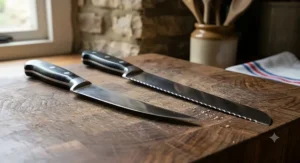
The F. Dick ErgoGrip Stiff Curved Boning Knife is built from German X55CrMo14 alloy, ice-hardened and tempered to around 56 HRC — hard enough to hold an edge through a full processing shift without becoming brittle. The curved profile follows the natural contour of bone, letting the blade hug joints on beef and pork carcasses rather than fighting against them, and the ErgoGrip handle is colour-coded (red, blue, green, black, yellow) so commercial kitchens can separate species and cuts hygienically.
Here’s what to weigh up: this is a knife designed for people who bone meat professionally, not occasionally. The stiffness that makes it so controlled against thick joints also means it offers less “give” than a semi-flexible blade when working around delicate poultry cartilage. Reviewers consistently report that the seamless blade-to-handle join resists the grime build-up that plagues cheaper riveted handles, and aggregated feedback from butchery-equipment retailers highlights the ErgoGrip’s non-slip texture as standing up well to hours of continuous, gloved use.
What most buyers overlook about this model is that F. Dick is a specialist butchery brand rather than a general cutlery house, so the whole knife — bolster, tang, temper — is engineered around one job. That focus shows in how it performs, but it’s arguably overkill if your boning sessions amount to one Sunday joint a fortnight.
Pros:
- ✅ Ice-hardened German steel holds an edge through long sessions
- ✅ Colour-coded handles support hygienic, species-specific use
- ✅ Curved blade tracks bone contours with real precision
Cons:
- ❌ Less forgiving around delicate poultry cartilage than flexible blades
- ❌ Higher price than home-focused alternatives for occasional use
Expect to pay in the £35-£55 range, positioning it as a mid-to-upper option that professional boning knife buyers will recognise immediately.
3. Mercer Culinary Genesis Stiff Boning Knife — best value professional-grade forged blade
Mercer Culinary Genesis Stiff Boning Knife is precision-forged from German high-carbon steel and finished with a Santoprene handle that Mercer specifically engineered to stay grippy even when soaked in raw meat juices. The forged bolster adds balance that stamped blades simply cannot match, shifting the knife’s centre of gravity closer to the hand for less wrist fatigue during long boning sessions.
Based on the spec comparison, this knife occupies an unusual sweet spot: forged construction and NSF certification normally push prices toward premium German brands, yet Mercer keeps it accessible. Reviewers consistently note that the blade “debones meat easily with minimal waste” and stays sharp for extended periods without needing constant honing, while aggregated sentiment across catering-supply retailers repeatedly praises the taper-ground edge for easy resharpening — a genuine advantage for anyone maintaining their own knives at home rather than sending them out.
What the spec sheet won’t tell you, but user reports suggest, is that the Santoprene handle can feel slightly bulkier than slimline European handles, which some users with smaller hands find takes a session or two to adjust to. For most home cooks and culinary students, that’s a minor trade-off against the durability on offer.
Pros:
- ✅ Forged construction with a proper bolster for balance
- ✅ Santoprene handle stays secure even when soaked
- ✅ Taper-ground edge is genuinely easy to resharpen at home
Cons:
- ❌ Handle feels bulky for those with smaller hands
- ❌ Not dishwasher-safe despite the tough-looking synthetic grip
Priced around £30-£45, the Mercer Culinary Genesis Stiff Boning Knife is arguably the strongest value argument in this whole round-up.
4. Wüsthof Classic Ikon Boning Knife — premium forged pick built to last decades
The Wüsthof Classic Ikon Boning Knife is precision-forged from a single block of high-carbon stainless steel and tempered to 58 HRC, with Wüsthof’s PEtec edge technology adding roughly 20% more sharpness and double the edge retention of the brand’s older grinding process. The half-bolster Ikon handle design balances beautifully in the hand, and the whole knife carries a limited lifetime warranty — a meaningful signal of confidence from a company that has been forging blades in Solingen since 1814.
On paper this means noticeably longer intervals between sharpenings and a blade that resists the kind of edge rolling that lower-carbon steels suffer from when working through connective tissue. Reviewers consistently note the exceptional balance and the “glides effortlessly” sensation Wüsthof owners frequently describe, and aggregated feedback confirms the narrow, curved geometry is particularly well suited to close, controlled cuts around joints on beef, pork and lamb.
Here’s what to weigh up before buying: this is genuinely premium pricing for a specialist knife you’ll use less often than a chef’s knife. If you bone meat rarely, the Victorinox Fibrox Pro Stiff Wide Boning Knife will do 90% of the job for a fraction of the outlay. But for anyone who treats kitchen tools as long-term equipment rather than consumables, the Wüsthof’s forged steel and half-century-plus expected lifespan make the maths add up eventually.
Pros:
- ✅ Forged from a single block of high-carbon stainless steel
- ✅ PEtec edge technology extends sharpness retention noticeably
- ✅ Backed by Wüsthof’s limited lifetime warranty
Cons:
- ❌ Significantly pricier than stamped or mid-range forged alternatives
- ❌ Overkill for occasional, once-a-month boning tasks
At roughly £90-£130, it’s the clear premium choice in this line-up, but every penny buys demonstrable steel quality rather than branding alone.
5. Dexter-Russell Traditional Stiff Boning Knife — best carbon-steel option for edge purists
Dexter-Russell Traditional Stiff Boning Knife swaps stainless steel for old-school high-carbon steel, paired with a natural beech wood handle in the American traditional style. Carbon steel takes a noticeably sharper edge than most stainless alloys and is easier to hone to a fine finish, which is precisely why so many professional butchers still specify it despite the extra maintenance it demands.
What most buyers overlook about carbon steel is that it will develop a grey-blue patina with use, and it needs drying immediately after washing to avoid rust spots — this isn’t a flaw so much as the trade-off for exceptional sharpness. Reviewers consistently describe the blade as “primarily used for deboning chicken and other meats” with a rigidity that holds its line through tendon and cartilage without flexing off course, and the beech handle, while less flashy than synthetic alternatives, has decades of use behind it in commercial kitchens.
Based on the spec comparison with synthetic-handled rivals, this knife rewards people willing to do a little extra care in exchange for superior cutting performance. It is not the right choice if you want to toss a knife in the dishwasher and forget about it.
Pros:
- ✅ High-carbon steel takes an exceptionally sharp edge
- ✅ Traditional, well-tested profile trusted in commercial kitchens
- ✅ Easy to resharpen to a fine finish with a whetstone
Cons:
- ❌ Requires immediate drying to prevent rust and staining
- ❌ Wood handle needs more care than synthetic alternatives
Typically priced in the £25-£40 range, it’s excellent value for anyone prepared to maintain it properly.
6. Victorinox Fibrox Narrow Stiff Boning Knife — best narrow stiff blade for lamb and poultry precision
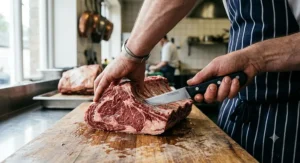
Where the wide Fibrox model favours leverage, the Victorinox Fibrox Narrow Stiff Boning Knife trades width for reach, using an ice-tempered high-carbon stainless blade that’s thin enough to slip into the tight pockets around a lamb shoulder blade or a chicken thigh joint without tearing surrounding meat. At roughly 26cm overall length with a rigid, thin profile, it’s built specifically for delicate, close-contact boning rather than brute-force separation.
Based on the spec comparison, narrow stiff blades like this one sacrifice some stability on thick joints in exchange for dramatically better access in cramped anatomy — exactly the trade-off you want for a stiff boning knife for lamb shoulders, saddles and racks, where precision beats power. Reviewers consistently praise the ergonomic handle for reducing hand fatigue during repetitive boning tasks, and aggregated feedback highlights the stainless blade’s resistance to rust and corrosion, useful if it sees frequent washing between cuts.
What the spec sheet won’t tell you is how much this narrow geometry changes your technique: you’ll find yourself using shorter, more controlled strokes rather than long draws, which some users initially find takes practice to adapt to after using a wider blade.
Pros:
- ✅ Thin, rigid profile reaches tight joints cleanly
- ✅ Ice-tempered stainless steel resists corrosion well
- ✅ Ergonomic handle reduces fatigue on repetitive tasks
Cons:
- ❌ Less stable than wider blades on thick beef joints
- ❌ Takes some adjustment if you’re used to wider knives
At under £35, it’s an affordable specialist addition rather than a sole do-everything blade.
7. Dexter-Russell SofGrip Wide Stiff Boning Knife — best ergonomic grip for long sessions
The Dexter-Russell SofGrip Wide Stiff Boning Knife pairs DEXSTEEL, a stain-free high-carbon steel, with a soft rubber grip handle that’s noticeably more cushioned than the firmer polymer handles found on most competitors. The wide, stiff blade is aimed squarely at pork and beef boning, where extra blade width adds rigidity for popping larger joints apart cleanly, and NSF certification confirms it meets recognised food-safety hygiene standards.
Here’s what to weigh up: the softer grip genuinely reduces hand fatigue over extended prep sessions, something reviewers consistently flag as a meaningful comfort advantage compared with harder Fibrox-style handles, particularly for anyone processing multiple joints back-to-back. Aggregated feedback from commercial kitchen buyers also notes the non-slip texture performs well even during all-day, continuous use in gloved hands.
What most buyers overlook is that soft-grip handles, while comfortable, can show wear faster than harder polymers over years of heavy commercial use — a fair trade for home cooks and small-scale butchers who won’t be putting it through daily industrial shifts, but worth knowing if you’re comparing total cost of ownership over a decade.
Pros:
- ✅ Soft rubber grip meaningfully reduces hand fatigue
- ✅ Stain-free DEXSTEEL blade resists corrosion well
- ✅ NSF certified to recognised hygiene standards
Cons:
- ❌ Soft grip may wear faster than harder handles long-term
- ❌ Wide blade less suited to delicate poultry work
Priced around £25-£40, it’s a genuinely comfortable, budget-friendly workhorse for home butchers doing regular sessions.
Practical Usage Guide: Getting the Best From a Stiff Boning Knife
Buying the right knife is only half the job — using it well is what actually saves you meat and time. Start by letting the blade do the work: a stiff boning knife should be guided along the bone with light pressure and short, controlled strokes, not sawed back and forth like a bread knife. Grip it in a “dagger” position, blade pointing down toward the bone, for most joint work, and switch to a standard forward grip when trimming fat, sinew or skin.
In the first 30 days, the most common mistake is over-gripping the handle out of nervousness, which tires your hand fast and reduces control rather than improving it. Aim to hold it the way you’d hold a pen — firm but relaxed. Hone the edge with a honing steel before every session; a genuinely stiff blade holds its geometry well, so light, consistent honing keeps the working edge aligned without removing much metal. Full resharpening on a whetstone or pull-through sharpener is typically needed every few months for a home cook, more often for anyone boning weekly.
Maintenance is straightforward but non-negotiable: wash by hand immediately after use with warm water and mild detergent, dry thoroughly before storing, and never leave a boning knife soaking in a sink where the edge can knock against other items. Store it in a knife block, on a magnetic strip, or in a blade guard rather than loose in a drawer — both to protect the edge and to protect your fingers when reaching in blind.
Deboning a Leg of Lamb: A Step-by-Step Scenario
Consider a fairly typical weekend cook: someone preparing a boned-and-rolled leg of lamb for a family roast, working with a whole bone-in leg from the butcher rather than a pre-boned joint. This is exactly the scenario a stiff boning knife for lamb was designed around, because the leg bone has an irregular shape with a ball joint at one end that a flexible blade struggles to navigate cleanly.
Start by placing the leg fat-side down and locating the aitch bone at the wider end. Using a narrow, rigid blade — the Victorinox Fibrox Narrow Stiff Boning Knife is well suited here — work the tip around the bone in short strokes, keeping the blade edge angled toward the bone rather than the meat to minimise waste. As you reach the ball-and-socket joint connecting to the leg bone, twist to pop the joint before continuing to cut through the connecting cartilage; forcing a stiff blade through cartilage without first separating the joint risks chipping the edge or slipping.
Once the aitch bone is free, work down the shank bone in the same manner, keeping the knife tip pressed against bone the whole way. Someone working through a full leg for the first time should expect the process to take 15-20 minutes; experienced butchers do it in a fraction of that. Budget-conscious cooks doing this once or twice a year will get excellent results from the Victorinox Fibrox Pro Stiff Wide Boning Knife, while anyone deboning lamb regularly — for a small catering operation, say — will feel the difference a forged blade like the F. Dick ErgoGrip Stiff Curved Boning Knife makes over a long prep session.
Problem → Solution: Common Boning Knife Mistakes
Problem: the blade keeps slipping off the bone. This usually means the edge has dulled more than it looks. Solution: hone before every session and check sharpness on a scrap of paper — a properly honed stiff blade should slice cleanly with minimal pressure.
Problem: too much meat is left on the bone. This is often a technique issue rather than a knife issue, though a blade that’s too wide for the joint doesn’t help. Solution: switch to a narrower profile like the Victorinox Fibrox Narrow Stiff Boning Knife for smaller joints, and keep the blade edge angled toward bone throughout the cut.
Problem: hand fatigue after longer sessions. Solution: a softer, ergonomic handle such as the one on the Dexter-Russell SofGrip Wide Stiff Boning Knife genuinely helps, but grip technique matters just as much — relax your hold and let the blade’s stiffness do the structural work rather than gripping harder.
Problem: rust spots appearing on a carbon-steel blade. Solution: dry the knife immediately after washing, never leave it wet, and apply a light film of food-safe mineral oil if it will be stored for more than a few days — a small step that protects knives like the Dexter-Russell Traditional Stiff Boning Knife for years.
Problem: the knife feels unbalanced and tip-heavy. Solution: this is common with cheaper stamped blades lacking a bolster. A forged option with a proper bolster, such as the Mercer Culinary Genesis Stiff Boning Knife or Wüsthof Classic Ikon Boning Knife, redistributes weight closer to the hand for noticeably better control.
How to Choose a Stiff Boning Knife
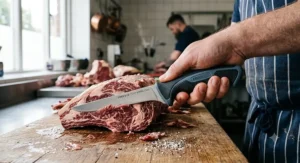
Choosing the right rigid boning knife comes down to matching blade characteristics to the meat and frequency of use, rather than simply picking the most expensive option. Here’s a practical framework:
- Decide on blade width first. Wide blades add rigidity and leverage for beef and pork; narrow blades trade some stability for reach into tight joints on lamb and poultry.
- Choose straight or curved based on your main task. Straight blades suit general trimming and larger cuts; curved blades track bone contours more naturally during dedicated deboning.
- Match steel type to your maintenance appetite. Stainless steel resists rust with minimal care; carbon steel sharpens to a finer edge but demands prompt drying and occasional oiling.
- Check for a forged bolster if balance matters to you. Forged knives with a bolster feel noticeably different in the hand than stamped blades, particularly during extended sessions.
- Consider handle material for hygiene and grip. Synthetic handles (Fibrox, Santoprene, SofGrip) resist bacteria absorption better than wood and stay grippy when wet — a genuine consideration given how easily bacteria transfer during raw meat prep.
- Factor in frequency of use. Occasional home cooks rarely need to spend premium prices; anyone boning meat weekly or professionally will feel the benefit of forged German or premium steel over years of use.
- Check the hardness rating if it’s listed. Blade hardness is usually expressed using the Rockwell hardness test, where higher HRC numbers generally mean better edge retention but slightly more brittleness — most quality boning knives sit between 55 and 58 HRC, balancing sharpness with the toughness needed to work around bone without chipping.
Curved Boning Knife vs Straight Boning Knife
This is one of the most common points of confusion for anyone buying their first rigid boning knife, and the honest answer is that neither shape is universally “better” — they’re suited to different stages of the same job. A straight blade offers a longer, more direct cutting edge, useful for trimming fat, slicing through larger sections of connective tissue, and general-purpose work where you’re not constantly following the curve of a bone.
A curved blade, by contrast, is shaped to hug bone contours, letting the edge maintain consistent contact as you scrape meat away from a joint’s natural shape — this is why so many dedicated butchery brands like F. Dick offer curved options specifically for close boning work on ribs, shoulders and legs. What most buyers overlook is that many professional butchers actually own both and switch between them mid-task: straight for the initial opening cuts, curved for the fiddly work around joints.
For a single all-purpose knife, a straight blade like the Victorinox Fibrox Pro Stiff Wide Boning Knife is the more versatile starting point. If you already own a general straight blade and want to add precision for joint work specifically, a curved option such as the F. Dick ErgoGrip Stiff Curved Boning Knife or Wüsthof Classic Ikon Boning Knife is the logical next purchase rather than a replacement.
Best Boning Knife for Beef: What Actually Matters
Beef presents a different challenge to poultry or lamb — larger joints, tougher connective tissue, and often bigger cuts of meat that need more leverage to separate cleanly. For beef specifically, blade width and stiffness both matter more than they do for smaller animals, because you’re frequently working through thicker sinew and larger bones like the femur or pelvis.
A wide, genuinely rigid blade resists flexing under the extra pressure beef often demands, which is why the Dexter-Russell SofGrip Wide Stiff Boning Knife and F. Dick ErgoGrip Stiff Curved Boning Knife both perform well here — their width adds structural stiffness exactly where beef boning puts the most strain on a blade. Reviewers consistently note that narrower knives can feel like they’re being pushed off-line when working through larger beef joints, confirming that this isn’t just theoretical.
On paper this means home cooks tackling the occasional beef brisket or shin should lean toward wide, stiff options rather than the narrow blades better suited to lamb. Budget shouldn’t be the deciding factor here — the Victorinox Fibrox Pro Stiff Wide Boning Knife provides ample stiffness for home-scale beef work without the premium price tag of forged German alternatives.
Rigid Boning Knife: Professional Kitchens vs Home Use
The gap between a professional boning knife and a butcher knife for home use isn’t really about capability — most of the knives in this guide can technically do either job. It’s about how much daily punishment the knife needs to survive and how quickly that cost pays for itself. A commercial kitchen boning several cases of chicken a day will wear through a stamped blade’s edge far faster than a home cook doing one Sunday roast a week, making the extra investment in forged steel and colour-coded hygiene handles like the F. Dick ErgoGrip Stiff Curved Boning Knife genuinely worthwhile.
For home use, the calculation flips. A knife that sits in a drawer for six days and gets used once rarely justifies premium German pricing — the Mercer Culinary Genesis Stiff Boning Knife or Victorinox Fibrox Pro Stiff Wide Boning Knife deliver commercial-grade sharpness and stiffness at a fraction of the outlay, and neither will see anywhere near the wear a professional kitchen inflicts. What most buyers overlook is that NSF certification, present on several knives in this round-up, isn’t just a professional-kitchen requirement — it’s a genuinely useful signal of hygienic handle design for home cooks too, since it means the handle-to-blade join won’t harbour bacteria over years of washing.
Stiff vs Flexible Boning Knives: Benefits Compared
| Feature | Stiff Boning Knife | Flexible Boning Knife | Best For |
|---|---|---|---|
| Control on thick joints | Excellent — resists deflection | Weaker — can bow under pressure | Stiff: beef, pork |
| Precision on delicate cuts | Good, but less forgiving | Excellent — follows contours | Flexible: poultry, fish |
| Learning curve | Lower — predictable behaviour | Higher — needs a lighter touch | Stiff: beginners |
| Typical use case | Beef, lamb, general butchery | Poultry, fish, fine trimming | Both have a place in a serious kitchen |
The table above makes the case clearer than any single product description could: a stiff blade rewards beginners because it behaves predictably and resists wandering off-line, while a flexible blade demands more finesse but repays it with tighter, more delicate cuts around small bones. Most serious home cooks eventually end up owning one of each rather than treating the choice as either/or, using the stiff blade for the heavy lifting and a flexible companion for finishing work.
Long-Term Cost & Maintenance
Total cost of ownership rarely gets discussed honestly in knife marketing, but it matters. A budget stamped knife at £25-£30 typically needs full resharpening every two to three months with regular home use, and the softer steel edge rolls faster under repeated contact with bone. A forged, higher-hardness blade like the Wüsthof Classic Ikon Boning Knife, sitting around 58 HRC, can often go six months or longer between full sharpenings with the same usage pattern, though it demands a slightly more careful sharpening technique to avoid chipping that harder edge.
Factor in replacement cycles too: a well-maintained forged German knife can realistically last 15-20 years or more, while a cheaper stamped blade, though perfectly serviceable, may need replacing within five to eight years of regular use as the edge geometry degrades beyond what honing alone can fix. Carbon steel options like the Dexter-Russell Traditional Stiff Boning Knife sit in an interesting middle ground — cheap to buy, exceptionally easy to keep sharp, but requiring more consistent care to avoid rust-related damage that can shorten lifespan if neglected.
Cost-per-use, then, tends to favour mid-range forged options like the Mercer Culinary Genesis Stiff Boning Knife for most home cooks: a modest premium over stamped blades, but meaningfully better durability and edge retention that spreads the cost over a much longer working life.
Victorinox Boning Knife Review: Is the Fibrox Range Worth It?
Victorinox’s Fibrox range comes up constantly in any stiff boning knife search, and it’s worth addressing directly. The brand’s reputation rests on Swiss manufacturing consistency and a textured polyethylene handle that has become something of an industry benchmark for grip security, particularly in wet, greasy conditions typical of meat prep. Both the wide and narrow stiff variants reviewed in this guide use the same core construction philosophy — stamped high-carbon steel, ice-tempered for durability, paired with that signature Fibrox handle.
Aggregated review sentiment across UK cutlery retailers is strikingly consistent: buyers repeatedly highlight the sharp factory edge and the handle’s grip performance, with relatively few complaints beyond the expected trade-offs of stamped construction. What most buyers overlook is that Fibrox knives are the same specification widely used in commercial catering, just packaged and priced for retail rather than wholesale buyers — you’re genuinely getting professional-grade steel at a home-cook price.
The honest verdict: for anyone weighing up whether Victorinox lives up to its reputation, the answer based on the evidence is yes, provided you understand you’re buying a stamped rather than forged blade. It won’t match a Wüsthof for balance or edge retention, but pound for pound it’s difficult to beat as a starting point or reliable everyday workhorse.
Safety, Regulations & Buying Knives Online in the UK
Buying a boning knife in the UK, whether from a specialist butchery supplier or a major online retailer, involves a few legal points worth knowing. Full detail is available in the government’s own guidance on selling, buying and carrying knives, but for standard kitchen knives like the ones in this guide, the relevant rule is straightforward: retailers cannot sell bladed items to anyone under 18, and online sellers are required to verify age both at the point of purchase and again on delivery. Expect to confirm your age when ordering and potentially show ID to a courier.
Beyond the legal side, food safety matters just as much once the knife is in your kitchen. Always use a dedicated board and, ideally, a dedicated knife for raw meat, and wash both thoroughly between tasks — cross-contamination guidance from UK food safety authorities is consistent on this point, and it’s especially relevant with a stiff boning knife given how much direct contact it has with raw meat and bone. Store the knife safely between uses, ideally in a sheath, block or on a magnetic strip, both to protect the edge and to reduce the risk of accidental cuts when reaching into a drawer.
Frequently Asked Questions
❓ What is a stiff boning knife used for?
❓ Is a stiff or flexible boning knife better for chicken?
❓ What's the difference between a rigid boning knife and a fillet knife?
❓ Can I use a stiff boning knife for deboning a leg of lamb at home?
❓ How often should I sharpen a professional boning knife?
Conclusion
A genuinely stiff boning knife earns its place in any serious kitchen the moment you try to debone something without one and end up fighting a flexible blade that won’t hold its line. Across the seven knives covered here, the pattern is fairly clear: budget-conscious cooks and those testing the waters do very well with the Victorinox Fibrox Pro Stiff Wide Boning Knife or Mercer Culinary Genesis Stiff Boning Knife, both of which deliver genuine rigidity and sharpness without premium pricing. Anyone tackling lamb or poultry precision work should look closely at the Victorinox Fibrox Narrow Stiff Boning Knife, while serious or semi-professional users will feel the difference forged steel makes with the F. Dick ErgoGrip Stiff Curved Boning Knife or, at the top end, the Wüsthof Classic Ikon Boning Knife.
There’s no single “best” answer here — only the right match for how often you’re boning meat, what you’re boning, and how much long-term maintenance you’re willing to put in. Whichever you choose, keep it sharp, keep it dry, and keep raw meat prep separate from everything else on the board, and any of these seven will reward you with cleaner cuts and less wasted meat for years to come.
✨ Ready to upgrade your kitchen kit? Compare current prices on any of the knives above and pick the one that matches how — and how often — you actually cook.
Recommended for You
- Flexible Filleting Knife 2026: 7 Best Picks & Buying Tips
- Best Boning Knife 2026: 7 Sharp Picks for Effortless Butchery
- Offset Bread Knife 2026: 7 Brilliant Picks Compared
Disclaimer: This article contains affiliate links. As an Amazon Associate, I earn from qualifying purchases. If you purchase products through these links, we may earn a small commission at no additional cost to you.
✨ Found this helpful? Share it with your friends! 💬🤗
