
In This Article
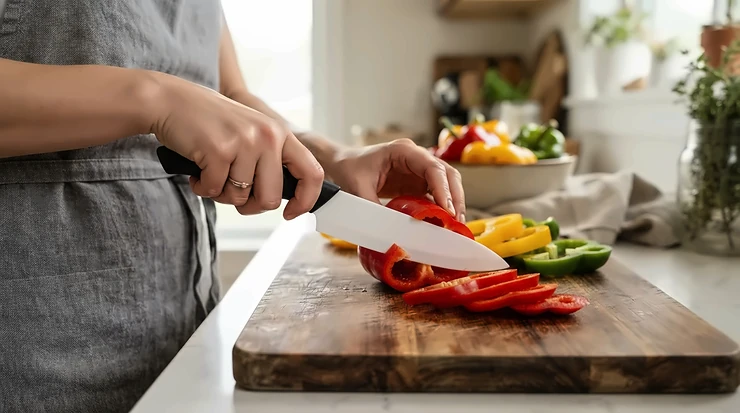
Picture a ripe tomato. Skin drum-tight, flesh slightly wobbly. Now picture a blunt steel knife approaching it. You know how this ends: squashed, weepy, a small kitchen tragedy before supper. A ceramic knife for vegetables rewrites that story. The blade is so fine and so hard that it glides through tomato skin, courgette, cucumber and onion with barely any pressure. It also leaves no metallic tang and no browned edges on your salad.
Now the honest bit. Ceramic is not magic. It is brittle, it hates being dropped, and ceramic blade chipping is the single biggest complaint in buyer reviews. Treat it like a scalpel, not a cleaver, and it can be a joy. Treat it like a general-purpose workhorse and you’ll be swearing at the bin.
So this guide isn’t just a list of shiny things. We’ve researched seven real knives and sets sold on amazon.co.uk and weighed their specs against genuine, aggregated review themes. The range runs from a benchmark ceramic paring knife to ceramic knives under £30 and a budget ceramic knife set for families. We also cover which vegetable prep knife suits which job, and how to stop a tip snapping. Along the way you’ll find a practical budget knife set guide, so you know when a set is a bargain and when it’s clutter.
A note on prices: all figures are ranges from the time of research and can change, so always check the current price before buying.
What Is a Ceramic Knife for Vegetables?
A ceramic knife for vegetables is a kitchen knife with a zirconia ceramic blade, chosen for slicing, dicing and paring soft to medium-firm produce. Its extremely hard, non-reactive edge stays sharp far longer than steel and won’t brown or taint food. The brittle blade, however, must never be twisted, dropped or used on bones.
Why zirconia? Wikipedia’s entry on zirconium dioxide blades and their brittleness explains that the blades are dry-pressed and sintered. They score roughly 8.5 on the Mohs hardness scale, against about 4.5 for ordinary steel. That hardness is the whole appeal, because a harder edge stays keen for much longer.
The catch is that hardness and toughness are different things. Steel bends when abused. Ceramic doesn’t bend; it chips or snaps. What this means in practice is that ceramic shines when the job is repetitive, precise and gentle. Think thin-sliced cucumber, paper-fine radish, tomatoes for a caprese, or a mountain of spring onions. It struggles with anything that needs prying, twisting or brute force.
The upshot: ceramic works best as a specialist. Many home cooks pair one or two ceramic blades with a sturdy steel knife for the heavy lifting. Keep that pairing in mind as you read on.
Quick Comparison: 7 Ceramic Knives for Vegetables at a Glance
| Knife | Blade / Type | Price Range | Best For |
|---|---|---|---|
| Kyocera FK-075 | 7.5cm paring | around £20–£30 | Garlic, shallots, trimming |
| Kyocera FK-110 | 11cm utility | around £25–£40 | All-round vegetable prep |
| Kyocera FK-140 | 14cm santoku | around £45–£60 | Daily chopping and slicing |
| Taylors Eye Witness 6-inch chef’s knife | 15cm chef’s, with sheath | around £20–£30 | One affordable all-rounder |
| Taylors Eye Witness 4-inch paring knife | 10cm paring | under £20 | Light prep on a tight budget |
| Astylway 6-piece set | Colour-coded set with sheaths | high-£20s | Family kitchens |
| Knendet 4-piece set | Multi-colour set with sheaths | £25–£40 | Trying ceramic cheaply |
Looking at the table, the Kyocera FK-110 is the most versatile single blade, and the Kyocera FK-075 is the cheapest way into genuinely well-regarded ceramic. If your budget is firm, the Taylors Eye Witness 4-inch paring knife is the lowest-risk entry, while the Astylway 6-piece set gives the most pieces per pound. Price bands overlap because sellers, colours and stock all shift the numbers, so treat these as guides rather than promises.
💬 Just one click — help others make better buying decisions too!😊
Top 7 Ceramic Knives for Vegetables: Expert Analysis
Every knife below gets the same treatment: what the specs mean in practice, who it suits, and what reviewers say. We haven’t hand-tested any of them. Where we couldn’t verify a review sample, we say so rather than paper over the gap.
1. Kyocera FK-075 — the benchmark ceramic paring knife
The FK-075 is the small blade that made many cooks take ceramic seriously. It’s the shortest tool in the Kyocera range and, for peeling and trimming, arguably the most useful.
Kyocera’s UK site lists the FK Gen series as hand-sharpened Z206 zirconia with a polypropylene handle. The 7.5cm blade suits work done in your hand, such as coring strawberries, mincing a shallot or trimming green beans. Because ceramic is roughly half the weight of comparable steel, your wrist barely notices a long prep session.
As a ceramic paring knife, this one suits people who want a precise tool rather than a multitasker. The short blade means it’s hopeless on a large butternut, but excellent on garlic, radishes and cherry tomatoes. We couldn’t verify a UK review sample specific to this size. Reviews across Kyocera’s Gen range on Amazon UK, however, repeat the same themes: startling sharpness, long edge life, and a reminder that the blade chips if treated carelessly.
Pros:
- ✅ Sharp enough for paper-thin garlic and tomato
- ✅ Lightweight, so there’s little wrist fatigue
- ✅ Short blade gives fine control in hand
Cons:
- ❌ Tip is fragile if dropped or levered
- ❌ Too short for larger vegetables
Price sits at roughly £20–£30, which comfortably qualifies it among ceramic knives under £30. Good value for a well-regarded brand.

2. Kyocera FK-110 — the vegetable prep knife that does the most
If you only buy one ceramic blade, this 11cm utility knife is the sensible choice. It bridges the gap between paring and chopping, so it’s the vegetable prep knife most cooks will reach for.
The 11cm length is long enough to slice a courgette or pepper in a single pass, yet short enough to control. That is why utility knives suit vegetables so well: you get slicing reach without a chef’s knife’s bulk. Pair it with the thin, hard edge and tomatoes stop being a battle.
Reviews on the Amazon UK starter set (this knife plus a peeler) are informative. Buyers describe the edge as extremely sharp and long-lasting, and one reviewer reported still being happy after about 14 months. One warns that they cut themselves badly while merely washing the blade, and another says it will chip if you’re careless. A reviewer also mentions Kyocera’s authorised UK sharpening service costing about £15 at the time, so check current terms.
Pros:
- ✅ Ideal size for peppers, tomatoes and courgettes
- ✅ Edge stays keen for a long time
- ✅ Same build quality as the wider range
Cons:
- ❌ Costs more than budget sets
- ❌ Needs careful washing and storage
Expect roughly £25–£40 depending on colour and seller. Worth it if vegetables dominate your cooking.
3. Kyocera FK-140 — the ceramic santoku for serious chopping
This 14cm santoku is Kyocera’s answer for cooks who want ceramic to do the heavy vegetable work. It is compact, flat-bellied and quick.
The santoku profile suits push-cutting and rock-free chopping, which is exactly what ceramic prefers. A 14cm blade is short by chef’s-knife standards, but for onions, carrots and cabbage it’s plenty. The weight is the big difference: it is far lighter than a steel santoku, so it feels almost like a scalpel with a handle.
An Amazon UK reviewer described it as extremely light and sharp enough to nick their fingernail while cutting a carrot. They use it more than their other knives and pair it with a plastic board plus a soft Kyocera board, while still wondering how long it will last. That mix of delight and caution is common with ceramic. It suits confident, gentle cooks; it doesn’t suit anyone who chops on a whim, or who has a habit of dropping things.
Pros:
- ✅ Very light, so long prep sessions stay easy
- ✅ Excellent for onions, carrots and salad veg
- ✅ Clean, non-reactive cuts
Cons:
- ❌ Most expensive pick here
- ❌ Unforgiving on hard squashes or bones
Prices sit around £45–£60. Worth it only if you’ll use it daily.
4. Taylors Eye Witness 6-Inch Chef’s Knife — British brand, sheath included
Sheffield-based Taylor’s Eye Witness has made knives since the 19th century, and this 15cm ceramic version brings that pedigree to a budget price.
The listing describes a white zirconia blade with a soft-grip handle. Crucially, it comes with a protective sheath, which is more than most single knives offer. The extra length over a 14cm santoku helps with larger vegetables such as cabbages and aubergines, though ceramic still won’t tolerate pressing through dense flesh. If you want the shape of a chef’s knife without the price of a premium ceramic, this is where to look.
Review evidence is thin. We found a short positive Amazon UK review, but not enough to call a trend. That means you’re buying on brand reputation and spec rather than a large body of feedback.
Pros:
- ✅ Longer blade covers bigger vegetables
- ✅ Sheath protects fingers and the edge
- ✅ Established British brand
Cons:
- ❌ Limited review evidence to verify long-term durability
- ❌ Still brittle despite the larger size
Roughly £20–£30 at the time of research; check the current price. Sensible value for a first ceramic chef’s knife.
5. Taylors Eye Witness 4-Inch Paring Knife — cheapest way to try ceramic
At 10cm, this black-bladed paring knife is the lowest-risk entry point in our list. If you’re unsure about ceramic, it lets you find out without much outlay.
The soft-grip handle and included cover make it drawer-friendly. The 10cm blade is a touch longer than a typical paring blade, so it handles small tomatoes and peppers comfortably. As a budget ceramic paring knife, its job is precise, light work: trimming, coring, peeling.
Reviews are mixed, and it’s worth being straight about that. Several buyers praise the sharpness, the cover and the grip, and one says they use it for everything. One disappointed reviewer, however, felt the edge was blunt and said it compared badly with a white Kyocera knife that had lasted over 15 years before being dropped. Read it as a reminder that build quality varies at this price.
Pros:
- ✅ Very low cost of entry
- ✅ Cover included for safe storage
- ✅ Comfortable soft-grip handle
Cons:
- ❌ Mixed feedback on edge sharpness
- ❌ Less refined than premium ceramic
Expect to pay under £20. Cheap enough to experiment with, but don’t expect Kyocera-level polish.
6. Astylway 6-Piece Set — colour-coded budget starter kit
This is the budget ceramic knife set for cooks who like organisation. Every knife has its own colour and sheath, which makes cross-use easy to avoid.
The listing includes a peeler, a 3-inch paring knife, a bread knife and a 6-inch small chef’s knife, among other pieces. Colour coding is a genuine practical advantage: red for meat, green for vegetables keeps your veg knife clean of raw-meat handling. On paper the numbers are appealing, but there’s a spec catch. Ceramic bread knives are a strange match, because sawing a crusty loaf is precisely the kind of stress that chips a brittle blade.
We couldn’t verify individual Amazon UK reviews for this set. A 2026 roundup, though, praised the value and colour-coding while noting the sheaths can be tight to remove. It also warned that glass or stone boards risk tip fractures. The listing itself advises against cutting bones or working on glass.
Pros:
- ✅ Each knife has a colour and sheath
- ✅ Generous piece count for the price
- ✅ Handy for separating veg and meat prep
Cons:
- ❌ Ceramic bread knife is a poor fit
- ❌ Build quality is less proven than Kyocera’s
Around the high-£20s at the time of research. Good value if you’ll use the paring and chef’s knives.
7. Knendet 4-Piece Set — a cheap way to test ceramic
Knendet’s four-piece set is a classic starter kit: multi-coloured handles, sheath covers and zirconia blades. It’s aimed squarely at cooks wanting variety without commitment.
Multiple sizes mean you can cover paring, utility and chopping in one purchase. The colourful handles let a household assign knives to people or tasks. Given the thin, lightweight construction typical at this price, treat it as a light-duty kit.
Honest caveat: we found limited genuine review data. The listing itself warns the blades are fragile and can chip or break if they hit bone or fall on the floor. A UK-focused ranking site places the set near the top, but that ranking is algorithmic, so we wouldn’t lean on it. If you buy, avoid glass or steel boards and keep the sheaths on.
Pros:
- ✅ Four sizes cover most vegetable jobs
- ✅ Sheath covers protect blades in drawers
- ✅ Handy colours for households sharing knives
Cons:
- ❌ Limited independent review evidence
- ❌ Not always under £30, depending on seller
Roughly £25–£40 depending on the retailer. Fine as an experiment, not a lifelong set.
Top 7 Comparison: Strengths and Watch-Outs
| Knife | Blade Length | Main Strength | Main Watch-Out | Best For |
|---|---|---|---|---|
| Kyocera FK-075 | 7.5cm | Precision paring | Too short for big veg | Small, fiddly jobs |
| Kyocera FK-110 | 11cm | Versatility | Careful washing needed | Everyday prep |
| Kyocera FK-140 | 14cm | Fast chopping | Highest price | Committed daily cooks |
| Taylors Eye Witness 6-inch chef’s knife | 15cm | Length plus sheath | Thin review evidence | Budget all-rounder |
| Taylors Eye Witness 4-inch paring knife | 10cm | Low price | Mixed sharpness feedback | Testing ceramic |
| Astylway 6-piece set | Varies | Colour-coding | Bread knife mismatch | Family kitchens |
| Knendet 4-piece set | Varies | Variety | Fragile, little evidence | Casual light use |
Reading across the table, the three Kyocera knives cost more per blade but carry the strongest reputation for edge quality. The budget sets trade certainty for quantity, so they suit light, careful use. If you can afford only one knife, the Kyocera FK-110 covers the widest range of jobs; if you can afford a set, the Astylway 6-piece set offers the best piece count.
How to Choose a Ceramic Knife for Vegetables
Choosing well means matching the knife to your cooking, not to the box’s marketing. Which?’s chef’s knife tests measure how sharp and comfortable knives feel in real prep, and that logic applies to ceramic too. Use these steps:
- Start with the job, not the brand. If you mostly trim and peel, a paring blade like the Kyocera FK-075 is enough. If you chop daily, consider a santoku such as the Kyocera FK-140.
- Choose a blade length of 7.5–14cm. Shorter blades are steadier and less likely to be twisted; longer blades reach bigger vegetables. Beyond 15cm, ceramic starts to feel risky.
- Check the handle. A grippy handle matters when your hands are wet with tomato juice. Soft-grip silicone, as on the Taylors Eye Witness 6-inch chef’s knife, helps.
- Look for a sheath. Sheaths protect fingers and edges, and they’re the cheapest chipping insurance going.
- Read the negative reviews first. They tell you how a knife fails. For ceramic, look for chipping, loose handles and blunt edges.
- Set a realistic budget. Under £30 you’ll find decent starters; above £40 you’re paying for refinement and reputation.
- Confirm you own the right board. A ceramic knife on glass is a broken knife. Budget for a wooden or plastic board if you don’t have one.
One UK-specific quirk: Amazon UK listings for knives typically require age verification, so expect an ID check on delivery.

Ceramic Blade Chipping: Why It Happens and How to Prevent It
Ceramic blade chipping is the reason many people give up on ceramic. Understand it and you can avoid most of it.
Chips happen because ceramic can’t flex. When steel meets a hard surface, the edge rolls or bends. Ceramic instead fractures at the weakest microscopic point. The usual triggers are cutting on glass, marble or stone; twisting the blade in a cut; prying; hitting bone or frozen food; and dropping the knife.
Here’s a quick problem-and-solution guide:
- Problem: tip snaps off. Solution: never use the tip as a lever, and don’t scrape food off the board with the edge. Use the blunt spine.
- Problem: micro-chips along the edge. Solution: switch to a wood or plastic board, and avoid hard vegetables such as raw swede or the skin of a butternut squash.
- Problem: chips in the drawer. Solution: keep the sheath on. Loose ceramic clattering against steel is a recipe for damage.
- Problem: shatter on the floor. Solution: nothing saves a dropped ceramic knife, so don’t try to catch a falling blade. Step back.
Reviews echo this. One Amazon UK buyer says a cherished Kyocera lasted over 15 years before a drop shattered it, while budget-set reviewers more often report early chips. The lesson is that build quality matters, but so does behaviour.
Ceramic vs Steel for Vegetable Prep
Ceramic isn’t better than steel; it’s different. Here is how they compare when the task is vegetables.
| Feature | Ceramic | Steel |
|---|---|---|
| Edge retention | Excellent | Good, needs regular honing |
| Toughness | Brittle, chips or snaps | Flexes, more forgiving |
| Weight | Very light | Heavier |
| Reactivity | Non-reactive | Can react with acidic foods |
| Sharpening | Specialist service or diamond tools | Home steels and whetstones |
| Best for | Precise slicing (Kyocera FK-110) | Heavy chopping and squashes |
What this means for you: if your cooking is mostly salad, tomatoes, cucumber and herbs, ceramic’s light weight and edge life are a real advantage. If you regularly wrestle butternut squash or swede, a steel chef’s knife should share the workload. Many cooks end up owning both, using the Kyocera FK-110 for delicate slicing and steel for brute-force jobs. Don’t force either to do the other’s work.
Ceramic Knives Under £30: What You Actually Get
Ceramic knives under £30 are a real category, but the quality range is wide. Below is how the price bands break down.
| Price Band | What You Get | Example | Best For |
|---|---|---|---|
| Under £20 | Single budget paring knife | Taylors Eye Witness 4-inch paring knife | Low-risk trial |
| £20–£30 | Branded paring knife, chef’s knife, or a set | Kyocera FK-075, Taylors Eye Witness 6-inch chef’s knife, Astylway 6-piece set | Best value tier |
| £30–£40 | Bigger sets or a utility knife | Knendet 4-piece set, Kyocera FK-110 | Utility or variety |
| £45+ | Premium santoku | Kyocera FK-140 | Daily committed use |
The sweet spot for ceramic knives under £30 is the £20–£30 band, where you can buy either proven brand quality in a single blade or a bigger set from a lesser-known maker. The key trade-off is certainty versus quantity. Spend at the higher end for one dependable blade, or spread the same money across several sheathed, colour-coded knives for flexibility. Since prices shift, verify the current cost before you commit.
Budget Knife Set Guide: Set or Single Knives?
This budget knife set guide rests on one principle: the best set is the one where you’d actually use every piece. A cheap set with two useful knives and four decorative ones is poor value, however low the headline price.
A budget ceramic knife set makes sense when you’re new to ceramic and want to discover what you’ll reach for. Colour-coded sets such as the Astylway 6-piece set and the Knendet 4-piece set also help households separate veg and meat prep. Sheaths come bundled, which matters given the chipping risks.
Single knives make sense when you already know your favourites. A Kyocera FK-110 plus a Kyocera FK-075 costs roughly what some larger sets do, and both are proven designs. The trade-off is fewer pieces and no colour-coding.
A quick way to decide:
- Buy a set if you want to try ceramic, cook for a family, or want colour-coded separation.
- Buy singles if you know you mostly need a paring blade and a utility knife.
- Avoid sets that include a ceramic bread knife you’ll never use, or pieces that duplicate each other.
One more thought: if you’d rather have a steel workhorse alongside, spend part of your budget there and buy a smaller ceramic pair. It’s usually the better long-term arrangement.
Ceramic Paring Knife: The Small Blade Doing Big Work
A ceramic paring knife is the most forgiving ceramic purchase you can make. It’s short, so leverage is low. It’s used in-hand, so heavy pressure is rare. And it handles the fiddly jobs where a large knife feels absurd.
Vegetable tasks where a paring blade shines include coring peppers, trimming asparagus ends, slicing radishes, prepping spring onions and mincing a single shallot. For those, a small blade like the Kyocera FK-075 offers precision that’s hard to match. The Taylors Eye Witness 4-inch paring knife offers a slightly longer 10cm reach for a lower price, albeit with more mixed feedback.
A few habits help. Cut towards a board, not towards your palm. Keep the sheath on between uses. Never use the tip to open packets, pry lids or dig out potato eyes. That last one is a classic tip-breaker.
Finally, consider a ceramic paring knife as a companion rather than a replacement. It pairs beautifully with a steel chef’s knife, and it gives you a low-stakes way to see whether ceramic suits your kitchen. If the small blade delights you, moving up to the Kyocera FK-110 or Kyocera FK-140 is a logical next step.
Your Vegetable Prep Knife Routine: A Practical Usage Guide
Owning a good vegetable prep knife is half the story. The other half is habit. Here’s a simple routine that protects both your blade and your family.
Before you start
- Pick the right board: wood or plastic only. Never glass, marble or stone.
- Choose the right knife: paring for small jobs, utility for mid-sized, santoku for bulk chopping.
- Wash and dry hands, and keep the board dry underneath so it doesn’t slide.
While you cut
- Use a smooth push or slicing motion, not a rocking chop with a twist.
- Let the blade do the work. If you’re pressing hard, switch to steel.
- Scrape food off with the spine, never the edge.
Keeping things hygienic
The Food Standards Agency advises using separate chopping boards and knives for raw and cooked food where possible, and preparing vegetables and fruit before raw meat if you can’t. Its guidance on avoiding cross-contamination is worth a read. Colour-coded sets like the Astylway 6-piece set make that separation almost automatic.
After you finish
- Hand wash promptly and dry the blade fully. Several reviewers of Kyocera knives mention washing by hand despite dishwasher-safe claims, and it’s the safer choice for the edge.
- Return the sheath. Store the knife away from loose steel utensils.
- Check the edge occasionally under good light for tiny chips.
Common mistakes in the first 30 days
Cutting frozen produce, dropping a knife into the sink, and using the knife as a scraper top the list. Avoid those three and most ceramic knives will treat you well.
Real-World Scenarios: Which Knife for Which Cook?
Specs only matter when they meet a real kitchen. Here are three profiles.
The salad-loving flat-sharer. Two people, a small kitchen, limited budget, salads most nights. The Kyocera FK-110 paired with the Kyocera FK-075 covers nearly every task. Budget: roughly £45–£70 for both. They’d use them a few times a week, so edge life matters more than piece count.
The family cook on a shoestring. Four people, lots of vegetable prep, a child who “helps”. A colour-coded budget ceramic knife set such as the Astylway 6-piece set or Knendet 4-piece set keeps veg and meat knives separate and includes sheaths. Budget: roughly £25–£40. The trade-off is that build quality is less proven, so this cook should keep a steel knife for tough jobs and supervise carefully.
The committed home chef. Cooks every day and loves fast, clean chopping. The Kyocera FK-140 santoku delivers, with a steel chef’s knife kept for squashes. Budget: roughly £45–£60 for the santoku. This cook should also learn to treat ceramic gently, because the price of carelessness is higher.
The curious first-timer. Wants to try ceramic before committing. The Taylors Eye Witness 4-inch paring knife costs little and gives a genuine taste. If it clicks, upgrade to a Kyocera; if it doesn’t, the loss is small.
The pattern across all four is the same: ceramic rewards care and punishes carelessness, so match your knife to your habits as much as your recipes.
Safety, Handling and Sharpening in UK Kitchens
A ceramic edge is thin and intensely sharp, and that cuts both ways. One Amazon UK reviewer of a Kyocera set described a deep cut from lightly catching the blade while washing it. That’s an anecdote, not a statistic, but it fits a pattern: people underestimate how little pressure it takes.
Practical safety points:
- Wash with care. Hold the blade spine-side towards your palm and avoid sweeping a cloth along the edge.
- Store in sheaths. It protects your fingers as much as the blade.
- Keep away from children. Listings for budget sets explicitly warn about this.
- Know basic first aid. The NHS guidance on cuts and grazes covers stopping bleeding with firm pressure and knowing when to seek medical help. Deep, gaping or spurting wounds need urgent care.
On sharpening: ceramic can’t be sharpened on a standard steel or whetstone. Wikipedia notes it needs diamond-coated grinding. Some brands offer sharpening services, and Kyocera has an authorised UK service, according to one reviewer, so check current terms. Cheap sets are usually replaced instead. For UK buyers, also remember the age check at delivery for knives ordered from Amazon.
Long-Term Cost and Maintenance
Cost-per-use is where ceramic can quietly beat steel, or quietly lose.
Suppose the Kyocera FK-110 costs around £30 and lasts several years with occasional sharpening. Used three times a week, that’s several hundred uses at a few pence each. A budget set at a similar price may offer more pieces but shorter lifespans, particularly if chips appear early. Reviews for the cheaper sets more often mention early chipping and loosening handles, while Kyocera reviews more often praise longevity, though neither group is guaranteed.
What to budget for over time:
- Sharpening: A professional service may cost a modest fee plus postage. One reviewer cited about £15 for Kyocera’s UK service, but confirm current pricing.
- A proper board: Wooden or plastic, which many kitchens already have.
- Replacement risk: Drops are the biggest hidden cost. A shattered £25 knife is a £25 lesson.
- Sheaths and storage: Cheap and worth it.
In total-cost terms, a single dependable blade like the Kyocera FK-075 is often better value than an unproven set. On the other hand, a set such as the Knendet 4-piece set costs little if you’re still exploring. Match your spend to your certainty.

FAQ: Ceramic Knives for Vegetables
❓ What is the best ceramic knife for vegetables under £30?
❓ Is a budget ceramic knife set worth buying?
❓ Are ceramic knives dishwasher safe?
❓ Can I sharpen a ceramic knife at home?
❓ Can a ceramic knife cut butternut squash?
Conclusion: Is a Ceramic Knife for Vegetables Right for You?
Here’s the short answer: yes, if you’re gentle, and no, if you want one knife to do everything. A ceramic knife for vegetables is a specialist that rewards care with effortless, clean cuts and an edge that outlasts most steel.
For a proven all-rounder, the Kyocera FK-110 is our pick for a vegetable prep knife. The Kyocera FK-075 is the smartest entry among ceramic knives under £30, and the Kyocera FK-140 suits daily chopping if you can stretch the budget. On a tighter budget, the Taylors Eye Witness 4-inch paring knife and the Taylors Eye Witness 6-inch chef’s knife offer low-risk ways in. If you’d rather start with a budget ceramic knife set, the Astylway 6-piece set and Knendet 4-piece set bring colour-coded convenience, with the caveat that long-term durability is less proven.
Whatever you choose, remember the three rules that prevent most ceramic blade chipping: wood or plastic boards only, no twisting or prying, and sheaths on between uses. Follow those and even a modest knife will serve you well.
✨ Ready to Slice Smarter?
🔍 Pick the knife that fits your kitchen, click any highlighted product name to check current pricing and availability, and enjoy vegetables cut cleaner than ever. Your salads will thank you!
Recommended for You
- Carbon Steel Knife Set: 7 Brilliant UK Picks for 2026
- Carbon Steel Chef’s Knife for Professionals: 7 Best Picks (2026)
- Carbon Steel Kitchen Knives: 7 Best UK Picks That Actually Cut (2026)
Disclaimer: This article contains affiliate links. As an Amazon Associate, I earn from qualifying purchases. If you purchase products through these links, we may earn a small commission at no additional cost to you.
✨ Found this helpful? Share it with your friends! 💬🤗
