In This Article
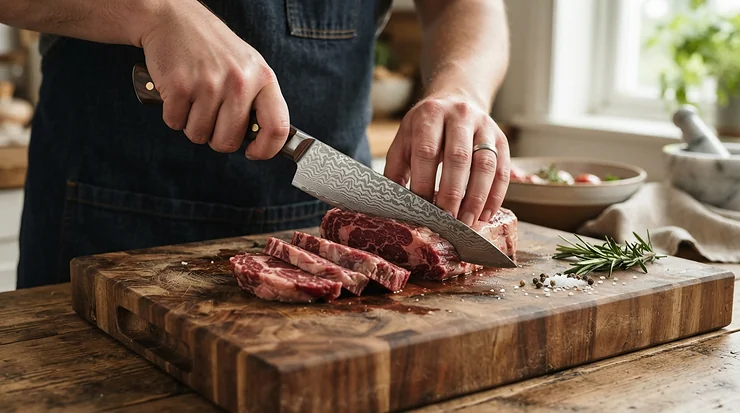
Stand in front of any decent kitchen shop display and you’ll notice the same thing happening every time: hands go straight for the blade with the swirling, water-like pattern down the steel. That’s the pull of a damascus steel chef’s knife, and it’s not just about looks. Underneath that pattern sits a genuinely different way of building a blade — one that, done properly, gives you an edge that lasts longer between sharpenings than most single-alloy stainless knives twice the price.
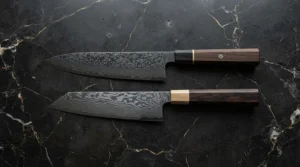
Here’s the thing nobody tells you before you buy one, though: “damascus” on a listing can mean wildly different things. Sometimes it’s 67 layers of proper high-carbon steel wrapped around a hardened core. Sometimes it’s a laser-etched pattern stamped onto ordinary stainless for £25. Both get called damascus. Only one of them is worth your money.
This guide walks through seven real, currently-listed damascus steel chef’s knives spanning budget, mid-range and proper premium territory, with honest analysis of what the spec sheets actually mean once you’re stood at a chopping board. We’ll also dig into how damascus stacks up against plain stainless, how a santoku knife differs from a chef’s knife when both wear a damascus pattern, and what actually keeps one of these blades performing for the next decade rather than the next six months. The history behind the pattern goes back further than most kitchenware marketing admits, and understanding it helps explain why some knives genuinely earn the name and others just borrow the look.
Quick Comparison Table
| Knife | Steel Core | Layers | Best For |
|---|---|---|---|
| SHAN ZU Damascus Chef Knife | High-carbon stainless | 67 | Best budget entry point |
| HOSHANHO Damascus Chef Knife | 10Cr15CoMoV | Multi-layer | Best value ergonomic handle |
| KYOKU Shogun Series Chef Knife | VG10 | Hammered damascus | Best mid-range all-rounder |
| Tramontina FlavCity Chef’s Knife | High-carbon steel | 67 | Best mid-range for home cooks |
| Dalstrong Shogun Series X Gyuto | AUS-10V | 66 | Best premium performance knife |
| Miyabi Birchwood SG2 Chef’s Knife | SG2 powder steel | 100 | Best luxury / gift-worthy pick |
| Kanngou Damascus Santoku Knife | AUS-8 | Forged damascus | Best santoku alternative |
Looking at the spread above, there’s a clear line between the sub-£60 knives built around Chinese high-carbon stainless cores and the £150+ knives running Japanese super steels like VG10, AUS-10V or SG2. That line matters more than the layer count: a 67-layer knife with a soft core is still a soft knife wearing a nice pattern, while a 66-layer Dalstrong Shogun Series X Gyuto with a 62+ HRC AUS-10V core will out-cut and out-last it by a wide margin. If you’re buying your first proper knife, the KYOKU Shogun Series Chef Knife sits in the sensible middle ground — Japanese core steel without the premium-brand price tag.
Just one click — help others make better buying decisions too!
Top 7 Damascus Steel Chef’s Knives: Expert Analysis
Picking seven knives worth featuring meant filtering out a lot of noise — there are hundreds of “damascus” listings on Amazon UK, and a good chunk of them use the term loosely. These seven represent genuine spread across budget, mid-range and premium tiers, with real, verifiable specifications rather than marketing fluff.
1. SHAN ZU Damascus Chef Knife — best budget entry into genuine layered steel
The standout here is that you’re getting authentic 67-layer Japanese-style damascus construction at a price point where most competitors cut corners on the core steel. The blade uses a high-carbon stainless cutting edge with a G10 handle, which is the same handle material you’ll find on knives costing three times as much — G10 is a fibreglass-resin composite that doesn’t swell, crack or absorb moisture the way some cheaper wood-effect handles do. What this means in practice is a knife that holds a working edge through several weeks of daily vegetable prep before you notice any real dulling, rather than the day-or-two window you get with a basic stamped stainless knife from a supermarket set.
Reviewers consistently report that the blade arrives properly sharp out of the box and stays serviceable well beyond what they expected at this price, though a handful mention the factory edge is slightly less refined than the Japanese-made options further up this list — understandable, given the price gap. Based on the spec comparison, this is the knife to buy if you want to find out whether you actually like cooking with a damascus blade before committing serious money to one.
Pros:
- ✅ Genuine 67-layer construction at an entry-level price
- ✅ G10 handle resists moisture and cracking long-term
- ✅ Ultra-sharp factory edge suited to daily prep
Cons:
- ❌ Core steel isn’t a named premium Japanese alloy
- ❌ Edge refinement trails behind pricier hand-honed blades
Priced firmly in the budget bracket — typically under £50 — the SHAN ZU Damascus Chef Knife represents strong value for anyone testing the damascus waters without committing to premium pricing.
2. HOSHANHO Damascus Chef Knife — best ergonomic handle on a tight budget
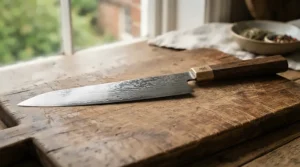
What jumps out about this knife is the ergonomic handle shaping, designed for extended prep sessions without the hand fatigue that flat, unshaped handles cause after twenty minutes of dicing. The cutting core is 10Cr15CoMoV, a Chinese high-carbon stainless alloy that isn’t as prestigious as VG10 or AUS-10V but still delivers respectable edge retention for home use, and the blade comes hand-finished with a visible hammered damascus pattern rather than a purely cosmetic etch.
For someone who cooks most nights of the week but isn’t chasing professional-grade steel, this is a sensible pick — the ergonomics matter more day-to-day than another five percent of edge retention you’ll never notice outside a lab test. Aggregated buyer sentiment points to strong comfort scores and consistent praise for the non-slip grip, with the main gripe being that, like most knives in this bracket, dishwasher use accelerates dulling and should be avoided.
Pros:
- ✅ Genuinely comfortable ergonomic handle for long sessions
- ✅ Visible hand-forged hammered damascus pattern
- ✅ Rustproof and corrosion-resistant cutting edge
Cons:
- ❌ Core steel is a mid-tier alloy, not a premium Japanese grade
- ❌ Dishwasher use noticeably shortens edge life
At a price sitting comfortably under £40 in most listings, the HOSHANHO Damascus Chef Knife is one of the better ergonomic budget picks currently available.
3. KYOKU Shogun Series Chef Knife — best mid-range all-rounder with VG10 core
This is where the jump in core steel quality really starts to show. The KYOKU Shogun Series Chef Knife uses a VG10 steel core — the same family of steel found in knives costing considerably more — wrapped in a hammered damascus cladding that reduces food sticking to the blade face during chopping. VG10 typically sits around 60-61 HRC on the Rockwell hardness scale, which translates to noticeably longer edge retention than the 55-58 HRC range common in budget stainless knives.
What most buyers overlook about VG10-core knives at this price is that you’re paying for the steel, not the branding — KYOKU isn’t a household name in the way Miyabi or Shun are, but the underlying metallurgy is comparable. Reviewers frequently highlight the included sheath and gift box as a nice touch for a knife clearly aimed at both everyday use and gifting, and the hammered tsuchime-style finish gets consistent praise for genuinely reducing drag when slicing through starchy vegetables like potato.
Pros:
- ✅ VG10 Japanese steel core at a mid-range price
- ✅ Hammered finish measurably reduces food sticking
- ✅ Comes with sheath and presentation box included
Cons:
- ❌ Less brand recognition than premium Japanese cutlery houses
- ❌ Handle material feels less premium than the blade deserves
Sitting in the low-to-mid £100s depending on retailer, the KYOKU Shogun Series Chef Knife offers some of the best steel-per-pound value in this entire list.
4. Tramontina FlavCity Chef’s Knife — best mid-range pick for everyday home cooks
Co-designed with a well-known food personality, this 67-layer damascus knife stands out for its forged-and-welded construction and a fine, hand-honed edge that arrives genuinely ready to use. The maroon wood handle gives it a warmer, more traditional look than the G10 and Pakkawood handles dominating this category, and Tramontina — a long-established cutlery manufacturer — brings a level of manufacturing consistency that some of the newer, less-established brands in this space can’t yet match.
Based on the spec comparison, this knife occupies an interesting middle ground: it’s not chasing the highest-end Japanese super steels, but it’s also clearly a step up from the sub-£50 tier in terms of fit, finish and blade geometry. For someone who wants a damascus knife that looks and feels premium on a kitchen counter without spending premium money, this is a strong candidate. User feedback tends to focus on the polished finish and the satisfying weight balance, with occasional notes that the wood handle needs the same care as any wood-handled knife — meaning no long soaks in the sink.
Pros:
- ✅ Established manufacturer with consistent build quality
- ✅ Fine, hand-honed edge ready to use on arrival
- ✅ Attractive wood handle with genuine weight balance
Cons:
- ❌ Wood handle demands more careful drying than synthetic grips
- ❌ Not built around a named premium super steel
Typically found in the £60-90 range, the Tramontina FlavCity Chef’s Knife rewards buyers who value brand pedigree and finish quality over headline steel specs.
5. Dalstrong Shogun Series X Gyuto — best premium performance knife
The AUS-10V super steel core here is vacuum heat-treated and cryogenically tempered with liquid nitrogen, pushing hardness to 62+ HRC — a genuinely serious number that puts this blade’s edge retention well ahead of anything on the budget end of this list. The 66-layer damascus cladding carries Dalstrong’s own “Tsunami Rose” finish, and the blade is hand-sharpened using the traditional three-step Honbazuke method at an 8-12° edge angle per side, roughly half the angle of a typical Western knife.
What that narrower edge angle means in practice is a genuinely thinner, more precise cut through delicate produce like tomato skin or herb leaves, at the cost of needing slightly more careful technique to avoid chipping against bone or frozen food. Reviewers who describe themselves as long-term knife collectors consistently rank this among the sharpest out-of-box edges they’ve tested, and the full-tang, triple-riveted G10 handle construction gets repeated praise for balance during extended prep work. The trade-off, honestly, is that this level of hardness means a slightly steeper learning curve for sharpening it yourself.
Pros:
- ✅ 62+ HRC AUS-10V core with genuinely elite edge retention
- ✅ Ultra-fine 8-12° hand-honed edge angle
- ✅ Full-tang, triple-riveted construction for serious balance
Cons:
- ❌ Harder steel is less forgiving of improper home sharpening
- ❌ Noticeably pricier than the mid-range options on this list
Sitting in the mid-£100s to around £200 depending on handle finish, the Dalstrong Shogun Series X Gyuto is a genuine professional-grade pick for anyone ready to invest.
6. Miyabi Birchwood SG2 Chef’s Knife — best luxury and gift-worthy option
There’s a reason this knife regularly tops “best if money’s no object” lists from UK kitchenware retailers: it’s built around SG2 powdered steel, a micro-carbide steel produced through powder metallurgy that delivers exceptional edge retention and toughness simultaneously — traits that usually trade off against each other in blade steel. Wrapped around that core sits a genuinely striking 100-layer flower damascus pattern, hand-finished in Seki, Japan, a city with centuries of bladesmithing heritage behind it, in the same tradition covered by Wikipedia’s overview of cutlery manufacturing.
The Karelian birch handle is a distinguishing touch few competitors offer, chosen for its density and natural moisture resistance rather than purely for looks. What most buyers overlook about SG2 steel specifically is that its powder-metallurgy production gives it a finer, more uniform grain structure than forged steels, which is part of why it can be hardened further without becoming brittle. Aggregated review sentiment is overwhelmingly positive on sharpness and craftsmanship, with the main honest criticism being that the price puts it well outside “everyday replacement knife” territory — this is a knife you buy once and hand down, not one you buy casually.
Pros:
- ✅ SG2 powdered steel balances hardness and toughness rare
- ✅ Striking 100-layer flower damascus, hand-finished in Seki
- ✅ Distinctive Karelian birch handle with genuine heritage
Cons:
- ❌ Firmly in premium territory, well above casual budgets
- ❌ Overkill for cooks who don’t prep daily
Expect pricing well into the £200-300+ bracket for this one, positioning the Miyabi Birchwood SG2 Chef’s Knife as the aspirational pick on this list rather than an impulse buy.
7. Kanngou Damascus Santoku Knife — best damascus santoku alternative
If the chef’s knife shape doesn’t suit your cutting style, this forged AUS-8 steel santoku is worth a look — and it’s proof that damascus construction isn’t limited to the classic chef’s knife silhouette. The shorter, flatter santoku blade profile is built for an up-and-down chopping motion rather than the rocking motion a chef’s knife favours, and the full-tang black Pakkawood handle keeps the balance point close to the hand for precise control during fine dicing.
AUS-8 sits a notch below VG10 and AUS-10V in the steel hierarchy, but it’s still a genuine high-carbon Japanese-style stainless alloy that takes a keen edge and resists corrosion well, making it a sensible mid-tier choice for someone specifically wanting the santoku shape rather than a chef’s knife. Reviewers frequently mention this knife feels lighter and quicker through repetitive chopping tasks than a comparable chef’s knife, which tracks with what santoku blades are designed to do. The trade-off is a shorter blade length that struggles with larger cuts of meat or big squash where a longer chef’s knife has more reach.
Pros:
- ✅ Genuine forged AUS-8 damascus construction
- ✅ Lighter, faster feel for repetitive chopping tasks
- ✅ Full-tang Pakkawood handle keeps balance close to hand
Cons:
- ❌ Shorter blade struggles with larger cuts and produce
- ❌ AUS-8 trails VG10/AUS-10V on edge retention
Usually priced under £50, the Kanngou Damascus Santoku Knife is the easiest way to try the santoku shape without abandoning the damascus look you’re after.
What Is a Damascus Steel Chef’s Knife?
A damascus steel chef’s knife is a kitchen knife built from multiple layers of steel — commonly 66 to over 100 — forge-welded together around a harder cutting core, then etched to reveal a distinctive rippled or “watered” pattern. The layering isn’t purely decorative: it can add flexibility and corrosion resistance around a harder, sharper core steel.
It’s worth being precise here, because the term gets stretched thin in modern marketing. Historical damascus steel, the kind used in swords from roughly the 3rd to 17th centuries, was actually a single-ingot crucible steel called wootz steel, imported from India and forged in the Middle East — its pattern came from carbide banding within the ingot itself, not from stacked layers. What’s sold today as “damascus steel” on kitchen knives is technically pattern-welded steel: separate layers of steel forge-welded together, then folded and etched. It’s a different process producing a visually similar result, and modern versions are frequently more consistent in hardness and performance than the historical originals ever were, precisely because manufacturers can control the core steel independently of the decorative cladding.
Damascus vs Stainless Steel Kitchen Knife: What Actually Wins in Real Cooking
This is the comparison most buyers actually need answering before they spend anything. A damascus steel chef’s knife and a single-piece stainless steel knife can use identical core steel — the difference is purely in the cladding around that core.
A well-made damascus knife typically pairs a hard, high-carbon cutting edge (VG10, AUS-10V, SG2) with softer, more flexible layers of steel wrapped around it for corrosion resistance and impact absorption. A quality single-piece stainless knife, by contrast, uses one consistent alloy throughout — no layering, no pattern, but also no potential weak point where dissimilar steels meet. In terms of raw cutting performance, if the core steel is equivalent, a damascus knife and a plain stainless knife with the same core will perform almost identically at the edge, because it’s the core steel doing the cutting, not the outer layers.
Where damascus genuinely pulls ahead is in two places: corrosion resistance from the cladding layers, and a reduced-friction surface from the hammered or textured finish many damascus blades carry, which measurably cuts down on food sticking to the blade face during dense chopping. Where plain stainless pulls ahead is price — you’re not paying for a labour-intensive layering and etching process — and, in some cases, simplicity of sharpening, since there’s no risk of the etched pattern looking uneven after repeated resharpening removes material unevenly across the layers.
Damascus Steel Santoku Knife vs Chef’s Knife: Which Shape Fits Your Cutting Style
Both a damascus santoku and a damascus chef’s knife can share identical core steel and layer count — the real difference is blade geometry, and it changes how you actually cut.
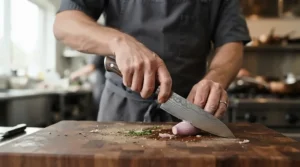
A chef’s knife carries a curved belly along the cutting edge, built specifically for a rocking motion where the tip stays roughly anchored to the board while the heel lifts and falls. This suits continuous prep — mincing garlic, rough-chopping onions, breaking down herbs at speed. A santoku, meaning roughly “three virtues” in Japanese, has a flatter profile with a sheep’s-foot-style tip, built for an up-and-down chopping motion rather than a rock. The flat-bottomed design and indented granton edge many santoku blades feature is specifically engineered to reduce food clinging to the blade during slicing.
In honest terms, neither shape objectively beats the other — it comes down to your existing technique. Cooks who learned on a Western-style chef’s knife tend to find the rocking motion faster once mastered, while cooks who prefer precise, controlled up-down cuts — particularly for fish, vegetables and boneless proteins — often gravitate to santoku once they try one. If you’re buying your first damascus knife and you already cook regularly, stick with the chef’s knife shape; it’s the more versatile all-rounder. If you’re building a second knife specifically for fine, controlled prep work, a santoku like the Kanngou Damascus Santoku Knife is a genuinely useful complement rather than a replacement.
Damascus vs Stainless Performance: Edge Retention, Sharpening, and Durability Compared
| Factor | Damascus (hard core, e.g. VG10/AUS-10V) | Plain Stainless (mid-tier, e.g. 1.4116) |
|---|---|---|
| Typical hardness | 60-63 HRC | 54-57 HRC |
| Edge retention | Longer between sharpenings | Requires more frequent honing |
| Sharpening difficulty | Slightly harder; needs finer stones | Easier for beginners |
| Corrosion resistance | Strong, aided by cladding layers | Good, but varies by alloy |
| Typical price premium | Higher, reflects labour and steel | Lower, simpler manufacturing |
The pattern here is straightforward once you see the hardness numbers side by side: a harder core steel holds its edge longer but demands a slightly more careful sharpening approach, since overly aggressive sharpening angles can chip a harder, more brittle edge rather than simply dulling it. If you’re not planning to learn proper whetstone sharpening technique, a knife like the HOSHANHO Damascus Chef Knife, sitting in the mid-hardness range, is more forgiving than pushing straight into a 62+ HRC blade like the Dalstrong Shogun Series X Gyuto. Total cost of ownership matters here too — a harder-core knife needing sharpening twice a year instead of monthly can actually work out cheaper over five years, even with a higher upfront price, once you factor in professional sharpening costs or replacement whetstones.
How to Choose a Damascus Steel Chef’s Knife
- Check the core steel name, not just the layer count. A listing boasting “67 layers” tells you nothing about hardness — look for a named steel like VG10, AUS-10V, AUS-8 or SG2, since that’s what actually determines cutting performance.
- Match blade length to your hand and board size. An 8-inch blade suits most home kitchens; smaller hands or tighter counter space often do better with a 6-7 inch option.
- Decide on handle material based on your washing habits. G10 and Pakkawood composite handles tolerate more moisture exposure than natural wood, which needs prompt drying every time.
- Weigh full tang against partial tang construction. A full-tang knife, where the steel runs the entire length of the handle, gives noticeably better balance and durability for daily heavy use.
- Look for a stated Rockwell hardness (HRC) figure. Anything from 58-62 HRC is a sensible working range for a home kitchen; higher figures demand more sharpening care in return for longer edge life.
- Read aggregated review sentiment, not star ratings alone. A 4.5-star average tells you little; look for recurring themes in written reviews about edge retention after months of use, not just week-one impressions.
- Set a realistic budget band before browsing. Genuine layered construction with a named premium core starts appearing reliably from the low £100s upward; below that, you’re often paying for pattern etching over a standard core.
Common Mistakes When Buying a Damascus Steel Chef’s Knife
The single most common mistake is assuming a higher layer count automatically means a better knife. A 100-layer damascus pattern over a mediocre core steel will still underperform a 33-layer pattern over genuine VG10 — the layers are largely cosmetic and corrosion-resistant, not the source of sharpness.
The second mistake is buying based purely on how striking the pattern looks in product photos. Etched patterns can be enhanced or exaggerated in listing images, and a genuinely beautiful pattern says nothing about the steel hiding beneath it. Third, plenty of buyers skip checking blade length against their own hand size and kitchen setup, then find an 8-inch blade unwieldy on a small board or too short for larger cuts of meat. Fourth — and this trips up more people than you’d think — buyers assume damascus automatically means dishwasher-safe because it “looks tougher.” It doesn’t; the thermal shock and detergent exposure in a dishwasher cycle degrades any knife edge, layered or not, and can also dull the visual contrast of the etched pattern over time. Finally, some buyers underestimate the ongoing cost of proper care — a genuinely sharp damascus knife needs a decent whetstone or honing rod eventually, and skipping that step means even the best blade on this list will dull faster than it should.
Damascus Blade Care: The Practical Maintenance Guide
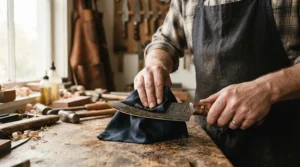
Getting the most out of any damascus knife comes down to a handful of habits, most of which take seconds longer than doing it wrong. Wash by hand immediately after use with warm water and mild soap, then dry the blade completely before storing it — moisture left sitting in the etched pattern grooves is where corrosion tends to start first, even on corrosion-resistant clad steels. Never leave a damascus knife soaking in a sink, particularly one with a wood or Pakkawood handle, since prolonged water exposure can loosen handle rivets over time.
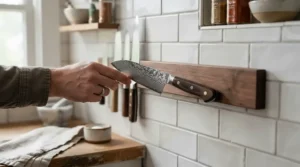
Store it properly: a magnetic strip, blade guard or knife block keeps the edge from knocking against other cutlery in a drawer, which is one of the fastest ways to chip a hard-core edge. For sharpening, a whetstone gives the most control and is genuinely worth learning on a cheaper knife first if you’re new to it — pulling a hard-core damascus blade like the Dalstrong Shogun Series X Gyuto across an unsuitable pull-through sharpener can strip the fine edge angle those knives are built around. A honing rod used before each cooking session realigns a slightly rolled edge without removing material, extending the gap between full sharpenings considerably. On cutting surfaces, always use wood or plastic boards rather than glass or stone, since harder surfaces dull any blade far faster regardless of how many layers it has — a point that overlaps with wider food safety guidance around keeping cutting surfaces properly maintained and safe to use.
Real-World Scenario: Which Damascus Chef’s Knife Suits Your Kitchen
Picture three different cooks, each with genuinely different needs. First, a university student moving into their first proper flat, cooking three or four times a week on a tight budget and a small worktop — for them, the SHAN ZU Damascus Chef Knife or HOSHANHO Damascus Chef Knife makes far more sense than anything premium, because the value gap between a £40 knife and a £250 knife won’t be felt if you’re mostly making pasta and stir-fries a few nights a week.
Second, a keen home cook who’s recently taken up meal prepping seriously, cooking daily and increasingly frustrated by how quickly their old supermarket knife dulls — this is exactly the buyer the KYOKU Shogun Series Chef Knife or Tramontina FlavCity Chef’s Knife is built for, offering a genuine step up in core steel without premium pricing. Third, someone shopping for a milestone gift — a wedding, a retirement, a passionate home cook’s birthday — where the Miyabi Birchwood SG2 Chef’s Knife earns its price through craftsmanship, presentation and genuine heirloom quality rather than pure practicality. Matching the knife to how often you actually cook, rather than how good a knife looks on a wall mount, is the single biggest factor in getting real value from this purchase.
Problem → Solution: Fixing Common Damascus Knife Complaints
Blade discolouration after cutting acidic foods like tomatoes or citrus is a common complaint, and the fix is simple: wipe the blade immediately after contact with acidic ingredients rather than letting juice sit on the steel, since even corrosion-resistant clad layers can develop light staining under prolonged acid exposure.
A knife that felt sharp on arrival but dulls unusually fast within weeks often points to cutting on the wrong surface — swap glass chopping boards or granite worktops for a proper wood or plastic board, and the difference in edge retention is often dramatic. Handle rivets feeling slightly loose after months of use usually traces back to submerging the knife in water rather than hand-washing and drying immediately; catching this early and keeping the handle dry going forward generally halts further loosening. Visible rust spots, when they do appear, should be treated straight away with a paste of baking soda and water and a soft cloth rather than an abrasive scourer, which can damage the etched pattern permanently. Finally, if a factory edge feels less sharp than expected on a budget pick like the SHAN ZU Damascus Chef Knife, a few passes on a fine honing rod before first use often resolves it, since factory edges on lower-cost knives aren’t always finished to the same standard as the steel itself allows.
Long-Term Cost & Maintenance: Is Damascus Steel Worth the Investment
Total cost of ownership is where the premium options genuinely start to justify themselves. A £30 supermarket knife that needs replacing every year or two, factoring in the frustration of cooking with a dull blade in the meantime, can realistically cost £150-300 over a decade. A £150-250 knife like the Dalstrong Shogun Series X Gyuto or Miyabi Birchwood SG2 Chef’s Knife, properly maintained with occasional professional or whetstone sharpening, can reasonably be expected to outlast that same decade and beyond — some owners report daily use spanning 15-20 years with proper care.
The maintenance cost itself is modest regardless of tier: a basic combination whetstone runs a one-off cost, and a honing rod is a similarly small investment that pays for itself many times over in extended edge life. Where costs diverge is in repair — a chipped premium blade can sometimes be professionally reground, while a cheap stamped knife with a chip is usually just replaced outright. The long tradition of British cutlery manufacturing, centred historically around Sheffield, is a useful reminder that well-made blades were always designed to be sharpened and maintained for decades, not replaced annually — a philosophy that genuinely still holds for the better knives on this list.
Features That Actually Matter (And Those That Don’t)
Named core steel, Rockwell hardness rating, full-tang construction and handle material genuinely matter — these directly affect how the knife cuts, how long it stays sharp, and how comfortable it is over a long prep session. Layer count above roughly 33 layers matters far less than marketing suggests; once you’re past that threshold, additional layers mostly refine the visual pattern rather than meaningfully changing performance.
Similarly, an included sheath, gift box or matching cutting board are nice-to-haves that add genuine value for gifting but shouldn’t sway a decision if the underlying steel doesn’t match your needs. Blade colour treatments — black-coated damascus, for instance — are purely cosmetic and have no bearing on sharpness or durability, though some coated finishes can show wear patterns faster than a natural steel finish. Brand name recognition sits somewhere in the middle: established manufacturers like Miyabi or Dalstrong bring genuine consistency in quality control, but a lesser-known brand using the same named core steel at the same hardness will perform comparably in the kitchen, even if it doesn’t carry the same resale or gift-giving prestige.
✨ Don’t Miss These Exclusive Deals!
🔍 Take your kitchen setup to the next level with these carefully selected knives. Click on any highlighted pick to check current pricing and availability — these blades will help you prep authentic, restaurant-quality meals your family will genuinely enjoy!
Safety, Regulations & Buying Knives Online in the UK
Buying a kitchen knife online in the UK isn’t quite as simple as adding it to your basket, and it’s worth knowing the rules before you order, particularly if you’re buying as a gift for someone else’s address. Under UK law, retailers selling knives online must verify that the purchaser is over 18, and delivery must go through a service that confirms the recipient is also an adult at the point of handover — this applies to kitchen knives exactly as it does to any other bladed article. The official government guidance on buying, carrying and using knives sets out these rules clearly, including the penalties for retailers and individuals who don’t comply.
In practical terms, this means you should expect an age-verification step at checkout, and possibly a signature-required delivery, when ordering any of the knives featured in this guide. It’s a minor extra step, but it exists for genuinely good reasons around public safety, and reputable Amazon sellers build this compliance into their delivery process automatically. Beyond the point of purchase, basic kitchen safety still applies once the knife’s in your hand: always cut on a stable board, keep fingers curled away from the blade path, and store knives point-down or blade-guarded in a drawer rather than loose, where an unprotected edge is a genuine hazard to anyone reaching in without looking.
FAQ
❓ Is damascus steel better than stainless steel for a chef's knife?
❓ How often should I sharpen a damascus steel chef's knife?
❓ Can you put a damascus steel knife in the dishwasher?
❓ What is the difference between a damascus chef's knife and a santoku knife?
❓ Is a real damascus steel knife expensive in the UK?
Conclusion
There’s no single “best” damascus steel chef’s knife — there’s the best one for your budget, your cooking frequency, and how much care you’re genuinely willing to put into maintaining an edge. If you’re testing the waters, the SHAN ZU Damascus Chef Knife or HOSHANHO Damascus Chef Knife get you into genuine layered construction without much financial risk. If you cook daily and want a meaningful upgrade in core steel, the KYOKU Shogun Series Chef Knife and Tramontina FlavCity Chef’s Knife deliver real Japanese-grade performance at sensible mid-range prices. And if you’re ready to invest in a knife built to outlast you, the Dalstrong Shogun Series X Gyuto and Miyabi Birchwood SG2 Chef’s Knife are genuinely exceptional pieces of kitchen equipment — not just striking to look at, but built around steel that rewards proper care with decades of service. Don’t overlook the Kanngou Damascus Santoku Knife either, if your cutting style favours a flatter, more controlled chop over the classic rock-cut motion.
Whichever tier you land on, the core lesson from this whole comparison holds: check the named steel and hardness rating before the layer count or the pattern, keep it hand-washed and properly dried, and invest in at least a basic honing rod. Do that, and even the most modest knife on this list will outperform expectations for years.
Recommended for You
- Damascus Knife Set: 7 Best UK Picks Ranked For 2026
- Ceramic Knife Set: 7 Sharp UK Picks Worth Buying (2026)
- Ceramic Chef’s Knife: 7 Best Picks Worth Buying In 2026
Disclaimer: This article contains affiliate links. As an Amazon Associate, I earn from qualifying purchases. If you purchase products through these links, we may earn a small commission at no additional cost to you.
✨ Found this helpful? Share it with your friends! 💬🤗
