
In This Article
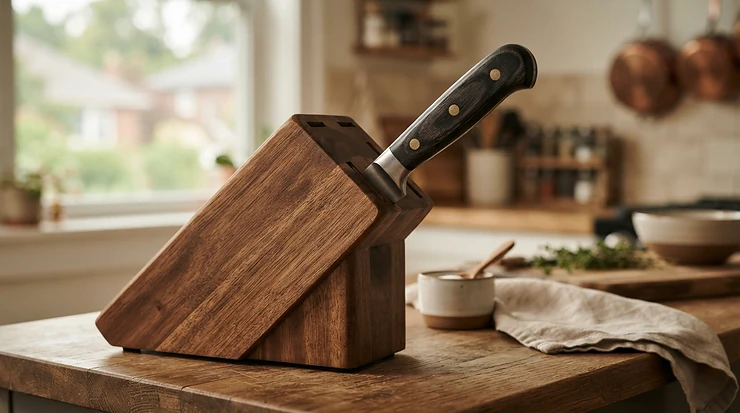
Picture a blade that glides through a ripe tomato as if the skin were a polite suggestion. It never rusts, it never leaves a metallic whiff on an onion, and it feels featherlight in your hand. That’s the sales pitch for a ceramic chef’s knife. Most of it holds up, provided you read the small print first.
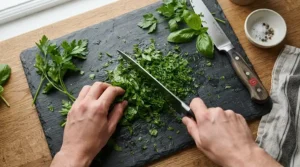
The small print matters because ceramic behaves differently from steel. It stays sharp for a very long time, then, when it finally fails, it chips instead of bending. That single trait explains most of the glowing reviews and most of the horror stories. Buy the right knife and treat it properly, and it becomes the most satisfying tool in your drawer. Buy the wrong one, or use it to hack through a frozen chicken breast, and you’ll be sweeping fragments off the worktop.
This guide compares seven real models you can find on amazon.co.uk, from budget sets to the premium benchmark. It also tackles the questions the product pages skip: how a ceramic vs steel kitchen knife stacks up, what a zirconium oxide blade actually is, and the best options for a ceramic knife sharpener. It covers ceramic vs steel durability, and when a knife sharpening service is the smarter move.
A quick honesty note. Where I describe reviewer sentiment, it comes from the reviews and independent tests I could actually find, and I’ve flagged the gaps. Listings and sellers change often, so check current stock and price before you buy.
Ceramic Chef’s Knife Quick Comparison: Seven Options at a Glance
| Product | Blade length | Best for | Indicative price band* |
|---|---|---|---|
| Kyocera Revolution 18cm Chef’s Knife | 18cm (7in) | Cooks who want the benchmark edge | Roughly £50–£90 |
| Kyocera Innovation ZK-180BK-BK | 18cm | Comfort-first, longer prep sessions | Roughly £60–£100 |
| Vos 8-inch Ceramic Chef Knife | 20cm (8in) | Big hands wanting maximum reach | Roughly £30–£60 |
| Taylors Eye Witness 15cm Ceramic Chef’s Knife | 15cm (6in) | British-brand value | Under £30 |
| Taylors Eye Witness 4pc Ceramic Set | Four knives | Households wanting a full kit | Under £50 |
| Knendet 4-Piece Ceramic Set | Mixed sizes | Colour-coded, budget-friendly | Under £30 |
| Magiware Ceramic Knife Set | 15cm chef’s knife | Tightest budgets | Under £30 |
*Bands are approximate as of my research; prices vary by seller, so check current price.
Reading the table, the two Kyocera models sit at the premium end, and that money buys a track record in zirconia. The Taylors Eye Witness pair offers the best balance of British heritage and price. If you’re really only after a ceramic chef’s knife to try, the budget sets do the job, but expect their edges to fade sooner.
💬 Just one click — help others make better buying decisions too!😊
What Is a Ceramic Chef’s Knife?
A ceramic chef’s knife is a general-purpose kitchen knife, usually 15–20cm long, with a blade of advanced ceramic instead of steel. Almost all use a zirconium oxide blade, which is pressed and fired at high temperature and then ground to an edge with diamond abrasives. The result is exceptionally hard, non-reactive and rust-proof, but brittle if twisted or dropped.
That definition sounds tidy, but the history is worth a glance. Ceramic blades have been sold commercially since the 1980s, and Wikipedia’s overview of ceramic knives is a useful neutral primer on how they’re made and why they need specialist sharpening once dull. The material is much harder than steel. That’s why it holds an edge, and also why a standard steel honing rod does nothing to it.
Top 7 Ceramic Chef’s Knives: Expert Analysis
1. Kyocera Revolution 18cm Chef’s Knife — the edge-retention benchmark
Kyocera pioneered zirconia kitchen blades, and the Kyocera Revolution is the model most other brands are quietly measured against.
The 18cm blade is made from the company’s own zirconia blend and comes in black or white, with the colour running through the material instead of sitting on top as a coating. Sharpening won’t change it. In practice, that means it holds its finish. It also weighs roughly half what a comparable steel knife does, which is why reviewers with tired wrists tend to love it.
Here’s the honest take: this is a precision tool, not a workhorse. An independent 90-day test named the four-piece Kyocera Revolution set the standout, but warned that bone-in chicken, frozen food and hard squash will frustrate you, because blades chip rather than bend when forced. Pair it with a steel knife for heavy work.
Pros:
- ✅ Class-leading edge retention in comparative testing
- ✅ Featherlight, easy on hands and wrists
- ✅ Colour and finish won’t fade or rust
Cons:
- ❌ Chips if forced through bones or frozen food
- ❌ Pricey to replace if you drop it
Expect to sit in the upper price band, roughly £50–£90. It’s worth it if your prep is mostly vegetables, fruit and boneless meat.
2. Kyocera Innovation ZK-180BK-BK — soft-touch grip for long sessions
The Kyocera Innovation line trades the Revolution’s simple handle for a soft-touch ergonomic one, which changes how the knife feels when you’re dicing for twenty minutes.
Kyocera lists this 18cm chef’s knife in its Innovation range, and the blade is the same zirconia family as the Revolution. On paper that means comparable edge retention, but the handle is the real selling point. A soft, slightly tacky grip helps when your hands are damp from rinsing herbs. The spec sheet won’t tell you this, but a grippier handle also means less squeezing, and less squeezing means fewer micro-twists that chip ceramic.
I found far fewer model-specific reviews for the Kyocera Innovation than for the Revolution, so treat its reputation as largely inherited from the brand. One reviewer on Kyocera’s own site did report a knife from the brand chipping within a week, so use it as intended.
Pros:
- ✅ Soft-touch handle reduces grip fatigue
- ✅ Same zirconia heritage as the Revolution
- ✅ Full-size 18cm blade suits most tasks
Cons:
- ❌ Fewer verifiable model-specific reviews
- ❌ Top-tier price for a ceramic knife
Expect roughly £60–£100. It’s a solid pick for comfort-focused cooks, though the Revolution has the stronger evidence base.
3. Vos 8-inch Ceramic Chef Knife — longest blade in the line-up
The Vos 8-inch is the one to pick if you want proper reach: a 20cm blade for slicing big cabbages and squashes.
Built from high-density zirconia with a jet-black finish, it gives you more leverage than the 15cm budget models. That matters when you’re halving a large aubergine, because a longer blade means fewer sawing motions. But length in ceramic has a catch: more blade means more leverage if you twist, and twisting is what breaks ceramic.
One roundup praised its luxury feel, long-term edge retention and fatigue-reducing design, calling it a smarter long-term investment than smaller, flimsier models. That’s a single source, so weigh it accordingly. I couldn’t confirm live amazon.co.uk stock for every seller, so check availability.
Pros:
- ✅ Generous 20cm blade for large produce
- ✅ High-density zirconia with a sleek black finish
- ✅ Reviewed as fatigue-reducing in extended use
Cons:
- ❌ Longer blade is easier to stress by twisting
- ❌ Limited independent UK review data
Expect roughly £30–£60. Value is good if you want length without paying Kyocera money.
4. Taylors Eye Witness 15cm Ceramic Chef’s Knife — Sheffield heritage on a budget
The Taylors Eye Witness 15cm is the easy entry point for British buyers who like their cutlery with a bit of Sheffield pedigree.
The company describes itself as one of the remaining Sheffield knife makers. This 15cm (6-inch) ceramic chef’s knife has a white zirconia blade, a black soft-grip handle and a protective sheath in the box. That sheath is quietly the most important accessory here. Ceramic chips when it bangs against other utensils in a drawer, so a sheath is a safety feature as much as a nicety.
At 15cm, it’s short for a chef’s knife, though this size is actually a sweet spot for beginners, because control matters more than reach when you’re learning what ceramic tolerates. I couldn’t retrieve enough verified individual reviews for this exact listing to summarise sentiment, so I won’t pretend otherwise. The listing also carries an age-verification notice at delivery, which is normal for knives in the UK.
Pros:
- ✅ British-brand heritage with sheath included
- ✅ Manageable size for beginners
- ✅ Corrosion-proof white zirconia blade
Cons:
- ❌ Short for a full-size chef’s knife
- ❌ Sold by a third-party seller on amazon.co.uk
Expect under £30, which makes it excellent value for a first ceramic knife.
5. Taylors Eye Witness 4pc Ceramic Set — a whole kitchen kit for the price of one Kyocera
If you want to swap most of your everyday steel for ceramic, the Taylors Eye Witness 4pc Set covers the bases with paring, utility, santoku and chef’s knives.
That range does real work. The paring knife handles hulling strawberries, while the chef’s blade takes on the bigger jobs. Each knife ships with its own sheath, which makes drawer storage far safer.
Reviewer sentiment is mixed but instructive. Buyers commonly describe the blades as extremely sharp and good value, with the four sizes covering their needs. One reviewer who had replaced a five-year-old Kyocera noted the set cost a fraction as much per knife. Negative reviews I found fell into two camps: people who cut themselves (a sharpness complaint, really) and one buyer who reported a blade failing after six months. That reviewer said the company promised a replacement within 24 hours.
Pros:
- ✅ Four useful sizes, each with a sheath
- ✅ Reviewers repeatedly praise the sharpness
- ✅ Very low cost per knife
Cons:
- ❌ Reports of durability failures on individual blades
- ❌ Ultra-sharp edges catch careless hands
Expect under £50 for the set. It’s the value pick for households.

6. Knendet 4-Piece Ceramic Set — colour-coded and cheerful
The Knendet set treats knives like a bit of kitchen theatre, with multi-coloured handles and matching sheaths.
It’s listed with zirconia blades, stain-resistant finish and non-slip handles. The colours are more useful than they look, because assigning one colour to fruit and another to savoury prep is a neat hygiene habit. Zirconia doesn’t absorb flavours, so cross-contamination is mostly a handle-and-board matter anyway.
Honestly, I couldn’t gather a large sample of verified reviews for this exact set, so I can’t summarise buyer sentiment with confidence. Budget ceramic sets in general tend to dull sooner than premium ones, so lower your expectations for long-term edge retention.
Pros:
- ✅ Colour-coded handles help separate tasks
- ✅ Sheaths protect blades in drawers
- ✅ Low-risk price for a trial
Cons:
- ❌ Limited verified review history
- ❌ Edge life likely shorter than premium brands
Expect under £30. It works as a “try ceramic” purchase, less so as a lifetime one.
7. Magiware Ceramic Knife Set — surprisingly capable at the bottom end
The Magiware set is the budget option that overperformed in a 90-day comparison.
Its 15cm chef’s knife arrived sharp and stayed that way through daily tomatoes, peppers and onions, according to that tester. The wooden-inlay handle looks pricier than it is, and three protective sheaths are included. However, the same tester noted the Magiware blades dulled faster than the Kyocera under identical conditions, and by day 60 the paring knife was visibly less sharp.
That tells you what you’re buying: a fine short-term performer that will need a knife sharpening service or replacement sooner. The manufacturer’s forging claims are marketing, not a guarantee of longevity. Given the price, replacing rather than resharpening may even be rational.
Pros:
- ✅ Arrives razor-sharp and performs well early on
- ✅ Three protective sheaths included
- ✅ Attractive handle for the price
Cons:
- ❌ Dulled faster than Kyocera in testing
- ❌ Manufacturer claims remain unverified
Expect under £30. It’s a good bargain if you accept its shorter edge life.
Top 7 at a Glance: What Reviewers Keep Saying
| Product | Storage | Common review theme | Best for |
|---|---|---|---|
| Kyocera Revolution | Not included | Best edge retention in testing | Serious produce prep |
| Kyocera Innovation ZK-180BK-BK | Not included | Brand reputation, thinner model data | Comfort seekers |
| Vos 8-inch | Not confirmed | Praised for length and feel | Big-handed cooks |
| Taylors Eye Witness 15cm | Sheath | Limited verified data | First-time buyers |
| Taylors Eye Witness 4pc | Sheaths | Sharp, good value, occasional failure | Families |
| Knendet 4-Piece | Sheaths | Limited verified data | Colour-coded prep |
| Magiware | Three sheaths | Sharp early, dulls sooner | Tight budgets |
The pattern is clear: premium Kyocera models buy longevity, while the budget sets buy sharpness now. If you cook daily, the extra spend on the Kyocera Revolution is easier to justify.
How to Choose a Ceramic Chef’s Knife
- Pick your blade length. 15cm suits beginners and small hands; 18cm is the all-rounder; 20cm rewards confident, big-handed cooks.
- Check the material. Look for zirconia listed plainly. Vague “ceramic” descriptions deserve suspicion.
- Judge the handle. Grippy, slightly soft handles reduce twisting and squeezing, which protects the edge.
- Insist on a sheath or block. Loose ceramic in a drawer is a chipped edge waiting to happen.
- Consider the sharpening path. Decide now whether you’ll use a diamond sharpener at home or a postal knife sharpening service.
- Match price to habit. Daily cooks should buy premium; occasional cooks can start cheap.
- Check delivery rules. Knives require age verification in the UK, so someone over 18 should be home.

Ceramic vs Steel Kitchen Knife: The Honest Comparison
Here’s where the marketing gets ahead of reality. A ceramic vs steel kitchen knife isn’t a fight with a winner. It’s two tools with opposite personalities.
| Feature | Ceramic chef’s knife | Steel chef’s knife | Best for |
|---|---|---|---|
| Edge retention | Excellent | Good, needs honing | Ceramic for produce |
| Toughness | Brittle, chips | Bends, forgiving | Steel for heavy work |
| Weight | Very light | Heavier | Ceramic for wrists |
| Rust | Immune | Depends on steel | Ceramic for damp kitchens |
| Home sharpening | Diamond only, tricky | Easy with stones/rods | Steel for DIYers |
| Best for | Vegetables, fruit, boneless meat | Everything, including bones | One of each |
The table says it plainly: ceramic wins on edge life and lightness, steel wins on forgiveness. What most buyers overlook is that they aren’t rivals. The sensible setup is a Kyocera Revolution or Taylors Eye Witness for delicate slicing, and a steel chef’s knife for bone-in and frozen jobs. One independent test noted that ceramic knives tested thicker than comparable steel ones, which affects how they feel in the cut.
Zirconium Oxide Blade: What You’re Actually Buying
A zirconium oxide blade isn’t the same ceramic as your mug. It’s a technical ceramic, pressed as a powder, fired at extreme temperature and ground with diamond. One UK sharpening firm puts zirconia at roughly 8.5 on the Mohs scale, against diamond’s 10 and 5–7 for typical steel.
That hardness is a double-edged sword. It’s why a good zirconium oxide blade stays sharp for months of ordinary use. It’s also why the material can’t flex: force it sideways and it fractures instead of bending. Think of it like a glass rod that happens to cut tomatoes.
The practical takeaway is simple. Slice and push with the blade, and never lever, twist or pry. Manufacturers such as Kyocera describe their blades as unsuitable for hard or frozen foods, and I’d take that at face value. Any zirconium oxide blade, budget or premium, follows the same physics.
Ceramic vs Steel Durability: Chips, Drops and Dishwashers
Ceramic vs steel durability depends on what you mean by “durable”. Edge durability strongly favours ceramic, because the edge wears far more slowly. Impact durability favours steel, which will survive being dropped on tiles or used to crack a lobster claw.
Steel dulls by rolling: the thin edge folds over and you realign it with a rod. Ceramic doesn’t roll. It chips, and, as one sharpening explainer notes, ordinary honing rods barely touch it. So ceramic vs steel durability is really a trade: fewer sharpenings, but harder repairs.
Practical rules follow. Hand wash, because dishwashers bang blades around. Store in a sheath or block. Use a wooden or bamboo board rather than glass, stone or ceramic. One independent dealer test noted that some sideways pressure is impossible to avoid entirely, which is a fair caution about the claim that ceramic is trouble-free in real kitchens.
Ceramic Knife Sharpener Best Options: Diamond or Nothing
If you want the ceramic knife sharpener best suited to home use, the answer is diamond, full stop. Standard whetstones, pull-through sharpeners and honing rods won’t cut zirconia.
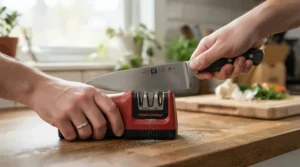
The best-known option in the UK is the Kyocera DS-38 Diamond Sharpener, a battery-powered unit with a diamond wheel. Kyocera says the wheel can remove chips up to 0.5mm deep, and its site notes it’s for right-handed use only and not recommended for a few specific models, so check compatibility. One UK reviewer called it pricey but said it sharpened a dull ceramic knife noticeably, though not back to brand-new. That’s a fair expectation.
Be realistic, though. An independent dealer test found getting an even result difficult with a diamond sharpener and reported the unit jamming. So the ceramic knife sharpener best for you depends on your patience. The Kyocera DS-38 suits light touch-ups on a Kyocera blade. For deep chips, a professional is safer.
Knife Sharpening Service: When to Post Your Ceramic Knife Away
A knife sharpening service earns its fee the moment chipping goes beyond a light touch-up. Diamond wheels and steady hands are expensive, which is why many services simply refuse ceramic.
Some don’t. Knife Sharp explains how it handles ceramic, stating ceramic sharpening and repairs are included in its standard package, with free postal shipping and a turnaround of roughly three to five days after receipt. Another postal firm listed ceramic sharpening per inch of blade, at around £1.50 per inch when I checked. A Cornwall service also lists ceramic among the knives it sharpens.
Choosing a knife sharpening service is a simple checklist: confirm they handle ceramic, ask about chip repairs, and wrap the blade well. Royal Mail guidance requires sharp items to be packaged so tips can’t pierce the packaging. Budget sets like the Magiware may cost less to replace than to post, which is honest arithmetic worth doing.
Practical Usage Guide: Your First 30 Days With a Ceramic Chef’s Knife
Give the first month some structure and your knife will thank you.
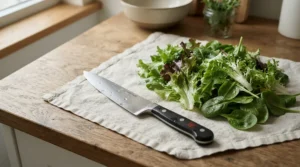
Week one: Wash any residue off new blades, as some arrive with a light film. Use it only on soft produce. Slice with a smooth push-pull; don’t chop down hard.
Week two: Add boneless meat, but skip anything with gristle. Keep the sheath on whenever the knife isn’t in your hand.
Week three: Check the edge under good light for tiny nicks. Tiny chips can often be smoothed with a Kyocera DS-38 Diamond Sharpener using very light passes.
Week four: Settle your routine. Wooden board, hand wash, sheath or block. Decide your sharpening route: home diamond or a postal knife sharpening service.
The common first-month mistakes are scraping food off the board with the blade edge and lifting the knife by twisting. Use the spine instead. Treat the Taylors Eye Witness 15cm or Kyocera Revolution like a scalpel and you’ll avoid nearly every early failure.
✨ Don’t Miss These Exclusive Deals!
🔍 Take your prep to the next level with these carefully selected knives. Click on any highlighted product to check current pricing and availability. A good ceramic chef’s knife will help you create effortless, beautifully sliced meals your family will love!
Real-World Scenarios: Which Ceramic Chef’s Knife Suits You?
The weeknight vegetable cook. You chop peppers, courgettes and salad five nights a week and mostly hate rust. The Kyocera Revolution matches this best: a light 18cm blade that holds its edge through routine produce prep.
The student on a tight budget. You’re in a shared kitchen with unpredictable housemates. The Magiware set or Knendet set costs little enough that a chip isn’t a disaster, and the sheaths help. Just accept you’ll replace them sooner.
The family kitchen. Several people cook, and you want a proper range. The Taylors Eye Witness 4pc Set covers paring to chef’s, with sheaths for safer storage. Keep a steel knife for meat on the bone.
The hands-on enthusiast with big hands. You find 15cm knives fiddly. The Vos 8-inch gives reach, but practise a gentle, straight cutting motion.
Whichever profile fits, run the same test: how often will I cut something hard? If the honest answer is “often”, ceramic should be a supplement, not a replacement.
Common Mistakes When Buying a Ceramic Chef’s Knife
The most frequent error is buying ceramic as a single do-everything knife. Independent testers repeatedly point out that cooks wanting one knife for all jobs should keep a quality steel chef’s knife beside it.
The second is ignoring storage. A knife with no sheath and a crowded drawer is asking for chips. Third: assuming the dishwasher is fine because ceramic doesn’t rust. It isn’t rust that hurts it, it’s the clattering.
Fourth, skipping sharpening logistics. Many buyers discover, only after the edge fades, that steel rods and pull-throughs are useless. Decide upfront between a diamond sharpener and a postal service. Fifth, over-trusting marketing numbers such as “stays sharp 10 times longer than steel”. That’s a manufacturer claim, so treat it as a best-case scenario rather than a guarantee.
Long-Term Cost & Value: What Ceramic Really Costs Over Time
Value isn’t the ticket price, it’s the cost per year of use.
| Tier | Products | Typical band | Best for |
|---|---|---|---|
| Premium | Kyocera Revolution, Kyocera Innovation | £50–£100 | Daily produce prep |
| Mid | Vos 8-inch, Taylors Eye Witness | £30–£60 | Balanced value |
| Budget | Knendet, Magiware | Under £30 | Trial or tight budgets |
A £70 knife that keeps a fine edge for years can beat a £20 set replaced every year, though that assumes you look after it. Add the sharpener or service cost on top: a Kyocera DS-38 is a one-off spend, while postal sharpening is per visit.
For heavy users, premium wins over time. For casual users, a Taylors Eye Witness knife at the lower end gives you most of the benefit for a fraction of the risk. Cost of ownership also includes replacing chipped blades, which is why a sheath and wooden board are effectively free insurance.
Ceramic Knife Safety and UK Rules: Age Checks and Care
Ceramic knives are still knives, and the law treats them accordingly. In England and Wales it’s an offence to sell knives to anyone under 18, and Scotland has its own domestic-knife rules. The government’s voluntary agreement for knife retailers says Amazon requires third-party sellers to comply with knife law, list products as over-18 and require age verification on delivery.
That explains the ID prompt on listings such as the Taylors Eye Witness knives. Make sure an adult is home to accept delivery, or your parcel may be returned.
On kitchen safety, store blades sheathed and out of children’s reach. Some writers raise the concern of tiny ceramic shards ending up in food from chipped edges. Inspect edges regularly and retire any knife that chips badly. A Kyocera blade with a fresh nick should be smoothed or professionally repaired before it meets another tomato.

FAQ
❓ Can you sharpen a ceramic chef's knife at home?
❓ Is a ceramic chef's knife dishwasher safe?
❓ How much does a knife sharpening service cost for ceramic knives?
❓ What size ceramic chef's knife should I buy?
❓ Which chopping board is best with a ceramic knife?
Conclusion
A ceramic chef’s knife is a specialist that behaves like a generalist until it doesn’t. It’s brilliant at fruit, vegetables and boneless meat, gloriously light, and stays sharp far longer than steel. It’s also brittle, awkward to sharpen at home, and unforgiving of twisting.
For most UK cooks, the smartest path is a single high-quality ceramic knife alongside a steel one. The Kyocera Revolution is the edge-retention benchmark, while the Kyocera Innovation adds a comfier grip. The Taylors Eye Witness knives give British-brand value, and the Vos 8-inch offers reach. If your budget is tight, the Knendet and Magiware sets are perfectly reasonable trial purchases, with shorter edge life as the trade-off.
Whichever you pick, plan your sharpening route now, whether that’s a diamond wheel or a postal knife sharpening service, and keep it in its sheath. Do that, and it’ll reward you every time you slice a tomato paper-thin.
✨ Ready to upgrade your prep?
🔪 Check current prices and availability on amazon.co.uk for the ceramic chef’s knife that fits your kitchen, and slice smarter from tonight! 🥒
Recommended for You
- Ceramic Knife For Vegetables: 7 Sharpest UK Picks (2026)
- Carbon Steel Knife Set: 7 Brilliant UK Picks for 2026
- Carbon Steel Chef’s Knife for Professionals: 7 Best Picks (2026)
Disclaimer: This article contains affiliate links. As an Amazon Associate, I earn from qualifying purchases. If you purchase products through these links, we may earn a small commission at no additional cost to you.
✨ Found this helpful? Share it with your friends! 💬🤗
