In This Article
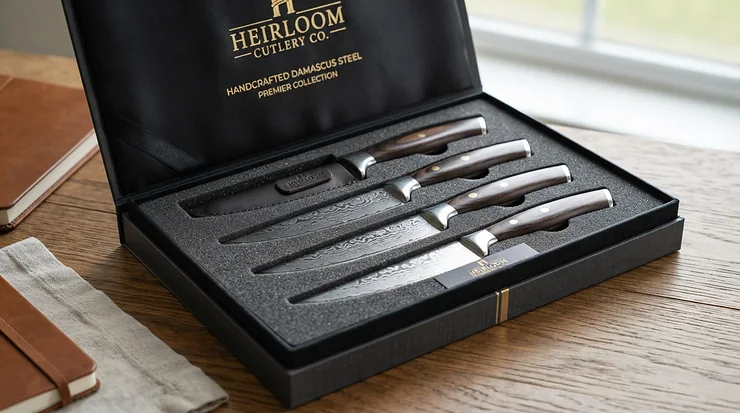
A Damascus knife set is a collection of kitchen knives — typically a chef’s knife, santoku, paring knife and often more — forged or clad from multiple layers of steel, producing both a distinctive wavy or swirling surface pattern and, when done properly, a harder, longer-lasting edge than a single sheet of ordinary stainless steel. That’s the textbook definition, anyway. The reality, standing in front of a kitchen worktop covered in cardboard and packing foam, is a bit messier and a lot more interesting.
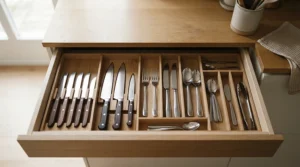
There’s a reason Damascus-style blades have exploded across British kitchens over the last few years — scroll through any cooking video online and you’ll spot that hypnotic rippled steel catching the light before it’s even sliced an onion. But here’s the thing nobody tells you before you buy: not every set calling itself “Damascus” is built the same way underneath that pretty pattern, and the difference between a genuine VG10-cored blade and a thin decorative etch can mean the difference between a knife that holds its edge for months and one that’s dull by February. This guide walks through seven real, currently available Damascus knife set options for UK buyers — budget, mid-range and premium — with honest analysis of what each one actually gets right, and where it falls short. We’ve dug into the specs, the aggregated review sentiment, and the metallurgy behind the pattern itself, which — for what it’s worth — is more accurately described as pattern-welded steel rather than “true” historic Damascus. No fabricated testing claims here, just a proper spec-by-spec breakdown so you can work out which set actually suits your kitchen.
Quick Comparison: 7 Damascus Knife Sets at a Glance
| Product | Pieces | Steel Core | Price Range | Best For |
|---|---|---|---|---|
| SHAN ZU Pro Series 3-Piece | 3 | 10Cr15MoV, 67-layer | Under £65 | First-time Damascus buyers |
| HOSHANHO 3-Piece | 3 | 10Cr15CoMoV, 67-layer | £50-£70 | Best paring knife inclusion |
| NANFANG BROTHERS 9-Piece Block Set | 9 | VG10, 67-layer | £90-£130 | All-round mid-range kitchens |
| SENKEN Tsunami Collection 7-Piece | 7 | VG10, 67-layer | £140-£190 | Widest blade role coverage |
| Sunnecko 7-Piece Block Set | 7 | VG10, 67-layer | £150-£220 | Serious home cooks wanting a whetstone |
| Wakoli 5-Piece Magnetic Block Set | 5 | VG10, 67-layer | £100-£140 | Compact, design-led kitchens |
| Yatoshi 6-Piece Magnetic Block Set | 6 | VG10, 67-layer | £90-£130 | Lesser-known alternative, strong value |
Looking across the table, the split is pretty clean: the two 3-piece sets from SHAN ZU and HOSHANHO are the entry point, priced to let you try genuine layered steel without much risk. The middle of the table — NANFANG BROTHERS, Wakoli and Yatoshi — is where most UK households will actually land, offering a fuller roster of blades without tipping into professional-kitchen pricing. SENKEN and Sunnecko sit at the top, and the extra cost isn’t just branding — both include accessories (a whetstone, extra blade shapes) that the cheaper sets skip entirely.
💬 Just one click — help others make better buying decisions too!😊
Top 7 Damascus Knife Sets: Expert Analysis
1. SHAN ZU Pro Series 3-Piece Damascus Knife Set — best entry point into genuine layered steel
The SHAN ZU Pro Series is where a lot of first-time Damascus buyers start, and there’s a decent reason for that: it’s a proper 67-layer construction rather than a printed pattern, at a price that doesn’t demand a second mortgage. The set covers the three blades you’ll reach for most — an 8-inch chef’s knife, a 7-inch santoku, and a 3.7-inch paring knife — all built on a 10Cr15MoV steel core hardened to roughly 60-62 HRC, with a G10 fibreglass handle that stays cool and grippy even mid-prep with wet hands. In practice, that hardness figure means the edge resists rolling when you’re working through something dense like a butternut squash, though it also means honing rod technique matters more than it would on a softer blade.
Based on the spec comparison against similarly priced sets, what stands out here is the santoku — a genuinely useful shape for vegetable-heavy British cooking that budget block sets often swap out for a second paring knife instead. Reviewers consistently note the out-of-box sharpness as a highlight, several describing it as noticeably keener than supermarket own-brand sets at a comparable price, though a recurring theme in feedback is that the finish on the handle rivets can feel slightly less refined than the blade itself suggests. This is a set for someone who cooks most nights and wants a meaningful upgrade over a drawer of mismatched knives, not someone hunting for heirloom quality.
Pros:
- ✅ Genuine 67-layer VG10-class core, not a printed pattern
- ✅ Santoku inclusion covers more everyday prep tasks
- ✅ G10 handle stays secure even when wet
Cons:
- ❌ No block or storage solution included as standard
- ❌ Handle rivet finish trails the blade quality slightly
At around £45-£65, the SHAN ZU Pro Series sits firmly in “try it and see” territory — cheap enough that the risk is low, sharp enough that most buyers won’t feel short-changed.
2. HOSHANHO 3-Piece Damascus Knife Set — best Damascus paring knife in a compact trio
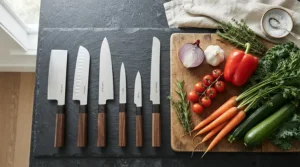
If your gripe with most starter knife sets is that the paring knife feels like an afterthought, the HOSHANHO set is worth a proper look. It pairs an 8-inch chef’s knife and 7-inch santoku with a 3.75-inch paring knife built on 10Cr15CoMoV steel — a cobalt-molybdenum variant that trades a touch of raw hardness for slightly better edge toughness, which matters more than people expect on a small blade doing fiddly work like deveining prawns or hulling strawberries. The ergonomic handle has a slightly fuller belly than the SHAN ZU’s, which suits cooks with larger hands or anyone doing extended prep sessions.
What most buyers overlook about a Damascus paring knife specifically is that the layered construction isn’t just cosmetic on a small blade — it genuinely helps the tip hold up to the twisting motion involved in coring and peeling, where a cheap stamped paring knife will flex and eventually chip. Aggregated review sentiment on this set is strongly positive around the paring knife’s control and balance, with several buyers specifically calling it out as the standout of the three; a smaller number of reviews flag that the chef’s knife runs slightly heavier than expected, which some find reassuring and others find tiring over a long prep session.
Pros:
- ✅ Genuinely well-balanced paring knife, not an afterthought
- ✅ 10Cr15CoMoV core adds toughness for detail work
- ✅ Comfortable, fuller-profile ergonomic handle
Cons:
- ❌ Chef’s knife weight polarises reviewers
- ❌ Three pieces only — no bread or utility knife
Priced around £50-£70, the HOSHANHO set earns its place for anyone whose kitchen tasks lean toward detail work over heavy chopping.
3. NANFANG BROTHERS 9-Piece Damascus Knife Set with Block — best all-round mid-range kitchen set
Step up to the NANFANG BROTHERS 9-Piece and the picture changes — this is a proper working kitchen set, built around a VG10 steel core wrapped in 67 layers, with triple-rivet ABS handles that lock the tang firmly in place. The lineup covers chef’s, santoku, utility, bread and paring knives, plus kitchen shears and a sharpener, all seated in a fraxinus wood block that keeps the counter tidy. VG10 is a meaningfully different animal from the 10Cr15MoV cores in the cheaper sets above — it’s a proper Japanese cutlery steel with better corrosion resistance and a finer grain structure, which translates into an edge that stays sharp through more sessions before it needs attention.
Here’s what the spec sheet won’t tell you, but reviewers note repeatedly: the bread knife on this set punches above its price bracket, cutting through crusty sourdough without the tearing that plagues cheaper serrated blades. Based on the comparison against similarly specced 9-piece sets, the main trade-off is the block itself — solid and functional, but noticeably plainer than the acacia or magnetic options on pricier competitors. For a household that cooks daily and wants one set to cover nearly every job without buying loose blades separately, this is the strongest value proposition on this list.
Pros:
- ✅ VG10 core outperforms the 10Cr steel in cheaper sets
- ✅ Nine pieces cover almost every everyday cutting task
- ✅ Bread knife performance exceeds its price point
Cons:
- ❌ Wood block is functional but visually plain
- ❌ Shears feel like the weakest included accessory
At roughly £90-£130, the NANFANG BROTHERS set is the one we’d point most undecided buyers toward.
4. SENKEN Tsunami Collection 7-Piece Damascus Knife Set — widest blade-role coverage in this list
The SENKEN Tsunami Collection pitches itself at the more serious home cook, and the piece count backs that up — chef’s knife, cleaver, santoku, bread knife and boning knife among the seven, all forged from 67-layer VG10 steel and finished with a black resin-blend handle designed to resist the swelling and cracking that plagues cheaper wood handles after repeated washing. Including a cleaver in a Damascus knife set is unusual at this tier, and it’s a genuinely practical addition for anyone who breaks down whole chickens or joints for a Sunday roast rather than buying pre-portioned meat.
Based on the spec comparison, what separates SENKEN from the mid-range block sets above is edge geometry — SENKEN grinds a narrower bevel angle, which means a sharper out-of-box edge but slightly more frequent honing to maintain it. Reviewers consistently praise the boning knife’s flex and control, a detail that’s easy to overlook until you’re actually removing a chicken thigh bone with it, though a handful of reviews mention that the resin handle, while durable, feels less premium to the touch than genuine wood. For buyers who want breadth of blade shapes over sheer piece count, this is the set that delivers it.
Pros:
- ✅ Cleaver inclusion is rare and genuinely useful at this tier
- ✅ Narrow bevel angle gives a notably sharp factory edge
- ✅ Boning knife flex praised repeatedly in reviews
Cons:
- ❌ Sharper bevel needs more frequent honing to maintain
- ❌ Resin handle feels less premium than wood alternatives
Expect to pay in the region of £140-£190 — a meaningful step up, justified mainly by the cleaver and boning knife additions.
5. Sunnecko 7-Piece Damascus Kitchen Knife Set with Block — best for cooks who want a whetstone included
The Sunnecko set is the one on this list that assumes you’re willing to look after your knives properly, and rewards you for it — a forged, full-tang VG10 core with a 10-12 degree edge angle per side (noticeably narrower than most block sets), housed in an acacia wood block that includes a built-in 1000/6000-grit whetstone. That’s a genuinely unusual inclusion; most sets expect you to buy sharpening kit separately, and a decent combination whetstone alone can cost £20-£30 on its own.
What the spec sheet won’t tell you, but the narrower edge angle implies, is that this set rewards technique — a 10-12 degree bevel slices more cleanly through soft produce like tomatoes and ripe fruit than the wider 15-20 degree edges common on budget sets, but it’s also less forgiving of being used as a general workhorse for bone-in cuts. Aggregated reviewer sentiment is strongly positive on out-of-box sharpness and the inclusion of the whetstone, with several buyers specifically mentioning it nudged them toward proper knife maintenance for the first time; a smaller cluster of reviews note the block’s footprint is larger than expected for smaller kitchens.
Pros:
- ✅ Built-in whetstone removes a common hidden extra cost
- ✅ Narrow 10-12° edge angle excels at clean, thin slicing
- ✅ Full-tang forged construction feels substantial in hand
Cons:
- ❌ Narrower edge is less forgiving of rough or bone-in use
- ❌ Acacia block has a larger counter footprint than rivals
At around £150-£220, the Sunnecko set is aimed squarely at buyers who see sharpening as part of the ritual, not a chore to avoid.
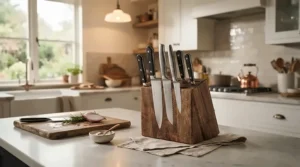
6. Wakoli 5-Piece Damascus Kitchen Knife Set with Magnetic Block — best for compact, design-led kitchens
The Wakoli 5-Piece takes a different approach to the storage question entirely, ditching the traditional slotted block for a magnetic wood stand that holds the blades exposed along one edge — a look that suits smaller kitchens or open-plan spaces where a bulky block feels visually heavy. Underneath the aesthetics sits the same VG10 core and 67-layer construction found in the pricier sets above, paired with sycamore handles that lean into a lighter, Scandinavian-adjacent look rather than the darker pakkawood common elsewhere on this list.
Based on the comparison against other 5-piece sets, Wakoli’s five blades (chef’s, santoku, utility, paring and bread) are a genuinely sensible edit — nothing feels like filler, and the santoku-plus-utility pairing covers most vegetable and protein prep without redundancy. Reviewers consistently comment on how the magnetic block changes daily habits, making knives easier to grab mid-cook and, several note, easier to keep visibly clean since nothing’s hidden in slots collecting crumbs. The trade-off reviewers flag most is capacity — five blades is genuinely all the stand holds, so there’s no room to add a future purchase without buying separate storage.
Pros:
- ✅ Magnetic block suits smaller or design-conscious kitchens
- ✅ Five-piece edit avoids redundant or filler blades
- ✅ Sycamore handles offer a distinct lighter aesthetic
Cons:
- ❌ No spare capacity if you add knives later
- ❌ Fewer pieces than similarly priced block sets
Pricing sits around £100-£140, making this a style-forward alternative to the more traditional NANFANG BROTHERS set above.
7. Yatoshi 6-Piece Magnetic Damascus Knife Block Set — strongest lesser-known alternative
Rounding out the list, the Yatoshi set is the “insider pick” of this group — a smaller brand than the others here, but built to the same 67-layer VG10 specification with a G10 handle, and priced closer to the budget end despite the more premium steel. The six-piece lineup and magnetic block echo the Wakoli set above, but Yatoshi’s G10 handle (rather than sycamore wood) trades some visual warmth for better grip security around water and oil.
Here’s what most buyers overlook: a smaller brand name on a Damascus knife set doesn’t automatically mean lower-grade steel — VG10 is VG10 regardless of who’s stamping the logo on the box, and the meaningful differences tend to show up in handle finishing and quality control consistency rather than the core material itself. Reviewers consistently rate the edge retention on par with better-known competitors at this price, though the aggregated feedback does show more variance in fit-and-finish complaints than the more established brands above — a handful of buyers received sets with a slightly uneven bolster join, while most report no issues at all. If you’re comfortable with a less recognised name in exchange for genuine spec parity at a friendlier price, this is worth serious consideration.
Pros:
- ✅ VG10 steel matches pricier, better-known competitors
- ✅ G10 handle offers reliable wet-hand grip
- ✅ Priced closer to budget tier despite premium core
Cons:
- ❌ More variance reported in fit-and-finish quality control
- ❌ Less established brand with a smaller review pool
At roughly £90-£130, the Yatoshi set is the value pick for buyers happy to trade brand recognition for spec-per-pound.
Getting the Most From Your Set: Setup, Care and the First 30 Days
Unboxing day is the easy part. What actually determines whether your Damascus knife set is still sharp and rust-free in three years comes down to a handful of habits most people never get told about. Start by hand-washing every blade immediately after use — even sets marketed as dishwasher safe suffer from the heat and detergent chemistry degrading both the handle material and, over time, the polished Damascus finish itself, which dulls the visual contrast between layers. Dry each blade fully before it goes back into the block; damp storage is the single biggest cause of the pitting and staining that new owners mistake for a manufacturing fault.
In the first 30 days, resist the urge to reach for a full sharpening session — a genuine 60+ HRC edge, like most in this guide, needs honing far more often than sharpening. A few strokes on a honing rod before each use realigns the microscopic edge without removing metal, and it’s the habit that most extends the life of a NANFANG BROTHERS or Sunnecko blade specifically. One common early mistake is using the knife block’s built-in slots as a scraping surface for food debris — a bench scraper protects both your cutting board and your blade’s edge far better than the spine of a knife ever will. If you’re ordering online, it’s also worth knowing that UK retailers must verify you’re over 18 before dispatching bladed items, under current UK law on buying and delivering knives — expect an ID check or signed-for delivery, which isn’t a fault with the seller, it’s a legal requirement.
Which Damascus Knife Set Suits You? Three Real Kitchens
Picture three genuinely different households, because “best Damascus knife set” honestly depends more on how you cook than on spec sheets alone. First, the weeknight cook — someone feeding two or three people, five nights a week, mostly vegetables, pasta and quick protein. For that kitchen, the SHAN ZU Pro Series or HOSHANHO 3-piece sets genuinely cover 90% of what gets used; a bread knife and boning knife would gather dust.
Second, the Sunday-roast household — bigger shop, batch cooking, the occasional whole chicken broken down for stock. This is where the extra pieces in the NANFANG BROTHERS 9-Piece or SENKEN Tsunami Collection earn their keep, particularly the bread knife and, on the SENKEN, the cleaver — tools that sit idle in a smaller kitchen but see real use here. Third, the enthusiast — someone who’s watched enough cooking content to care about edge angles and actually wants to learn proper sharpening technique. For that cook, the Sunnecko set’s built-in whetstone isn’t a gimmick, it’s the entire point of the purchase, turning maintenance from a chore into part of the hobby itself.
How to Choose a Damascus Knife Set
Working out which set is right for your kitchen comes down to a handful of decision points, roughly in order of importance:
- Check the steel core, not just the word “Damascus.” VG10 or similarly branded high-carbon cores (like the 10Cr15CoMoV on the HOSHANHO) hold an edge meaningfully longer than budget alloys — the layered pattern on top is largely cosmetic if the core underneath is soft.
- Count the pieces you’ll actually use. A 15-piece set sounds generous, but if eight of those are steak knives you’ll rarely touch, you’re paying for storage slots, not utility.
- Match the handle material to your kitchen habits. G10 and resin handles (SHAN ZU, SENKEN) shrug off wet hands better than wood; wood and sycamore (Wakoli) look warmer but need more careful drying.
- Decide if you want storage included. Blocks, magnetic stands and loose sets all have trade-offs in counter space and hygiene — independent testing of knife block sets consistently flags storage design as a factor buyers underrate before purchase.
- Factor in edge angle if you’re an enthusiast. Narrower angles (Sunnecko’s 10-12°) cut more cleanly but need more frequent honing than the wider, more forgiving angles on general-purpose sets.
- Set a realistic budget band and stick close to it. The jump from budget to mid-range (roughly £65 to £130) buys you a genuinely better steel core; the jump from mid-range to premium mostly buys extra pieces and accessories.
- Read the aggregated review themes, not just the star rating. A 4.6-star average tells you less than a repeated comment about handle rivets loosening after six months — patterns in the text matter more than the headline number.
Common Mistakes When Buying a Damascus Knife Set
The most expensive mistake buyers make isn’t overspending — it’s assuming every knife with a rippled pattern is built the same way underneath. Some budget listings apply an acid-etched or even printed Damascus-style finish to a plain, low-grade steel blade purely for looks, with none of the layered core’s actual edge-retention benefit; if a listing doesn’t mention a steel type or layer count at all, treat that as a red flag rather than an oversight. A second common error is buying purely by piece count — a 20-piece set stuffed with steak knives and a fork isn’t more useful than a well-chosen 6-piece set if half the pieces never leave the block.
Third, buyers regularly skip checking handle material against their own habits — someone who cooks with consistently wet or oily hands will find a polished wood handle genuinely more slippery over time than G10 or resin, regardless of how attractive it looks in photos. And finally, plenty of people assume “Damascus” automatically means “dishwasher safe” because the listing photos look tough and metallic — in nearly every case across this entire list, hand-washing is the manufacturer’s actual recommendation, dishwasher claims notwithstanding.
Damascus Steel vs Traditional Stainless Steel Knife Sets
It’s worth being honest about what the layered construction is actually buying you over a conventional single-alloy stainless set, because the differences aren’t as dramatic as marketing photography suggests.
| Factor | Damascus (Layered) Sets | Traditional Stainless Sets | Best For |
|---|---|---|---|
| Edge retention | Longer between sharpenings, thanks to harder core steel | Shorter, needs more frequent honing | Sunnecko, SENKEN for infrequent maintenance |
| Corrosion resistance | Strong on VG10-cored sets; weaker on budget alloys | Generally consistent across price points | NANFANG BROTHERS for humid kitchens |
| Price for entry-level | Slightly higher for genuine layered cores | Lower for equivalent basic performance | Traditional sets for tight first-time budgets |
| Visual appeal | Distinctive pattern, harder to replicate cheaply well | Uniform, less visually distinctive | Wakoli, Yatoshi if aesthetics matter |
Reading the table, the honest takeaway is that a genuine VG10-cored Damascus set like NANFANG BROTHERS or Sunnecko does outperform a comparably priced plain stainless set on edge retention, but a cheap Damascus-patterned blade with a mystery core can actually underperform a well-made traditional stainless knife. The pattern itself is not the thing doing the cutting; the steel underneath it is.
✨ Don’t Miss These Exclusive Deals!
🔍 Take your kitchen setup to the next level with these carefully selected sets. Click on any highlighted item to check current pricing and availability. These tools will help you create genuinely restaurant-quality prep your family will notice!
Budget Damascus Steel Knife Sets: What You Actually Get for Less
There’s a persistent myth that a budget Damascus steel knife is automatically a compromise on quality, and it’s only half true. What buyers are actually trading away at the lower end — sets like the SHAN ZU Pro Series and HOSHANHO — isn’t usually the core steel itself, since both still use genuine multi-layer construction rather than a fake etched pattern. What’s trimmed is piece count, storage (no block included), and finishing details like rivet polish or handle contouring. On paper, this means a budget-conscious buyer genuinely can get a sharp, durable core blade without paying for accessories they may not need.
Where budget sets do fall short more consistently, based on aggregated review patterns across this category, is quality-control variance — a wider spread of “mine arrived slightly uneven” comments compared to the mid-range and premium sets, simply because manufacturing tolerances tighten as price rises. If you’re specifically hunting a budget Damascus steel knife purchase, prioritise verified steel type over piece count, and treat any set under roughly £30 with more scepticism than one in the £45-£70 range, where genuine VG10-class cores start to become realistic.
Understanding Damascus Pattern Layers
The swirling pattern that gives these sets their name comes from repeatedly folding and forge-welding alternating layers of steel — this technique is properly termed pattern welding, and it’s distinct from the “true” wootz Damascus steel of antiquity, whose original production method was lost centuries ago. Modern kitchen knives marketed as Damascus, including every product on this list, use pattern-welded construction: a harder core steel (VG10, 10Cr15MoV or similar) sandwiched between dozens of softer outer layers, then etched or polished to reveal the contrast.
Layer count matters, but not linearly — a 67-layer blade isn’t necessarily twice as good as a 33-layer one; beyond a certain point, additional layers mainly refine the pattern’s visual complexity rather than meaningfully changing performance. What actually determines cutting quality is the core steel’s carbon content and heat treatment, not the layer number printed on the box. Understanding Damascus pattern layers this way helps explain why a well-made 33-layer knife can genuinely outperform a poorly heat-treated 67-layer one — the pattern is the signature, but the core steel is doing the work.
Mid-Range Damascus Knife Sets: The Value Sweet Spot
If this guide has a single recommendation for most UK households, it’s to look hardest at the mid-range knife set tier — roughly £90 to £150 — where NANFANG BROTHERS, Wakoli and Yatoshi all sit. This is the price band where VG10-class steel cores become the norm rather than the exception, where storage solutions (blocks or magnetic stands) start getting included as standard, and where the jump in piece count from three to six or nine blades genuinely reflects daily kitchen use rather than padding.
As a rough knife set value guide: below roughly £65, expect a genuine but limited 3-piece core-steel set with no storage; between £65 and £150, expect fuller piece counts, VG10-class steel and included storage, which is where value per pound peaks; above £150, expect accessories like whetstones or rarer blade shapes (cleavers, boning knives) rather than dramatically better steel, since VG10 is already close to the practical ceiling for this price category regardless of brand. Framed as cost-per-use across a few years of regular cooking, the mid-range tier consistently works out cheaper per meal prepped than repeatedly replacing a cheap set every year or two.
Damascus Steel Knife Set Review: What Reviewers Actually Say
Scanning aggregated feedback across all seven sets in this guide, a few themes repeat often enough to be worth trusting. Out-of-box sharpness is consistently the most praised attribute across every price tier — even the budget SHAN ZU set draws genuine surprise from reviewers used to blunter supermarket knives. Handle comfort splits more by personal preference than by price, with G10 and resin handles praised for grip security and wood/sycamore handles praised for aesthetics, rarely both from the same reviewer.
The most consistent complaint across every Damascus steel knife set review we examined, regardless of brand, is disappointment when buyers discover a set isn’t genuinely dishwasher safe despite ambiguous packaging language — a maintenance expectation mismatch rather than a fault with the blade itself. Storage quality (block sturdiness, magnetic strength) is the second most-discussed theme, and it tracks closely with price, exactly as you’d expect from the comparison table earlier in this guide.

Frequently Asked Questions
❓ Is a Damascus knife set worth it for a home kitchen?
❓ How do you clean and store a Damascus knife set?
❓ What's the difference between Damascus and stainless steel knives?
❓ How many layers should a genuine Damascus knife have?
❓ Can you sharpen a Damascus knife set yourself at home?
Conclusion
There’s no single “best” Damascus knife set here — only the best one for how your kitchen actually runs. If you’re testing the waters, the SHAN ZU Pro Series or HOSHANHO trio genuinely deliver real layered steel without much financial risk. If you cook daily for a household and want one set that covers nearly everything, the NANFANG BROTHERS 9-Piece remains the strongest all-rounder on this list, with Wakoli and Yatoshi as compact, style-conscious alternatives. And if you’re the sort of cook who actually enjoys the ritual of sharpening, the Sunnecko and SENKEN Tsunami Collection sets reward that investment with accessories and blade shapes the cheaper options simply don’t offer.
Whatever you land on, the pattern rippling across the blade is genuinely secondary to what’s happening underneath it — a well-heat-treated VG10 core in a modestly priced set will outcut a flashier-looking budget blade every single time. Spend your money on the steel, and let the pattern be the pleasant bonus it was always meant to be. For further independent testing of knife sets beyond this guide, Which?’s ongoing kitchen knife reviews are a useful cross-reference before you commit.
Recommended for You
- Ceramic Knife Set: 7 Sharp UK Picks Worth Buying (2026)
- Ceramic Chef’s Knife: 7 Best Picks Worth Buying In 2026
- Ceramic Knife For Vegetables: 7 Sharpest UK Picks (2026)
Disclaimer: This article contains affiliate links. As an Amazon Associate, I earn from qualifying purchases. If you purchase products through these links, we may earn a small commission at no additional cost to you.
✨ Found this helpful? Share it with your friends! 💬🤗
