In This Article
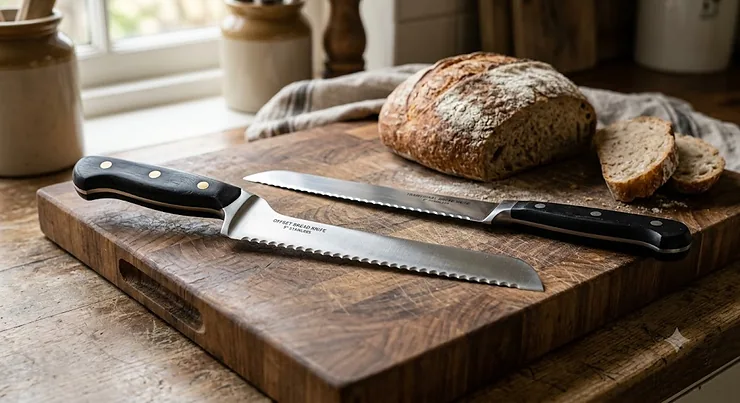
Ask any baker who’s sliced a warm sourdough boule with a straight-handled knife, and they’ll tell you the same story: knuckles scraping the board, an awkward wrist angle, and a slightly squashed first slice. An offset bread knife solves this with one clever tweak — the handle sits raised above the cutting edge, so your hand stays clear of both the loaf and the worktop. It’s a small geometric shift with a surprisingly big payoff, and it’s why so many professional kitchens quietly swap their straight bread knives out for one. If you’re weighing up your first offset serrated knife, or replacing a tired one, you’re in the right place — we’ve dug into real specs, real aggregated reviews, and honest comparisons across budget, mid-range and professional options. According to Wikipedia’s entry on bread knives, an offset serrated knife uses a raised handle specifically to keep the cook’s knuckles clear of the cutting surface once the blade has sliced all the way through — which is the whole point of this design, and exactly what we’re testing for below. We’ll walk through seven genuinely good options, when an offset handle actually earns its keep, and how to avoid the mistakes that leave people with a knife gathering dust in a drawer.
Quick Comparison Table
| Offset Bread Knife | Blade Length | Handle | Price Range | Best For |
|---|---|---|---|---|
| Dexter-Russell Traditional 9″ Offset | 9″ | Rosewood | £35-£45 | Classic wood-handle lovers |
| Dexter-Russell Sani-Safe Offset | 9″ | Polypropylene | £25-£35 | Colour-coded commercial kitchens |
| Victorinox 7.6058.20 Offset | 9″ | Fibrox | £45-£60 | Reliable everyday all-rounder |
| Mercer Culinary Millennia Offset | 9″ | Santoprene | £20-£30 | Budget-conscious beginners |
| Dexter-Russell V-Lo Offset | 9″ | Dex-Tex Armadillo | £40-£55 | Best knuckle clearance and grip |
| F. Dick ProDynamic Offset | 7″ | Ergonomic polymer | £50-£70 | Professional bakeries |
| Piklohas Offset Handle Knife | 10″ | Wood/composite | £15-£25 | Home artisan bakers on a budget |
Looking at the spread above, the Mercer Culinary Millennia Offset and Piklohas Offset Handle Knife dominate the entry-level end, while the F. Dick ProDynamic Offset justifies its higher price tag with NSF-rated commercial durability. The Dexter-Russell V-Lo Offset sits in the sweet spot for most home bakers, balancing grip comfort with a price that doesn’t require a special occasion to justify. Note that all prices are indicative ranges at the time of research — always check the current price on the product page before buying, as retailer pricing shifts frequently.
💬 Just one click — help others make better buying decisions too! 😊
Top 7 Offset Bread Knives: Expert Analysis
1. Dexter-Russell Traditional 9″ Offset Bread Knife — the wood-handled classic
The rosewood handle on the Dexter-Russell Traditional 9″ Offset Bread Knife is what first catches your eye, but it’s the scalloped DEXSTEEL blade underneath that does the real work. This is a stain-free, high-carbon steel blade, precision-ground and hand-honed, mounted on a compression-riveted rosewood handle — a construction method Dexter-Russell has used for decades in commercial kitchens. In practice, that means the points of the scallops bite into a crust cleanly, while the flat spine keeps the whole knife balanced during a long sawing stroke, so you’re not fighting the blade to keep it level. Based on the spec comparison with poly-handled alternatives, this is the pick for anyone who wants the warmth and grip of natural wood without sacrificing the offset knuckle clearance that makes this knife category useful in the first place — it particularly suits home bakers who value the classic Dexter Russell offset bread knife aesthetic on display in a knife block. Reviewers consistently report that the handle needs the occasional oiling to stay in top condition, and one long-time buyer specifically praised it as a gift for a home baker who called it the best bread knife she’d owned in years.
Pros:
- ✅ Rosewood handle offers genuine warmth and grip
- ✅ DEXSTEEL blade resists staining long-term
- ✅ Full compression-rivet construction feels substantial
Cons:
- ❌ Wood needs occasional oiling to avoid drying out
- ❌ Not dishwasher safe like poly-handled rivals
Priced in the £35-£45 range at the time of research, this knife represents solid mid-range value for anyone who wants a proper wood-handled offset bread knife without straying into premium territory.
2. Dexter-Russell Sani-Safe Offset Sandwich Knife — best for colour-coded commercial kitchens
Where the Traditional model leans classic, the Dexter-Russell Sani-Safe Offset Sandwich Knife is built for the realities of a busy catering kitchen. Its textured polypropylene handle comes in several colours, which matters more than it sounds — colour-coded handles are a standard allergen and cross-contamination control in professional food service, letting a kitchen dedicate one knife colour strictly to bread or sandwich prep. The scalloped, high-carbon offset blade is identical in cutting geometry to Dexter’s wood-handled range, so you’re not trading performance for practicality here — you’re gaining a handle that shrugs off dishwasher cycles and repeated sanitising without warping. What most buyers overlook about this model is that the polypropylene grip actually outperforms wood in wet-hand conditions, since it doesn’t get slick the way oiled rosewood can after a few hours of continuous slicing. Aggregated review sentiment across commercial cutlery retailers points to this being a dependable workhorse rather than an exciting purchase — and for a knife that might get used forty times a shift, dependable is exactly the point.
Pros:
- ✅ Colour options support allergen-control systems
- ✅ Dishwasher-safe polypropylene handle
- ✅ Identical scalloped blade geometry to premium Dexter models
Cons:
- ❌ Less visually appealing than wood-handled options
- ❌ Textured grip can feel utilitarian for home use
Expect to pay in the £25-£35 range, making this one of the more affordable ways into genuine NSF-standard commercial cutlery.
3. Victorinox 7.6058.20 Offset Bread Knife — best trusted all-rounder
Victorinox rarely needs an introduction in professional kitchens, and the Victorinox 7.6058.20 Offset Bread Knife brings that Swiss cutlery pedigree to the offset bread knife category. The 9-inch serrated blade is mounted on the brand’s signature Fibrox handle — a patented polymer designed to stay grippy even when wet, which is precisely the scenario a bread knife finds itself in most often, whether that’s damp hands from kneading dough or condensation on a chilled loaf. Here’s what to weigh: independent kitchen-gear testers have repeatedly found this knife slices crusty sourdough cleanly without shattering the crust into crumbs, and it handles softer sandwich loaves and challah with equally little effort, which is a genuinely rare combination in a serrated blade. The offset handle keeps knuckles well clear of the board, and the knife’s overall balance means you’re relying on the sawing motion rather than muscling the blade downward. Reviewers do note the handle, while comfortable, is fairly bulky plastic rather than a premium material — a fair trade-off, most would argue, for a knife built to be dishwasher-abused for years without complaint.
Pros:
- ✅ Fibrox handle stays grippy even when wet
- ✅ Cuts crusty and soft loaves equally well
- ✅ Backed by Victorinox’s long-standing reputation
Cons:
- ❌ Handle feels somewhat bulky compared to slimmer rivals
- ❌ Sits at the higher end of the mid-range bracket
At around £45-£60, this is the knife most people should default to if they want one purchase that simply works for years.
4. Mercer Culinary Millennia Offset Bread Knife — best budget entry point
If price is the main barrier to trying an offset serrated knife for the first time, the Mercer Culinary Millennia Offset Bread Knife removes that excuse. Mercer’s Millennia range uses a textured, non-slip Santoprene handle rather than premium materials, and the wavy-edge blade is stamped rather than forged — both sensible cost-saving decisions that don’t meaningfully affect how the knife performs on an everyday loaf. What the spec sheet won’t tell you, but user reports across kitchen-supply retailers suggest, is that this line punches well above its price point for balance and edge retention, which is why it’s frequently recommended as a starter knife for home bakers experimenting with sourdough for the first time. The offset handle geometry here matches the pricier models in this list almost exactly, which is the real insight: knuckle clearance is a function of handle shape, not premium materials, so a budget knife with the correct offset can genuinely rival a premium one on that specific benefit. Where it falls short is edge longevity — the stamped blade will need re-sharpening sooner than a forged high-carbon alternative.
Pros:
- ✅ Genuinely low price for a proper offset design
- ✅ Non-slip Santoprene handle grips well
- ✅ NSF-certified construction despite the budget tag
Cons:
- ❌ Stamped blade dulls faster than forged alternatives
- ❌ Feels lighter and less substantial in hand
Typically found in the £20-£30 range, this is the knife to buy if you’re not yet sure an offset handle is right for you.
5. Dexter-Russell V-Lo Offset Bread and Sandwich Knife — best knuckle clearance and grip
The Dexter-Russell V-Lo Offset Bread and Sandwich Knife is arguably the purest expression of what an offset handle is supposed to achieve. Its Dex-Tex Armadillo textured handle is paired with a curved, protective finger guard, and the 8-inch scalloped blade sits low enough relative to the raised grip that even large loaves clear the cutting board comfortably. Based on the spec comparison with the rest of this list, the finger guard is the standout feature most competitors skip entirely — it’s a small addition that meaningfully reduces the chance of a slip when cutting through a tough crust at speed. Aggregated review sentiment from commercial kitchen buyers is unusually consistent here: multiple long-term owners specifically credit the offset design with genuine knuckle clearance during daily service, and several mention the knife remaining comfortable and functional after years of continuous restaurant use, with one reviewer noting it was still slicing cleanly after two years of regular use. Reviewers consistently note the grippy Armadillo texture as the standout over smoother polypropylene handles, particularly for anyone whose hands get wet or floury during prep.
Pros:
- ✅ Curved finger guard adds a real safety margin
- ✅ Armadillo texture grips well even when floury
- ✅ Reviewers report years of reliable daily use
Cons:
- ❌ Bulkier handle than slimmer wood-handled designs
- ❌ Premium features push it above budget territory
At roughly £40-£55, this is the model worth choosing if ergonomics and knuckle clearance are your absolute top priority.
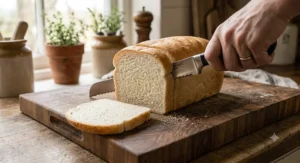
6. F. Dick ProDynamic Offset Sandwich Knife — best for professional bakeries
German cutlery maker F. Dick has been making serrated knives since exhibiting one at the 1893 World’s Columbian Exposition, and the F. Dick ProDynamic Offset Sandwich Knife carries that heritage into a thoroughly modern, NSF-certified package. Its 7-inch blade is hardened to 56 HRC, a notably high figure for a serrated knife, which on paper translates into better edge retention under the sustained daily use a bakery or deli counter demands. The ergonomic handle is designed specifically for repetitive slicing motions, which matters enormously if you’re the person cutting hundreds of sandwiches or loaf ends across a single shift — this is squarely a professional bakery knife rather than a weekend-sourdough tool, and its shorter blade length reflects that focus on sandwich and roll-sized cuts rather than large artisan boules. Here’s what to weigh against the premium price: you’re paying for a hardness rating and NSF certification that a home baker slicing two loaves a week simply doesn’t need, but that a commercial kitchen absolutely does, both for compliance reasons and to avoid replacing a cheaper blade every few months.
Pros:
- ✅ 56 HRC hardness gives strong edge retention
- ✅ NSF certification suits commercial food service
- ✅ Handle engineered for repetitive slicing motions
Cons:
- ❌ Shorter 7-inch blade limits use on large boules
- ❌ Premium German pricing for occasional home use
Expect a price range around £50-£70, which is easiest to justify if you’re slicing professionally rather than occasionally at home.
7. Piklohas Resharpenable Offset Handle Bread Knife — best budget pick for artisan bread
Rounding out the list, the Piklohas Resharpenable Offset Handle Bread Knife targets exactly the audience searching for the best bread knife for artisan bread on a tight budget. Its 10-inch wavy-edge blade is longer than every other knife on this list bar none, which practically matters when you’re slicing a full sourdough boule or a wide bloomer in a single pass rather than sawing awkwardly partway through and repositioning. The knife is explicitly marketed as resharpenable, addressing one of the most common frustrations with cheaper serrated blades — that once dull, they’re effectively disposable. On paper this means a lower total cost of ownership than the price tag alone suggests, assuming you’re willing to send it for professional serrated sharpening every year or two rather than replacing it outright. Reviewers consistently note the generous blade length as the standout feature for anyone regularly baking large home loaves, though as with most budget offset knives, the handle materials feel noticeably less premium than the Dexter-Russell or Victorinox options further up this list.
Pros:
- ✅ Longest blade of the seven, ideal for full boules
- ✅ Genuinely resharpenable rather than disposable
- ✅ Comes gift-boxed, useful if buying for a baker friend
Cons:
- ❌ Handle materials feel budget compared to premium picks
- ❌ Less suited to heavy daily commercial use
At around £15-£25, it’s an easy low-risk way to try a longer-bladed offset serrated knife before committing to a pricier upgrade.
Offset Bread Knife vs Regular Bread Knife
The core difference between an offset bread knife vs regular bread knife comes down to one measurement: where the handle sits relative to the cutting edge. On a regular bread knife, the handle is in line with the blade, so your knuckles travel in a straight path towards the cutting board as the blade completes its slice. On an offset design, the handle is raised — typically by a few centimetres — which lifts your entire hand clear of both the food and the surface beneath it.
| Feature | Offset Handle | Regular (In-Line) Handle |
|---|---|---|
| Knuckle clearance | Excellent — hand stays raised | Poor — knuckles approach the board |
| Visibility of cut | Better, hand doesn’t block the loaf | Can obscure the cutting line |
| Wrist angle | More neutral over long sessions | Can force wrist flexion |
| Storage | Slightly bulkier in a drawer | More compact, stacks flatly |
| Cost | Usually a modest premium | Generally cheaper |
This comparison matters most if you slice bread daily rather than occasionally — a home baker cutting one loaf a week may never notice the difference a regular handle makes, whereas someone slicing dozens of sandwiches or loaves a shift will feel the offset handle’s benefit within days. Straight-handled knives aren’t inferior tools generally, they’re simply optimised for a different priority: compactness and lower manufacturing cost over ergonomic clearance.
Offset Handle Bread Knife Benefits and Ergonomics
The offset handle bread knife benefits go well beyond simply keeping your hands clean of crumbs. The Health and Safety Executive notes that upper limb disorders are more common in tasks involving prolonged repetitive work and awkward postures — and repeatedly cutting bread with your wrist bent downward to clear a straight handle is precisely that kind of awkward, repetitive posture. Offset handle ergonomics address this directly by keeping the wrist in a more neutral position throughout the sawing motion, since the hand doesn’t need to drop as far to complete each cut.
It’s worth being honest about the limits of this claim: no single kitchen tool prevents a musculoskeletal condition on its own, and the NHS notes that carpal tunnel syndrome results from compression of the median nerve in the wrist, with causes ranging well beyond any one repetitive task. What an offset handle genuinely does is reduce one specific source of strain — sustained wrist flexion during a repetitive cutting motion — for anyone slicing bread often enough for it to matter, such as a professional baker, deli worker, or enthusiastic home sourdough baker cutting several loaves a week. For occasional users, the ergonomic benefit is real but modest; for daily users, it can be the difference between comfortable prep and a sore wrist by the end of a shift.
Practical Usage Guide: Setup, Technique and Knuckle Clearance
Getting the most from any offset bread knife starts before the first cut. Set your cutting board on a stable, non-slip surface at a height that lets your elbow sit close to a right angle — too low a board forces extra wrist flexion regardless of how good your knife’s handle is. This is where knuckle clearance and cutting board height work together: an offset handle only delivers its full benefit if the board itself isn’t so low that you’re reaching down awkwardly to compensate.
First 30 days — common setup mistakes to avoid:
- Skipping the “sawing” motion and pressing straight down, which crushes the crumb and blunts serrations faster than proper use.
- Cutting on a hard surface like glass or stone, which dulls scalloped edges within weeks.
- Washing a wood-handled knife in the dishwasher, which cracks rosewood over repeated cycles.
- Storing the blade loose in a drawer where it knocks against other cutlery and dulls the tips.
- Ignoring the finger guard on models like the Dexter-Russell V-Lo Offset, which is there specifically to protect your grip hand during fast slicing.
For maintenance, hand-wash and dry your knife immediately after use rather than leaving it wet, and consider professional resharpening every 12-18 months for daily users — scalloped edges can’t be touched up with a standard honing steel the way a straight blade can, since each individual scallop needs specific attention.
✨ Ready to Upgrade Your Bread-Slicing Setup?
🔍 Take your bread game to the next level with one of the offset picks above. Click through to check current pricing and availability, and find the knife that fits your kitchen and your budget!
Real-World Scenarios: Who Actually Needs One
The artisan home baker: If you’re baking sourdough or crusty artisan loaves two or three times a week, the best bread knife for artisan bread is one with a long blade — 9 to 10 inches — to clear a full boule in a single pass. The Piklohas Offset Handle Bread Knife or Dexter-Russell Traditional 9″ Offset both suit this profile well, balancing blade length with a manageable price.
The occasional weekend cook: If bread appears on your worktop once a week at most, a budget pick like the Mercer Culinary Millennia Offset delivers the ergonomic benefit without asking you to spend on features you won’t use daily.
The professional bakery or deli: Anyone slicing dozens of loaves or sandwiches per shift needs a genuine professional bakery knife — NSF certification, a hardened blade, and a handle engineered for repetitive motion. The F. Dick ProDynamic Offset and Dexter-Russell Sani-Safe Offset were built with exactly this environment in mind, right down to colour-coded handle options for allergen management.
How to Choose an Offset Bread Knife
Choosing the right offset serrated knife comes down to matching a handful of specs to how you’ll actually use it:
- Blade length — 9-10 inches suits large artisan loaves; 7-8 inches is plenty for sandwiches and rolls.
- Handle material — wood (like the Dexter-Russell Traditional) offers grip and looks, while polypropylene or Santoprene handles resist moisture and dishwasher cycles better.
- Serration style — scalloped edges (rounded notches) produce cleaner cuts with fewer crumbs than sharply pointed serrations.
- Certification — NSF-listed models matter for commercial kitchens but are irrelevant for most home use.
- Resharpenability — check whether the manufacturer supports professional resharpening, as with the Piklohas model, rather than expecting a disposable blade.
- Grip features — a finger guard, as on the Dexter-Russell V-Lo Offset, adds meaningful safety margin during fast, repeated cuts.
- Budget realism — decide whether you’re an occasional user (budget tier is fine) or a daily one (mid-range or premium pays for itself in edge retention).
Common Mistakes When Buying an Offset Bread Knife
A surprising number of buyers pick the wrong knife for reasons that have nothing to do with the blade itself. First, many assume any serrated knife will do, without checking that the handle is genuinely offset rather than simply ergonomically shaped — the two are not the same thing, and only a true offset design lifts the hand clear of the board. Second, buyers frequently underestimate blade length needs, purchasing a 7-inch knife and then struggling with large boules it simply can’t clear in one stroke. Third, home cooks sometimes buy premium NSF-certified commercial knives like the F. Dick ProDynamic Offset expecting dramatically better everyday performance, when a mid-range option like the Victorinox 7.6058.20 Offset would serve identically for occasional use at a lower price. Finally, many people neglect handle material entirely, choosing wood for aesthetics without considering that a busy household dishwasher will shorten its life considerably compared to polypropylene alternatives.
What to Expect: Real-World Performance
On paper, spec sheets talk about steel hardness and blade angles — in practice, what you’ll actually notice is how cleanly the first slice comes away from a warm loaf. A well-designed scalloped offset blade, such as those on the Dexter-Russell V-Lo Offset or Victorinox 7.6058.20 Offset, should glide through a crusty exterior with minimal downward pressure, leaving a clean cross-section rather than a crumb-strewn one. Softer sandwich loaves and challah are where cheaper, sharply-pointed serrations tend to tear rather than slice — this is where scalloped edges specifically earn their reputation over standard sawtooth patterns. Expect a genuine, if modest, reduction in wrist fatigue during long slicing sessions with any properly offset handle, most noticeably on models with a contoured grip like the Dex-Tex Armadillo handle. Where performance diverges most sharply between budget and premium options is edge retention over months of use, not day-one sharpness — a fresh Mercer Culinary Millennia Offset cuts almost as well as a fresh F. Dick ProDynamic Offset, but the gap widens considerably after a hundred loaves.
Long-Term Cost & Maintenance
| Knife | Price Range | Resharpening Need | Estimated Lifespan |
|---|---|---|---|
| Piklohas Offset Handle Knife | £15-£25 | Annual | 3-5 years |
| Mercer Culinary Millennia Offset | £20-£30 | Annual | 3-5 years |
| Dexter-Russell Sani-Safe Offset | £25-£35 | Every 18 months | 5-8 years |
| Dexter-Russell Traditional 9″ Offset | £35-£45 | Every 18-24 months | 8-10 years |
| Victorinox 7.6058.20 Offset | £45-£60 | Every 2 years | 10+ years |
| Dexter-Russell V-Lo Offset | £40-£55 | Every 18-24 months | 8-10 years |
| F. Dick ProDynamic Offset | £50-£70 | Every 2-3 years | 10+ years |
Looking at total cost of ownership rather than sticker price alone, the Victorinox 7.6058.20 Offset and F. Dick ProDynamic Offset both justify their higher upfront cost through genuinely longer service life and less frequent resharpening. Budget options like the Piklohas and Mercer Culinary Millennia aren’t false economy exactly, but expect to either replace or resharpen them more frequently, which narrows the long-run price gap more than the initial price tags suggest.
Features That Actually Matter (And Those That Don’t)
Marketing copy loves to mention blade steel grades and handle textures, but not every spec translates into a noticeably better slicing experience. Blade length and true offset geometry matter enormously — get either wrong and no amount of premium steel compensates. Scalloped versus sharply pointed serrations matter too, genuinely affecting crumb mess and cut cleanliness. Handle material matters for durability and hygiene but has a smaller day-to-day impact on cutting performance than most listings suggest. What matters far less: exact steel hardness figures beyond a sensible threshold (56 HRC on the F. Dick ProDynamic Offset is excellent, but a home baker won’t notice a one or two point difference either way), and cosmetic handle colour, which is only functionally relevant in commercial kitchens using colour-coding for allergen control.
Safety, Certification and Compliance for Kitchen Knives
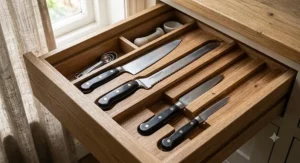
For UK buyers, it’s worth knowing that bladed kitchen knives sold online are subject to age-verification requirements under UK law, meaning most retailers require proof of age at checkout or delivery for any knife purchase. For commercial buyers, NSF certification — present on models like the F. Dick ProDynamic Offset, the Dexter-Russell Sani-Safe Offset, and the Dexter-Russell V-Lo Offset — indicates the handle and blade junction meets recognised food-safety hygiene standards, which matters for compliance in any professional kitchen subject to environmental health inspection. At home, safe use simply means proper storage (a knife block or magnetic strip rather than a loose drawer), regular hand-washing rather than dishwasher cycles for wood-handled models, and letting the serrations do the work through a sawing motion rather than forcing the blade downward.
Frequently Asked Questions
❓ Is an offset bread knife worth it for home use?
❓ What is the best offset bread knife for artisan sourdough?
❓ Can you sharpen an offset serrated knife at home?
❓ Do professional bakeries need NSF-certified knives?
❓ What's the difference between offset and regular bread knife handles?
Conclusion
An offset bread knife isn’t a gimmick — it’s a genuinely sensible piece of kitchen geometry that solves a specific, everyday annoyance: knuckles hitting the board mid-slice. Whether you land on the budget-friendly Mercer Culinary Millennia Offset, the all-round dependable Victorinox 7.6058.20 Offset, or the professional-grade F. Dick ProDynamic Offset, the right choice comes down to how often you’re actually slicing bread and what you’re slicing it on. As covered in Expert Reviews’ independent bread knife testing, balance and blade length matter just as much as the handle style itself, so weigh the full spec sheet rather than the offset feature alone. For most home bakers, a mid-range pick like the Dexter-Russell V-Lo Offset or Dexter-Russell Traditional 9″ Offset delivers the best balance of comfort, durability and price — while professional kitchens will find the extra investment in NSF-certified models pays for itself in longevity.
🔪 Ready to say goodbye to bruised knuckles? Check today’s prices on your favourite pick above and slice with confidence! 🍞
Recommended for You
- Serrated Bread Knife: 7 Best Picks for Crusty Loaves (2026)
- Best Bread Knife 2026: 7 Top Picks That Won’t Wreck a Loaf
- Straight Paring Knife: 7 Best Picks Tested for UK Kitchens 2026
Disclaimer: This article contains affiliate links. As an Amazon Associate, I earn from qualifying purchases. If you purchase products through these links, we may earn a small commission at no additional cost to you.
✨ Found this helpful? Share it with your friends! 💬🤗
