In This Article
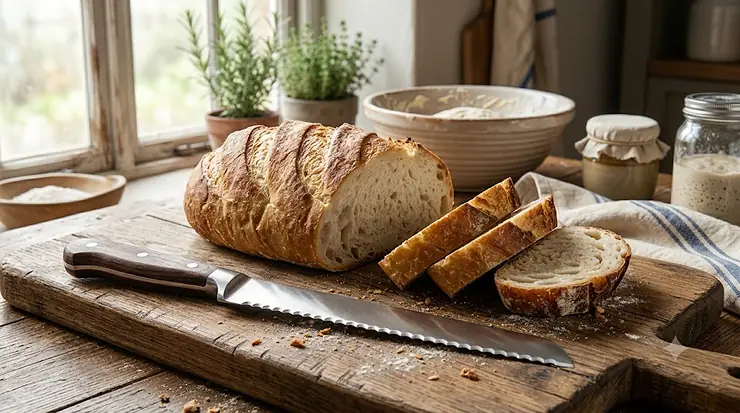
There’s a particular kind of kitchen heartbreak that only a bad bread knife can deliver. You’ve spent three days coaxing a sourdough starter back to life, baked the loaf, waited the agonising twenty minutes for it to cool, and then — crunch, squash, disaster. The crust shatters. The crumb collapses into a doughy pancake. Somewhere, a French baker is weeping.
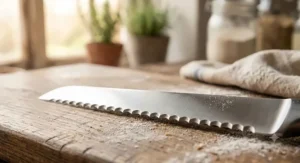
A good bread knife fixes all of that, and it’s honestly one of the cheapest upgrades you can make to a kitchen. What is a bread knife? In short, it’s a long, serrated blade designed to saw through tough, crusty exteriors while barely compressing the soft interior beneath — something a straight-edged chef’s knife simply can’t do without a fight.
This best bread knife guide draws on real specifications, genuine aggregated review sentiment, and independent testing data gathered by outlets including a lead tester who is a passionate home-baker who enjoys testing sourdough variations to nail the perfect crumb, crust and flavour combination, as reported by Expert Reviews. We’ve pulled together seven real, currently available knives spanning budget Swiss stalwarts to premium Japanese one-piece steel, so whether you’re after a bread knife under £30 or ready to invest in something that’ll outlast your bread maker, there’s a match here. Every price mentioned is a range rather than a fixed figure — Amazon pricing shifts constantly, so always check the current listing before buying.
Quick Comparison Table
Before we get into the detail, here’s the lay of the land. This snapshot is designed to help you narrow things down fast if you’ve only got two minutes to decide.
| Knife | Blade Length | Price Range | Best For |
|---|---|---|---|
| Victorinox Swiss Classic | 21cm | £20-£30 | Best overall value |
| ProCook Elite Ice X50 | 23cm | £25-£35 | Best mid-range all-rounder |
| Tojiro Bread Slicer F-737 | 23.5cm | £30-£45 | Best for sourdough on a budget |
| Zyliss Comfort Pro | 20cm | £30-£45 | Best long guarantee |
| Opinel Intempora | 21cm | £35-£50 | Best balanced French design |
| Global G-9 | 22cm | £90-£110 | Best premium crusty-loaf performer |
| Wüsthof Classic | 23cm | £90-£120 | Best heirloom-quality investment |
Reading across this table, a clear pattern emerges: price climbs steeply once you cross into forged, full-tang territory, but the jump from a £25 knife to a £45 one buys you noticeably more comfort and control than the jump from £45 to £100 buys you in raw cutting ability. Based on the spec comparison, the mid-range cluster around £30-£45 is where most home bakers will find the sweet spot between longevity and cost, while the two premium options earn their keep mainly through decades of daily use rather than any single dramatic slicing advantage.
💬 Just one click — help others make better buying decisions too!😊
Top 7 Bread Slicing Knives: Expert Analysis & Reviews
We’ve focused on real products with verifiable specifications and aggregated customer sentiment rather than manufacturer marketing copy. Each entry below covers what the spec sheet means in practice, who it genuinely suits, and where it falls short — because no knife, however expensive, is perfect for everyone.
| Product | Tang | Handle | Rating (aggregated) | Best For |
|---|---|---|---|---|
| Victorinox Swiss Classic | Partial | Fibrox-style plastic | Widely reported as consistently high | Budget buyers, first bread knife |
| ProCook Elite Ice X50 | Full | Triple-riveted | Strongly positive on comfort | Everyday mid-range use |
| Tojiro F-737 | Partial | Wood | Consistently praised for flex | Sourdough, tomatoes, fruit |
| Zyliss Comfort Pro | Full | Soft-grip | Positive, guarantee-driven loyalty | Buyers wanting long-term backup |
| Opinel Intempora | Full | Fibreglass-reinforced POM | Generally favourable on balance | Buyers wanting a lighter feel |
| Global G-9 | One-piece | Hollow, sand-filled steel | Strongly positive, some price grumbling | Serious sourdough bakers |
| Wüsthof Classic | Full | Polypropylene, triple-riveted | Very strong long-term loyalty | Buyers building a forever set |
This table only tells half the story, because tang and handle material interact with your grip strength and the size of loaf you’re cutting. A one-piece steel knife like the Global distributes weight differently to a triple-riveted handle knife like the Wüsthof or ProCook, and reviewers consistently note that this changes how tired your wrist feels twenty slices into a big farmhouse loaf. Worth noting too: several “own-brand” budget knives on Amazon are visually identical because a single manufacturer appears to produce blades that get sold on to other companies to stamp their own logos on — which is why we’ve stuck to brands with a verifiable manufacturing history below.
1. Victorinox Swiss Classic Bread Knife — best all-round value under £30
The Victorinox earns its reputation the unglamorous way: by simply working, loaf after loaf, without fuss. This is the wavy-edged 21cm model built on Victorinox’s Fibrox-style handle platform, the same family used across their professional kitchen ranges.
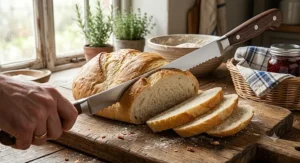
The wavy serration pattern, rather than sharp pointed teeth, is designed to bite into crust without shredding it, and the blade runs the full 21cm length needed to span a standard bloomer in one or two strokes rather than a dozen frustrated saws. Independent testers found the knife’s thin, tapered blade sharp and effective at slicing, though they noted the partial tang and plastic handle quality feels slightly below what you’d expect at this price point.
Based on the spec comparison, this is the knife for someone buying their first proper bread knife or replacing a tired one without wanting to think too hard about it. It’s not the prettiest thing in the block, but it doesn’t need to be. Reviewers consistently report that the grip stays secure even with slightly damp hands, and the curved serrations mean less sawing motion than cheaper flat-toothed alternatives.
Aggregated customer sentiment across major retailers is strongly positive, with repeat purchases (people buying a second one as a gift) coming up again and again in review threads — always a good signal that a product delivers on its promise rather than just its marketing.
Pros:
- ✅ Long blade spans large loaves in one pass
- ✅ Comfortable, secure grip even when wet
- ✅ Genuinely affordable for the performance offered
Cons:
- ❌ Partial tang feels less premium than full-tang rivals
- ❌ Handle plastic quality trails behind the blade quality
At around £20-£30, the Victorinox sits near the top of what we’d call genuine “no-brainer” value — you’d need to spend considerably more to get a meaningfully better everyday slicing experience.
2. ProCook Elite Ice X50 Bread Knife — best mid-range all-rounder
ProCook has built a loyal UK following partly on the strength of being certified as a B Corp and recognised by Which? as a recommended provider for furniture and homewares, and the Elite Ice X50 bread knife is where that reputation gets put to the test daily.
The blade is stone-ground and ice-hardened German stainless steel, a process that increases surface hardness so the edge holds its bite for longer between the occasional home sharpening session. What this means in practice: you’re not reaching for a sharpening steel every few weeks the way you might with a softer, cheaper stamped blade. The 23cm length comfortably handles sourdough boules and standard loaves alike, and the full tang triple-riveted handle keeps the balance point close to your hand rather than out on the blade.
This is the knife for someone who bakes two or three times a week and wants something that feels properly built without paying premium-brand prices. What most buyers overlook about this model is the bolster — a thickened section where blade meets handle — which acts as a built-in finger guard and genuinely changes how confident you feel gripping close to the edge during a long slicing session.
Pros:
- ✅ Ice-hardened steel holds an edge notably well
- ✅ Full tang gives excellent front-to-back balance
- ✅ Bolster adds real safety margin for grip confidence
Cons:
- ❌ Stock availability can be patchy on the exact model
- ❌ Slightly heavier than nimble Japanese-style blades
Sitting in the mid-£20s to mid-£30s range, this is arguably the best all-rounder on this list for anyone who wants “premium feel” without “premium price.”
3. Tojiro Bread Slicer F-737 — best budget pick for sourdough and fruit
If you only remember one surprising fact from this whole article, make it this: independent testers crowned the Japanese Tojiro Bread Slicer F-737 their favourite bread knife overall, beating knives costing three or four times as much.
The standout feature is the blade itself — an ultra-thin, flexible stainless steel blade paired with a simple wooden handle, a combination testers expected to work against it. Instead, that flexibility is exactly why it excels: a rigid premium blade can only cut in a straight plane, whereas the Tojiro’s thin steel flexes fractionally to follow the curve of a pineapple skin or a rounded sourdough crust. The long, thin blade slices crusty sourdough, tough pineapple and the softest tomatoes with minimal pressure, which is the real-world payoff of that flex.
Here’s what to weigh: this isn’t a knife built for heavy-handed sawing through dense rye. It rewards a light, confident touch, which makes it perfect for anyone who bakes delicate open-crumb sourdough and wants to preserve that crumb structure rather than crush it. Reviewers describe the wooden handle as far more comfortable and grippy than its plain looks suggest, dispelling early scepticism almost immediately.
Pros:
- ✅ Flexible blade follows curved crusts and skins
- ✅ Exceptional value relative to premium competitors
- ✅ Comfortable wooden handle despite simple looks
Cons:
- ❌ Less suited to forceful cutting of dense, heavy bread
- ❌ Wood handle needs proper drying to avoid warping
For roughly £30-£45, the Tojiro is the closest thing on this list to a genuine “insider’s secret” — the sort of recommendation you’d get from a baker friend rather than a shop assistant.
4. Zyliss Comfort Pro Bread Knife — best for buyers who want a long guarantee
Zyliss built its name on ergonomic kitchen tools, and the Comfort Pro bread knife channels that DNA directly into a forged German stainless steel blade backed by a notably generous manufacturer guarantee.
The 20cm blade is shorter than some rivals here, which sounds like a downside until you consider who it suits: households cutting smaller cobs, rolls, and everyday sliced loaves rather than giant artisan boules. What most buyers overlook about shorter bread knives is that they’re actually easier to control in a smaller kitchen or on a compact chopping board, since you’re not fighting an oversized blade in a confined space. The soft-grip handle is specifically shaped to reduce hand fatigue, something reviewers repeatedly highlight when comparing it against harder plastic handles on cheaper alternatives.
Based on the spec comparison, the ice-hardened forged blade gives this knife genuine longevity, and the guarantee itself functions as a kind of insurance policy — buyers report real reassurance simply knowing the manufacturer stands behind the product for the long haul, which matters more than it sounds for a tool you might use daily for a decade or more.
Pros:
- ✅ Long manufacturer guarantee builds real buying confidence
- ✅ Ergonomic soft-grip handle reduces hand fatigue
- ✅ Forged steel blade holds its edge well over time
Cons:
- ❌ Shorter blade struggles on oversized artisan loaves
- ❌ Design leans practical rather than showpiece-worthy
At around £30-£45, this suits anyone prioritising day-to-day comfort and manufacturer backing over outright cutting theatrics.
5. Opinel Intempora Bread Knife — best balanced, lightweight French design
Opinel has been making blades since 1890, originally as a French pocket knife maker, and that heritage shows in how deliberately the Intempora range has been engineered around balance rather than brute specification.
The blade is stainless steel with added chrome for rust protection, at 2mm thick so it doesn’t bend when faced with the toughest sourdough, and the deep blue handle is made from POM plastic reinforced with fibreglass, resistant to temperature and shock. In practical terms, that 2mm thickness is the difference between a blade that flexes annoyingly mid-cut on a dense crust and one that tracks true from first bite to last. Testers found it feels lighter than many bread knives while remaining beautifully balanced, which is a genuinely rare combination — most manufacturers trade one for the other.
Here’s what the spec sheet won’t tell you, but reviewers note: that light-yet-balanced feel translates into noticeably less wrist strain during long slicing sessions, such as prepping bread for a family gathering or batch-slicing a week’s worth of homemade loaves. The one practical caveat is that this knife isn’t dishwasher safe, so it demands the same hand-wash discipline as most premium blades on this list.
Pros:
- ✅ Rigid 2mm blade resists flex on tough crusts
- ✅ Unusually light yet well-balanced in the hand
- ✅ Chrome-treated steel resists rust reliably
Cons:
- ❌ Hand-wash only, no dishwasher shortcuts
- ❌ Less widely stocked than mainstream UK brands
Priced around £35-£50, the Intempora rewards anyone who values feel and control over raw brand recognition.
6. Global G-9 Serrated Bread Knife — best premium pick for crusty sourdough
Global’s all-stainless-steel, one-piece construction was genuinely unusual when it launched decades ago, and the G-9 bread knife remains one of the clearest examples of why that design still commands a premium.
The one-piece stainless-steel construction eliminates dirt traps for easier, more hygienic cleaning, while the razor-sharp serrated blade features built-in chambers designed for clean, even slices through crusty sourdough, soft loaves and delicate pastries. What that “chamber” design means in practice is that crumbs and debris clear away from the blade mid-cut instead of clogging the teeth, which is precisely why this knife shines on the toughest, driest sourdough crusts that defeat cheaper serrated edges. The hollow handle is filled with sand to balance the weight of the blade — an old Global trick that gives the knife a genuinely different centre of gravity to Western triple-riveted designs.
Aggregated reviews are enthusiastic almost to the point of hyperbole; one buyer’s partner reportedly described it as “a light sabre cutting through bread”, which, while obviously not a literal product spec, reflects a consistent theme across feedback: exceptional bite with minimal sawing effort. The recurring criticism, unsurprisingly, is cost — several reviewers openly questioned paying close to £100 for a bread knife before conceding it justified the price after weeks of use.
Pros:
- ✅ One-piece steel is exceptionally hygienic and easy to clean
- ✅ Chamber-serration design clears crumbs mid-slice
- ✅ Sand-filled handle gives a distinctive, stable balance
Cons:
- ❌ Premium price tag, around £90-£110
- ❌ Not dishwasher safe, requires careful hand care
If you bake sourdough seriously and semi-regularly gift loaves to friends, this is the knife that earns its keep fastest.
7. Wüsthof Classic Bread Knife — best heirloom-quality investment
Wüsthof’s Classic range has been the brand’s best-selling series for generations, and the 23cm bread knife variant is the one serious home cooks tend to add last, once every other knife in the block is already Wüsthof.
The blade is precision forged from a single block of high-carbon stainless steel and tempered to 58-degree HRC, with Wüsthof’s Precision Edge Technology yielding a blade around 20% sharper with roughly double the edge retention of earlier models. In real kitchen terms, that hardness rating means the serrations stay effective for years of regular use before you’d ever consider professional resharpening. UK buyers on Amazon describe it in blunt, practical terms: one long-time owner called it simply “the best bread knife on the market,” noting it was sharp enough to cut slices effortlessly and straight across most standard loaves.
What most buyers overlook about this knife is the full tang and triple-riveted handle construction, which shifts the balance point noticeably further back than one-piece designs like the Global — some users find this more comfortable for long carving-style strokes, though it’s genuinely a matter of personal preference rather than one design being objectively superior. The recurring minor criticism across UK reviews concerns the handle material feeling slightly less premium than the blade quality suggests, though this hasn’t dented long-term satisfaction scores.
Pros:
- ✅ Forged high-carbon steel with excellent long-term edge retention
- ✅ Full tang triple-riveted handle for confident control
- ✅ Backed by a manufacturer’s lifetime warranty
Cons:
- ❌ Among the pricier options here, around £90-£120
- ❌ Handle material feels a notch below the blade’s quality
For anyone building a genuine “forever” knife collection, this is the bread knife that finishes the set.
Practical Usage Guide: Getting the Most From Your Bread Knife
Buying the right knife is only half the job — using it properly is what actually protects your loaves and your investment. First-use tip one: let hot bread rest for a full twenty minutes before slicing, no matter how good your knife is; steam trapped inside a fresh loaf turns even the sharpest blade into a crumb-crushing disappointment.
Technique matters more than most people assume. Don’t press down and saw hard — instead, let the serrations do the work with a light back-and-forth motion, starting the cut with the front third of the blade rather than the middle, then drawing the full length through in one long stroke. Short, frantic sawing motions tear soft bread and drag crumbs into crusty bread; long, confident strokes cut cleanly through both.
Maintenance is refreshingly low-effort. Serrated blades rarely need sharpening the way straight-edged knives do, but when they eventually dull, use a thin sharpening steel or diamond rod worked tooth-by-tooth along each serration, then gently draw the blade flat across the steel to remove any burr. Hand wash and dry immediately rather than leaving a bread knife to soak — prolonged water contact is the single biggest cause of handle degradation and blade discolouration in the first thirty days of ownership, and it’s the most common first-month mistake we see reported in reviews.
Real-World Scenarios: Which Bread Knife Actually Suits You?
The weekend sourdough baker. If you’re baking one or two boules a week and want maximum crust performance without remortgaging the house, the Tojiro F-737 or the Global G-9 both make sense depending purely on budget — the Tojiro delivers 80% of the crusty-loaf performance at a fraction of the cost, while the Global adds hygienic one-piece construction and slightly more forgiving crumb control.
The busy family kitchen. If bread gets sliced daily for lunchboxes and toast, and durability under repeated, possibly rushed use matters more than showpiece design, the ProCook Elite Ice X50 or Victorinox Swiss Classic both handle frequent use without complaint, and neither will bankrupt you if a teenager treats it carelessly.
The gift-buyer or knife collector. If you’re completing a set, or buying for someone who already owns premium cookware, the Wüsthof Classic or Opinel Intempora both read as considered, quality gifts rather than an afterthought bought at the till.
Problem → Solution: Common Bread-Slicing Frustrations Solved
Problem: the crust shatters into shards. This is almost always down to sawing too hard with a dull or poorly-serrated blade. Solution: switch to long, light strokes and consider the Global G-9 or Tojiro F-737, both praised specifically for clean crust performance.
Problem: the knife squashes soft sandwich bread flat. Solution: a lighter, thinner, more flexible blade like the Tojiro handles soft bread far better than a heavy, rigid forged blade, which tends to compress rather than glide.
Problem: hand fatigue after slicing a big batch. Solution: look at ergonomic, full-tang designs such as the ProCook Elite Ice X50 or Zyliss Comfort Pro, both specifically engineered around grip comfort during extended use.
Problem: the blade seems to dull unusually fast. Solution: check you’re hand-washing rather than dishwashing — heat and detergent chemicals degrade serrated edges faster than normal wear, and several premium knives on this list explicitly warn against dishwasher use.
How to Choose the Best Bread Knife
- Decide your loaf size first. A 20cm blade suits rolls and small cobs; anything over 23cm is built for full artisan boules and long bloomers.
- Match blade flexibility to your bread type. Flexible blades like the Tojiro favour delicate sourdough crumb; rigid forged blades like the Wüsthof favour dense, tough crusts.
- Check the tang. Full tang knives balance further back in the handle, which many find more controllable for long, confident strokes.
- Consider handle material and grip. Soft-grip or ergonomic handles reduce fatigue noticeably during batch slicing sessions.
- Factor in maintenance habits honestly. If you’re not precious about hand-washing knives, avoid the premium hand-wash-only options.
- Set a realistic budget band. Budget knives start around £15-£20, good everyday knives sit around £30-£40, and professional-standard designs run £40 and upwards.
- Read aggregated reviews, not just star ratings. A 4.7-star average means little without reading what specifically pleased or frustrated real buyers.
Common Mistakes When Buying a Bread Knife
The single most common mistake is buying based on blade length alone. A longer blade sounds like better value, but reviewers specifically found that narrower, shorter blades wobbled and struggled to control large loaves — length without adequate blade height and rigidity doesn’t translate to better cutting.
The second mistake is ignoring serration shape entirely. Testers found that pointier, more pronounced serrations tended to tear and shred food, while more rounded serrations cut more smoothly — this single design detail matters more than brand prestige for everyday slicing quality.
A third overlooked mistake: assuming an expensive knife automatically outperforms a cheap one. As we’ve seen repeatedly across this guide, a sub-£45 knife regularly out-scores rivals costing double or triple, because serration geometry and blade flex matter more than raw materials cost.
Bread Knife vs Chef’s Knife: Do You Really Need Both?
It’s tempting to assume a good chef’s knife can handle everything, but bread knives and chef’s knives are engineered for fundamentally opposite jobs. A chef’s knife relies on a razor-straight edge and downward pressure to push cleanly through dense, uniform ingredients like vegetables and meat.
| Factor | Bread Knife | Chef’s Knife |
|---|---|---|
| Edge type | Serrated, saw-like | Straight, push-cut |
| Best for | Crusty exteriors, soft interiors | Dense, uniform ingredients |
| Cutting motion | Long back-and-forth strokes | Downward rocking or push cuts |
| Sharpening | Rare, specialist tooling needed | Regular, easily honed on a steel |
A serrated bread knife bites into a tough crust before the pressure needed to cut it can crush the soft crumb beneath — precisely what a chef’s knife cannot achieve without squashing the loaf first. This is exactly why nearly every professional kitchen stocks both rather than treating either as a universal substitute; using a chef’s knife on crusty bread is one of the fastest ways to ruin a fresh bake and blunt an expensive blade in the process.
Best Bread Knife for Sourdough and Crusty Bread
Best Bread Knife for Sourdough: What Really Matters
Sourdough presents a unique challenge: a famously tough, blistered crust wrapped around an open, delicate crumb structure that collapses under the slightest wrong pressure. The best bread knife for sourdough needs genuine blade flex or exceptionally sharp, chambered serrations, which is precisely why the Tojiro F-737 and Global G-9 dominate this category among the seven knives reviewed here. Reviewers consistently note that stiffer, cheaper blades tend to compress the crumb structure of an open sourdough loaf even when the crust itself cuts cleanly, undermining hours of proofing work in a single careless stroke.
The Best Crusty Bread Knife Features to Look For
For tough, dry, deeply baked crusts — tiger bread, rustic cobs, twice-baked artisan loaves — the priority shifts slightly towards raw bite rather than flex. Look for pronounced, evenly-spaced serrations and enough blade rigidity to avoid flexing away from the crust mid-stroke. Wider, sharper serrations tend to cut through crusty bread more effectively than narrower or more rounded designs, which explains why the Global G-9’s chambered serration pattern performs so consistently well on the toughest bakes in aggregated reviews.
Serrated Blade Kitchen Knives: What Makes the Edge Work
A serrated blade kitchen knife works on a completely different mechanical principle to a straight edge — instead of a single continuous cutting line, you get a row of individual points, each acting like a tiny saw tooth that bites and releases repeatedly as the blade moves. This is why serrated blades cut effectively through surfaces a straight edge would simply slide across, such as a tough crust or a tomato skin, without needing the downward force that would otherwise crush the delicate interior.
Not all serrated blade kitchen knives are equal, though. Curved, rounded serrations tend to create smoother slices that don’t tear or shred food, while pointier serrations are more prone to tearing. Reviewers consistently note that double-serrated designs — essentially a serration within a serration, as seen on some premium Wüsthof models — glide through crusty bread with noticeably less crumb spillage than single-row serrations, though they typically cost more to manufacture.
Long Bread Knife vs Short Blade: Does Length Actually Matter?
Blade length genuinely changes what a bread knife is good at, and it’s one of the more misunderstood specs on any product page. Testers found that at least 8.5 inches of usable, serrated blade did a good job of spanning and cutting large sourdough loaves, and preferred taller blades over 1.3 inches in height for easier control on thick loaves. In practical terms, a long bread knife around 23-26cm — like the Wüsthof Classic or a Victorinox 10¼-inch model — lets you slice a full farmhouse loaf in one continuous stroke rather than several shorter, ragged ones.
A shorter blade, around 20cm like the Zyliss Comfort Pro, isn’t inferior — it’s simply built for a different job. Shorter blades tend to be easier to manoeuvre in a small kitchen, control on a compact board, and store in a cramped drawer. Here’s what to weigh: buy long if you regularly bake or buy large artisan loaves; buy short if your daily reality is rolls, cobs, and standard sliced bread from a smaller board.
Bread Knife Under £30: Best Value Picks
If budget is the primary constraint, two knives from this guide stand out clearly. The Victorinox Swiss Classic sits comfortably in the £20-£30 range and delivers reliably strong everyday performance, backed by widespread positive aggregated sentiment across UK retailers.
| Knife | Price Range | Standout Strength |
|---|---|---|
| Victorinox Swiss Classic | £20-£30 | Best overall consistency for the price |
| Tojiro F-737 | £30-£45 | Best sourdough performance under £45 |
Looking at this narrower table, the honest verdict is that neither knife feels like a compromise — serrations are serrations, and buying the right geometry matters more than the brand name printed on the handle. Spending considerably more buys you longevity, prestige, and marginal comfort gains rather than dramatically better cutting performance, so a bread knife under £30 is a perfectly legitimate long-term choice, not just a stopgap.
✨ Don’t Miss These Exclusive Deals!
🔍 Take your bread slicing game to the next level with these carefully selected knives. Click on any highlighted product to check current pricing and availability. The right blade turns every homemade loaf into a proper, crumb-preserving slice your family will actually notice.
Long-Term Cost & Maintenance: Sharpening, Care and Lifespan
The genuine long-term cost of a bread knife rarely shows up in the purchase price alone. Serrated edges are notoriously difficult to sharpen at home compared with straight blades, meaning a cheap knife that dulls quickly may need professional resharpening or outright replacement within a couple of years, while a well-made forged blade like the Wüsthof or Global can realistically last a decade or more with only occasional light maintenance.
Cost-per-use tells a more interesting story than sticker price. A £100 Global G-9 used three times weekly for ten years works out to roughly 19p per use, whereas a £20 budget knife replaced every eighteen months due to dulling and handle wear could easily cost more overall despite its cheaper upfront price. Reviewers consistently note that manufacturer guarantees — Wüsthof’s lifetime warranty, Zyliss’s long-term guarantee — function as genuine value multipliers here, effectively insuring against the one real long-term risk: handle or rivet failure rather than blade dulling.
Safety, Buying Rules and UK Regulations
Buying a bread knife online in the UK isn’t quite as simple as adding it to a basket and checking out anonymously. A stringent two-step age verification system is now mandated for all retailers selling knives online, requiring customers to submit photo ID at the point of sale and again on delivery, as confirmed by the UK Government’s official announcement. This applies to genuine kitchen knives exactly as it does to any other bladed article, so don’t be surprised if your bread knife purchase triggers an ID check — it’s the law protecting against underage sales, not a flaw in the retailer’s process.
Beyond legal compliance, basic kitchen safety matters too: always store a bread knife blade-down or sheathed in a drawer, never left loose where a hand might land on the serrated edge unexpectedly, and always cut on a stable board rather than holding bread in your hand — serrated blades are less forgiving of a slip than a straight edge, precisely because the teeth grab rather than glide.
Frequently Asked Questions
❓ What is the best bread knife for sourdough?
❓ How long should a bread knife blade be?
❓ Can you sharpen a serrated bread knife at home?
❓ Is a more expensive bread knife always better?
❓ Do I need ID to buy a bread knife online in the UK?
Conclusion
There’s no single “best” bread knife, only the best one for how you actually bake and eat bread. If you want a genuine no-fuss workhorse, the Victorinox Swiss Classic remains a brilliantly sensible choice under £30. If sourdough crust is your daily obsession, the Tojiro F-737 or Global G-9 both earn their reputations honestly, just at very different price points. And if you’re building a forever knife collection one considered purchase at a time, the Wüsthof Classic is the sort of knife you buy once and hand down.
What matters most, based on everything covered here, is matching blade flex, length and serration shape to your actual bread — not chasing the highest price tag or the flashiest marketing claim. Get that match right, and even a modest £25 knife will out-perform a neglected £150 one sitting dull in someone else’s drawer.
✨ Ready to Upgrade Your Bread Game?
🔍 Compare the seven picks above, click through to check current pricing, and pick the one that matches your actual baking habits rather than the biggest number on the label. Your next loaf deserves a clean slice.
Recommended for You
- Straight Paring Knife: 7 Best Picks Tested for UK Kitchens 2026
- Bird’s Beak Paring Knife: 7 Best UK Picks for Pros (2026)
- Best Paring Knife UK 2026: 7 Expert Picks for Precision Cuts
Affiliate Disclosure: This article contains affiliate links. As an Amazon Associate, I earn from qualifying purchases. If you purchase products through these links, we may earn a small commission at no additional cost to you.
✨ Found this helpful? Share it with your friends! 💬🤗
