
In This Article
There’s a quiet confidence that comes with reaching for the right small knife. Not the hefty chef’s knife — that’s a workhorse, magnificent in its own right — but the nimble, almost unassuming paring knife that handles the fiddly bits: peeling a butternut squash, segmenting a blood orange, removing the eyes from a potato, or deveining prawns while half-watching something on the telly. In short, the best paring knife is the tool you barely notice until it’s not there, and then you absolutely miss it.
For British home cooks, a good paring knife is arguably more essential than in many other food cultures. We peel a lot — parsnips, swedes, apples, potatoes — and we tend to do so in smaller kitchens with less worktop space, where a compact, well-balanced blade is considerably more useful than something designed for a sprawling American prep kitchen. If you live in a terraced house in Leeds or a flat in Bristol, you’ll appreciate a paring knife that stores neatly, handles everything from Sunday roast prep to midweek stir-fry garnishing, and doesn’t occupy half your knife block.
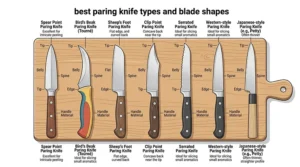
So, what is the best paring knife, exactly? For the purposes of this guide, it’s a short-bladed knife — typically between 6cm and 10cm — with a straight or slightly curved edge, designed for precision tasks that a chef’s knife would make a hash of. The blade should be sharp enough to work off the board (in your hand), comfortable to grip for extended prep sessions, and durable enough to hold an edge through the weekly shop’s worth of fruit and veg.
I’ve researched and analysed seven paring knives currently available on Amazon.co.uk, ranging from very affordable options under £10 to premium blades that justify a more serious investment. Let’s get into it.
Quick Comparison: Best Paring Knives Available on Amazon.co.uk (2026)
| Knife | Blade Length | Material | Price Range (GBP) | Best For |
|---|---|---|---|---|
| Victorinox Swiss Classic Paring Knife | 8cm | Stainless steel | Under £15 | Best overall value |
| Wüsthof Classic Paring Knife | 8.9cm | High carbon stainless | Around £40–£50 | Premium performance |
| Global GS-38 Paring Knife | 9cm | CROMOVA 18 steel | Around £40–£50 | Japanese precision fans |
| MasterClass Edgekeeper Paring Knife | 9cm | Stainless steel | Under £15 | Beginners & busy kitchens |
| Zyliss Peeling Knife | 6cm | German stainless steel | Under £15 | Dedicated peeling tasks |
| Viners Assure 3.5″ Paring Knife | 9cm (3.5″) | Stainless steel | Under £15 | Safety-conscious cooks |
| Chef Aid Paring Knife (Wooden Handle) | ~8cm | Stainless steel | Under £10 | Budget-friendly entry pick |
What the table above makes clear at a glance is that paring knives span a surprisingly wide price range, yet the core function — a short, agile blade for intricate tasks — remains the same. The Victorinox sits in a particularly interesting sweet spot: it performs well above its price point and consistently outperforms knives in the same budget bracket. Meanwhile, both the Wüsthof and Global occupy premium territory where the difference in day-to-day performance is real but nuanced — the right choice between them depends far more on personal grip preference and cooking style than on sharpness alone, as both are genuinely excellent straight out of the box.
✨ Don’t Miss These Exclusive Deals!
🔍 Take your kitchen prep to the next level with these hand-picked paring knives. Click on any highlighted item to check current pricing and availability on Amazon.co.uk — these picks will help you find exactly what you need!
Top 7 Paring Knives for UK Kitchens: Expert Analysis
1. Victorinox Swiss Classic Paring Knife, 8cm — Best Overall Value 🏆
The Victorinox Swiss Classic Paring Knife is, frankly, the one I’d buy with my own money — and I wouldn’t feel the need to apologise for it.
The 8cm stainless steel blade is laser-sharpened to a fine edge straight out of the packaging, and the lightweight polypropylene handle (available in a range of colours, which is cheerfully practical for kitchens that like to colour-code) gives you a surprisingly secure grip even when your hands are damp — a situation that arises with remarkable frequency during British cooking sessions. The Swiss-made build quality is reassuringly solid without adding unnecessary weight, and at under £15, it represents outstanding value that rarely needs defending.
What most UK buyers overlook about this knife is just how well it performs on the tasks that actually dominate British kitchen prep. Peeling a root vegetable in hand? The slim profile means less fatigue over a pile of carrots. Scoring a fig or segmenting a lemon? The straight edge tracks cleanly without dragging. It won’t hold an edge quite as long as a forged German knife, but it sharpens so easily — even on a basic whetstone or pull-through sharpener — that this barely registers as a drawback in practice.
UK customers on Amazon.co.uk consistently praise its lightness and approachability, with many noting it’s their “everyday workhorse” knife that gets used far more than the expensive chef’s knife sitting next to it.
✅ Lightweight and nimble — ideal for extended hand-peeling sessions
✅ Easy to sharpen and maintain for home cooks of all skill levels
✅ Excellent value; excellent colour range for kitchen organisation
❌ Stamped rather than forged — edge retention is good, not exceptional
❌ Handle may feel a touch basic compared to premium alternatives
Price range: Under £15 — outstanding value at this price point. Possibly the most sensible kitchen purchase you’ll make all year.
2. Wüsthof Classic Paring Knife, 8.9cm — Best Premium Buy 🔪
If you’re the sort of cook who buys knives with the vague intention of handing them down to future generations, the Wüsthof Classic Paring Knife is your knife.
This is a German-forged blade in every meaningful sense of the phrase. The 8.9cm (3.5-inch) blade is crafted from X50CrMoV15 high carbon stainless steel and runs through a meticulous 38-step production process, including hand-honing by Wüsthof craftspeople in Solingen. The result is a blade that arrives sharp — genuinely, properly sharp — and stays that way through serious, sustained use. The full tang extends through the triple-riveted handle, which distributes weight beautifully and gives the knife a substantial, almost reassuring feel in the hand.
The bolster — the thick junction between blade and handle — offers excellent finger protection, which matters more than people think when you’re working quickly on a small knife. For UK cooks tackling dense autumn produce (swedes, celeriac, hard pears), the structural rigidity of a forged blade like this one makes a genuine, tangible difference to how the knife performs under pressure.
UK reviewers on Amazon.co.uk frequently describe it as “the last paring knife I’ll ever buy,” and based on the build quality, that’s not implausible. Weight is around 60g — heavier than the Victorinox, but not so much that it causes fatigue.
✅ Forged construction with exceptional edge retention
✅ Balanced, professional-grade feel that inspires confidence
✅ Outstanding long-term durability — a genuine one-time purchase
❌ Price point rules it out for casual or occasional cooks
❌ Requires a proper honing rod and occasional professional sharpening to maintain at its best
Price range: Around £40–£50 — a serious investment, but justified for serious home cooks.
3. Global GS-38 Paring Knife, 9cm — Best for Japanese Blade Fans ⚡
The Global GS-38 is the knife that tends to elicit a peculiar response from people who try it for the first time: a slight pause, then “oh — right.”
Made in Japan from CROMOVA 18 stainless steel (a proprietary Global alloy with higher chromium and molybdenum content than standard stainless), the GS-38 is sharpened to a notably acute 15-degree edge angle on each side — significantly sharper out of the box than most European knives. The result is a blade that glides through fruit skin, soft herbs, and delicate vegetables with almost unsettling ease. Its iconic seamless stainless steel construction (hollow handle filled with sand for balance, smooth dimpled grip) is both visually distinctive and functionally clever.
The 9cm blade sits just a touch longer than the Victorinox or Wüsthof, which some find excellent for scoring and slicing but slightly less intuitive for hand-peeling — personal preference plays a significant role here. What’s not debatable is the edge: Global’s Japanese steel takes a finer, more acute angle, which means sharper performance but also more careful maintenance. You’ll want a ceramic or Japanese water whetstone rather than a standard European honing rod; European sharpeners can chip the harder steel.
For UK buyers in smaller kitchens who cook Asian-inspired food regularly — lots of spring onion prep, paper-thin cucumber slices, precise herb work — the GS-38 earns its place emphatically. It’s also worth noting that Global knives are widely available through UK retailers including Amazon.co.uk, with no compatibility concerns.
✅ Exceptional initial sharpness — noticeably keener than European alternatives
✅ Distinctive, seamless construction with no crevices for bacteria to hide
✅ Excellent for delicate, precision tasks and Japanese-influenced cooking styles
❌ Harder steel chips more easily if used on hard surfaces or bones
❌ Requires Japanese-specific sharpening tools — standard honing rods may damage the blade
Price range: Around £40–£50 — comparable to the Wüsthof in cost but a genuinely different experience in use.
4. MasterClass Edgekeeper Self-Sharpening Paring Knife, 9cm — Best for Beginners 🌟
The MasterClass Edgekeeper is a quietly clever product that solves a problem most home cooks don’t realise they have: the knife that slowly gets duller and duller because nobody ever gets around to sharpening it.
The Edgekeeper range integrates a built-in ceramic sharpener into the blade sheath — so every time you slide the knife in or out of storage, it gets a micro-sharpen. It’s not a replacement for proper sharpening, but it meaningfully extends the time between sessions, which makes this an excellent choice for cooks who own a paring knife primarily for occasional use. The 9cm stainless steel blade is decent quality for the price, and the black polymer handle is comfortable and non-slip.
For UK buyers in their first “proper kitchen” — whether that’s a flat share in Manchester or a first house in Cardiff — this is a pragmatic, sensible choice. You don’t need to think about sharpening, the knife stays reasonably sharp, and it fits into a drawer or knife block without drama. It’s available on Amazon.co.uk, Prime-eligible, and consistently well-reviewed for everyday practicality.
UK customers note that the self-sharpening feature genuinely extends usable life beyond what you’d expect from a knife at this price point. It’s not a knife you’d show off to a chef friend, but it’s a knife that quietly gets on with the job.
✅ Built-in sharpening sheath extends useful edge life with no effort required
✅ Great entry-level option for occasional cooks or new kitchen set-ups
✅ Sensible price, decent build quality for everyday household use
❌ Ceramic self-sharpener is not a substitute for proper sharpening in the long run
❌ Blade steel is functional rather than exceptional — not suited to heavy daily use
Price range: Under £15 — superb value for a low-maintenance everyday knife.
5. Zyliss Peeling Knife, 6cm — Best Dedicated Peeling Knife 🥕
The Zyliss Peeling Knife is the specialist tool in this list, and it earns its place precisely because it doesn’t try to do everything.
With a compact 6cm (roughly 2.3-inch) blade crafted from German stainless steel and a handle made from sustainable wheat straw composite, the Zyliss is designed specifically for the curve-following work that defines peeling: potatoes, carrots, parsnips, apples, pears. The curved blade profile allows it to follow the contour of round or irregular produce in a way that a standard straight-edged paring knife simply cannot, reducing waste and reducing the effort required. The wheat straw handle is a genuinely pleasant detail — it feels lighter and more natural in the hand than standard plastic, and it’s a nice nod to sustainability that doesn’t feel like marketing fluff.
The 5-year Zyliss guarantee is also worth noting for UK consumers. Under the Consumer Rights Act 2015, you’re already well-protected, but an explicit brand guarantee over five years signals genuine confidence in build quality and simplifies any potential warranty claim considerably.
For a British household that goes through a lot of root vegetables — and let’s be honest, between the Sunday roast, the midweek shepherd’s pie, and the inevitable soup on a rainy Thursday, most of us do — this is an underrated addition to the knife drawer. It’s dishwasher safe, which is a thoughtful practical touch, though hand washing will extend the edge life.
✅ Curved blade excels at following the contour of round produce — noticeably less waste
✅ Sustainable wheat straw handle is lightweight, comfortable, and eco-conscious
✅ 5-year guarantee — excellent peace of mind for UK buyers
❌ Too specialist to replace a standard paring knife — best used alongside one, not instead
❌ Very short blade means it’s not suited to scoring, segmenting, or precision cutting tasks
Price range: Under £15 — a worthwhile secondary knife for UK cooks who peel a lot of root veg.

6. Viners Assure 3.5″ Paring Knife — Best for Safety-Conscious Cooks 🛡️
The Viners Assure range has a specific design feature that sets it apart from every other knife on this list: a squared-off, rounded blade tip. This is a deliberate safety choice that makes the Assure paring knife an interesting option for households with children, older family members, or anyone who finds traditional pointed knife tips anxiety-inducing.
The 3.5-inch (roughly 9cm) stainless steel blade has a non-stick coating, which helps prevent food sticking and makes it easier to slide cleanly through soft produce without tearing. The soft-grip handle is comfortable and provides a secure grip — important for a knife that may be used by a wider range of people within a household. The rust-resistant finish means storage in a damp kitchen drawer is less of a concern than it might be with uncoated steel.
Viners is a British brand with a strong heritage in UK kitchenware, and the Assure range reflects an understanding of British domestic kitchen needs rather than a product designed for another market and adapted as an afterthought. It’s available on Amazon.co.uk and generally Prime-eligible, making delivery quick and hassle-free.
UK reviewers tend to appreciate the thoughtfulness of the design for family households, particularly those with young children who are beginning to learn kitchen skills. The rounded tip provides a sensible safeguard without meaningfully compromising on functionality for standard peeling and cutting tasks.
✅ Rounded tip design reduces the risk of accidental stabbing injuries
✅ Non-stick blade coating prevents food adhesion — particularly useful for starchy vegetables
✅ Trusted British brand with good domestic retail presence
❌ Non-stick coatings do eventually wear off with heavy use or dishwasher cycles
❌ Rounded tip limits suitability for tasks requiring a pointed end — not ideal for deveining prawns or scoring fruit
Price range: Under £15 — a sensible, safety-conscious choice for family kitchens.
7. Chef Aid Paring Knife with Wooden Handle — Best Budget Entry Pick 🪵
The Chef Aid Paring Knife with Wooden Handle is, without pretension, a basic knife that does what a basic knife needs to do — and at under £10, there’s an honesty to that which is rather refreshing.
The food-grade stainless steel blade is adequately sharp for standard kitchen tasks: peeling, trimming, slicing small fruit. The wooden handle gives it a pleasingly traditional feel that’s at odds with its very modest price point — there’s something satisfying about a wooden-handled knife in the kitchen that polymer handles rarely replicate. It’s not going to perform at the level of the Victorinox or Global, and it won’t hold an edge as long. But for a kitchen drawer that needs a spare paring knife, for a student flat in Edinburgh, or for someone who just wants something decent without any financial commitment whatsoever, the Chef Aid delivers without complaint.
It’s also worth acknowledging that Chef Aid as a brand is widely distributed across UK retailers and straightforwardly available on Amazon.co.uk, typically at prices that don’t require a second thought. UK reviewers tend to describe it simply: “does the job,” “good for the price,” “wouldn’t be without it.” Unpretentious praise for an unpretentious knife.
✅ Extremely affordable — the lowest-cost entry into a dedicated paring knife
✅ Traditional wooden handle with a pleasing, warm feel in the hand
✅ A solid spare or backup knife for occasional use
❌ Edge retention is noticeably shorter than mid-range or premium alternatives
❌ Wooden handle requires hand washing only — not dishwasher safe
Price range: Under £10 — the right tool for budget-conscious buyers who need the basics covered.
How to Use a Paring Knife Like a Pro: A Practical Guide for UK Kitchens
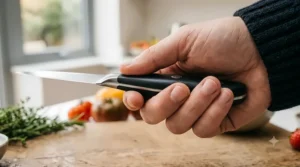
A surprising number of people own a paring knife but use it predominantly on a chopping board, which rather defeats the purpose. The paring knife is fundamentally an in-hand tool — the whole point is that you hold the food in one hand and guide the knife with the other, off the board, in the air. Once you switch to this technique, prep speed increases noticeably, and the knife actually becomes easier to control, not harder.
Peeling: Hold the produce in your non-dominant hand, thumb pointing upward. Guide the blade downward along the contour of the vegetable or fruit, rotating the produce into the blade rather than chasing it. For round produce like potatoes or apples, this means less waste and far more consistent peeling than a standard vegetable peeler achieves on awkward curves.
Segmenting citrus: Score around the equator of an orange or lemon first, then use the tip to lift each segment free of the membrane. This works elegantly with any reasonably sharp paring knife — the Global GS-38’s particularly acute edge makes this task feel almost effortless.
Maintenance tips for British kitchens: The damp British climate doesn’t affect stainless steel knives directly, but wooden knife blocks can harbour moisture and mould in humid kitchens. Consider a magnetic knife strip (wall-mounted) as a cleaner alternative for storage — it also keeps the edges away from other utensils that might nick the blade. Always hand-wash paring knives and dry them immediately; even stainless steel can develop surface discolouration if left wet in a sink for extended periods. For sharpening, a pull-through sharpener works well for the Victorinox, MasterClass, and budget options. The Global GS-38 specifically needs a ceramic or Japanese whetstone — standard V-slot sharpeners can damage its harder steel edge.
Which Paring Knife is Right for You? A Buyer’s Decision Framework
The right knife depends less on brand prestige and more on how you actually cook. Here’s a practical framework:
If you cook every day and tackle a wide range of produce — from root vegetables to delicate herbs to occasional fruit work — invest in the Victorinox Swiss Classic or the Wüsthof Classic. The Victorinox wins on price-to-performance; the Wüsthof wins on longevity and edge retention for those who really value a premium tool.
If you’re drawn to Japanese cooking techniques or precision vegetable prep — thin cucumber ribbons, precise brunoise, paper-thin radish slices — the Global GS-38 is the natural choice. Its harder, more acutely ground steel rewards careful technique and appropriate maintenance.
If you live in a family household with children or mixed cooking abilities, the Viners Assure’s rounded tip offers a genuinely useful safety margin without compromising general usability. Paired with the Zyliss Peeling Knife for serious root veg work, you’d have a capable, sensible duo for under £30.
If you’re equipping a first flat, student kitchen, or a spare room for guests, the Chef Aid or MasterClass Edgekeeper are solid, no-fuss choices. The Edgekeeper’s self-sharpening sheath adds practical value that makes it the stronger of the two for anyone who won’t remember to sharpen their knives regularly (which, realistically, is most of us).
Budget conscious but serious about cooking? The Victorinox Swiss Classic remains the answer. Under £15 for a Swiss-made knife that professional chefs genuinely use — it’s one of those cases where the “budget” recommendation is also, quietly, the correct one.
How to Choose a Paring Knife in the UK: 6 Key Criteria
1. Blade Length
Most paring knives fall between 6cm and 10cm. For general purpose use, 8–9cm hits the sweet spot: short enough for control, long enough for scoring and segmenting. Anything shorter than 7cm becomes a specialist peeling knife (like the Zyliss); anything longer starts to feel like a utility knife.
2. Blade Steel: Stamped vs Forged
Forged knives (Wüsthof, Global) are cut from a single piece of steel and ground to shape. Stamped knives (Victorinox, Chef Aid, MasterClass) are punched from sheet steel. Forged blades are generally heavier and hold an edge longer; stamped blades are lighter and easier to sharpen. Neither is objectively superior — it depends on how you cook and how you maintain your knives.
3. Handle Comfort
Spend a few seconds imagining peeling an entire bag of King Edward potatoes. If the handle makes you wince at the thought, it’s the wrong knife. Look for handles with a gentle taper, no sharp edges, and a material that stays secure when wet. Polymer handles (Victorinox) and stainless steel (Global) both work well with damp hands; some wooden handles (Chef Aid) can become slightly slippery.
4. Weight and Balance
A paring knife should feel comfortable extended in your hand, not front- or back-heavy. The Global GS-38 achieves balance through a hollow handle filled with sand — clever engineering that produces a well-weighted, manoeuvrable knife despite being all-steel. The Wüsthof’s full tang and bolster distribute weight toward the handle, giving a more grounded feel.
5. Maintenance Requirements
Be honest with yourself about how often you’ll sharpen your knives. If the answer is “not very,” prioritise ease of sharpening (Victorinox, MasterClass) over maximum initial sharpness (Global). A dull knife is more dangerous than a sharp one, and a self-sharpening sheath like the MasterClass Edgekeeper is a genuinely pragmatic solution.
6. UK Availability and Amazon Delivery
All seven knives in this guide are confirmed available on Amazon.co.uk. Prime members benefit from next-day delivery; standard orders over £25 qualify for free delivery. Given that most of these knives fall under £15 individually, you may want to add a compatible honing rod or sharpening stone to reach the free delivery threshold.
Common Mistakes When Buying a Paring Knife
Buying on brand prestige alone. A well-known knife brand doesn’t automatically mean the right knife for your cooking style. The Victorinox outperforms many knives that cost three or four times as much, and the Global GS-38 — excellent though it is — represents poor value if you’ll never take the time to sharpen it correctly.
Ignoring maintenance requirements. This particularly affects buyers attracted to Japanese-style knives. The Global GS-38 and similar hard-steel knives require Japanese-specific sharpening tools — a fact that’s rarely prominent on Amazon listings. If you’re buying a hard-steel knife without a compatible whetstone, you’re setting yourself up for a gradual decline in performance with no easy remedy.
Assuming all paring knives are interchangeable. They’re not. A 6cm peeling knife and a 9cm straight-edged paring knife serve meaningfully different purposes. If you do a lot of root vegetable peeling, the Zyliss curved blade will save you time and waste. If you primarily score, segment, and trim, a standard straight edge works better.
Putting knives in the dishwasher. This is a particularly common British household error. The high heat and aggressive detergents in dishwasher cycles dull edges rapidly and can warp handles over time — especially wooden ones. It’s a two-minute hand-wash job. Do it properly. Your knife will thank you.
Buying US-format products without checking UK compatibility. This is less of a concern with knives than with electrical items, but worth bearing in mind: some imported knife sets on Amazon.co.uk arrive with documentation, warranties, and customer service pathways pointed at non-UK markets. All seven knives in this guide are sold with UK-based fulfilment and standard UK consumer rights protection.
Paring Knife vs Other Small Kitchen Knives: What’s the Difference?
The terminology around small kitchen knives can be genuinely confusing, so it’s worth clarifying the distinctions:
Paring knife vs utility knife: A utility knife (typically 12–15cm) bridges the gap between paring and chef’s knife. It’s better for slicing tasks but less manoeuvrable for in-hand work. Think of the paring knife as precision, the utility knife as versatility.
Paring knife vs peeling knife: A peeling knife (like the Zyliss in this guide) typically has a shorter, curved blade specifically designed for following the contours of round produce. Peeling knives are more specialist; paring knives are more versatile.
Paring knife vs boning knife: Completely different tools. A boning knife has a long, narrow, flexible blade for separating meat from bone — it may look similar at a glance but is designed for entirely different work.
For most British home kitchens, the hierarchy of necessity runs: chef’s knife → paring knife → bread knife. According to culinary experts at BBC Good Food, these three knives cover the overwhelming majority of everyday kitchen tasks without duplication or waste. A dedicated peeling knife (like the Zyliss) is a genuinely worthwhile addition if you find yourself peeling large quantities of root vegetables regularly — but it sits alongside a paring knife, not in place of one.
The Craft Guild of Chefs, the UK’s leading chefs’ association, similarly notes that knife selection in professional kitchens is built around function-specific choices rather than volume — a principle that applies equally well in domestic settings.
What to Expect: Real-World Performance in British Kitchens
What the spec sheets don’t tell you is how a knife actually feels on a wet Tuesday evening when you’re peeling three parsnips, trimming the stems off sprouts, and trying to segment a grapefruit for a salad — all while your pasta is threatening to boil over.
In that context — which is, let’s be honest, the actual context — the Victorinox Swiss Classic performs with quiet competence that makes it genuinely hard to fault. Its lightness reduces fatigue; its grip stays secure despite damp hands; its edge, maintained with even occasional attention, handles everything from soft tomatoes to dense raw beetroot without drama.
The Wüsthof Classic elevates that experience noticeably — there’s a solidity and precision to a well-maintained forged knife that stamped steel simply doesn’t replicate — but the practical gap between them in daily use is smaller than the price gap might suggest. The Global GS-38 offers a different kind of experience altogether: lighter, sharper straight off the whetstone, with a more acute edge that excels at fine work but requires more mindful use on hard produce.
For the budget options — Chef Aid, Viners, MasterClass — expect adequate, unpretentious performance. They won’t transform your cooking, but they won’t frustrate you either, which is really all you’re asking at this price point. The MasterClass Edgekeeper is the standout among them for practical everyday use, largely because the self-sharpening sheath means it’s consistently sharper than a comparable budget knife that nobody ever sharpens.
Long-Term Cost & Maintenance in the UK
Over five years, a Victorinox Swiss Classic maintained on a pull-through sharpener (around £10–£20 from Amazon.co.uk) works out to considerably less than replacing a cheap paring knife every year. At under £15 plus a one-time sharpener investment, the five-year cost of ownership is under £35 — excellent value.
The Wüsthof Classic or Global GS-38 in the £40–£50 range represent a higher upfront cost but should last decades with proper care. A compatible whetstone for the Global (budget around £15–£25 for a decent double-sided stone) is a necessary additional purchase; factor that into your overall budget. The BBC Good Food guide to knife maintenance recommends sharpening forged knives with a honing rod before each use and a full sharpening every 2–3 months for regular home cooks — a routine that takes under five minutes once you’re in the habit.
Replacement knife guards or sheaths — useful for safe drawer storage — are available on Amazon.co.uk for under £5 for universal-fit models. If you’re storing knives in a drawer (common in the compact British kitchen), a sheath protects both the blade and your fingers considerably better than leaving the knife loose.
Under the Consumer Rights Act 2015, any knife purchased from an Amazon.co.uk seller that proves faulty or not as described within 30 days can be returned for a full refund; within six months, the retailer must prove the fault wasn’t present at time of sale. It’s worth keeping purchase receipts and order confirmations — straightforward enough when buying through Amazon.
Frequently Asked Questions
❓ What is a paring knife used for in a UK kitchen?
❓ What is the best paring knife under £20 available on Amazon.co.uk?
❓ How do I keep a paring knife sharp in a busy UK household?
❓ Is a paring knife the same as a peeling knife?
❓ Are paring knives dishwasher safe?
Conclusion
The best paring knife isn’t necessarily the most expensive one. It’s the one that fits your cooking style, your kitchen, and your maintenance habits — and that you’ll actually reach for every time the prep board comes out.
For most UK home cooks, the Victorinox Swiss Classic Paring Knife remains the default recommendation: it’s sharp, it’s light, it’s Swiss-made, and it costs less than a decent bottle of wine. If you’re cooking seriously and want a lifetime tool, the Wüsthof Classic or Global GS-38 will genuinely reward the investment. And if you just need something reliable at the most accessible price point possible, the Chef Aid or MasterClass Edgekeeper will serve you perfectly well without any fuss.
What all seven knives share is availability right now on Amazon.co.uk, with Prime delivery for eligible members. Check the current pricing on each — knife prices do move around — and factor in whether you need a compatible sharpener or storage solution as part of your purchase.
✨ Don’t Miss These Exclusive Deals!
🔍 Ready to upgrade your kitchen prep? Click on any highlighted product above to check current pricing and availability on Amazon.co.uk — these carefully selected paring knives will help you find exactly what you need, whatever your budget!
Recommended for You
- Santoku Knife vs Chef Knife: 7 Best UK Picks for 2026
- Best Western Style Santoku Knife UK 2026: 7 Expert Picks
- Best Japanese Santoku Knife UK 2026: 7 Expert Picks Reviewed
Disclaimer: This article contains affiliate links. As an Amazon Associate, I earn from qualifying purchases. If you purchase products through these links, we may earn a small commission at no additional cost to you.
✨ Found this helpful? Share it with your mates! 💬🤗
