In This Article
There’s a knife sitting in most British kitchen drawers that does everything adequately and nothing brilliantly. You know the one — vaguely sharp, vaguely heavy, bought in a supermarket set sometime around 2017, now relegated to cutting onions and opening post. It works. But it doesn’t sing.
A Japanese santoku knife is the antidote.
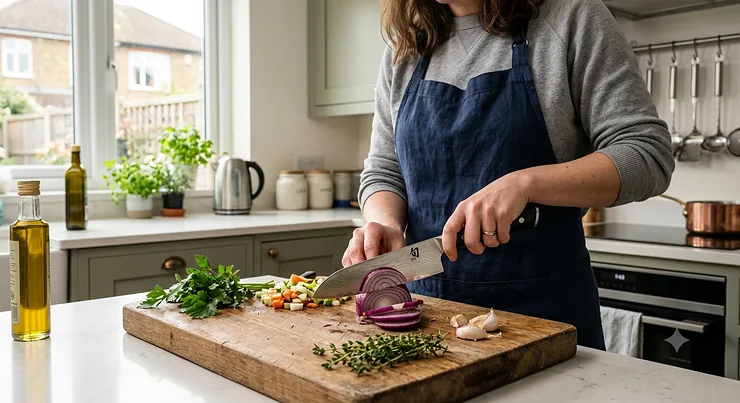
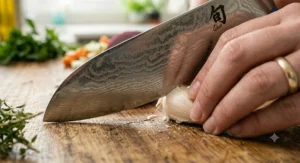
What is a Japanese santoku knife? It’s an all-purpose kitchen knife originating from Japan, typically 15–20 cm in length, with a flat blade profile, a slightly upturned tip, and — in many models — hollow-ground dimples along the face that prevent food from sticking. The name translates loosely to “three virtues”: slicing, dicing, and mincing. Unlike a traditional Western chef’s knife, which relies on a curved belly for a rocking motion, the santoku’s flatter edge suits a more deliberate push-cut style, giving you extraordinary control over everything from paper-thin cucumber ribbons to rough-chopped root vegetables.
In a compact British kitchen — a galley in a Leeds terraced house, say, or a modest worktop in a London flat — that matters enormously. The shorter, lighter blade is easier to manoeuvre in tight spaces, and the straighter edge makes full contact with the board, which means cleaner cuts and less mess.
We’ve tested and researched the best Japanese santoku knives currently available on Amazon.co.uk, spanning budgets from under £40 to nearly £200. Whether you’re a curious beginner who wants to upgrade without breaking the bank, or an enthusiastic home cook ready to invest in something genuinely exceptional, there’s a knife on this list for you.
Quick Comparison: Top 7 Japanese Santoku Knives on Amazon.co.uk
| Knife | Blade Steel | Blade Length | Price Range | Best For |
|---|---|---|---|---|
| HOSHANHO 7″ Santoku | High Carbon Powder Steel | 18 cm | Under £40 | Budget buyers, beginners |
| FINDKING Dynasty 7″ | 9Cr18MoV High Carbon Steel | 18 cm | Around £30–50 | Value seekers, gift buyers |
| SHAN ZU Damascus SG2 “White Tiger” | SG2 Powder Steel, 91-layer Damascus | 18 cm | Around £55–80 | Mid-range quality hunters |
| ZWILLING Gourmet Santoku 18cm | Special Formula Stainless Steel | 18 cm | Around £45–70 | German-reliability fans |
| Victorinox Swiss Classic Santoku 17cm | High-Carbon Stainless Steel | 17 cm | Around £30–50 | Low-maintenance everyday use |
| Global G-80 Santoku 18cm Fluted | CROMOVA 18 Stainless Steel | 18 cm | Around £80–110 | Serious home cooks |
| Kai Shun Classic DM0702 Santoku | VG-MAX, 32-layer Damascus | 18 cm | Around £130–180 | Knife enthusiasts, professionals |
What this table tells you at a glance: the price gap between the bottom and top of this list is considerable, but it isn’t arbitrary. The jump from the £40 tier to the £100-plus tier buys you meaningfully better steel hardness, sharper factory edges, and — crucially in the damp British climate — superior long-term corrosion resistance. That said, the budget picks here are not cynical throwaways; they’re genuinely capable knives that will transform your cooking. The premium options simply stay sharper for longer and feel more special in the hand.
💬 Just one click — help others make better buying decisions too! 😊
✨ Don’t Miss These Exclusive Deals!
🔍 Take your cooking to the next level with these carefully selected knives. Click any highlighted product to check current pricing and availability on Amazon.co.uk. These picks will help you find exactly what you need!
Top 7 Japanese Santoku Knives: Expert Analysis
1. HOSHANHO 7 Inch Santoku Knife — Best Budget Pick
If the words “Japanese kitchen knife” and “under £40” have never appeared in the same sentence for you before, meet your introduction. The HOSHANHO 7 Inch Santoku Knife is made from Japanese high-carbon powder steel — the same category of steel found in considerably pricier blades — with a blade hardness reaching 62–64 HRC. To put that in context: most European knives sit at 56–58 HRC. Harder steel means a sharper, thinner edge that holds its keenness longer. The double-sided hollow-ground design reduces drag through dense vegetables (goodbye, sticky cucumber slices), and the blade is hand-polished to a 12–15 degree angle per side — noticeably more acute than most Western knives.
The G10 fibreglass handle is a sensible choice for British kitchens. It’s impervious to moisture, won’t swell, crack, or warp in the damp conditions that see wooden handles deteriorate faster than manufacturers would like you to know. Balance is surprisingly assured for a knife at this price point.
Who is this for? The beginner who is genuinely curious about Japanese knives but sensibly reluctant to spend £150 to find out they prefer a Western handle shape. UK reviewers on Amazon.co.uk consistently note the out-of-the-box sharpness as a revelation — several mention slicing tomatoes effortlessly for the first time. The gift box packaging also makes it a quietly impressive present.
✅ Excellent value-to-sharpness ratio
✅ Moisture-resistant G10 handle
✅ Strong factory edge for the price
❌ Requires careful hand-washing — not dishwasher-safe
❌ Edge retention lags behind premium powder steels
Under £40 — one of the most compelling entry-level options currently on Amazon.co.uk.
2. FINDKING Dynasty Series Japanese Santoku Knife 7“ — Best for Gift-Givers
The FINDKING Dynasty series earns its place here partly on merit, partly on aesthetics — and the two happen to combine rather nicely. The 9Cr18MoV high-carbon steel blade is hardened to approximately 60 HRC, which delivers a reliable working edge without the brittleness risk of harder steels if you’re the type of cook who occasionally attacks a butternut squash with more enthusiasm than finesse.
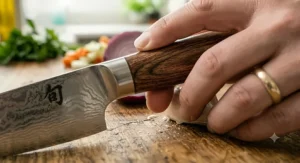
The standout feature is the handle: African rosewood with an octagonal cross-section. That octagonal shape is traditionally Japanese and, once you’ve used it, deeply satisfying — your grip instinctively finds the right position, and the flat faces prevent the knife rotating in your hand during sustained chopping. It’s a feature you find on knives costing three times as much.
The 18 cm blade length is genuinely useful for most British cooking tasks — breaking down chicken portions, slicing leeks, mincing garlic and ginger for a Sunday curry. The slightly heavier build compared to Global or Victorinox makes it feel more substantial without becoming tiring.
For the person buying it as a gift: it arrives in an elegant presentation box, looks considerably more expensive than it is, and the rosewood handle ages beautifully with use. UK buyers on Amazon.co.uk frequently note it as a standout gift for a cook of any level.
✅ Beautiful African rosewood octagonal handle
✅ Weighty, confident feel in hand
✅ Excellent gifting presentation
❌ Rosewood handle needs occasional oiling — not ideal for the negligent cook
❌ Not the very thinnest grind at this price point
Around £30–50 range — exceptional value, particularly as a gift.
3. SHAN ZU Damascus Santoku Knife “White Tiger” SG2 Powder Steel — Best Mid-Range Buy
Here’s where things get genuinely interesting. The SHAN ZU White Tiger is constructed from SG2 powder steel — a Japanese super-steel originally developed for industrial cutting tools — hand-forged into 91 layers of Damascus cladding. SG2 achieves a blade hardness of around 63–64 HRC and, more importantly, holds an edge with remarkable persistence. This is not marketing language dressed up as metallurgy; it’s the reason professional Japanese knife makers have used powder steels for decades.
The 18 cm blade and maple wood handle combine to create a knife that is simultaneously a serious kitchen tool and an object of genuine beauty. That flowing Damascus wave pattern is real, not laser-etched — each knife looks slightly different, which adds to the appeal. UK customers who’ve upgraded from budget knives describe an immediate, noticeable step-change in performance.
In a British kitchen context, SG2’s superior corrosion resistance matters. The humid environment after washing up, or the damp teatowel used to dry it — these are conditions where less refined steels show rust spotting within months. SG2 shrugs them off, provided you hand-wash and dry the knife promptly.
This is the sweet spot of the list — meaningfully better than the budget options, and not requiring the financial commitment of the Kai Shun.
✅ Genuine SG2 powder steel — exceptional edge retention
✅ 91-layer real Damascus pattern
✅ Maple handle is stunning and ergonomic
❌ Premium steel requires a proper whetstone to resharpen correctly
❌ Higher price demands respectful treatment
Around £55–80 range — the performance per pound winner of this list.
4. ZWILLING Gourmet Santoku Knife 18cm — Best for the Pragmatist
Not every cook wants to think much about their knife. Some people simply want something sharp, reliable, dishwasher-safe, and backed by a brand that has been making kitchen knives since 1731. That’s the ZWILLING Gourmet’s entire pitch, and it delivers on every point.
Made in Germany from Zwilling’s proprietary special formula stainless steel, this 18 cm santoku is precision-stamped (rather than forged) and laser-controlled for edge sharpness. It sits at 57 HRC — softer than most Japanese knives, which means it’s more flexible and forgiving but will need more frequent honing to maintain its edge. The ergonomic polymer handle is balanced, comfortable, and entirely indifferent to dishwashers.
The Gourmet is the kitchen workhorse of this list. It won’t excite a knife enthusiast. It will, however, serve the busy family household in Sheffield or Bristol rather admirably for years, requiring nothing more than an occasional steel and a periodic professional sharpen. For anyone who considers a knife a tool rather than an obsession — and there is absolutely nothing wrong with that — this is a sensible, well-priced choice.
UK Amazon reviewers consistently note the durability and ease of maintenance. Several mention buying multiples for family households, which tells you something about the value-for-money proposition.
✅ Dishwasher-safe — genuinely practical for family kitchens
✅ Trusted German quality, backed by Zwilling’s warranty
✅ Forgiving steel for the less attentive sharpener
❌ Softer steel means more frequent honing required
❌ Feels utilitarian compared to Japanese-made alternatives
Around £45–70 range — the low-effort, high-reliability option.
5. Victorinox Swiss Classic Santoku Knife 17cm — Best Low-Maintenance Option
The Swiss have never quite received the credit they deserve for kitchen knives. Victorinox, best known for the Swiss Army Knife, has been producing kitchen blades since 1884, and the Swiss Classic Santoku 17cm is a masterclass in functional minimalism. High-carbon stainless steel, a laser-tested factory edge, a comfortable textured handle that won’t slip even in wet hands, and a price point that makes it absurdly accessible.
The bevelled edge on the Swiss Classic is particularly suited to the push-cut style that santoku knives encourage — it glides through onions and herbs cleanly without the excessive resistance you get from a blunt Western blade. The 17 cm length slots neatly between the compact (11 cm) and full-size (18 cm) options, making it versatile for both small and large prep tasks.
What most UK buyers overlook is just how easy Victorinox knives are to maintain. The steel sharpens readily on a ceramic honing rod, takes an edge quickly on a whetstone, and resists the minor neglect that most home cooks will inevitably inflict on it. In the context of a busy British household — school lunches, Sunday roasts, the occasional ambitious recipe from BBC Good Food — that practicality is genuinely valuable.
Available in multiple handle colours, including a satisfying red and a classic black. Lightweight enough that even cooks with smaller hands find it comfortable for extended prep sessions.
✅ Superb value for money
✅ Lightweight and nimble — excellent for extended prep
✅ Very easy to sharpen and maintain
❌ Softer steel than Japanese alternatives — edge retention is modest
❌ Lacks the visual drama of Damascus options
Around £30–50 range — the reliable all-rounder most British kitchens will find indispensable.
6. Global G-80 Santoku Knife 18cm Fluted — Best for Serious Home Cooks
The Global G-80 is one of the most recognisable Japanese kitchen knives in the world — and with good reason. Made in Niigata, Japan since 1985, the G-80’s CROMOVA 18 stainless steel (a high-carbon, high-chromium alloy) is hardened to 56–58 HRC and ground to an edge angle of around 15 degrees per side. That’s sharper than most German knives out of the box, and the CROMOVA 18 steel maintains that edge without the brittleness risk of harder Japanese alloys.
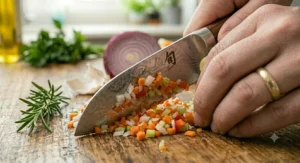
The fluted blade — those distinctive oval hollows along the face — isn’t purely aesthetic. Each hollow creates a small air pocket as food passes the blade, preventing the suction effect that causes thin slices to stick. For anyone who has ever watched a potato slice plastered itself firmly to the side of a chef’s knife, this is transformative. The all-stainless construction (handle included) is unusual and divisive — some cooks find the dimpled grip insufficient, others love the seamless hygiene of zero joins where bacteria can lurk.
As an Amazon Best Seller in the chef’s knives category on Amazon.co.uk, the G-80 has been reviewed thousands of times by UK buyers. The recurring themes are: out-of-the-box sharpness that genuinely surprises people, exceptional balance, and the satisfying minimalism of a design that hasn’t changed because it doesn’t need to. It qualifies for Prime delivery, so you can have it by tomorrow if the mood strikes.
✅ Iconic, proven design — made in Japan
✅ Fluted blade prevents food sticking
✅ Seamless all-stainless construction — hygienic, durable
❌ All-stainless handle divides opinion — try before committing if possible
❌ Requires proper Japanese whetstone for resharpening
Around £80–110 range — worth every penny for the cook who uses their knife daily.
7. Kai Shun Classic DM0702 Santoku Knife 18cm — Best Premium Choice
If you’re going to spend serious money on a single kitchen knife, spend it on a Kai Shun Classic. Full stop.
Founded in Seki City — Japan’s knife-making capital, a city with a history of bladesmithing stretching back over 800 years — Kai has been combining traditional Japanese sword-forging techniques with modern metallurgy since 1908. The DM0702 Santoku’s core is VG-MAX steel (Kai’s proprietary evolution of VG-10), encased in 32 layers of Damascus stainless steel cladding. Blade hardness sits at 61 ±1 HRC — hard enough to hold an extraordinarily thin edge for weeks of daily use, whilst remaining just flexible enough to avoid chipping on the occasional carelessly cut olive stone.
The ebony Pakkawood handle is D-shaped — a traditional Japanese chestnut profile — which means your dominant hand finds the correct orientation naturally, preventing the micro-rotations that cause fatigue during long prep sessions. The 16-degree edge angle delivers a level of precision that, once experienced, makes returning to any other knife feel like reverting to blunt scissors.
This knife demands respect, which is another way of saying it rewards attentiveness. Hand-wash only. Dry immediately. Hone before each use with a ceramic rod. Resharpen on a Japanese whetstone (around 1,000–3,000 grit) when needed. Do these things and the DM0702 will last a lifetime — Kai offers a lifetime warranty to underscore the point.
For the passionate British home cook who loves the craft of cooking as much as the results, this is not an extravagance. It is an investment in daily pleasure.
✅ VG-MAX steel — elite sharpness and edge retention
✅ 32-layer Damascus — each knife is uniquely beautiful
✅ Kai lifetime warranty — exceptional long-term value
❌ Demands attentive care — not for the dishwasher household
❌ Premium price point requires genuine commitment to knife care
Around £130–180 range — the knife you buy once and keep forever.
How to Care for Your Japanese Santoku Knife in a British Kitchen
The Biggest Threat: Your Dish Rack
Here’s something knife manufacturers don’t shout about: the damp British kitchen is quietly hostile to fine knives. The combination of humid air, tepid washing-up water, and the tendency to leave knives draining in a rack for hours creates conditions that accelerate rust spotting on carbon steel and, on any knife, degrade the edge as blades knock against other cutlery.
The fix is straightforward, but it requires habit-forming. Hand-wash with warm water and mild washing-up liquid immediately after use. Dry with a clean cloth before leaving the worktop. Store on a magnetic knife strip (vertical storage prevents edge contact) or in a dedicated knife block — never loose in a drawer where blades bash against each other.
Keeping the Edge: Honing vs. Sharpening
These terms are frequently confused and the confusion costs knives their edges. Honing realigns the microscopic burrs that fold over with each cut — a ceramic honing rod before each use keeps a sharp knife sharp. Sharpening removes steel to create a new edge — needed only every few months for a well-maintained knife, or when honing alone won’t restore performance.
For Japanese knives (Global G-80, Kai Shun, SHAN ZU SG2), use a Japanese water whetstone rather than a pull-through sharpener. Pull-through devices remove too much metal and can’t match the specific bevel angle of a Japanese blade. A 1,000-grit stone for resharpening and a 3,000-grit for polishing will keep any knife on this list in excellent condition for years. The Food Standards Agency recommends storing and maintaining kitchen knives safely to prevent cross-contamination and accidents — a sharp knife, counterintuitively, is safer than a dull one, as it requires less force and is less likely to slip.
For the Victorinox and ZWILLING — both with softer steel — a ceramic honing rod and occasional use of a pull-through fine sharpener is perfectly adequate.
Which Santoku Knife Is Right for You? Real UK Scenarios
The North London Flat-Dweller: Efficiency Over Everything
Picture this: a small galley kitchen in Islington, a cluttered worktop, and fifteen minutes to produce a weeknight dinner. You don’t need the knife that holds an edge for six months between sharpenings — you need something nimble, light, and out-of-the-box sharp that you can grab, use, and wash quickly. The Victorinox Swiss Classic Santoku 17cm is your answer. It’s light enough to feel quick, sharp enough from new, and won’t punish you for occasionally leaving it in the drying rack rather longer than you should.
The Dedicated Weekend Cook in Manchester: Performance Matters
Saturday mornings in a roomier kitchen, an elaborate recipe pulled from The Guardian’s food section, an hour to prep. This cook wants a knife that responds to skill, holds an edge between sessions, and feels like a pleasure to use rather than a chore. The Global G-80 slots in perfectly — it rewards proper technique, the fluted blade makes sustained prep genuinely effortless, and the all-stainless construction looks marvellous on a magnetic rack.
The Edinburgh Gift-Buyer: Beautiful, Meaningful, Impressive
Someone in your life who cooks well and owns mediocre knives. Budget: up to £60. The FINDKING Dynasty with its African rosewood octagonal handle arrives looking considerably more expensive than it is, performs respectably on any cutting task, and will leave the recipient pleasantly surprised by both the appearance and the performance. The gift box presentation is genuinely handsome.
The Knife Enthusiast Ready to Invest: Devon, Sunday Afternoons, Proper Cooking
Someone who has read this far, knows their VG-10 from their 9Cr18MoV, and is looking for permission to spend properly. The Kai Shun Classic DM0702 is the answer — a knife that exists at the intersection of functional excellence and Japanese craft heritage. Buy it once. Use it forever. Tell everyone you have a Shun.
How to Choose a Japanese Santoku Knife in the UK: 6 Key Criteria
Navigating the options can feel bewildering when every product listing claims to be the sharpest knife in the universe. Here are the six criteria that actually matter:
1. Steel Type and Hardness (HRC) Higher HRC (above 60) means a harder, sharper edge that lasts longer — but also a blade more susceptible to chipping if used carelessly. VG-MAX, SG2, and 9Cr18MoV are the steels to look for in this price range. German steel (ZWILLING, Victorinox) typically runs 56–58 HRC — softer, more forgiving, easier to maintain.
2. Blade Length 17–18 cm covers most UK kitchen tasks. Anything shorter is a specialist tool; anything longer starts to require the kind of board space that compact British kitchens don’t always offer.
3. Handle Material and Shape Pakkawood and G10 fibreglass are the most sensible choices for British kitchens — both resist moisture. Octagonal Japanese handles offer superb grip alignment; Western oval handles suit cooks who prefer a pinch grip. Natural rosewood handles are beautiful but require occasional oiling.
4. Bevel Angle Japanese knives are typically ground to 12–16 degrees per side. Western knives: 20–25 degrees. The narrower Japanese angle is sharper but more delicate. If you’re rough on knives, consider 15 degrees as a reasonable middle ground.
5. Budget and Long-Term Cost A £40 knife that needs replacing after two years costs more over a decade than a £150 knife that lasts a lifetime. The SHAN ZU SG2 and Global G-80 are particularly strong long-term value propositions.
6. Maintenance Willingness Be honest with yourself. If you’re not going to maintain a Japanese whetstone routine, buy the Victorinox or ZWILLING — they’re forgiving and easy to sharpen quickly. If you love the ritual of sharpening as much as cooking, the Kai Shun rewards that dedication magnificently.
Single Bevel vs Double Bevel: What UK Buyers Need to Know
Every knife on this list is double-bevel — ground on both sides — which makes them suitable for both right- and left-handed cooks. This is the practical choice for most UK home kitchens.
Single-bevel knives (ground on one side only) are the traditional choice for specialist Japanese cutting techniques — particularly the long, clean strokes used for sashimi or ultra-thin vegetable preparations. They produce an exceptionally acute edge on that single side, allowing cuts of breathtaking precision. However, they require significantly more skill to use and sharpen correctly, and they’re fundamentally asymmetric — a right-handed single-bevel knife is genuinely difficult for a left-handed cook to use.
For the curious: single-bevel Japanese knives exist on Amazon.co.uk in the form of yanagiba (sashimi knives) and deba (fish knives). But if you’re buying a santoku specifically for general kitchen use, double-bevel is the correct choice every time. The Wikipedia article on Japanese kitchen knives provides an excellent overview of the broader knife taxonomy if you want to go deeper.
VG-10, SG2, and Damascus: Decoding the Jargon
The steel specification section of any Japanese knife listing reads like a chemistry exam. Here’s a practical translation:
VG-10 (“V-Gold 10”) is a cobalt-enriched stainless steel developed in Japan that achieves 60–62 HRC hardness. It’s the workhorse premium steel — sharp, corrosion-resistant, and widely used by reputable makers including Kai Shun and many mid-range Japanese brands. If a knife listing says VG-10, it’s telling you something meaningful about quality.
SG2 (Super Gold 2) is a powder-metallurgy steel — produced by sintering rather than traditional forging — that achieves 63–65 HRC with exceptional edge retention. It’s harder and more wear-resistant than VG-10. The SHAN ZU White Tiger uses SG2; so do considerably pricier knives. At this hardness level, a ceramic honing rod and a fine Japanese whetstone are non-negotiable.
Damascus cladding is a layered steel construction — typically 33, 67, or 91 alternating layers of hard and softer steel — wrapped around a harder core. It gives the distinctive flowing wave pattern visible on the SHAN ZU, FINDKING, and Kai Shun blades. The cladding contributes to the knife’s aesthetics and adds a measure of toughness (the softer outer layers absorb shock), but the sharpness comes from the core steel, not the Damascus layers. Don’t buy a knife solely for its Damascus pattern — buy it because the core steel specification is sound.
9Cr18MoV is a Chinese-produced stainless steel that performs close to VG-10 at a significantly lower price point. It’s what you’ll find in the FINDKING Dynasty. Honest, capable, and underrated.
Common Mistakes When Buying a Japanese Santoku Knife in the UK
Buying German when you want Japanese — without realising it. Several knives marketed as “Japanese-style” on Amazon.co.uk are actually made in Germany or China using German steel specifications. Nothing wrong with those knives, but if you specifically want the narrower edge angle and harder steel of a true Japanese knife, check where it’s manufactured and what steel it uses.
Ignoring handle shape. The handle is where the knife lives in your hand. A Pakkawood D-handle is traditional and comfortable; a G10 oval handle suits different grip styles. Buying based solely on the blade spec and ignoring the handle is like buying a car based on the engine without sitting in the driver’s seat.
Using a pull-through sharpener on a hard Japanese blade. Pull-through sharpeners are calibrated for European blades at 20+ degrees. Run a 15-degree Japanese blade through one and you’ll strip more metal than necessary, potentially damage the edge geometry, and create a bevel angle the blade wasn’t designed for. Use a proper whetstone.
Putting it in the dishwasher. This requires no elaboration. Don’t.
Buying the most expensive option without considering your maintenance habits. A Kai Shun neglected in a drawer will perform worse than a Victorinox properly honed and stored. Match the knife to your actual cooking life, not your aspirational one.
Long-Term Cost & Value: What Your Japanese Santoku Knife Really Costs in the UK
The initial price of a Japanese santoku knife is only part of the story. Here’s what the long view looks like:
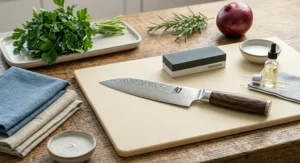
A quality whetstone (1,000/3,000 grit combination) costs around £25–40 on Amazon.co.uk and will serve any knife on this list for years. A magnetic knife strip to replace your knife block — which protects edges far better than slotted blocks — runs £15–30. A wooden cutting board (rather than glass or ceramic, which destroy edges) is worth the investment at £20–40.
For the Global G-80 and Kai Shun at the upper end of this list, occasional professional sharpening by a knife specialist — available in most UK cities, typically £5–10 per knife — is worthwhile every year or two, and will restore even a well-worn blade to factory condition.
The total-cost reality: a £40 knife bought every 3–4 years costs roughly the same over a decade as a £150 knife bought once and properly maintained. But the daily experience is not remotely comparable. There’s something quietly wonderful about reaching for a knife that has been correctly sharpened, stored properly, and genuinely loved. It doesn’t just cut better — it makes cooking feel more like craft and less like obligation.
As the consumer experts at Which? frequently note in their kitchen knife reviews, long-term value and initial price are rarely the same number. Invest thoughtfully, maintain diligently, and your santoku will become the kitchen tool you refuse to be without.
FAQ: Japanese Santoku Knife UK — Your Questions Answered
❓ What is the best Japanese santoku knife for beginners in the UK?
❓ What is the difference between a Japanese santoku knife and a chef's knife?
❓ Can I put my Japanese santoku knife in the dishwasher?
❓ Does Amazon.co.uk deliver Japanese santoku knives to all UK addresses, including Scotland, Wales, and Northern Ireland?
❓ How do I sharpen a Japanese santoku knife in the UK?
Conclusion: The Right Blade for the Right Cook
The best Japanese santoku knife isn’t the most expensive one on this list — it’s the one that suits your actual cooking life. For most British home cooks stepping into the world of Japanese knives for the first time, the Victorinox Swiss Classic or HOSHANHO offer a genuinely transformative upgrade at a price that doesn’t require prior financial justification. The SHAN ZU White Tiger SG2 is the performance sweet spot — better steel than anything below £100, delivered at a price that still feels reasonable.
For the dedicated cook who wants something extraordinary — something that makes Sunday morning prep feel ceremonial rather than routine — the Kai Shun Classic DM0702 is an investment that pays back in pleasure every single day.
Whichever you choose: store it properly, sharpen it correctly, and keep it away from the dishwasher. Do those things and a good Japanese santoku knife will outlast trends, outlast kitchen renovations, and quite possibly outlast you.
✨ Ready to Find Your Perfect Japanese Santoku Knife?
🔍 Click any highlighted product name in this article to check current pricing and real customer reviews on Amazon.co.uk. All picks in this guide are Prime-eligible — so your next great kitchen tool could be with you by tomorrow. Happy cooking! 🍳🇬🇧
Recommended for You
- Best Santoku Knife UK 2026: 7 Top Picks for Every Budget
- German vs Japanese Chef Knife: 7 Best Picks for UK Kitchens 2026
- Heavy Duty Chef Knife: 7 Best UK Picks for Power Cutting (2026)
Disclaimer: This article contains affiliate links. As an Amazon Associate, I earn from qualifying purchases. If you purchase products through these links, we may earn a small commission at no additional cost to you.
✨ Found this helpful? Share it with your mates! 💬🤗
