In This Article
You’ve stood in your kitchen — or scrolled through Amazon.co.uk at half past eleven — and thought: do I actually need a better knife? The answer, almost certainly, is yes. But the real question is which kind. The German vs Japanese chef knife debate is one of the most enduring in the culinary world, and for good reason: these two traditions represent genuinely different philosophies about what a kitchen knife is for.
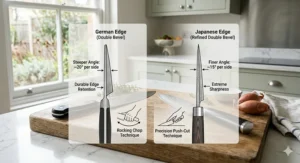
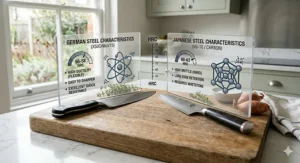
In plain terms: a German vs Japanese chef knife comes down to this. German knives are heavier, tougher, and sharpened to an angle of around 15–20° per side — built for rocking motions, workhorse tasks, and the sort of casual abuse that home cooking inevitably involves. Japanese knives are thinner, harder (typically 60–66 HRC versus the German 56–58 HRC), and sharpened to a finer 10–15° edge. They slice with extraordinary precision but require more considered handling and sharpening.
For British home cooks, the choice matters more than you might expect. Our kitchens tend to be compact, our chopping boards get cluttered, and our cooking style is eclectic — one night you’re breaking down a whole chicken, the next you’re paper-thin slicing courgettes for a Vietnamese salad. Neither tradition is universally superior. What’s actually superior is choosing the right one for you. This guide walks you through exactly that: seven real products currently available on Amazon.co.uk, honest analysis of what each one offers, and a clear framework for making the decision without regret.
Quick Comparison: German vs Japanese Chef Knife at a Glance
| Feature | German Chef Knife | Japanese Chef Knife |
|---|---|---|
| Blade hardness (HRC) | 56–58 | 60–66 |
| Edge angle (per side) | 15–20° | 10–15° |
| Blade thickness | Thicker, robust | Thinner, refined |
| Weight | Heavier (220–280g typical) | Lighter (150–200g typical) |
| Best cutting motion | Rock chopping | Push/pull slicing |
| Sharpening ease | Easier (softer steel) | Requires more skill/care |
| Chip resistance | Higher | Lower |
| Typical price range | £40–£200+ | £50–£250+ |
| Best for | All-round durability | Precision cutting |
The table above captures the mechanics, but mechanics alone don’t tell the full story. A harder Japanese blade holds its edge longer — sometimes significantly longer — but when it does chip (and on hard foods it can), repairing it demands a whetstone and patience. German steel, being softer, dulls more steadily but is simple to bring back with a few strokes on a honing rod. For a busy British household where the knife goes from onions to butternut squash to chicken thighs without ceremony, that practical resilience matters enormously.
✨ Don’t Miss These Exclusive Deals!
🔍 Take your knife game to the next level with these carefully selected products. Click on any highlighted item to check current pricing and availability on Amazon.co.uk. These picks will help you find exactly what you need!
💬 Just one click — help others make better buying decisions too! 😊
Top 7 German vs Japanese Chef Knives: Expert Analysis
1. Wüsthof Classic Cook’s Knife 20cm
The benchmark. If you asked a German chef what knife they reached for every single day, there’s an excellent chance the answer would be this one. The Wüsthof Classic has been forged in Solingen — Germany’s so-called “City of Blades” — since 1814, and the 20cm cook’s knife is the quintessential expression of that heritage. Made from X50CrMoV15 high-carbon stainless steel with a Rockwell hardness of 58 HRC and sharpened to 14° per side using Wüsthof’s own PrecisionEdge Technology (PEtec), it arrives razor-sharp from the box. The full bolster, triple-riveted POM handle, and full tang give it a satisfying heft — around 225g — that many cooks find reassuring rather than tiring.
What this means in practice for a UK kitchen: the belly of the blade is perfectly shaped for the rock-chopping technique that most British home cooks use by default, and the weight does some of the work for you when you’re breaking down a Sunday roast. The full bolster protects your fingers; the downside is that sharpening the final centimetre near the bolster is slightly fiddly, though a decent honing rod used regularly means you won’t need full sharpening often.
UK reviewers consistently praise its longevity. One Amazon.co.uk customer noted they’d been using theirs for decades with no deterioration. Professional chefs tend to describe it as “the standard” by which they measure other western knives. That’s earned, not marketing.
✅ Exceptional out-of-box sharpness via PEtec
✅ Lifetime durability if properly maintained
✅ Superb balance for rocking/chopping technique
❌ Full bolster limits heel-to-tip sharpening access
❌ On the pricier end of the German mid-range
Available on Amazon.co.uk in the £100–£160 range (Prime-eligible; next-day delivery available). A genuine lifetime investment — the kind of knife you pass on.
2. ZWILLING Pro Chef’s Knife 20cm
ZWILLING J.A. Henckels has been Wüsthof’s great rival out of Solingen for nearly 300 years. The Pro 20cm is their flagship, and it distinguishes itself from the Classic in one clever engineering detail: a half-bolster (demi-bolster) rather than a full one. The result is a knife that offers the satisfying weight and robustness of a German blade — FRIODUR® ice-hardened steel at 57 HRC, a blade angle of 15° — while giving you full access from heel to tip when sharpening. Practical. Thoughtful. Very German in the best sense.
The blade profile is slightly more curved than Wüsthof’s, with the tip sitting a touch higher toward the spine. Rock choppers who spend serious time mincing garlic and herbs will feel this immediately — the rocking arc is smooth and natural. Push choppers who work flat and precise may find Wüsthof’s flatter profile more intuitive, so this is genuinely a matter of how you cook.
SIGMAFORGE technology — single-piece forging with geometric precision — produces a blade that’s both flexible and resilient. UK buyers in shared houses or families with kids tend to appreciate how forgiving this knife is: drop it on a tile floor and it bounces back where a Japanese blade might chip. It’s dishwasher-safe in theory; in practice, hand wash it and it’ll thank you.
✅ Half-bolster allows full-edge sharpening access
✅ Excellent weight and balance for sustained chopping
✅ FRIODUR hardening increases edge retention vs standard steel
❌ Slightly heavier than some may prefer for longer sessions
❌ The pronounced curve won’t suit push-cut purists
Available on Amazon.co.uk in the £90–£140 range. Prime-eligible. Arguably the most versatile German knife in this list.
3. Victorinox Fibrox Chef’s Knife 25cm
Right. Here’s the one that surprises people. Victorinox is Swiss, not German — but the Fibrox sits firmly in the western/German-style tradition: soft-ish high-carbon stainless steel (around 56 HRC), a ground edge rather than forged, and a utilitarian design that absolutely nobody would call glamorous. And yet — professional kitchens across Britain use these in rotation. Culinary schools issue them to students. Michelin-starred restaurants keep them as backup blades.
Why? Because they’re ruthlessly functional. The Fibrox handle is thermoplastic rubber: ergonomic, non-slip, dishwasher-safe, and utterly impervious to the kind of casual abuse a domestic kitchen inflicts. The blade at 25cm (the larger of the two main sizes available in the UK) is stamped rather than forged, making it lighter and thinner than the Wüsthof or ZWILLING. This actually makes it faster in the hand for rhythmic prep work — slicing through a pile of leeks, for instance, is almost meditative.
The edge angle is around 15° and resharpens easily. It won’t hold an edge quite as long as a forged German knife, but when it dulls, three passes on a ceramic rod and you’re back. For families on a budget, students in a flat share, or anyone who wants a no-fuss workhorse rather than an heirloom, this is the sensible choice. It lacks prestige. It more than compensates in practicality.
✅ Outstanding value for a professional-quality blade
✅ Non-slip Fibrox handle — crucial in wet British kitchens
✅ Dishwasher-safe (though hand wash is still recommended)
❌ Stamped rather than forged — less prestige and slightly less balance
❌ 25cm may feel long and unwieldy for smaller UK kitchen worktops
Available on Amazon.co.uk in the £35–£55 range. Prime-eligible. The intelligent budget pick.
4. Global G-2 Cook’s Knife 20cm
Now we cross into Japanese territory, and the Global G-2 is the gateway drug for many British cooks. Made in Yoshioda, Japan, from Cromova 18 stainless steel (around 56–58 HRC — softer than most Japanese knives but harder than typical German steel), with an ice-tempered edge sharpened to 15° each side, it bridges the two worlds rather gracefully. It’s lighter than any German blade here — around 160g — and the hollow handle, filled with sand for balance, gives it a unique feel: nimble but not toy-like.
The all-steel construction is polarising. Some people love it — seamless, hygienic, modern, striking on a magnetic strip. Others find the handle too cold and slippery, particularly with wet or oily hands. British reviewers on Amazon.co.uk frequently note this; a grip cloth or the occasional pat dry solves it, but it’s worth knowing.
In the kitchen, the G-2 shines at slicing. Its fine edge and thin blade glide through soft vegetables, fresh fish, and herbs with genuinely satisfying ease. What it’s less suited to is the occasional bone-near-boning or hard squash attack — at that point, the inherent brittleness of a thin blade and the hollowness of the handle make you want to reach for a German alternative. Think of it as a specialist’s everyday knife rather than a true all-rounder.
Which? magazine has historically given Global knives strong marks for edge retention. Amazon.co.uk UK reviewers consistently rate the G-2 among the best Japanese knives under £100 available in Britain.
✅ Distinctive all-steel design — hygienic and elegant
✅ Excellent edge retention for daily prep
✅ Bridge between German toughness and Japanese precision
❌ All-steel handle can be slippery — particularly in damp UK conditions
❌ Not ideal for hard, dense ingredients (butternut squash, hard cheese)
Available on Amazon.co.uk in the £80–£110 range. Prime-eligible. A genuinely loveable middle ground.
5. KAI Shun Classic Chef’s Knife 20cm (DM-0706)
This is where Japanese knife-making stops being practical and starts being art. The KAI Shun Classic Chef’s Knife — specifically the 20cm model — features a VG-MAX core steel enveloped in 32 layers of Damascus steel. VG-MAX is Shun’s proprietary formula: extra tungsten, cobalt, and vanadium compared to the industry-standard VG-10. The result is a blade hardened to 61 (±1) HRC, sharpened to an astonishing 16° combined (8° per side), with a pakkawood handle that feels like holding a well-made musical instrument. Genuinely.
At this hardness, the Shun Classic holds its edge for a remarkably long time under normal home use. You’ll sharpen a German knife several times before this one needs attention. The Damascus layering isn’t merely decorative — it provides micro-serrations at a microscopic level that aid slicing — though the wave pattern is admittedly beautiful and will raise eyebrows at any dinner party.
The critical context for UK buyers: this knife requires care. It must not go in the dishwasher. It should not be used on frozen food or bones. It should be sharpened on a whetstone (not a steel honing rod, which can damage the hard edge) at its specific 8°-per-side angle. A ceramic honing rod is acceptable for maintenance. If that sounds like commitment — it is. But for the cook who’s ready to reciprocate, the experience of using a blade this sharp is genuinely transformative.
UK Amazon customers who’ve made the jump frequently describe it as their single best kitchen purchase. One reviewer said it cuts through tomatoes “like they’re made of air.” That’s not far off.
✅ 61 HRC VG-MAX steel — exceptional edge retention
✅ Damascus layering for both beauty and micro-slicing performance
✅ Pakkawood handle: ergonomic, water-resistant, elegant
❌ Requires whetstone sharpening at a precise angle — not for beginners
❌ Vulnerable to chipping on hard bones or frozen food
Available on Amazon.co.uk in the £160–£220 range. For the committed home cook ready to invest. Prime-eligible.
6. MITSUMOTO SAKARI 8-Inch Gyuto Chef’s Knife
Not all exceptional Japanese knives cost a fortune. The MITSUMOTO SAKARI Gyuto is a hand-forged 3-layer high-carbon knife (9CR18MOV steel core, around 58–60 HRC) that arrives in a beautifully finished sandalwood gift box — making it the finest-looking present-per-pound on this list by some margin. The rosewood wa-handle is ergonomic and warm in the hand, and the blade geometry is pure Japanese gyuto: thin, slightly tapered, with a profile designed for both the push-cut and the gliding pull-cut that Japanese cuisine demands.
The 8-inch (approximately 20cm) blade hits a sweet spot for UK kitchens. Long enough to handle a whole salmon fillet or a large chicken breast in one stroke; compact enough not to feel like a machete on a standard worktop. The hand-forged quality shows: there’s a consistency to the grind that factory stamped blades simply can’t match at this price.
What most UK buyers overlook about this model is how well it handles the full domestic cooking range. It’s not precious in the way some Japanese knives are. The 9CR18MOV steel is harder than German X50CrMoV15 but softer than VG-10, giving it a nice middle position: sharper out of the box than most German knives, but not so brittle that the odd encounter with a tough parsnip becomes a catastrophe. The sandalwood box also suggests it’s been thought about as a gift, which makes it an obvious choice for a birthday or Christmas present for a cook who has everything except a good knife.
✅ Hand-forged quality at an accessible mid-range price
✅ Stunning rosewood handle and sandalwood presentation box
✅ Versatile gyuto profile suits wide range of cooking styles
❌ 9CR18MOV is good but not at the level of VG-10/VG-MAX
❌ Rosewood handle requires occasional oiling — not entirely maintenance-free
Available on Amazon.co.uk in the £45–£75 range. Prime-eligible. The best-value Japanese-style knife on this list.
7. Wüsthof Classic Ikon Cook’s Knife 20cm
If the Classic is Wüsthof’s dependable workhorse, the Classic Ikon is its more sophisticated sibling. The blade is essentially identical — X50CrMoV15, 58 HRC, PEtec sharpening — but the handle is where everything changes. The Ikon’s double-bolster, contoured polymer handle curves inward in a way that cradles the pinch grip naturally. The weight shifts rearward slightly, making the blade feel almost lighter than it is — nimble but still substantial.
The practical implication: if you’ve ever finished a long prep session with an aching hand or a cramped thumb, the Ikon’s ergonomics are likely to solve that. The absence of a full front bolster also means sharpening access runs the full length of the blade, correcting the one ergonomic frustration of the original Classic.
For UK buyers debating between the two Wüsthof entries on this list, the choice is simple: if you cook in a professional or semi-professional capacity — or if you spend 30+ minutes at a time doing prep — the Ikon’s ergonomics justify the modest premium. If you cook three or four times a week for a family and want a reliable tool without overthinking it, the Classic does everything you need and costs a little less.
✅ Superior ergonomics — ideal for extended prep work
✅ Half-bolster allows full blade sharpening
✅ Same exceptional PEtec blade as the Classic series
❌ Premium price for what is essentially a handle upgrade
❌ Handle-heavy balance may not suit all cutting techniques
Available on Amazon.co.uk in the £130–£190 range. Prime-eligible. The refined choice for the serious home cook.
How to Choose: German vs Japanese Chef Knife for Your Kitchen
This is the section most buying guides skip. They list the products, let you squint at a table, and leave you to it. Let’s do better.
Step 1: Assess Your Cooking Frequency and Style
If you cook daily, the knife is a tool that earns its cost through use. If you cook twice a week, you don’t need to spend £200 to eat well. More importantly: think about how you cut. Do you rock the blade back and forth in a rhythmic chopping motion? That’s the technique German knives are built for, and the curved belly of a Wüsthof or ZWILLING facilitates exactly this. Do you slice forward and pull back, working from the tip? That’s push-cutting, and a Japanese blade’s flatter profile and thinner edge rewards it.
Step 2: Be Honest About Maintenance Commitment
Japanese knives demand a whetstone and patience. If the idea of spending twenty minutes on a Sunday morning sharpening your knife sounds meditative and satisfying, brilliant — go Japanese. If it sounds like a chore you’ll never actually do, the result is a hard, dulled blade that’s genuinely dangerous to use because it requires excessive force. German knives hone easily with a few strokes on a steel rod before each session; this two-minute habit keeps them performing well for months.
Step 3: Consider Your Kitchen and Budget
British kitchens — particularly in flats, terraced houses, and the sort of compact Victorian layouts that make up half of our housing stock — often have limited worktop space. A 20cm knife is the sweet spot for most; go longer than 25cm and you’ll be battling the splashback. Budget-wise, think in tiers: under £60 (Victorinox Fibrox, MITSUMOTO SAKARI), £80–£150 (Global G-2, ZWILLING Pro, Wüsthof Classic), and £150+ (Wüsthof Classic Ikon, KAI Shun Classic). None of these is wasteful spending. All of them outlast any £20 supermarket knife by years.
Step 4: Factor in Household Reality
Families with children, housemates, or anyone who might grab the wrong knife from the block should probably lean German. Softer steel is more forgiving of the inevitable dishwasher incident or hard-food encounter. Solo cooks or couples who treat their knives with care can safely explore Japanese options.
Step 5: Start with One
The single biggest mistake British buyers make is buying a knife block set when all they actually need is one excellent chef’s knife. Master one, then expand. A great 20cm chef’s knife handles 80% of everything you’ll do in a domestic kitchen.
What Real-World Performance Actually Looks Like in a British Kitchen
Let me paint three scenarios, because “ideal user” profiles are only useful if they reflect how people actually cook.
The North London professional, cooking in a galley kitchen. Sarah works long hours and cooks four or five times a week, mostly mid-week stir-fries, weekend roasts, and the occasional ambitious dinner party attempt. She values speed and ease of maintenance above all else. The ZWILLING Pro or Wüsthof Classic are her knives: durable, confident-handling, forgiving of a rushed sharpening session. The MITSUMOTO SAKARI gyuto would also serve her well and costs significantly less.
The retired couple in rural Shropshire. David and Margaret cook thoughtfully, enjoy the process, have time for maintenance, and want to feel something when they pick up a knife. They’re the Shun Classic customer. They’ll learn to use a whetstone, enjoy doing so, and the knife will outlive several kitchen renovations.
The student in Manchester. Ben shares a kitchen with four others and owns a magnetic strip on his bedroom wall for his one good knife. He needs something that survives being washed up by flatmates, doesn’t require specialist care, and still cuts properly. Victorinox Fibrox. Full stop. Nothing else at this price competes.
The Hard Steel vs Soft Steel Kitchen Knife Debate: What the HRC Scale Actually Means
The Rockwell hardness scale measures the resistance of steel to indentation — and in knife terms, it’s the single most predictive number for how a blade will perform and need maintaining. Here’s the honest translation for home cooks.
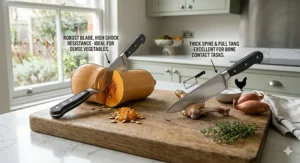
German knives typically land at 56–58 HRC. This means the steel is hard enough to take a good edge but soft enough to flex without cracking and to be honed back to sharpness with a steel rod. It also means edge retention is moderate: expect to hone every few uses and sharpen properly perhaps twice a year under typical domestic use.
Japanese knives typically run 60–66 HRC. The KAI Shun Classic, for instance, sits at 61 HRC. That extra hardness means the edge stays sharper for longer — sometimes dramatically longer — but the steel becomes more brittle. Think of it like this: softer steel is like willow, harder steel like glass. Willow bends; glass cuts better but shatters if you drop it wrong.
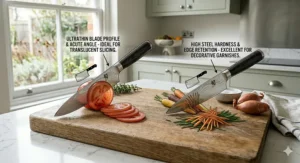
The knife sharpening angle degrees matter just as much as the steel hardness. A German blade sharpened to 15° per side (30° total) holds up to lateral stress. A Japanese blade at 8° per side (16° total) is almost surgical but requires straight, disciplined cutting to protect that fine edge. If you use a Japanese knife to twist, pry, or saw, you’ll regret it. If you use it to slice, glide, and follow the grain of ingredients, it’ll reward you beyond any German alternative.
Common Mistakes When Buying a Chef Knife in the UK
Buying Based on Handle Appearance in Photos
A knife handle looks very different in a photograph than it feels in a hand. If possible, visit a specialist retailer — or at minimum read UK Amazon reviews specifically for comments on grip comfort. UK reviewers tend to be usefully candid about this.
Ignoring Blade Length for Your Kitchen Layout
Most UK kitchens are not large. A 25cm blade can feel unwieldy in a compact galley kitchen where you’re a foot from the wall behind you. The 20cm is the safest universal choice and covers 90% of domestic cutting tasks.
Buying a Japanese Knife Without a Whetstone Budget
A £180 Japanese knife sharpened on a pull-through sharpener is a £180 Japanese knife being quietly destroyed. The investment in a Japanese blade assumes a quality whetstone — budget an additional £30–£60 for a decent double-sided whetstone (1000/6000 grit is the standard starting point). If that feels excessive, a German knife with a honing steel is genuinely the better practical choice.
Assuming Dishwasher-Safe Means It’s a Good Idea
The Victorinox Fibrox is technically dishwasher-safe. The others on this list are not. But even the Fibrox benefits from hand washing — detergent degrades handles over time, and the high heat of a dishwasher can cause micro-warping in thinner blades. Five seconds under the tap after use. That’s all it takes.
Ignoring Post-Brexit Pricing on European Brands
Some European knife brands carry slightly higher UK retail prices than their EU equivalents since Brexit, owing to import adjustments. You benefit from UK consumer protection under the Consumer Rights Act 2015 and hassle-free Amazon.co.uk returns within 14 days under Consumer Contracts Regulations — but it’s worth being aware that identical models may be priced differently across borders.
Wüsthof vs Global Knife: The Detailed Comparison
This is arguably the most practically useful comparison for British buyers, as these two brands represent the clearest possible expression of the German and Japanese traditions at a similar price point.
| Criterion | Wüsthof Classic 20cm | Global G-2 20cm |
|---|---|---|
| Steel | X50CrMoV15 (German) | Cromova 18 (Japanese) |
| Hardness | 58 HRC | 56–58 HRC |
| Edge angle | 14° per side | 15° per side |
| Weight | ~225g | ~160g |
| Handle material | POM polymer | All steel (hollow, sand-filled) |
| Sharpening | Honing rod + whetstone | Whetstone recommended |
| UK price range | £100–£160 | £80–£110 |
| Best for | All-round durability | Precision slicing |
At face value, these knives look close on paper. In the hand, they feel like different countries. The Wüsthof is weighty and authoritative — like a well-engineered tool. The Global is light, precise, and modern — like a sports car compared to a Land Rover. Neither is objectively better.
The key insight that most reviews miss: the Global G-2’s slightly softer Cromova 18 steel means it doesn’t hold a truly fine edge quite as long as you’d expect from a Japanese knife, despite the origin. It’s been engineered to be more approachable and chip-resistant than harder Japanese steels — a sensible compromise for an export knife. If you want pure Japanese hardness and edge retention, the KAI Shun Classic is where that conversation begins.
Knife Maintenance Guide: Keeping Your Investment Sharp in a British Kitchen
Whether you’ve opted for German or Japanese, these habits protect your knife and keep it performing.
Daily honing (German knives): A few strokes on a honing rod before each session realigns the edge without removing steel. This is maintenance, not sharpening. Hold the rod vertical, blade at 15°, and draw downward. Three strokes each side. Thirty seconds total.
Whetstone sharpening (Japanese knives): Soak your 1000-grit stone for ten minutes. Maintain your blade’s specific angle — 8° for Shun, 15° for Global — and work heel-to-tip in smooth, controlled strokes. Finish on the fine side (6000 grit) to polish the edge. Once every three to six months under regular home use. It’s less daunting than it sounds; BBC Good Food’s guide to knife sharpening is a useful starting point.
Storage: A magnetic knife strip or a knife block. Drawer storage dulls edges. The magnetic strip also happens to be the most space-efficient solution for compact UK kitchens.
Cutting surfaces: Wood or plastic boards only. Ceramic, glass, or stone surfaces — including the smooth granite worktops that became fashionable in British kitchens during the 2010s — will destroy any fine edge within weeks. Hard maple is ideal; bamboo, despite its eco-credentials, is actually harder than most wood boards and marginally more damaging to edges over time.
Rust prevention: British humidity is real. Even “stainless” steel develops surface rust if left wet on a worktop. Dry your knife immediately after washing. Carbon steel Japanese knives (not featured here, but worth knowing) require occasional food-safe mineral oil treatment.
Long-Term Cost and Value in the UK
One of the genuinely useful perspectives that never appears on knife product pages: the cost-per-year calculation.
A Victorinox Fibrox at around £40 lasting eight to ten years works out at roughly £4–£5 per year. A Wüsthof Classic at around £130 lasting twenty-five to thirty years (which, with proper care, is entirely realistic — Wüsthof offers a lifetime guarantee) works out at roughly £4–£5 per year. A KAI Shun Classic at around £190 lasting fifteen to twenty years — again, realistic with proper care — is approximately £9–£13 per year.
The arithmetic makes a fairly persuasive case for buying once and buying well. What it can’t account for is the cost of a whetstone, honing steel, or knife block, which add £20–£80 to the total investment depending on what you already own. Factor these in, and the total cost of ownership narrows further between the budget and premium options.
All prices include UK VAT at 20%, which is already reflected in Amazon.co.uk prices — unlike US prices, which typically exclude sales tax.
FAQ: German vs Japanese Chef Knife UK
❓ Is a German or Japanese chef knife better for home cooking in the UK?
❓ What is the difference in knife sharpening angle degrees between German and Japanese knives?
❓ What does HRC hardness mean for a kitchen knife?
❓ Can I buy Wüsthof and KAI Shun knives on Amazon.co.uk with UK delivery?
❓ Do Japanese knives need special sharpeners?
Conclusion
The German vs Japanese chef knife debate doesn’t have a winner. It has different right answers for different kitchens, different cooks, and different habits. German knives — the Wüsthof Classic, ZWILLING Pro, and Victorinox Fibrox — offer durability, ease of maintenance, and the kind of confident all-round performance that British home cooking genuinely benefits from. Japanese knives — the KAI Shun Classic, Global G-2, and MITSUMOTO SAKARI Gyuto — offer a different experience entirely: lighter, finer, sharper, and more rewarding when used with care.
The most sensible path for most UK buyers: start with a mid-range German knife (the ZWILLING Pro or Wüsthof Classic are both worth every penny), master it, develop your sharpening habit, and then — if the knife passion takes hold, as it tends to — add a Japanese blade for precision work. Two exceptional knives cover every task your kitchen will ever present. Everything beyond that is enthusiasm, which is entirely justified.
✨ Don’t Miss These Exclusive Deals!
🔍 Ready to upgrade your kitchen? Click any highlighted product above to check current pricing and availability on Amazon.co.uk. All picks are Prime-eligible, all prices include UK VAT, and all purchases are protected under UK consumer law.
Recommended for You
- Heavy Duty Chef Knife: 7 Best UK Picks for Power Cutting (2026)
- Lightweight Chef Knife UK: 7 Best Picks That Won’t Wreck Your Wrist (2026)
- Best 10 Inch Chef Knife for Large Hands UK 2026 | Top 7 Picks
Disclaimer: This article contains affiliate links. As an Amazon Associate, I earn from qualifying purchases. If you purchase products through these links, we may earn a small commission at no additional cost to you.
✨ Found this helpful? Share it with your mates! 💬🤗
