In This Article
There’s a kitchen truth nobody talks about at dinner parties: most home cooks are quietly suffering with a rubbish knife. Not dramatically rubbish — just a blunt, unbalanced, slightly-too-flimsy thing that makes slicing an onion feel like an arm workout. It sits in the knife block looking the part, then lets you down every single evening. Sound familiar?
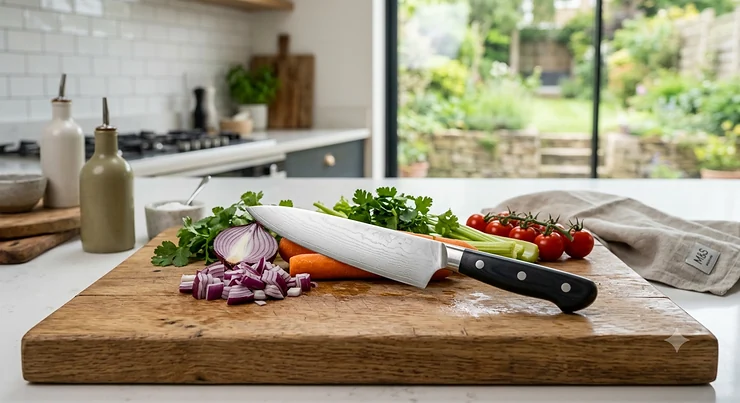
A great best chef’s knife changes all of that. One knife. It’s the single most transformative upgrade you can make to your kitchen — more impactful than that stand mixer you’ve been eyeing, more useful than any gadget filling your drawer. The best chef’s knife for home cook use doesn’t need to cost a fortune, either. What it needs to do is feel right in your hand, hold an edge through six months of British cooking (which, let’s be honest, involves a lot of root vegetables and Sunday roasts), and make you actually enjoy prep work rather than dread it.
In this guide, I’ve researched and reviewed 7 real chef’s knives currently available on Amazon.co.uk — from budget blades that genuinely punch above their price to professional chef knives used in Michelin-starred kitchens. Whether you’re a complete beginner looking for your first proper knife, or an experienced home cook ready to invest in something serious, you’ll find your match here.
What is the best chef’s knife? Put simply, it’s an all-purpose, 18–25cm kitchen knife with a broad, tapering blade designed to handle chopping, slicing, dicing, and mincing. The edge geometry and steel quality determine how sharp it gets and how long it stays that way — and that’s where most cheap knives fall flat within six months.
Quick Comparison: Best Chef’s Knives Available on Amazon.co.uk (2026)
| Knife | Style | Blade Length | Steel | Best For | Price Range |
|---|---|---|---|---|---|
| Wüsthof Classic 8″ Chef’s Knife | German/Western | 20cm | X50CrMoV15 | All-round serious use | £100–£130 |
| Global G-2 Cook’s Knife | Japanese | 20cm | CROMOVA 18 | Lighter, faster cutting | £80–£100 |
| Tojiro DP F-808 Gyutou | Japanese | 21cm | VG-10 core | Edge retention, value | £60–£80 |
| ZWILLING Professional S 20cm | German | 20cm | FRIODUR steel | Home to professional bridge | £80–£100 |
| Victorinox Fibrox Pro 8″ | Swiss/Western | 20cm | X50CrMoV15 | Beginners, daily workhorse | £30–£50 |
| PAUDIN 8″ Chef’s Knife | Japanese-inspired | 20cm | High carbon German steel | Budget gift, home cook | £20–£35 |
| MOSFiATA 8″ Chef’s Knife | German-style | 20cm | EN1.4116 German steel | Budget + starter kit | £20–£30 |
From this table, the pattern is clear: you’re essentially choosing between the Japanese school (thinner blade, harder steel, exceptional sharpness) and the German school (thicker spine, softer steel, more robust and forgiving). Neither is wrong — they’re tools for different hands and different habits. The Tojiro DP is the standout value proposition if you’re willing to treat a knife with a bit more care. The Victorinox is arguably the best chef knife for beginners on the market, full stop. And the Wüsthof? It’s the knife you buy once and leave to your children.
✨ Don’t Miss These Exclusive Deals!
🔍 Take your kitchen to the next level with these carefully selected chef’s knives. Click on any highlighted item to check current pricing and availability on Amazon.co.uk. These picks will help you find exactly what you need!
💬 Just one click — help others make better buying decisions too! 😊
Top 7 Best Chef’s Knives: Expert Analysis
1. Wüsthof Classic 8″ Chef’s Knife — The Gold Standard of German Blades
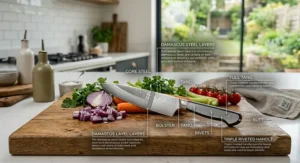
If you’ve ever used a truly great knife, there’s a fair chance it was a Wüsthof. The Wüsthof Classic has been made in Solingen — Germany’s “City of Blades” — since 1814, and it shows in every detail. The 20cm blade is forged from a single piece of X50CrMoV15 German stainless steel, hardened to 58 HRC, with a full bolster and full tang running through the triple-riveted handle.
What does that mean in practice? The bolster shifts the weight forward slightly, giving you that satisfying sense of control when you’re rocking through a pile of carrots. The 58 HRC hardness is softer than Japanese equivalents, which means it won’t hold a razor’s edge quite as long — but it’s dramatically easier to sharpen on a standard honing rod, and it won’t chip if you accidentally hit a hard bit of swede. For British kitchens where a knife gets used hard and sometimes treated casually, that resilience matters.
This is the top chef knife if you want something you’ll use daily for twenty years. UK customers consistently praise the balance and the quality of the feel straight out of the box.
✅ Forged full tang construction — excellent balance and longevity
✅ Easier to maintain than Japanese knives — hones beautifully with a steel
✅ 200+ years of manufacturing heritage; lifetime use potential
❌ Heavier than Japanese equivalents — not ideal for lighter, faster cutting styles
❌ Premium price point — a considered investment rather than an impulse buy
Price range: around £100–£130 on Amazon.co.uk. Worth every penny for a serious home cook.
2. Global G-2 Cook’s Knife 20cm — The Japanese Icon That Won Which?
Some knives look expensive. The Global G-2 looks like something designed by an engineer for a spaceship and then reconsidered for a kitchen. That distinctive all-stainless steel look — seamless, sculptural, a single piece of dimpled metal — divides opinion aesthetically, but in terms of performance, it’s earned its reputation as one of the best-selling Japanese knives in the world.
The blade is CROMOVA 18 stainless steel, ice-hardened to 56–58 HRC, with a convex 15-degree edge on both sides. That edge geometry is sharper than most German knives straight out of the box, and the seamless construction means no food trapping in handle joints — a hygiene advantage that professional kitchens appreciate. The knife weighs around 175g, which feels almost light if you’re used to a heavy German blade. That lightness translates into speed — Global is the top chef knife for rapid vegetable prep and fine slicing work.
Which? awarded the G-2 a Best Buy rating, and British home cooks have been loyal to it for decades. The learning curve is minimal; the payoff is immediate.
✅ Seamless one-piece construction — hygienic and built to last
✅ Which? Best Buy winner — trusted by UK consumer experts
✅ 15° convex edge — notably sharper initial edge than German equivalents
❌ Requires a ceramic or whetstone sharpener — standard steel rods aren’t ideal
❌ The smooth steel handle can feel slippery to some — practice required
Price range: around £80–£100 on Amazon.co.uk. Prime eligible; next-day delivery available.
3. Tojiro DP Gyutou F-808 (21cm) — The Expert’s Open Secret
Here’s what most buyers overlook: you do not need to spend £100 to get a genuinely professional chef knife. The Tojiro DP F-808 is the best chef’s knife for sheer edge quality at its price point — and it’s the one that knife enthusiasts whisper about online while everyone else is queueing up for more recognisable brands.
The F-808 uses a VG-10 stainless steel core sandwiched in softer stainless cladding — a construction technique borrowed from Japanese sword-making. VG-10 is hardened to around 60 HRC, meaningfully harder than German steel, which translates to an edge that stays genuinely sharp for longer between maintenance sessions. The Western-style handle makes the transition from a German knife seamless; no need to adopt a different grip. At 21cm, it’s very slightly longer than most competitors at this price, giving you extra knuckle clearance when cutting on a board.
UK buyers on Amazon.co.uk consistently note the shock of just how sharp this knife arrives — several reviewers mention cutting paper-thin slices of tomato without a serrated knife for the first time. That’s not marketing. That’s VG-10 steel doing what it was designed to do.
✅ VG-10 core steel — exceptional edge retention at a mid-range price
✅ Western handle — no learning curve switching from German knives
✅ Harder steel = longer-lasting sharpness between maintenance sessions
❌ VG-10 is more brittle than German steel — avoid the dishwasher and glass boards
❌ Requires proper whetstone sharpening to restore edge fully — not beginner maintenance
Price range: £60–£80 on Amazon.co.uk — arguably the best value full tang kitchen knife in this guide.
4. ZWILLING Professional S 20cm Chef’s Knife — The Trusted German Professional
ZWILLING J.A. Henckels is the other great name from Solingen, and the ZWILLING Professional S is the brand’s benchmark chef’s knife for serious home and professional use. What sets it apart from budget German options is the FRIODUR ice-hardening process — the blade is hardened to 57 HRC at temperatures below -70°C, which produces a more refined grain structure than standard hardening. In plain English: it’s sharper than you’d expect from German steel, and more resistant to corrosion.
The handle is a classic black polymer with a comfortable, slightly wider grip that suits larger hands well. The blade has a gentle curve from heel to tip that encourages the rocking-chopping motion that many UK home cooks naturally use — the kind of movement that makes mincing herbs feel effortless rather than laborious. This is a high carbon stainless steel blade that’s been tested in professional kitchens for decades and emerged with its reputation completely intact.
If you learned to cook with a German-style knife and want to upgrade properly, the ZWILLING Professional S is a natural, satisfying step up.
✅ FRIODUR ice-hardening — sharper than standard German steel construction
✅ Ergonomic handle — particularly comfortable for larger hands
✅ Full tang, robust construction — professional kitchen reliability
❌ Heavier feel than Japanese alternatives — not the best for extended, fast prep sessions
❌ Premium price — similar cost to the Wüsthof Classic, so a direct comparison is worth making
Price range: around £80–£100 on Amazon.co.uk. Check for Prime eligibility for next-day delivery.
5. Victorinox Fibrox Pro 8″ Chef’s Knife — The Unbeatable Workhorse
Right. Let’s talk about the Victorinox. This is the best chef knife for beginners, the best chef knife for cooking schools, the best knife for people who’ve been burned by cheap blades before and want something genuinely reliable without remortgaging the kitchen. The Swiss company that made the Swiss Army Knife also makes some of the most sensibly designed, brilliantly practical kitchen knives on the planet.
The Victorinox Fibrox Pro uses X50CrMoV15 Swiss steel — the same alloy as the Wüsthof, hardened to around 56 HRC — with a laser-cut edge that arrives surprisingly sharp from the factory. The Fibrox handle is the magic detail: a textured, ergonomic polymer grip that is genuinely non-slip even when wet and covered in chicken juices. In a damp UK kitchen, that matters rather more than you’d think. The knife is also dishwasher safe, though hand-washing will extend its life considerably.
What it isn’t is glamorous. There’s nothing to admire on the windowsill. But pick it up, use it for a week, and you’ll understand why it’s been a culinary school staple for decades and why food professionals the world over reach for it when the knives-as-status-symbols nonsense falls away.
✅ Exceptional value — professional-grade performance under £50
✅ Fibrox handle — non-slip grip even in wet conditions
✅ NSF approved, dishwasher safe — practical for busy kitchens
❌ Less premium feel in hand — purely functional rather than pleasurable
❌ 56 HRC hardness — will need more frequent honing than Japanese knives
Price range: around £30–£50 on Amazon.co.uk. Often Prime eligible — excellent first serious knife.
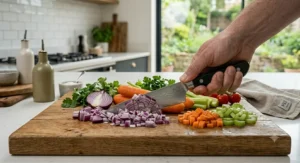
6. PAUDIN 8″ Professional Chef’s Knife — The Best Budget Knife with Real Credentials
Budget chef’s knives in the £20–£35 range are a mixed bag. Most are stainless-steel disappointments with a flashy box and a blade that goes dull within a month. The PAUDIN Chef’s Knife is a genuine exception to that rule. It’s Japanese-inspired in its design philosophy — a thinner blade profile, a sharper 15–17° edge angle, and a handsome Pakkawood handle that looks considerably more expensive than its price suggests.
The blade is high carbon German stainless steel (similar in spec to the EN1.4116 alloy used by more expensive brands), and it arrives sharp enough to make a real impression. The ergonomic knife handle has a satisfying heft for its size, with a full tang construction running through the Pakkawood. PAUDIN also includes a nice gift box — making it genuinely the best budget option for a thoughtful present without the giver looking stingy.
UK buyers report that PAUDIN holds up well with regular use and proper hand-washing. It won’t outlast a Wüsthof, and the steel will need more frequent attention, but for a household budget knife or a student in a university flat, it does everything right at a price that doesn’t cause financial distress.
✅ Full tang construction — better balance than most budget knives
✅ Pakkawood handle — attractive, comfortable, surprisingly durable
✅ Excellent value gift — presentation box included
❌ Carbon steel content is lower than premium options — edge won’t last as long under heavy use
❌ Will need frequent honing — budget steel requires more maintenance discipline
Price range: around £20–£35 on Amazon.co.uk. Free delivery with Prime or orders over £25.
7. MOSFiATA 8″ Ultra Sharp Chef’s Knife — The Budget Starter Kit
For someone who has literally nothing — no honing rod, no finger guard, no idea where to start — the MOSFiATA Chef’s Knife solves a problem that no other knife at this price solves: it comes as a complete kit. The knife itself (EN1.4116 German stainless steel, full tang, 8 inches/20cm) is paired with a pull-through sharpener and a finger guard, all in a gift box. It’s the best chef knife for beginners who want to get going immediately without buying accessories separately.
The EN1.4116 steel is the standard specification German alloy, performing similarly to the PAUDIN above. At 56–58 HRC hardness, it’s easy to maintain but won’t hold an edge as long as Japanese steel. The handle on the MOSFiATA is slightly chunkier than the PAUDIN, which some users prefer for a firmer grip. The included pull-through sharpener is a beginner-friendly tool — not the ideal maintenance method, but perfectly adequate for keeping the edge serviceable between proper sharpenings.
This is the knife to buy when you’re setting up a first flat, when you want to give a student something useful, or when you simply need a perfectly decent, complete kitchen knife solution under £30.
✅ Complete starter kit — knife, sharpener, and finger guard included
✅ Full tang, 20cm blade — proper knife, not a toy
✅ Excellent under £30 — the best-value all-in package in this guide
❌ Pull-through sharpener removes more metal than honing — not ideal long-term
❌ Handle finish is less refined than pricier options — quality gap is visible
Price range: around £20–£30 on Amazon.co.uk. Frequently a bestseller — often available with Prime delivery.
How to Use Your Chef’s Knife Properly (And Avoid the Mistakes Most UK Home Cooks Make)
Buying a great knife is only half the story. The other half is learning not to ruin it — which, honestly, is easier than it sounds once you know the rules.
The most important rule: never, ever put it in the dishwasher. Even if the manufacturer says it’s safe (Victorinox does), the combination of high-alkaline detergent, steam heat cycles, and vibration slowly degrades the edge and corrodes the handle junction. In the damp UK climate, where kitchens often lack good ventilation, this is even more of an issue. Hand-wash, dry immediately, done.
Use a proper cutting board. Glass and ceramic boards — increasingly popular as kitchen aesthetics have taken over — are genuinely terrible for knives. They’ll ruin a £100 blade in months. Stick to wood or quality plastic. A large wooden board (around 40 x 30cm) is the ideal setup for a British kitchen worktop.
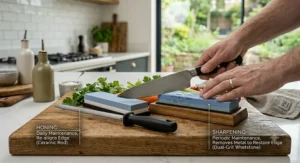
Hone before you cook, sharpen twice a year. There’s a distinction most beginners miss. Honing realigns the edge microscopically using a honing rod — it should take about ten seconds before each use. Sharpening actually removes metal to rebuild the edge and should happen once or twice a year with a whetstone or professional sharpening service. Using your local knife sharpener (many UK farmers markets have them) costs around £3–£5 per knife and is well worth it.
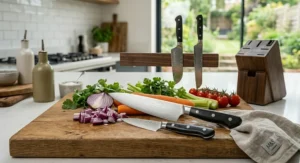
Store it right. A knife block, a magnetic wall strip, or individual blade guards — all fine. A cluttered drawer where the edge is bouncing off other utensils is a swift way to dull a good blade and, frankly, a minor safety hazard for anyone rummaging around in the morning.
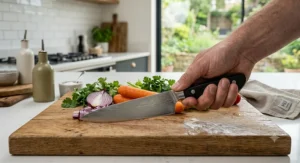
For beginners transitioning to a proper knife: start with the pinch grip (thumb and index finger pinching the blade just above the handle), not the handle grip. It gives you control, reduces wrist fatigue, and is how professional chefs actually hold their knives.
Which Chef’s Knife Suits You? A British Home Cook’s Decision Guide
Not everyone needs the same knife. Here’s how I’d match UK buyers to the options above:
If you’re a complete beginner setting up your first kitchen — the Victorinox Fibrox Pro is your knife. Non-negotiable. It’s honest, reliable, and forgiving of the occasional dishwasher incident. It’ll teach you to cook properly before you decide what kind of knife person you really are. Spend under £50 and don’t look back.
If you cook seriously at home and want one knife that does everything well — the Wüsthof Classic or ZWILLING Professional S. Both will last twenty years with basic care. The Wüsthof has a marginally more refined feel; the ZWILLING has a slightly sharper factory edge. Either is a knife you’ll reach for every single day and never once wish you’d chosen differently.
If you’re an enthusiast who’s read this far and is genuinely interested in knife craft — the Tojiro DP F-808. VG-10 steel at that price is remarkable, and once you’ve experienced proper Japanese edge retention, German steel feels like a different category of tool. You’ll need to learn whetstone sharpening, but that’s half the enjoyment.
If you want the Japanese experience without the maintenance commitment — the Global G-2. CROMOVA 18 steel is easier to maintain than VG-10, and the seamless construction is practically bomb-proof for the everyday kitchen. The Which? endorsement isn’t accidental.
If you’re buying a gift — the PAUDIN in its gift box. It looks the part, performs genuinely well, and lands at a price that’s thoughtful without being extravagant. Under £35 for a knife someone will actually use: that’s a win.
Steel Type, Edge Angle, and Weight: The Features That Actually Matter
Walk into any kitchen shop or browse Amazon long enough and you’ll encounter a blizzard of numbers and terminology designed to make buying a kitchen knife feel like a physics exam. Here’s what actually matters — and what you can safely ignore.
Steel hardness (HRC rating): This determines how long the edge lasts between sharpenings. Japanese knives are typically 60+ HRC (harder, sharper, holds edge longer, but more brittle). German knives are 56–58 HRC (softer, easier to maintain, more forgiving of rough use). For most British home kitchens — where a knife might hit a chopping board several hundred times a week — 58–60 HRC is the sweet spot.
Edge angle: Japanese knives are typically sharpened to 15° per side; German knives to 20–22°. The narrower the angle, the sharper the edge — but also the more fragile. For general UK home cooking, a 15–17° edge (like the Global G-2 or Tojiro DP) will noticeably improve your cutting experience compared to a standard 20° German edge.
Full tang construction: This is the single most important structural specification. A full tang knife has the blade steel running the full length of the handle — it’s visible as two metal rivets or a visible steel strip. It means the knife is balanced, robust, and won’t snap at the handle junction after heavy use. Every knife in this guide is full tang; avoid any budget knife that doesn’t mention this.
What doesn’t matter: The number of layers in Damascus cladding (purely decorative beyond the core steel), the specific country of origin (German and Japanese steel is made by many manufacturers), and whether the knife comes in a fancy magnetic box. Pretty packaging doesn’t translate to sharper vegetables.
Best Chef’s Knife for Specific UK Cooking Styles
The classic British roast requires a different relationship with a knife than, say, Thai cooking or Italian pasta prep. Here’s how the knives above perform across the most common UK kitchen scenarios:
Sunday roast preparation: Peeling and dicing root vegetables — parsnips, swede, celeriac — requires a robust blade with a good belly curve. The Wüsthof Classic and ZWILLING Professional S both excel here; their heavier blades power through tough vegetables without the micro-chipping risk that harder Japanese steel carries.
Asian-inspired weeknight cooking: Quick, thin vegetable slices for stir-fries or salads are where the Global G-2 and Tojiro DP shine. The thinner blade profiles produce thinner, cleaner cuts with less effort — particularly noticeable with spring onions, chillies, and ginger.
Herbs and aromatics: Any sharp knife will mince herbs, but a knife with a well-curved belly — the Wüsthof and ZWILLING in particular — rocks beautifully for rapid herb mincing. The Victorinox also performs brilliantly here for its price.
Fish and poultry: The lighter Japanese knives (Global, Tojiro) produce cleaner cuts through raw chicken and fish fillets. The control offered by a thinner blade is particularly useful when portioning fish — a task where a clunky knife makes a noticeable mess.
Long-Term Cost of a Good Chef’s Knife in the UK
The penny-wise argument for cheap knives doesn’t hold up over five years. Here’s the honest maths.
A £25 budget knife that goes dull within six months gets replaced — or, more commonly, ends up being used badly while a sharp replacement sits in the drawer, and the cycle repeats. Over five years, that’s anywhere from £75 to £150 in replaced knives, none of which ever gave you a genuinely satisfying cooking experience.
The Victorinox Fibrox Pro costs around £35–£50. Maintained properly (hand-washed, honed before use, professionally sharpened once a year at roughly £4), it costs around £55–£70 total over five years. That’s a vastly better experience for less money.
The Wüsthof Classic costs £100–£130 upfront. Maintained well, it will last twenty to thirty years with minimal additional cost. Over two decades, that’s roughly £5–£7 per year for a knife that makes cooking genuinely better every day. When framed as daily-use equipment rather than a luxury purchase, a premium knife is an obvious investment.
One final UK-specific note: Amazon.co.uk’s Consumer Contracts Regulations mean you have a 14-day cooling-off period on all online knife purchases — so if a knife genuinely doesn’t feel right in your hand, you can return it. Take the opportunity to handle knives in a physical kitchen shop first if possible, then buy online for better pricing.
Frequently Asked Questions
❓ What is the best chef's knife for a home cook in the UK?
❓ What's the difference between a Japanese and a German chef's knife?
❓ Are chef's knives available on Amazon.co.uk with free delivery?
❓ How do I maintain a chef's knife properly?
❓ Is a full tang kitchen knife worth the extra cost?
Conclusion: One Good Knife Changes Everything
The best chef’s knife isn’t the one with the most impressive name on the blade or the most dramatic Damascus pattern. It’s the one you’ll actually reach for every evening, the one that makes prepping a weeknight dinner feel less like a chore and more like something worth doing properly.
For most UK home cooks, that knife is the Victorinox Fibrox Pro — honest, brilliant, and perpetually underestimated. If you’re ready to invest in something that’ll outlast a decade of Sunday roasts and Wednesday stir-fries, the Wüsthof Classic or Global G-2 represent the upper tier of practical kitchen tools. And for the value-seeking knife enthusiast who wants professional edge retention without a professional price tag, the Tojiro DP F-808 remains one of the best-kept secrets in UK kitchen retail.
Buy one good knife. Use it, maintain it, and eat better because of it.
✨ Don’t Miss These Exclusive Deals!
🔍 Ready to upgrade your kitchen? Click on any highlighted knife above to check current pricing and availability on Amazon.co.uk. Your Sunday roast will thank you for it.
Recommended for You
- Lightweight Chef Knife UK: 7 Best Picks That Won’t Wreck Your Wrist (2026)
- Best 10 Inch Chef Knife for Large Hands UK 2026 | Top 7 Picks
- Best 8 Inch Chef Knife UK 2026: 7 Top Picks Reviewed
Disclaimer: This article contains affiliate links. As an Amazon Associate, I earn from qualifying purchases. If you purchase products through these links, we may earn a small commission at no additional cost to you.
✨ Found this helpful? Share it with your mates! 💬🤗
