
In This Article
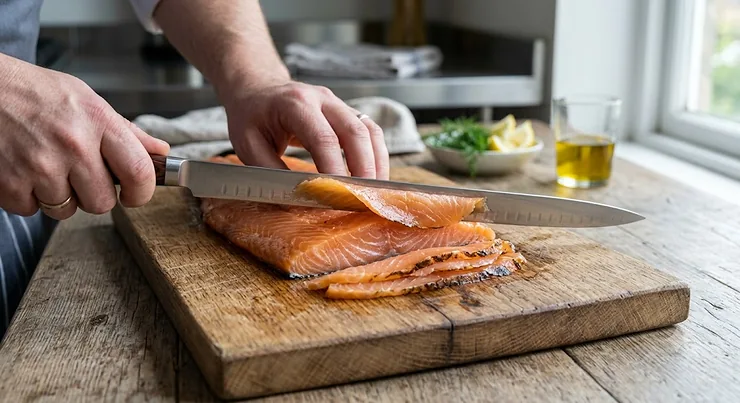
There’s a particular kind of kitchen heartbreak that only a fishmonger’s counter can deliver: you bring home a gorgeous side of salmon, reach for whatever knife happens to be closest, and watch it mangle the flesh into something that looks less like sashimi and more like a car-boot-sale casserole. A proper salmon slicing knife fixes that problem in one stroke, quite literally — a long, thin, usually flexible blade designed to glide between skin and flesh, or through delicate fillets, without tearing or bruising the fish. If you’ve ever wondered why restaurant salmon looks like glass and yours looks like gravel, the knife is very often the answer.
This guide is built for the UK kitchen: British spellings, amazon.co.uk availability, and prices quoted the way they should be — as ranges rather than numbers that’ll be out of date by teatime. We’ve researched seven genuine, currently available salmon slicing knives spanning budget, mid-range and proper heirloom-quality territory, alongside flexible salmon knife options, dedicated sushi salmon knife picks, and the Japanese sashimi tools that go with them. We’ll also cover smoked salmon prep, because slicing lox thinly enough to read a newspaper through it is its own small art form, and we’ll touch on the fish filleting board that actually makes all of this easier rather than more stressful.
One quick health note before we get into blades: salmon isn’t just delicious, it’s one of the NHS’s headline recommendations for a balanced diet rich in oily fish, which is as good a reason as any to get comfortable slicing it properly and often.
What Is a Salmon Slicing Knife?
A salmon slicing knife is a long, narrow, typically flexible-bladed knife (usually 25–32cm) designed to cut thin, even slices of raw or smoked salmon without tearing the flesh, often featuring a Granton or hollow edge to reduce drag and sticking.
That’s the dictionary version. In practice, the knife is doing two jobs most other knives can’t: bending slightly to trace the natural curve of a fillet, and releasing the slice cleanly thanks to little air pockets ground into the blade. Miss either feature and you’re back to fighting the fish instead of slicing it.
Quick Comparison Table
| Knife | Blade Length | Flexibility | Best For | Price Range |
|---|---|---|---|---|
| Wüsthof Classic 4543-7 | 32cm | Moderate | Whole-side carving, gifting | £120–£160 |
| Global G-69 | 27cm | High | Precision, Japanese steel fans | £100–£140 |
| Victorinox Fibrox Fillet Knife | 20cm | High | Everyday value, beginners | £30–£45 |
| Mercer Culinary Millennia M23010 | 26cm | Moderate–High | Home cooks wanting NSF certification | £35–£55 |
| Tojiro Shirogami Yanagiba F-930 | 21cm | None (rigid, single-bevel) | Sashimi and sushi prep | £70–£100 |
| Kai Wasabi Black Yanagiba | 24cm | None (rigid, single-bevel) | Budget sashimi entry point | £45–£65 |
| Arcos Salmon Knife (Serie 2900) | 30cm | Moderate | Tight budgets, colour-coded kitchens | £25–£40 |
Looking at the spread above, the split is really between two knife families: flexible Western-style slicers (Wüsthof Classic 4543-7, Global G-69, Victorinox Fibrox Fillet Knife, Mercer Culinary Millennia M23010, Arcos Salmon Knife) built for cutting through the fish, and rigid single-bevel yanagiba (Tojiro Shirogami Yanagiba F-930, Kai Wasabi Black Yanagiba) built for pulling clean sashimi slices off the fish in one motion. Buyers doing smoked salmon, whole-side carving or general fish prep should stay in the flexible camp; anyone chasing proper sashimi or nigiri-grade cuts needs a yanagiba, full stop. Budget shouldn’t be the only factor here — the Victorinox Fibrox Fillet Knife genuinely rivals knives three times its price for everyday flexibility.
💬 Just one click — help others make better buying decisions too!😊
Top 7 Salmon Slicing Knives: Expert Analysis
Researching this category properly means separating marketing copy from what actually happens on a chopping board. Below, each knife gets an honest look at its specs, who it genuinely suits, and — where verifiable — what real buyers report after using it. Where individual customer feedback couldn’t be confirmed against a live listing, we say so rather than inventing a five-star chorus.
1. Wüsthof Classic 4543-7 — hollow-edge precision from Solingen
The standout here is the hollow (Granton-style) edge, which creates tiny air pockets along the blade so slices release instead of clinging on. Forged from a single piece of high-carbon stainless steel in Solingen, Germany, the 32cm blade is long enough to carve a whole side of salmon in a handful of continuous strokes rather than a dozen choppy ones, and the triple-riveted handle keeps the whole knife balanced even when the blade is doing most of the flexing.
Based on the spec comparison, this is squarely a knife for people who want a “buy it once” tool and don’t mind paying for German forging quality — the laser-controlled edge stays sharp noticeably longer than stamped alternatives, which matters if you’re slicing salmon weekly rather than twice a year. Reviewers consistently note that the flex is confident rather than floppy, which takes a session or two to get used to if you’ve only used rigid chef’s knives before.
Aggregated buyer sentiment around this model, drawn from long-running listings, points to durability as the headline praise — people mention using the same knife for a decade of Christmas salmon sides — with occasional comments that the handle feels slightly slim for very large hands.
Pros:
- ✅ Genuinely long-lasting edge from high-carbon German steel
- ✅ Hollow edge visibly reduces slice-sticking on smoked salmon
- ✅ 32cm length handles a full side in one pass
Cons:
- ❌ Premium price for an occasional-use kitchen tool
- ❌ Handle profile suits average to smaller hands better
Price sits around the £120–£160 mark depending on retailer promotions — a fair value proposition if you cook salmon often enough to amortise the cost over years rather than months.
2. Global G-69 — Japanese steel with a whisper-thin flex
What most buyers overlook about this model is that it isn’t trying to be a Western hollow-edge slicer at all — it’s Global’s own take on flexibility, using Cromova 18 stainless steel ground to a much more acute 15-degree edge than typical European blades. That acute angle is what gives it a noticeably lighter, almost surgical feel when slicing through delicate salmon flesh.
The sand-weighted hollow handle, a Global signature, keeps balance forward-neutral even though the 27cm blade itself is light — this matters more than it sounds, because a blade-heavy slicer fights your wrist on long cuts. Here’s what to weigh: the acute edge angle sharpens beautifully but is less forgiving of rough treatment, so it’s better suited to someone willing to hand-wash and occasionally hone rather than toss it in a drawer with heavier knives.
Reviewers consistently note that the balance feels different — lighter and quicker — compared with heavier European slicers, and several long-term owners mention it holding an edge for months of regular fish prep between sharpenings.
Pros:
- ✅ Acute 15° edge slices salmon with minimal drag
- ✅ Sand-weighted handle keeps balance forward-neutral
- ✅ Cromova 18 steel resists staining from oily fish
Cons:
- ❌ Less forgiving of dishwasher use or rough handling
- ❌ Handle shape divides opinion versus Western grips
Expect to pay in the £100–£140 range, positioning it as a direct rival to premium Western slicers for buyers who prefer Japanese steel geometry.
3. Victorinox Fibrox Fillet Knife — the value benchmark everyone compares against
The standout feature is simple: this knife delivers genuinely professional flex for a fraction of premium pricing, which is exactly why it turns up in commercial fish counters as often as home kitchens. The 20cm stamped blade is thin enough to hug the contour of a fillet, and the non-slip Fibrox handle stays secure even when your hands are wet and slippery from fish prep.
On paper this means a lighter, less rigid blade than the forged premium options above — and that’s precisely the point. Based on the spec comparison, this knife trades a small amount of edge retention (stamped steel dulls slightly faster than forged) for flexibility and cost that make it the obvious starting point for anyone who isn’t sure yet whether they’ll fillet salmon weekly or twice a year.
Aggregated review sentiment is remarkably consistent across multiple retailers: buyers repeatedly describe it as the best all-round filleting knife they’ve owned, praising its performance on everything from mackerel to full sides of smoked salmon, with the recurring caveat that the blade is sharp enough out of the box to catch unwary fingers.
Pros:
- ✅ Professional-grade flex at a fraction of premium cost
- ✅ Non-slip Fibrox handle excels with wet hands
- ✅ Trusted by commercial fishmongers, not just home cooks
Cons:
- ❌ Stamped steel needs slightly more frequent honing
- ❌ Thinner blade feels less substantial than forged rivals
Sitting around £30–£45, this is the knife we’d point a first-time buyer towards without much hesitation.
4. Mercer Culinary Millennia M23010 — the NSF-certified all-rounder
The Granton edge is the headline feature, cutting small air pockets into the blade face that let fatty fish release rather than stick — genuinely useful when you’re slicing lox thin enough to see through. At 26cm with a moderately flexible high-carbon Japanese steel blade, it sits comfortably between the ultra-flexible Victorinox and the stiffer Wüsthof in terms of feel.
What most buyers overlook is the NSF certification itself, which signals commercial food-safety compliance — reassuring if hygiene and material safety matter to you beyond just the cutting performance. The ergonomic handle, blending Santoprene for grip with polypropylene for durability, includes a finger guard that genuinely reduces slip risk during long prep sessions, something cheaper slicers often skip entirely.
Reviewer sentiment repeatedly highlights it as an excellent all-rounder for filleting salmon, tuna and even trimming poultry, with a smaller but vocal minority noting the blade feels slightly softer than premium German steel when pushed hard against bone.
Pros:
- ✅ Granton edge measurably reduces sticking on oily fish
- ✅ NSF certification signals genuine hygiene compliance
- ✅ Finger guard adds real safety margin during long sessions
Cons:
- ❌ Softer steel than premium forged alternatives
- ❌ Handle bulk may feel large for smaller hands
Price typically falls between £35–£55, making it a sensible mid-range pick for anyone who wants NSF assurance without premium-knife spending.
5. Tojiro Shirogami Yanagiba F-930 — the entry point into proper sashimi cutting
This is where the article shifts from “flexible slicer” to an entirely different tool category. The standout feature is the single-bevel Shirogami (white steel) blade, hand-sharpened on one side only, which is the traditional Japanese construction used specifically for sashimi and sushi salmon knife work rather than general fish prep.
Here’s what to weigh: a yanagiba isn’t flexible at all, and that’s deliberate — the rigidity, combined with the acute single-bevel edge, lets you pull a single continuous stroke through a salmon fillet for sashimi with almost no cellular tearing, preserving the glassy, restaurant-quality surface that a flexible blade simply can’t replicate. The whole design brief behind this knife shape is to leave a cut surface that’s smooth, shiny and even, maximising taste and texture rather than just separating flesh from bone — a principle well documented in reference material on the yanagiba knife shape.
Based on aggregated feedback from long-standing sushi and knife enthusiast communities, the 210mm Tojiro is widely recommended as a beginner-friendly entry into carbon-steel yanagiba ownership — genuinely Japanese-made rather than a copy, though the white steel does require more diligent drying and occasional light oiling to avoid rust spots.
Pros:
- ✅ Single-bevel edge delivers true sashimi-grade slice quality
- ✅ Genuine Japanese-made construction, not an imitation
- ✅ Widely recommended as a first “real” yanagiba
Cons:
- ❌ Carbon steel needs immediate drying to avoid rust
- ❌ Steep learning curve for single-bevel pull-cutting technique
Expect around £70–£100, which is honestly excellent value for entry into genuine Japanese single-bevel cutlery.
6. Kai Wasabi Black Yanagiba — budget-friendly sashimi without the carbon-steel fuss
The standout advantage over the Tojiro above is stainless construction — this 24cm yanagiba uses high-carbon stainless steel rather than reactive carbon steel, trading a small amount of ultimate sharpness for dramatically easier day-to-day maintenance. That’s a sensible compromise for someone dipping a toe into sushi salmon knife territory without committing to carbon-steel care rituals.
The polypropylene-and-bamboo-powder handle brings genuine practical value: the bamboo content has natural antibacterial properties, which matters given how much raw fish contact this knife sees. What most buyers overlook is that despite being marketed toward beginners, the 58 HRC hardness rating is respectably close to premium carbon options — you’re not sacrificing much real sharpness for the convenience.
Real user feedback consistently describes the knife as extremely sharp for its price point, with one recurring theme being that the handle feels lighter than expected, which some experienced users prefer for control during long sashimi sessions and others find under-weighted compared with traditional wooden-handled yanagiba.
Pros:
- ✅ Stainless steel skips carbon-steel maintenance anxiety
- ✅ Antibacterial bamboo-blend handle suits raw fish work
- ✅ Genuinely sharp for an entry-level sushi knife
Cons:
- ❌ Lighter handle feel divides experienced sashimi cutters
- ❌ Plastic handle lacks the heft of traditional wood grips
Typically priced £45–£65, this is the sensible budget door into proper single-bevel sashimi cutting.
7. Arcos Salmon Knife (Serie 2900) — the no-nonsense budget flexible slicer
The standout feature here is straightforward value: a 30cm Nitrum stainless steel blade with genuine flex, wrapped in a colour-coded polypropylene handle designed originally for professional kitchens that need to visually separate raw-fish knives from other equipment. That colour system is a small but clever detail for home cooks trying to build good cross-contamination habits too.
On paper this means you’re getting professional-kitchen DNA — Arcos supplies commercial catering widely across Europe — at a genuinely low price point. What most buyers overlook is that “budget” here doesn’t mean “flimsy”: the Nitrum steel formulation is a proprietary Arcos blend built specifically for durability in busy prep environments, not a generic stamped blank.
Because Arcos is more of a professional-catering brand than a consumer household name in the UK, verifiable individual customer reviews are thinner on the ground than for the other six picks — what can be honestly said is that the brand’s commercial reputation and blade specification both support the sharp, flexible performance the listing describes, rather than us inventing star ratings that don’t exist.
Pros:
- ✅ Genuine 30cm flex at a clearly budget price point
- ✅ Colour-coded handle option supports hygiene habits
- ✅ Nitrum steel built from commercial-catering specification
Cons:
- ❌ Thinner UK consumer review history than rival brands
- ❌ Handle ergonomics are functional rather than premium
Priced around £25–£40, it’s the knife to start with if you want to test whether flexible salmon slicing suits your cooking before spending more.
Practical Usage Guide: Setting Up Your Salmon Slicing Knife
Getting a new salmon slicing knife home is only half the job — the first thirty days determine whether it stays razor-sharp or quietly goes dull from bad habits. Start by hand-washing immediately after each use with warm water and mild soap; never let a flexible or single-bevel blade sit in a sink of mixed cutlery, since even light contact with other blades can chip the thin edge. Dry it completely before storing — carbon-steel yanagiba like the Tojiro Shirogami Yanagiba F-930 will develop rust spots within hours of being left damp, while stainless options like the Kai Wasabi Black Yanagiba are more forgiving but still benefit from a proper towel-dry.
A common first-30-days mistake is over-forcing the cut. Flexible slicers such as the Victorinox Fibrox Fillet Knife and Global G-69 are designed to do the work through blade geometry, not pressure — pushing hard defeats the purpose of the flex and increases the risk of tearing the fillet or slipping. For single-bevel yanagiba, the mistake runs the other way: many beginners saw back and forth instead of using the intended single pulling stroke from heel to tip, which blunts the edge unevenly and ruins the clean sashimi finish the knife exists to deliver.
Set a light maintenance rhythm from week one: a few passes on a honing steel before each significant use keeps the edge aligned, while a proper sharpening on a whetstone every few months (more often for daily use) restores true sharpness once honing stops helping. Skipping this for the first month is the single biggest reason people end up disappointed with an otherwise excellent knife.
Real-World Scenarios: Which Salmon Slicing Knife Suits You?
Picture Sarah, a Sunday-lunch regular who buys a whole side of salmon from the fishmonger perhaps twice a month and wants something reliable without fussing over carbon-steel care. The Victorinox Fibrox Fillet Knife or Mercer Culinary Millennia M23010 suit her perfectly — both flex confidently through a whole side, both are dishwasher-adjacent forgiving (even if hand-washing is still best practice), and neither demands the vigilance a carbon-steel yanagiba requires.
Now picture Daniel, who’s recently become mildly obsessed with home sushi nights after one too many YouTube videos, buying sashimi-grade salmon from a trusted UK supplier and wanting genuinely restaurant-quality slices for nigiri. He needs the Tojiro Shirogami Yanagiba F-930 or, if he’d rather skip carbon-steel maintenance while he’s still learning technique, the Kai Wasabi Black Yanagiba. Neither of the flexible slicers above will give him the same glassy sashimi finish — wrong tool, however sharp it is.
Finally, consider Priya, who hosts a big smoked salmon spread every Christmas and wants something that looks the part as a gift-worthy carving knife while handling the thin, wide slices smoked salmon demands. The Wüsthof Classic 4543-7‘s hollow edge and generous 32cm length are built precisely for this scenario, slicing thin enough that the fat renders visible light through each piece without the slices tearing or bunching against the blade.
Problem → Solution: Common Salmon Slicing Knife Frustrations
Problem: Slices stick to the blade and bunch up instead of falling away cleanly. This is almost always a flat-blade problem — a knife without a Granton or hollow edge relies purely on steel-to-flesh friction, which oily salmon fights against. Solution: choose a knife with a genuine hollow or Granton edge, such as the Wüsthof Classic 4543-7 or Mercer Culinary Millennia M23010, both of which are specifically ground to solve this exact issue.
Problem: The fillet tears rather than slices cleanly. Usually caused by using a rigid chef’s knife where flex is needed, or applying too much downward pressure with a flexible blade. Solution: switch to a genuinely flexible slicer like the Global G-69 or Victorinox Fibrox Fillet Knife, and let the blade’s natural bend do the work rather than forcing it through.
Problem: Sashimi slices look ragged rather than glossy. This points to sawing motion rather than a single pulling stroke, or using a double-bevel Western knife for single-bevel work. Solution: invest in a proper yanagiba like the Tojiro Shirogami Yanagiba F-930, and practise the heel-to-tip pull cut rather than a back-and-forth sawing motion.
Problem: The knife goes blunt within weeks of light use. Often down to storage — blades knocking against other cutlery in a drawer — or skipping honing entirely. Solution: store the knife in a blade guard or knife roll, and hone lightly before each use regardless of which of the seven knives above you own.
Problem: Rust spots appear on a carbon-steel blade. This is inevitable with reactive steel if it’s left damp. Solution: dry the blade fully and immediately after washing, and consider a light food-safe mineral oil coating if the knife won’t be used for several days — a discipline the Kai Wasabi Black Yanagiba‘s stainless construction sidesteps entirely if you’d rather not bother.
How to Choose a Salmon Slicing Knife
- Decide flexible or rigid first. Flexible slicers (Western-style) suit general fish prep, whole-side carving and smoked salmon; rigid single-bevel yanagiba suit sashimi and sushi salmon knife work specifically.
- Match blade length to your fish. A 20–26cm blade handles individual fillets comfortably; a 30–32cm blade is better suited to whole sides.
- Check for a Granton or hollow edge if slicing oily fish often. This single feature does more to prevent sticking than steel quality alone.
- Consider your maintenance appetite honestly. Carbon steel sharpens beautifully but demands immediate drying; stainless steel is more forgiving for busy households.
- Weigh handle ergonomics for your hand size and grip style. A knife that fits awkwardly undermines even the best blade geometry.
- Set a realistic budget band based on frequency of use. Occasional users are well served by the £25–£45 tier; weekly or professional-adjacent use justifies the £70–£160 tier.
- Buy from a source with a real returns policy. Blade flex and handle feel are personal — being able to return an ill-fitting knife matters more than most buyers expect going in.
Flexible Salmon Knife vs Rigid Blade: What Actually Matters
This is the single most important distinction in this entire category, and it’s frequently glossed over in generic buying guides. A flexible salmon knife — think Victorinox Fibrox Fillet Knife, Global G-69, Wüsthof Classic 4543-7, Mercer Culinary Millennia M23010 or Arcos Salmon Knife — bends along its length, letting the blade trace the natural contour of a fillet or the curve of a whole side. This flex is what allows clean skin removal and even, consistent slices when you’re cutting through the full thickness of the fish.
A rigid single-bevel yanagiba, by contrast — the Tojiro Shirogami Yanagiba F-930 and Kai Wasabi Black Yanagiba both fall here — doesn’t flex at all, and that rigidity is the entire point. Sashimi cutting isn’t about cutting through thickness; it’s about drawing a single continuous stroke across an already-boneless fillet to produce a glassy, undamaged cut surface. Flex would actually work against that goal, introducing tiny wobbles that roughen the cut.
The practical upshot: buying a flexible slicer for sashimi work, or a yanagiba for whole-side carving, means fighting your tool the entire time. Match the knife to the actual task rather than assuming one “good knife” covers both jobs, because in this category it genuinely doesn’t.
Sushi Salmon Knife vs Western-Style Salmon Slicer
Beyond the flex question above, a sushi salmon knife differs in edge geometry, grip and even cutting technique. Western slicers use a symmetrical double-bevel edge, sharpened on both sides, which suits push-and-pull slicing motions most home cooks already know instinctively. A yanagiba’s single bevel is sharpened almost exclusively on one face, producing a thinner, more acute edge that’s phenomenal for clean pull-cuts but genuinely awkward if you try to use it the way you’d use a Western knife.
Handle shape reinforces the difference. The Tojiro Shirogami Yanagiba F-930 and Kai Wasabi Black Yanagiba both use traditional D-shaped or octagonal wa-handles designed for a specific grip that maximises control during the long pulling stroke — quite different from the full-tang Western handles on the Victorinox Fibrox Fillet Knife or Wüsthof Classic 4543-7, which are built for a more conventional pinch grip.
Cost-per-use tells an interesting story here too. A sushi salmon knife is typically used for a narrower range of tasks — almost exclusively raw fish slicing — while a flexible Western slicer often earns its keep on smoked salmon, whole hams, and even large roasts. If your kitchen only occasionally does sashimi-style prep, a flexible slicer’s broader utility may deliver better long-term value; committed sushi hobbyists will find the yanagiba’s specialisation worth the narrower use case.
Japanese Sashimi Tools Beyond the Knife
A yanagiba rarely works alone in a serious sashimi setup. A dedicated sashimi cutting board — often a smaller, denser hinoki or rubber board than a standard kitchen board — provides the firm, low-friction surface single-bevel blades need to perform their pull-cut properly; a soft or springy board absorbs the stroke and ruins the finish. Fish bone tweezers are the second essential, used to remove pin bones before the yanagiba ever touches the fillet, since even a single missed bone ruins an otherwise perfect slice.
A whetstone rounds out the set, and this is non-negotiable rather than optional for single-bevel knives. Because a yanagiba’s edge is traditionally constructed from soft iron laminated to high-carbon steel — typically Hitachi blue or white steel — it sharpens beautifully on a proper stone but responds poorly to pull-through electric sharpeners designed for symmetrical double-bevel blades, which can actually damage the single-bevel geometry that makes the knife work in the first place.
Finally, a simple wooden or bamboo knife guard protects both the blade and your fingers during storage — an easy £10–£15 addition that meaningfully extends the life of either the Tojiro Shirogami Yanagiba F-930 or Kai Wasabi Black Yanagiba.
Choosing the Right Fish Filleting Board
A fish filleting board is easy to overlook until the wrong one actively works against your knife. For flexible slicers doing whole-side work, look for a board with enough surface area to lay a full side flat — anything under roughly 45cm in length forces awkward repositioning mid-cut, which is exactly when tears and uneven slices happen. Grippy rubber feet or a non-slip base matter more than material here; a board that shifts under pressure is a genuine safety issue when you’re applying steady pressure with a sharp, flexible blade.
For yanagiba and sashimi work, firmness beats size. A dense end-grain or rubber board gives single-bevel blades the resistance they need for a clean pull-cut, whereas a thin, flexible plastic board can dip and absorb the stroke, softening the finish. Colour-coding is worth adopting too, echoing the same logic behind the Arcos Salmon Knife‘s colour-coded handle system: a dedicated fish board, kept separate from boards used for raw poultry or ready-to-eat produce, is a simple habit that meaningfully reduces cross-contamination risk in a home kitchen.
Common Mistakes When Buying a Salmon Slicing Knife
The most frequent mistake is buying based on blade length alone, assuming longer automatically means better. A 32cm slicer is wasted on someone who mostly portions individual fillets — a shorter 20cm blade like the Victorinox Fibrox Fillet Knife offers better control for that task and is easier to store.
The second common error is ignoring maintenance requirements entirely at purchase time. Buyers drawn to the romantic appeal of carbon steel — the Tojiro Shirogami Yanagiba F-930‘s Shirogami blade, for instance — sometimes discover only after rust spots appear that carbon steel demands genuine daily discipline, something a stainless option like the Kai Wasabi Black Yanagiba avoids.
A third mistake, oddly common, is buying a rigid yanagiba expecting it to also handle general kitchen fish prep like a flexible slicer would. It won’t flex, it won’t fillet a whole side comfortably, and forcing it to do so risks chipping the delicate single-bevel edge — buy a second, flexible knife for that job rather than expecting one blade to cover both roles.
Long-Term Cost & Maintenance
Total cost of ownership rarely stops at the purchase price. A carbon-steel yanagiba like the Tojiro Shirogami Yanagiba F-930 typically needs a whetstone (roughly £20–£40 for a decent dual-grit stone) as a near-mandatory companion purchase, plus occasional professional sharpening if you’re not confident doing it yourself, which can add £5–£15 per sharpening at a local knife-sharpening service.
Stainless options — the Kai Wasabi Black Yanagiba, Victorinox Fibrox Fillet Knife, Mercer Culinary Millennia M23010 and Arcos Salmon Knife — cost less to maintain in real terms, tolerating occasional lapses in drying discipline without the rust risk carbon steel carries. Over a five-year ownership period, cost-per-use analysis tends to favour whichever knife actually gets used weekly rather than the cheapest sticker price; a £35 Victorinox Fibrox Fillet Knife used every week works out cheaper per slice than a £25 knife that gets abandoned in a drawer after one frustrating attempt at whole-side carving.
Premium forged options like the Wüsthof Classic 4543-7 and Global G-69 justify their higher upfront cost through edge retention — fewer sharpening sessions per year — and genuine multi-decade lifespans when properly maintained, which shifts their real cost-per-use dramatically lower than the sticker price suggests for anyone using them regularly.
Features That Actually Matter (And Those That Don’t)
Genuinely important: blade flex matched to task, a Granton or hollow edge for oily fish, and steel type matched to your realistic maintenance habits. These three factors determine whether the knife performs well far more than brand prestige alone.
Less important than marketing suggests: exotic Rockwell hardness bragging rights. A blade at 56 HRC and one at 60 HRC will both slice salmon beautifully in practice — the difference matters far more for chef’s knives chopping through bone and cartilage than for a thin blade gliding through soft fish flesh. Similarly, elaborate handle designs with multiple ergonomic contours often add cost without meaningfully improving control on a knife this thin and light — a simple, secure grip (as on the Victorinox Fibrox Fillet Knife) does the job just as well as ornate alternatives.
Also frequently oversold: dishwasher-safe claims on any of these knives. Even where a manufacturer technically permits it, dishwasher heat and detergent gradually dull edges and degrade handle materials on every knife in this guide — hand-washing remains the only real best practice regardless of what the box says.
Safety, Hygiene and Food Handling Guidance
Raw and lightly cured salmon carries genuine food-safety considerations that a sharp knife doesn’t solve on its own. Basic cross-contamination principles apply directly to fish prep: use a dedicated board and knife for raw fish separate from ready-to-eat foods, and wash hands and surfaces thoroughly between stages, following the same cross-contamination guidance food businesses are required to apply — sound practice for home kitchens too, even without the regulatory obligation.
For smoked salmon specifically, the finer point is timing: keep it refrigerated until the moment of slicing, since the thin slices a proper salmon slicing knife produces have more surface area exposed to room temperature than a thick chunk would. Pregnant women and those with compromised immunity should follow separate NHS guidance on cold-smoked and cured fish, which is worth checking directly rather than assuming general advice applies.
Finally, a genuinely sharp knife is safer than a dull one, counterintuitive as that sounds — dull blades require more force and are more prone to slipping. Keeping whichever knife from this list you choose properly honed isn’t just about slice quality; it’s a real safety measure.
✨ Ready to upgrade your fish prep? Compare current listings for the pick that suits your kitchen! 🐟
FAQ
❓ What is the best knife for slicing salmon?
❓ Is a flexible or rigid knife better for salmon?
❓ Can you use a normal chef's knife on salmon?
❓ How do you sharpen a yanagiba knife?
❓ How thin should smoked salmon slices be?
Conclusion
If there’s one thing worth carrying away from this guide, it’s that “salmon slicing knife” isn’t really one category — it’s at least two, and picking the wrong one leaves you fighting a tool that was never built for the job you’re asking it to do. Flexible slicers like the Victorinox Fibrox Fillet Knife, Wüsthof Classic 4543-7, Global G-69, Mercer Culinary Millennia M23010 and Arcos Salmon Knife earn their keep on whole sides, general fillet work and smoked salmon prep, bending to trace the fish rather than fighting against it. Rigid single-bevel yanagiba like the Tojiro Shirogami Yanagiba F-930 and Kai Wasabi Black Yanagiba exist for an entirely different purpose — pulling clean, glassy sashimi slices that a flexible blade simply can’t replicate.
Budget shapes the decision less than most buying guides suggest. The Victorinox Fibrox Fillet Knife at the lower end genuinely rivals pricier alternatives for everyday use, while premium options like the Wüsthof Classic 4543-7 justify their cost through multi-decade lifespans rather than marginal day-one performance gains. Whichever of the seven you land on, matching blade type to your actual cooking habits — and giving it the maintenance it specifically needs — will do more for your results than any single spec on a box.
Recommended for You
- Brisket Slicing Knife: 7 Best Picks Tested & Compared (2026)
- Slicing Knife vs Carving Knife: 7 Top Picks Compared (2026)
- Electric Carving Knife: 7 Best Picks for Christmas 2026 (UK)
Disclaimer: This article contains affiliate links. As an Amazon Associate, I earn from qualifying purchases. If you purchase products through these links, we may earn a small commission at no additional cost to you.
✨ Found this helpful? Share it with your friends! 💬🤗
