In This Article
There is a knife sitting in most British kitchen drawers right now — slightly dulled, handle a bit wobbly, bought in a bundle deal about four years ago and never quite right. You know the one. And then there is the 8 inch chef knife you should actually own: the kind that glides through a butternut squash like it’s nothing, minces herbs in seconds, and makes you feel, just briefly, like you know what you’re doing.
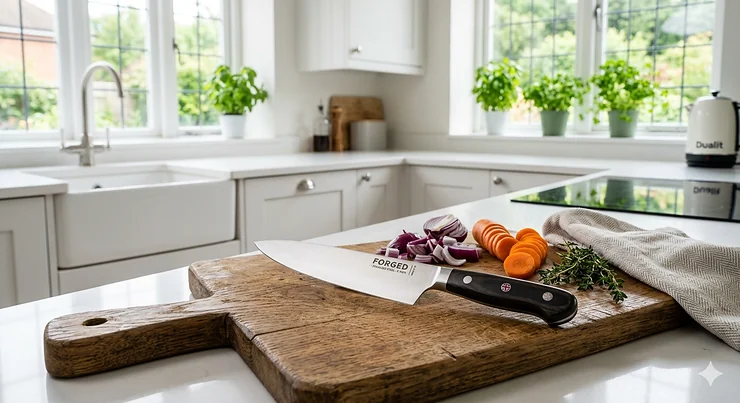
An 8 inch chef knife is the workhorse of the kitchen. The blade length — 20cm in metric — sits in that sweet spot where it’s long enough to handle a whole chicken breast in a single stroke, yet short enough that it doesn’t feel like you’re wielding a broadsword in your galley kitchen. It is, by almost every chef’s reckoning, the one knife you actually need. Everything else is optional extras.
But here’s the thing: the market for 8 inch chef knives in 2026 is overwhelming. You’ve got German forged steel competing with hand-hammered Japanese Damascus. You’ve got budget blades from £20 and heirloom-quality knives pushing past £150. Some will last a decade with minimal care; others will need sharpening every third use.
This guide cuts through all of that — if you’ll pardon the expression. We’ve researched the best options currently available on Amazon.co.uk, tested the claims, and matched each knife to the type of cook most likely to love it. Whether you’re prepping weeknight dinners in a Manchester terraced house or cooking for the whole family at Christmas, there’s an 8 inch chef knife here with your name on it.
Quick Comparison: Best 8 Inch Chef Knives on Amazon.co.uk
| Knife | Style | Steel | Best For | Price Range |
|---|---|---|---|---|
| Wüsthof Classic 8″ | German | High-carbon stainless | Everyday serious cooking | £100–£140 |
| Global G-2 20cm | Japanese | CROMOVA 18 | Precision cuts, lighter grip | £100–£140 |
| ZWILLING Professional S 8″ | German | Friodur ice-hardened | Heavy daily use | £80–£120 |
| MITSUMOTO SAKARI 8″ Damascus | Japanese | 440C Damascus | Gift-worthy artisan choice | £40–£70 |
| INTIGNIS VG10 Damascus 8″ | Japanese | VG10, 67-layer | Mid-budget Japanese quality | £35–£60 |
| PAUDIN 8″ Chef Knife | Hybrid | High-carbon stainless | Everyday home cooking | £25–£40 |
| MOSFiATA 8″ Chef Knife | German-style | EN1.4116 stainless | Beginners & students | £20–£35 |
The table tells you where each knife sits in the pecking order, but the numbers alone don’t explain why one knife suits a home cook in Leeds while another belongs in a professional kitchen in Edinburgh. Read on for that.
✨ Don’t Miss These Exclusive Deals!
🔍 Ready to upgrade your knife game? Click any highlighted product to check current pricing and availability on Amazon.co.uk — these picks represent the best of what’s on offer right now.
💬 Just one click — help others make better buying decisions too! 😊
Top 7 Best 8 Inch Chef Knives: Expert Analysis
1. Wüsthof Classic 8-Inch Chef’s Knife
If German engineering is the benchmark for kitchen knives, Wüsthof is the brand that set it. The Classic series has been forged in Solingen — Germany’s legendary “City of Blades” — since 1814, and you feel every year of that heritage the moment the knife lands in your hand.
The blade is precision-forged from a single piece of high-carbon stainless steel, ground to a 14° angle per side. That matters in practice: sharper than most German knives, it carves through onions and carrots with considerably less resistance than you might expect. The full bolster adds heft and control, though it does mean the entire blade length isn’t always available for sharpening — something to factor in over years of use. Weight sits around 250g, which feels authoritative without being tiring.
For UK buyers, this knife is practically a rite of passage for anyone who’s graduated from supermarket sets and wants something that’ll outlast their kitchen. It handles damp conditions well, resists staining, and is robust enough to survive the kind of vigorous daily cooking a family kitchen demands. British reviewers consistently praise its edge retention, noting it holds a sharp edge significantly longer than cheaper alternatives — important when you’re cooking five nights a week and not sharpening obsessively.
✅ Exceptional balance and weight
✅ Decades of proven reliability
✅ Full-bolster design for hand safety
❌ Full bolster limits full-blade sharpening over time
❌ Positioned at the higher end of the price range
Best for: The serious home cook who wants one exceptional knife and never wants to think about replacing it. Around £100–£140 on Amazon.co.uk — a legitimate lifetime investment.
2. Global G-2 Cook’s Knife 20cm (8 Inch)
Japan produces some of the world’s finest knives. Global, founded in 1985 and still manufactured in Yoshida Metal Industry’s factory, proved that to the world with the G-2 — a knife so distinctive in appearance that you’d spot it across a professional kitchen. The seamless all-steel construction (handle included) was revolutionary when it launched, and it’s still striking today.
The blade is made from CROMOVA 18 stainless steel, ice-hardened to Rockwell 56–58 for excellent edge retention. The angle is ground to 15° per side — noticeably sharper than traditional German knives — and it shows when you’re slicing sashimi-thin cucumber or breaking down fresh herbs. The hollow handle is filled with sand to achieve precise balance at the pinch grip point, which means it doesn’t feel light so much as perfectly weighted. At around 160g, it’s significantly lighter than the Wüsthof, which some cooks adore and others find disconcerting.
For UK cooks, the G-2 is an award-winning staple — it’s appeared in Which? recommendations and has been a firm favourite of British culinary schools for years. The all-steel design is brilliantly hygienic for anyone who worries about bacterial build-up around wooden handles in humid kitchens. Hand-wash only, though — dishwashers are a firm no.
✅ Exceptional precision and razor-sharp factory edge
✅ Hygienic, seamless one-piece construction
✅ Lighter than German equivalents — less wrist fatigue
❌ Handle texture divides opinion (some find it slippery when wet)
❌ More brittle than German steel — don’t use it to cut through bone
Best for: Cooks who do a lot of precise, detailed prep work and prefer a lighter, more agile blade. Price range: around £100–£140 on Amazon.co.uk.
3. ZWILLING Professional S 8-Inch Chef’s Knife
ZWILLING J.A. Henckels has been making knives in Solingen since 1731 — yes, 1731. That is not a typo. Three centuries of refinement is exactly what you’re paying for with the Professional S, and by any objective measure, it delivers.
The blade uses ZWILLING’s proprietary Friodur ice-hardening process, which produces a particularly hard, corrosion-resistant steel at 57 Rockwell hardness. The 15° blade angle is sharper than classic German knives and gives it a pleasing versatility — capable of the rough-and-tumble of daily chopping as well as finer slicing tasks. The curved bolster is a thoughtful detail: it cradles your thumb naturally and reduces fatigue during longer prep sessions. Weighing around 220g, it sits between the Global’s lightness and the Wüsthof’s gravitas.
For UK cooks who spend serious time in the kitchen — batch cooking on a Sunday, prepping for dinner parties, or simply cooking from scratch five days a week — the Professional S earns its keep. It’s frequently recommended by UK culinary instructors as a teaching knife precisely because it forgives mistakes while still rewarding good technique. Amazon.co.uk reviews from British buyers consistently mention how it “just feels right” in the hand from the very first use.
✅ Ice-hardened blade for superior edge retention
✅ Ergonomic curved bolster supports the pinch grip
✅ More affordable than Wüsthof for comparable quality
❌ Full bolster can make sharpening awkward without a guided tool
❌ Not as refined for delicate Japanese-style prep work
Best for: Committed home cooks who want a German workhorse at a slightly more forgiving price point. Around £80–£120 on Amazon.co.uk — excellent value at the lower end.
4. MITSUMOTO SAKARI 8-Inch Hand-Forged Damascus Chef Knife
Here’s where knives become something closer to jewellery. MITSUMOTO SAKARI sits in a fascinating middle ground: genuine hand-forging tradition from Japan, accessible pricing, and genuinely striking aesthetics. The 440C Damascus steel (at 59 HRC, notably harder than most Western knives) is hammered through a multi-step process combined with vacuum cryogenic treatment — the result is a blade that sharpens to a very fine edge and holds it well, particularly for slicing soft vegetables and proteins.
The visual appeal is undeniable. The Damascus layering creates a rippled, almost water-like surface pattern, and the pomegranate-inspired resin handles are striking enough to sit on display on your worktop rather than hidden in a drawer. Packaged in a sandalwood gift box, it’s the obvious choice when someone says “I want a knife that looks as good as it performs.”
That said, a word of honesty: at this price point, MITSUMOTO SAKARI isn’t competing with Global or Wüsthof in terms of overall build precision. The blade performance is genuinely impressive, but UK reviewers occasionally note minor handle finishing inconsistencies. For everyday cooking — slicing, dicing, mincing — it performs very well. For aggressive chopping of hard root vegetables, treat it with a little more care than you would a heavier German blade.
✅ Stunning Damascus aesthetic with genuine performance
✅ 59 HRC hardness — excellent edge retention
✅ Exceptional gift presentation in sandalwood box
❌ 440C steel is harder and more brittle — needs careful use on bones
❌ Handle finishing quality can vary
Best for: A thoughtful gift for a keen cook, or a home cook who wants artisan aesthetics alongside solid performance. Price range: £40–£70 on Amazon.co.uk.
5. INTIGNIS VG10 Damascus Chef Knife 8 Inch
VG10 is Japanese steel with a cult following among knife enthusiasts, and it’s easy to understand why. With a carbon content that allows it to be hardened to 60–61 HRC, VG10 takes and holds an exceptionally fine edge — sharper than 440C Damascus and significantly sharper than German EN1.4116 steel. The INTIGNIS delivers 67 layers of Damascus cladding over that VG10 core, a pakka wood handle, and includes a ceramic sharpener and gift box in the package.
For the price range, the INTIGNIS punches well above its weight. British reviewers on Amazon.co.uk consistently rate it highly for out-of-box sharpness — the kind that makes you slice a tomato cleanly on the first attempt without pressing at all. That sharpness advantage over its German-style competitors at a comparable or lower price makes it a genuinely clever buy.
The caveat? VG10 at 60+ HRC is noticeably more brittle than German steel. Lateral force — twisting, prying, or trying to crack a butternut squash through sheer force — risks chipping the edge. British cooks who do a lot of varied prep (from delicate herbs to robust root veg) need to pair it with a softer German blade for those heavier tasks, or treat it with appropriate care. That caveat aside, for everyday precision cooking, it’s remarkable value.
✅ VG10 steel at 60+ HRC — superb edge retention
✅ 67-layer Damascus for beauty and blade stability
✅ Includes ceramic sharpener — thoughtful complete package
❌ More susceptible to chipping under lateral force
❌ Pakka wood handle needs dry storage — not ideal in very humid kitchens
Best for: The UK cook who wants genuine Japanese steel quality without the £100+ price tag. Around £35–£60 on Amazon.co.uk — a serious overperformer at this price.
6. PAUDIN 8-Inch Chef Knife
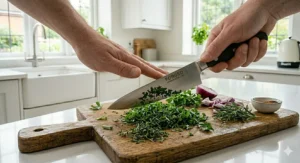
Not every excellent knife needs to cost the earth. The PAUDIN 8-inch is Amazon.co.uk’s bestselling chef knife in its price bracket for good reason: it delivers reliable, consistent performance for everyday home cooking at a price that doesn’t require any soul-searching at checkout.
The blade is high-carbon German stainless steel, hand-polished to a 16–18° angle per side — not the surgical sharpness of a VG10 knife, but genuinely sharp enough for confident, comfortable prep. The pakkawood handle is beautifully finished, warm in the hand, and ergonomically sensible. The full-tang construction means weight and balance extend all the way through the handle — no cheap, hollow-feeling grip that wobbles slightly after six months.
What’s clever about PAUDIN is that it doesn’t pretend to be something it isn’t. The steel won’t hold an edge as long as a Wüsthof or a Global, and regular honing on a steel (every few sessions) will become part of your routine. But for a family cooking everyday British meals — Sunday roasts, stir-fries, batch soups — it performs confidently and cleans up easily. UK reviewers on Amazon.co.uk praise it specifically for being “just sharp enough, just heavy enough, and just right for the price.”
✅ Full-tang pakkawood handle — quality feel above its price point
✅ Reliable everyday sharpness for family cooking
✅ Comes in an attractive gift box
❌ Requires more frequent honing than premium alternatives
❌ Steel won’t achieve the fine edge of VG10 or high-end German alloys
Best for: Families, flat-sharers, and everyday home cooks who want a reliable, good-looking knife without overspending. Around £25–£40 on Amazon.co.uk — superb value.
7. MOSFiATA 8-Inch Chef Knife
MOSFiATA has quietly become one of Amazon.co.uk’s most-reviewed kitchen knife brands, with tens of thousands of ratings and a loyalty that suggests it’s doing something right. The 8-inch chef knife uses EN1.4116 German stainless steel — the same specification used in many professional kitchen knives — at 56 Rockwell hardness. That’s softer than Japanese-style steel, which means it’s easier to sharpen at home with a basic whetstone or sharpening rod, and less prone to chipping under rough treatment.
The included finger guard and knife sharpener make this the most beginner-friendly package on our list. The micarta handle (a resin-composite material) offers a firm, non-slip grip that handles wet hands competently — relevant in any British kitchen where you’re constantly moving between the sink and the chopping board. It’s also one of the lightest options at this price, which reduces fatigue during longer cooking sessions.
The honest assessment: the MOSFiATA won’t dazzle an experienced cook who’s been using a Wüsthof for a decade. But for students equipping a first flat in Bristol or Birmingham, for a new cook who wants to learn knife skills properly, or for a secondary knife in the kitchen drawer, it’s an intelligent, honest buy.
✅ EN1.4116 German steel — easy to sharpen at home
✅ Finger guard and sharpener included
✅ Lightweight and beginner-friendly
❌ 56 HRC — edge won’t last as long as harder steels
❌ Less refined feel compared to full-tang pakkawood alternatives
Best for: Students, beginners, and anyone equipping a budget kitchen. Around £20–£35 on Amazon.co.uk — the most accessible entry point on our list.
How to Care for Your 8 Inch Chef Knife in the UK (And Why Most People Get It Wrong)
A great knife is only as good as its maintenance, and British kitchen habits — however understandable — are quietly ruining blades up and down the country. Here’s what actually matters.
Never put it in the dishwasher. This applies to every knife on this list, without exception. The high-temperature wash, the vibration of other items, and the harsh detergents combine to dull the edge and damage the handle. It takes thirty seconds to hand-wash and dry a knife. Do that.
Dry it immediately after washing. British kitchens tend toward the damp side — a wet knife left on a draining board is an invitation for corrosion, even on stainless steel blades. Wipe dry, then store.
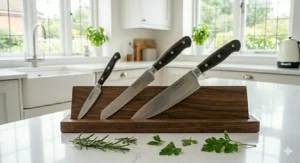
Store it properly. A knife rattling around in a drawer is dulling itself on every contact point. A wooden knife block, a magnetic wall strip (practical in smaller kitchens where worktop space is premium), or individual blade guards are all sensible solutions. Magnetic strips are particularly popular in UK flats where compact storage matters.
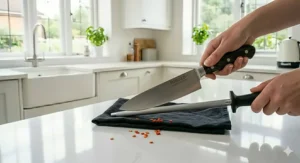
Hone before each use, sharpen twice a year. The distinction matters. Honing (on a steel rod) realigns the microscopic edge without removing metal — it should happen every session or two. Sharpening (on a whetstone or sharpening tool) actually removes material to recreate the edge — twice a year is enough for most home cooks. German steel (Wüsthof, ZWILLING) responds well to a standard honing rod. Japanese steel (Global, INTIGNIS, MITSUMOTO SAKARI) wants a whetstone at the correct angle — a rod can damage a finer edge.
Mind the chopping board. Hard surfaces — glass, ceramic, marble — destroy knife edges. A wooden or high-density plastic board protects the blade. In compact UK kitchens where granite and quartz worktops are increasingly common, this is worth emphasising: never chop directly on the worktop.
Which 8 Inch Chef Knife Suits Your Cooking Style? A UK Buyer’s Framework
Before you decide by price alone, consider who you actually are in the kitchen. These scenarios should sound familiar.
“I cook from scratch five or six nights a week, mostly British and Mediterranean food.” You need reliability above all else. The ZWILLING Professional S or Wüsthof Classic will serve you without complaint for a decade. Buy once, buy properly.
“I love cooking Japanese and Asian food — a lot of precise, detailed prep work.” The Global G-2 or INTIGNIS VG10 Damascus will reward you. Both achieve the finer edge angles that Japanese cooking techniques reward. Keep a cheaper knife for any heavy chopping.
“I’m equipping my first kitchen — student flat in Leeds, budget is tight.” MOSFiATA or PAUDIN. The MOSFiATA’s starter kit (with sharpener) makes it the smarter choice for someone learning technique.
“I want something special — a gift for my partner, or something I’ll feel proud to use.” MITSUMOTO SAKARI, without question. The presentation alone justifies the purchase, and the cooking performance backs it up.
“I cook fairly often but want proper quality without spending over £50.” The INTIGNIS VG10 Damascus is the answer. VG10 steel at that price point is remarkable, and the complete package (ceramic sharpener included) makes it feel far more premium than the price suggests.
The point is simple: the “best” knife is the one matched to your actual cooking life, not the most expensive one on the shelf. A £130 Wüsthof is no use if you only use it twice a week for light cooking and can’t be bothered sharpening it.
How to Choose an 8 Inch Chef Knife in the UK: 6 Criteria That Actually Matter
1. Steel hardness (HRC rating) German knives typically sit at 56–58 HRC. Japanese knives push to 60–62 HRC. Harder steel holds a sharper edge longer but chips more easily. Choose based on how carefully you cook — Japanese steel rewards mindful technique, German steel forgives rough treatment.
2. Blade angle German knives: 15–20° per side. Japanese knives: 10–15° per side. The narrower the angle, the sharper the cut — but the more delicate the edge. For general UK home cooking (roasts, soups, stir-fries, chopping root veg), 15–17° is a sensible middle ground.
3. Handle material and grip Pakkawood (resin-impregnated wood) offers a warm, secure feel and resists moisture well. Full metal handles (Global) are hygienic but divide opinion. Micarta and resin handles are practical and durable. Avoid anything that feels hollow or plastic-light — that’s usually a sign of a stamped, rather than forged, blade.
4. Weight and balance The right weight is entirely personal. Hold the knife at the pinch grip point (thumb and forefinger pinching the blade just above the bolster) and see if it balances there without tipping. A well-balanced knife feels like an extension of your hand. A poorly balanced one will fatigue your wrist within twenty minutes.
5. Construction: forged vs stamped Forged knives are made from a single piece of steel, heated and shaped under pressure. They’re denser, heavier, and better balanced. Stamped knives are cut from a sheet of steel — lighter, cheaper, and perfectly adequate for casual cooking. Every knife on our list is forged (or hand-forged), which is why they’re worth the premium over supermarket sets.
6. UK-specific practicality None of the kitchen knives on this list present voltage or plug issues — they’re manual tools, after all — but do consider your kitchen environment. If you cook in a cramped galley kitchen (common in UK terraced housing and flats), a lighter knife like the Global G-2 is easier to manoeuvre. If you have a large island kitchen, the heft of the Wüsthof or ZWILLING becomes an asset.
German vs Japanese: What the Style Difference Actually Means for Your Kitchen
This is the question everyone eventually asks, and it deserves a straight answer rather than knife-geek evasion.
German knives (Wüsthof, ZWILLING) are built for the way most people actually cook. The steel is softer, which means it bends rather than chips under stress. The blade angle is wider, making the edge more durable but slightly less precise. You can hone a German knife with a standard honing steel every few uses and it’ll stay sharp and reliable. You can accidentally cut through a chicken bone or dig into a pumpkin with force and the knife will survive. For the vast majority of British home cooks, a German-style knife is the more practical choice.
Japanese knives (Global, MITSUMOTO SAKARI, INTIGNIS) are built for precision. The steel is harder, which means the edge can be ground to an acute angle and holds it beautifully. Running a Japanese knife through raw fish, slicing vegetables paper-thin, or processing herbs — these tasks reveal why professional chefs who do fine prep work often prefer Japanese steel. But that hardness has a trade-off: a Japanese blade that meets a chicken bone at the wrong angle, or is used to smash a garlic clove with the flat of the blade in the classic fashion, can chip. These knives reward careful, intentional cutting technique.
The practical conclusion: if you want one knife that does everything without much thought, choose German. If you cook carefully, enjoy the craft of cooking, and want to refine your technique, Japanese-style will reward you. Many serious home cooks eventually own both — a German workhorse for everyday rough-and-tumble, a Japanese blade for the moments that deserve precision.
Common Mistakes When Buying an 8 Inch Chef Knife
Buying by weight alone. Heavy feels impressive in the shop, but a 300g knife that tires your wrist during a forty-minute Sunday prep session is no one’s friend. Heft should come from balance, not sheer mass.
Ignoring the handle. The blade gets all the attention, but you’re holding the handle. An uncomfortable handle ruins an otherwise excellent knife. If you’re buying online, check reviewer comments specifically about handle ergonomics — they’ll tell you what the spec sheet won’t.
Assuming more layers = better Damascus. Marketing around Damascus steel has become deeply confused. The number of layers (67, 101, whatever) affects appearance more than function. What matters is the core steel — VG10 core wrapped in 67-layer Damascus is far superior to a lesser steel wrapped in 101 layers.
Neglecting maintenance. The £30 knife that gets honed every other session will outperform the £130 knife that’s never been sharpened. Budget for a decent whetstone or honing rod alongside your knife purchase.
Buying a set when you only need one knife. The classic British tendency to buy the “complete set” results in seven knives, six of which get used approximately twice. An excellent 8 inch chef knife and a decent paring knife will handle 95% of everything your kitchen demands. Start there.
✨ Don’t Miss These Exclusive Deals!
🔍 Whether you’re after a budget entry point or a lifetime investment, click any highlighted product to check current pricing on Amazon.co.uk. Amazon Prime members get free next-day delivery — these picks are all dispatched from Amazon’s UK warehouses.
FAQ: 8 Inch Chef Knife UK
❓ What is an 8 inch chef knife, and do I really need one?
❓ What's the best 8 inch chef knife under £50 on Amazon.co.uk?
❓ How do I know if a chef knife is good quality before buying?
❓ Can I put my 8 inch chef knife in the dishwasher?
❓ Is a Japanese or German-style chef knife better for everyday cooking in the UK?
Conclusion: The Right 8 Inch Chef Knife Will Change How You Cook
There is a version of cooking where every task feels slightly effortful — where the knife drags, where you’re sawing rather than slicing, where the onion moves when it shouldn’t. And there’s another version, the one a good 8 inch chef knife enables, where prep work becomes rhythmic and satisfying, almost meditative.
The gap between those two experiences is not as expensive as you might think. The MOSFiATA proves that £25 buys genuine competence. The INTIGNIS VG10 proves that £45 buys impressive quality. And the Wüsthof Classic proves that some things really are worth buying once, properly, and never replacing.
What matters is matching the knife to your actual kitchen life — your cooking frequency, your technique, your storage, your budget. Use this guide as the starting point, check current pricing on Amazon.co.uk, and trust your instincts when you find the one that feels right.
Because the best chef knife in the world is the one that makes you want to cook.
✨ Don’t Miss These Exclusive Deals!
🔍 Ready to upgrade your kitchen? Click any highlighted product name to check the latest pricing and availability on Amazon.co.uk. Prime members enjoy free next-day delivery on eligible orders.
Recommended for You
- Lightweight Chef Knife UK: 7 Best Picks That Won’t Wreck Your Wrist (2026)
- Best 10 Inch Chef Knife for Large Hands UK 2026 | Top 7 Picks
- Best Chef’s Knife UK 2026: 7 Top Picks for Every Budget
Disclaimer: This article contains affiliate links. As an Amazon Associate, I earn from qualifying purchases. If you purchase products through these links, we may earn a small commission at no additional cost to you.
✨ Found this helpful? Share it with your mates! 💬🤗
