In This Article
There are few more demoralising moments in the kitchen than watching your lightweight, bargain-bin knife bounce off a butternut squash like it’s made of rubber. You press harder. The squash laughs. The knife bends. You consider ordering a takeaway.
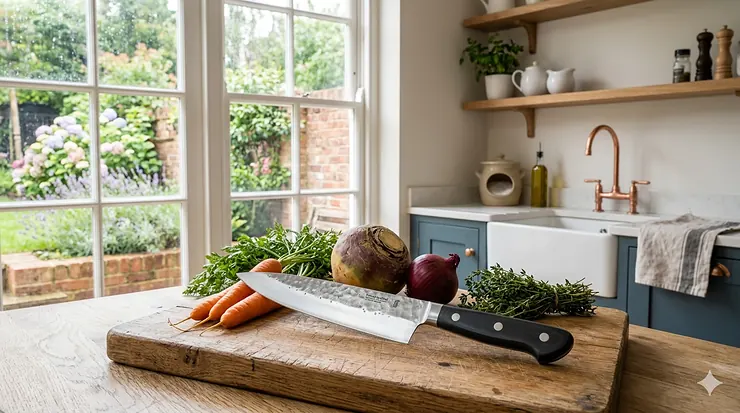
This is precisely when a heavy duty chef knife earns its keep.
So, what exactly is a heavy duty chef knife? In short, it’s a cook’s knife engineered to handle the jobs that would send an ordinary blade packing — dense root vegetables like swede, celeriac, and pumpkin; breaking down whole chickens with bone-adjacent cuts; or simply surviving years of daily professional use without developing a worrying wobble. The defining characteristics are typically a thick spine (2.5 mm or greater), a full bolster for balance and finger protection, a substantial blade weight between 220 g and 300 g, and construction from either forged high-carbon steel or comparably robust materials. A heavy duty kitchen knife for butchering isn’t the same as a cleaver — it still needs to perform precise slicing and dicing — but it brings enough mass and structural integrity to handle demanding ingredients without drama.
In the UK, where cooking traditions lean heavily on hearty, bone-in roasts and tough seasonal vegetables (swede, anyone?), owning a genuinely capable heavy duty chef knife is less a luxury and more a practical necessity. And with Amazon.co.uk now carrying a remarkable range of professional-grade knives at every price point, there’s no excuse for limping along with a blade that can’t handle a parsnip without wincing.
This guide covers the 7 best heavy duty chef knives currently available on Amazon.co.uk, alongside genuine expert commentary, a buyer’s framework for British kitchens, and some honest opinions on what the spec sheets don’t tell you.
Quick Comparison: Top 7 Heavy Duty Chef Knives at a Glance
| Knife | Blade Length | Construction | Spine Approx. | Full Bolster | Price Range | Best For |
|---|---|---|---|---|---|---|
| Wüsthof Classic 8″ | 20 cm | Forged | ~2.6 mm | ✅ Yes | £100–£140 | Serious home cooks & lifetime investment |
| ZWILLING Professional S 20cm | 20 cm | Forged | ~2.5 mm | ✅ Yes | £60–£95 | Everyday heavy-duty use, excellent value |
| ZWILLING PRO 20cm | 20 cm | Forged | ~2.6 mm | ✅ Yes | £95–£140 | Professional kitchens, ergonomic comfort |
| Victorinox Fibrox 25cm | 25 cm | Stamped | ~2.0 mm | ❌ No | £30–£55 | Budget buyers, culinary students, high volume |
| Zelite Infinity Comfort-Pro 8″ | 20 cm | Forged | ~2.4 mm | ✅ Yes | £45–£70 | Mid-budget buyers wanting German-forged quality |
| Global G-2 Cook’s Knife 20cm | 20 cm | Compressor moulded | ~2.0 mm | ❌ No | £80–£120 | Japanese-style precision with all-metal durability |
| MOSFiATA 8″ Professional Chef Knife | 20 cm | Full tang stamped | ~2.2 mm | ✅ Yes | £25–£45 | Entry-level buyers wanting a capable workhorse |
The table makes one thing immediately clear: if raw spine thickness and full bolster protection are your priorities for heavy-duty work, the German-forged trio of Wüsthof, ZWILLING Professional S, and ZWILLING PRO are the natural front-runners. However, the Victorinox Fibrox punches well above its weight class for everyday tough cutting despite lacking a bolster — its stamped blade is thinner, but its geometry and steel quality more than compensate at its price. Budget buyers shouldn’t write off the MOSFiATA either; it’s a surprisingly solid performer for the price, provided you’re not expecting heirloom-quality construction.
💬 Just one click — help others make better buying decisions too! 😊
✨ Don’t Miss These Exclusive Deals!
🔍 Take your cooking to the next level with these carefully selected heavy duty chef knives. Click on any highlighted product name to check current pricing and availability on Amazon.co.uk — and find exactly the blade your kitchen deserves.
Top 7 Heavy Duty Chef Knives on Amazon.co.uk: Expert Analysis
1. Wüsthof Classic 8″ Chef’s Knife — The German Standard-Bearer
The Wüsthof Classic is, quite simply, the knife against which all other full bolster chef knives are measured. Forged from a single piece of high-carbon stainless steel in Solingen — a German city so synonymous with blade-making that carrying its name is a legally protected quality designation — the Classic is tempered to 58 HRC and features Wüsthof’s proprietary PEtec (Precision Edge Technology) sharpening, which yields a factory edge roughly 20% sharper than previous generations. The spine measures approximately 2.6 mm at the heel, which gives it just enough heft to sail through a butternut squash without the blade deflecting sideways mid-cut. That sounds like a small thing. It isn’t.
What most UK buyers overlook is the full bolster. It’s not just cosmetic — it shifts the balance point of the knife to sit comfortably around the junction of blade and handle, which means you can chop for 20 minutes without your wrist staging a protest. For anyone cooking roast dinners regularly, or prepping large amounts of root vegetables through the British autumn and winter, this balance matters enormously. The triple-riveted polyoxymethylene handle resists moisture and heat, which is precisely what you want in a steam-heavy British kitchen.
UK reviewers consistently praise the out-of-box sharpness and long-term edge retention. Several note it survived years of daily professional use without reground. The main criticism? Some buyers with smaller hands find the handle slightly long and the bolster quite pronounced — it requires a proper pinch grip to use comfortably.
✅ Forged in Solingen Germany with 200+ years of heritage
✅ Full bolster and finger guard — ideal for heavy vegetable and meat prep
✅ PEtec edge technology for superior sharpness out of the box
❌ Premium price — represents a significant investment
❌ Full bolster makes tip-to-heel sharpening on a whetstone trickier
Available on Amazon.co.uk — Prime-eligible for next-day delivery. In the £100–£140 range, this is a lifetime tool rather than a short-term purchase.
2. ZWILLING Professional S Chef’s Knife, 20cm — The Sensible German Classic
The ZWILLING Professional S is what happens when a knife manufacturer with nearly 300 years of history decides to make something genuinely unpretentious. It’s forged in Solingen from ZWILLING’s proprietary special steel blend, ice-hardened via their FRIODUR process to produce a blade that’s simultaneously corrosion-resistant, flexible, and holds its edge with admirable stubbornness. At 260 g for the 20 cm model, it sits right in the sweet spot for a heavy duty kitchen knife for butchering — heavy enough for serious work, light enough that you won’t be exhausted after prep for Sunday roast.
The blade geometry is classically German: moderately curved belly, wide profile, and a full bolster with integrated finger guard. That finger guard isn’t just for safety (though it is genuinely useful when you’re pushing hard against a dense swede) — it also improves proprioception, giving you a clearer sense of exactly where your fingertips are relative to the blade. Practically speaking, this makes it a safer knife in a busy family kitchen, especially if children are occasionally hovering nearby asking whether dinner is ready yet.
UK buyers rate it extremely highly for everyday reliability. One reviewer described it as “the knife that makes you realise how rubbish your old one was.” The three-rivet plastic handle is durable and easy to clean, though some users find it slightly uninspiring aesthetically compared to pakkawood alternatives.
✅ Fully forged in Solingen with FRIODUR ice-hardening for long-term sharpness
✅ Full bolster and integrated finger guard — genuinely useful, not just decorative
✅ Excellent value for a German-made forged knife
❌ Plastic handle feels utilitarian compared to premium alternatives
❌ Bolster requires careful sharpening technique (like all full-bolster knives)
Currently in stock on Amazon.co.uk — Prime-eligible. £60–£95 range, representing arguably the best value German-forged option on the UK market.
3. ZWILLING PRO Chef’s Knife, 20cm — The Professional’s Daily Driver
Where the Professional S plays it straight, the ZWILLING PRO adds a distinctive innovation: a curved bolster (sometimes called an “ergonomic bolster” or “curved heel”) that allows the index finger to rest naturally behind the blade in a proper pinch grip without the bolster digging in. It sounds like a minor detail. Ask any professional chef who has used both, and they’ll tell you it changes everything about how the knife feels over a long shift. The blade geometry is nearly identical — FRIODUR ice-hardened special steel, forged full tang, roughly 2.6 mm spine — but the ergonomics are noticeably superior for extended use.
This is the knife to reach for if you’re serious about cooking and your hands are going to be working hard. For UK home cooks who prep for large family gatherings, or anyone who regularly cooks from scratch most evenings, the PRO’s ergonomics genuinely reduce hand fatigue in a way you’ll notice immediately. The broad blade also makes it well-suited to the rocking chop technique favoured in European-style cookery.
UK customer feedback is excellent — buyers frequently note it feels more balanced than the Professional S at first handling. Some mention it’s slightly blade-heavy, which is actually an advantage for heavy duty chopping through dense ingredients like celeriac or pumpkin.
✅ Curved bolster designed for proper pinch grip — reduces fatigue on long prep sessions
✅ Full tang forged construction with FRIODUR ice-hardening
✅ Broad blade ideal for heavy-duty chopping and German rocking technique
❌ Slightly pricier than Professional S for incremental ergonomic improvements
❌ Blade-heavy balance may not suit all cutting styles
Available on Amazon.co.uk, Prime-eligible. £95–£140 range — worth the premium over the Professional S if you cook frequently and intensively.
4. Victorinox Fibrox 25cm Cooking Knife — The Budget Powerhouse That Keeps Embarrassing Expensive Knives
Right. Let’s address the elephant in the room. The Victorinox Fibrox is a stamped knife. No bolster. Not forged in the romantic German tradition. It weighs just 188 g. And yet professional chefs — including Michelin-starred ones — use it daily. America’s Test Kitchen has recommended it consistently for nearly three decades. What’s going on?
The answer is geometry and steel quality. The Fibrox blade is made from Swiss high-carbon stainless steel, laser-tested to an exceptionally consistent edge angle. It arrives sharp, stays sharp longer than you’d expect for its price, and sharpens back to razor-keen with minimal effort. The 25 cm (10-inch) blade length on this model is particularly suited to the best chef knife for squash and pumpkin, because the extra reach means you can rock through large, awkward vegetables in fewer strokes. The Fibrox handle — that distinctive rubberised black grip — is genuinely non-slip even when wet, which matters in a British kitchen where damp hands are a constant reality.
Yes, it lacks a bolster, and the spine is thinner than the German heavyweights. But at this price? For everyday family cooking, culinary students in shared flats, or anyone who wants a capable daily-use knife without a significant financial commitment, the Fibrox remains one of the best kitchen knives available at any price point on Amazon.co.uk.
✅ Exceptional value — professional performance at an accessible price
✅ Non-slip Fibrox handle — genuinely safe in wet UK kitchen conditions
✅ 25 cm blade gives extra reach for large vegetables and meat prep
❌ Stamped blade lacks the spine thickness of forged alternatives
❌ No bolster — not ideal for those who rely on finger-guard protection
In stock on Amazon.co.uk — Prime-eligible, often qualifies for free delivery. £30–£55 range. An extraordinary deal.
5. Zelite Infinity Comfort-Pro Chef Knife 8“ — Mid-Budget German Steel with a Premium Feel
The Zelite Infinity Comfort-Pro occupies an interesting middle ground: it delivers German X50Cr MoV15 high-carbon stainless steel construction, a full bolster, and a full-tang design at a price that sits comfortably between the budget and premium tiers. The steel (X50Cr MoV15, also used by Wüsthof and ZWILLING) is hardened to around 56–58 HRC — not quite the edge retention of premium Japanese steel, but extremely rust-resistant and very easy to maintain with a standard honing rod, which is relevant in a humid British kitchen.
The pakkawood handle is where this knife genuinely punches above its price. Pakkawood (a resin-impregnated hardwood composite) is moisture-resistant, attractive, and feels far more substantial than the plastic handles on comparably-priced knives. It gives the Zelite Infinity an almost premium appearance, making it a surprisingly elegant option for gift-giving — the knife arrives in a gift box, which is a thoughtful touch.
For UK buyers who want German-spec forged steel without stretching to Wüsthof or ZWILLING prices, this is a very sensible choice. It’s well-suited to home cooks upgrading from budget supermarket knives for the first time. UK reviewers praise the initial sharpness and the comfortable grip; some note the edge doesn’t hold quite as long as the more expensive German alternatives, meaning honing every few sessions is advisable.
✅ German X50Cr MoV15 steel with full bolster — proper heavy-duty construction
✅ Pakkawood handle looks and feels far more premium than the price suggests
✅ Gift box included — a thoughtful option for presents
❌ Edge retention slightly below Wüsthof and ZWILLING at a similar duty level
❌ Some UK reviewers note blade finish inconsistency between batches
Available on Amazon.co.uk — Prime-eligible. £45–£70 range, making it a compelling mid-budget option.
6. Global G-2 Cook’s Knife 20cm — The Japanese Outlier in a German World
The Global G-2 is the knife that Anthony Bourdain famously championed, and it remains one of the best-selling Japanese kitchen knives in the world — including in the UK. It is, however, a very different animal from the German heavyweights reviewed above. Constructed entirely from CROMOVA 18 stainless steel (including the handle, which is hollow and filled with sand for balance), the G-2 is lighter, thinner-spined, and sharpened to a more acute 15° angle than the typical German 20–22°. It’s a best German chef knife alternative for those who prefer Japanese precision over German brawn.
What makes it relevant to a heavy duty discussion is its exceptional build quality and the fact that CROMOVA 18 is specifically engineered for superior edge retention compared to standard stainless steel — it holds that acute edge through surprisingly demanding work. The all-stainless design also means there are no handle joints, rivets, or crevices for bacteria to accumulate, which is why Global knives are popular in professional catering environments.
The honest caveat: at a 2 mm spine and no bolster, the G-2 is not the knife you’d choose for brute-force splitting of a pumpkin. It’s best suited to cooks who want a forged vs stamped knife debate settled by Japanese engineering philosophy — a knife that’s fast, precise, and surprisingly capable for its weight. It’s available on Amazon.co.uk as a standalone knife and in sets.
✅ CROMOVA 18 steel with exceptional edge retention
✅ All-stainless seamless construction — hygienic for professional use
✅ Lighter design reduces fatigue during extended fine prep work
❌ Thinner spine and no bolster — less suited to hard-chopping squash or bones
❌ Requires water stones rather than standard honing rods for resharpening
Available on Amazon.co.uk. £80–£120 range — premium positioning for a knife that earns it through pedigree and longevity.
7. MOSFiATA 8″ Professional Chef Knife — The Sensible Starter with No Excuses
At the entry end of the price spectrum, the MOSFiATA 8″ Professional Chef Knife deserves more credit than its modest price might suggest. Constructed from German EN1.4116 stainless steel with a full tang running the length of the pakkawood-style Micarta handle, it features a full bolster — a specification you genuinely don’t expect at this price point — and comes packaged with a finger guard and a sharpener, making it a well-rounded starter kit for new cooks.
The EN1.4116 steel is softer than the premium blends used in Wüsthof or ZWILLING knives (typically around 56 HRC), which means it won’t hold an edge quite as long under heavy use. But it also means it’s extremely easy to resharpen with the included sharpener, and it’s very forgiving of less-than-perfect sharpening technique — important for beginners who are still learning. The knife ships sharp and handles everyday kitchen tasks competently. For a student moving into their first flat, or anyone setting up a kitchen from scratch on a tight budget, this is a genuinely respectable starting point.
UK buyers consistently appreciate the included accessories and the gift-box presentation. Several UK reviews mention being “pleasantly surprised” by the build quality relative to the price — which is about as high a compliment as understated British consumers tend to volunteer.
✅ Full tang with Micarta handle and full bolster — genuine quality at a budget price
✅ Comes with sharpener and finger guard — excellent starter package
✅ German EN1.4116 steel — easy to maintain and resharpen
❌ Softer steel means more frequent honing/sharpening needed under heavy use
❌ Not suitable as a long-term professional-grade tool
Available on Amazon.co.uk — Prime-eligible, often qualifies for free delivery. £25–£45 range. Outstanding value for what it is.
How to Use and Maintain Your Heavy Duty Kitchen Knife: A UK Guide
Owning a proper heavy duty chef knife is only half the equation. The other half is keeping it in the condition that made you buy it in the first place.
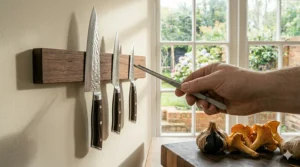
Storage. Don’t throw it in a drawer. A magnetic wall strip or a knife block is far preferable — loose drawers cause edge dulling and, frankly, the sort of surprise you don’t want when rummaging for a spatula. In compact British kitchens where counter space is at a premium, a magnetic strip mounted vertically on a splashback tile is an elegant solution.
Honing, not sharpening. There’s a common confusion here. A honing steel doesn’t sharpen — it realigns the microscopic teeth of the blade edge, which fold over during use. Run your knife along a steel at approximately 20° (for German blades) or 15° (for Japanese blades like the Global G-2) every few uses, and you’ll extend the time between proper sharpenings significantly. Think of honing as maintenance, and sharpening as restoration.
Washing. Hand wash only. Every time. The dishwasher is the enemy of a quality knife — the high temperatures, moisture cycling, and rattling against other items will destroy an edge and damage handles (even ostensibly dishwasher-safe models deteriorate faster in the machine). Dry immediately after washing. British kitchens can be draughty and humid; even stainless steel will eventually spot or discolour if left wet.
Cutting surfaces. Use wood or plastic boards only. Ceramic, glass, and stone surfaces destroy edges catastrophically — a single session on a ceramic plate will set your knife’s edge back months. The UK has a strong tradition of heavy wooden chopping boards, which are genuinely ideal for knife maintenance.
Rust prevention. In the British climate, even high-carbon stainless knives benefit from occasional light oiling on the blade (food-safe mineral oil) if they’re stored for extended periods without use.
Real-World UK Cook Profiles: Which Heavy Duty Chef Knife Fits Your Life?
The Ambitious Home Cook in Edinburgh
Sarah preps from scratch five evenings a week, cooks roasts every Sunday, and has a weakness for recipes involving butternut squash and whole chickens. She wants a knife that will last a decade and not require constant maintenance. The Wüsthof Classic 8″ is the answer — it’s expensive enough to feel like an investment, forgiving enough to handle aggressive cutting, and durable enough to be her grandchildren’s problem to worry about eventually.
The Culinary Student in a Manchester Shared House
Rayan is learning to cook properly for the first time, sharing a kitchen with four other people, and working with a modest budget. He needs something competent and virtually indestructible. The Victorinox Fibrox 25cm is made for him — it doesn’t require precious storage, tolerates occasional rough handling (within reason), and will teach him proper knife technique without punishing him financially if something goes wrong.
The Weekend Warrior in a Cotswolds Farmhouse
Helen is an enthusiastic but occasional cook who wants equipment that looks good in her kitchen and performs reliably when she’s hosting dinner parties. She’s not a professional, but she’s not buying cheap either. The Zelite Infinity Comfort-Pro is her match — the pakkawood handle and gift-box presentation give it a premium feel, the German steel performs admirably for her use frequency, and it sits beautifully on the magnetic strip above her range cooker.
The Professional Caterer in Central London
Marcus runs a busy catering operation and needs knives that survive daily professional use, are hygienic for food-safety inspections, and can be maintained quickly between services. The ZWILLING PRO 20cm for the ergonomics and daily reliability, or the Global G-2 if he prefers the all-stainless precision approach.
How to Choose a Heavy Duty Chef Knife in the UK: 7 Criteria That Actually Matter
Buying a heavy duty chef knife is not like buying a kitchen gadget. Do it right and you won’t need to do it again for years — possibly decades. Here are the seven criteria worth your attention.
1. Steel construction (forged vs stamped knife). Forged knives (Wüsthof, ZWILLING, ZWILLING PRO) are hammered from a single billet of heated steel, producing a denser, better-balanced blade with a natural bolster. Stamped knives (Victorinox Fibrox, MOSFiATA) are cut from sheet steel — lighter, cheaper, and in quality examples like the Fibrox, surprisingly capable. For genuinely heavy-duty work, forged construction generally wins on durability and balance, but don’t discount premium stamped options.
2. Spine thickness. For a thick spine chef knife suited to hard vegetables, aim for at least 2.4 mm at the heel. Anything below 2 mm will flex under serious pressure. The Wüsthof Classic at ~2.6 mm and the ZWILLING PRO at similar spec are the gold standard here.
3. Full bolster. A full bolster chef knife offers a natural finger guard and shifts the balance point towards the handle. This is genuinely important for safety and comfort during sustained cutting. If you’re regularly working through hard root vegetables — swede, celeriac, Jerusalem artichokes — a bolster matters.
4. Blade length for your use case. A 20 cm (8-inch) blade is the kitchen workhorse and suits most tasks. A 25 cm (10-inch) blade like the Victorinox Fibrox option gives extra reach and leverage for large pumpkins or whole cauliflowers, though it’s less manoeuvrable in tight spaces — which matters in the average British kitchen worktop.
5. Handle ergonomics. You’ll be holding this knife for extended periods. Try to handle options in a kitchen shop where possible before committing. Triple-riveted handles (Wüsthof, ZWILLING) are proven; pakkawood (Zelite Infinity, MOSFiATA) looks beautiful but verify the moisture resistance of the specific model.
6. Edge angle and maintenance requirements. German knives typically sharpen to 20°; Japanese blades to 15°. The acute Japanese edge is sharper but more fragile. For a heavy duty kitchen knife for butchering or general tough-ingredient work, the German 20° angle is more appropriate — it handles rough cutting without chipping.
7. Budget and lifetime value. Don’t think about the purchase price alone. A Wüsthof Classic at £120 amortised over 20 years of daily use costs roughly £6 per year. A £25 knife that needs replacing every two years costs more in the long run and far more in patience.
Forged vs Stamped Knife: The Honest Truth for UK Buyers
The knife world loves a good forged vs stamped debate, and like most debates in the knife world, the truth is more nuanced than the partisans on either side would admit.
Forged knives are made by heating a steel billet and hammering or pressing it into shape — a process that aligns the grain structure of the metal and produces a naturally integrated bolster. This results in a denser blade with better balance, superior heft for heavy-duty tasks, and — in quality steel — excellent edge retention. Wüsthof, ZWILLING, and ZWILLING PRO are the obvious examples in this guide. The downside is cost and weight; forged knives are always more expensive, and not everyone finds the extra weight comfortable for precision tasks.
Stamped knives are cut from cold-rolled sheet steel, like a cookie cutter pressed into metal. They’re inherently lighter, cheaper to produce, and — when made from quality steel with proper heat treatment — remarkably capable. The Victorinox Fibrox is the classic argument for stamped construction: tested by professional chefs worldwide, recommended by culinary institutions, and sharpened to a geometry that more than compensates for its lack of bolster.
For a heavy duty chef knife specifically, forged construction generally has the edge (if you’ll forgive the pun) because the spine thickness, balance, and structural integrity better suit aggressive tasks. But if budget is a constraint, don’t let anyone tell you a quality stamped knife is inherently inferior — the Victorinox Fibrox will outlast and outperform many mediocre forged options.
Heavy Duty Chef Knife for Hard Vegetables: A Practical Assessment
The best chef knife for squash and pumpkin — and by extension, swede, celeriac, kohlrabi, and other seasonally relevant British tough vegetables — needs three things: enough spine thickness to resist lateral deflection, enough weight to carry momentum through the cut, and enough belly curve to allow a rocking motion that progressively drives the blade through the ingredient.
By those criteria, the Wüsthof Classic and ZWILLING PRO are the clear winners in this guide. Their spine thickness sits at approximately 2.6 mm, their weight is in the 220–270 g range, and the moderately curved German belly is ideal for rocking through a halved butternut squash.
The Victorinox Fibrox 25cm deserves special mention here too — the additional blade length gives it excellent leverage on larger pumpkins, and the wide blade provides a useful knuckle clearance for push-cutting. The 10-inch format is notably better for hard-vegetable work than the standard 8-inch.
What to avoid for hard vegetables: thin Japanese blades (acute angle, prone to micro-chipping on hard surfaces), any knife under 2 mm spine, and anything flexible or lightweight. And regardless of which knife you choose, ensure your board is large, stable, and heavy — a sliding chopping board is a hazard when you’re applying downward pressure to a resistant squash.
✨ Ready to Upgrade Your Kitchen Game?
🔍 Check current pricing and availability on Amazon.co.uk for any highlighted knife in this guide. Prime members get next-day delivery — so you could be slicing through that squash problem by tomorrow evening.
Common Mistakes When Buying a Heavy Duty Kitchen Knife in the UK
Even well-researched buyers make these errors. Don’t be them.
Prioritising looks over geometry. A beautiful Damascus pattern on a thin-spined blade doesn’t make it a heavy duty knife. Some of the most visually spectacular knives in the under-£80 range have blades better suited to slicing tomatoes than splitting a pumpkin.
Ignoring handle ergonomics for your grip size. Most knives are tested by people with average-to-large hands. If you have smaller hands, the long handles and pronounced bolsters of some German knives can feel unwieldy. Try before you buy where possible.
Assuming “German steel” means the knife is made in Germany. Many knives marketed with German steel names are manufactured in China using steel of the specified grade. This isn’t inherently bad — manufacturing quality matters as much as steel grade — but it’s worth knowing. The Wüsthof Classic and ZWILLING knives are genuinely made in Solingen, Germany. Others may use the same steel designation while being assembled elsewhere.
Over-spending on a knife you won’t maintain. A £150 knife you never hone or sharpen will perform worse within six months than a £40 Victorinox that gets regularly maintained. Buy the knife you’ll actually look after, not the knife that looks impressive.
Buying based on blade hardness alone. Higher HRC hardness means better edge retention, but also a more brittle edge that chips more easily on hard vegetables. The 56–58 HRC range of German knives is intentionally balanced for general-purpose toughness. Japanese knives at 60–62 HRC hold an edge longer but require more careful use. Choose based on how you actually cook, not how you imagine you cook.
Ignoring the Consumer Rights Act 2015. UK buyers are well-protected when purchasing online — you have 14 days to return an item under the Consumer Contracts Regulations, and the Consumer Rights Act 2015 provides additional protection against goods that don’t meet reasonable quality expectations. Don’t be afraid to return a knife that doesn’t meet the description.
Long-Term Cost & Maintenance in the UK: What You Actually Spend
Let’s be honest about the total cost of knife ownership, because the purchase price is only the beginning.
A quality German-forged knife (Wüsthof, ZWILLING) in the £90–£140 range will typically need:
- A honing steel (£15–£30, one-time purchase)
- Professional resharpening once or twice a year if used daily (£5–£10 per service at a local knife shop or farmers’ market sharpener — these are increasingly common across UK cities and market towns)
- A knife block or magnetic strip if not already owned (£20–£50)
Total five-year cost of ownership for a Wüsthof Classic: approximately £175–£240 — which sounds reasonable for a decade-plus tool.
A budget option like the MOSFiATA in the £25–£45 range will likely need:
- More frequent resharpening given the softer steel
- Possible replacement at 3–5 years under regular heavy use
- The included sharpener is a starting point, but a quality pull-through or whetstone (£15–£40) will extend blade life considerably
The Victorinox Fibrox sits in an interesting middle ground: its steel is soft enough to need regular honing but its edge geometry is so well-designed that resharpening is unusually easy, making it arguably the lowest-maintenance option per pound spent.
For UK buyers, it’s also worth knowing that Which? magazine regularly tests and rates kitchen knives and is an excellent independent resource before committing to a purchase. The Food Standards Agency also provides useful guidance on food-safe materials and hygienic kitchen equipment standards.
FAQ
❓ What makes a chef knife 'heavy duty' compared to a standard kitchen knife?
❓ Are heavy duty chef knives available for next-day delivery in the UK?
❓ Is a full bolster chef knife better for butchering and hard vegetables?
❓ What is the difference between forged and stamped chef knives for heavy duty use?
❓ How do I maintain a heavy duty kitchen knife in the UK's damp climate?
Conclusion: The Right Heavy Duty Chef Knife for Your British Kitchen
There are knives, and then there are tools. The difference isn’t price — it’s the moment you stand at a chopping board with a truly capable blade and realise that the ingredient in question has absolutely no hope.
Choosing the right heavy duty chef knife ultimately comes down to how you cook and how much you’re willing to invest in that experience. If you cook seriously and frequently, the Wüsthof Classic 8″ or ZWILLING PRO 20cm will reward you handsomely for years. If you’re budget-conscious and want professional results without the professional price tag, the Victorinox Fibrox 25cm is one of the best kitchen purchases you can make on Amazon.co.uk, full stop. And if you’re somewhere in between — a passionate home cook who wants German engineering without the premium price — the ZWILLING Professional S or Zelite Infinity Comfort-Pro are both excellent, well-balanced choices.
Whatever you choose, buy it from a reputable source, maintain it properly, and remember: the best knife is the one you actually look after. Even the finest blade in the world is just decorative if it spends its life dull in a drawer.
For further reading on knife safety standards and food hygiene in the UK, the British Standards Institution and the Food Standards Agency are worth consulting. And if you’re interested in the deeper metallurgical history behind Solingen steel, Wikipedia’s entry on Solingen is a genuinely fascinating rabbit hole.
✨ Don’t Miss These Exclusive Deals!
🔍 Found your match? Click on any highlighted knife name to check current pricing and real-time availability on Amazon.co.uk. These picks represent the best of what British home cooks and professional chefs have access to in 2026 — happy cutting. 🇬🇧
Recommended for You
- Lightweight Chef Knife UK: 7 Best Picks That Won’t Wreck Your Wrist (2026)
- Best 10 Inch Chef Knife for Large Hands UK 2026 | Top 7 Picks
- Best 8 Inch Chef Knife UK 2026: 7 Top Picks Reviewed
Disclaimer: This article contains affiliate links. As an Amazon Associate, I earn from qualifying purchases. If you purchase products through these links, we may earn a small commission at no additional cost to you.
✨ Found this helpful? Share it with your mates! 💬🤗
