In This Article
If you’ve ever lost forty minutes scrolling Amazon.co.uk at some ungodly hour, you’ve almost certainly found yourself caught between a santoku knife and a chef knife. Both claim to be the one blade you truly need. Both look impressive hanging on a magnetic strip. And both will, if you let them, cost you considerably more than you’d planned.
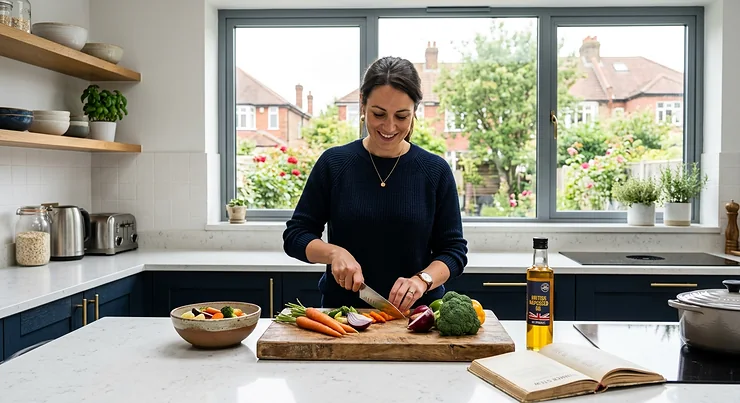
Here’s the thing: the santoku knife vs chef knife debate isn’t really about which one is objectively better. It’s about which one is better for you — your cooking style, your chopping board, your kitchen worktop, and yes, the fact that the typical British kitchen is roughly the size of a modest landing.
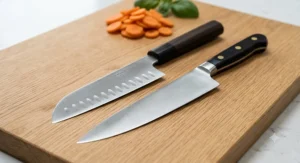
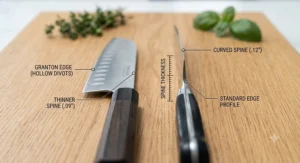
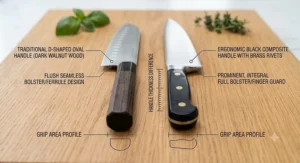
In a nutshell: a santoku (Japanese for “three virtues”) is a shorter, lighter blade — usually 14–18 cm — with a flat cutting edge and a rounded “sheepsfoot” tip, designed for precise up-and-down chopping. A chef knife is the long-standing Western workhorse — curved belly, pointed tip, heavier build — engineered for the rolling rock-chop that most of us were taught to use. Both handle meat, fish, and vegetables with ease. The key differences lie in technique, balance, and what kind of cook you actually are when nobody’s watching.
Over the following pages, we’ll cover the real-world differences between these two kitchen staples, review seven of the best options currently available on Amazon.co.uk across every budget, and give you a clear, no-waffle framework for choosing the right blade for your kitchen. Whether you’re kitting out your first flat in Manchester, upgrading the knife drawer in a family home in Surrey, or simply tired of hacking through butternut squash with something that came free with a set of saucepans — you’re in the right place.
Quick Comparison: Santoku vs Chef Knife at a Glance
| Feature | Santoku Knife | Chef Knife |
|---|---|---|
| Typical blade length | 14–18 cm | 18–25 cm (20 cm most popular) |
| Blade profile | Flat edge, sheepsfoot tip | Curved belly, pointed tip |
| Cutting technique | Push cut / up-and-down chop | Rock chop / rocking motion |
| Best for | Vegetables, fish, boneless meat | General purpose, large cuts, herbs |
| Typical weight | 120–200 g (lighter) | 200–300 g (heavier) |
| Blade angle | 10–15° (sharper) | 15–20° (more robust) |
| Maintenance | Whetstone preferred | Honing rod + standard sharpener |
| Best for… | Precision-focused, veggie-heavy cooking | Versatility-first, high-volume cooking |
The table above gives you the bare bones, but here’s what it doesn’t tell you: for most UK home cooks preparing weekday suppers — a stir-fry on Tuesday, a Sunday roast on the weekend — both knives handle the job admirably. Where the gap genuinely opens up is technique preference and frequency of use. If you cook Japanese or Asian-inspired meals regularly (and Ottolenghi-obsessed Britain clearly does), the santoku’s flat profile and lighter weight tend to feel more natural. If you’re dealing with larger joints, whole chickens, or long-stemmed leeks, the chef knife’s extra reach earns its keep. Neither is superior — they’re different answers to slightly different questions.
💬 Just one click — help others make better buying decisions too! 😊
✨ Don’t Miss These Exclusive Deals!
🔍 Take your kitchen game to the next level with these carefully selected knives. Click any highlighted product below to check current pricing and availability on Amazon.co.uk. These picks will help you find exactly the blade you need!
Top 7 Santoku & Chef Knives: Expert Analysis
The seven knives below span the full range of budget, style, and intended user — from the first serious kitchen knife to the lifetime investment. All have been verified as currently available on Amazon.co.uk. Prices are ranges based on research at time of writing; always check current pricing directly on Amazon.co.uk, as these fluctuate regularly.
1. Victorinox Swiss Classic Santoku Knife, 17 cm — Best Budget Santoku
The Victorinox Swiss Classic Santoku is the entry point that genuinely punches above its price tag — think of it as the Swiss equivalent of a reliable Ford Fiesta: not flashy, but utterly dependable.
The blade is 17 cm of stamped high-carbon stainless steel (X55CrMo14) with a bevelled edge ground to 15° on each side, making it noticeably sharper than most knives in this price bracket. The lightweight handle comes in a range of colours — red, green, yellow, orange, and pink — which means it doubles as a practical tool and a handy colour-coding system if you’re serious about food hygiene. The flat blade profile is ideally suited to the push-cut technique, making short work of courgettes, peppers, and onions on a standard UK kitchen worktop.
What most buyers overlook: this knife’s stamped construction means it lacks a bolster, which is actually an advantage for sharpening — you can run the entire edge along a whetstone without hitting a metal lip. It can also be maintained with a standard pull-through sharpener, no specialist equipment required.
UK reviewers on Amazon.co.uk are overwhelmingly positive, noting consistent out-of-the-box sharpness and the surprising longevity of a stamped blade with minimal maintenance.
✅ Pros:
- Outstanding value; best-in-class sharpness at this price
- Colour options aid kitchen hygiene and food safety
- Easy to sharpen with standard UK tools; no specialist sharpener needed
❌ Cons:
- Stamped blade lacks the heft of forged alternatives
- No granton (dimpled) edge — food may occasionally stick to the blade
Price range: Under £35 | Best for: First-time buyers, students, compact UK kitchens, gifting
2. Robert Welch Signature Santoku Knife, 17 cm — Best British-Designed Santoku
Here’s a name you might not immediately associate with Japanese knives — but Robert Welch, the Cotswolds-based British design house, has quietly built one of the most respected mid-range knife ranges in the UK. The Signature Santoku 17 cm is multi-award-winning and British-designed from the ground up, which counts for something beyond mere nationalism.
The blade is crafted from German DIN 1.4116 stainless steel, hand-sharpened to a 15° Japanese-style edge. The DuPont polymer handle is ergonomic, tactile, and slightly slimmer than typical German-style handles — a natural fit for the smaller hands that typify the average home cook rather than the average professional chef. At around 180 g, it’s not feather-light, but the balance across the bolster is excellent.
What makes this stand out for UK buyers specifically is the combination of British design heritage, genuine quality materials, and superb aftercare: a lifetime guarantee and UK-based customer support means you’re not navigating a German or Japanese returns process should anything go wrong. UK reviewers on Amazon.co.uk consistently highlight how well the blade handles thin vegetable slices — ideal for the careful prep work that Ottolenghi recipes demand on a Saturday afternoon.
✅ Pros:
- British design heritage with genuine premium credentials
- 15° Japanese-style edge; impressive factory sharpness
- Lifetime guarantee; excellent UK-based aftercare
❌ Cons:
- Slimmer handle won’t suit very large hands
- Less well-known brand may give pause at the price point — undeservedly
Price range: £40–£60 | Best for: UK buyers wanting quality with British provenance, keen home cooks, gift-buyers
3. ZWILLING Gourmet Santoku Knife, 18 cm — Best German Santoku
ZWILLING is one of the oldest knife manufacturers in the world, founded in Solingen — the “City of Blades” — in 1731. The Gourmet Santoku 18 cm brings that considerable pedigree to the santoku format at a genuinely accessible mid-range price.
The blade is stamped from a single piece of special formula stainless steel and precision-honed to 15° per side using laser-controlled technology. At 18 cm, this is at the longer end of the santoku spectrum — useful for larger chopping boards and more ambitious prep work. The ergonomic polymer handle is lightweight, secure, and won’t absorb odours or stains over time. Crucially, the blade features a partial granton edge — those shallow oval hollows that help food release cleanly rather than sticking to the blade mid-slice, a real-world advantage when working through cucumbers, potatoes, or courgettes at pace.
For the UK home cook, this knife occupies a sweet spot: German engineering at a price that doesn’t require advance notice from your bank. ZWILLING products sold on Amazon.co.uk are typically dispatched from UK fulfilment centres, making them Prime-eligible for next-day delivery. Reviewers frequently note how well it handles the classic British Sunday prep — parsnips, carrots, beetroot — without the blade losing its composure.
✅ Pros:
- 290+ years of German knife-making heritage
- Partial granton edge aids food release for cleaner slices
- Longer 18 cm blade suits a broader range of kitchen tasks
❌ Cons:
- Stamped rather than forged — less heft than ZWILLING’s Pro-series knives
- Handle is functional rather than beautiful — aesthetics are purely secondary
Price range: £45–£70 | Best for: Mid-range buyers wanting German quality without the premium price; frequent vegetable prep
4. Global G-46 Santoku Knife, 18 cm — Best Premium Japanese Santoku
If you’ve spent any time around serious home cooks, you’ve almost certainly seen someone produce a Global knife with the quiet pride of someone showing off a rather good watch. The G-46 is the full-sized flagship of Global’s santoku range — 18 cm of CROMOVA 18 stainless steel, entirely hand-crafted in Japan since 1985.
Built to a Rockwell hardness of 58 HRC — harder than most European blades, which typically sit at 56–57 HRC — the edge is finer, holds longer, and requires less frequent sharpening in day-to-day use. The iconic hollow stainless steel handle, filled with sand for balance, is genuinely polarising: some cooks love the sleek, hygienic, seamless construction (no wood to warp, no rivets to loosen); others find the uniform steel surface less grippy than a traditional handle, particularly when hands are wet. What’s not in dispute is the balance: Global designed the handle to perfectly counterweight the blade, and after twenty minutes of vegetable prep, your wrist will thank them.
At 175 g, this is a lighter knife than its substantial look suggests — a genuine asset in a British kitchen where extended Sunday curry prep is a reality. The convex 15° edge stays sharp considerably longer than European equivalents, though it requires either a Global-specific sharpener or a whetstone for maintenance — a standard honing rod won’t do, and this is a cost worth factoring in at purchase. Available on Amazon.co.uk with a healthy volume of positive UK reviews.
✅ Pros:
- CROMOVA 18 steel at 58 HRC: harder, sharper, superior edge retention
- Hygienic seamless construction — no joints, no rust traps
- Excellent factory balance; lighter in use than it appears
❌ Cons:
- Stainless steel handle can feel slippery when wet — a period of adjustment required
- Requires specific Global sharpener or whetstone; standard honing rods won’t maintain the edge
Price range: £80–£110 | Best for: Serious home cooks investing in a long-term knife; cooks with small to medium hands
5. Global G-80 Santoku Knife, 18 cm Fluted — Best Premium Santoku for Vegetable Work
Consider the G-80 the G-46’s more practically inclined sibling. The fundamental design is identical — CROMOVA 18 stainless steel, hollow sand-filled handle, made in Japan — but the G-80 adds a full fluted (granton) edge: 16 shallow hollows ground along the blade that create micro air pockets as you slice, dramatically reducing surface contact with food and preventing the stubborn suction that makes cucumber and potato slices cling to a flat blade.
In a British kitchen context, this matters considerably. If you regularly work through dense root vegetables — parsnips, celeriac, sweet potatoes, swede — the fluted edge makes the job noticeably faster and more pleasant. Thin-slicing beetroot for a salad without ending up with a magenta mosaic stuck to your blade? The G-80 handles it without complaint. Reviewers on Amazon.co.uk consistently highlight the food release as the standout feature, and the knife is Prime-eligible for next-day delivery.
Like all Global knives, this requires hand-washing only and a Global-specific sharpener for maintenance. The spec sheet won’t tell you this, but the sealed stainless construction is particularly well-suited to a damp British kitchen — no concerns about handle wood warping or rivets collecting moisture over the years of a British winter.
✅ Pros:
- Full fluted edge: outstanding food release for clean, unsticking slices
- Same premium CROMOVA 18 steel as the G-46
- Ideal for high-volume, vegetable-forward cooking
❌ Cons:
- Price premium over the G-46 for a benefit most cooks will only notice with sticky veg
- Same hand-wash-only and specific sharpener requirement as all Global knives
Price range: £100–£140 | Best for: Serious vegetable-focused cooks; frequent Asian-inspired cooking; premium gift-buyers
6. Victorinox Swiss Classic Chef’s Knife, 20 cm — Best Budget Chef Knife
No honest knife guide can omit the Victorinox Swiss Classic 20 cm chef’s knife. It’s the one professional chefs, culinary school students, and food writers return to again and again when asked: “What’s the best kitchen knife under £50?” The honest answer, almost invariably, is this one.
The blade is stamped X55CrMo14 high-carbon stainless steel, sharpened to 15° on each side. At 20 cm, you get the full Western chef’s knife experience: a gentle curved belly perfectly suited to the rock-chop technique, a pointed tip for detail work, and enough length to halve a large butternut squash without the blade running out of room. The Fibrox handle — a textured, non-slip polypropylene grip — is ergonomic, NSF-certified for professional kitchen use, and frankly one of the better handles in any price bracket. It’s particularly comfortable during extended Sunday roast prep.
What this knife lacks in forged heft it more than compensates for in sharpness and ease of maintenance. It’ll take a sharp edge from a standard honing rod, a whetstone, or a pull-through sharpener — no specialist equipment required. UK reviewers on Amazon.co.uk are almost universally positive, with many noting it as the best knife they’ve ever owned relative to cost. Prime-eligible for next-day delivery across the UK.
✅ Pros:
- Exceptional value; professional-grade sharpness at a domestic price
- Maintains edge with standard UK sharpening tools — no specialist equipment
- NSF-certified Fibrox handle; comfortable for extended prep sessions
❌ Cons:
- Stamped blade: lighter and less balanced than a forged knife
- No bolster — purists will notice the difference in feel versus a forged chef knife
Price range: £35–£55 | Best for: Budget-conscious buyers; first knife purchases; students in shared flats; anyone unconvinced by premium marketing
7. Wüsthof Classic Chef’s Knife, 20 cm — Best Premium Chef Knife
If the Victorinox is the sensible family hatchback, the Wüsthof Classic is the finely engineered German saloon you buy when you’ve decided to stop compromising. Made in Solingen since 1814, the Classic 20 cm chef’s knife is the benchmark against which most European knives are still quietly measured.
The blade is forged from a single piece of X50CrMoV15 high-carbon stainless steel, hardened to 58 HRC using Wüsthof’s proprietary PEtec (Precision Edge Technology) — laser-controlled sharpening that guarantees every blade leaving the factory is edge-perfect from tip to heel. The result is an impressively sharp, impressively consistent edge that handles the rock-chop technique with a satisfying authority you simply won’t find at this price point from a stamped blade.
At around 220 g, this is a heavier knife than the santoku options on this list — which is rather the point. The weight does much of the work on larger tasks: halving whole chicken breasts, working through a dense celeriac, or reducing a pile of flat-leaf parsley to fine mince in thirty seconds of confident rocking motion. The triple-riveted, contoured synthetic handle is comfortable for pinch-grip users and those with larger hands, and the full bolster provides both balance and a reliable finger guard. Available on Amazon.co.uk; UK age verification required at delivery — the driver will confirm your year of birth, standard procedure for all bladed products under UK law.
✅ Pros:
- Forged German steel at 58 HRC: superb edge retention; built to last decades
- PEtec laser sharpening: guaranteed consistent factory edge
- Full bolster and triple-riveted handle; serious balance for serious cooking
❌ Cons:
- Premium price — a genuine investment rather than an impulse purchase
- Heavier than Japanese alternatives; may fatigue smaller hands on longer prep sessions
Price range: £100–£130 | Best for: Serious home cooks seeking a lifetime knife; those cooking large joints, roasts, and family meals regularly
Top 7 Products Comparison at a Glance
| Product | Type | Blade Length | Steel / HRC | Price Range | Best For |
|---|---|---|---|---|---|
| Victorinox Swiss Classic Santoku | Santoku | 17 cm | X55CrMo14 / 55–56 HRC | Under £35 | Budget / first knife |
| Robert Welch Signature Santoku | Santoku | 17 cm | DIN 1.4116 / 57 HRC | £40–£60 | British design quality |
| ZWILLING Gourmet Santoku | Santoku | 18 cm | Special stainless / 57 HRC | £45–£70 | German mid-range |
| Global G-46 Santoku | Santoku | 18 cm | CROMOVA 18 / 58 HRC | £80–£110 | Premium Japanese |
| Global G-80 Santoku Fluted | Santoku | 18 cm | CROMOVA 18 / 58 HRC | £100–£140 | Vegetable-focused |
| Victorinox Swiss Classic Chef | Chef | 20 cm | X55CrMo14 / 55–56 HRC | £35–£55 | Budget / best value |
| Wüsthof Classic Chef | Chef | 20 cm | X50CrMoV15 / 58 HRC | £100–£130 | Premium lifetime buy |
From the comparison above, the clearest takeaway is the value gap between the Victorinox options — exceptional performance at entry-level prices — and the premium tier, where Global and Wüsthof earn their cost through harder steel, superior edge retention, and build quality that genuinely differs from budget alternatives. The middle ground (Robert Welch, ZWILLING Gourmet) is where most British home cooks will find their sweet spot: real quality without the price anxiety. One thing worth noting: the Global knives’ 58 HRC rating matches the Wüsthof Classic, but from Japanese steel at a sharper initial angle — a different approach to similar hardness, with different maintenance implications.
✨ Don’t Miss These Exclusive Deals!
🔍 Ready to upgrade your knife drawer? Click any highlighted product above to check current pricing and Prime delivery availability on Amazon.co.uk. Free next-day delivery for Prime members on eligible orders.
Push Cut vs Rocking Cut: How to Get the Most from Your New Knife
This is the section most Amazon listings won’t tell you — because the knife you choose only performs as well as the technique you use with it. Buy the wrong one for your natural style, and even an excellent blade will feel awkward.
The Rock Chop (Chef Knife’s Natural Habitat)
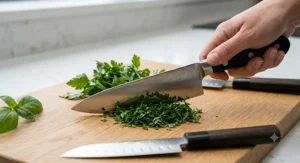
Hold the tip of the blade lightly against the chopping board. Keeping the tip in contact, rock the handle up and down while drawing the knife slightly back with each stroke. The curved belly of a chef knife is specifically designed for this motion: it lets you work through a pile of herbs, onions, or garlic in smooth, continuous arcs without lifting the blade off the board entirely. It’s efficient, fast, and — once the muscle memory is established — genuinely satisfying. Most of us were taught this technique first, which is why the chef knife feels instinctively natural.
The Push Cut (Santoku’s Strength)
Lift the blade fully, push it forward and down through the ingredient, then lift again. No rocking — the santoku’s flat edge means there’s minimal belly to rock on, and attempting the technique results in an awkward tipping motion rather than a smooth arc. The push cut creates clean, decisive slices with minimal force, particularly valuable when working with delicate fish, wafer-thin courgette rounds, or fresh herbs where bruising matters. Many home cooks find the push cut more intuitive once they try it — there’s a satisfying finality to each stroke.
Which Should You Use?
In practice, most UK home cooks who’ve been using a chef knife for years find the rocking motion deeply ingrained — switching to a santoku can initially feel clunky precisely because you’re fighting muscle memory. The inverse is equally true. The good news: both techniques can be learned in a weekend of deliberate practice, and neither is technically superior. They are simply different tools shaped for different approaches to the same task. If you’re genuinely uncertain which suits you better, BBC Good Food’s knife skills guide provides a concise, practical introduction to both.
Which Knife Should You Actually Buy? A British Cook’s Decision Framework
Rather than hedging endlessly, here’s a practical decision framework shaped around real UK cooking habits:
If you mostly cook weeknight suppers and stir-fries — a santoku is almost certainly the better daily driver. Its lighter weight and push-cut efficiency suits the high-veggie, quick-prep cooking most of us actually do Monday to Friday in a compact British kitchen.
If you regularly cook roasts, joint whole chickens, or work through large cuts of meat — a chef knife’s extra length and weight earn their place. The Global G-46’s precision won’t help you much when you’re trying to break down a leg of lamb.
If you have smaller hands or wrist fatigue is a concern — santoku wins fairly comfortably. The shorter, lighter profile puts meaningfully less strain on the wrist during extended prep.
If you’re buying your first serious kitchen knife — the Victorinox Swiss Classic chef’s knife is the answer, full stop. It’s forgiving, easy to maintain with standard tools, and will handle every reasonable kitchen task short of deboning.
If budget allows only one premium knife — the Global G-46 offers the best long-term value as a dedicated santoku; the Wüsthof Classic is the equivalent investment for a chef knife.
If you cook regularly for a family — consider both. A santoku for daily veg prep and a chef knife for roast days is a combination that British food writers have quietly recommended for decades. With the Victorinox options at both ends, you could have both for under £90 total — less than one mid-range premium knife.
Santoku vs Gyuto Knife Difference: What UK Buyers Need to Know
A question that comes up regularly, particularly among buyers drawn to Japanese kitchen knives: is there a meaningful difference between a santoku and a gyuto? The short answer is yes — and it’s worth understanding before committing your money.
A gyuto (literally “cow sword”) is the Japanese equivalent of the Western chef’s knife: longer (typically 21–27 cm), with a more pronounced belly curve, a pointed tip, and a design built around the rocking-cut technique. In many respects, choosing between a santoku and a gyuto mirrors the choice between a santoku and a chef knife — the gyuto simply offers the same rolling motion as its German and French counterparts, crafted from harder Japanese steel at a sharper angle.
For UK buyers on Amazon.co.uk, gyuto knives from brands such as Global, PAUDIN, and MITSUMOTO SAKARI are currently available, typically priced in the £50–£200 range depending on steel quality. If you’re committed to Japanese steel but prefer the longer blade and rock-chop technique of a Western chef’s knife, a gyuto is worth investigating as an alternative to both knives on this list.
According to the Wikipedia article on the santoku knife, the style originated in postwar Japan as an adaptation of the Western chef’s knife for Japanese domestic cooking patterns, which were traditionally more vegetable-focused and required less of the heavy-duty butchery a full chef’s knife was built for. That historical context is rather illuminating when deciding which style genuinely suits your kitchen habits — and whether you’re reaching for a knife shaped by your actual cooking, or one shaped by someone else’s.
Chef Knife vs Santoku for Vegetables: The Real-World Test
Ask any professional chef which knife they reach for when breaking down a large quantity of vegetables, and the answer is frequently: it depends. For UK home cooks, the vegetable question is the most practically relevant comparison in the santoku knife vs chef knife debate.
For large, dense vegetables (swede, celeriac, butternut squash, large beetroot): the chef knife wins. Weight and length give you leverage and momentum through dense, resistant produce without the effort becoming a workout. The Wüsthof Classic’s forged blade handles these tasks with a satisfying authority.
For precise, thin slicing (cucumber, courgette, fennel, shallots, radishes): the santoku wins. The flat edge and lighter build give you finer control over slice thickness, and the shorter blade is more manoeuvrable on a standard UK chopping board.
For herbs: personal preference, but the rock chop of a chef knife tends to produce finer mince more quickly. A santoku can mince herbs — it simply requires a slightly different, more deliberate technique.
For onions: broadly equal. The difference here comes down to technique comfort more than blade geometry.
Which? magazine’s kitchen knife testing programme — one of the most rigorous independent consumer tests in the UK — has consistently found that both styles perform well across general vegetable prep, with the key differentiator being user technique rather than blade design. The right knife is the one you’ll use confidently and maintain properly.
How to Choose a Kitchen Knife in the UK: 7 Key Questions
- What’s your dominant cutting technique? If you rock-chop by instinct, buy a chef knife. If you push-cut or want to learn, buy a santoku.
- How large is your chopping board? Smaller boards — common in UK flat kitchens — suit the shorter santoku profile.
- What do you cook most often? High-vegetable, Asian-inspired cooking: santoku. Large joints, varied prep, high-volume cooking: chef knife.
- What’s your hand size? Smaller hands tend to prefer the santoku’s lighter, shorter profile; larger hands generally find the chef knife’s bolster and weight more natural.
- What’s your maintenance commitment? Japanese-steel santokus (Global) require whetstone maintenance. German-style chef knives (Victorinox, Wüsthof) work with standard honing rods and pull-through sharpeners readily available in UK supermarkets.
- What’s your storage setup? If you’re storing in a kitchen drawer rather than a magnetic strip, a shorter santoku is less likely to damage its edge against other utensils — a real consideration in compact UK kitchens.
- What’s your honest budget? Both Victorinox options on this list offer the best entry-level value in the UK market. Global rewards long-term investment for a santoku; Wüsthof for a chef knife. Don’t spend premium money on your first serious knife — develop technique first.
Common Mistakes When Buying Your First Kitchen Knife
1. Buying a knife set instead of one excellent knife. A block of eight knives for £30 sounds like a bargain until you realise you’re using two of them and the remaining six are occupying valuable worktop real estate. Buy one excellent knife first and build from there.
2. Overlooking the total cost of ownership. A Global G-46 at around £90 is excellent value. A Global G-46 maintained with entirely the wrong sharpening tool and dulled beyond useful sharpness after eighteen months is considerably less so. Budget for maintenance: a decent whetstone (£20–£40 on Amazon.co.uk) or the brand-appropriate sharpener is part of the honest cost.
3. Choosing on aesthetics rather than handle ergonomics. The damascus-patterned knife with the gorgeous walnut octagonal handle looks spectacular. Whether it fits your actual hand, for your actual cutting style, after thirty minutes of prep, is the more pressing question. If possible, handle a knife before buying — John Lewis, ProCook, and Lakeland stores across the UK have floor displays for exactly this reason.
4. Putting Japanese knives in the dishwasher. The UK’s hard water (particularly across the South East and Midlands) combined with aggressive dishwasher detergents is spectacularly effective at destroying even premium knife edges within weeks. Hand-wash only, every time, without exception.
5. Ignoring UK delivery and age verification requirements. All knives sold on Amazon.co.uk are subject to UK law: buyers must be 18 or over, and delivery requires age verification at the door. Prime next-day delivery is available for most bladed products in eligible postcodes — the driver will confirm your year of birth on arrival, a standard process that typically takes under a minute.
Long-Term Care & Maintenance for British Kitchens
British kitchens present a specific set of challenges for knife care: ambient moisture in older homes, hard tap water across large swaths of England and Wales, and the eternal temptation of the dishwasher.
Storage: A magnetic knife strip is the gold standard — keeps edges off hard surfaces, airs the blade, and frees up drawer space in a typically compact UK kitchen. If storage is genuinely limited, blade guards (widely available on Amazon.co.uk for around £5–£10 each) protect both the edge and your fingers.
Cleaning: Warm water, a small amount of washing-up liquid, a soft cloth — rinse and dry immediately. Hard water deposits left to dry on a blade over time create micro-corrosion on even quality stainless steel. Ten seconds of thorough drying makes a meaningful long-term difference.
Sharpening: Japanese-steel knives (Global) maintain best with a whetstone — a 1,000 grit stone handles regular touch-ups; a 3,000–6,000 grit stone refines the edge. German steel (Victorinox, Wüsthof) responds well to a honing rod used every three to five cooking sessions. Pull-through sharpeners are fine for emergency touch-ups but remove more metal than necessary for routine maintenance.
Humidity awareness: In British conditions — particularly in older terraced housing or flats without good kitchen ventilation — store knives on a strip or in a block rather than loose in a damp drawer. It’s a small habit that extends blade life considerably.
FAQ
❓ What is the main difference between a santoku knife and a chef knife?
❓ Should I buy a santoku or chef knife as my first kitchen knife?
❓ Can I use a santoku knife for rocking cuts like a chef knife?
❓ Are Global knives worth the money for a UK home cook?
❓ Do Amazon.co.uk knife deliveries require age verification in the UK?
Conclusion
The santoku knife vs chef knife debate, when you strip away the marketing copy and the aesthetics, comes down to a straightforward question: how do you actually cook?
If your weeknight prep leans heavily on vegetables, you favour precise push cuts over rolling rock chops, and your kitchen is a typical compact British flat — the santoku, in one of its excellent forms, is likely your ideal daily companion. Start with the Victorinox Swiss Classic for outstanding value, step up to the Robert Welch Signature for British design credentials, or invest in the Global G-46 for a knife you’ll still be reaching for in twenty years.
If you cook everything — large joints, whole chickens, mixed prep for a family — or if the rocking motion is simply too deeply ingrained to change, the chef knife remains the most versatile tool in the Western kitchen. The Victorinox Swiss Classic chef’s knife is the best value entry point on the UK market today; the Wüsthof Classic is the lifetime investment for those who want forged German excellence and can genuinely justify the cost.
The honest truth? Many serious home cooks across Britain quietly end up with both: a santoku for daily vegetable-forward cooking and a chef knife for roast days and larger jobs. Between the two, you’d cover every reasonable kitchen task. But if the mortgage is a consideration — and in Britain, when isn’t it? — start with one excellent knife from this list and discover how far it takes you.
For independent, rigorous UK consumer testing on kitchen equipment, the team at Which? remains the most trusted resource for British buyers navigating the knife market.
✨ Don’t Miss These Exclusive Deals!
🔍 Ready to find your perfect blade? Click any highlighted knife in this article to check current pricing, Prime availability, and delivery options on Amazon.co.uk. Your best kitchen upgrade might be one click away.
Recommended for You
- Best Western Style Santoku Knife UK 2026: 7 Expert Picks
- Best Japanese Santoku Knife UK 2026: 7 Expert Picks Reviewed
- Best Santoku Knife UK 2026: 7 Top Picks for Every Budget
Disclaimer: This article contains affiliate links. As an Amazon Associate, I earn from qualifying purchases. If you purchase products through these links, we may earn a small commission at no additional cost to you.
✨ Found this helpful? Share it with your mates! 💬🤗
