
In This Article
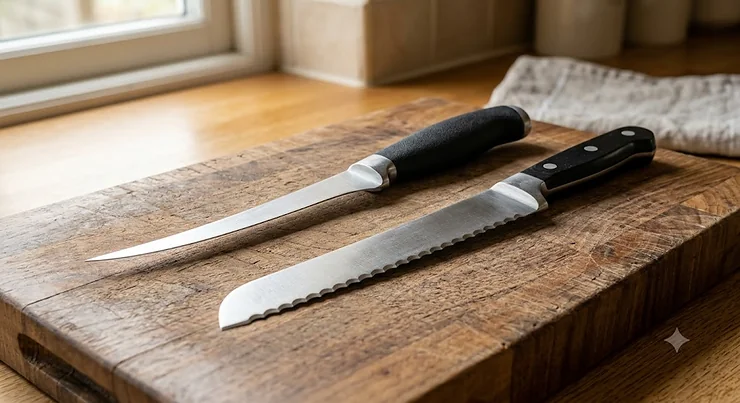
There’s a very specific kind of heartbreak that comes from mangling a beautiful piece of salmon because your knife wouldn’t flex, wouldn’t hold an edge, or simply wasn’t built for the job. A fish filleting knife is a long, narrow-bladed knife — usually flexible or semi-flexible — designed to glide along a fish’s spine and ribcage, separating flesh from bone with minimal waste and a clean skin-off finish. Unlike a chef’s knife, which is built for chopping downward through vegetables and meat, a fillet knife works almost horizontally, following the curve of a backbone rather than fighting it.
Whether you’re a weekend angler cleaning a sea trout on the riverbank, a home cook who’s decided that a whole sea bass from the fishmonger is cheaper (and fresher) than pre-cut fillets, or someone prepping flatfish like dover sole for the first time, the right blade changes everything. Buy the wrong one and you’ll spend twenty minutes hacking apart what should have been a five-minute job. Buy the right one and filleting becomes almost meditative.
This guide covers seven genuinely well-reviewed knives — from angler favourites to professional semi-flex blades — plus honest, spec-backed advice on choosing between long and short blades, stainless steel grades, and electric versus manual options. All prices below are approximate ranges rather than fixed figures, since retail prices shift constantly; always check the current price before buying.
Quick Comparison Table
| Knife | Blade Length | Flexibility | Best For |
|---|---|---|---|
| Rapala Fish’n Fillet | 19cm (7.5″) | Flexible | Salmon and trout |
| Victorinox Fibrox/Swibo | 20cm | Flexible | All-round long blade |
| Morakniv Fishing Comfort Fillet 155 | 15.5cm | Flexible | Budget value |
| F. Dick Pro Dynamic | 20.3cm | Semi-flexible | Sea bass, professional use |
| Taylors Eye Witness Heritage | 18cm | Semi-flexible | British-made durability |
| SHAN ZU Japanese Filleting Knife | 18cm | Flexible | Tight budgets |
| Electric Fillet Knife (Rapala Heavy Duty) | 15–23cm blades | Reciprocating | High-volume, flatfish batches |
Looking at the spread above, the pattern that jumps out is that flexibility and length aren’t the same decision — a knife can be long and stiff, or short and whippy, and each combination suits different fish. The Rapala Fish’n Fillet and Victorinox Fibrox/Swibo dominate for oily, round-bodied fish like salmon, while the F. Dick Pro Dynamic and Taylors Eye Witness Heritage trade a little flex for control, which matters more on firmer-fleshed sea bass. If you’re processing a lot of fish in one sitting, the electric option earns its keep purely on speed and reduced wrist fatigue.
💬 Found a knife you like the look of already? Scroll down to see it in action below!😊
Top 7 Fish Filleting Knives: Expert Analysis
1. Rapala Fish’n Fillet Knife — the angler’s classic since the 1950s
The standout here is heritage: Rapala’s Fish’n Fillet has reportedly sold over 100 million units, and it’s the knife that shaped what most people picture when they hear “fillet knife.” The 19cm progressively tapered blade is full-tang, made from European stainless steel, and anchored into a varnished birch handle that’s been essentially unchanged for decades — a genuine leather sheath and built-in sharpener come as standard.
In practice, that taper matters: the blade starts stiff near the handle for control and thins toward the tip for delicate work around bones, which is exactly what salmon and trout demand. The birch handle isn’t ergonomic in the modern ridged-rubber sense, but it’s light, doesn’t get slippery when wet, and full-tang construction means it won’t loosen with years of use. Based on the spec comparison with softer 420-grade blades on cheaper knives, the tempered stainless here holds an edge noticeably longer between sharpenings.
According to a UK-focused test from Testix, which examined nine fillet knives against roughly 1,900 aggregated customer reviews from UK retailers, the Rapala Fish’n Fillet consistently ranked at the top for control and edge retention, with testers noting it produced clean fillets on sea trout in well under four minutes each. Reviewers on general retail sites also flag it as a reliable gift for anglers, thanks to the recognisable Rapala branding stamped into the blade.
Pros:
- ✅ Full-tang blade holds an edge through repeated use
- ✅ Classic taper suits salmon, trout, and other round fish
- ✅ Comes with sheath and built-in sharpener as standard
Cons:
- ❌ Birch handle can feel dated next to rubberised grips
- ❌ No finger guard on the base model
Prices sit in the £30-£40 range depending on blade length chosen. For anyone who fillets salmon or trout regularly, this is genuinely hard to beat on value.
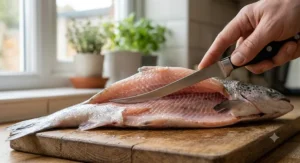
2. Victorinox Fibrox/Swibo Filleting Knife — best long, flexible all-rounder
Victorinox built its reputation on the Swiss Army knife, but its Fibrox professional kitchen line is arguably more respected among working chefs. The 20cm narrow blade here is noticeably longer than most of this list, paired with the brand’s signature black Fibrox handle — textured, non-slip, and designed to stay grippy even when your hands are covered in fish slime.
The extra 5cm of blade over something like the Morakniv changes the geometry of every stroke: on a larger salmon or sea bass, a longer blade lets you complete a single fillet cut in one continuous pass rather than several shorter strokes, which reduces the ragged, sawn-looking edges that come from stopping and restarting. Victorinox also grinds these blades with a straight edge that, per the brand’s own guidance, rarely needs resharpening under normal home use — a real advantage if you only fillet fish a handful of times a year and don’t own a sharpening stone.
Amazon UK listings for the Fibrox filleting range show consistently strong customer sentiment, with the wider Fibrox family averaging around 4.7 out of 5 stars across hundreds of reviews; buyers frequently cite value for money and comfortable ergonomics as recurring themes, alongside praise for how the knife holds its edge.
Pros:
- ✅ 20cm blade suits larger fish and longer single strokes
- ✅ Fibrox handle stays secure even when wet
- ✅ Straight edge needs infrequent resharpening
Cons:
- ❌ Longer blade is less nimble on small pan fish
- ❌ Sold without a sheath on some listings, so check before buying
Expect to pay somewhere in the £25-£45 range depending on the exact model and blade length. This is the one to reach for when “long fish filleting knife” is genuinely what you’re searching for.
3. Morakniv Fishing Comfort Fillet 155 — best value Scandinavian pick
Morakniv has been making knives in Mora, Sweden since 1891, and the Fishing Comfort Fillet 155 is its dedicated fish knife: a 15.5cm blade in Sandvik 12C27 stainless steel, only 1.9mm thick, with a patterned high-friction handle built specifically to stay put in slippery hands.
That Sandvik steel is worth pausing on. It’s a Swedish alloy prized in the knife industry for combining sharpness, toughness and rust resistance in one package, which is why you’ll find it on knives costing far more than this one. What most buyers overlook about the 155 is that the thin 1.9mm blade stock is what gives it such lively flex — it follows the contours of a ribcage almost passively, which is forgiving for less experienced filleters who haven’t yet developed a steady hand.
Aggregated review sentiment on Morakniv’s fishing range is largely positive, with buyers frequently praising edge retention and ease of resharpening; a recurring theme in reviews is that the grippy handle takes a session or two to get used to if you’re coming from a smooth wooden handle, but most reviewers say they preferred it once adjusted.
Pros:
- ✅ Sandvik 12C27 steel offers excellent edge retention
- ✅ Thin, lively blade flex suits beginners
- ✅ High-friction handle grips well when wet
Cons:
- ❌ Textured handle feels unfamiliar to some at first
- ❌ Shorter blade struggles on larger fish over 2kg
Typically priced in the £25-£35 range with sheath and belt clips included, this is one of the strongest value propositions on the list.
4. F. Dick Pro Dynamic Fillet Knife — best semi-flex for sea bass
F. Dick has been making German cutlery since 1778, and its fish filleting range uses X55CrMo14 stainless steel hardened to around 56 HRC — hard enough to hold an edge through a demanding shift, but not so hard that it becomes brittle or difficult to resharpen. The 20.3cm blade here is semi-flexible rather than fully floppy, which is a deliberate choice for fish with firmer flesh.
Here’s what to weigh: sea bass, unlike salmon, has a denser flesh structure and a tougher skin, and a blade with too much flex can wander off-line mid-stroke, wasting meat. The semi-flex geometry on this F. Dick gives just enough give to follow bone contours while staying predictable under pressure — which is precisely why it turns up repeatedly in professional fishmonger kits rather than purely recreational ones.
Reviewers on Amazon UK, including at least one self-described fishmonger with a decade of experience competing in fish-prep competitions, describe the flex as excellent and the knife as feeling like a natural extension of the hand; other buyers highlight the ergonomic handle as comfortable even for those with hand strength issues, alongside praise for how easily the blade resharpens.
Pros:
- ✅ Semi-flex blade tracks straight through firm-fleshed fish
- ✅ 56 HRC steel balances sharpness with easy resharpening
- ✅ Ergonomic handle comfortable for extended sessions
Cons:
- ❌ Semi-flex feels stiff to anyone used to a floppier blade
- ❌ Sits at a higher price point than budget alternatives
Prices generally fall in the £45-£65 range. If sea bass, pollock, or other firmer-fleshed fish are your main catch, this is the pick worth the extra spend.
5. Taylors Eye Witness Heritage Fish Filleting Knife — best British-made stainless steel pick
Taylors Eye Witness has been forging knives in Sheffield since 1838, and its Heritage range fish filleting knife is a direct nod to that history: an 18cm high-carbon stainless steel blade, full-tang construction, and a handle finished with triple brass rivets rather than the moulded plastic seen on cheaper competitors.
The high-carbon stainless blend here is a genuine middle ground — high-carbon steels sharpen to a keener edge than standard stainless, while the added chromium content keeps corrosion at bay, which matters enormously for a knife that’s going to spend its life around wet fish and salt water. On paper this means slightly more maintenance than a pure stainless blade, but noticeably better cutting performance once properly honed. Full-tang construction (where the steel runs the entire length of the handle) also means the knife is far less likely to loosen or snap at the bolster over years of use, unlike partial-tang budget knives.
Amazon UK customer sentiment for the Heritage range skews strongly positive, with the wider Taylors Eye Witness knife catalogue averaging around 4.5 out of 5 stars across thousands of reviews; buyers frequently cite the lifetime guarantee and Sheffield manufacturing as reasons for choosing the brand over imported alternatives.
Pros:
- ✅ Full-tang, high-carbon stainless blade for lasting sharpness
- ✅ Made in Sheffield with a lifetime guarantee
- ✅ Triple brass rivet handle resists loosening over time
Cons:
- ❌ High-carbon blend needs slightly more careful drying and storage
- ❌ 18cm blade is shorter than dedicated long-blade competitors
Expect a price range of roughly £20-£30, which is remarkable value for a full-tang, British-forged blade with a lifetime guarantee attached.
6. SHAN ZU Japanese Filleting Knife — best budget pick
For anyone who wants to try filleting before committing serious money, the SHAN ZU Japanese Filleting Knife is a sensible entry point: an 18cm double-edged, ultra-thin blade in German stainless steel hardened to 55-57 HRC, paired with an ergonomic Pakkawood-style handle.
That hardness figure sits comfortably in professional territory — for reference, most kitchen knives fall somewhere between 52 and 62 on the Rockwell C scale, and anything in the mid-to-high 50s is considered a solid balance of edge retention and ease of sharpening (a scale explained in more technical detail on Wikipedia’s overview of the Rockwell hardness test). The thin, narrow grind here is what most buyers overlook about budget knives generally: a thinner blade can genuinely out-perform a thicker, more expensive one on delicate filleting tasks, because it displaces less flesh as it moves.
Reviewers frequently describe the SHAN ZU as impressively sharp straight out of the box, with the lightweight balance reducing wrist strain during longer sessions; the main recurring criticism in aggregated feedback is that the coating on the blade can show wear faster than on premium steels, which is a fair trade-off at this price point.
Pros:
- ✅ Thin double-edged blade excels at delicate cuts
- ✅ German stainless steel at 55-57 HRC holds a sharp edge
- ✅ Lightweight design reduces wrist fatigue
Cons:
- ❌ Blade coating shows wear faster than premium alternatives
- ❌ Handle isn’t as refined as pricier competitors
Typically priced under £20, this is the knife to start with if you’re not yet sure filleting is a hobby you’ll stick with.
7. Electric Fillet Knife (Rapala Heavy Duty style) — best for volume and flatfish batches
The odd one out on this list, and deliberately so: an electric fillet knife swaps hand-powered slicing for a motor-driven reciprocating blade, typically offered in corded and cordless versions with interchangeable blades in various lengths.
The case for going electric is almost entirely about volume and consistency. What the spec sheet won’t tell you, but reviewers note, is that a reciprocating blade produces a far more even cut across multiple fish than tired hands managing fish number fifteen of a long session — the motor doesn’t fatigue, so fillet thickness stays consistent from the first fish to the last. This also makes electric knives a genuinely strong option for flatfish like plaice or dover sole processed in bulk, since the reciprocating action handles the thin, wide profile without the wrist twisting a manual blade demands.
Aggregated customer sentiment for electric fillet knives is more polarised than for manual ones: buyers processing large numbers of fish (charter anglers, allotment-adjacent smallholders with a pond, or anyone doing a big freezer-stocking trip) tend to rate them very highly for speed, while occasional home cooks sometimes find the extra bulk and charging/cord requirements unnecessary for a couple of fish a year.
Pros:
- ✅ Motor-driven blade stays consistent across many fish
- ✅ Handles thin flatfish profiles without wrist strain
- ✅ Interchangeable blades adapt to different fish sizes
Cons:
- ❌ Bulkier to store and clean than a manual knife
- ❌ Overkill for filleting one or two fish occasionally
Prices generally range from around £50 to £90 depending on battery capacity and blade kit included. It earns its place here specifically because it changes the electric vs manual fish filleting knife conversation from theoretical to practical.
Practical Usage Guide: Setting Up and Maintaining Your Fish Filleting Knife
Getting the most from any fillet knife starts before the first cut. On first use, always hand-wash and dry the blade thoroughly, even if the packaging claims dishwasher safety — the combination of heat, detergent salts, and jostling against other cutlery is a fast track to a dulled or pitted edge, particularly on high-carbon blades like the Taylors Eye Witness. Store the knife in its sheath or a dedicated blade guard rather than loose in a drawer, both for safety and because unprotected edges chip against other metal tools.
A common first-30-days mistake is over-sharpening: honing steels and pull-through sharpeners realign or remove a small amount of metal each pass, so using one every single session — rather than only when the edge genuinely starts to drag — shortens the knife’s useful life considerably. A better rhythm is a quick strop on a honing rod before each use, with a proper sharpening stone session only every few weeks depending on frequency of use.
For maintenance beyond the first month, rinse the blade in fresh water immediately after contact with saltwater fish, since salt accelerates corrosion even on stainless steel. Dry it completely before storage, and apply a light film of food-safe mineral oil to the blade if it won’t be used for several weeks. A dedicated cutting board — ideally a flexible plastic one you can bend to funnel offcuts into a bin — also speeds up cleanup considerably and keeps bones and scales away from other food prep surfaces.
Real-World Scenarios: Matching the Right Knife to Your Fish
The weekend salmon angler: if you’re bringing home one or two salmon or sea trout a month, the flexible taper on the Rapala Fish’n Fillet or Victorinox Fibrox/Swibo is built for exactly this job — both glide along a salmon’s backbone with minimal resistance, and the birch or Fibrox handles stay grippy through a slimy cleaning session on a riverbank or kitchen counter.
The sea bass and firmer-fish cook: if your local fishmonger’s counter leans toward sea bass, pollock, or other firmer-fleshed species, the semi-flex F. Dick Pro Dynamic earns its higher price tag here. A fully floppy blade tends to wander through denser flesh, wasting meat on the first few attempts, whereas the added backbone in this blade keeps cuts tracking straight.
The flatfish and Dover sole household: flatfish like plaice, lemon sole, and dover sole present an entirely different challenge — a thin, wide body with bones running perpendicular rather than along a central spine. Here, a slightly stiffer, shorter blade like the Taylors Eye Witness Heritage gives more control for the four-quadrant filleting method flatfish require, while the electric option comes into its own if you’re processing a full catch of flatfish at once.
The budget-conscious beginner: if you’ve never filleted a fish and don’t want to commit £40-plus before knowing whether you’ll enjoy it, the SHAN ZU Japanese Filleting Knife or Morakniv Fishing Comfort Fillet 155 offer genuine performance without the outlay, and both are capable enough to grow with a beginner’s improving technique.
How to Choose a Fish Filleting Knife
Choosing the right blade comes down to a handful of concrete decisions rather than guesswork:
- Match blade flexibility to your fish. Oily, round-bodied fish like salmon and trout want a flexible blade; firmer species like sea bass benefit from semi-flex control.
- Pick length based on fish size. A 15-18cm blade suits smaller pan fish and flatfish; 20cm-plus blades handle larger salmon and sea bass in fewer strokes.
- Check the steel grade. Sandvik 12C27, German X50CrMoV15-family steels, and high-carbon stainless blends all balance sharpness and corrosion resistance well; avoid unnamed “stainless steel” with no grade specified.
- Consider the handle material in wet conditions. Textured rubber or Fibrox-style handles outperform smooth wood once your hands are slick with fish oils.
- Decide if you need a sheath. Anglers filleting on the riverbank need a secure sheath; home cooks filleting in a kitchen may not.
- Factor in frequency of use. Occasional cooks are well served by a manual knife; anyone processing large volumes regularly should weigh up an electric option.
- Set a realistic budget. Genuinely capable knives exist at every price point on this list — a bigger spend buys refinement and edge retention, not a fundamentally different result.
Fish Filleting Knife for Flatfish and Dover Sole
Flatfish demand a different technique to round fish, and the knife best suited to the job reflects that. Because species like dover sole, plaice, and lemon sole lie flat with bones radiating outward from a central line rather than a single spine running the fish’s length, most professional filleters use the four-fillet method — cutting down the centre line first, then working each quadrant outward toward the edges.
A slightly stiffer, shorter blade holds its line better through this repeated, shallow-angle slicing than a very floppy one, which is why the semi-flex Taylors Eye Witness Heritage or F. Dick Pro Dynamic tend to outperform ultra-flexible knives on dover sole specifically. The blade’s tip also matters more here than on round fish: a fine point lets you feel for the thin rib bones that run close to the surface on flatfish, reducing wastage. For anyone filleting flatfish in bulk — say, a good day’s catch of plaice — the reciprocating electric fillet knife genuinely shines, since its consistent stroke handles the thin, wide profile without the repetitive wrist motion a manual blade demands over dozens of fish.
Long Fish Filleting Knife vs Short Blade: What Length Actually Changes
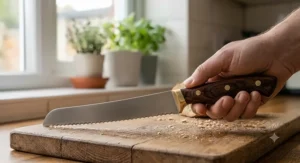
The instinct to buy the longest blade available is understandable but not always correct. A long fish filleting knife — typically 20cm or more, like the Victorinox Fibrox/Swibo — genuinely earns its length on larger, longer fish: it allows a single continuous stroke down the length of a salmon or large bass, avoiding the stop-start sawing motion that shorter blades force on bigger catches, which in turn produces a smoother, more presentable fillet surface.
Shorter blades in the 15-18cm range, like the Morakniv Fishing Comfort Fillet 155 or Taylors Eye Witness Heritage, trade that single-stroke advantage for manoeuvrability. On smaller pan fish, trout under a kilo, or flatfish, a shorter blade is easier to control at tight angles and less likely to flex unpredictably mid-cut. Reviewers consistently note that a knife feeling “too long” for the fish in hand is one of the most common complaints in aggregated feedback — length should match your typical catch, not simply your budget ceiling.
Rapala Fish Filleting Knife Review: Is It Still Worth Buying in 2026?
Given how often the Rapala name comes up in any search for a fillet knife, it’s worth a dedicated look at whether the reputation holds up. The core design — a tapered, full-tang blade in a varnished birch handle — has barely changed in decades, and that’s largely by design rather than neglect; the geometry was already close to optimal for salmon and trout when it was introduced, so there’s been little reason to overhaul it.
Independent UK testing from Testix, which compared nine fillet knives against nearly 1,900 aggregated customer reviews sourced from Currys, John Lewis, Argos, and Amazon UK, placed the Rapala Fish’n Fillet at the top of its rankings, citing reliable sharpness, good control, and consistent performance on sea trout weighing around 1.5kg. Aggregated Amazon reviews echo this, with buyers frequently describing the knife as a long-standing family favourite passed down or repurchased after decades of use — a strong signal of durability, even if individual experiences vary.
Where it falls short by 2026 standards is ergonomics: the birch handle, while functional, doesn’t offer the textured, non-slip grip found on newer Fibrox or rubberised handles, and there’s no integrated finger guard on the standard model. For sea bass or other firmer-fleshed fish, its full flex can also feel less controlled than the semi-flex alternatives on this list. On balance, though, for salmon and trout specifically, it remains a genuinely strong buy rather than a knife coasting on nostalgia.
Electric vs Manual Fish Filleting Knife: Which Should You Buy
This decision hinges almost entirely on volume and physical comfort rather than raw cutting quality. A well-chosen manual knife, like the F. Dick Pro Dynamic or Rapala Fish’n Fillet, gives more tactile feedback — you can feel bones and adjust pressure instantly, which matters for precision on a single prized fish. An electric fillet knife trades that feedback for consistency and speed: the reciprocating blade removes flesh at a steady rate regardless of hand fatigue, which becomes a real advantage past roughly the fifth or sixth fish in one sitting.
Here’s what to weigh practically: electric knives need charging or a power source, add bulk to a tackle bag or kitchen drawer, and their reciprocating blades are genuinely harder to control on delicate work like removing pin bones. Manual knives require more physical technique but offer finer control, easier cleaning, and no dependency on battery life. Reviewers consistently note that anglers who fillet occasionally tend to regret buying electric, while those processing regular large catches — particularly of flatfish — rarely go back to manual once they’ve made the switch.
Stainless Steel Fish Knife: Why Blade Steel Matters More Than Brand
It’s tempting to shop by brand name alone, but the steel grade inside a stainless steel fish knife does more to determine real-world performance than the logo on the handle. Sandvik 12C27, used in the Morakniv range, is a Swedish steel prized for balancing sharpness, toughness, and corrosion resistance — genuinely competitive with steels found in knives costing considerably more. German X-series steels, like the X55CrMo14 used by F. Dick, trade a touch of edge retention for exceptional toughness, which suits the repeated flexing a semi-flex fillet blade endures.
Hardness, measured on the Rockwell C scale (HRC), is the number worth checking on any spec sheet: most quality fillet knives sit between 55 and 58 HRC, a range that holds an edge well without becoming brittle enough to chip when flexed against bone. Anything advertised simply as “stainless steel” with no grade or hardness figure listed is a reasonable signal of a budget blade — not necessarily a bad one, but one where corrosion resistance was likely prioritised over cutting performance during manufacturing. Reviewers consistently flag unnamed steel blades as needing more frequent resharpening than graded alternatives, even when both start equally sharp out of the box.
Comparison Table: Steel, Handle, and Price Range Across the Range
| Knife | Steel | Hardness | Price Range |
|---|---|---|---|
| Rapala Fish’n Fillet | European stainless | Not published | £30-£40 |
| Victorinox Fibrox/Swibo | Swiss stainless | Not published | £25-£45 |
| Morakniv Fishing Comfort Fillet 155 | Sandvik 12C27 | ~57-58 HRC | £25-£35 |
| F. Dick Pro Dynamic | X55CrMo14 | ~56 HRC | £45-£65 |
| Taylors Eye Witness Heritage | High-carbon stainless | Not published | £20-£30 |
| SHAN ZU Japanese Filleting Knife | German stainless | 55-57 HRC | Under £20 |
| Electric Fillet Knife | Stainless (varies) | Not published | £50-£90 |
The clearest takeaway from this table is that published hardness figures cluster tightly in the mid-to-high 50s HRC across every serious contender, which confirms that this range is genuinely the sweet spot for fillet knives rather than marketing spin. Where knives diverge more meaningfully is price relative to steel quality — the Morakniv in particular delivers a named, well-regarded steel grade at a price point where several competitors offer only unspecified stainless.
✨ Ready to stop wrestling with a blunt kitchen knife? Compare these picks and pick your fillet partner for 2026.
Common Mistakes When Buying a Fish Filleting Knife
The most frequent error is buying based on length alone, assuming bigger is simply better — as covered above, a blade mismatched to typical catch size causes more wasted meat than a shorter, well-matched one. A close second is ignoring flex entirely: shoppers often assume “flexible” is universally good, when firmer fish like sea bass actively perform worse with an overly floppy blade.
Another common misstep is skipping the sheath or storage question until after purchase. A fillet knife without a secure sheath is a genuine safety hazard in a tackle bag, and retrofitting a universal sheath rarely fits as well as a knife’s dedicated one. Finally, many first-time buyers overlook handle material entirely, focusing purely on blade specs — but a smooth wooden handle that turns slippery the moment hands are wet with fish oils can undo even the best blade’s performance.
What to Expect: Real-World Performance
On paper, every knife on this list looks broadly similar: sharp, stainless, flexible to some degree. In practice, the differences show up in the details of a real filleting session. A well-matched knife produces a fillet with a smooth, unbroken surface and minimal flesh left on the carcass; a mismatched one leaves ragged edges, wasted meat near the ribs, and a session that takes noticeably longer than it should.
Expect a learning curve regardless of knife quality — even the best blade won’t compensate for unfamiliar technique on the first few attempts. What reviewers across every product in this guide consistently agree on, though, is that a properly sharp, well-suited knife makes that learning curve considerably shorter, because clean cuts give faster feedback on what’s working than the ragged cuts a poor knife produces.
Long-Term Cost and Maintenance
A fillet knife’s real cost isn’t just its purchase price — it’s the cumulative expense of sharpening, replacement, and occasionally a cracked handle or snapped tip from misuse. A named-steel knife like the Morakniv or F. Dick, while pricier upfront in the latter’s case, typically needs resharpening less often than unnamed budget steel, which can offset the initial price gap over a few seasons of regular use.
Sharpening stones or honing rods represent a modest one-off cost (typically £15-£30) that pays for itself many times over compared to replacing a dulled budget knife annually. Electric fillet knives carry an additional long-term consideration: replacement blades, which typically run £10-£20 per set and wear out faster than manual blades due to the reciprocating motion’s stress on the metal. Factoring in a knife’s expected lifespan against its price and maintenance needs — rather than purchase price alone — usually favours a mid-range, named-steel knife over the cheapest available option.
Safety and Regulations: Buying and Carrying Fish Filleting Knives in the UK
Fish filleting knives are, legally, kitchen and angling knives — but UK knife law still applies once one leaves the house. Under the Criminal Justice Act 1988, it’s an offence to carry a bladed article in public without good reason, and official government guidance confirms that using a knife for a lawful activity, such as angling, is generally accepted as a good reason, though the burden of proof sits with the person carrying it if challenged.
For anglers, this means transporting a fillet knife to and from a fishing spot in a secure sheath, ideally packed away rather than visibly worn, is the sensible approach. Buying is more straightforward: retailers must verify buyers are over 18 for any bladed product, including fillet knives, and most Amazon UK listings for fixed-blade fillet knives now require online age verification at checkout. Beyond legality, basic kitchen hygiene applies too — a fillet knife used on raw fish should be washed separately from other food-prep tools to avoid cross-contamination, particularly before it touches anything eaten raw.
Benefits vs Traditional Kitchen Knives
| Factor | Fillet Knife | Standard Chef’s Knife |
|---|---|---|
| Blade flex | Flexible/semi-flexible | Rigid |
| Bone navigation | Follows contours cleanly | Tends to cut through, wasting meat |
| Best For | Filleting fish of all types | General chopping, dicing, slicing |
| Skin removal | Purpose-built angle | Awkward, higher waste |
A rigid chef’s knife simply isn’t built to flex along a fish’s spine, and forcing one through a filleting job typically wastes considerably more usable flesh than a proper fillet knife would, while also increasing the risk of the blade slipping off a curved bone. The trade-off runs the other way for general kitchen tasks — a flexible fillet blade performs poorly at chopping vegetables or portioning meat, which is exactly why most serious cooks own both rather than expecting one knife to do everything well.

FAQ
❓ What is the best knife for filleting fish at home?
❓ How long should a fish filleting knife be?
❓ Is stainless steel or carbon steel better for a fillet knife?
❓ Can I use an electric fillet knife on flatfish like dover sole?
❓ How often should I sharpen my fillet knife?
Conclusion
The right fish filleting knife comes down to matching flexibility and length to what you actually catch or cook, rather than chasing the priciest or longest option available. The Rapala Fish’n Fillet and Victorinox Fibrox/Swibo remain outstanding for salmon and trout, the F. Dick Pro Dynamic earns its price for firmer fish like sea bass, and the Morakniv Fishing Comfort Fillet 155 or SHAN ZU Japanese Filleting Knife prove that genuine performance doesn’t require a premium spend. For flatfish specialists or high-volume filleting, the Taylors Eye Witness Heritage and the electric fillet knife round out a set that covers essentially every scenario a UK angler or home cook is likely to face.
Whichever knife you choose, remember that steel grade, blade flex, and handle grip matter more than brand recognition alone — and that a genuinely sharp, well-suited knife will save far more time and wasted fish than its price tag suggests. According to the Marine Conservation Society’s Good Fish Guide, choosing well-managed, sustainably sourced fish matters just as much as the knife you fillet it with, so it’s worth checking a species’ rating before your next trip to the fishmonger.
✨ Don’t Miss These Exclusive Deals!
🔍 Take your fish filleting to the next level with these carefully selected knives. Click on any highlighted item to check current pricing and availability. These tools will help you create restaurant-quality fillets your family will love!
Recommended for You
- Stiff Boning Knife: 7 Best Rigid Blades for Butchery in 2026
- Flexible Filleting Knife 2026: 7 Best Picks & Buying Tips
- Best Boning Knife 2026: 7 Sharp Picks for Effortless Butchery
Disclaimer: This article contains affiliate links. As an Amazon Associate, I earn from qualifying purchases. If you purchase products through these links, we may earn a small commission at no additional cost to you.
✨ Found this helpful? Share it with your friends! 💬🤗
