
In This Article
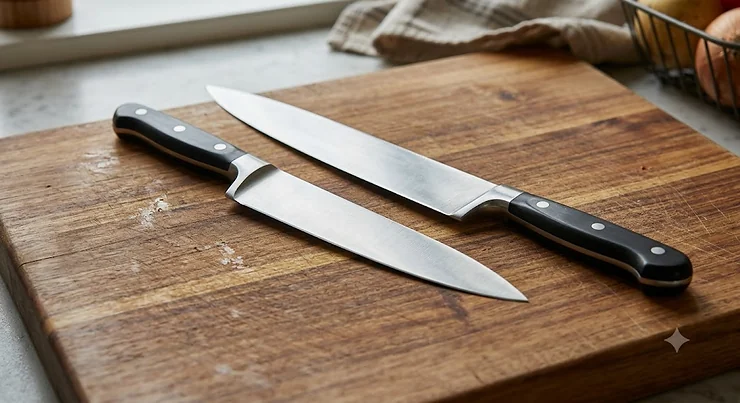
Standing in front of a knife display, torn between an 8 inch and 10 inch blade, feels a bit like choosing between a hatchback and an estate car. Both will get the job done, but one suits your driveway (and your drawer) a lot better than the other. The 8 inch vs 10 inch chef knife decision trips up more home cooks than almost any other kitchen purchase, mostly because retailers rarely explain what those two extra inches actually change in daily use.
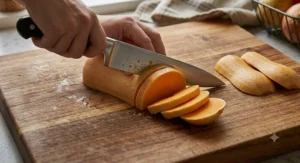
Here’s the short version: an 8 inch chef knife is the go-to size for most UK kitchens, offering manoeuvrability, easy storage, and enough blade length for 90% of everyday tasks. A 10 inch chef knife earns its keep with larger cuts of meat, bigger batches, and cooks who value reach over nimbleness. Neither is objectively “better” — the right one depends on your hand size, worktop space, cutting board dimensions, and what you actually cook most nights.
This guide breaks down seven real knives available in the UK, spanning budget stainless-steel workhorses to Japanese-forged premium blades, so you can see the size debate play out on actual products rather than abstract specs. We’ll cover honest aggregated review sentiment, feature-by-feature interpretation, and practical buying advice tailored to small flats, family kitchens, and everything in between. Prices mentioned are ranges only, since Amazon pricing shifts constantly — always check current price before buying.
What Is an 8 Inch vs 10 Inch Chef Knife?
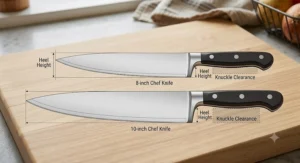
An 8 inch chef knife has a blade roughly 20cm long, balancing control and versatility for most chopping, slicing, and dicing tasks. A 10 inch chef knife, at roughly 25cm, trades some manoeuvrability for extra reach — useful for large cuts of meat, big vegetables, or high-volume prep where fewer strokes save time.
The size difference isn’t just about length on paper. A longer blade shifts the knife’s centre of balance further from your wrist, which changes how the knife feels mid-chop, not just how far it reaches. Many of the specs you’ll see quoted below, like Rockwell hardness, describe how well a blade resists denting and holds an edge — the Rockwell scale is the same hardness measurement used across the cutlery industry, so a higher number generally signals a harder, longer-lasting edge.
Quick Comparison Table
| Knife | Blade Size | Best For | Price Range |
|---|---|---|---|
| Victorinox Fibrox Pro 8″ | 20cm | Everyday small-kitchen workhorse | around £35-£45 |
| Victorinox Fibrox Pro 10″ | 25cm | Budget large-batch prep | around £45-£55 |
| Robert Welch Signature 20cm | 20cm | British design, all-rounder | around £55-£70 |
| Wüsthof Classic 8″ | 20cm | Premium balance and control | around £120-£150 |
| Zwilling Pro 10″ | 25cm | Serious home cooks, big cuts | around £150-£180 |
| Global G-2 8″ | 20cm | Lightest, nimblest blade | around £90-£110 |
| Tojiro Classic (DP) 240mm | 24cm | Japanese steel on a budget | around £70-£90 |
Looking at the spread above, the pattern is fairly clear: 8 inch knives dominate the budget-to-mid tier because most manufacturers assume that’s what home kitchens actually need, while 10 inch options tend to sit in the mid-to-premium bracket, aimed at cooks who already know they want the extra length. Independent testing from Which? has found that sharpness and comfort vary more between brands than between the two sizes themselves, which is worth remembering before you assume “bigger” automatically means “better.”
💬 Just one click — help others make better buying decisions too!😊
Top 7 Chef Knives: Expert Analysis
1. Victorinox Fibrox Pro 8″ — best all-round value for small kitchens
The Victorinox Fibrox Pro 8″ has become something of a default recommendation among professional test kitchens, and the reasons are refreshingly unglamorous: it’s sharp, light, and doesn’t cost more than a decent takeaway. The high-carbon stainless steel blade holds an edge well for its price bracket, and the wide, slightly curved profile makes rock-chopping herbs and onions intuitive even for beginners. Its TPE Fibrox handle stays grippy when wet, which matters more than people expect until they’re holding a slippery knife over a chopping board full of tomato juice.
Based on the spec comparison, this is a knife built for volume rather than finesse — the blade geometry favours speed and durability over the ultra-thin edge you’d get from a Japanese gyuto. That makes it ideal for beginners, students, and anyone who wants one dependable blade rather than a drawer full of specialists. Reviewers consistently report that the handle remains comfortable through long prep sessions, and that the blade takes a fresh edge easily on a basic sharpening steel. A recurring complaint in aggregated feedback is that the blade can look a little utilitarian next to a wooden-handled knife, though this rarely affects performance.
Pros:
- ✅ Excellent grip even with wet or greasy hands
- ✅ Holds an edge well for a budget stainless blade
- ✅ Dishwasher safe, though hand-washing extends its life
Cons:
- ❌ Plain looks compared with wood-handled alternatives
- ❌ Thicker edge than premium Japanese blades
At around £35-£45, the Victorinox Fibrox Pro 8″ remains one of the strongest value propositions in this whole line-up — a genuinely difficult knife to talk anyone out of buying first.
2. Victorinox Fibrox Pro 10″ — budget-friendly large-batch prepping powerhouse
Same DNA as its 8 inch sibling, but the Victorinox Fibrox Pro 10″ stretches that dependable Fibrox formula across a longer blade for cooks who batch-cook or regularly break down whole chickens. The extra 5cm of blade means fewer strokes when slicing a joint of beef or portioning a large squash, and the wider blade face still doubles as a handy scoop for transferring chopped vegetables to the pan.
What most buyers overlook about this model is that the extra length changes the knife’s balance point more than its weight — it can feel noticeably less nimble for fine mincing work, even though the blade itself isn’t much heavier. This is a knife for people who already know they cook in bigger batches: parents cooking for a large family, meal-preppers filling the freezer for the week, or anyone who’s outgrown their 8 inch blade on Sunday roast day. Aggregated review sentiment highlights the same durability and edge retention as the 8 inch version, with a recurring note that first-time buyers sometimes find the extra length intimidating until they get used to the rocking motion required.
Pros:
- ✅ Extra reach speeds up large cuts of meat
- ✅ Same proven steel and edge retention as the 8 inch
- ✅ Great value for a 10 inch blade
Cons:
- ❌ Less nimble for fine, detailed knife work
- ❌ Needs a longer cutting board and more drawer space
Priced around £45-£55, the Victorinox Fibrox Pro 10″ is arguably the easiest, lowest-risk way to actually test whether the bigger size suits your cooking style.
3. Robert Welch Signature 20cm — best British-designed all-rounder
Designed at the Old Silk Mill in Chipping Campden, the Robert Welch Signature 20cm brings a distinctly British sensibility to a category dominated by German and Japanese brands. The German 1.4116 stainless steel blade carries a hand-applied 15-degree Japanese-style edge, which the brand’s own CATRA sharpness testing claims delivers meaningfully better edge retention than comparable competitors — a specific, checkable claim rather than vague marketing fluff.
Here’s what to weigh: the DuPont handle is injection-moulded directly onto the tang, creating a seamless, hygienic join with no food traps, which matters if you’re someone who cooks daily and hates scrubbing handle crevices. This knife suits home cooks who want a genuinely premium daily-driver without importing a German or Japanese brand name, and who appreciate a lifetime manufacturing guarantee as reassurance. Reviewers consistently note the blade arrives noticeably sharper out of the box than many rivals at a similar price, though a handful mention the straight-edged profile takes slight adjustment if you’re used to a more curved rocking motion.
Pros:
- ✅ Hand-applied edge with strong sharpness credentials
- ✅ Hygienic one-piece handle with no food traps
- ✅ Backed by a lifetime manufacturing guarantee
Cons:
- ❌ Straighter profile needs adjustment for rocking chops
- ❌ Smaller range of blade sizes than bigger global brands
At around £55-£70, the Robert Welch Signature 20cm is a compelling mid-range pick for anyone who likes supporting British-designed kitchenware without sacrificing performance.
4. Wüsthof Classic 8″ — best premium balance and control
Solingen-forged since the brand’s founding over two centuries ago, the Wüsthof Classic 8″ is precision-forged from a single block of high-carbon steel and tempered to 58 HRC, which in practical terms means a genuinely durable edge that shrugs off months of daily chopping before it needs proper sharpening. The full bolster and triple-riveted handle give it a reassuring heft without tipping into tiring heaviness.
Based on the spec comparison, the Precision Edge Technology grinding process is what separates this from cheaper stamped blades — it’s roughly 20% sharper out of the box than Wüsthof’s own earlier models, according to the brand’s published testing, and that sharpness translates into cleaner cuts on soft produce like tomatoes and herbs. This is the knife for someone who cooks most nights and wants a single blade that will comfortably outlast a kitchen renovation. Reviewers consistently praise the balance point sitting right at the bolster, though the trade-off is a hand-wash-only recommendation, since dishwasher detergent can dull the edge and damage the handle finish over time.
Pros:
- ✅ Exceptional edge retention from forged high-carbon steel
- ✅ Full bolster protects fingers and aids balance
- ✅ Triple-riveted handle built for decades of daily use
Cons:
- ❌ Hand-wash only despite some listings claiming dishwasher-safe
- ❌ Noticeably heavier than stamped budget alternatives
Sitting in the mid-£300s bracket is common for premium German knives generally, but the Wüsthof Classic 8″ itself typically runs around £120-£150, making it accessible premium rather than aspirational-only.
5. Zwilling Pro 10″ — best for serious home cooks tackling big cuts
The Zwilling Pro 10″ was designed by architect Matteo Thun with a curved bolster specifically shaped to support a professional pinch grip, and it shows the moment you pick it up — your thumb and forefinger settle into the blade almost automatically. SIGMAFORGE construction means the whole knife is forged from one piece of Zwilling’s special-formula steel, then ice-hardened using the brand’s FRIODUR process for a blade that starts sharp and stays that way.
What most buyers overlook about this model is that the broader front curve is specifically engineered to make the Western rocking motion easier on a 10 inch blade, which is normally the hardest length to rock smoothly. That makes it a genuinely good fit for cooks who’ve outgrown an 8 inch knife but worried a longer blade would feel unwieldy. Aggregated customer sentiment is strongly positive on comfort during long prep sessions, with a recurring theme that this knife “disappears” in the hand once you’re used to it — reviewers’ words for describing how little fatigue it causes, not a literal quote from any single source. A minority of reviews mention the black resin handle showing wear marks faster than a wooden equivalent.
Pros:
- ✅ Curved bolster genuinely supports a proper pinch grip
- ✅ Ice-hardened steel holds its edge impressively long
- ✅ Full length of blade usable for slicing and chopping
Cons:
- ❌ Premium price for a 10 inch home-kitchen knife
- ❌ Handle shows cosmetic wear before the blade dulls
At around £150-£180, the Zwilling Pro 10″ sits at the top of this list’s price ladder, but it’s aimed squarely at cooks who’ve already decided the 10 inch size is right for them.
6. Global G-2 8″ — lightest blade for nimble, fast knife work
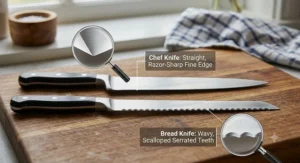
Instantly recognisable by its one-piece stainless construction and dimpled handle, the Global G-2 8″ takes a completely different design philosophy: instead of a heavy bolster for stability, it uses a sand-filled hollow handle to achieve balance through lightness rather than mass. The CROMOVA 18 steel is ice-hardened to Rockwell 56-58 and ground to a sharper 15-degree convex edge than most Western knives.
On paper this means a blade that moves faster through repetitive tasks like dicing onions or mincing garlic, since there’s simply less mass to accelerate and decelerate with every stroke. Reviewers consistently describe an adjustment period for cooks used to heavier European knives, since the balance point and grip feel entirely different, but most settle in within a week or two of regular use. This suits cooks who prioritise speed and precision over heft, and who don’t mind a slightly steeper (if short) learning curve. A recurring theme in aggregated feedback is that the seamless one-piece design makes cleaning genuinely effortless, since there’s no bolster seam or rivet gap for grime to hide in.
Pros:
- ✅ Exceptionally light for reduced hand fatigue over long sessions
- ✅ Hygienic one-piece build with no dirt traps
- ✅ Convex edge geometry stays sharper for longer
Cons:
- ❌ Unfamiliar balance takes adjustment for first-time buyers
- ❌ Hollow handle feels less substantial to some hands
Typically priced around £90-£110, the Global G-2 8″ rewards cooks willing to adapt to a genuinely different knife philosophy rather than a Western variation on the same theme.
7. Tojiro Classic (DP) 240mm — best Japanese steel on a budget
Often cited as the most recommended entry point into serious Japanese cutlery, the Tojiro Classic (DP) 240mm — formerly branded the Tojiro DP — clads a VG-10 core steel between two layers of softer stainless using the traditional honwarikomi method. That construction lets the core reach Rockwell 60-61, hard enough to take and hold a genuinely sharp edge, while the softer cladding keeps the knife easier to sharpen than a mono-steel Japanese blade.
Based on the spec comparison, the thin blade profile and 240mm length (closer to 9.5 inches, effectively bridging the 8 vs 10 inch gap) give it more reach than a typical 8 inch Western knife while staying nimbler than a full 10 inch blade. What most buyers overlook is that this thinness means the knife excels at push-cuts and slicing but isn’t designed for twisting or prying, unlike sturdier Western blades. Reviewers consistently note the price-to-performance ratio embarrasses far more expensive knives, with a recurring theme of cooks replacing long-serving German knives with this as their new daily driver. A minority mention the traditional wooden handle shape takes some getting used to compared with an ergonomic Western grip.
Pros:
- ✅ VG-10 core holds an exceptionally sharp edge
- ✅ Thin blade excels at precise, clean slicing
- ✅ Outstanding performance relative to its price point
Cons:
- ❌ Not designed for twisting cuts or bone contact
- ❌ Traditional handle shape unfamiliar to Western-trained hands
Around £70-£90 depending on retailer, the Tojiro Classic (DP) 240mm is arguably the best-value route into genuine Japanese steel performance on this entire list.
What Size Chef Knife Should I Buy?
Working out what size chef knife should I buy usually comes down to five practical checks rather than abstract preference:
- Measure your dominant hand from wrist to middle fingertip. Under 18cm generally pairs better with an 8 inch blade; over 20cm often suits a 10 inch comfortably.
- Check your cutting board length. A 10 inch blade needs a board of at least 35-40cm to avoid the tip hanging off the edge mid-stroke.
- Consider your typical batch size. Cooking for one or two most nights favours an 8 inch blade; regular family-sized or freezer-prep batches favour 10 inch.
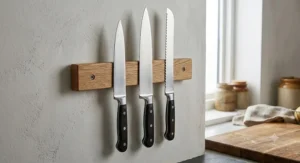
- Think about storage. Knife blocks, magnetic strips, and drawer inserts are usually sized around 8 inch blades by default; 10 inch blades sometimes protrude or need a dedicated slot.
- Factor in current comfort. If you’ve never used a chef knife longer than a paring knife, an 8 inch blade is the gentler learning curve.
- Weigh how often you break down whole proteins. Regularly jointing a chicken or trimming a large joint of beef is where a 10 inch blade earns its extra length fastest.
- Test before committing where possible. Handling both sizes in a shop, even briefly, reveals balance preferences that specs alone can’t.
Reviewers consistently note that indecisive buyers do best starting with an 8 inch knife, since it’s the safer, more versatile default, and upgrading to a 10 inch later is a far smaller financial and storage commitment than the reverse.
8 Inch or 10 Inch Knife for Home Cook: Which Wins?
For the average UK home cook, an 8 inch knife wins on pure day-to-day usability, but that verdict shifts the moment your cooking style changes. Here’s the more detailed picture behind that headline.
An 8 inch blade excels at the tasks that make up most weeknight cooking: dicing an onion, slicing chicken breasts, chopping herbs, and prepping vegetables for a stir-fry. Its shorter length means less blade to control, which translates into steadier, more confident cuts for anyone without years of knife-skills practice behind them. It also fits comfortably in standard UK kitchen storage, from magnetic strips above a worktop to the compact knife blocks common in smaller flats and starter homes.
A 10 inch blade, by contrast, earns its keep in specific, recurring scenarios: butchering whole chickens, portioning a large gammon joint, slicing a big batch of bread for sandwiches, or breaking down a whole watermelon in one motion rather than several. Home cooks who batch-cook for the freezer, host large family dinners regularly, or simply cook in bigger volumes than a typical two-person household often find the extra reach genuinely saves time rather than just looking impressive.
What most buyers overlook is that “which wins” isn’t really size-versus-size — it’s task-versus-task. A cook who does 90% weeknight dinners and 10% Sunday roasts is usually better served by an 8 inch knife with occasional patience for the roast, rather than a 10 inch knife that feels oversized every single weeknight.
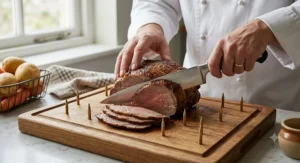
Is a 10 Inch Chef Knife Too Big for Home Use?
Answering “is a 10 inch chef knife too big for home use” honestly requires separating two different things: physical size and practical usability. Physically, a 10 inch blade is not too big for a home kitchen — professional chefs use them daily in far more cramped commercial kitchens than most UK homes. Practically, though, it can feel oversized if your worktop, cutting board, or storage weren’t chosen with it in mind.
The real friction points tend to be storage (a 10 inch blade often won’t fit a compact knife block designed around 8 inch defaults) and control (smaller hands can find the extra leverage tiring during long chopping sessions). Reviewers consistently report that the adjustment period for a first 10 inch knife is roughly one to two weeks of regular use before the size stops feeling unwieldy.
If you’re genuinely unsure, the safer route is trying a budget 10 inch option like the Victorinox Fibrox Pro 10″ before investing in a premium blade like the Zwilling Pro 10″ — that way, an ill-fitting size costs you £50, not £170.
Chef Knife for Small Kitchens
Choosing the right chef knife for small kitchens is less about the knife itself and more about the whole ecosystem it lives in: drawer space, worktop width, and cutting board dimensions. In a genuinely compact UK kitchen — the kind found in many flats and older terraced houses — an 8 inch blade like the Victorinox Fibrox Pro 8″ or Global G-2 8″ tends to be the more livable daily companion, since it fits standard drawer inserts and doesn’t demand a full-length cutting board just to use safely.
Small-kitchen cooks also benefit from lighter knives generally, since less counter space often means less room to manoeuvre a heavier blade without knocking into other tools. This is where the Global G-2 8″‘s hollow-handle lightness becomes a genuine practical advantage rather than just a nice-to-have. If your small kitchen still demands occasional big-batch cooking — Christmas dinner in a one-bedroom flat, for instance — a single well-chosen 10 inch knife stored separately (rather than in a cramped block) can bridge that gap without permanently colonising your limited storage.
Kitchen Knife Size Recommendation by Cooking Style
A genuinely useful kitchen knife size recommendation has to account for what you actually cook, not just how many people you’re feeding. Someone who cooks primarily Asian-influenced stir-fries, doing rapid, repetitive dicing of vegetables, often prefers an 8 inch blade or even the nimbler Global G-2 8″, since speed and control matter more than reach. Someone whose weekly routine includes Sunday roasts, batch-cooking casseroles, or breaking down whole birds regularly leans toward a 10 inch blade like the Zwilling Pro 10″ or Victorinox Fibrox Pro 10″, where fewer, longer strokes save real time.
Bakers and bread-heavy households sometimes find a 240mm Japanese gyuto like the Tojiro Classic (DP) 240mm hits a useful middle ground — enough reach for a large loaf, without the full bulk of a 10 inch Western blade. Ultimately, matching knife size to cooking style rather than household size alone tends to produce a happier long-term match, since technique and task type affect comfort more than raw serving numbers.
Best Knife Size for Meal Prep
For committed Sunday meal-preppers working through several kilograms of vegetables and protein in one sitting, the best knife size for meal prep usually skews toward 10 inch, purely on efficiency grounds. Fewer strokes per vegetable, faster portioning of bulk-bought meat, and less repetitive hand motion over a two-hour prep session all favour the longer blade — fatigue accumulates fastest during exactly this kind of repetitive, high-volume task.
That said, reviewers consistently note that meal-preppers with smaller hands sometimes prefer sticking with an 8 inch blade and simply accepting a few extra minutes of prep time, trading raw efficiency for reduced strain. If meal prep is a weekly ritual rather than an occasional event, investing in a genuinely sharp, well-balanced 10 inch knife such as the Zwilling Pro 10″ tends to pay for itself in saved time within a few months, especially compared with pushing through with a dull or ill-fitting blade.
Practical Usage Guide: Setting Up Your New Knife
Getting a new chef knife performing at its best starts before the first chop. Unbox it, hand-wash it in warm soapy water even if it’s marketed as dishwasher safe, and dry it immediately — this removes any factory residue and starts good habits early. In the first 30 days, resist the temptation to test the blade on bone, frozen food, or glass chopping boards; these are the fastest routes to a chipped or rolled edge, regardless of how premium the steel is.
Invest in a honing steel from day one and use it every two to three uses, not just when the knife feels dull — honing realigns the edge rather than removing metal, and it’s the single habit that extends time between proper sharpenings the most. Store the knife on a magnetic strip, in a block, or with a blade guard rather than loose in a drawer, since drawer contact is one of the most common causes of accidental dulling and chipping in home kitchens.
A common first-30-days mistake is gripping the handle too tightly, which tires the forearm quickly and reduces control paradoxically. A relaxed pinch grip near the bolster, thumb and forefinger on the blade itself, gives far better precision with noticeably less fatigue over a full cooking session. The University of Southampton’s Cookery School knife skills series is a genuinely useful free refresher on grip and maintenance basics if you’re building these habits from scratch.
Real-World Scenarios: Matching Buyers to Blades
The Student in a Shared Flat: Cooking mostly pasta, stir-fries, and quick dinners for one or two, with minimal drawer space and a tight budget. The Victorinox Fibrox Pro 8″ fits this life almost perfectly — affordable, compact, and forgiving of imperfect knife skills while those skills are still developing.
The Weekend Batch-Cooker: Works full-time, cooks in bulk on Sundays to fill the week’s lunches and the freezer, and values speed over ceremony. The Zwilling Pro 10″ or budget-friendly Victorinox Fibrox Pro 10″ suit this rhythm well, since the extra reach shaves real minutes off repetitive weekend prep sessions.
The Enthusiast Upgrading Their First “Proper” Knife: Has been cooking seriously for a few years, wants to feel the difference premium steel makes, and is willing to hand-wash and maintain a knife properly. The Wüsthof Classic 8″ or Tojiro Classic (DP) 240mm both reward that extra care with noticeably better edge retention and cutting feel than an entry-level blade.
Common Mistakes When Buying a Chef Knife
The single most common mistake is choosing size based on what looks impressive rather than what fits existing storage and hand size — a striking 10 inch blade that never leaves the block because it’s awkward to store isn’t a bargain at any price. A close second is assuming a higher price always means a sharper knife out of the box; as Which?’s own testing shows, sharpness and comfort vary significantly by brand and model, not simply by spend.
Another frequent error is buying a knife set to get a “better deal,” only to use the chef knife almost exclusively while the rest of the set sits untouched — a single excellent chef knife plus a paring knife usually covers 90% of home cooking needs. Finally, many buyers skip researching maintenance requirements, then feel disappointed when a knife marketed as “low maintenance” still needs regular honing to perform as advertised.
Long-Term Cost & Maintenance
| Factor | 8 Inch Knives | 10 Inch Knives |
|---|---|---|
| Typical price range | £35-£150 | £45-£180 |
| Honing frequency | Every 2-3 uses | Every 2-3 uses |
| Professional sharpening | Every 6-12 months | Every 6-12 months |
| Cutting board size needed | 30cm+ | 35-40cm+ |
| Best For | Everyday versatility | Large-batch, high-volume prep |
The maintenance burden between the two sizes is nearly identical — honing frequency and sharpening intervals depend far more on steel quality and usage volume than on blade length itself. Where the real cost difference emerges is in accessories: a 10 inch knife often demands a larger cutting board and sometimes a dedicated storage slot, which are easy-to-forget additional costs when comparing sticker prices alone. Over a five-year ownership period, a well-maintained mid-range knife from either size category, professionally sharpened once or twice a year, typically works out cheaper per use than repeatedly replacing budget blades that were never honed at all.
Safety & Blade Regulations in the UK
Kitchen knife safety is a genuine, if often overlooked, consideration, and the UK’s Health and Safety Executive publishes specific guidance on safe knife handling, carrying, and sharpening for catering environments that applies just as usefully at home. Key habits include always cutting away from your body, using the “claw grip” with fingertips tucked back on your guiding hand, and never trying to catch a falling knife — instinct says grab it, but stepping back and letting it fall is safer every time.
For everyday domestic use, there’s no special legal restriction on owning an 8 inch or 10 inch kitchen knife at home; UK knife legislation around carrying blades in public applies to transporting knives outside the home, not to using or storing them in your own kitchen. Sensible practice — proper storage, careful washing (never leave a knife submerged in a sink full of water where it’s invisible to the next person reaching in), and regular maintenance — accounts for the overwhelming majority of kitchen knife incidents avoided.
✨ Don’t Miss These Exclusive Deals!
🔍 Take your kitchen knife collection to the next level with these carefully selected picks. Click on any highlighted product to check current pricing and availability, and find the blade that turns everyday prep into a genuine pleasure. 🔪
Frequently Asked Questions
❓ Is an 8 inch or 10 inch chef knife better for beginners?
❓ Can I use a 10 inch chef knife on a standard UK chopping board?
❓ Do professional chefs prefer 8 inch or 10 inch knives?
❓ How much should I spend on a good chef knife in the UK?
❓ Is it worth owning both an 8 inch and 10 inch chef knife?
Conclusion
The 8 inch vs 10 inch chef knife debate isn’t really about which size is objectively superior — it’s about matching blade length to your hands, your storage, and how you actually cook on a Tuesday night versus a Sunday roast. For most UK kitchens, an 8 inch knife like the Victorinox Fibrox Pro 8″ or Robert Welch Signature 20cm remains the safer, more versatile default, while a 10 inch blade like the Zwilling Pro 10″ rewards cooks who already batch-cook, host often, or regularly break down whole proteins.
Whichever size you land on, the knife’s steel quality, maintenance routine, and how well it fits your hand will matter more to your daily cooking experience than the extra two inches ever will. Start with honest self-assessment of your cooking habits, check your cutting board and storage measurements, and choose the blade that fits the kitchen you actually have — not the one you imagine having.
✨ Ready to Upgrade Your Kitchen?
🔍 Browse today’s current pricing on any of the seven knives above and find the size that finally makes weeknight prep feel effortless. Your future self, chopping onions in half the time, will thank you. 🥕
Recommended for You
- Boning Knife Vs Filleting Knife — 7 Picks Compared (2026)
- Fish Filleting Knife 2026: 7 Best Picks Anglers Trust
- Stiff Boning Knife: 7 Best Rigid Blades for Butchery in 2026
Disclaimer: This article contains affiliate links. As an Amazon Associate, I earn from qualifying purchases. If you purchase products through these links, we may earn a small commission at no additional cost to you.
✨ Found this helpful? Share it with your friends! 💬🤗
