
In This Article
Stand in a knife aisle long enough and the vegetable cleaver starts to look like an identity crisis with a handle. Cai dao, Chinese chef’s knife, vegetable chopper, Chinese cleaver — different names, same rectangular blade, all of them doing a job that a standard chef’s knife frankly struggles with: turning a mountain of onions, cabbage, ginger and carrots into neat, even prep in a fraction of the time. If you cook a lot of stir-fries, or you’ve recently gone heavier on plant-based meals and found your old knife wilting under the workload, this is the tool that fixes it.
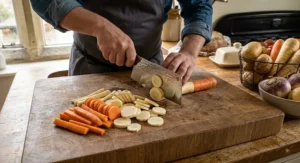
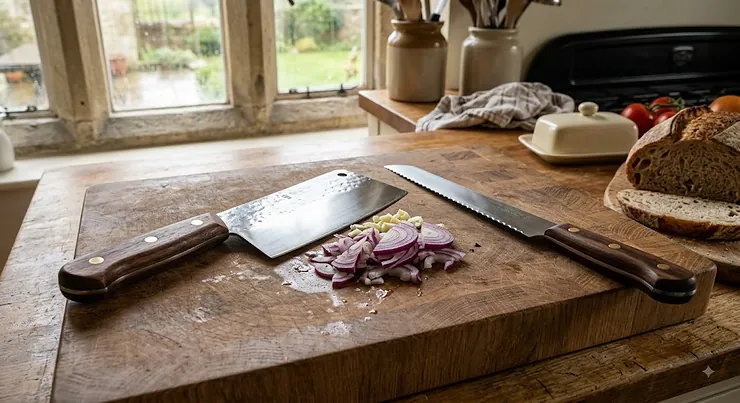
So, what is a vegetable cleaver? It’s a broad, rectangular kitchen knife — typically 15-20cm long and noticeably taller than a chef’s knife — designed for slicing, dicing and mincing vegetables and boneless proteins, with a flat spine that doubles as a scraper for shovelling prepped food straight into the pan.
Choosing the best vegetable cleaver isn’t really about finding “the best” in the abstract — it’s about matching blade weight, steel and price to how you actually cook. A student wanting to get through a stir-fry in ten minutes has very different needs to a keen home cook building a plant-based repertoire around a chef-grade Damascus blade. Below, we’ve researched seven genuinely good options sold in the UK, spanning honest budget buys to serious premium steel, and broken down exactly who each one suits. We’ll also dig into the recurring questions — nakiri vs vegetable cleaver, how much a lightweight blade actually matters, and what a thin blade does differently to a thick one — so that by the end, you’re choosing with your eyes open rather than guessing from a product photo.
Quick Comparison Table
For readers in a hurry, here’s the snapshot. Full breakdowns of each vegetable cleaver follow further down the page.
| Cleaver | Price Range | Blade Length | Best For |
|---|---|---|---|
| Shi Ba Zi Zuo 8-Inch Professional Cleaver | Under £30 | 20cm | First-time buyers on a budget |
| Zwilling J.A. Henckels Twin Signature Vegetable Cleaver | £30-£45 range | 18cm | Lightest, most nimble everyday use |
| HOSHANHO 7-Inch High-Carbon Cleaver | £20-£35 range | 18cm | Best value stir-fry workhorse |
| KYOKU Shogun Series Vegetable Cleaver | £70-£90 range | 18cm | Mid-range Damascus upgrade |
| Dalstrong Valhalla Nakiri Vegetable Cleaver | £70-£90 range | 18cm | Thin-blade precision, nakiri fans |
| Shun Classic 7-Inch Vegetable Cleaver | £150-£190 range | 18cm | Premium all-day comfort |
| Global G49 Chinese Vegetable Chopper | In the £200s | 20cm | Ultra-thin precision, professional feel |
Looking at the spread, the gap between the cheapest and priciest option here isn’t really about how well each blade cuts a carrot on day one — it’s about steel quality, edge retention over years of use, and how the handle holds up to nightly washing-up. Budget models like the Shi Ba Zi Zuo 8-Inch Professional Cleaver and HOSHANHO 7-Inch High-Carbon Cleaver will happily handle weekly stir-fry prep for a couple of years, while the Shun Classic 7-Inch Vegetable Cleaver and Global G49 Chinese Vegetable Chopper are built for cooks who chop daily and want a blade that’s still performing in a decade.
💬 Already got a favourite in mind? Scroll down to the full reviews — or keep reading for the “how to choose” section that’ll save you buying the wrong one.
Top 7 Vegetable Cleavers: Expert Analysis
Before the individual write-ups, here’s the fuller spec comparison, because “best for” only tells half the story.
| Cleaver | Steel | Handle | Weight Feel | Best For |
|---|---|---|---|---|
| Shi Ba Zi Zuo 8-Inch Professional Cleaver | Stainless steel, non-stick coating | Anti-slip wood | Medium | Beginners, everyday veg |
| Zwilling J.A. Henckels Twin Signature Vegetable Cleaver | Stamped German stainless | Polymer, ergonomic | Very light | Speed and control |
| HOSHANHO 7-Inch High-Carbon Cleaver | High-carbon steel | Wood, riveted | Medium | Stir-fry batch prep |
| KYOKU Shogun Series Vegetable Cleaver | VG10 Damascus core | Pakkawood | Medium-heavy | Home cooks wanting an upgrade |
| Dalstrong Valhalla Nakiri Vegetable Cleaver | 9CR18MOV, 8-12° edge | Wood and resin | Medium | Thin, precise slicing |
| Shun Classic 7-Inch Vegetable Cleaver | VG-MAX, Damascus clad | Pakkawood | Medium | Daily premium use |
| Global G49 Chinese Vegetable Chopper | CROMOVA 18 stainless | Sand-filled steel | Balanced, blade-forward | Precision, pro-style scraping |
The pattern worth noting: as price climbs, blades generally get thinner and harder, which sharpens precision but reduces forgiveness — a soft budget steel like the one in the Shi Ba Zi Zuo 8-Inch Professional Cleaver will shrug off the odd clumsy chop against a bone-in chicken thigh, while the hardened VG10 core in the KYOKU Shogun Series Vegetable Cleaver would rather you didn’t. Handle material tells a similar story: wood and Pakkawood feel warmer in the hand but need more care than the sealed polymer grip on the Zwilling J.A. Henckels Twin Signature Vegetable Cleaver.
1. Shi Ba Zi Zuo 8-Inch Professional Cleaver — best budget all-rounder for beginners
If you’ve never owned a vegetable cleaver and aren’t sure you’ll love the format, this is where to start. The Shi Ba Zi Zuo 8-Inch Professional Cleaver is a stainless steel blade with a non-stick coating and an anti-slip wooden handle, and it’s built to be a no-drama first purchase rather than a forever knife. The stainless construction resists staining from acidic veg like tomatoes and onions, while the non-stick finish stops sticky ingredients like sweet potato or beetroot clumping to the blade mid-chop — a small thing that saves real time during batch prep. Based on the spec sheet, this sits in the softer steel category, which means the edge won’t hold quite as long between sharpenings as the pricier picks further down this list, but it’s also more forgiving if your knife skills are still developing. It’s aimed squarely at cooks who want to try the cleaver format, students furnishing a first kitchen, or anyone who wants a reliable backup blade. Aggregated buyer feedback on cleavers in this style and price bracket consistently flags good value and comfortable handling as the main draws, with edge retention between sharpenings as the most common trade-off reviewers mention — worth knowing going in rather than discovering after the first month.
Pros:
- ✅ Genuinely low entry price for the format
- ✅ Non-stick coating reduces ingredient sticking
- ✅ Comfortable anti-slip wooden handle
Cons:
- ❌ Softer steel needs more frequent honing
- ❌ Less refined balance than pricier alternatives
At under £30, this is one of the cheapest genuine entries into vegetable cleavers, and for anyone testing the waters before committing to a premium blade, it represents solid value.

2. Zwilling J.A. Henckels Twin Signature Vegetable Cleaver — lightest blade for effortless prep
This is the pick for anyone specifically searching for a lightweight cleaver for vegetables, and it earns that reputation honestly. The Twin Signature line is Zwilling’s stamped range rather than forge-hammered, and stamped construction is inherently thinner and lighter than a forged blade of the same dimensions — here that translates to a blade that flicks through onions and peppers with noticeably less wrist fatigue over a long prep session. The trade-off, and it’s a fair one, is that stamped steel typically has a slightly softer edge than a forged equivalent, so it favours speed and control over raw toughness. What most buyers overlook about lightweight cleavers is that they’re often easier to control precisely because there’s less mass to manage — for fine julienne or thin ribbon cuts on courgette, that lighter swing can actually beat a heavier blade. Aggregated review sentiment across Zwilling’s stamped range tends to highlight balance and comfortable handling as consistent strengths, with occasional mentions that the handle material feels less premium than Zwilling’s forged lines, which tracks with its position as an accessible entry point into a well-known German cutlery brand.
Pros:
- ✅ Noticeably lighter than forged alternatives
- ✅ Easier wrist control during long prep sessions
- ✅ Trusted, well-known cutlery brand
Cons:
- ❌ Softer edge than forged Zwilling ranges
- ❌ Handle feels less premium than top-tier lines
Sitting in the £30-£45 range, this model rewards anyone who values speed and manoeuvrability over sheer heft — ideal for smaller hands or anyone prepping vegetables daily rather than occasionally.
3. HOSHANHO 7-Inch High-Carbon Cleaver — best value stir-fry workhorse
Stir-fry cooking punishes a knife in a specific way: rapid, repetitive chopping through a wide mix of textures — from soft pak choi to dense carrots — often followed immediately by using the flat of the blade to scoop everything into a screaming-hot wok. The HOSHANHO 7-Inch High-Carbon Cleaver is built around a high-carbon steel blade that takes a genuinely sharp edge and holds it better than the stainless steel used in cheaper cleavers, which matters enormously if wok cooking is a weekly habit rather than a once-a-month treat. High-carbon steel does need a touch more care — dry it promptly to avoid spotting — but in exchange you get an edge that slices through fibrous stems like celery and lemongrass without the tearing you sometimes get from duller stainless blades. This is best suited to home cooks who batch-prep vegetables for multiple stir-fries across the week, or anyone who’s found a cheaper stainless cleaver going blunt faster than expected. Reviewers commonly report that the blade arrives noticeably sharper out of the box than similarly priced stainless competitors, with the main recurring caution being a reminder to hand-wash and dry rather than leave it wet in a sink.
Pros:
- ✅ High-carbon steel holds an edge longer
- ✅ Handles fibrous stir-fry ingredients cleanly
- ✅ Strong value against stainless rivals at this price
Cons:
- ❌ Needs prompt drying to avoid spotting
- ❌ Less forgiving of dishwasher use
In the £20-£35 range, this is arguably the sharpest starting point on this list for anyone whose kitchen life genuinely revolves around a wok.
4. KYOKU Shogun Series Vegetable Cleaver — best mid-range Damascus upgrade
Once you’ve decided the cleaver format suits your cooking, the KYOKU Shogun Series Vegetable Cleaver is a sensible next step up. It’s built around a VG10 steel core, which is a genuine step above the stainless and high-carbon steels used in the budget picks — VG10 holds a finer edge for longer and takes a sharper angle, meaning cleaner cuts on delicate ingredients like herbs and thin-sliced ginger. The forged Damascus cladding around that core isn’t purely cosmetic either; the layered construction adds a small amount of flex resistance while keeping the blade from feeling brittle. Based on the spec comparison with the budget tier above, the jump in steel quality here is the headline reason to pay more, not the included sheath and case, though those are a genuinely useful bonus for knife storage or travel. This suits home cooks who’ve outgrown a starter cleaver and want something that’ll still be sharp in three years, plus anyone buying a gift for a keen cook. Aggregated feedback on VG10 Damascus knives in this price bracket typically praises edge sharpness and presentation, while the more common criticism is that the handle profile takes a session or two to get used to if you’re moving up from a slimmer Western-style knife.
Pros:
- ✅ VG10 core holds a finer edge longer
- ✅ Genuine step up in steel quality for the price
- ✅ Comes with a protective sheath and case
Cons:
- ❌ Handle shape needs brief adjustment period
- ❌ Requires more careful sharpening technique than softer steel
Priced in the £70-£90 range, this is where “hobbyist cook” starts to look like “serious home cook,” and the steel quality reflects that shift.
5. Dalstrong Valhalla Nakiri Vegetable Cleaver — best hybrid nakiri-style thin blade
This one sits right at the crossroads of the nakiri and vegetable cleaver categories, and it’s a genuinely useful pick if you’re drawn to the idea of a thin blade vegetable cutting experience without giving up the taller, cleaver-style profile for scooping prepped food. The Dalstrong Valhalla Nakiri Vegetable Cleaver uses 9CR18MOV steel with an 8-12° edge angle — noticeably more acute than the wider edge on a typical Western chef’s knife, which is what gives nakiri-style blades their reputation for clean, almost surgical vegetable cuts with minimal cell damage to what you’re slicing. Here’s what the spec sheet won’t tell you outright: that thinner edge geometry means the blade is genuinely better at push-cutting straight down through dense vegetables like squash or sweet potato, rather than the rocking motion you’d use with a curved chef’s knife. It suits cooks who prioritise cut quality and precision — particularly anyone doing a lot of plant-forward cooking where vegetables are the star rather than a side act. Aggregated review sentiment for this range tends to single out the sharpness straight from the box, with the resin-and-wood handle drawing praise for grip, though a handful of buyers note the thinner edge demands slightly gentler technique than a thicker cleaver blade.
Pros:
- ✅ Thin edge geometry gives cleaner vegetable cuts
- ✅ Comfortable wood-and-resin handle grip
- ✅ Genuinely sharp performance out of the box
Cons:
- ❌ Thinner edge is less forgiving on tough stems
- ❌ Not ideal for anyone wanting a do-everything blade
At around £70-£90, this is the pick to make if the “nakiri vs vegetable cleaver” debate below resonates with how precisely you like your veg cut.
6. Shun Classic 7-Inch Vegetable Cleaver — best premium all-day comfort pick
The Shun Classic 7-Inch Vegetable Cleaver is a handcrafted Japanese knife built around a VG-MAX steel core with Damascus stainless steel cladding and a Pakkawood handle, and it’s NSF certified, meaning it meets commercial kitchen hygiene and durability standards rather than just home-kitchen expectations. In practice, VG-MAX is a refinement of VG10 with added chromium, cobalt and tungsten, which typically means slightly better edge retention and corrosion resistance than the steel used in the mid-range picks above. What that means day to day: fewer trips to the sharpening stone across a year of regular use, and a blade that copes well with the acidity of tomatoes, citrus and vinegar-based marinades without dulling as quickly. This is squarely aimed at cooks who chop vegetables daily and want a blade that feels effortless after twenty minutes of continuous prep, not just the first five cuts. Aggregated reviews of Shun’s Classic range consistently praise comfort over long sessions and the visual appeal of the Damascus cladding, with the main recurring caveat being that, like most premium Japanese steel, it rewards — and somewhat requires — proper care rather than a quick rinse and dishwasher cycle.
Pros:
- ✅ NSF-certified, commercial-grade build quality
- ✅ VG-MAX steel holds its edge exceptionally well
- ✅ Comfortable for extended prep sessions
Cons:
- ❌ Requires hand-washing and careful storage
- ❌ Premium price relative to mid-range alternatives
Sitting in the £150-£190 range, this is a genuine long-term investment piece rather than an impulse buy, and the price reflects materials and craftsmanship rather than marketing.
7. Global G49 Chinese Vegetable Chopper — best precision blade for professional-style prep
At the top of this list, the Global G49 Chinese Vegetable Chopper is built from CROMOVA 18 stainless steel — a proprietary Global alloy combining chromium, molybdenum and vanadium — ice-tempered and hardened to a Rockwell range that holds its edge notably longer than the stainless steels used further down this list. The defining feature is the thin, roughly 2.2mm blade, which is unusually slender for a cleaver-format knife and gives it a precision that borders on surgical for fine slicing, julienne and mincing work. The sand-filled hollow steel handle is the other signature Global touch: it shifts the balance point noticeably towards the blade compared with a wood-handled cleaver, which professional-style cooks tend to prefer because it makes the knife feel like an extension of the wrist rather than something you’re steering from behind. This is a knife for cooks who already know what they want from a blade — restaurant-trained home cooks, keen amateurs who’ve used Global knives before, or anyone building a proper Japanese-style knife roll. Aggregated feedback on Global’s cleaver-style knives tends to be sharply divided along one line: people either love the all-steel handle and blade-forward balance, or find it takes real adjustment coming from a traditional wood-handled knife, so it’s worth handling one in person if that’s possible before committing.
Pros:
- ✅ Exceptional edge retention from CROMOVA 18 steel
- ✅ Ultra-thin blade for precision slicing
- ✅ Distinctive balance favoured by professional-style cooks
Cons:
- ❌ All-steel handle divides opinion on comfort
- ❌ Highest price point on this list
Priced in the £200s, this is the splurge option here — justified only if you’re genuinely chopping vegetables often enough to feel the difference in edge retention and control.
✨ Don’t Miss These Exclusive Deals!
🔍 Take your vegetable prep to the next level with these carefully selected cleavers. Click on any highlighted pick above to check current pricing and availability, and start slicing through your weekly veg box in a fraction of the time.
How to Use and Maintain Your Vegetable Cleaver
Buying the right blade is only half the job — how you use and look after it decides whether it’s still performing well in five years or blunt and rusting in a drawer by next spring. In the first month with any new cleaver, resist the urge to attack a butternut squash or a bone-in chicken thigh straight away; even a robust option like the Shi Ba Zi Zuo 8-Inch Professional Cleaver is designed for boneless vegetable and light protein work, not heavy bone chopping. Get comfortable with the pinch grip first — thumb and forefinger resting on the blade just above the handle — which gives far more control than gripping the handle alone, especially with a taller-profile blade like the Global G49 Chinese Vegetable Chopper.
For maintenance, hone the edge with a honing steel every few uses to keep the existing edge aligned, and plan on a proper sharpen every one to three months depending on frequency of use — carbon and premium Japanese steels like those in the HOSHANHO 7-Inch High-Carbon Cleaver and Shun Classic 7-Inch Vegetable Cleaver hold an edge longer but need a slightly more careful sharpening angle than softer stainless blades. Always hand-wash and dry immediately rather than leaving any cleaver wet in the sink or running it through a dishwasher, which accelerates corrosion and can dull the edge against other cutlery. Store it in a knife block, on a magnetic strip, or in a blade guard rather than loose in a drawer — a loose blade dulls faster and is a genuine safety risk when someone reaches into that drawer without looking. The most common first-month mistake is using a glass, marble or stone chopping surface: these look smart but blunt an edge far faster than a wooden or good-quality plastic board, undoing weeks of careful sharpening in a handful of chops.
Real-World Scenarios: Which Cleaver Suits Your Kitchen?
Specs only mean so much until you map them onto an actual week of cooking, so here are three common profiles and the pick that fits each one.
If you’re a student or first-time cook living on a tight budget, cooking three or four times a week and mostly working through basic veg like onions, peppers and carrots, the Shi Ba Zi Zuo 8-Inch Professional Cleaver or Zwilling J.A. Henckels Twin Signature Vegetable Cleaver make the most sense — low financial risk, easy to handle, and forgiving of the occasional clumsy chop while your knife skills catch up with your ambition.
If you’re someone who cooks stir-fries two or three times a week and has started leaning more plant-based — swapping meat-heavy dinners for tofu, tempeh and a wider variety of vegetables — the HOSHANHO 7-Inch High-Carbon Cleaver or Dalstrong Valhalla Nakiri Vegetable Cleaver earn their keep. Both handle the rapid, repetitive chopping stir-fry demands, and the thinner nakiri-style edge on the Dalstrong in particular rewards the kind of fine, even cuts that make vegetables cook consistently in a hot wok.
If you’re a confident home cook who chops vegetables daily, has the storage and care routine down, and wants a blade that’ll still be performing beautifully in a decade, the Shun Classic 7-Inch Vegetable Cleaver or Global G49 Chinese Vegetable Chopper are worth the outlay. Budget around fifteen to twenty minutes a week for care — honing before use and the occasional proper sharpen — and the steel quality genuinely pays for itself in reduced maintenance frequency and cutting performance that doesn’t fade.
Common Vegetable Prep Problems Solved
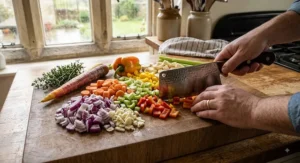
Problem: Vegetables sticking to the blade mid-chop. Sticky, starchy or sugary vegetables like sweet potato and beetroot cling to a flat blade surface. A non-stick coated option like the Shi Ba Zi Zuo 8-Inch Professional Cleaver, or simply an occasional light wipe of the blade with a damp cloth between batches, solves most of this.
Problem: Uneven stir-fry cooking. If some vegetables end up mushy while others are still raw, the cause is usually inconsistent cut size rather than the pan. A thinner, sharper edge — like the one on the Dalstrong Valhalla Nakiri Vegetable Cleaver or HOSHANHO 7-Inch High-Carbon Cleaver — makes it far easier to cut consistently sized pieces quickly, which is the actual fix for patchy stir-fry results.
Problem: Wrist fatigue during long prep sessions. Heavier forged blades can genuinely tire out a wrist over a long batch-cooking session. Switching to a lighter option such as the Zwilling J.A. Henckels Twin Signature Vegetable Cleaver reduces the physical load considerably without sacrificing much cutting performance.
Problem: Blade going blunt faster than expected. This is almost always down to cutting surface or storage, not the knife itself — glass boards and loose drawer storage are the two biggest culprits, regardless of whether you’re using a budget blade or the premium Global G49 Chinese Vegetable Chopper.
Problem: Struggling to scoop chopped vegetables into the pan. This is precisely what the flat spine of a vegetable cleaver is built for — use the broad side of the blade as a scraper rather than trying to sweep ingredients with your hand or a separate tool, which is faster and keeps your fingers away from the edge.
How to Choose the Best Vegetable Cleaver
Cutting through the marketing noise, here’s what actually matters when picking a vegetable cleaver, in order of impact:
- Steel type. High-carbon and VG10/VG-MAX steels hold an edge longer than basic stainless, but need slightly more careful drying and storage — decide how much maintenance you’re genuinely willing to do.
- Blade weight. Heavier blades chop through denser vegetables with less effort per stroke; lighter blades, like the Zwilling J.A. Henckels Twin Signature Vegetable Cleaver, offer more control and less fatigue over long sessions.
- Blade thickness. Thinner blades give cleaner, more precise cuts on delicate ingredients; thicker blades are more forgiving and slightly more durable against the odd hard squash or root vegetable.
- Handle material. Wood and Pakkawood feel warmer and often better balanced but need more care; sealed polymer handles are lower maintenance and dishwasher-friendlier, though not all premium cleavers should go in a dishwasher regardless of handle.
- Balance point. A blade-forward balance, as on the Global G49 Chinese Vegetable Chopper, suits confident cooks who prefer precision; a more even balance suits beginners learning technique.
- Budget vs frequency of use. If you cook vegetables daily, the cost-per-use maths favours spending more on a durable steel; occasional cooks get better value from a budget or mid-range pick.
- Certifications and warranty. NSF certification, as on the Shun Classic 7-Inch Vegetable Cleaver, signals commercial-grade durability standards, and a solid manufacturer warranty is a useful proxy for how much the brand trusts its own steel.
Nakiri vs Vegetable Cleaver: What’s the Real Difference?
This is one of the most searched comparisons in this category, and the honest answer is: less than the names suggest. Both are Japanese or Japanese-influenced blades designed for vegetable prep, both have flat-bottomed edges rather than the curved profile of a Western chef’s knife, and both favour a straight push-cut motion rather than rocking. According to the widely cited overview of the format on Wikipedia, the Chinese chef’s knife or “caidao” resembles a Western cleaver in shape but is typically much thinner in cross-section, designed for slicing and mincing rather than heavy chopping — which is essentially the design philosophy nakiri knives share, just filtered through a different regional tradition.
The practical differences that do matter: a traditional nakiri, like the profile on the Dalstrong Valhalla Nakiri Vegetable Cleaver, tends to be narrower top-to-bottom and lighter, optimised almost entirely for precision slicing. A taller Chinese-style vegetable cleaver, such as the Global G49 Chinese Vegetable Chopper or Shun Classic 7-Inch Vegetable Cleaver, has more blade surface area, which makes it noticeably better for scraping prepped food into a pan and gives a touch more heft for slightly tougher ingredients like winter squash. Neither is designed for bone-in cutting — that’s a genuine meat cleaver’s job — and manufacturers of both formats generally warn against using them that way.
| Format | Blade Height | Best Strength | Best For |
|---|---|---|---|
| Nakiri-style (e.g. Dalstrong Valhalla Nakiri Vegetable Cleaver) | Shorter, narrower | Precision slicing | Fine, delicate cuts |
| Chinese vegetable cleaver (e.g. Global G49 Chinese Vegetable Chopper) | Taller, broader | Scraping and versatility | All-round veg prep |
| Traditional chef’s knife | Curved profile | Rocking-motion versatility | Mixed meat and veg tasks |
The table makes the trade-off clear: if you almost exclusively prep vegetables and want maximum precision, lean nakiri; if you want one blade that also scoops, portions and handles the odd boneless chicken breast, the taller vegetable cleaver format is the more flexible daily driver. Buying guides from specialist UK knife retailers echo this same distinction — as the team at Sous Chef’s guide to Chinese cleavers and choppers explain, the terminology gets used loosely, but the thinner “chopper” style is built for precision veg and boneless protein work, not the heavy bone-splitting job a true cleaver handles.
Thin Blade vs Thick Blade: What Actually Matters for Vegetable Cutting
Blade thickness gets less marketing attention than steel type, but it arguably affects your day-to-day cutting experience more directly. A thinner blade — think the 2.2mm profile on the Global G49 Chinese Vegetable Chopper or the acute 8-12° edge on the Dalstrong Valhalla Nakiri Vegetable Cleaver — wedges less material apart as it passes through food, which means cleaner cuts with less cell damage. In practice, that translates to onions that sting your eyes less because fewer cells rupture, and herbs that bruise less because the blade slices rather than crushes.
Thicker blades, like the one on the Shi Ba Zi Zuo 8-Inch Professional Cleaver, sacrifice some of that precision but gain durability — they’re less prone to chipping against a stray hard seed or an unexpectedly tough squash stem, and they’re generally more forgiving of imperfect technique. The feature that genuinely doesn’t matter much, despite how often it’s marketed: blade length beyond about 18cm for home use. Unless you’re routinely prepping vegetables for a crowd, the extra reach rarely gets used, while a shorter blade is easier to control and store. What does matter that’s often glossed over: edge angle. A narrower edge angle, as found on nakiri-style blades, cuts more precisely but chips more easily on hard ingredients, while a wider angle trades a little precision for resilience — worth weighing against how carefully you tend to treat your kitchen tools.
Best Vegetable Cleaver for Stir-Fry and Wok Cooking
Stir-fry cooking has its own specific demands that separate a good general vegetable cleaver from a great one for this exact task. Speed matters more than almost anywhere else in home cooking, because wok cooking is fast and unforgiving — vegetables need to hit the heat at a similarly even size, or you end up with the classic problem of mushy carrots sitting next to raw broccoli stems. For this reason, blades that combine a sharp, thin edge with a bit of speed-friendly lightness tend to outperform heavier premium options for pure stir-fry prep. The HOSHANHO 7-Inch High-Carbon Cleaver earns its “stir-fry workhorse” reputation here because high-carbon steel takes an aggressively sharp edge that slices through fibrous aromatics like lemongrass and ginger cleanly rather than crushing them, which matters for flavour release in a hot wok.
The Dalstrong Valhalla Nakiri Vegetable Cleaver is the other strong contender for this exact use case, thanks to its thin-blade precision, while the broad, flat spine on any of the Chinese-style cleavers in this list — particularly the Global G49 Chinese Vegetable Chopper and Shun Classic 7-Inch Vegetable Cleaver — makes transferring a full chopping board of prepped veg into a hot wok a one-motion job rather than a fiddly scrape with a spatula. If your stir-fry routine involves prepping several vegetables in sequence before cooking even starts, prioritise a blade you can sharpen quickly and confidently, since a dulling edge shows up fastest in exactly this kind of repetitive, high-volume task.
Vegetable Cleavers for Plant-Based Meal Prep
As more UK households shift toward eating more plant-based meals — whether fully, or simply more often — the vegetable cleaver becomes less of a niche specialist tool and more of a genuine kitchen workhorse. The NHS Eatwell Guide recommends fruit and vegetables make up just over a third of what we eat each day, which in practical terms means a lot more chopping than a meat-centred diet typically demands — root vegetables, leafy greens, pulses, tofu and a far wider variety of textures than a weekly roast dinner ever required.
For batch plant-based meal prep — think a Sunday session producing several days’ worth of chopped vegetables for the week ahead — edge retention becomes the deciding factor over almost anything else, because you’re putting a blade through far more repetitions than occasional cooking demands. The Shun Classic 7-Inch Vegetable Cleaver and KYOKU Shogun Series Vegetable Cleaver both suit this pattern well, since their harder steel cores hold a working edge through a long prep session without needing a mid-session touch-up. For cooks newer to heavier veg-based cooking, the HOSHANHO 7-Inch High-Carbon Cleaver offers much of that edge-retention benefit at a fraction of the price, which matters if you’re still working out how central vegetables will become in your weekly cooking before committing serious money to a premium blade.
Lightweight Cleavers: Why Weight Matters More Than You Think
Weight is one of the most underrated factors in choosing a vegetable cleaver, and it’s rarely given the attention steel type gets in marketing copy. A heavier blade uses gravity to help drive through denser vegetables — useful for squash, swede or celeriac — but that same weight becomes a liability over a long prep session, particularly for anyone with smaller hands, wrist strain, or simply less knife-handling experience. This is exactly why a lightweight cleaver for vegetables, like the Zwilling J.A. Henckels Twin Signature Vegetable Cleaver, earns a dedicated recommendation on this list rather than being treated as a lesser budget option.
Lighter blades also tend to be easier to control precisely, because there’s less momentum to manage mid-cut — a genuinely useful trait for fine work like julienne carrots or thinly sliced spring onion. The trade-off is that a lightweight blade generally needs a slightly firmer, more deliberate stroke on tougher vegetables, since it isn’t relying on its own mass to help the cut along. For anyone prepping vegetables daily, or teaching a child or beginner to cook safely, prioritising a lighter blade over a heavier “premium-feeling” one is often the more sensible choice, regardless of price point.
Common Mistakes When Buying a Vegetable Cleaver
The most frequent mistake is buying based on blade length alone, assuming bigger automatically means better — in reality, an 18cm blade suits the vast majority of home kitchens, and anything larger mostly adds storage headaches without meaningfully improving cutting performance for typical portions. A close second is ignoring handle size relative to your own hand — a handle designed for a larger grip, common on some premium Japanese cleavers, can feel unwieldy for smaller hands regardless of how good the steel is.
Buyers also frequently underestimate maintenance requirements, picking a high-carbon or premium Japanese steel like the one in the Shun Classic 7-Inch Vegetable Cleaver without accounting for the hand-washing and prompt-drying routine it needs to avoid staining or corrosion — if that sounds like more care than you’re realistically going to give a knife, a stainless option like the Shi Ba Zi Zuo 8-Inch Professional Cleaver will serve you better long-term, even if the steel itself isn’t as impressive on paper. Finally, a surprisingly common error is buying a cleaver expecting it to replace a chef’s knife entirely — it excels at vegetables and boneless proteins, but a curved chef’s knife’s rocking motion still has genuine advantages for tasks like fine herb mincing or breaking down a whole chicken.
Long-Term Cost & Maintenance
Thinking in total cost of ownership rather than sticker price changes the maths considerably. A budget cleaver like the Shi Ba Zi Zuo 8-Inch Professional Cleaver costs less upfront but typically needs professional sharpening or a replacement sooner, while a premium option like the Shun Classic 7-Inch Vegetable Cleaver costs more initially but, cared for properly, can realistically last a decade or more without needing replacement — only occasional honing and professional sharpening every few months.
| Tier | Typical Price Range | Expected Lifespan (with care) | Ongoing Maintenance |
|---|---|---|---|
| Budget (e.g. Shi Ba Zi Zuo 8-Inch Professional Cleaver) | Under £30 | 2-4 years | Frequent honing, earlier replacement |
| Mid-range (e.g. KYOKU Shogun Series Vegetable Cleaver) | £70-£90 | 6-10 years | Regular honing, sharpen every few months |
| Premium (e.g. Global G49 Chinese Vegetable Chopper) | £200s | 10+ years | Careful hand-care, occasional professional sharpening |
Run the numbers over a decade and the mid-range and premium tiers often work out cheaper per year of use than repeatedly replacing a budget blade every couple of years — though that maths only holds if you’re actually willing to give the knife the hand-washing and drying routine it needs. If you know realistically you’ll leave a knife wet in the sink or run it through a dishwasher regardless of what the manual says, a durable stainless budget option will outlast a neglected premium one, cost aside.
Safety, Care and UK Knife Regulations
A sharp cleaver is a safer cleaver — dull blades require more pressure and are more likely to slip, which is the opposite of what most people assume. Always cut on a stable board, keep fingers curled away from the blade path using a claw grip, and never try to catch a falling knife; step back and let it drop.
Buying knives online in the UK also comes with legal requirements worth knowing, even for a straightforward kitchen purchase. Under the Criminal Justice Act 1988, retailers cannot sell knives or other bladed articles to anyone under 18, and online sellers must verify the buyer’s age and mark parcels as containing a bladed item, delivered only to an adult. Full details on current rules around buying, carrying and selling knives in the UK are set out on the official GOV.UK guidance page, which is worth a quick read if you’re buying a cleaver as a gift or for a household member. Beyond the legal side, sensible storage — a knife block, magnetic strip, or blade guard rather than a loose kitchen drawer — is both a safety measure and a maintenance one, protecting the edge from other cutlery while keeping curious hands away from an exposed blade.
Frequently Asked Questions
❓ What is the best vegetable cleaver for beginners?
❓ Is a vegetable cleaver better than a chef's knife?
❓ Can a vegetable cleaver cut through bone?
❓ How often should I sharpen a vegetable cleaver?
❓ What's the difference between a nakiri and a vegetable cleaver?
Conclusion
There isn’t a single “best” vegetable cleaver so much as a best match for how you actually cook. If you’re dipping a toe into the format, the Shi Ba Zi Zuo 8-Inch Professional Cleaver or Zwilling J.A. Henckels Twin Signature Vegetable Cleaver get you there without much financial risk. If stir-fry night is a weekly fixture, the HOSHANHO 7-Inch High-Carbon Cleaver and Dalstrong Valhalla Nakiri Vegetable Cleaver both earn their keep through sharpness and precision exactly where it counts. And if you’re chopping vegetables daily and ready to invest in a blade that’ll outlast a decade of dinners, the KYOKU Shogun Series Vegetable Cleaver, Shun Classic 7-Inch Vegetable Cleaver and Global G49 Chinese Vegetable Chopper each deliver genuinely superior steel and edge retention for the money.
Whichever you choose, the format itself is the real upgrade — once you’ve felt how much faster a proper vegetable cleaver gets through a weekly veg box compared with a standard chef’s knife, it’s hard to go back. Pair the right blade with the care routine covered above, and this is realistically the last vegetable knife purchase you’ll need to make for years.
Recommended for You
- Chinese Cleaver Knife: 7 Top Picks for UK Cooks in 2026
- Bone Chopping Cleaver: 7 Best Picks Tested for 2026
- Best Meat Cleaver 2026: 7 Top Picks for UK Kitchens
Disclaimer: This article contains affiliate links. As an Amazon Associate, I earn from qualifying purchases. If you purchase products through these links, we may earn a small commission at no additional cost to you.
✨ Found this helpful? Share it with your friends! 💬🤗
