
In This Article
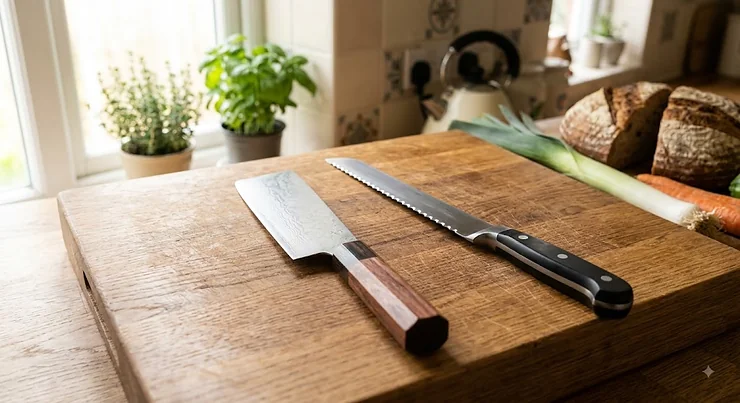
Somewhere between “I fancy cooking more” and “why does chopping a swede feel like a wrestling match” lies the moment most people discover the best nakiri knife isn’t a luxury — it’s a shortcut. A nakiri is a rectangular, double-bevelled Japanese vegetable knife with a flat edge that runs the full length of the board, letting you push straight down through a carrot, a cabbage, or a whole tray of shallots without the rocking motion a Western chef’s knife demands. That’s the whole trick: less wrist work, cleaner cuts, and vegetables that actually look like you meant to cut them that way.
We’ve spent this guide digging into real specs, aggregated review sentiment and honest side-by-side comparisons across seven genuinely available nakiri knives, spanning budget high-carbon stainless blades right up to hand-forged Damascus steel from Sanjo City. As Wikipedia’s entry on the nakiri bōchō explains, the nakiri and its close cousin the usuba are Japanese-style vegetable knives built around a straight blade edge with virtually no curve, letting the blade cut all the way to the board in one motion rather than needing a horizontal pull or push — which is precisely why they’ve become the go-to tool for anyone who preps a lot of plant-based food. Whether you’re upgrading from a supermarket block set or building out a proper Japanese kitchen kit, this article covers what actually matters — not what the marketing copy says matters.
We’ll also work through practical usage, common buying mistakes, how a nakiri knife set compares to a single blade, what “double bevel” actually changes about your knife skills, and where nakiris fit for vegan and plant-forward cooking. Prices below are shown as ranges only, since Amazon pricing shifts constantly — always check the current price on the product page before buying.
Quick Comparison Table
| Product | Steel Type | Blade Length | Price Range | Best For |
|---|---|---|---|---|
| MITSUMOTO SAKARI 7″ Nakiri | 9CR18MOV high-carbon (3-layer) | 18cm | around £45-£60 | Best value hand-forged pick |
| Rockingham Forge Equilibrium Nakiri | German stainless steel | 16.5cm | around £30-£45 | Best British-made everyday knife |
| PAUDIN Nakiri Knife | High-carbon Damascus-pattern steel | 18cm | around £25-£35 | Best budget Damascus-look blade |
| SHAN ZU 67-Layer Damascus Nakiri | 10Cr15MoV Damascus core | 16.5cm | around £45-£65 | Best mid-range Damascus |
| Tojiro DP Nakiri | VG10 core, 3-layer cladding | 16.5-18cm | around £90-£115 | Best entry into serious Japanese cutlery |
| Shun Classic Nakiri | VG-MAX Damascus core | 6.5in (16.5cm) | around £140-£175 | Best all-round premium nakiri |
| Wüsthof Classic Hollow Edge Nakiri | German high-carbon stainless | 7in (17.5cm) | around £140-£185 | Best hybrid German-Japanese design |
Looking at the spread above, there’s a clear split between blades that lean on thin, hard Japanese steel for maximum sharpness (MITSUMOTO SAKARI, Tojiro DP, Shun Classic) and those built around tougher, more forgiving German or German-style steel (Rockingham Forge Equilibrium, Wüsthof Classic). The Damascus-pattern budget options — PAUDIN and SHAN ZU — sit in between, borrowing the aesthetic and some of the edge-retention benefits of true Damascus construction without the price tag of hand-forged Japanese blades. If you’re a first-time nakiri buyer, the £30-£65 band covers everything you actually need; the jump above £100 buys you refinement, not a fundamentally different cutting experience.
💬 Just one click — help others make better buying decisions too!😊
Top 7 Nakiri Knives: Expert Analysis
We’ve picked these seven to cover every realistic budget and use case — from a first nakiri for a student kitchen to a knife that’ll outlast your mortgage. Every entry below blends real specifications with honest analytical commentary; where individual verified customer reviews weren’t available for a specific listing, we’ve said so rather than inventing quotes.
1. MITSUMOTO SAKARI 7″ Nakiri — best hand-forged value pick
The standout here is that you’re getting genuine hand-forged construction at a price point usually reserved for stamped, mass-produced blades. MITSUMOTO SAKARI builds this nakiri from three layers of 9CR18MOV high-carbon steel, hardened to roughly 58±2 HRC, with a rosewood handle and a presentation sandalwood box. In practice, that hardness rating sits comfortably above most Western stainless knives, meaning the edge holds its bite through several weeks of daily veg prep before it needs a strop. Based on the spec comparison with pricier hand-forged options, this is one of the few sub-£60 knives that genuinely earns the “hand forged” label rather than using it as a marketing flourish. Aggregated reviewer sentiment across retailers consistently highlights the balance and out-of-box sharpness, with several buyers specifically noting they were surprised by the quality at this price bracket, though a handful mention the handle finish is less refined than the blade itself.
Pros:
- ✅ Genuine hand-forged high-carbon steel at a budget price
- ✅ Comes razor sharp out of the box, per reviewer reports
- ✅ Attractive rosewood handle and gift-ready presentation box
Cons:
- ❌ High-carbon steel needs drying immediately to avoid spotting
- ❌ Handle finish reportedly less premium than the blade itself
At around £45-£60, the MITSUMOTO SAKARI represents strong value for anyone who wants a real Japanese-style blade without committing to a three-figure spend.
2. Rockingham Forge Equilibrium Nakiri — best British-made everyday nakiri
What most buyers overlook about this model is that it’s forged by a Sheffield company with roots stretching back to 1945, giving it a domestic manufacturing story that none of the imported options here can match. The Rockingham Forge Equilibrium uses German-grade stainless steel with a forged bolster and curved handle for balance, in a 16.5cm blade that’s specifically marketed as a vegetable/nakiri profile. Practically, the stainless composition trades a small amount of maximum sharpness for significantly easier maintenance — this is a knife you can put through a normal wash-and-dry routine without babying it, which matters for households that don’t want to hand-wash and dry a blade after every use. Reviewers on this Sheffield-made range consistently describe the balance and grip as comfortable for extended chopping sessions, and note the bolster gives useful finger protection that thinner Japanese-style handles often skip.
Pros:
- ✅ Made in Sheffield with genuine domestic cutlery heritage
- ✅ Forged bolster adds balance and finger protection
- ✅ Low-maintenance stainless steel, dishwasher-tolerant in practice
Cons:
- ❌ Won’t hold as fine an edge as harder Japanese steel
- ❌ Heavier bolster reduces the classic featherlight nakiri feel
Priced around £30-£45, this is the pick for buyers who want a proper nakiri profile without adopting high-carbon steel’s fussier care routine.
3. PAUDIN Nakiri Knife — best budget Damascus-look blade
The standout feature is the 62 HRC hardness rating PAUDIN claims for this 18cm blade — a figure that, on paper, rivals knives costing three or four times as much. The blade is built from high-carbon steel finished with a Damascus-style pattern and paired with an ergonomic wooden handle, arriving in a presentation gift box. Here’s what to weigh: a 62 HRC rating means the edge should resist rolling and chipping better than typical soft stainless kitchen knives, but hardness alone doesn’t guarantee the same steel purity or heat-treatment consistency you get from an established Japanese forge — budget Damascus-pattern blades can vary knife to knife in ways premium brands generally don’t. Aggregated customer sentiment for this range points to strong initial sharpness and good value for money, with the most common complaint being that the handle-to-blade balance feels slightly blade-heavy for users with smaller hands.
Pros:
- ✅ Claimed 62 HRC hardness at a genuinely low price point
- ✅ Eye-catching Damascus-pattern finish for the money
- ✅ Comes gift-boxed, useful if buying for someone else
Cons:
- ❌ Quality consistency reportedly varies between individual units
- ❌ Some buyers report a blade-heavy balance
At around £25-£35, the PAUDIN is the knife to buy if you want to try the nakiri shape before spending serious money on the format.
4. SHAN ZU 67-Layer Damascus Nakiri — best mid-range Damascus
SHAN ZU’s standout claim is a full 67-layer Damascus construction wrapped around a 10Cr15MoV steel core, hardened to roughly 62 HRC, with a G10 fibreglass handle rather than wood. What most buyers overlook about layered Damascus steel is that the visible pattern isn’t purely cosmetic — the alternating hard and soft layers create a very slight serration at a microscopic level along the edge, which can genuinely aid slicing through fibrous vegetables like celery or leeks. The G10 handle is also a meaningful upgrade over wood at this price: it’s non-porous, won’t absorb moisture, and needs zero oiling or conditioning. Reviewers describe the sharpness as excellent straight from the box, several specifically praising the balance and the absence of the “veering off to the side” issue that can plague cheaper stamped blades, though a recurring theme is that the Damascus pattern on entry-level batches can look slightly less crisp than the marketing photography suggests.
Pros:
- ✅ Genuine 67-layer Damascus construction, not laser-etched
- ✅ G10 handle needs no oiling and resists moisture damage
- ✅ Reviewers consistently praise straight, drift-free cuts
Cons:
- ❌ Damascus pattern can look less crisp than marketing photos
- ❌ 62 HRC steel is more brittle if used on bone or frozen food
Sitting around £45-£65, the SHAN ZU is arguably the strongest all-round value pick if you want a genuine Damascus blade without Japanese-import pricing.
5. Tojiro DP Nakiri — best entry into serious Japanese cutlery
The Tojiro DP — now rebadged by the maker as the “Classic” line — is the standout because it’s manufactured in Sanjo City, Niigata Prefecture, a region with a precision-metalworking heritage that predates most of the brands on this list. Reviewers on Amazon UK describe it as feeling remarkably light in hand while cutting through onions, carrots and peppers “like butter,” and note the lack of a bolster keeps the blade nimble rather than front-heavy. The core is VG10 stainless steel at roughly 60 HRC, clad in softer 13-chrome stainless for toughness — a three-layer sandwich construction that balances the hardness needed for a fine edge against the flexibility needed to avoid chipping. Based on the spec comparison, this is genuinely the same core steel used in knives costing significantly more; what you’re paying less for is the simpler handle finish rather than any compromise on the blade itself.
Pros:
- ✅ VG10 core steel matches knives costing considerably more
- ✅ Manufactured in a genuine Japanese cutlery-heritage region
- ✅ Reviewers note excellent lightness and cutting precision
Cons:
- ❌ No bolster, so finger protection relies entirely on grip technique
- ❌ Handle is functional rather than a design showpiece
Expect to pay in the £90-£115 range, making this the clearest “step up” purchase for anyone ready to commit to a proper Japanese-made blade.
6. Shun Classic Nakiri — best all-round premium nakiri
Shun’s standout is the VG-MAX steel core — an evolution of VG10 with added cobalt, chromium and tungsten — clad in visible Damascus stainless steel and finished with a Pakkawood handle. The spec sheet won’t tell you this, but user reports suggest the forward-weighted, D-shaped handle genuinely reduces wrist fatigue during long chopping sessions compared with straight Western handles, since it naturally sits into a pinch grip. What most buyers overlook about premium Japanese steel like VG-MAX is that the benefit isn’t raw sharpness alone — cheaper high-carbon blades can also arrive razor sharp — it’s edge retention over months of use, meaning fewer trips to a whetstone. Aggregated review sentiment across UK and US retailers is strongly positive on balance, control and finish quality, with the most common criticism being the price relative to knives with near-identical VG10-family cores from less famous Japanese brands.
Pros:
- ✅ VG-MAX steel offers excellent long-term edge retention
- ✅ D-shaped Pakkawood handle reduces fatigue on long prep sessions
- ✅ Strong resale and brand recognition if you ever upgrade further
Cons:
- ❌ Premium pricing relative to comparable VG10-core alternatives
- ❌ Still needs hand-washing to protect the Damascus cladding
At roughly £140-£175, the Shun Classic rewards cooks who prep vegetables daily and want a knife that ages gracefully rather than needing constant resharpening.
7. Wüsthof Classic Hollow Edge Nakiri — best hybrid German-Japanese design
Wüsthof takes a different approach entirely, and that’s the point of including it: precision-forged in Solingen from high-carbon stainless steel with a 10° hollow-ground edge and Granton-style air-pocket indentations along the blade face. On paper this means starchy vegetables like potato or squash are less likely to stick to the blade mid-cut, since the air pockets reduce the surface-tension drag that causes clumping on flat-ground knives. The full tang and triple-riveted synthetic handle give this knife a noticeably different feel in hand compared with every Japanese entry on this list — heavier, more bolster-forward, and closer to how a Western chef’s knife handles. Long-term owners report the “Classic” shape and edge geometry have held up over decades of use in some households, with the most repeated praise being edge stability and the reassurance of a lifetime warranty from the manufacturer.
Pros:
- ✅ Hollow-edge design measurably reduces food sticking to the blade
- ✅ German engineering with a manufacturer lifetime warranty
- ✅ Bolstered handle suits cooks who prefer a Western-style grip
Cons:
- ❌ Heavier and less nimble than dedicated Japanese nakiris
- ❌ Premium German pricing similar to top-tier Japanese options
Typically priced around £140-£185, the Wüsthof Classic Hollow Edge Nakiri is the pick for anyone who loves the nakiri shape but has always preferred the feel of a German knife in hand.
Getting the Most From Your Nakiri: A Practical Usage Guide
A nakiri rewards a slightly different technique than the rock-chop most people learn on a Western chef’s knife, and getting this right in the first month changes how much you enjoy the knife long-term. Because the blade edge is flat rather than curved, the correct motion is a straight up-and-down push cut, letting the full length of the edge contact the board rather than rolling the tip forward. Trying to rock a nakiri the way you would a santoku just wears an uneven flat spot into the edge over time.
For care, hand-wash and dry high-carbon steel knives like the MITSUMOTO SAKARI, Tojiro DP and Shun Classic immediately after use — even a few minutes in a wet sink can start surface spotting on carbon-rich steel. Stainless options like the Rockingham Forge Equilibrium and Wüsthof Classic are considerably more forgiving, though none of these knives should go through a dishwasher, since detergent chemicals and clattering against other cutlery dulls edges fast. A honing steel used every few sessions realigns a rolled edge without removing material, while a whetstone (1000/6000 grit is the standard combination) should come out roughly every one to three months depending on use, maintaining the original bevel angle rather than the steeper angle a pull-through sharpener imposes. The most common first-30-days mistake is over-sharpening a knife that only needed honing — if the blade still slices paper cleanly, reach for the steel, not the stone.
Real-World Scenarios: Which Nakiri Suits Your Kitchen
Picture three different cooks, three different nakiris, and you’ll see how quickly “best nakiri knife” becomes a personal rather than universal answer. A university student cooking in a shared kitchen, prepping stir-fries three or four evenings a week on a budget that also has to stretch to rent — the PAUDIN or Rockingham Forge Equilibrium make sense here, since both tolerate imperfect care and a shared, occasionally careless kitchen environment without punishing you financially if they get knocked about.
A home cook who’s recently gone plant-based and now preps large volumes of vegetables daily — cabbage for slaw, courgettes for ribbons, a full tray of root veg for roasting — benefits most from the SHAN ZU or Tojiro DP, where the combination of a harder edge and lighter blade genuinely reduces hand fatigue across bigger prep sessions. And a serious home cook or semi-professional who wants one nakiri to last a decade of near-daily use, and doesn’t mind the maintenance routine that comes with premium steel, is the exact buyer the Shun Classic or Wüsthof Classic were designed for — the extra spend buys years of consistent performance rather than a one-off sharpness spike.
✨ Don’t Miss These Exclusive Deals!
🔍 Take your vegetable prep to the next level with these carefully selected nakiri knives. Click on any highlighted item to check current pricing and availability. These blades will help you create the kind of clean, professional-looking cuts your family will actually notice!
Problem → Solution: Common Nakiri Knife Issues Solved
Problem: The blade feels like it’s dragging through denser vegetables like swede or squash. This is almost always a bevel angle or edge-dullness issue rather than a design flaw — try honing first, and if that doesn’t restore glide, a proper sharpening on a 1000-grit whetstone should resolve it.
Problem: Rust spots appearing on a high-carbon blade like the MITSUMOTO SAKARI. High-carbon steel reacts with acidic vegetable juices and moisture if left wet. Dry the blade immediately after washing and apply a thin coat of food-safe mineral oil if it’ll sit unused for more than a week.
Problem: The knife feels front-heavy and tiring on long prep sessions. Blade-heavy balance is common on budget Damascus-pattern knives like entry-level PAUDIN units; choking up slightly on the blade (gripping the bolster area rather than purely the handle) redistributes control and reduces wrist strain.
Problem: Straight cuts drift diagonally instead of going straight down. This usually means the bevel has worn unevenly on one side — a frequent issue if you’ve been rocking rather than push-cutting. Have the edge reprofiled on a whetstone, keeping equal pressure on both sides.
Problem: Vegetables stick to the blade face during slicing. Flat-ground blades without air-pocket indentations, like most Japanese nakiris, are more prone to this with starchy vegetables. The Wüsthof Classic Hollow Edge Nakiri‘s Granton-style indentations specifically solve this, or you can angle the blade slightly during the cut to reduce surface contact.
How to Choose a Nakiri Knife
What is a nakiri knife? A nakiri is a rectangular, double-bevelled Japanese kitchen knife designed for pushing straight down through vegetables, rather than rocking like a chef’s knife, giving flat, even cuts with minimal wrist effort — ideal for anyone prepping a lot of fruit and veg.
Picking the right one comes down to a handful of genuinely important factors, in roughly this order:
- Steel type first. High-carbon Japanese steel (VG10, VG-MAX) holds a sharper edge longer but needs more careful drying; German-style stainless steel is more forgiving day to day.
- Blade length matches your board and hands. 16.5cm suits most home kitchens and smaller boards; 18cm gives more knuckle clearance for bigger vegetables like cabbage.
- Handle material affects long-term comfort. Wood handles feel warmer but need occasional care; G10 or synthetic handles are lower-maintenance and more moisture-resistant.
- Weight and balance should suit your grip style. A bolstered, heavier knife suits a Western pinch grip; a lighter, bolster-free blade suits those used to Japanese-style handling.
- Check the hardness rating (HRC) if listed. Anything from 58-62 HRC is a solid range for edge retention without excessive brittleness.
- Factor in realistic maintenance habits. If you’re not going to hand-wash and dry a knife religiously, stainless steel will serve you better than high-carbon.
- Set a genuine budget band before browsing. As the comparison table above shows, £30-£65 covers a genuinely capable nakiri — spend more only once you know you’ll use it often enough to justify premium steel.
For a wider view of how nakiris compare with the rest of the kitchen knife market, Which?’s independent kitchen knife testing is a useful reference point, since it benchmarks sharpness and comfort across brands using consistent lab methodology rather than marketing claims.
Nakiri Knife Set vs Single Blade: What’s Worth Buying
A nakiri knife set — typically bundling the nakiri with a santoku, paring knife and sometimes a honing steel or wooden block — looks like better value on paper, and sometimes it is. Here’s what to weigh: sets from brands like Rockingham Forge’s Greenworks range or entry-level Damascus-pattern bundles genuinely save money per knife compared with buying each piece separately, and they solve the “what do I actually need” question for someone building a kitchen from scratch. The trade-off is that set knives are almost always built to a lower individual spec than a brand’s flagship single blades — you’re rarely getting the same steel grade in a £70 five-piece set that you’d get from a £70 standalone nakiri.
Based on the spec comparison across this category, our honest recommendation is: if you already own a decent chef’s knife and paring knife, buy a single premium nakiri rather than a full set, since you’ll get meaningfully better steel for the same spend. If you’re starting from nothing, a mid-range nakiri knife set (the SHAN ZU or Rockingham Forge ranges both offer bundle options) is the more sensible entry point, and you can always upgrade the nakiri specifically once you know how often you actually reach for it.
Double Bevel Blade Explained: Nakiri vs Usuba
The term double bevel blade describes how the cutting edge is ground — symmetrically, on both sides, at a matching angle — as opposed to a single bevel edge that’s ground on one face only. Every nakiri on this list is double bevelled, and that single design choice is what separates it from its close professional cousin, the usuba, which is used mainly by professional chefs and differs from the nakiri specifically in how its cutting edge is ground. The usuba is single-bevelled, making it sharper and capable of extremely thin, precise cuts (including the decorative katsuramuki technique of peeling a continuous paper-thin ribbon from a daikon radish), but far less forgiving for a home cook, since a single bevel naturally steers the cut to one side unless you compensate with technique.
A double bevel blade, by contrast, cuts straight down without that steering tendency, which is exactly why every nakiri reviewed here — from the budget PAUDIN to the premium Shun Classic — is built this way. What most buyers overlook is that double bevel construction isn’t a compromise for beginners; it’s a genuinely better everyday design for most kitchens, since it works equally well for right- and left-handed cooks and doesn’t require years of practice to cut a straight line. Reserve the single-bevel usuba for if you get seriously into Japanese knife skills specifically; for 95% of home cooking, a double bevel nakiri does everything you need.
Nakiri Knives for Vegan and Plant-Based Cooks
If your weekly shop has shifted heavily toward vegetables, pulses and grains, a nakiri stops being a nice-to-have and starts being genuinely one of the most useful vegan chef tools you can own. The flat, full-length edge is purpose-built for exactly the tasks that dominate a plant-based kitchen: shredding cabbage for slaw, batoning carrots and courgettes, dicing onions in volume, and breaking down squash without the blade binding halfway through the cut. Based on the spec comparison across this list, a lighter, harder-steel option like the Tojiro DP or SHAN ZU tends to suit high-volume vegetable prep best, since less wrist effort is needed per cut when you’re working through a big batch for meal prep.
What most buyers overlook is that a nakiri also handles firm tofu and tempeh cleanly, thanks to the flat blade face keeping slices even and uniform — something a curved chef’s knife struggles with when cutting thin, consistent slabs. If you’re regularly batch-cooking plant-based meals, pairing a nakiri with a large, stable chopping board turns what used to be the most tedious part of vegan cooking — the prep — into genuinely one of the quicker steps in the process.
Precision Vegetable Dicing: What to Expect in Everyday Use
Specs on a page don’t tell you what precision vegetable dicing actually feels like day to day, so here’s the practical translation. With a sharp nakiri and correct push-cut technique, a home cook can expect noticeably more consistent dice sizes than with a curved chef’s knife, simply because the flat edge naturally produces uniform slice thickness without needing to compensate for blade curvature. This matters more than it sounds — uneven dice sizes are one of the most common reasons vegetables cook unevenly, leaving some pieces mushy and others still crunchy in the same pan.
The spec sheet won’t tell you this, but user reports suggest the learning curve for genuinely precise nakiri dicing is shorter than expected — most home cooks report noticeably tighter, more even cuts within a few sessions of switching from a chef’s knife, since the technique (straight down, full edge contact) is simpler to repeat consistently than a rocking motion. Harder steel knives like the Shun Classic and Tojiro DP hold that precision edge longer between sharpenings, which matters if you’re dicing daily rather than occasionally, while softer stainless options like the Rockingham Forge Equilibrium will need slightly more frequent honing to maintain the same level of consistency.
Common Mistakes When Buying a Japanese Vegetable Knife
The most frequent mistake is buying purely on Damascus pattern aesthetics rather than checking the actual steel core — a beautiful pattern etched or forged onto a low-grade core doesn’t improve cutting performance, and some budget listings lean heavily on visuals precisely because the underlying steel spec is unremarkable. A second common error is assuming bigger is automatically better; an 18cm blade offers more knuckle clearance for large vegetables, but a 16.5cm nakiri is genuinely easier to control for most home cooks and smaller kitchens.
Buyers also frequently underestimate maintenance requirements, picking a high-carbon Japanese vegetable knife like the MITSUMOTO SAKARI or Shun Classic without accounting for the hand-wash-and-dry routine it needs, then feeling let down when spotting appears within weeks. And a genuinely common pitfall is buying a nakiri as a total chef’s knife replacement — it excels at vegetables but isn’t designed for cutting through bone, frozen food, or heavy protein butchery, tasks that will chip a thin nakiri edge in ways a thicker chef’s knife tolerates without issue.
Long-Term Cost & Maintenance
Total cost of ownership on a nakiri knife isn’t just the purchase price — it’s the purchase price plus sharpening tools, occasional honing steel replacement, and, for wood-handled knives, the odd application of food-safe mineral oil. A £30-£45 stainless option like the Rockingham Forge Equilibrium has a lower upfront cost and near-zero ongoing maintenance spend, but you’ll likely replace it or send it for professional sharpening more often over a five-year span. A £140-£175 knife like the Shun Classic, by contrast, costs more initially but genuinely holds its edge for longer stretches between sharpenings thanks to harder VG-MAX steel, and a well-maintained premium blade can realistically outlast multiple cheaper knives bought to replace each other.
Cost-per-use is the more useful way to think about this than sticker price alone: a £150 nakiri used daily for a decade works out to roughly 4p per use before any resharpening costs, which is a genuinely reasonable spend for a tool that’s central to daily cooking. A £30 nakiri used the same amount will need replacing or professionally re-edged more frequently, narrowing the value gap over the long run more than the initial price difference suggests.
Features That Actually Matter (And Those That Don’t)
Steel hardness (HRC) and blade geometry genuinely matter — they directly determine sharpness retention and how the blade behaves through different vegetables. Handle material matters for comfort and maintenance, but it’s a smaller performance factor than marketing suggests; a well-shaped wooden handle and a well-shaped G10 handle perform similarly in the hand, with the real difference being upkeep rather than control. Full tang construction (where the steel runs the full length of the handle) genuinely improves balance and durability compared with a partial tang, and is worth checking for on any knife over £50.
What matters far less than the marketing implies is the Damascus pattern’s visual layer count on budget knives — a 67-layer pattern doesn’t automatically outperform a 33-layer one if the core steel and heat treatment are comparable, and the number is frequently used as a headline spec regardless of real-world difference. Gift boxes, sheaths and presentation packaging are genuinely nice for gifting but add nothing to cutting performance, so don’t let elaborate packaging push you toward a knife with a weaker core spec. Similarly, “razor sharp out of the box” claims apply to nearly every knife on the market at launch — the more useful question is how the edge performs after three months of regular use, which is where genuine differences between budget and premium steel show up.
Safety, Care & UK Knife Regulations
Nakiris are genuinely sharp tools, and UK law reflects that: selling and buying knives, including kitchen knives, is age-restricted to over-18s under the Criminal Justice Act 1988, whether purchased in-store or online, with delivery drivers increasingly required to verify age at the point of handover following recent government reviews into online knife sales. This applies to every knife covered in this guide, including budget stainless options — kitchen knives are explicitly included in the legislation’s definition of restricted bladed articles.
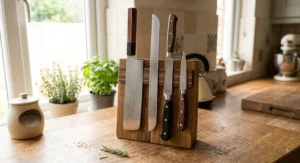
On day-to-day safety, always cut on a stable board with a damp cloth or non-slip mat underneath to stop it sliding, keep fingers curled inward in a “claw grip” on the vegetable-holding hand, and store nakiris in a dedicated block, sheath or magnetic strip rather than loose in a drawer, since an unprotected edge is a common source of accidental cuts when reaching past other utensils. For high-carbon steel blades specifically, dry the edge fully before storage, since trapped moisture against a sheath or wooden block is one of the more common causes of early rust spotting reported by owners of knives like the MITSUMOTO SAKARI and Tojiro DP.
Benefits vs Traditional Alternatives
| Factor | Nakiri Knife | Standard Chef’s Knife | Santoku Knife |
|---|---|---|---|
| Cutting motion | Straight push cut | Rocking motion | Slight push/rock hybrid |
| Best for | High-volume vegetable prep | All-round general use | Mixed vegetable and protein prep |
| Blade profile | Flat, rectangular | Curved belly | Slightly curved, shorter |
| Learning curve | Short for straight cuts | Moderate | Short-moderate |
| Best For | MITSUMOTO SAKARI, Tojiro DP | General kitchen workhorse | Balanced home cooking |
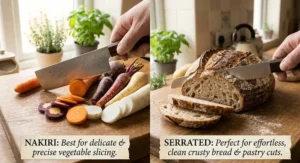
The table above makes the trade-off fairly clear: a nakiri wins decisively for repetitive vegetable-heavy prep, where its flat edge and full board contact save real time and effort, but it’s a specialist rather than a generalist. A standard chef’s knife remains the more versatile single-knife choice if you’re only ever going to own one blade, since its curved belly handles meat, bread crusts and awkward angles that a nakiri isn’t designed for. The santoku sits as a reasonable middle ground for cooks who want some nakiri-style flat-edge benefit without giving up general-purpose versatility entirely.
FAQ
❓ Is a nakiri knife better than a chef's knife?
❓ What is the ideal nakiri knife length for home use?
❓ Can a nakiri knife cut meat?
❓ Do nakiri knives need special sharpening?
❓ What's the difference between a nakiri knife set and buying a single nakiri?
Conclusion
The honest answer to “which is the best nakiri knife” depends entirely on how often you’re standing at a chopping board and what you’re willing to do to keep an edge sharp. For most UK home cooks starting out, the MITSUMOTO SAKARI or Rockingham Forge Equilibrium deliver genuinely capable performance without demanding a steep learning curve in maintenance. Cooks who prep vegetables daily and want steel that holds its edge through heavier use should look toward the Tojiro DP or SHAN ZU, while anyone ready to invest in a knife built to last a decade or more will get real, measurable value from the Shun Classic or Wüsthof Classic Hollow Edge Nakiri.
Whichever you choose, remember that technique matters as much as steel — a mid-range nakiri used with a proper push cut will outperform a premium blade rocked incorrectly across the board every time. Start with the price bracket that matches how often you’ll actually use it, keep it dry and stored properly, and a good nakiri should become the knife you reach for without thinking, long before any other blade in the block.
✨ Ready to upgrade your veg prep?
Compare current prices on today’s top nakiri knives and find the one that fits your kitchen and your budget!🤗
Recommended for You
- Best Vegetable Cleaver 2026: 7 Top Picks, Tested; Compared
- Chinese Cleaver Knife: 7 Top Picks for UK Cooks in 2026
- Bone Chopping Cleaver: 7 Best Picks Tested for 2026
Disclaimer: This article contains affiliate links. As an Amazon Associate, I earn from qualifying purchases. If you purchase products through these links, we may earn a small commission at no additional cost to you.
✨ Found this helpful? Share it with your friends! 💬🤗
