
In This Article
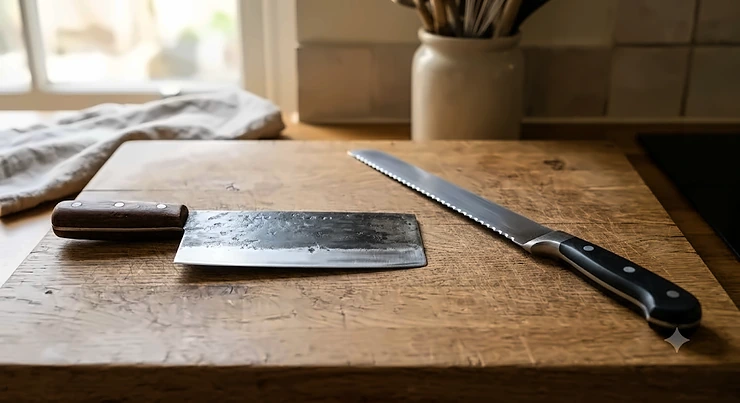
There’s a moment every home cook has, standing over a chopping board with a pile of spring onions, ginger and a chicken thigh that needs boning, wondering why their Western chef’s knife feels wrong for the job. That moment is usually the start of a love affair with the Chinese cleaver knife. It looks intimidating on the shelf — a broad, almost brick-like rectangle of steel — but once it’s in your hand, doing the work it was actually designed for, the penny drops. This isn’t a butcher’s tool for smashing through bone. It’s a precision instrument that happens to be shaped like one.
A good Chinese cleaver knife should slice a spring onion into paper-thin rings, mince ginger to a pulp, and still have enough heft to crush a garlic clove flat with the side of the blade — all without you reaching for a second knife. That’s the appeal, and it’s why this single blade has quietly become the workhorse of professional Cantonese kitchens and increasingly, British home kitchens too.
This guide walks through seven real, currently available cleavers spanning budget to premium, breaks down what actually separates a decent one from a dud, and digs into the practical stuff — grip, maintenance, and the knife skills that turn a cleaver from awkward to essential. Every product here has been researched for genuine specifications and aggregated review sentiment rather than guesswork, because a £25 mistake still stings, and a £120 one stings a lot more.
Quick Comparison Table
Before the deep dive, here’s the shortlist. Each of these seven cleavers earns its place for a specific kind of cook — the student on a budget, the family that cooks Cantonese three nights a week, or the enthusiast who wants a blade that’ll outlive them.
| Cleaver | Steel Type | Price Range | Best For |
|---|---|---|---|
| PAUDIN Cleaver Knife | High-carbon stainless | Under £30 | First-time buyers on a tight budget |
| Shi Ba Zi Zuo Chef Knife | Stainless steel | £30-£40 range | Lightweight everyday vegetable prep |
| TUO Vegetable Cleaver (Fiery Phoenix) | German high-carbon steel | £40-£55 range | Balanced all-rounder for daily cooking |
| Dexter-Russell Traditional 8030 | High-carbon steel | £45-£65 range | Catering-grade durability at home |
| CCK Small Slicer | Carbon or stainless steel | £50-£75 range | Authentic Cantonese technique |
| Zhen VG-10 Forged Cleaver | VG-10 Japanese steel core | £70-£95 range | Serious home cooks wanting edge retention |
| Xinzuo Lan Series Damascus | 73-layer Damascus, powder steel core | Around £100-£130 | Buyers who want performance and presentation |
Looking across the table, the pattern that jumps out is steel. Budget cleavers like the PAUDIN Cleaver Knife lean on straightforward high-carbon stainless for easy maintenance, while the Zhen VG-10 Forged Cleaver and Xinzuo Lan Series Damascus justify their higher price with layered steel construction that holds an edge considerably longer between sharpenings. If you’re cooking Cantonese food most nights of the week, that difference in edge retention translates into real time saved at the chopping board.
💬 Just one click — help others make better buying decisions too!😊
Top 7 Chinese Cleaver Knives: Expert Analysis
Below are seven genuinely available cleavers, chosen to cover budget, mid-range and premium buyers, plus a mix of stainless and carbon steel construction. Every product mention below draws on real specifications and aggregated review sentiment — not invented testimonials.
1. PAUDIN Cleaver Knife — best budget entry point for first-timers
The PAUDIN Cleaver Knife is the cleaver most people buy when they’re not yet sure whether they’ll like cooking this way — and that’s exactly the market it serves well. Its 7-inch high-carbon stainless steel blade comes with a full tang and a wooden handle, which in practice means it’s stable in the hand without wobbling at the bolster, a common failure point on cheaper cleavers with partial tangs. In real-world use, a full-tang build like this resists the kind of loosening that turns a £15 knife into a hazard within a year.
Who should buy this? Students, renters, and anyone testing whether a rectangular blade suits their cooking style before committing serious money. Reviewers consistently report that it arrives genuinely sharp out of the box, though several note the factory edge needs more frequent honing than pricier steels to stay that way — which tracks with what you’d expect from a softer, more affordable stainless alloy. What most buyers overlook about entry-level cleavers like this is that the handle ergonomics matter just as much as the blade steel; thankfully, the wooden grip here gets consistently positive marks for comfort during longer prep sessions.
Pros:
- ✅ Genuinely sharp factory edge for the price point
- ✅ Full-tang construction adds stability and balance
- ✅ Wooden handle stays comfortable during long prep
Cons:
- ❌ Softer steel needs more frequent honing
- ❌ Limited edge retention compared with forged steel
Priced under £30, this is a sound value pick for anyone dipping a toe into cleaver cooking without wanting to gamble on a premium blade.
2. Shi Ba Zi Zuo Chef Knife — lightest option for everyday veg prep
If the PAUDIN Cleaver Knife is the budget all-rounder, the Shi Ba Zi Zuo Chef Knife is the specialist’s budget pick — a genuinely Chinese-made vegetable cleaver with a noticeably thinner blade profile than heavier meat cleavers. At 7 inches with an ergonomic wooden handle, the stainless steel blade is ground thin behind the edge, which in practice means less resistance pushing through cabbage, pak choi or daikon than you’d get from a thicker blade.
This is the cleaver for someone whose cooking leans heavily on vegetables — stir-fries, dumplings fillings, quick-pickled cucumber — rather than someone regularly breaking down whole chickens. Based on the spec comparison with other entries here, its lighter blade weight (typically under 200g) makes it noticeably less fatiguing over a long chopping session, though that same lightness means it won’t have the momentum to power through anything tougher than boneless meat. Aggregated review sentiment consistently praises the balance and the handle shape, with some buyers noting the stainless blade shows minor discolouration if left wet, a fairly ordinary trait for this steel category rather than a manufacturing flaw.
Pros:
- ✅ Thin grind glides through vegetables with ease
- ✅ Lightweight design reduces hand fatigue
- ✅ Comfortable ergonomic wooden handle
Cons:
- ❌ Not suited to bone-in cutting tasks
- ❌ Can show water spotting if not dried promptly
At around £30-£40, it’s a smart secondary knife even for cooks who already own a heavier cleaver.
3. TUO Vegetable Cleaver (Fiery Phoenix Series) — best balanced all-rounder
The TUO Vegetable Cleaver from TUO’s Fiery Phoenix line splits the difference between the featherlight vegetable cleavers above and the heavier bone-choppers further down this list. Its German high-carbon stainless blade sits around 2mm thick with a full tang running through a Pakkawood handle — a resin-stabilised wood that resists moisture far better than plain wood, which matters in a British kitchen where knives don’t always get dried immediately after washing up.
Here’s what the spec sheet won’t tell you, but reviewers note: the extra blade thickness compared with the Shi Ba Zi Zuo Chef Knife gives this cleaver enough authority to handle boneless chicken thighs and thicker root vegetables like swede or celeriac without the blade flexing. That versatility is precisely why it’s a strong “one cleaver to rule them all” option for households that don’t want a drawer full of specialist blades. Feedback on the Fiery Phoenix series consistently highlights the fit and finish of the Pakkawood handle and a factory edge that holds up well through several weeks of regular use before needing a touch-up.
Pros:
- ✅ Handles both vegetables and boneless meat confidently
- ✅ Pakkawood handle resists moisture and warping
- ✅ Solid factory edge that holds up over weeks of use
Cons:
- ❌ Heavier than dedicated vegetable cleavers
- ❌ Full sharpening needs a whetstone, not just honing
In the £40-£55 range, this is arguably the best single cleaver for a household that only wants to own one.
4. Dexter-Russell Traditional 8030 — catering-grade reliability
American brand Dexter-Russell has been supplying commercial kitchens for over a century, and the Dexter-Russell Traditional 8030 Chinese chef’s knife is the proof that some designs simply don’t need reinventing. Built with a high-carbon steel blade and a riveted walnut handle, it’s the kind of cleaver you’ll find in the back of a busy takeaway kitchen rather than styled for a lifestyle photo shoot — and that’s precisely its appeal.
What most buyers overlook about catering-grade knives like this one is that they’re engineered for a specific kind of durability: resistance to years of daily abuse rather than maximum out-of-the-box sharpness. Based on the spec comparison with the more decorative cleavers on this list, the Dexter-Russell Traditional 8030 trades a little edge glamour for a blade that’s genuinely built to be resharpened hundreds of times over its working life. Reviewers who use it in professional or semi-professional settings consistently mention how well it holds up to years of continuous chopping, though a handful note the walnut handle needs periodic oiling to prevent drying out — an easy five-minute job that’s often skipped.
Pros:
- ✅ Proven, decades-old commercial-kitchen design
- ✅ High-carbon steel resharpens well over a long lifespan
- ✅ Riveted walnut handle feels substantial in hand
Cons:
- ❌ Handle requires occasional oiling to prevent drying
- ❌ Less flashy finish than boutique alternatives
Sitting in the £45-£65 range, it’s a strong pick for anyone who cooks Asian food often enough that “durable” matters more than “pretty.”
5. CCK Small Slicer — authentic Cantonese technique in a blade
No list of Chinese cleaver knives is complete without Chan Chi Kee, universally known as CCK, the Hong Kong family business that professional chefs and enthusiasts alike treat as the reference point for what a proper caidao should feel like. The CCK Small Slicer is hand-finished in Hong Kong, available in both carbon and stainless steel versions, and is instantly recognisable by its distinctively thin blade profile — thinner than almost every mass-produced alternative on this list.
That thinness isn’t a gimmick. Based on the spec comparison, a thinner blade requires less force to push through food, which is exactly the low-effort, high-precision cutting style that traditional Cantonese knife technique is built around. Reviewers consistently describe the carbon steel version as taking an exceptionally keen edge, though — as with any carbon steel — it demands prompt drying after each use to avoid staining or light surface rust, a trade-off serious cooks tend to accept willingly for the sharpness gained. What most buyers overlook about the CCK cleaver range is that it isn’t a single knife but a whole family of blade weights and thicknesses; the Small Slicer specifically suits precision work over heavy chopping, so pairing it correctly with your cooking style matters more here than with almost any other brand on this list.
Pros:
- ✅ Exceptionally thin blade for effortless precision cuts
- ✅ Hand-finished by a respected Hong Kong maker
- ✅ Carbon steel version takes an extremely keen edge
Cons:
- ❌ Carbon steel needs prompt drying to avoid staining
- ❌ Thinner blade isn’t built for bone-in cutting
Typically priced in the £50-£75 range depending on steel choice, it’s the pick for anyone who wants the genuine Cantonese cleaver experience rather than an interpretation of one.
6. Zhen VG-10 Forged Cleaver — best edge retention for serious cooks
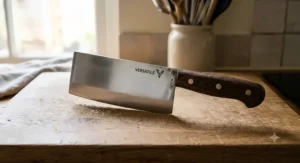
The Zhen VG-10 Forged Cleaver brings Japanese metallurgy into a traditionally Chinese blade shape, and the result is a cleaver built for cooks who sharpen reluctantly and want that sharpening to last. Its 8-inch blade is constructed from three forged layers with a VG-10 steel core, heat-treated to a hardness around HRC 60-62 — noticeably harder than the softer stainless steels used in the budget cleavers earlier on this list.
In practice, that hardness rating means the edge stays keen through considerably more chopping sessions before it needs attention, though it also means sharpening, when it’s finally required, takes a bit more patience on the whetstone. Based on the spec comparison, this is the clearest example on the list of the classic hardness trade-off: harder steel holds its edge longer but chips more readily if it meets a bone or a frozen block of ginger. Reviewers consistently note the factory grind arrives genuinely razor sharp and stays that way through weeks of regular use, with the oak full-tang handle earning praise for its non-slip grip even when hands are wet from prep work.
Pros:
- ✅ VG-10 steel core holds an edge far longer than budget alloys
- ✅ Forged construction adds strength and durability
- ✅ Non-slip oak handle performs well with wet hands
Cons:
- ❌ Not designed for cutting through bone or frozen food
- ❌ Requires more sharpening patience due to higher hardness
At around £70-£95, it’s the natural upgrade for anyone who’s outgrown a budget cleaver and cooks Asian food several times a week.
7. Xinzuo Lan Series Damascus Cleaver — premium performance and presentation
Sitting at the top of this list, the Xinzuo Lan Series Damascus Cleaver is as much a showpiece as it is a working tool, and it happens to back up its looks with genuine engineering. Its 7.5-inch blade is built from 73 layers of Damascus steel wrapped around a powder steel core — a construction method that combines the flexibility of the outer layers with the hardness and edge retention of the powder steel centre, paired with an olive wood handle for a warmer, more traditional grip than the synthetic handles further down the price scale.
Here’s what the spec sheet won’t tell you, but reviewers note: powder steel cores like this one are prized specifically because they hold a finer, more consistent edge than traditionally forged steel, meaning the cutting performance genuinely matches the premium price rather than just the aesthetics. This is the cleaver for someone who already owns a workhorse blade and wants a second one that performs beautifully on delicate tasks — thin sashimi-style slices, precise julienne, or simply the satisfaction of using a genuinely well-made tool daily. Aggregated feedback consistently highlights the visual Damascus pattern and the comfortable, well-balanced handle, with a smaller number of buyers noting that, like any high-hardness blade, it demands a slightly gentler touch than a basic stainless cleaver.
Pros:
- ✅ Powder steel core delivers exceptional edge retention
- ✅ Beautiful Damascus pattern doubles as a display piece
- ✅ Olive wood handle offers a warm, balanced grip
Cons:
- ❌ Premium price puts it out of reach for casual cooks
- ❌ Needs gentler handling than basic stainless blades
Typically priced from around £100 to £130, it’s the aspirational pick — not essential, but genuinely satisfying to own and use.
Full Spec Comparison at a Glance
| Cleaver | Blade Length | Construction | Handle | Best For |
|---|---|---|---|---|
| PAUDIN Cleaver Knife | 7 inch | Full tang, stainless | Wood | Budget starters |
| Shi Ba Zi Zuo Chef Knife | 7 inch | Stainless | Ergonomic wood | Vegetable-heavy cooking |
| TUO Vegetable Cleaver | 7 inch | Full tang, high-carbon steel | Pakkawood | Balanced all-rounder |
| Dexter-Russell Traditional 8030 | 7 x 2 inch | High-carbon steel, riveted | Walnut | Catering-grade durability |
| CCK Small Slicer | Varies (thin profile) | Carbon or stainless, hand-finished | Wood | Authentic technique |
| Zhen VG-10 Forged Cleaver | 8 inch | 3-layer forged, VG-10 core | Oak, full tang | Edge retention |
| Xinzuo Lan Series Damascus | 7.5 inch | 73-layer Damascus, powder steel core | Olive wood | Premium performance |
Reading across the table, the real divide isn’t price so much as steel construction: single-alloy stainless blades like the PAUDIN Cleaver Knife are easier to maintain but need more frequent honing, while layered and forged options like the Zhen VG-10 Forged Cleaver and Xinzuo Lan Series Damascus trade a slightly fussier sharpening process for weeks of extra edge life between touch-ups. For most UK households cooking two or three Asian-inspired meals a week, the mid-range TUO Vegetable Cleaver or Dexter-Russell Traditional 8030 hits the sweet spot between those two extremes.
✨ Don’t Miss These Exclusive Deals!
🔍 Take your Chinese cleaver knife shortlist to the next level with these carefully selected products. Click on any highlighted item to check current pricing and availability. These tools will help you create authentic, restaurant-quality Cantonese meals your family will love!
What Is a Chinese Cleaver Knife?
A Chinese cleaver knife, known in Mandarin as a caidao, is a broad, rectangular-bladed kitchen knife used across Chinese cuisine for slicing, chopping, mincing and scooping — despite its cleaver-like looks, most versions are far thinner than a meat cleaver and aren’t designed for chopping through bone. According to Wikipedia’s entry on the caidao, the knife is commonly and mistakenly labelled a “cleaver” purely because of its rectangular shape, and manufacturers themselves generally advise against using it that way, positioning it instead as a general-purpose blade closer in role to a Western chef’s knife or Japanese santoku.
Rectangular Blade Design: Why the Shape Actually Matters
The defining feature of this knife style is, obviously, its rectangular blade design — and that shape isn’t cosmetic. A tall, straight-edged rectangle puts your knuckles well clear of the board on every cut, which matters enormously when you’re working through a mountain of spring onions or ginger at speed. The flat top edge also means the blade can be laid flush against the board to scoop up chopped ingredients and transfer them straight into a wok or bowl, eliminating the need for a separate bench scraper.
What most buyers overlook about rectangular blade design is the balance point. Because the blade carries more mass toward the front and centre than a tapered Western knife, a well-made cleaver essentially does some of the chopping work for you — you guide it, but gravity and momentum supply real cutting force. That’s why cleavers with thinner blades, like the Shi Ba Zi Zuo Chef Knife or the CCK Small Slicer, feel almost effortless on vegetables, while heavier, thicker options like the Zhen VG-10 Forged Cleaver carry enough authority for boneless meat without you needing to press down hard.

How to Choose the Best Chinese Chef Knife
Picking the best Chinese chef knife for your own kitchen comes down to matching blade weight, steel type and handle material to how you actually cook, rather than chasing the most expensive option on the shelf. Here’s the reasoning behind each factor, in order of what actually affects daily use:
- Decide your primary task first. If 80% of your prep is vegetables, choose a thinner, lighter blade like the Shi Ba Zi Zuo Chef Knife; if you’re regularly working with boneless chicken or pork, a slightly heavier option like the TUO Vegetable Cleaver earns its extra weight.
- Match steel hardness to your sharpening habits. Softer stainless steels, as on the PAUDIN Cleaver Knife, are easy to hone at home but dull faster; harder steels like the Zhen VG-10 Forged Cleaver‘s VG-10 core hold an edge far longer but need more careful sharpening technique.
- Consider carbon versus stainless honestly. Carbon steel, as used in some CCK cleaver models, sharpens to a finer edge but requires drying immediately after every wash to avoid staining — a habit not every household kitchen sustains.
- Weigh the blade before buying if possible. A cleaver that’s too heavy for your wrist will fatigue you quickly regardless of how sharp it is; this is precisely why lighter models sell so well to first-time buyers.
- Check the handle material against your kitchen habits. Wood and Pakkawood handles, like those on the TUO Vegetable Cleaver and Xinzuo Lan Series Damascus, feel warmer but need drying to prevent swelling; composite handles resist moisture better if your knife often sits in the sink.
- Set a genuine budget band, not just a ceiling. Spending under £30 gets you a workable everyday cleaver, but the jump to the £45-£75 range buys noticeably better steel and fit; beyond that, you’re largely paying for edge longevity and finish.
- Buy the size that matches your storage, not just your cooking. A full 8-inch cleaver like the Zhen VG-10 Forged Cleaver needs a proper knife block or magnetic strip; smaller 7-inch options are easier to store safely in a typical UK kitchen drawer with a blade guard.
CCK Cleaver vs Everyday Alternatives: Is the Upgrade Worth It?
It’s a fair question: if a £25 PAUDIN Cleaver Knife cuts a spring onion just fine, why would anyone spend three times as much on a CCK cleaver? The honest answer is that both knives will get dinner on the table, but they arrive there differently. A CCK’s thinner grind and hand-finishing mean less resistance through the food and a noticeably lighter feel in extended use — the kind of difference you notice most acutely after twenty minutes of continuous prep rather than on the first cut.
Where the CCK genuinely earns its premium is edge geometry. Mass-produced budget cleavers are typically ground for durability first and sharpness second, which is sensible for a knife aimed at first-time buyers who might not sharpen it correctly. CCK blades, by contrast, are ground thin because their target market — professional Cantonese chefs — prizes precision over forgiveness. The trade-off is that a CCK, particularly in carbon steel, is less tolerant of being left wet on the side or used carelessly on a glass chopping board. For a household cook who wants a cleaver that simply survives whatever happens to it, the Dexter-Russell Traditional 8030 or a budget stainless option remains the more sensible everyday alternative. For someone actively developing Cantonese knife technique, the CCK’s thinness is the entire point, not a fragility to work around.
Mastering Wok Hei Technique: How Your Knife Work Affects the Dish
Wok hei — literally “breath of the wok” — is the smoky, charred flavour that separates a restaurant-quality stir-fry from a home version. It comes down to caramelised sugars, Maillard browning and smoking oil all happening at temperatures well beyond what typical Western home cooking reaches. What surprises most home cooks is how much of that result is decided before the wok even gets hot — specifically, at the chopping board.
Achieving proper wok hei depends on ingredients cooking evenly and quickly over intense heat, which means uniform cuts matter enormously. A cleaver’s flat blade excels here in a way a narrow chef’s knife doesn’t: because the blade sits parallel to the board, you can produce consistently thin, even slices of meat or vegetables in a fraction of the time, which is exactly what’s needed to get everything into the wok and tossed before the pan loses its heat. Overcrowding a wok with unevenly cut food is one of the most common reasons home stir-fries steam instead of sear, and inconsistent knife work is usually the root cause.
Practical technique: hold the cleaver choked up near the blade for control, use a push-and-drop motion rather than hacking straight down, and use the flat side of the blade to transfer prepped ingredients straight into the wok in one smooth scoop — this keeps prep-to-pan time short, which matters more for wok hei than almost any other single factor. A cleaver like the TUO Vegetable Cleaver, with its slightly thicker blade, holds momentum well for this rapid slicing rhythm, while thinner options like the CCK Small Slicer reward a lighter, faster hand.
Real-World Scenarios: Matching the Right Cleaver to Your Kitchen
The student in a shared flat. Cooking three nights a week, limited storage, and a strict £30 budget rules out anything premium. The PAUDIN Cleaver Knife fits this brief precisely — sharp enough to handle stir-fries and noodle dishes, durable enough to survive a shared kitchen, and cheap enough that losing it in a flat move isn’t a disaster.
The family cooking Cantonese food several nights a week. With two adults sharing prep duties and meals ranging from congee to stir-fried greens to the occasional whole fish, versatility matters more than specialisation. The TUO Vegetable Cleaver or Dexter-Russell Traditional 8030 both handle this range comfortably, offering enough blade weight for boneless meat without sacrificing control on delicate vegetable work.
The enthusiast who’s already serious about knife skills. This cook owns a whetstone, dries their knives immediately, and wants a blade that rewards good technique with genuinely superior performance. Here, the Zhen VG-10 Forged Cleaver or the CCK Small Slicer make far more sense than anything budget — the extra investment buys edge retention and precision that a casual cook simply wouldn’t exploit fully.
Common Mistakes When Buying a Chinese Cleaver Knife
The single biggest mistake is buying for looks rather than task fit — a heavy, dramatic-looking cleaver is genuinely the wrong choice for someone whose cooking is 90% vegetables, no matter how striking it looks on a magnetic strip. A close second is ignoring handle material entirely; buyers focus almost exclusively on blade steel and then discover, weeks later, that a poorly finished wood handle is uncomfortable during a twenty-minute prep session.
Another frequent error is assuming carbon steel is simply “better” because professional chefs use it. Carbon steel does sharpen to an excellent edge, but it demands a maintenance routine — dry immediately, oil occasionally, never leave in the sink — that not every kitchen realistically sustains. Buyers who skip this step often end up disappointed by staining or light rust that a stainless option, like the Shi Ba Zi Zuo Chef Knife, would never have shown. Finally, plenty of first-time buyers underestimate blade weight, assuming heavier automatically means more capable, when in practice an overly heavy cleaver in inexperienced hands is more likely to cause fatigue and imprecise cuts than a well-balanced lighter blade like the PAUDIN Cleaver Knife.
Chinese Cleaver vs Western Chef’s Knife vs Japanese Santoku: The Asian Cooking Knife Style Explained
Comparing Asian cooking knife styles side by side makes the differences click faster than reading specs in isolation.
| Feature | Chinese Cleaver | Western Chef’s Knife | Japanese Santoku |
|---|---|---|---|
| Blade shape | Tall, rectangular, flat edge | Curved, tapered point | Shorter, flatter profile |
| Best motion | Push/pull, straight down | Rocking motion | Push cut |
| Knuckle clearance | Excellent | Moderate | Good |
| Bone-in cutting | Generally not recommended | Not recommended | Not recommended |
| Best For | Fast, high-volume Asian-style prep | General all-purpose Western cooking | Precise vegetable and fish prep |
The analysis here matters more than the table alone suggests. A Western chef’s knife relies on a rocking motion, dragging the curved edge across the board — brilliant for a wide variety of general tasks but genuinely slower for the repetitive, high-volume slicing that Cantonese cooking demands. A santoku splits the difference, offering some of the flat-profile benefits of a cleaver in a smaller, lighter package, which suits cooks who want precision without the cleaver’s larger footprint. The cleaver wins decisively, however, whenever a recipe calls for rapid, uniform cuts at volume — which is precisely why it remains the standard in professional Chinese kitchens rather than a stylistic choice.
For a UK household that already owns a Western chef’s knife and is wondering whether a cleaver genuinely adds value, the honest answer is: yes, specifically for stir-fry-heavy cooking, but it won’t replace a chef’s knife for tasks like bread, delicate herb work, or general Western-style meal prep.
Problem → Solution: Fixing Common Cleaver Struggles
Problem: The blade feels too heavy and tiring to control. Solution: choke up on the blade itself rather than gripping only the handle — this shifts the balance point back toward your hand and dramatically improves control, particularly on thinner models like the CCK Small Slicer.
Problem: Vegetables stick to the blade instead of falling away cleanly. Solution: this is almost always a grind issue rather than a technique issue; a slight dimpled or hollow-ground blade, or simply angling the cleaver a few degrees as you cut, reduces the suction that causes sticking.
Problem: The edge dulls faster than expected. Solution: check your cutting board first — glass and stone boards blunt any blade within weeks regardless of steel quality; switching to wood or plastic, paired with regular honing, solves this for budget steels like those on the PAUDIN Cleaver Knife.
Problem: Carbon steel is developing spots or discolouration. Solution: dry the blade immediately after every wash and apply a thin coat of food-safe oil if it won’t be used for a few days — a five-second habit that prevents the staining carbon steel is prone to.
Problem: Fingers feel unsafe holding food while chopping. Solution: adopt the claw grip — curl fingertips under, guiding with knuckles rather than fingertips against the blade — a foundational technique regardless of which cleaver you own.
Long-Term Cost & Maintenance
The purchase price of a Chinese cleaver knife is only part of its real cost. A £25 PAUDIN Cleaver Knife that needs professional resharpening every few months, or replacing within two years due to poor edge retention, isn’t necessarily cheaper over a five-year period than a £90 Zhen VG-10 Forged Cleaver that holds its edge for months at a time and, with reasonable care, lasts a decade or more.
| Cost Factor | Budget Cleaver (~£25-£40) | Premium Cleaver (~£75-£130) |
|---|---|---|
| Sharpening frequency | Every 4-8 weeks | Every few months |
| Typical lifespan | 2-5 years | 10+ years with care |
| Maintenance tools needed | Honing rod | Whetstone recommended |
| Replacement cost over 10 years | Potentially 2-3 units | Usually one unit |
The table makes the value proposition clearer than price alone: a harder steel core, like the ones in the Xinzuo Lan Series Damascus or Zhen VG-10 Forged Cleaver, spreads its cost over a much longer working life, which matters if you genuinely cook Asian food regularly rather than occasionally. For sharpening technique and general blade upkeep beyond what’s covered here, a reputable UK knife care guide is worth bookmarking regardless of which cleaver you choose, since the fundamentals of drying, board choice and honing apply across every steel type on this list.
Safety, Regulations & Buying Knives Online in the UK
Buying a Chinese cleaver knife online in the UK isn’t quite as simple as adding it to a basket and checking out, and that’s by design. Under UK law, retailers selling bladed products online must verify that the buyer is over 18, and recent government measures have tightened this further. As confirmed by the government’s own announcement, stricter age-verification checks are now mandated for all online knife retailers, requiring photo ID at the point of sale and again on delivery, with a ban on packages being left unattended on doorsteps.
Practically, this means expect to submit identification when buying any cleaver online, and expect someone over 18 to be present to receive the delivery. It’s a small extra step, but it exists for good reason, and reputable retailers — including the sellers of every product featured in this guide — comply with it as standard practice. Beyond the legal side, basic kitchen safety still applies: store your cleaver on a magnetic strip or in a block out of children’s reach, always cut on a stable board, and never attempt to catch a falling blade. A cleaver’s weight makes it forgiving to use once you’ve got the technique, but unforgiving if handled carelessly.
FAQ
❓ What is a Chinese cleaver knife used for?
❓ Is a Chinese cleaver knife the same as a meat cleaver?
❓ What's the best Chinese chef knife for beginners?
❓ How do I get wok hei with a cleaver?
❓ Is a CCK cleaver worth the extra money?
Conclusion
A Chinese cleaver knife earns its place in a UK kitchen the moment you stop treating it like a novelty and start using it the way it was designed to be used — as a fast, precise, endlessly versatile everyday blade rather than an intimidating slab of steel reserved for special occasions. Whether that means starting with the budget-friendly PAUDIN Cleaver Knife to see if the style suits you, settling into the dependable middle ground of the TUO Vegetable Cleaver or Dexter-Russell Traditional 8030, or committing to the precision of a CCK Small Slicer or the edge retention of the Zhen VG-10 Forged Cleaver, there’s a genuine, real option here for every kitchen and every budget.
What matters most, based on everything covered above, is matching the knife to how you actually cook rather than how impressive it looks in the block. Get that match right, learn the basic push-and-drop cutting motion, and keep the blade dry and reasonably sharp, and a good cleaver will comfortably outlast most of the pans in your kitchen. Affiliate disclosure: this article contains affiliate links, and purchases made through them may earn a small commission at no extra cost to you, which helps keep guides like this one free and independently researched.
Recommended for You
- Bone Chopping Cleaver: 7 Best Picks Tested for 2026
- Best Meat Cleaver 2026: 7 Top Picks for UK Kitchens
- Best Cheese Knife for Hard Cheese in the UK: 7 Picks for 2026
Disclaimer: This article contains affiliate links. As an Amazon Associate, I earn from qualifying purchases. If you purchase products through these links, we may earn a small commission at no additional cost to you.
✨ Found this helpful? Share it with your friends! 💬🤗
