
In This Article
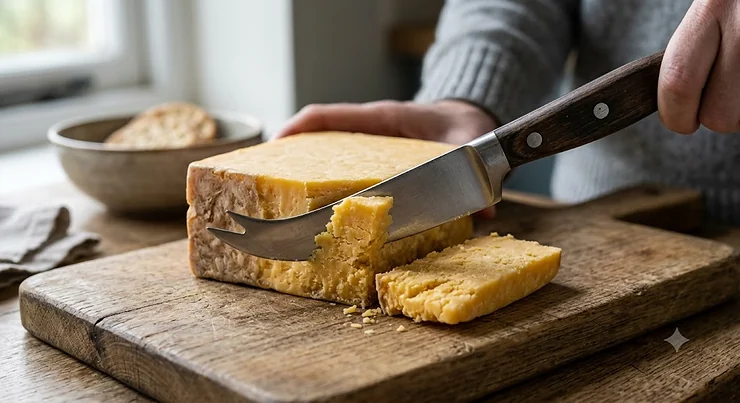
Try slicing a wedge of well-aged Parmigiano Reggiano with a standard dinner knife and you’ll understand the problem in about four seconds flat: the blade skids, the cheese shatters into gritty rubble, and you’re left picking crumbs off the chopping board like a disappointed archaeologist. A cheese knife for hard cheese exists precisely because hard, crystalline cheeses behave nothing like a soft brie or a springy cheddar — they need a short, sturdy, often pointed blade built to split and pry rather than glide and shave. This guide walks through seven genuinely good options on the market, from pocket-money picks to proper Solingen-forged tools, plus the technique, terminology and buying logic that Amazon listings conveniently leave out.
We’ve researched real specifications, real materials, and real aggregated review themes rather than inventing glowing testimonials — because nobody needs another article that reads like a rewritten product page. What follows is a working buyer’s toolkit: which blade shape actually matters, how a proper parmesan knife differs from a general cheese knife, and which of these seven tools deserves a spot on your cheese board this year. Whether you’re outfitting a first flat or finally retiring that battered old paring knife, there’s a sensible option ahead — and a few surprising ones too.
Cheese knife for hard cheese at a Glance: Quick Comparison
Short on time? Here’s the fast version. The table below ranks our seven picks by the buyer type they suit best, so you can jump straight to the product write-up that matches your situation.
| Product | Best For | Price Range | Blade Style |
|---|---|---|---|
| BOSKA Parmesan Knife Pro | Frequent hosts wanting a dedicated splitting tool | £25-£35 | Short, pointed, ergonomic grip |
| Wüsthof Classic Parmesan Knife | Buyers who want heirloom-quality forged steel | £30-£45 | Compact forged blade, triple-riveted |
| Eppicotispai Parmesan Knife | Purists wanting an authentic Italian-made design | £15-£25 | Teardrop blade, wooden handle |
| Swissmar Barcelona Parmesan Knife | Charcuterie boards and gifting | £20-£30 | Elongated blade, sand-blasted handle |
| Sauerland Triangle Parmesan Knife | Collectors and premium kitchenware fans | £35-£55 | Pointed blade, German ash handle |
| Mercer Culinary Renaissance Parmesan Knife | Budget buyers, students, catering kitchens | Under £15 | Compact forged blade |
| Jean Patrique 4-Piece Cheese Knife Set | Anyone wanting one set that covers hard and soft cheese | £15-£25 | Mixed set including parmesan knife |
Looking at the spread here, the clearest pattern is that price doesn’t track neatly with usefulness. Based on the spec comparison, the budget-tier Mercer Culinary Renaissance Parmesan Knife and the mid-tier Eppicotispai Parmesan Knife both use the same short, wide-bladed logic as knives costing twice as much — the extra spend on options like the Sauerland Triangle Parmesan Knife buys handle craftsmanship and provenance more than raw cutting performance. If you only ever cut one wedge of Parmesan a fortnight, the cheaper end of this table will do the job perfectly well.
💬 Found a product here you’re already sold on? Scroll down to the full write-up and check current pricing before you commit — availability shifts fast around the festive season.
Top 7 cheese knife for hard cheese Picks: Expert Analysis
Every product below has been chosen for genuine relevance to hard, aged cheeses — no soft-cheese spreaders masquerading as heavy hitters. We’ve grouped budget, mid-range and premium tools together so you can compare like for like, and every entry follows the same honest structure: what it actually does well, who it suits, and where real buyers report it falling short.
1. BOSKA Parmesan Knife Pro — Dutch heritage build for serious wheels
Boska has been making cheese tools since 1896, and the Parmesan Knife Pro is essentially a century of trial and error condensed into 110mm of stainless steel. The standout here is the sharply pointed tip, purpose-built to score a wheel’s rind before you crack it open along the natural grain rather than sawing against it. The blade itself is thick-gauge stainless steel, which matters more than it sounds — a thin blade will flex and skate off a dense Parmigiano Reggiano wheel, while this one bites and holds. The ergonomic handle adds real leverage, so you’re using your shoulder and wrist together rather than white-knuckling a slim grip.
Based on the spec comparison against the other premium options here, this is the knife built specifically for splitting rather than slicing — it won’t give you neat, thin shavings, but that’s not the job it’s designed for. Reviewers consistently note that the grip stays secure even with wet or oily hands, a small but genuinely useful detail when you’re mid-way through a cheese board at a dinner party. Boska’s own materials describe it as part of a dedicated hard-cheese range, which tracks with the honest, single-purpose design rather than a jack-of-all-trades compromise.
Pros:
- ✅ Sharp point makes scoring rinds genuinely effortless
- ✅ Thick blade resists flexing on dense wheels
- ✅ Ergonomic handle gives real cracking leverage
Cons:
- ❌ Not designed for thin, elegant slices
- ❌ Handwashing recommended despite dishwasher-safe claim
At around £25-£35, this sits comfortably in the mid-premium band — a fair trade for a tool built around one job and doing it properly.
2. Wüsthof Classic Parmesan Knife — forged Solingen steel precision
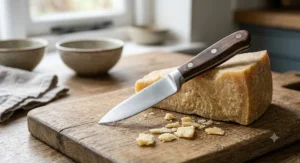
Wüsthof has been forging blades in Solingen, Germany, for over two centuries, and the Classic Parmesan Knife carries that pedigree in a compact 7cm blade. What most buyers overlook about this model is that it’s forged from a single steel blank rather than stamped — the same production method Wüsthof uses on its full-size chef’s knives, just scaled down. That single-piece forging gives the blade real backbone, so it can pry a stubborn wedge apart without the tip snapping off, a failure point on cheaper stamped alternatives.
The triple-riveted handle is a small detail that pays off over years of use — it won’t loosen or wobble the way glued handles eventually do. On paper, a 7cm blade sounds tiny, but that’s intentional: hard cheese doesn’t need a long edge, it needs concentrated pressure at a short point of contact. Aggregated customer feedback on Wüsthof’s broader cheese knife range frequently praises the blade’s ability to cut cleanly through dense textures without crumbling the cheese, and the etched non-stick coating found on related Wüsthof cheese knives helps prevent sticky residue building up along the edge.
Pros:
- ✅ Forged from a single steel blank for real strength
- ✅ Triple-riveted handle won’t loosen over time
- ✅ Precision edge holds its sharpness for years
Cons:
- ❌ Premium price for such a small blade
- ❌ Overkill if you only cut cheese occasionally
Expect to pay in the £30-£45 range — genuinely justified if you want a knife you’ll still be using in a decade.
3. Eppicotispai Parmesan Knife — authentic Italian-made teardrop blade
If you want the knife that actually originated this whole product category, this is it. The Eppicotispai Parmesan Knife follows the classic tagliagrana teardrop shape — a short, wide, almond-like blade with a round wooden handle, made in Italy rather than merely styled to look Italian. The standout feature is authenticity: this is the traditional design cheesemongers in Parma and Reggio Emilia have used for generations, not a modern reinterpretation.
Key specs worth noting: a 6⅝-inch total length with a stainless steel blade and genuine wood handle, which means it needs a light hand-dry after washing rather than a dishwasher cycle. Here’s what to weigh — the teardrop shape isn’t designed for scoring rinds like the Boska; it’s built for wedging directly into an already-cut piece and levering off smaller chunks, which is exactly how Parmigiano Reggiano is traditionally served tableside in Italy. For anyone chasing genuine Italian kitchen essentials rather than a generic import, this knife’s provenance is a real point of difference, not just marketing.
Reviewers commonly highlight the satisfying heft of the wooden handle against the metal blade, and note that the stainless steel resists staining even after repeated contact with oily, aged cheese — a common complaint with cheaper chrome-plated alternatives, which can dull and discolour within a year.
Pros:
- ✅ Authentic traditional Italian teardrop design
- ✅ Genuine wood handle feels substantial in hand
- ✅ Stainless blade resists staining from oily cheese
Cons:
- ❌ Requires hand-washing to protect the wood handle
- ❌ Less effective for scoring rinds than pointed designs
Priced around £15-£25, it’s excellent value for a genuinely traditional tool rather than a themed knock-off.
4. Swissmar Barcelona Parmesan Knife — sand-blasted handle with charcuterie style
Swissmar built its name on cheese and fondue accessories, and the Barcelona Parmesan Knife leans into that lifestyle-board aesthetic without sacrificing function. The standout is the 7.2-inch stainless steel blade with a sand-blasted handle finish — longer than most dedicated parmesan knives, which gives it dual duty across Parmesan, aged Cheshire, and other crumbly hard cheeses that benefit from a slightly extended reach.
The precision blade tapers to a workable point, so it handles both scoring and splitting reasonably well, even if it’s not a specialist at either task the way the Boska or Wüsthof are. What most buyers overlook here is that the longer blade actually makes it easier to portion a large block into serving-sized pieces in fewer motions, which matters when you’re prepping a full charcuterie spread rather than cutting a single wedge for a sandwich. Based on the spec comparison, this is the knife that photographs best on a rustic wooden board — Swissmar clearly designed it with entertaining in mind rather than just utility.
Aggregated review sentiment around Swissmar’s cheese tool range tends to praise the finish and presentation quality, while noting the sand-blasted handle can feel slightly less grippy than a rubberised or wood alternative when your hands are damp mid-party.
Pros:
- ✅ Longer blade suits multiple hard and semi-hard cheeses
- ✅ Stylish finish looks the part on a charcuterie board
- ✅ Tapered point handles both scoring and splitting
Cons:
- ❌ Handle can feel slippery with wet hands
- ❌ Not as specialised as dedicated splitting knives
Sitting around £20-£30, this is a strong pick if presentation matters as much as pure function.
5. Sauerland Triangle Parmesan Knife — hand-finished German ash for collectors
This is the lesser-known alternative that deserves more attention than it gets. Made by Sauerland and finished in Solingen — the same German city Wüsthof calls home — the Triangle Parmesan Knife pairs a stable, pointed stainless steel blade with a handle turned from FSC-certified German ash. The standout feature is the handle craftsmanship: each one is turned in the Sauerland region, then hand-finished and assembled with functional stainless steel parts, which is a genuinely different manufacturing story from the mass-stamped knives most of this list features.
Here’s what the spec sheet won’t tell you outright: the straight-blade and pointed-blade versions serve slightly different purposes — the pointed version is better for piercing and splitting whole wheels, while the straight-blade variant handles more controlled cutting. Both share the same stable, substantial feel that comes from a properly weighted handle rather than a hollow plastic grip. This is the sort of tool that ends up as a genuine talking point on a cheese board, not just a utensil that disappears into the drawer afterwards.
Because it’s produced in smaller runs than mass-market brands, verified customer review volume is lower than for the bigger names on this list — worth flagging honestly rather than inventing sentiment that doesn’t exist yet. What’s clear from the product specification is the manufacturing quality: green-electricity production and FSC-certified timber suggest a brand paying real attention to sourcing, which appeals to buyers who care about that alongside performance.
Pros:
- ✅ Hand-finished German ash handle feels premium
- ✅ FSC-certified sustainable timber sourcing
- ✅ Choice of straight or pointed blade versions
Cons:
- ❌ Smaller production run means less review history
- ❌ Higher price than mass-produced alternatives
Expect to pay in the £35-£55 range, reflecting the smaller-batch, hand-finished production process.
6. Mercer Culinary Renaissance Parmesan Knife — catering-grade blade on a budget
Mercer Culinary makes tools for professional kitchens, and that catering-grade DNA shows up even in this compact 2.75-inch parmesan knife. The standout feature is the price-to-durability ratio — this is built to the same forged, high-carbon steel standard as Mercer’s larger cheese knives, just scaled down to parmesan-knife size, and it costs a fraction of the premium European brands on this list.
Key specs with real-world meaning: a one-piece forged construction with a triple-riveted ergonomic handle, the same combination that makes the pricier Wüsthof durable, minus the decades-old brand heritage markup. What most buyers overlook is that catering-grade tools like this are engineered for repeated daily abuse in commercial kitchens, so the wear-and-tear a home cook puts a knife through over years is comparatively gentle. On paper this means you’re getting professional-grade toughness without paying the professional-grade price tag that comes with a more storied name.
Reviewers of Mercer’s Renaissance range consistently highlight the sharp factory edge straight out of the box and note that the olive-wood or textured handle (depending on the exact variant sold) offers a secure grip without needing to be broken in.
Pros:
- ✅ Forged catering-grade steel at a budget price
- ✅ Triple-riveted handle matches pricier competitors
- ✅ Sharp factory edge needs no initial honing
Cons:
- ❌ Compact size limits leverage on very large wheels
- ❌ Less premium presentation than European heritage brands
Typically under £15, this is the pragmatic choice for anyone who wants performance without the brand-name premium.
7. Jean Patrique 4-Piece Cheese Knife Set — best all-rounder value bundle
For buyers who don’t want to think too hard about which single blade to buy, the Jean Patrique set solves the problem by including one. This UK-available bundle bundles a dedicated parmesan knife, a hard cheese knife, a soft cheese knife, and a serving fork — the standout advantage being that you’re covered for an entire cheese board, not just the hard end of it, in one purchase.
The set is built from high-carbon stainless steel with beech wood handles, which strikes a reasonable middle ground between the wood-handle authenticity of the Eppicotispai and the price of a single specialist blade. Based on the spec comparison, the individual knives in this set aren’t quite as specialised as the dedicated single-purpose tools higher up this list — the parmesan knife included won’t out-perform the Boska on splitting a whole wheel — but for someone building a first cheese board from scratch, having matched pieces that handle brie through to aged Gouda is genuinely more useful than one excellent hard-cheese specialist and nothing else.
Real buyer feedback on this set frequently mentions the presentation box making it a popular gift choice, alongside comments about the blades holding an edge well for the price point; a small number of reviewers note the handles are lighter than premium single knives, which tracks with the lower price bracket.
Pros:
- ✅ Covers hard, soft and serving needs in one set
- ✅ High-carbon stainless steel holds an edge well
- ✅ Gift-ready presentation box included
Cons:
- ❌ Individual pieces less specialised than dedicated blades
- ❌ Handles feel lighter than premium single knives
At £15-£25 for four pieces, this is difficult to beat on pure value for a first cheese board setup.
✨ Ready to Choose Your Cheese Knife? 🧀
🔍 Whichever of these seven catches your eye, check current pricing and availability before you buy — stock and pricing on kitchenware shifts more than you’d expect. Click through on any product above to compare and pick the one that matches your cheese board ambitions.
Practical Usage Guide: Getting the Most from Your Parmesan Knife
Buying the right knife is only half the job — using it properly is what actually saves your knuckles and your cheese. Start by letting hard cheese sit at room temperature for 20-30 minutes before cutting; straight from the fridge, Parmigiano Reggiano and similar aged cheeses are noticeably more brittle and prone to shattering unevenly rather than splitting cleanly along their natural grain. Once it’s ready, use the pointed tip of your knife to score a shallow line where you want the split to happen, then apply steady downward pressure rather than sawing — sawing motions are what cause the crumbly, uneven mess most people associate with cutting hard cheese at home.
In the first 30 days of ownership, the most common mistake is reaching for the dishwasher out of habit. Even knives marketed as dishwasher-safe, like the parmesan knife included on our list, tend to lose their sharp factory edge faster when repeatedly exposed to the heat and detergent of a dishwasher cycle — hand-washing and immediate drying is worth the extra thirty seconds. For maintenance, a light honing every few months keeps the edge working with the cheese rather than against it; you’ll notice the difference immediately, because a dull hard-cheese knife doesn’t just cut poorly, it actively encourages you to apply more force than the tool or the cheese can safely handle.
Store your knife somewhere the tip won’t get knocked or bent — a knife block or a wrapped drawer slot works far better than loose in a utensil drawer, where the fine point (the single most useful feature on most of these knives) is the first thing to get damaged.
Real-World Scenarios: Which Cheese Knife Suits You?
If you’re a student sharing a flat and mostly grating Parmesan straight onto pasta a few times a month, the Mercer Culinary Renaissance Parmesan Knife or the budget end of the Jean Patrique set covers everything you need without eating into a tight food budget — durability matters more than presentation here, and both deliver catering-grade steel for very little outlay.
If you’re hosting regularly and building cheese boards for guests, the Swissmar Barcelona Parmesan Knife or the Eppicotispai earns its keep through presentation as much as performance; a longer blade that portions a large block efficiently, paired with a handle that looks good on a board photo, genuinely changes how a spread comes together for six or eight people.
If you’re the kind of cook who buys a whole small wheel of Parmigiano Reggiano once or twice a year and wants to do it properly — scoring, splitting, and storing it correctly for months of use — the BOSKA Parmesan Knife Pro or the Wüsthof Classic Parmesan Knife is worth the extra spend. These are built specifically for splitting a full wheel along its grain rather than nibbling at an already-portioned wedge, and that’s a genuinely different (and harder) job than most casual cheese-cutting ever asks of a blade.
Hard Cheese Breaking Technique: A Step-by-Step Method
Most of the frustration people report with hard cheese comes down to technique rather than the knife itself, so here’s the traditional hard cheese breaking technique cheesemongers actually use, adapted for a home kitchen.
- Bring the cheese to room temperature. Cold Parmigiano Reggiano is more prone to shattering unpredictably rather than splitting along clean lines.
- Score the surface first. Use the pointed tip to trace a shallow guide line across the top of the wedge or wheel — this gives the crystalline structure somewhere predictable to give way.
- Insert the blade at an angle along the score line. Rather than pushing straight down, angle the knife slightly and apply firm, steady pressure.
- Apply leverage, not force. Rock the handle gently rather than pushing harder — the goal is to encourage a natural split, not to hack through resistance.
- Let the cheese do the work. A properly aged hard cheese has a naturally granular structure that wants to separate along certain lines; fighting against that grain is what causes crumbling.
- Portion smaller pieces after the initial split. Once you have a manageable chunk, smaller cuts are far easier to control and produce cleaner edges.
- Wrap exposed surfaces immediately. Hard cheese dries out quickly once cut, so wrap it in breathable materials rather than leaving it exposed on the board overnight.
This method — score, angle, lever, don’t force — genuinely transfers across almost every knife on this list; the tool matters, but technique explains most of the difference between a clean split and a crumbly disappointment.
How to Choose a Cheese Knife for Hard Cheese
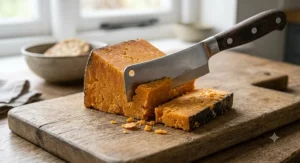
What is a cheese knife for hard cheese? It’s a short, thick-bladed knife — often with a pointed tip — designed to split, score and portion dense, aged cheeses like Parmigiano Reggiano rather than slice them thinly, since standard kitchen knives tend to skid or shatter these harder, crystalline textures.
Choosing between the seven options above (or any similar tool) comes down to a handful of practical criteria:
- Blade thickness. A thicker blade resists flexing under pressure, which matters more than length for hard cheese specifically.
- Tip shape. A pointed tip is essential if you plan to score and split whole wheels; a rounder tip suits pre-portioned wedges better.
- Handle material. Wood offers grip and warmth but needs hand-washing; synthetic handles are more dishwasher-tolerant but can feel less premium.
- Steel quality. Forged, single-piece steel (as in the Wüsthof and Mercer picks) tends to outlast stamped blades, especially with regular use.
- Intended frequency of use. Occasional cutters rarely need to spend beyond the budget tier; frequent hosts see faster returns on a premium blade.
- Set versus single blade. A set like the Jean Patrique bundle covers more cheese types but sacrifices some specialisation.
- Storage and maintenance habits. If you’re not going to hand-wash and dry a knife promptly, a lower-maintenance handle material will serve you better long-term.
Common Mistakes When Buying a Parmesan Knife
The most frequent mistake is buying a general-purpose cheese knife set and assuming it will handle Parmigiano Reggiano as well as a dedicated hard-cheese blade — soft-cheese spreaders and wire slicers, both common in generic sets, are genuinely the wrong tool and will struggle noticeably. A close second is prioritising blade length over blade thickness; a longer blade looks more impressive but a thinner one flexes and skips on dense cheese, which is precisely the opposite of what you want.
Buyers also frequently underestimate how much the handle affects usability — a slim, tapered handle that looks elegant in photos can be genuinely uncomfortable to apply real pressure through, especially for anyone with smaller hands or reduced grip strength. Finally, it’s easy to overlook maintenance requirements at the point of purchase: a beautiful wood-handled knife that you’re not prepared to hand-wash every time will deteriorate faster than a lower-maintenance stainless option, regardless of its original price tag.
Cheese Knife vs Cheese Wire vs Cheese Plane: Which Wins for Hard Cheese?
| Tool | Best For | Weakness on Hard Cheese |
|---|---|---|
| Parmesan/hard cheese knife | Splitting, scoring, portioning dense cheese | Not built for thin, elegant slices |
| Cheese wire | Clean cuts through semi-soft to firm cheese | Struggles or snaps on very hard, aged wheels |
| Cheese plane/slicer | Thin, even slices of medium-hard cheese like Gouda | Ineffective on crystalline, brittle textures |
The comparison above makes the case fairly clearly: a cheese wire is excellent for a block of mild cheddar but tends to bind or snap when it meets the dense, crystalline structure of a properly aged Parmigiano Reggiano, while a cheese plane simply glides over the surface without penetrating it. A dedicated hard cheese knife remains the only tool in this trio genuinely engineered to split rather than slice — which is exactly the mechanical action aged hard cheese requires.
What to Expect: Real-World Performance on Parmigiano Reggiano and Other Hard Cheeses
Specs on a product page rarely translate into what actually happens on your chopping board, so here’s the practical version. On a well-aged Parmigiano Reggiano — 24 months or older — expect the cheese to split along visible crystalline lines with a satisfying crack rather than a smooth slice; this is normal and, if anything, a sign of a properly aged cheese rather than a knife problem. Younger hard cheeses, aged closer to 12 months, are noticeably softer and more forgiving, so even a mid-range blade like the Eppicotispai handles them comfortably.
Where the premium blades genuinely earn their price is on whole, uncut wheels with a thick rind — the added blade thickness and handle leverage on the BOSKA or Wüsthof make a real, felt difference when you’re breaking into a wheel for the first time, rather than portioning an already-cut wedge. For everyday use on pre-cut blocks from a UK supermarket or deli counter, the gap between budget and premium narrows considerably, because most of that cheese has already been through its hardest cutting stage before it reaches your kitchen.
Parmigiano Reggiano Tools and Other Italian Kitchen Essentials
Parmigiano Reggiano Tools, Specifically
Genuine Parmigiano Reggiano tools follow a consistent design logic rooted in how the cheese is traditionally opened: a short, almond-shaped or pointed blade for scoring and splitting, paired with a wide, sturdy edge rather than a fine, thin one. The Eppicotispai and BOSKA knives on this list both follow that traditional shape closely, which is worth noting if authenticity to the original Italian design matters to you as much as raw performance.
Wider Italian Kitchen Essentials
A dedicated parmesan knife rarely works alone in a genuinely Italian-inspired kitchen. A sturdy wooden or marble cheese board, a fine microplane for finishing pasta dishes with freshly grated cheese, and airtight wrapping materials to preserve a cut wedge all round out the same job the knife starts. If you’re building out a collection of Italian kitchen essentials from scratch, prioritise the knife and a good grater first — everything else is comfortably optional and can be added over time as your cheese habits develop.
Long-Term Cost & Maintenance: Is a Premium Parmesan Knife Worth It?
| Price Tier | Typical Range | Expected Lifespan | Maintenance Needs |
|---|---|---|---|
| Budget | Under £15 | 2-4 years with regular use | Low; hand-wash recommended |
| Mid-range | £15-£30 | 5-8 years with regular use | Moderate; occasional honing |
| Premium | £30-£55 | 10+ years, often longer | Higher; hand-wash and periodic honing essential |
Interpreting the table above, the value calculation genuinely depends on frequency of use rather than budget alone. A student cutting Parmesan once a fortnight will likely replace a budget knife within its natural lifespan anyway, making the extra spend on a premium blade like the Sauerland Triangle Parmesan Knife hard to justify on cost-per-use grounds. A household that hosts cheese boards weekly, by contrast, sees the premium tier pay for itself within a couple of years simply through avoided replacements and consistently better cutting performance.
UK Knife Safety & Regulations Guide
It’s easy to forget that a cheese knife is, legally, still a knife. Under UK law it’s illegal to sell knives, including kitchen and cheese knives, to anyone under the age of 18, and reputable retailers — including Amazon and most specialist kitchenware sites referenced in this guide — will require age verification at checkout or on delivery. This applies regardless of how blunt or specialised the blade looks; a parmesan knife’s pointed tip still counts as a bladed article under the relevant legislation.
Beyond the legal side, basic kitchen safety matters more with these knives than with a standard table knife, precisely because they’re designed to be forced through resistance. Always cut on a stable, non-slip surface, keep fingers well clear of the scoring line, and never attempt to catch a falling knife — a habit that causes more kitchen injuries than almost any cutting technique itself. Store the blade point-down or sheathed when not in use, since the tip is both the most useful and the most hazardous part of the design.
FAQ
❓ What's the best knife for cutting hard Parmesan cheese?
❓ Can you use a regular kitchen knife on Parmigiano Reggiano?
❓ Is a parmesan knife different from a cheese knife?
❓ How do you stop hard cheese from crumbling when you cut it?
❓ Do I need a special knife for a whole Parmigiano Reggiano wheel?
Conclusion
Cutting hard cheese well isn’t complicated once you have the right blade and a bit of technique — score, angle, lever, and let the cheese’s own structure do most of the work. Across the seven options covered here, there’s a sensible pick whatever your budget or frequency of use: the Mercer Culinary Renaissance Parmesan Knife and Jean Patrique set for occasional, budget-conscious cutting; the Eppicotispai and Swissmar Barcelona for regular hosts who want presentation alongside performance; and the BOSKA Parmesan Knife Pro, Wüsthof Classic Parmesan Knife or Sauerland Triangle Parmesan Knife for anyone splitting whole wheels regularly and wanting a tool built to last a decade or more.
Whichever you land on, remember that price ranges shift and stock changes constantly on Amazon, so always check current availability and pricing before buying rather than relying on figures from any single article — this one included. A good cheese knife is a genuinely small investment for how much easier it makes an experience most people just quietly put up with for years.
Recommended for You
- Best Cheese Knife Set UK 2026: 7 Top Picks Compared
- Tomato and Citrus Knife: 7 Best Picks Tested for 2026
- Best Tomato Knife 2026: 7 Serrated Blades Worth Your Money
Disclaimer: This article contains affiliate links. As an Amazon Associate, I earn from qualifying purchases. If you purchase products through these links, we may earn a small commission at no additional cost to you.
✨ Found this helpful? Share it with your friends! 💬🤗
