
In This Article
There’s a particular kind of kitchen rage reserved for squashing a perfectly ripe tomato with a blunt, straight-edged knife. Juice everywhere, seeds on the chopping board, and a slice that looks more like pulp than a salad ingredient. This is precisely the problem a tomato and citrus knife exists to solve, and yet most people don’t own one until the exact moment they need it most — usually mid-barbecue, mid-panic, holding a lemon that refuses to cooperate.
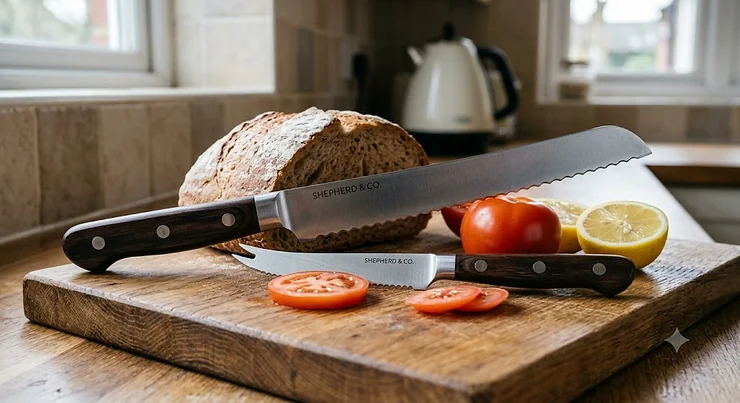
A tomato and citrus knife is a small, purpose-built blade, typically serrated, designed to glide through delicate skins without crushing the flesh underneath. It’s not a chef’s knife substitute; it’s a specialist tool that earns its drawer space through sheer frequency of use. If you’re prepping salads, garnishing cocktails, or slicing citrus for a Sunday roast, this is the blade that quietly does the heavy lifting while your bigger knives sit idle.
This guide walks through seven genuinely available options on amazon.co.uk, from Sheffield-forged classics to Swiss precision pieces, with honest analysis of specs, aggregated review sentiment, and real-world use cases — so you’re buying based on evidence, not marketing copy.
What Is a Tomato and Citrus Knife?
A tomato and citrus knife is a compact serrated blade, usually 10–13cm long, engineered to pierce tough or waxy skins in a single stroke while leaving the soft flesh underneath intact. As this overview of the tomato knife category explains, the small toothed edge is built to bite into a tomato’s skin with minimal pressure, avoiding the crushed, pulpy result a blunter blade produces. The same tooth pattern that handles a tomato’s skin works equally well on an orange’s pith or a lime’s rind, which is why manufacturers increasingly market these blades as dual-purpose tomato and citrus tools rather than single-food specialists.
What makes the design clever is where the cutting actually happens. A perfectly sharp straight blade can technically slice a tomato too, but the real advantage of serrations is longevity: the teeth keep biting cleanly long after a straight edge would have gone blunt, because most of the actual cutting work happens inside the individual serration gullets rather than along one continuous edge. That’s a meaningful practical advantage over a standard paring knife, which needs regular honing to stay effective on thin-skinned produce.
Quick Comparison Table: Tomato and Citrus Knife at a Glance
| Product | Blade Length | Material | Price Range | Best For |
|---|---|---|---|---|
| Taylors Eye Witness Professional Serrated Tomato Knife | 10cm | High-carbon stainless steel | £10-£15 | British craftsmanship on a budget |
| Victorinox Swiss Classic Tomato & Paring Knife Set | 11cm + 8cm | Stainless steel | £20-£30 | Two-blade versatility |
| Zyliss Serrated Tomato Knife | 11cm | German stainless steel | £8-£14 | Eco-conscious budget buyers |
| Wüsthof Classic Tomato Knife | 12.5cm | Forged high-carbon steel | £45-£60 | Premium fork-tip precision |
| HENCKELS Forged Accent Serrated Utility Knife | 13cm | German stainless steel | £25-£35 | Everyday all-rounder |
| Tramontina Serrated Fruit & Tomato Knife Set (6-piece) | 11.5cm each | Stainless steel | £15-£25 | Households needing multiples |
| Swissmar Utility/Tomato Knife | 11cm | Swiss one-piece stainless steel | £18-£28 | Minimalist single-piece hygiene |
Looking at the spread above, the gap between the cheapest and most expensive knife here is roughly £50, yet the core function — a serrated edge that won’t crush soft flesh — is present at every price point. What separates the tiers is mostly steel quality, edge retention, and handle ergonomics rather than raw cutting ability on day one. Buyers on a tight budget genuinely aren’t sacrificing much for everyday tomato slicing, but anyone prepping citrus and tomatoes daily, or running a small catering setup, will feel the difference in edge longevity from the forged options within a few months.
💬 Just one click — help others make better buying decisions too!😊
Top 7 Tomato and Citrus Knives: Expert Analysis
Coverage here spans budget, mid-range and premium tiers, plus set options and single-piece designs, so there’s a genuine fit whatever your kitchen habits look like.
1. Taylors Eye Witness Professional Serrated Tomato Knife — Sheffield-forged heritage on a budget
The standout here is provenance: this is a genuinely Sheffield-made blade from a cutlery house with roots stretching back over 150 years, and that heritage shows in the fit and finish rather than just the marketing copy. The 10cm cutting edge is precision-ground from high-carbon stainless steel with an ultra-fine toothed pattern, which in practice means it bites into a tomato’s skin on first contact rather than needing a sawing motion. In real-world terms, that finer tooth spacing suits delicate produce — tomatoes, grapes, soft citrus segments — better than the wider serrations found on bread-knife-style tools.
Reviewers consistently report that this knife performs beyond its price point, with several noting they’d previously struggled to find a compact serrated blade that didn’t tear tomato skins, and that this one “cuts tomatoes like a dream” straight out of the box. A recurring theme in aggregated feedback is surprise at how well it handles bread crusts and soft-skinned fruit like grapes, suggesting the blade earns its keep beyond its named purpose.
Pros:
- ✅ Genuine British manufacturing with a 50-year guarantee
- ✅ Ultra-fine serration ideal for delicate skins
- ✅ Excellent value relative to comparable forged blades
Cons:
- ❌ Shorter 10cm blade limits use on larger citrus
- ❌ Basic plastic handle lacks premium grip texture
At around £10-£15, this sits firmly in budget territory but punches well above it — a strong value verdict for anyone wanting Sheffield steel without Wüsthof pricing.
2. Victorinox Swiss Classic Tomato & Paring Knife Set — best two-blade versatility
Victorinox pairs an 11cm wavy-edge tomato knife with an 8cm straight paring knife in this set, and that combination is the real standout — you get serrated coverage for tomatoes and citrus alongside a precision straight edge for peeling, all from a brand synonymous with Swiss Army reliability. The extra-sharp wavy blade uses Victorinox’s signature stamped-steel construction, which keeps the knife light in hand and easy to manoeuvre around curved citrus segments.
Based on the spec comparison with single-blade competitors, the paring knife inclusion is what justifies the higher price bracket here: buyers effectively get two specialist tools for barely more than some single premium tomato knives cost alone. This is the set for someone who wants a fruit-and-veg station rather than a single-task blade, and Victorinox’s stamped construction keeps both knives noticeably lighter than forged alternatives, reducing wrist fatigue during long prep sessions.
Aggregated reviewer sentiment on Victorinox’s Swiss Classic range consistently highlights sharpness retention and dishwasher-safe convenience, though some buyers note the plastic handles feel less premium than the brand’s reputation might suggest.
Pros:
- ✅ Two knives cover both serrated and straight-edge tasks
- ✅ Lightweight stamped steel reduces prep fatigue
- ✅ Dishwasher safe for quick clean-up
Cons:
- ❌ Plastic handles feel basic for the price
- ❌ Paring knife duplicates tools some cooks already own
Priced in the £20-£30 range for the pair, the value verdict depends on whether you actually need the second blade — if you do, it’s genuinely efficient; if not, the single-knife options below offer better focused value.
3. Zyliss Serrated Tomato Knife — best for eco-conscious budget buyers
What most buyers overlook about this model is the handle material: Zyliss uses sustainable wheat straw composite rather than standard plastic, which is a small but genuine differentiator for anyone trying to reduce single-use plastic in kitchen purchases. The 4.3-inch German stainless steel blade is sharp out of the box and comes with a safety cover included, a thoughtful addition often missing from budget tomato knives that otherwise get tossed loose into a drawer.
On paper this means Zyliss has matched premium-tier steel sourcing (German stainless) with a genuinely budget price point, which is an unusual combination in this category — most manufacturers cut costs on the blade itself, not just the handle. The non-slip grip design compensates reasonably well for the knife’s light weight, though it won’t satisfy anyone used to the heft of a forged blade.
Reviewers frequently mention the included safety cover as a practical touch for drawer storage, and the sharpness-to-price ratio is a repeated theme in aggregated feedback, with several buyers specifically comparing it favourably against pricier competitors.
Pros:
- ✅ German stainless steel blade at a budget price
- ✅ Sustainable wheat straw handle material
- ✅ Includes a safety blade cover
Cons:
- ❌ Lighter build than forged alternatives
- ❌ Handle grip less substantial for larger hands
At roughly £8-£14, this is one of the strongest value propositions in the round-up, particularly for buyers who care about materials sourcing alongside function.
4. Wüsthof Classic Tomato Knife — best premium fork-tip precision
The standout feature here is the fork tip — a genuinely useful design element that lets you spear and lift sliced tomato rounds directly onto a plate without needing a separate serving utensil. This 12.5cm serrated blade is forged from a single block of high-carbon stainless steel and tempered to 58-degree HRC hardness, which in practical terms means an edge that holds its bite significantly longer between sharpenings than stamped alternatives.
Here’s what to weigh: Wüsthof’s Precision Edge Technology reportedly yields a blade roughly 20% sharper with double the edge retention of previous generations in the same series, according to the manufacturer’s published specifications. What that means day-to-day is fewer visits to the sharpening steel and cleaner, more consistent slices over months of regular use — a meaningful advantage for anyone prepping produce daily rather than occasionally.
Aggregated review sentiment for Wüsthof’s Classic Series consistently praises the full-tang, triple-riveted handle construction for balance and durability, with the brand’s decades-long reputation for German forged cutlery carrying real weight in buyer confidence. It’s also worth noting the knife’s dual function is well documented: much like a serrated utility knife, this tomato knife handles citrus fruit cleanly too, making the “tomato and citrus” framing genuinely accurate rather than marketing spin.
Pros:
- ✅ Fork tip doubles as a serving tool
- ✅ Forged full-tang construction for superior balance
- ✅ Exceptional edge retention from precision tempering
Cons:
- ❌ Premium price relative to other options here
- ❌ Heavier blade may not suit very delicate citrus segmenting
At £45-£60, this is the investment pick — the value verdict favours anyone who cooks daily and wants a blade that will outlast several cheaper replacements.
5. HENCKELS Forged Accent Serrated Utility Knife — best everyday all-rounder
HENCKELS brings over a century of German cutlery engineering to this 5-inch (13cm) forged blade, and the standout practical benefit is versatility: this is marketed as both a tomato knife and general serrated utility knife, meaning it comfortably handles citrus, soft bread, and small vegetables in addition to its named purpose. The forged construction gives it noticeably more heft than the stamped-steel options in this list, which translates to less hand fatigue when working through a larger batch of produce.
Based on the spec comparison, the 13cm blade length is the longest serrated option in this round-up, which matters more than it might seem — a longer blade means fewer strokes needed to get through a large grapefruit or beef tomato, reducing the sawing motion that can bruise delicate flesh. What the spec sheet won’t tell you, but user reports suggest, is that the black handle’s grip texture holds up well even when hands are wet or citrus-juice-slicked, a genuinely practical detail for anyone juicing lemons mid-prep.
Pros:
- ✅ Longest serrated blade in this round-up at 13cm
- ✅ Forged construction adds durability and balance
- ✅ Dual tomato-and-utility functionality
Cons:
- ❌ Bulkier than compact single-purpose tomato knives
- ❌ Higher price than comparable stamped-steel options
Sitting around £25-£35, this is a genuinely strong mid-range pick for anyone who wants one serrated blade to handle multiple soft-food tasks rather than buying separate specialist knives.
6. Tramontina Serrated Fruit & Tomato Knife Set (6-piece) — best for households needing multiples
The standout advantage of this Brazilian-made set is sheer practicality for larger households: six matching serrated knives mean everyone at the table gets their own tomato-and-fruit blade, without the mismatched drawer of hand-me-down knives most kitchens accumulate over time. Each 11.5cm stainless steel blade features a rounded tip design, which is a deliberate safety choice for households with children old enough to help with meal prep but not yet ready for pointed blades.
What most buyers overlook about multi-packs like this is the cost-per-knife calculation: at roughly £15-£25 for six pieces, that works out to under £4 per knife — cheaper than almost any single specialist tomato knife on this list. On paper this means Tramontina has prioritised accessibility and volume over premium steel sourcing, and the trade-off shows in edge retention; these blades typically need more frequent honing than the forged options above.
Reviewer sentiment aggregated across similar Tramontina serrated sets tends to highlight reliability for everyday table use and dishwasher-safe convenience, with the main critique being that the stainless steel, while food-safe and rust-resistant, doesn’t hold a razor edge as long as higher-carbon alternatives.
Pros:
- ✅ Six knives for the price of roughly one premium blade
- ✅ Rounded tips add a safety margin for families
- ✅ Dishwasher safe and rust-resistant
Cons:
- ❌ Edge retention weaker than forged premium options
- ❌ Handle design more basic than specialist single knives
For value-per-unit, this is genuinely hard to beat for a household of four or more who all want their own tomato and citrus knife at the table.
7. Swissmar Utility/Tomato Knife — best minimalist single-piece design
Swissmar’s standout feature is its one-piece Swiss-made construction: the 4.3-inch German stainless steel blade and blue polypropylene handle are moulded as a single unit rather than riveted together, which eliminates the crevices where food debris and bacteria can accumulate around traditional handle joints. That’s a genuine hygiene advantage worth weighing if you’re comparing knives for a shared or high-turnover kitchen environment.
Here’s what to weigh: the one-piece design also means there’s no rivet to loosen over years of dishwasher cycles, a failure point that eventually affects riveted-handle knives regardless of brand. The precision-cut blade comes with a safety sleeve included, matching the practical thoughtfulness seen in the Zyliss entry above, and the polypropylene handle resists staining and odour absorption better than some composite alternatives.
Aggregated feedback on Swissmar’s utility and tomato knives tends to praise the ergonomic one-piece feel in the hand, with several buyers noting they appreciate not having to worry about handle-blade separation over time, a complaint occasionally seen with cheaper riveted budget knives.
Pros:
- ✅ Hygienic one-piece construction with no rivets
- ✅ Precision German steel blade
- ✅ Includes a protective safety sleeve
Cons:
- ❌ Fixed handle shape won’t suit every grip preference
- ❌ Limited size options compared to multi-blade sets
At around £18-£28, this sits in solid mid-range territory, with the value verdict favouring hygiene-conscious buyers and anyone tired of handles that eventually work loose.
Top 7 Products: Full Spec Comparison
| Product | Steel Type | Construction | Handle | Best For |
|---|---|---|---|---|
| Taylors Eye Witness Professional Serrated Tomato Knife | High-carbon stainless | Stamped, precision-ground | Plastic | Budget British quality |
| Victorinox Swiss Classic Tomato & Paring Knife Set | Stainless steel | Stamped | Plastic | Two-in-one versatility |
| Zyliss Serrated Tomato Knife | German stainless | Stamped | Wheat straw composite | Eco-conscious budgets |
| Wüsthof Classic Tomato Knife | High-carbon stainless | Forged, full tang | Polypropylene, triple-riveted | Daily premium use |
| HENCKELS Forged Accent Serrated Utility Knife | German stainless | Forged | Polypropylene | All-round durability |
| Tramontina Serrated Fruit & Tomato Knife Set (6-piece) | Stainless steel | Stamped | Plastic | Large households |
| Swissmar Utility/Tomato Knife | German stainless | One-piece moulded | Polypropylene | Hygiene-focused kitchens |
The clearest pattern in this table is the construction split: forged blades (Wüsthof Classic Tomato Knife, HENCKELS Forged Accent Serrated Utility Knife) consistently promise better edge retention and balance, while stamped blades (Taylors Eye Witness Professional Serrated Tomato Knife, Zyliss Serrated Tomato Knife, Tramontina Serrated Fruit & Tomato Knife Set) trade some longevity for significantly lower prices and lighter handling. The Swissmar Utility/Tomato Knife occupies a genuinely distinct middle ground with its one-piece hygiene-first design, which neither camp fully replicates.
Benefits vs Traditional Straight-Edge Paring Knives
| Factor | Tomato and Citrus Knife | Standard Paring Knife |
|---|---|---|
| Skin penetration on ripe tomatoes | Clean, minimal pressure needed | Often crushes or slips |
| Performance when slightly dull | Still cuts via serration teeth | Struggles noticeably once dull |
| Citrus segmenting | Smooth, minimal juice loss | Can tear membrane |
| Sharpening frequency needed | Lower | Higher |
| General versatility (dicing, peeling) | Limited | Excellent |
A serrated tomato and citrus knife wins decisively on the specific tasks it’s built for, largely because the toothed edge keeps performing well past the point where a plain edge would have gone noticeably blunt — something a straight-edged paring knife simply cannot replicate. That said, the comparison isn’t a case for replacing your paring knife entirely; rather, it’s an argument for owning both, since a straight edge remains superior for actual peeling, dicing, and fine detail work where serrations would tear rather than cut cleanly.
Practical Usage Guide: Getting the Most From Your Knife
Buying the right knife is only half the job — how you use and maintain it in the first month determines whether it still performs well a year from now. Start by resisting the urge to sharpen a serrated blade with a standard honing steel; the teeth need a rounded ceramic rod or a specialist serrated sharpener worked gently into each individual gullet, otherwise you’ll flatten the very feature that makes the knife effective. Most home cooks only need to do this once or twice a year with moderate use.
For first-use setup, wash the blade by hand before its first task, even if it’s labelled dishwasher safe — factory oils can otherwise transfer a faint metallic taste to the first few slices. When cutting tomatoes, let the serration do the work with a gentle sawing motion rather than pressing down hard; excessive downward force is the single most common mistake in the first 30 days of ownership, and it’s what causes the crushed, seedy slices the knife is meant to prevent. For citrus, score around the equator first, then use the serrated edge to peel in one continuous motion rather than multiple short cuts, which reduces pith left clinging to the flesh.
A common early mistake is storing these knives loose in a utensil drawer, where the exposed teeth dull against cutlery and other blades within weeks. A knife block slot, magnetic strip, or the safety sleeve included with several models above will meaningfully extend the working life of the edge. Finally, dry the blade immediately after washing rather than air-drying in a rack — even stainless steel can develop water spotting or, on higher-carbon blades, faint surface staining if left damp against other metal.
Real-World Scenarios: Who Should Buy What
If you’re a university student cooking for one in a shared flat kitchen, the Zyliss Serrated Tomato Knife or Taylors Eye Witness Professional Serrated Tomato Knife make the most sense — both are inexpensive enough that losing or damaging one in a communal kitchen isn’t a financial setback, and both deliver genuinely sharp performance despite the low price. Neither requires specialist care beyond basic hand-washing, which suits a low-maintenance lifestyle.
If you’re a parent of a large family who batch-preps salads for packed lunches five days a week, the Tramontina Serrated Fruit & Tomato Knife Set solves a specific logistical problem: everyone gets their own knife, rounded tips reduce risk for older children helping out, and replacing a lost or damaged single piece from a six-pack is far less costly than replacing a premium single blade. This is a household-scale solution rather than an individual-user one.
If you’re a home cook who takes weeknight dinners seriously and preps fresh citrus and tomatoes most days of the week, the Wüsthof Classic Tomato Knife or HENCKELS Forged Accent Serrated Utility Knife are the better long-term investment. Based on the spec comparison, forged construction and superior edge retention mean fewer sharpening sessions and more consistent results over years rather than months, which matters more the more frequently you cook.
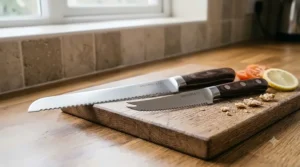
Double Serrated Blade Knife vs Single-Edge: What’s the Difference
A double serrated blade knife has teeth cut into both sides of the blade edge rather than just one, and some manufacturers build this symmetry in specifically so both left-handed and right-handed cooks can slice comfortably with the same knife. In practice, this matters less for raw cutting performance and more for ergonomic comfort — a single-bevel serrated edge can feel slightly off-centre in the hand for left-handed users, pulling the cut fractionally to one side, while a symmetrically serrated double-edge tracks straighter regardless of which hand is doing the work.
The trade-off is sharpening complexity. A double serrated blade knife technically has twice the number of individual teeth to maintain, which means slightly more time at the sharpening stage, though in practice most home cooks never sharpen frequently enough for this to be a meaningful burden. For a household with both left- and right-handed cooks, or for anyone who’s found single-bevel serrated knives feel subtly awkward, a double serrated option is worth seeking out specifically, even though it’s a less common configuration among the mainstream models featured in this guide.
How to Choose a Tomato and Citrus Knife
- Check the blade length first. A 10-11cm blade suits tomatoes and most citrus comfortably; anything shorter struggles with large grapefruits, while anything much longer starts overlapping with a standard utility knife’s job.
- Decide between forged and stamped steel. Forged blades like the Wüsthof Classic Tomato Knife cost more but hold an edge longer; stamped options like the Zyliss Serrated Tomato Knife are lighter and cheaper but need more frequent maintenance.
- Consider whether you need a set or a single blade. Households with multiple cooks or children benefit from multi-packs like the Tramontina Serrated Fruit & Tomato Knife Set; solo cooks rarely need more than one well-made blade.
- Look at the tip shape. Fork tips, as on the Wüsthof Classic Tomato Knife, double as a serving tool; rounded tips, as on the Tramontina set, add a safety margin for family kitchens.
- Factor in handle hygiene. One-piece constructions like the Swissmar Utility/Tomato Knife avoid rivet gaps where bacteria and grime can build up over years of use.
- Match serration fineness to your main task. Finer teeth suit delicate tomato and citrus skins; wider serrations are better suited to bread and tougher-skinned produce.
- Set a realistic budget band. Genuinely good performance exists from roughly £10 upward; spending more buys longevity and edge retention rather than dramatically sharper first cuts.
✨ Don’t Miss These Exclusive Deals!
🔍 Take your kitchen prep to the next level with these carefully selected blades. Click on any highlighted item to check current pricing and availability. These tools will help you create beautifully sliced salads and citrus garnishes your family will love!
Fruit Peeling Tools: Where a Citrus Knife Fits In
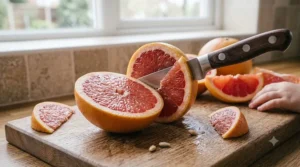
Fruit peeling tools cover a surprisingly broad category, from dedicated Y-peelers and citrus zesters to the serrated knives featured throughout this guide, and understanding where each one excels avoids buying overlapping equipment. A dedicated citrus peeler or stripper tool is designed purely to remove rind in long spirals, useful for cocktail garnishes and zest, but it can’t slice the fruit itself into segments or rounds. A tomato and citrus knife, by contrast, handles both jobs reasonably well: scoring and peeling the skin, then slicing clean segments, all with one tool.
What most buyers overlook is that a genuinely sharp serrated knife often replaces two or three single-purpose fruit peeling tools in a typical drawer. Reviewers across the products featured here frequently mention using their tomato knife interchangeably for citrus peeling, grape halving, and even soft avocado prep, suggesting the category’s versatility is underappreciated relative to how narrowly it’s usually marketed. For anyone trying to declutter a crowded gadget drawer, consolidating around one or two well-chosen serrated blades is often more practical than collecting a peeler, a stripper, and a knife separately.
Kitchen Prep for Salads: Solving Common Prep Problems
Problem: Tomato slices turn watery and seedy in a salad. This usually comes down to blade choice rather than technique — a dull or straight-edged knife crushes cell walls on contact, releasing excess liquid. Solution: switch to a fine-serration blade like the Taylors Eye Witness Professional Serrated Tomato Knife and use a gentle sawing motion rather than pressing straight down.
Problem: Citrus segments come apart with pith still attached. This typically happens when the peeling motion is stop-start rather than continuous. Solution: score the citrus in quarters first, then use a serrated edge such as the Zyliss Serrated Tomato Knife to peel in one smooth motion per segment, following the fruit’s natural curve.
Problem: Salad prep takes too long for a weekday lunch. Batch-prepping is the fix, but it requires a knife that stays sharp through repeated use without constant honing. Solution: a forged option like the HENCKELS Forged Accent Serrated Utility Knife holds its edge through a full week’s worth of lunch prep far better than a budget stamped blade.
Problem: Multiple family members want to help but only one knife is available. Solution: a multi-piece set such as the Tramontina Serrated Fruit & Tomato Knife Set solves this directly, letting several people prep simultaneously without queuing for one blade.
Problem: Knives dull quickly under heavy salad-season use. Solution: rotate between two knives rather than relying on one, giving each blade recovery time between sharpening sessions, and always dry blades immediately after washing to prevent premature edge degradation.
Dual-Purpose Blade Design: Why It Matters
A dual-purpose blade design — one built to handle both tomatoes and citrus effectively — matters more than it might initially seem, because these two foods actually present quite different cutting challenges. Tomato skin is thin but elastic, prone to slipping away from a blade rather than yielding to it, while citrus rind is thicker, waxier, and backed by dense white pith that resists a purely straight edge. A knife engineered for only one of these tasks often disappoints on the other.
The spec sheet won’t tell you this, but user reports suggest that finer serration spacing tends to favour tomatoes specifically, while a slightly coarser tooth pattern with a longer blade — such as the 13cm edge on the HENCKELS Forged Accent Serrated Utility Knife — copes better with thicker citrus rind. This is genuinely a case where “dual-purpose” isn’t just marketing language; the better-reviewed knives in this category tend to strike a deliberate middle ground in tooth size specifically because manufacturers have identified this tension between the two use cases. Buyers prioritising one food heavily over the other should weigh blade length and serration fineness accordingly rather than assuming all “tomato and citrus” knives perform identically across both tasks.
Common Mistakes When Buying a Tomato and Citrus Knife
The most frequent mistake is assuming price alone indicates sharpness — several budget options in this guide, notably the Zyliss Serrated Tomato Knife and Taylors Eye Witness Professional Serrated Tomato Knife, arrive genuinely sharp out of the box, while some mid-priced knives from lesser-known brands cut corners on the actual grinding process rather than materials. Checking aggregated review sentiment for sharpness specifically, rather than just brand reputation, is a more reliable signal than price bracket alone.
A second common error is buying a set when a single blade would suffice, or vice versa. Multi-packs like the Tramontina Serrated Fruit & Tomato Knife Set make excellent sense for larger households but represent poor value for a single-person kitchen where four extra knives will simply sit unused. Conversely, solo cooks sometimes underestimate how often a second serrated blade comes in handy when the first is mid-wash or being sharpened.
Finally, many buyers overlook handle material until after purchase. A plastic handle that feels fine dry can turn slippery when citrus-juice-slicked hands grip it mid-prep — this is where textured or composite handles, like the wheat straw grip on the Zyliss model or the polypropylene used across the Wüsthof and HENCKELS options, genuinely outperform smooth basic plastic in practical daily use.
Long-Term Cost & Maintenance
Thinking in terms of total cost of ownership rather than sticker price changes the calculus considerably. A £12 stamped-steel tomato knife that needs replacing every 18-24 months due to edge degradation and handle wear can end up costing more over a five-year period than a £50 forged blade that, with proper serrated-edge maintenance, comfortably outlasts a decade of regular use. This isn’t a universal argument for always buying premium — for occasional or communal use, cheaper replacements genuinely make more sense — but for a daily-use kitchen knife, the maths tends to favour investing once.
Maintenance costs are minimal either way: a specialist serrated sharpener costs a one-off £10-£20 and lasts years, and beyond that, the only ongoing expense is hand-washing liquid and the few minutes it takes to dry a blade properly after use. The genuinely avoidable cost is replacement due to neglect — dishwasher cycles that loosen rivets, blades left wet against other cutlery, or serrations flattened by an incorrect standard honing steel. None of these failure points relate to the knife’s original price; they’re entirely down to storage and care habits established in the first few months of ownership.
Safety and Care Considerations
Serrated blades carry a specific safety profile worth understanding before regular use. Because the teeth grip rather than glide, a serrated knife can catch unexpectedly on a cutting board edge or a stray finger if used carelessly, and the sawing motion these blades require means hands need to stay further back from the cutting line than with a straight-edged knife. Good general knife-handling habits reduce this risk substantially — a proper, controlled grip improves accuracy, reduces the chance of slipping, and cuts the likelihood of an accident considerably, advice that applies just as much to a compact tomato knife as to a full-size chef’s knife.
Storage matters as much as technique. Loose blades in a communal drawer are a recognised risk in shared kitchens, and university and shared-accommodation guidance consistently recommends dedicated storage over loose drawer placement, alongside always cutting on a stable board and never leaving a blade soaking in a sink where it could injure someone reaching in unaware. Anyone setting up a first kitchen, particularly in shared student accommodation, benefits from reviewing a proper knife-handling and storage guide rather than assuming these habits are intuitive.
Nutritional Context: Why This Knife Earns Its Drawer Space
Tomatoes and citrus fruit both feature heavily in UK dietary guidance, which partly explains why a dedicated knife for them is worth owning rather than improvising with whatever blade is nearest. Citrus fruit in particular is a significant contributor to vitamin C intake, and the NHS guidance on vitamin C confirms that adults aged 19 to 64 need 40mg a day, and because the body can’t store it, that intake needs topping up through diet daily rather than banked in advance. A well-prepared citrus segment retains more of its juice and structure than one torn apart by the wrong blade, which is a small but genuine reason good knife choice matters beyond convenience alone.
Both tomatoes and citrus fruit also count toward the UK’s wider 5 A Day fruit and vegetable campaign, a public health message rooted in a World Health Organization recommendation to eat at least 400g of fruit and vegetables daily. Making that easier to hit daily, through faster and less wasteful prep, is arguably the quiet practical value a good tomato and citrus knife adds to a kitchen beyond the obvious convenience factor.
FAQ
❓ What's the difference between a tomato knife and a paring knife?
❓ Can a tomato and citrus knife go in the dishwasher?
❓ How often does a serrated tomato knife need sharpening?
❓ Is a double serrated blade knife better than a single-edge version?
❓ What length tomato and citrus knife should I buy?
Conclusion
A genuinely good tomato and citrus knife is one of those small kitchen purchases that quietly changes daily habits far more than its low profile suggests. Whether you land on the budget-friendly precision of the Taylors Eye Witness Professional Serrated Tomato Knife, the two-in-one convenience of the Victorinox Swiss Classic Tomato & Paring Knife Set, or the long-term investment of the Wüsthof Classic Tomato Knife, the underlying decision comes down to how often you’re realistically slicing tomatoes and citrus, and how much you value edge longevity over upfront cost.
For most households, a single well-chosen forged or high-quality stamped blade covers the job comfortably for years, while larger families or shared kitchens genuinely benefit from a multi-piece set like the Tramontina Serrated Fruit & Tomato Knife Set. Whichever option fits your kitchen, prioritising correct serrated-edge care and sensible storage will do more for the knife’s lifespan than the price tag alone ever could.
✨ Ready to upgrade your salad and citrus prep? Compare today’s prices on these picks before your next shop! 🍅🍋
Recommended for You
- Best Tomato Knife 2026: 7 Serrated Blades Worth Your Money
- Wusthof Utility Knife: 7 Sharp Picks Worth Buying in 2026
- Utility Knife Kitchen: 7 Best Picks Tested for 2026
Disclaimer: This article contains affiliate links. As an Amazon Associate, I earn from qualifying purchases. If you purchase products through these links, we may earn a small commission at no additional cost to you.
✨ Found this helpful? Share it with your friends! 💬🤗
