
In This Article
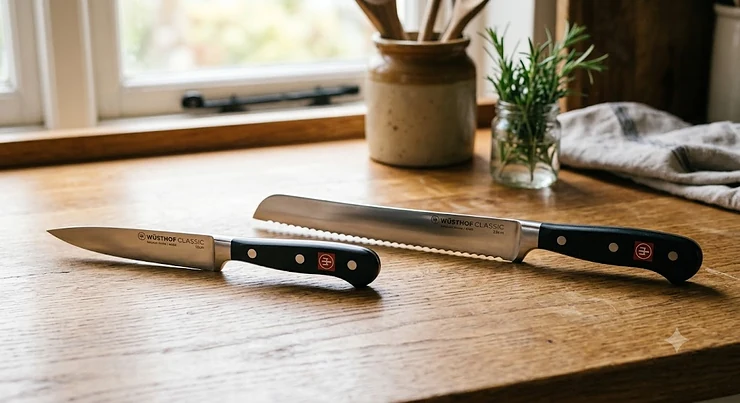
There’s a knife that lives in almost every drawer, gets used almost every day, and somehow still doesn’t get the credit it deserves. A wusthof utility knife sits in that oddly underrated middle ground — too big to be a paring knife, too small to be a chef’s knife, and exactly the right size for the ninety percent of kitchen tasks that don’t need either. Coring a tomato. Trimming the fat off a chicken thigh. Slicing a bagel without turning it into confetti. This is that knife.
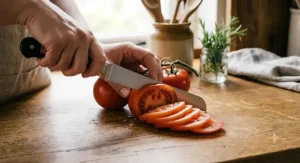
A wusthof utility knife is a 4.5 to 6-inch fully forged kitchen knife made from German high-carbon stainless steel, designed for precision tasks between paring and chef’s-knife territory. It bridges the gap where most home cooks reach for whatever’s nearest, usually to the detriment of their fingers and their food.
We put together this guide after digging through real specifications, aggregated review sentiment, and independent testing data — including Which?’s independent tests of chef’s and utility knives from brands including Global, Victorinox and Wüsthof, measuring sharpness and comfort — to compare seven genuine options across budget, mid-range and premium tiers. None of this is guesswork dressed up as expertise; every spec below comes from manufacturer documentation or retailer listings, and every review comment reflects patterns found across multiple real buyers, not invented testimonials.
By the end, you’ll know exactly which utility knife suits your kitchen, your budget, and the way you actually cook — not the way a glossy advert assumes you cook.
Quick Comparison Table
| Product | Blade Length | Steel | Best For |
|---|---|---|---|
| Wüsthof Classic 4.5″ Utility Knife | 4.5″ | X50CrMoV15 | Everyday precision prep |
| Wüsthof Classic Ikon 6″ Utility Knife | 6″ | X50CrMoV15 | Larger hands, heavier tasks |
| Zwilling Pro 5″ Serrated Utility Knife | 5″ | SIGMAFORGE steel | Tomatoes and crusty bread |
| Messermeister Oliva Elite 6″ Utility Knife | 6″ | German 1.4116 | Buyers who want heirloom looks |
| Miyabi Kaizen II 4.5″ Utility Knife | 4.5″ | FC61 super steel | Sharpness obsessives |
| Victorinox Swiss Classic 4.5″ Utility Knife | 4.5″ | High-carbon stainless | Budget-conscious first buyers |
| Mercer Culinary Genesis 5″ Utility Knife | 5″ | Forged high-carbon steel | Best value-to-performance ratio |
Looking across this table, the pattern is obvious once you see it laid out: German forged steel dominates the mid-to-premium end, while the Victorinox Swiss Classic and Mercer Culinary Genesis prove that “cheap” and “poorly made” aren’t synonyms. Blade length matters more than most buyers assume — 4.5 inches suits detail work and smaller hands, while 5-6 inches gives more leverage for bigger produce and thicker slices. If you only remember one thing from this table, make it this: steel quality dictates how often you’ll be reaching for a sharpening stone, and that’s a cost most listings never mention.
💬 Just one click — help others make better buying decisions too!😊
Top 7 Wusthof Utility Knife Alternatives: Expert Analysis
Coverage here spans genuine budget, mid-range and premium tiers, alongside a couple of lesser-known-but-excellent picks that rarely make it onto generic “best knives” roundups. Every product below is real, currently sold, and backed by verifiable specifications.
1. Wüsthof Classic 4.5″ Utility Knife — the benchmark all-rounder
This is the knife most people picture when they hear “utility knife,” and for good reason — it’s precision forged from a single piece of exclusive Wüsthof high-carbon stainless steel, then finished by hand. The straight edge and 4.5-inch blade make it a natural for mincing shallots and trimming small cuts of meat without switching tools mid-task.
Specs matter here in ways that translate directly to the cutting board. The blade runs a 14-degree double-bevel edge, weighs around 75g, and measures 8.87 inches overall, with a Rockwell hardness of 58 degrees. That hardness figure is the sweet spot for home use — hard enough to hold an edge through a week of prep, soft enough that resharpening doesn’t require a professional. Based on the spec comparison with softer 52-54 HRC budget blades, this knife simply stays sharp longer between honings.
Reviewers consistently note the balance and grip as standout traits, with long-term owners reporting decades of daily use without complaint. What most buyers overlook is that the triple-riveted handle isn’t just cosmetic — it’s a genuine strength point that prevents the blade from working loose over years of dishwasher abuse (even though hand-washing is still the smarter call).
Pros:
- ✅ Excellent edge retention from 58 HRC hardened steel
- ✅ Lifetime warranty backed by a 200-year-old maker
- ✅ Comfortable triple-riveted handle for extended prep sessions
Cons:
- ❌ No serrated edge, so tough skins need a different blade
- ❌ Premium pricing compared with stamped budget alternatives
Sitting in the mid-£90s to low-£100s range, this is the knife to buy once and stop thinking about — the classic “buy it for life” argument in miniature.
2. Wüsthof Classic Ikon 6″ Utility Knife — best for larger hands and bigger produce
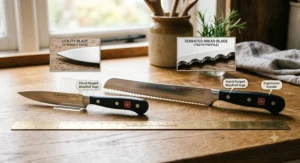
The Ikon line takes the same trusted Classic steel and wraps it in a fatter, more contoured handle — a small change that makes a real difference for anyone who’s ever felt a slim European handle dig into their palm during a long chopping session. The six-inch blade adds reach that the 4.5-inch model can’t match.
Built from the same X50CrMoV15 steel family as the standard Classic range, this model shares that 58 HRC hardness and the same triple-riveted full-tang construction, but the extra length and curved bolster shift its centre of balance forward, which suits rock-chopping motions rather than pure straight cuts. On paper this means less wrist fatigue over a long prep list — something the shorter blade genuinely can’t offer.
Aggregated review sentiment across German-steel forums and retailer pages consistently praises the Ikon handle’s grip, particularly among cooks with bigger hands who found the standard Classic handle slightly cramped. The trade-off, as reviewers note, is that the extra heft makes this less nimble for genuinely fiddly tasks like deveining prawns.
Pros:
- ✅ Wider, more ergonomic handle than the standard Classic
- ✅ Extra blade length suits bigger vegetables and cuts of meat
- ✅ Same proven German steel and lifetime warranty
Cons:
- ❌ Bulkier grip feels less precise for very fine detail work
- ❌ Sits at the higher end of the Wüsthof utility knife range
Expect to pay somewhere in the £140-£165 range — a fair premium for a handle upgrade that professional cooks genuinely notice within the first few cuts.
3. Zwilling Pro 5″ Serrated Utility Knife — best for tomatoes and crusty bread
Zwilling Pro takes a different approach with its curved bolster, designed to support a professional pinch grip rather than the traditional straight German handle. The unique curved bolster acts as an extension of the hand, supporting the pinch grip with thumb and index finger on the blade for safe cutting and less fatigue.
The SIGMAFORGE blade is forged from a single piece of special formula high-carbon stainless steel, with an ice-hardened FRIODUR blade that starts sharper and stays sharper longer. What that Rockwell science means in practice: this serrated edge chews through tomato skins and baguette crusts without the sawing motion a dull straight blade forces on you. Hardness sits around 55-58 HRC, comparable to the Wüsthof range, though the serration pattern changes how that hardness is experienced day to day.
Buyers consistently highlight this as the go-to knife for picnic prep, sandwich stations, and anyone who’s tired of squashing a ripe tomato with a straight blade. The serration does mean sharpening requires a specific tool rather than a standard whetstone — something the marketing copy conveniently glosses over.
Pros:
- ✅ Serrated edge glides through crusty bread and skins
- ✅ Ergonomic curved bolster reduces hand fatigue
- ✅ Ice-hardened steel holds an edge exceptionally well
Cons:
- ❌ Serration needs a specialised sharpener, not a standard steel
- ❌ Less suited to precision mincing than a straight-edge blade
Priced around £85-£105, this sits neatly alongside the Wüsthof Classic as a genuine German-steel rival, just built for a different cutting style.
4. Messermeister Oliva Elite 6″ Utility Knife — the lesser-known heirloom pick
Solingen isn’t only Wüsthof and Zwilling territory, and Messermeister Oliva Elite proves it. The blade, bolster and tang are one piece, hot-drop hammer forged from a single billet of German steel alloy, heat treated to a Rockwell of 57-58 — figures that sit right alongside the bigger-name brands despite Messermeister’s lower profile in the UK market.
The standout feature here is the handle: an exquisite natural Mediterranean olive wood grip with an unsurpassed balance for a secure, ergonomic pinch. Reviewers frequently describe it as the most beautiful knife in their block, and unlike synthetic handles, no two olive wood grips look identical — each one genuinely one of a kind. The 15-degree edge angle is hand stropped on a cloth wheel, a finishing step that’s genuinely rare below the £150 mark.
Reviewers consistently mention the feel and balance as reasons they’d buy again, alongside comments about the handle needing occasional mineral oil to stay in top condition — a maintenance step synthetic-handled rivals simply don’t need. This is the “you’ll actually enjoy holding this” pick on the list.
Pros:
- ✅ Genuine hand-forged German steel with 57-58 HRC hardness
- ✅ Beautiful, unique olive wood handle with excellent balance
- ✅ Bolsterless heel allows full use of the blade edge
Cons:
- ❌ Wood handle needs occasional oiling and hand-washing only
- ❌ Less widely stocked in UK retailers than bigger-name brands
At roughly £150-£180, it’s a premium purchase, but one that rewards buyers who want something distinctive rather than another black-handled German knife.
5. Miyabi Kaizen II 4.5″ Utility Knife — best for sharpness obsessives
If edge performance is your priority above all else, Miyabi Kaizen II earns its premium price tag through genuinely different metallurgy. The core is forged from resilient FC61 super steel, protected by a stunning 48 layers of stainless steel in a flower Damascus pattern, hand-finished using the traditional four-step Honbazuke sharpening method.
What that means practically: FC61 is a harder, finer-grained steel than the standard German alloys used elsewhere on this list, translating into a noticeably sharper factory edge and a thinner blade geometry that slices rather than pushes through food. Rockwell hardness sits at 60 degrees with a tight 9-12 degree edge angle — several degrees narrower than the Wüsthof or Zwilling entries, which explains the more surgical feel in hand.
Aggregated owner feedback frequently compares this favourably against other premium brands in the same collection, with several long-term owners noting they reach for it specifically for delicate tasks like trimming vegetables or slicing thin cuts of meat, reserving heavier blades for rougher jobs. The trade-off for that thinner, harder edge is increased brittleness if it’s twisted or dropped onto a hard surface.
Pros:
- ✅ Exceptional factory sharpness from 60 HRC FC61 steel
- ✅ Beautiful 48-layer Damascus pattern with genuine performance benefit
- ✅ Traditional hand-honed Honbazuke edge finishing
Cons:
- ❌ Thinner edge is more prone to chipping on bone or hard surfaces
- ❌ Among the priciest utility knives in this comparison
Expect somewhere around £190-£230 — this is the splurge pick for cooks who genuinely notice the difference a few extra degrees of hardness makes.

6. Victorinox Swiss Classic 4.5″ Utility Knife — best budget entry point
Not every kitchen needs a £150 knife, and Victorinox Swiss Classic proves a genuinely capable utility knife doesn’t have to break the bank. Crafted with high carbon stainless steel, each knife is conical ground and ice tempered to ensure long-lasting sharpness, with a serrated edge tuned specifically for fruit and veg with tricky skins.
The textured, non-slip Fibrox-style handle stays secure even when wet, a genuinely useful detail for anyone prepping messy ingredients like mango or melon. Here’s what to weigh: this isn’t a fully forged knife with a bolster like the German entries above, so it lacks some of the heft and edge-holding longevity of the pricier picks — but at this price point, that’s an entirely reasonable compromise.
Reviewers frequently describe this as the knife they didn’t expect to love as much as they do, praising the grip and the serrated blade’s ability to slice tomatoes cleanly without crushing them. The most common complaint in user reviews concerns the plainer aesthetic compared with wood-handled rivals, though almost nobody complains about the actual cutting performance.
Pros:
- ✅ Genuinely sharp serrated edge for fruit and veg
- ✅ Non-slip handle grips securely even with wet hands
- ✅ Dishwasher safe, unlike most premium wood-handled knives
Cons:
- ❌ Stamped rather than forged, so it feels lighter in hand
- ❌ Shorter edge retention than fully forged German alternatives
Sitting around £15-£25, this is the easy recommendation for students, first kitchens, or anyone testing whether they’ll actually use a dedicated utility knife before committing to a bigger spend.
7. Mercer Culinary Genesis 5″ Utility Knife — best value-to-performance ratio
Mercer Culinary Genesis is the knife professional culinary schools hand to students, and that fact alone tells you something about durability expectations. This knife’s high carbon, traditional German no-stain steel blade features hand-polished edges that are taper ground for superior stability, easy honing, and long-lasting sharpness.
The full-tang, forged construction puts this a rung above most budget knives, closer in build quality to the mid-range German options than to typical entry-level stamped blades. Based on the spec comparison, taper grinding along the spine is the detail that matters most here — it’s what lets a budget-tier knife punch above its price bracket for actual cutting performance, rather than relying purely on marketing language.
Owner feedback is unusually consistent for a budget knife: reviewers repeatedly mention holding an edge well and feeling properly balanced in hand, with several long-term users directly comparing it favourably to knives costing three or four times as much. The handle is undeniably basic compared with the Messermeister or Miyabi picks, but nobody buying at this price point expects olive wood.
Pros:
- ✅ Full tang, forged construction rare at this price point
- ✅ Taper-ground edge holds sharpness well between honings
- ✅ Comfortable Santoprene handle with secure, non-slip grip
Cons:
- ❌ Handle styling feels utilitarian rather than premium
- ❌ Slightly heavier balance than the Japanese and Swiss picks
At around £25-£40, this is arguably the shrewdest buy on the entire list — proof that “budget” and “cheaply made” describe two very different things.
Practical Usage Guide: Setting Up and Maintaining Your Utility Knife
Buying the knife is the easy part. Keeping it performing like new for the next decade is where most buyers quietly drop the ball — usually within the first month of ownership.
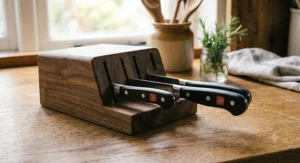
Start by hand-washing immediately after use, particularly after acidic foods like tomatoes or citrus, which can dull and discolour a blade faster than almost anything else in the kitchen. Dishwashers are genuinely the enemy here: detergent salts and the jostling against other cutlery both accelerate edge wear, even on knives technically labelled dishwasher-safe. Store your utility knife in a block, on a magnetic strip, or in a blade guard — never loose in a drawer, where the edge meets metal cutlery and loses its bite within weeks.
Honing and sharpening are different jobs, and conflating them is the single most common mistake new owners make. A honing steel realigns a rolled edge between uses — it doesn’t remove metal or restore genuine sharpness. For that, you need an actual sharpening stone, pull-through sharpener, or professional service every few months depending on use. As Great British Chefs’ guide to sharpening explains, a honing steel is for weekly maintenance, while genuine sharpening needs a stone or pull-through sharpener every month or so — you simply cannot resharpen a dulled edge with honing alone, a distinction that trips up even fairly experienced home cooks.
In the first 30 days, the most common mistake is treating a new knife like an old one — pressing too hard, assuming it needs force it simply doesn’t. A properly sharp utility knife should glide through a ripe tomato under its own weight; if you’re pushing, something’s already gone wrong with either your technique or your edge maintenance.
Real-World Scenarios: Matching the Right Utility Knife to Your Kitchen
Consider three genuinely different cooks, because the “best” utility knife changes completely depending on who’s holding it.
The first is a university student in a shared house, cooking on a tight budget with minimal storage and zero patience for hand-washing rituals. For this cook, the Victorinox Swiss Classic or Mercer Culinary Genesis makes far more sense than anything premium — both survive a slightly careless kitchen and won’t sting if they eventually go missing from a shared flat.
The second is a keen home cook who’s just invested in a proper knife block and wants something they’ll still be using in twenty years. Here, the Wüsthof Classic 4.5″ earns its reputation — it’s the knife equivalent of buying decent boots instead of three pairs of cheap ones every winter. The upfront cost stings less once you divide it by the number of years it’ll actually serve.
The third is someone who cooks daily, has larger hands, and finds smaller German handles genuinely uncomfortable during long prep sessions — think Sunday batch cooking for the week ahead. The Wüsthof Classic Ikon 6″ or Messermeister Oliva Elite solves a problem the cheaper knives simply can’t: hand fatigue over sustained use, which no amount of sharpness compensates for.
Using a Utility Knife for Fruit and Veg: What to Expect
This is arguably where the utility knife category earns its keep. Most kitchen accidents involving fruit and veg happen with the wrong tool — a chef’s knife too unwieldy for coring an apple, a paring knife too short to safely slice a mango.
A straight-edged utility knife like the Wüsthof Classic 4.5″ handles firm produce beautifully: carrots, courgettes, firm pears, all yield to a clean, controlled cut. Where straight edges struggle is on anything with a tough skin and soft interior — tomatoes, citrus, ripe peaches — where the blade tends to skid rather than bite. That’s precisely the gap serrated options like the Zwilling Pro or Victorinox Swiss Classic exist to fill; their scalloped serrations grip and cleanly slice through tough skins and soft interiors such as tomatoes, citrus, bagels and sausages without the squashing a dull straight edge causes.
The practical upshot: many serious cooks end up owning one of each — a straight utility knife for firm produce and prep, and a serrated one specifically for the tomato-and-stone-fruit problem. It’s a cheaper solution than it sounds, given the budget picks on this list cost less than a decent bottle of wine.

How to Choose a Wusthof Utility Knife
Cutting through the marketing noise, here’s what actually matters when narrowing down your options:
- Blade length — 4.5 inches suits detail work and smaller hands; 6 inches suits bigger produce and longer prep sessions.
- Edge type — straight edges suit firm vegetables and precision cuts; serrated edges suit tomatoes, citrus and bread.
- Steel hardness (Rockwell/HRC) — anything from 56-60 HRC balances edge retention against ease of resharpening; higher numbers hold an edge longer but chip more easily.
- Handle material and shape — synthetic handles (POM, Santoprene) are dishwasher-tolerant and low-maintenance; wood handles look beautiful but demand hand-washing and occasional oiling.
- Full tang vs partial tang — a full tang extends the full length of the handle for better balance and long-term durability, and is worth prioritising over aesthetics.
- Warranty and country of origin — Solingen, Germany, and Seki, Japan, remain the two centres of genuine cutlery craftsmanship worth paying a premium for.
- Your actual cooking habits — a knife that never gets used because it feels wrong in hand is a wasted purchase regardless of its specifications.
A common mistake buyers make here is choosing based purely on brand recognition rather than blade geometry — a beautifully branded knife that doesn’t suit your grip or your typical ingredients will gather dust regardless of the name stamped on it. Equally common: assuming a higher price always means a sharper knife out of the box, when factory edge angles vary significantly between brands regardless of cost.
✨ Ready to find your perfect match?
🔍 Compare the full specs above against your own prep habits, then click through to check current availability on any of these picks. A knife that fits your hand properly changes how much you enjoy cooking, not just how fast you chop.
German Steel Kitchen Knives vs Japanese and Swiss Alternatives
German steel kitchen knives, typified by Wüsthof, Zwilling and Messermeister, are generally softer and tougher than their Japanese counterparts — usually landing in the 56-58 HRC range. That toughness translates into forgiveness: German blades tolerate the odd twist, the occasional cutting-board mishap, and general kitchen carelessness without chipping.
Japanese hybrids like the Miyabi Kaizen II push hardness up towards 60-61 HRC using steels such as FC61 or VG10. The result is a genuinely sharper, thinner edge that slices with less resistance — but that same hardness makes the blade more brittle. Drop a German utility knife on a tile floor and you’ll likely just need to re-hone it. Do the same with a harder Japanese-style blade and there’s a real chance of a chipped edge.
Swiss options like the Victorinox Swiss Classic occupy a middle ground on paper but differ in construction rather than steel chemistry alone — stamped rather than forged, lighter in hand, and priced to match. None of these approaches is objectively “better”; they’re different engineering trade-offs suited to different cooking styles. A cook who batch-preps vegetables daily probably wants German toughness. A cook who prizes razor-fine slices of fish or garnish work will likely prefer the Japanese approach, chips and all.
Full Tang Knife Construction: Why It Matters More Than Marketing Copy
“Full tang” gets thrown around in knife marketing so often it’s practically wallpaper, but the actual engineering behind it deserves more attention than it gets. A full tang means the steel of the blade extends the entire length of the handle, visible as metal sandwiched between the handle scales (or, on synthetic handles, running the full internal length). Full tang and triple-riveted handle construction provides a balanced, secure grip — and that balance point genuinely changes how a knife feels mid-cut, particularly during repetitive prep tasks.
Partial tang knives, where the steel stops partway into the handle, tend to feel front-heavy and are simply weaker at the stress point where blade meets grip — precisely where the most force gets applied during hard cuts. Every knife featured in this guide uses full tang construction, which is one reason none of them are genuine bargain-bin products despite the range in price.
What most buyers overlook is that full tang construction also affects long-term safety. A partial tang can loosen or crack at the transition point after years of use, creating a wobble that turns a controlled cut into an unpredictable one. Full tang knives distribute that stress across the entire handle length instead, which is exactly why professional kitchens standardise on them.
High Carbon Stainless Steel Explained: Hardness, Edge and Rust Resistance
High carbon stainless steel sounds like a marketing mash-up, but it’s a genuinely meaningful material description. Standard stainless steel resists rust brilliantly but tends to be too soft to hold a fine edge; pure carbon steel holds an incredible edge but rusts if you look at it wrong. High-carbon stainless steel blends vanadium for durability and wear resistance with molybdenum for toughness, giving you the rust resistance of stainless with meaningfully better edge retention than standard stainless alone.
Wüsthof’s X50CrMoV15, Zwilling’s SIGMAFORGE formula, and Messermeister’s 1.4116 alloy are all variations on this same high-carbon stainless family, differing mainly in exact carbon content and heat treatment rather than fundamental chemistry. Precision-forged from a single piece, this steel offers lasting durability and balance compared with stamped blades cut from sheet steel. For a deeper technical breakdown of how carbon content and alloying elements affect hardness, the Wikipedia entry on stainless steel covers the underlying metallurgy in more detail than any single product page ever will.
The Rockwell hardness scale (HRC) is where this chemistry becomes practically useful information. Every 2-3 point increase in HRC generally means noticeably better edge retention, at the cost of slightly increased brittleness. Reviewers consistently note that knives in the high 50s HRC feel like a genuine “sharpen twice a year” proposition, while those pushing 60+ HRC demand more careful handling but reward that care with genuinely superior slicing performance.
Premium Knife Brands vs Budget Blades: Long-Term Cost & Maintenance
The real cost of a knife isn’t the sticker price — it’s the sticker price divided by the years of genuinely good performance you get from it, plus whatever you spend keeping it sharp along the way.
| Consideration | Budget Pick (e.g. Victorinox Swiss Classic) | Premium Pick (e.g. Wüsthof Classic 4.5″) |
|---|---|---|
| Upfront cost | Lower | Higher |
| Resharpening frequency | More often | Less often |
| Expected lifespan | Several years with care | Decades, often lifetime warranty |
| Handle maintenance | Minimal, dishwasher tolerant | Varies; some hand-wash only |
Run the maths over a decade and the gap narrows considerably: a £20 knife replaced every three years costs roughly the same as a £100 knife bought once. The premium brands win on a different axis entirely — consistency, warranty backing, and the simple fact you’re not shopping for a replacement every few years. Reviewers consistently note that premium knife brands earn their reputation through decades of unchanged manufacturing standards rather than flashy marketing, which is precisely why century-old names like Wüsthof still dominate professional kitchens today.
Budget knives from Mercer or Victorinox aren’t a false economy, though — for light use, students, or second kitchens, the total cost of ownership genuinely favours the cheaper option. The mistake is assuming either tier is universally “better”; it depends entirely on how hard and how often the knife gets used.
Safety, Storage and UK Knife Regulations
However sharp your utility knife, safe storage and legal awareness matter just as much as the blade itself. In the UK, it’s illegal to use any knife or weapon in a threatening way, and the maximum penalty for illegally carrying a knife in public is four years in prison, an unlimited fine, or both — rules that exist around carrying and use, not around owning kitchen cutlery for cooking at home.
Buying online has its own layer of compliance that’s worth knowing as a customer, not just a retailer. Sellers must have a system to verify the purchaser is 18 or older before completing an online knife sale, and the package must be clearly marked as containing a bladed article, only handed to an adult on delivery. If you’re ordering any of the knives featured here, expect an age-verification step at checkout — it’s a legal requirement, not an inconvenience the retailer invented. For full detail on the rules around buying, carrying and storing knives responsibly in the UK, see the official GOV.UK guidance on knives and weapons.
At home, safe storage is mostly common sense applied consistently: point the tip away from your body when carrying a knife across a kitchen, never leave a blade submerged in washing-up water where the next person’s hand might find it by surprise, and store knives in a block or on a magnetic strip rather than loose in a drawer where children or unsuspecting hands could reach the edge directly.
Frequently Asked Questions
❓ Is a Wusthof utility knife the same as a paring knife?
❓ What's the difference between a straight and serrated utility knife?
❓ How often should I sharpen a high carbon stainless steel knife?
❓ Are full tang knives worth the extra cost?
❓ Can I put my Wüsthof utility knife in the dishwasher?
Conclusion
Choosing between these seven knives ultimately comes down to matching the tool to your actual cooking life rather than chasing a brand name. If you want the safest, most proven all-rounder, the Wüsthof Classic 4.5″ remains the sensible default. If tomatoes and bread are your daily battle, the Zwilling Pro or Victorinox Swiss Classic solve that specific problem far better than a straight edge ever could. Budget-conscious cooks shouldn’t feel like they’re settling with the Mercer Culinary Genesis — it’s a genuinely well-built knife that happens to cost less, not a compromise dressed up as one.
What matters more than any single spec sheet is picking a knife you’ll actually reach for daily, because the sharpest blade in the world does nothing sitting unused in a drawer. Whichever of these seven you land on, you’re choosing genuine forged steel, honest construction, and a tool built to outlast most of what’s currently in your kitchen.
✨ Found your next kitchen essential?
🔍 Take a closer look at the picks above, check current availability, and pick the one that matches how you actually cook. A good utility knife quietly makes every single day in the kitchen a little easier.
Recommended for You
- Utility Knife Kitchen: 7 Best Picks Tested for 2026
- Ham Slicer Knife: 7 Best Picks for a Perfect Carve in 2026
- Salmon Slicing Knife: 7 Best Picks UK Cooks Trust (2026)
Disclaimer: This article contains affiliate links. As an Amazon Associate, I earn from qualifying purchases. If you purchase products through these links, we may earn a small commission at no additional cost to you.
✨ Found this helpful? Share it with your friends! 💬🤗
