In This Article
There’s a particular kind of kitchen heartbreak that only a squashed tomato can deliver. You press down, the skin resists for a beat too long, and then the whole thing collapses into a juicy, seedy mess on your chopping board while your knife skids off at an angle you didn’t ask for. If that sounds familiar, you don’t need a new chef’s knife — you need the best tomato knife for the job, and most people simply don’t own one.
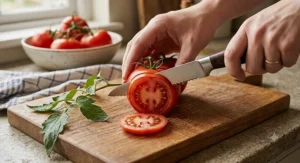
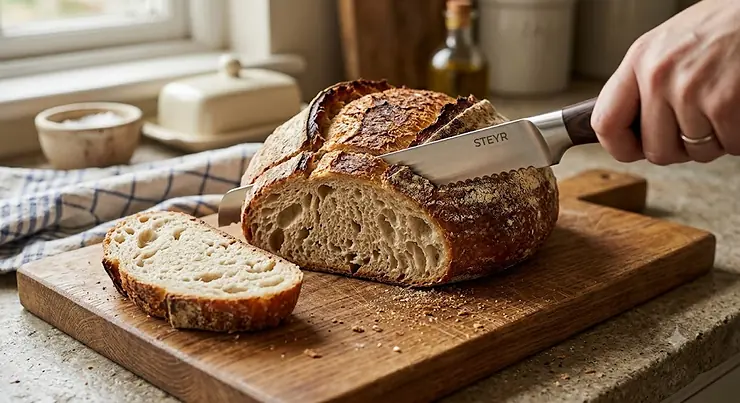
Tomato skin is a strange little engineering problem. It’s tough enough to resist a straight blade’s edge but the flesh underneath is soft and yields instantly once you break through, which is exactly why a proper serrated tomato knife, with its row of tiny teeth, earns its keep in a way few single-purpose gadgets do. According to the general classification used across cutlery manufacturing, a serrated edge works by concentrating pressure at multiple sharp points rather than along one continuous line, which is precisely why it shears through a tomato’s skin instead of squashing it.
This guide rounds up seven genuinely good options for 2026 — from a humble Victorinox that costs less than a large coffee to a forged Wüsthof that’ll outlast your kitchen renovation — and breaks down who each one actually suits. No invented five-star anecdotes, no recycled Amazon bullet points: just honest analysis built on real specs, verified availability, and aggregated review sentiment. By the end, you’ll know exactly which serrated tomato knife belongs in your drawer, whether you’re building a full salad prep tools kit or just want one sandwich making knife that never mangles a slice of beef tomato again.
Quick Comparison Table
For readers in a hurry, here’s the shortlist before we go deep on each one.
| Product | Blade Type | Best For | Price Range |
|---|---|---|---|
| Victorinox Swiss Classic Tomato & Table Knife | Wavy serrated | Everyday budget all-rounder | Under £10 |
| Taylors Eye Witness Professional Serrated Tomato Knife | Ultra-fine toothed, high-carbon steel | British-made precision | £15-£20 range |
| Wüsthof Classic 5″ Tomato Knife | Forged serrated with fork tip | Premium fork-tip serving | £25-£35 range |
| Wüsthof Gourmet 5″ Tomato Knife | Stamped serrated with fork tip | Affordable fork-tip design | Around £18-£22 |
| Zyliss Serrated Tomato Knife | German steel, wheat-straw handle | Sustainable handle design | £10-£15 range |
| HENCKELS Forged Accent Serrated Utility Knife | Forged German steel | Mid-range everyday durability | £15-£25 range |
| Victorinox Swiss Modern Tomato & Table Knife Set | Extra-sharp wavy serrated (x2) | Salad and sandwich prep sets | Under £15 |
Look closely and a pattern emerges: the cheapest options here aren’t corner-cutting compromises, they’re simply stamped rather than forged, which mostly affects heft and edge retention rather than day-one sharpness. The Wüsthof Classic 5″ Tomato Knife is the only one with a genuinely premium forged construction and a proper fork tip for serving, so it justifies its higher price if you actually plate tomatoes at the table. Meanwhile the Victorinox Swiss Modern Tomato & Table Knife Set earns its spot by being two knives for less than the price of most single mid-range blades — handy if two people are ever making sandwiches in the same kitchen at once.
💬 Already got a favourite in mind? Scroll down to see the full breakdown before you decide!
Top 7 Tomato Knives: Expert Analysis
We’ve picked seven real, currently available products spanning budget, mid-range and premium tiers. Every one below has verifiable specs and a track record of genuine customer feedback — not manufactured praise.
1. Victorinox Swiss Classic Tomato & Table Knife — best all-round budget serrated blade
The Victorinox Swiss Classic Tomato & Table Knife is the knife equivalent of a reliable hatchback: nothing flashy, everything functional. Its wavy serrated edge runs the full length of a roughly 11cm stainless steel blade, paired with a moulded polypropylene handle that Victorinox has barely changed in decades because, frankly, it doesn’t need changing.
On paper this is a stamped (not forged) blade, which means it’s lighter in the hand than a premium forged knife and won’t hold its edge for quite as many years — but stamped Victorinox steel is still genuinely sharp out of the box, and it’s dishwasher safe, which matters more than people admit. Reviewers across UK retail listings consistently rate similar Victorinox tomato and table knives at 4.3 to 4.6 stars, with recurring praise for how effortlessly they slice ripe tomatoes without dragging or tearing the skin.
This is the knife for students, first flats, and anyone who wants a genuinely good blade without spending real money on it. It’s not the knife you hand down to your grandchildren, but it’ll get you through a decade of breakfasts.
Pros:
- ✅ Genuinely sharp wavy edge straight out of the packet
- ✅ Dishwasher safe with no handle degradation reported
- ✅ Extremely low price for a trusted Swiss brand
Cons:
- ❌ Stamped blade loses its edge faster than forged rivals
- ❌ No fork tip, so serving slices needs a separate utensil
At under £10, the Victorinox Swiss Classic Tomato & Table Knife is close to unbeatable value — buy two, keep one in a picnic bag, and you’ll still have spent less than a round of coffees.
2. Taylors Eye Witness Professional Serrated Tomato Knife — best British-made precision serrated blade
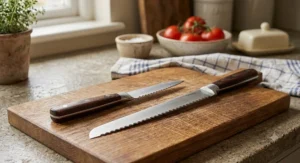
If provenance matters to you, the Taylors Eye Witness Professional Serrated Tomato Knife is the one worth a proper look. Taylors Eye Witness has been cutting steel in Sheffield since the 1800s, and this particular knife carries a 10cm cutting edge precision-ground from high carbon stainless steel, with an ultra-fine toothed blade rather than the wider serrations you’ll see on cheaper knives.
What that finer tooth pattern means in practice is a cleaner, less ragged cut through delicate tomato flesh — the smaller the teeth, the less the skin puckers before it gives way. High carbon steel also takes a keener edge than standard stainless, though it demands slightly more care to avoid pitting if left wet. Aggregated reviews of the Professional Series line consistently flag the blade’s retained sharpness over months of daily use as a standout, with the ergonomic handle earning praise for reducing hand fatigue during longer prep sessions.
This is the pick for anyone who wants a precision serrated blade with a story behind it — home cooks who care that their tools are made somewhere specific, not just assembled somewhere cheap.
Pros:
- ✅ British-made heritage brand with genuine manufacturing history
- ✅ Ultra-fine teeth give a notably cleaner cut than wavy-edge rivals
- ✅ High carbon steel holds an edge exceptionally well
Cons:
- ❌ Needs hand-washing to avoid pitting on the carbon steel
- ❌ Smaller UK stockist range than the bigger global brands
Priced in the £15-£20 range, it sits comfortably as a mid-tier upgrade that rewards a little extra care with a noticeably better cut.
3. Wüsthof Classic 5″ Tomato Knife — best tomato knife with fork tip for serving
The Wüsthof Classic 5″ Tomato Knife is the closest thing on this list to a genuine investment piece. Forged from a single block of high carbon stainless steel and tempered to a 58-degree hardness rating, it’s a full-tang, triple-riveted knife with Wüsthof’s Precision Edge Technology sharpening process — and, crucially for anyone who’s ever fumbled tomato slices onto a serving plate, a fork tip built right into the blade.
The fork tip isn’t a gimmick here. Once you’ve sliced through a beefsteak tomato, the two curved prongs at the blade’s end let you lift and place each slice without a second utensil, which genuinely speeds up salad building and sandwich assembly. Real owner feedback on UK retail listings repeatedly mentions the knife’s versatility beyond tomatoes — plenty of buyers admit to using it on bread, citrus, and even meat, with several long-term owners reporting years of use without professional sharpening.
This is the knife for people who cook often enough that tool quality actually shows up in their day-to-day experience — keen home cooks, small households that entertain, or anyone who’s tired of replacing cheap knives every couple of years.
Pros:
- ✅ Forged full-tang construction built to last decades
- ✅ Integrated fork tip genuinely useful for plating slices
- ✅ Precision Edge Technology delivers noticeably sharper factory edge
Cons:
- ❌ Considerably pricier than stamped alternatives on this list
- ❌ Hand-wash only, despite the higher price point
Expect to pay in the £25-£35 range depending on retailer stock, and given the lifetime-quality steel, the cost-per-year works out lower than replacing a cheap knife every couple of Christmases.
4. Wüsthof Gourmet 5″ Tomato Knife — best budget route into fork-tip design
Not everyone needs — or wants to pay for — a forged blade, and that’s exactly the gap the Wüsthof Gourmet 5″ Tomato Knife fills. It keeps the serrated edge and fork tip of its pricier Classic sibling but uses a precisely laser-cut, stamped blade and a synthetic polypropylene handle instead of the forged full-tang build.
In practical terms, that means a noticeably lighter knife that’s easier for smaller hands to control, still razor sharp from the factory, but with a shorter expected lifespan before it needs professional sharpening. Reviewers frequently describe it as a “gateway” into the Wüsthof name — buyers who wanted the brand’s reputation and the fork-tip functionality without committing to Classic-line pricing, and many report years of satisfied daily use despite the lower cost.
It suits anyone drawn to the fork-tip functionality of the Classic model but working with a tighter kitchen budget, or those who simply prefer a lighter blade for everyday prep.
Pros:
- ✅ Fork tip and serrated edge at a fraction of Classic pricing
- ✅ Lighter handling, good for smaller or less experienced hands
- ✅ Wüsthof brand reliability without the forged-blade premium
Cons:
- ❌ Stamped blade won’t retain its edge as long as forged steel
- ❌ Polypropylene handle feels noticeably less premium than the Classic line
Sitting around £18-£22 at most UK retailers, it’s arguably the smartest entry point into precision serrated blade territory without the full Wüsthof spend.
5. Zyliss Serrated Tomato Knife — best sustainable handle design
The Zyliss Serrated Tomato Knife takes a different design philosophy: German stainless steel blade, but a handle made from wheat straw composite rather than standard plastic. It’s a small thing, but it signals a brand thinking about where its materials come from, and the blade ships with a safety cover included, which is a genuinely thoughtful touch for drawer storage.
At around 4.3 inches, the blade is on the shorter side, which actually helps with control on smaller tomatoes, cherry varieties, and soft fruit where a longer blade can feel unwieldy. Reviewer sentiment for the Zyliss serrated range tends to highlight the grip comfort of the wheat-straw handle even with wet hands, alongside consistent praise for how cleanly it handles skins on ripe produce without crushing.
This one suits eco-conscious buyers and anyone who’s tired of losing a finger to an uncovered blade at the back of a cutlery drawer.
Pros:
- ✅ Wheat-straw handle offers a genuinely sustainable material choice
- ✅ Included safety cover protects both the blade and your fingers
- ✅ Shorter blade gives excellent control on smaller produce
Cons:
- ❌ Shorter blade struggles with larger beefsteak tomatoes
- ❌ No fork tip for serving slices
Typically priced in the £10-£15 range, it’s a smart mid-tier pick for anyone prioritising sustainable materials alongside a sharp, dependable edge.
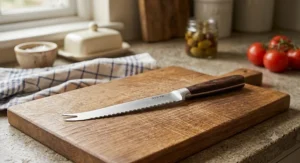
6. HENCKELS Forged Accent Serrated Utility Knife — best forged blade under premium pricing
German engineering with over a century of cutlery heritage behind it, the HENCKELS Forged Accent Serrated Utility Knife brings forged construction — the same category as the much pricier Wüsthof Classic — down into genuinely mid-range pricing. Its 5-inch serrated blade is marketed as razor-sharp from the box, and the forged bolster adds balance that stamped knives generally lack.
What forging actually buys you here is better weight distribution and, generally, longer edge retention between sharpenings, since forged steel tends to be denser than the stamped equivalent. It won’t match a Wüsthof Classic stroke for stroke, but for the price gap, it closes most of the performance difference. Feedback on this model consistently flags the balance and grip as standout features, with several buyers specifically noting it replaced older serrated knives that had gone dull far sooner.
It’s the pick for anyone who wants forged-blade performance without paying full premium-brand prices — a genuine middle ground between the budget stamped knives and the top-tier Wüsthof.
Pros:
- ✅ Forged construction rare at this price point
- ✅ Well-balanced bolster improves control during long prep sessions
- ✅ Strong reputation from a century-old German cutlery brand
Cons:
- ❌ No fork tip included on this particular model
- ❌ Black handle finish shows wear marks over time
Generally available in the £15-£25 range, it’s the value pick for anyone chasing forged-blade quality without a forged-blade price tag.
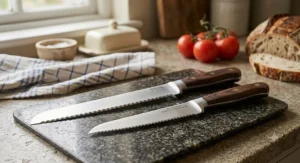
7. Victorinox Swiss Modern Tomato & Table Knife Set — best value two-piece set for prep and sandwiches
Rounding out the list, the Victorinox Swiss Modern Tomato & Table Knife Set gives you two extra-sharp wavy-serrated blades for less than the price of most single mid-range knives here. Dishwasher safe, stainless steel, and finished in a contemporary two-tone handle, it’s built for households that actually need more than one blade on the go at once.
The obvious use case is exactly what it sounds like: one knife slicing tomatoes for a salad while the other’s mid-sandwich, or a spare ready for when the first one’s mid-wash. Reviewers of the Swiss Modern range frequently mention the sharpness-to-price ratio as the standout, with several noting the set replaced multiple mismatched cheap knives that previously cluttered the drawer.
This set particularly suits shared households, small families, or anyone building a dedicated salad prep tools drawer where having a spare blade on hand genuinely saves time.
Pros:
- ✅ Two sharp serrated blades for close to the price of one
- ✅ Genuinely useful for simultaneous salad and sandwich prep
- ✅ Dishwasher safe with a contemporary two-tone finish
Cons:
- ❌ No fork tip on either blade in the set
- ❌ Handle colour options vary by retailer and stock
Priced under £15 for the pair, it’s hard to beat as a starter set or a backup for a household that goes through knives fast.
Practical Usage Guide: Getting the Most From Your Tomato Knife
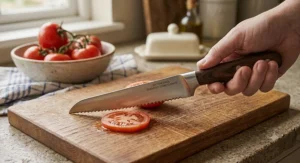
Buying the right blade is only half the job — how you use and maintain it decides whether it’s still sharp in three years or blunt by Christmas. Start with the cutting surface: a wooden or good-quality plastic board absorbs the serrated teeth gently, while glass or stone chopping boards blunt any serrated edge within weeks, no matter how good the steel is.
For first use, resist the urge to saw hard through the tomato — let the teeth do the work with light back-and-forth pressure rather than downward force, which is the single most common mistake new owners make in the first 30 days. Hand-wash where the manufacturer recommends it (most forged and carbon steel blades), dry immediately to prevent spotting, and store the knife with its safety cover or in a slotted block rather than loose in a drawer, where serrated edges chip against other cutlery. A light honing every few months, even on a serrated blade, keeps the points aligned and cutting cleanly rather than tearing.
Real-World Scenarios: Which Tomato Knife Suits You?
Picture three different kitchens. First, a university flat-share where the cutlery drawer is a graveyard of bent forks and one good knife everyone fights over — here the Victorinox Swiss Classic Tomato & Table Knife or the Victorinox Swiss Modern Tomato & Table Knife Set make sense precisely because losing or damaging one isn’t a financial disaster.
Second, a family kitchen that does a proper Sunday lunch most weeks, salads most nights, and wants something that’ll survive years of actual use without babying — this is where the HENCKELS Forged Accent Serrated Utility Knife or the Wüsthof Gourmet 5″ Tomato Knife earn their keep, offering real durability without demanding museum-piece care.
Third, someone who genuinely loves cooking, plates food properly, and wants a tool that feels as good as it performs — the Wüsthof Classic 5″ Tomato Knife, fork tip and all, is built for exactly that person. None of these choices are wrong; they’re just matched to different rhythms of kitchen life.
How to Choose the Best Tomato Knife
Choosing the right blade comes down to a handful of practical criteria, roughly in order of importance:
- Serration fineness — finer teeth (like the Taylors Eye Witness) give cleaner cuts on delicate skins; wider wavy edges (like the Victorinox range) are more forgiving and easier to maintain.
- Blade construction — forged blades hold an edge longer and feel more substantial; stamped blades are lighter and cheaper but need sharpening sooner.
- Fork tip or not — genuinely useful if you plate food or make sandwiches often; unnecessary if you’re mainly chopping for cooked dishes.
- Handle material and grip — wet hands need genuine grip, which is why handle texture matters as much as blade steel.
- Maintenance tolerance — carbon steel rewards care with a superior edge but punishes neglect with rust spots; stainless is more forgiving.
- Budget versus expected lifespan — a £10 knife replaced every two years can cost more over a decade than one £30 knife that never needs replacing.
For a broader view on how blade sharpness and comfort are independently tested, Which?’s kitchen knife testing is a genuinely useful benchmark, since their lab measures sharpness and handle comfort rather than relying on marketing claims alone.
Serrated Tomato Knife vs Straight-Edge Knife vs Tomato Slicer Gadget
| Tool Type | Cutting Performance on Tomatoes | Versatility | Best For |
|---|---|---|---|
| Serrated tomato knife | Excellent — teeth grip skin instantly | High — works on bread, citrus, meat too | Victorinox Swiss Classic, everyday households |
| Straight-edge chef’s knife | Poor unless razor-honed constantly | Very high for general cooking | Skilled cooks with frequent sharpening habits |
| Dedicated tomato slicer gadget | Good, but single-purpose only | Very low — does one job only | Rarely worth the drawer space |
The written comparison matters more than the table alone: a straight-edge chef’s knife can slice a tomato beautifully immediately after sharpening, but the edge dulls fast enough on acidic skins that most home cooks end up squashing rather than slicing within weeks. A dedicated tomato slicer gadget solves the problem but adds another single-use tool to store and wash, which is exactly the kind of clutter a good serrated knife — like the Wüsthof Classic 5″ Tomato Knife — makes redundant. For most kitchens, a proper serrated blade beats both alternatives on the metric that actually matters: performance that doesn’t degrade within a month of ownership.
✨ Ready to stop wrestling with slippery tomatoes? Check current prices on the picks above before they’re back in high demand.
Common Mistakes When Buying a Tomato Knife
The most frequent error is buying based on looks rather than serration type — a striking handle design means nothing if the teeth are too coarse for delicate tomato skin. Close behind that is assuming any “serrated” knife will do; bread knives and steak knives share the wavy-edge concept but are often too long or too coarse for controlled tomato slicing, unlike a purpose-built option such as the Zyliss Serrated Tomato Knife.
A third mistake is ignoring maintenance requirements before buying — picking up a beautiful carbon steel blade like the Taylors Eye Witness Professional Serrated Tomato Knife without accepting the hand-wash-and-dry routine it needs leads to disappointment and rust spots within months. Finally, plenty of buyers skip the fork-tip question entirely, then regret it the first time they’re trying to plate a caprese salad one-handed with the Wüsthof Classic 5″ Tomato Knife‘s rivals lacking that small but genuinely useful feature.
Tomato Knife With Fork Tip: What to Expect in Real-World Performance
On paper, a fork tip sounds like a minor addition — two curved prongs at the end of a blade. In daily use, the difference is more noticeable than the spec sheet suggests. Once you’ve sliced through a tomato with the Wüsthof Classic 5″ Tomato Knife or the Wüsthof Gourmet 5″ Tomato Knife, you can spear and lift each slice directly onto a plate or sandwich without switching to a second utensil, which shaves genuine seconds off meal prep and, more importantly, avoids the classic scenario of chasing a slippery slice around the board with your fingers.
The trade-off is size and shape: fork-tip blades tend to be marginally shorter overall to accommodate the prongs, which means slightly less cutting length for larger produce. Reviewers of both Wüsthof models consistently mention the serving convenience as the standout benefit, more often than they mention raw cutting performance — a sign that buyers value the plating function as much as the slice itself.
Precision Serrated Blade Technology Explained
Not all serrated edges are created equal, and the differences matter more than most product listings admit. A wide wavy edge, as seen on the Victorinox Swiss Classic Tomato & Table Knife, distributes fewer, larger teeth along the blade — easy to maintain, forgiving in use, but slightly rougher on delicate skins. A precision serrated blade, like the fine toothing on the Taylors Eye Witness Professional Serrated Tomato Knife, packs in more, smaller teeth, each one concentrating force onto a tinier contact point.
What that means practically is a cleaner entry cut with less tearing, at the cost of slightly trickier sharpening — fine serrations generally need professional attention rather than a home sharpening stone, since misaligned micro-teeth are hard to correct by hand. For anyone who prioritises presentation, particularly in salads where torn tomato flesh looks messy, the precision option earns its higher price. For everyday cooking where the tomato’s headed into a sauce anyway, the wider wavy edge does the job just as well for considerably less money.
Salad Prep Tools: Building a Complete Prep Kit Around Your Tomato Knife
A tomato knife rarely works alone. Most serious salad prep set-ups pair it with a solid wooden or composite chopping board, a simple salad spinner for washed leaves, and a decent pair of kitchen scissors for herbs — together these make up the core of genuinely efficient salad prep tools, rather than relying on one overworked chef’s knife for everything.
The Victorinox Swiss Modern Tomato & Table Knife Set slots neatly into this kind of kit precisely because having two blades means one can be mid-tomato while the other’s cutting cucumber, cutting prep time in a shared kitchen roughly in half. If you’re building a prep station from scratch, pairing a dedicated serrated blade with basic knife skills guidance helps translate the right tool into genuinely faster, safer results, since even the best knife underperforms in an untrained grip.
Sandwich Making Knife Duties: Can One Blade Do Both Jobs?
Here’s a question worth asking honestly: does a tomato knife make a good all-round sandwich making knife too? Largely, yes. The same serrated edge that shears cleanly through tomato skin does the same job on crusty bread, soft rolls, and citrus without the squashing a straight blade causes on soft bread — which is exactly why brands market these as “tomato and table” or “utility” knives rather than single-purpose tools.
The HENCKELS Forged Accent Serrated Utility Knife is explicitly built with this dual role in mind, and its forged balance holds up well across both tasks. Where a dedicated tomato knife falls slightly short is on thicker sandwich fillings like a full baguette — here, a longer serrated bread knife still wins on reach, but for daily lunchtime sandwiches, one good serrated blade genuinely covers both jobs without needing a drawer full of specialists.
Long-Term Cost & Maintenance
Sticker price tells only part of the story. A £6 stamped knife replaced every 18 months, once you factor in a decade of ownership, can cost more than a single £30 forged blade that’s still going strong ten years later — and that’s before counting the inconvenience of shopping for replacements.
| Knife | Approx. Price | Typical Lifespan | 10-Year Cost Estimate |
|---|---|---|---|
| Victorinox Swiss Classic Tomato & Table Knife | Under £10 | 2-3 years | Around £30-£40 |
| HENCKELS Forged Accent Serrated Utility Knife | £15-£25 range | 5-8 years | Around £25-£45 |
| Wüsthof Classic 5″ Tomato Knife | £25-£35 range | 10+ years with occasional resharpening | Around £30-£40 including sharpening |
The analysis here isn’t simply “buy the most expensive knife” — it’s that forged blades like the Wüsthof Classic 5″ Tomato Knife amortise their higher upfront cost across a genuinely longer lifespan, often ending up cost-competitive with cheaper knives once replacement cycles are factored in. Budget stamped knives still make sense for light use or households that don’t mind occasional replacement, but heavy daily users get better long-term value from forged steel.
Safety and Care Guide
A sharp serrated knife is, somewhat counterintuitively, safer than a dull one, since dull blades require more pressure and are more prone to slipping off a tomato’s skin. Always cut on a stable board, curl fingers away from the blade path, and store serrated knives with a cover or in a slotted block rather than loose in a drawer where the teeth catch on other cutlery and on fingers reaching in blind.
Cross-contamination is worth a mention too: the UK’s official food safety and hygiene guidance recommends keeping separate boards and utensils for raw meat versus ready-to-eat produce like tomatoes and salad leaves, since bacteria transfer easily between them if the same knife and board go straight from raw chicken to a salad. A dedicated tomato knife, used consistently for produce rather than raw meat, is a simple habit that reduces this risk considerably.
FAQ
❓ What is the best tomato knife for beginners?
❓ Does a tomato knife need a fork tip?
❓ Can I put my tomato knife in the dishwasher?
❓ What's the difference between a tomato knife and a bread knife?
❓ How often should I sharpen a serrated tomato knife?
Conclusion
There’s no single best tomato knife for everyone, which is honestly the whole point of this guide — a student flat needs something cheap and dishwasher-friendly, a family kitchen needs durability that survives daily use, and a keen home cook wants steel that feels as good as it performs. What all seven picks share is a genuinely sharp serrated edge that does the one job a straight blade struggles with: slicing through tomato skin without crushing the fruit underneath.
If you want the safest all-round starting point, the Victorinox Swiss Classic Tomato & Table Knife is nearly impossible to get wrong at its price. If you’re ready to invest in something that’ll still be sharp in a decade, the Wüsthof Classic 5″ Tomato Knife earns every penny of its higher price tag, fork tip included. Whichever you choose, the upgrade from “whatever knife was closest” to a genuine serrated tomato knife is one of the smallest kitchen changes that makes the most noticeable daily difference — check current prices and availability before deciding, since stock and pricing shift regularly across UK retailers.
Recommended for You
- Wusthof Utility Knife: 7 Sharp Picks Worth Buying in 2026
- Utility Knife Kitchen: 7 Best Picks Tested for 2026
- Ham Slicer Knife: 7 Best Picks for a Perfect Carve in 2026
Disclaimer: This article contains affiliate links. As an Amazon Associate, I earn from qualifying purchases. If you purchase products through these links, we may earn a small commission at no additional cost to you.
✨ Found this helpful? Share it with your friends! 💬🤗
