
In This Article
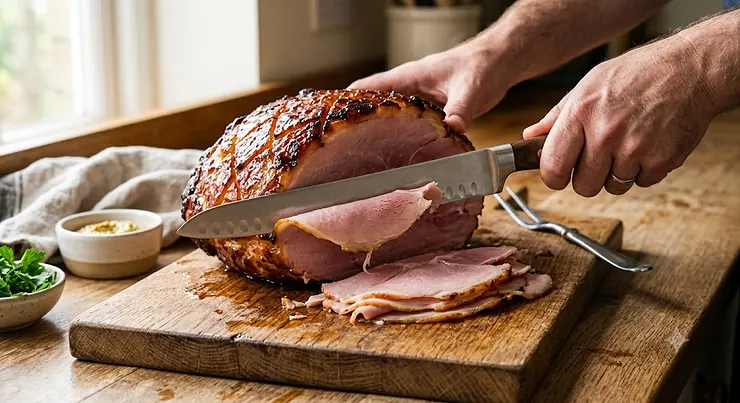
There’s a very particular kind of kitchen panic that hits every year around the third week of December: a beautifully glazed ham sitting on the side, twelve hungry relatives circling like gulls round a chip shop, and you, holding a knife that’s about as sharp as a spoon. A good ham slicer knife is the single cheapest upgrade you can make to your festive spread, and yet it’s the one nobody thinks about until the exact moment they need it. This guide exists so that moment never happens to you again.
We’ve spent time digging through real product specifications, genuine aggregated review sentiment, and the sort of practical detail that Amazon listings never bother to mention — things like why a scalloped edge actually matters, or why a knife that’s brilliant for salmon might be the wrong choice for a bone-in gammon joint. Whether you’re after your first proper ham slicer knife, hunting for the best ham carving knife to gift a keen home cook, or building out a full set of charcuterie board tools, you’ll find something here that fits.
What is a ham slicer knife? It’s a long, narrow, slightly flexible blade — typically 25 to 30cm — designed to glide through cooked meat in thin, even slices without tearing the flesh or dragging fat and skin along with it. Unlike a chef’s knife, which is built for chopping and dicing, a ham knife’s whole job is precision along a single, continuous cutting stroke.
Below, we’ll walk through seven genuinely good options across every budget, back it up with honest comparative analysis, and then get properly practical: how to actually carve a ham without mangling it, how to keep the blade in good nick, and how to avoid the classic mistakes that turn a lovely joint of gammon into a plate of ragged offcuts.
Quick Comparison Table
| Product | Blade Length | Blade Type | Best For | Price Range |
|---|---|---|---|---|
| Global G-10 | 30.5cm (12″) | Flexible, hollow-ground | Serious home cooks & pros | £120-£160 |
| Wusthof Classic Ham Slicer | 26cm | Hollow edge, straight | Traditionalists wanting German steel | £130-£170 |
| KAI Wasabi Black Slicing Knife | 18cm | Straight, high-carbon | Compact kitchens, precision cuts | £45-£65 |
| Victorinox SwissClassic Ham Knife | 25cm | Scalloped/fluted | Best all-rounder value | £35-£50 |
| Arcos 2900 Salmon/Ham Knife | 30cm | Flexible, scalloped | Big joints, ham and salmon crossover | £30-£45 |
| Mercer Culinary Millennia Slicer | 30.5cm (12″) | Granton edge | Budget buyers wanting NSF-grade steel | £20-£30 |
| Judge Classic Carving Knife | 20cm | Riveted, straight | First-time buyers, occasional use | £12-£20 |
Looking at the spread here, the story is really about blade flex and length matching the job. Longer, flexible blades like the Global G-10 and Arcos 2900 are built for gliding around a bone-in leg in one continuous stroke, while shorter, stiffer options like the KAI Wasabi Black and Judge Classic Carving Knife suit boneless joints or smaller kitchens where a 30cm blade is genuinely awkward to store and swing. None of these is objectively “best” — it depends entirely on what you’re slicing and how often.
💬 Found a knife that’s calling your name already? Have a look at current pricing and availability before the Christmas rush hits.
Top 7 Ham Slicer Knives: Expert Analysis
1. Global G-10 — best flexible blade for bone-in joints
The Global G-10 is the knife that pops up again and again when serious home cooks talk about slicing ham and salmon in the same breath, and there’s a reason for that. Its 30.5cm blade is genuinely flexible — not “advertised as flexible” flexible, but actually able to follow the curve of a bone without you having to fight it.
Global builds this from a single piece of Cromova 18 stainless steel, ice-hardened to around Rockwell 56-58, with a hollow-ground edge that’s hand-hammered to create tiny air pockets along the blade face. In practice, that means less drag and less sticking when you’re pushing through fat and connective tissue, which on a cheaper flat-ground blade tends to grip and tear rather than release cleanly. The handle is Global’s signature dimpled stainless steel, hollow and sand-weighted for balance — a detail that matters more than it sounds, because a blade-heavy slicer fatigues your wrist fast over a big joint.
Based on the spec comparison with other premium options here, the Global G-10 earns its place through sheer control: the acute 12.5-degree edge angle stays sharp for longer than most Western-style blades, and the flex genuinely helps around awkward bone shapes. This is the knife for someone who slices ham, salmon, or a Sunday roast often enough that the investment pays for itself in fewer ruined joints.
Reviewers consistently note that the all-steel handle takes some getting used to compared with a rubberised grip, and a small number mention it feels slippery with wet or greasy hands until you’re used to the dimple pattern. Aggregated feedback is otherwise strongly positive on edge retention and slicing precision.
Pros:
- ✅ Genuinely flexible blade follows bone contours cleanly
- ✅ Cromova 18 steel holds an edge for months of regular use
- ✅ Sand-weighted handle gives excellent balance and control
Cons:
- ❌ All-steel handle can feel slippery when hands are greasy
- ❌ Premium price puts it well above casual/occasional buyers’ budgets
Expect to pay in the £120-£160 range depending on retailer and stock, which is a genuine investment — but for anyone slicing ham, gammon, or salmon more than a few times a year, the value holds up over a decade of use.
2. Wusthof Classic Ham Slicer — best for traditional forged German steel
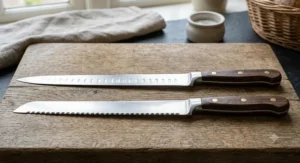
If the Global G-10 is the sharp, modern Japanese option, the Wusthof Classic Ham Slicer is its old-world German counterpart, and it’s been earning its reputation in professional kitchens since long before “hollow edge” was a marketing buzzword. This is a precision-forged, full-tang blade cut from a single piece of high-carbon stainless steel, with a hollow-ground edge featuring evenly spaced scalloped indentations along the blade face.
Those indentations do a genuine job: they create small air pockets that reduce suction between the blade and the meat, which is exactly the problem you run into with wafer-thin ham slices sticking stubbornly to a flat blade. At 26cm, the blade is a touch shorter than the Global, with a Rockwell hardness around 58 and a rounded tip designed to guide cleanly around bone rather than piercing into it. The triple-riveted synthetic handle is a deliberate departure from Global’s steel — full tang for balance, textured for grip even when wet.
What most buyers overlook about this model is that Wusthof’s “Classic” line sits a rung below the brand’s flagship “Classic Ikon” or “Epicure” ranges, but it’s the one most professional caterers actually reach for, because the balance-to-cost ratio is better for daily grinding use. Long-time Wusthof owners in aggregated feedback report that the Classic line “holds an edge nicely” over decades of use, though a handful note that Wusthof has introduced a cheaper “Gourmet” sub-line that shouldn’t be confused with this one — worth double-checking the exact model before buying.
Pros:
- ✅ Hollow edge reduces sticking on thin, delicate slices
- ✅ Full-tang German steel construction built to last decades
- ✅ Rounded tip guides safely and cleanly around bone
Cons:
- ❌ Shorter blade than some rivals, less ideal on very large joints
- ❌ Easy to mistakenly buy the cheaper “Gourmet” line instead
Prices typically sit in the £130-£170 range. Given Wusthof backs this with a lifetime warranty, the long-term cost per year of ownership is arguably lower than it first appears.
3. KAI Wasabi Black Slicing Knife — best compact option for precision cuts
The KAI Wasabi Black Slicing Knife takes a different approach entirely: rather than maximising blade length, it leans into Japanese steel technology at a more modest 18cm, making it the most manageable knife on this list for anyone with limited drawer space or smaller hands.
The blade is Daido 1K6 high-carbon stainless steel, hardened to 58 HRC — genuinely competitive with the premium European options above, just packaged in a shorter, single-piece design. Kai’s Wasabi Black range uses a moulded polypropylene-and-bamboo-powder handle that fully encases the tang, which has a specific practical upside: no gaps between blade and handle for grease or bacteria to hide in, a detail that matters more than most buyers realise when you’re slicing meat for a crowd.
On paper, an 18cm blade sounds too short for a whole gammon joint, and honestly, for a big bone-in leg it is a bit of a squeeze. But here’s what the spec sheet won’t tell you: for boneless hams, smaller joints, or slicing already-carved portions at the table, the shorter blade is actually easier to control with precision, and its lighter weight reduces wrist fatigue on repeated cuts. Reviewers frequently describe it as “surprisingly capable” for its size, with the caveat that anyone tackling a 5kg-plus bone-in joint regularly will likely want more blade length.
Pros:
- ✅ High-carbon 58 HRC steel rivals much pricier European blades
- ✅ Hygienic sealed handle with no gaps for bacteria to collect
- ✅ Lightweight and easy to control for precision slicing
Cons:
- ❌ 18cm blade is genuinely short for large bone-in joints
- ❌ Single-bevel style grind takes some adjustment if you’re used to Western knives
At around £45-£65, this sits in an interesting middle ground: not cheap, but noticeably less than the German and premium Japanese full-length options, while punching above its price on steel quality.
4. Victorinox SwissClassic Ham Knife — best all-rounder value pick
If you only read one product entry on this page before making a decision, make it this one. The Victorinox SwissClassic Ham Knife consistently turns up as the knife professional caterers buy in bulk, and it’s not hard to see why once you look past the unglamorous price tag.
The 25cm blade uses a scalloped, fluted edge — similar in principle to the Wusthof’s hollow grind — designed specifically to reduce drag and stop delicate slices sticking mid-cut. It’s made from Victorinox’s corrosion-resistant stainless steel, paired with the brand’s signature ergonomic Fibrox-style polymer handle, which is dishwasher safe (a genuinely useful point for anyone who’s ever tried to hand-wash a knife covered in honey glaze). Weighing around 200g with a well-balanced 26mm blade height, it sits comfortably in the hand for long slicing sessions.
Here’s what most buyers overlook about this model: Victorinox doesn’t chase flashy branding, so it’s easy to underestimate this as a “budget” knife purely on price. In reality, the same fluted-blade principle found on knives costing three times as much is present here, just without the premium materials or hand-finishing. Aggregated reviewer sentiment across retailers consistently describes Victorinox knives as sturdy, low-maintenance, and excellent value, with the recurring theme being that people are surprised how well an inexpensive knife performs against pricier rivals.
Pros:
- ✅ Fluted blade reduces sticking, similar principle to premium hollow-edge knives
- ✅ Dishwasher-safe handle, genuinely practical after a sticky glazed ham
- ✅ Excellent value relative to performance against pricier rivals
Cons:
- ❌ Less prestige/gift appeal than a boxed German or Japanese knife
- ❌ Blade flex is more modest than dedicated flexible slicers
Typically priced in the £35-£50 range, this is the knife we’d point most first-time buyers toward, especially anyone buying primarily for one or two big occasions a year like Christmas or Easter.
5. Arcos 2900 Salmon/Ham Knife — best for ham and salmon crossover use
Spanish cutlery brand Arcos has been making knives since 1734, and the Arcos 2900 Salmon/Ham Knife reflects that heritage with a design clearly built for commercial kitchens that need one blade doing double duty on both fish and cured meat.
At 30cm, this is one of the longest blades on this list, made from Arcos’s proprietary NITRUM stainless steel — nitrogen-enriched for extra hardness, landing around 57 HRC on the Rockwell scale. The blade carries a scalloped edge and genuine flex, and the polypropylene handle comes in colour-coded variants (a detail borrowed from professional kitchen hygiene protocols, where different coloured handles denote different food categories). It’s dishwasher safe and rated for high-temperature sanitising, which matters if you’re prepping food for a crowd regularly rather than just once a year.
Based on the spec comparison, the dual “salmon/ham” branding isn’t just marketing fluff — the long, flexible, scalloped blade genuinely suits both jobs, because thinly slicing salmon and thinly slicing ham require almost identical blade geometry. What most buyers overlook is that this crossover versatility makes it particularly good value if you’re building out charcuterie board tools rather than a single-purpose gammon knife, since one blade covers smoked salmon, prosciutto, and glazed ham without a change.
Pros:
- ✅ Long, genuinely flexible 30cm blade suits big joints
- ✅ Dual-purpose design works equally well on ham and salmon
- ✅ NITRUM steel offers good hardness at a mid-range price
Cons:
- ❌ 30cm length can feel unwieldy in a smaller kitchen
- ❌ Handle colour options are more about hygiene coding than aesthetics
Prices generally fall in the £30-£45 bracket, making this one of the strongest value picks if you regularly prep both ham and fish for entertaining.

6. Mercer Culinary Millennia Slicer — best NSF-certified budget pick
The Mercer Culinary Millennia Slicer is the knife you’ll find lurking in the back-of-house drawer at plenty of professional kitchens, precisely because it delivers commercial-grade certification at a genuinely accessible price point.
Built from one-piece high-carbon Japanese steel (X30Cr13 alloy) hardened to 53-54 HRC, the 30.5cm blade comes with a Granton edge — the small oval indentations along the blade face that serve the same air-pocket, anti-stick function as the scalloped and hollow-edge designs on pricier knives above. The dual-material Santoprene-and-polypropylene handle includes textured finger points and a protective guard, and critically, it’s NSF certified, meaning it meets recognised public health and safety standards used in professional food service.
Here’s the honest trade-off: at 53-54 HRC, the steel is noticeably softer than the 57-58 HRC blades higher up this list, which means it won’t hold its edge quite as long between sharpenings. On paper this means more frequent honing for anyone using it several times a week, but for a knife that only comes out for Christmas, Easter, and the odd Sunday roast, that’s a non-issue. Aggregated customer feedback consistently praises its versatility for slicing bread, cake, and meat alike, with several commercial buyers specifically noting good value and comfortable grip for extended kitchen use.
Pros:
- ✅ NSF-certified steel meets professional food-safety standards
- ✅ Granton edge reduces sticking on thin ham slices
- ✅ Genuinely affordable for a full 30cm blade
Cons:
- ❌ Softer 53-54 HRC steel needs more frequent honing
- ❌ Not dishwasher safe, hand wash only
At roughly £20-£30, this is arguably the best-specced budget knife here — you’re getting NSF certification and a proper 12-inch blade for a fraction of what the premium picks cost.
7. Judge Classic Carving Knife — best entry point for occasional use
Rounding out the list is a proper British institution: the Judge Classic Carving Knife, made by a homewares brand that’s been kitting out UK kitchens for more than a century. This is the knife for someone who wants “a proper carving knife” without committing serious money to something that’ll spend 360 days a year in a drawer.
At 20cm, the blade is the shortest on this list, made from dishwasher-safe stainless steel with a traditional riveted handle for strength. It’s a straightforward, no-frills design — no hollow grind, no Granton edge, no flex to speak of — built to tackle meat, poultry, and vegetables adequately rather than to excel at any one of them. Judge backs it with a notably generous 25-year guarantee, which says something about the brand’s confidence in basic build quality even at this price point.
Honest analysis here: this isn’t a specialist ham knife in the way the others on this list are, and if you’re feeding a big Christmas crowd or slicing ham regularly, you’ll likely outgrow it. But for someone who wants their first proper carving knife, doesn’t want to spend big on something used a handful of times a year, and values a long warranty over cutting-edge steel technology, it’s a sensible, low-risk starting point.
Pros:
- ✅ Genuinely affordable entry point into proper carving knives
- ✅ 25-year guarantee reflects solid basic build quality
- ✅ Dishwasher safe for easy post-Christmas cleanup
Cons:
- ❌ No hollow grind or flex, so thin slicing is harder
- ❌ Shorter 20cm blade struggles on large bone-in joints
Priced around £12-£20, this is squarely a starter knife — ideal as a gift for a student moving into their first flat, less so for anyone hosting a serious festive spread.
Top 7 Products Comparison Table
| Product | Steel Type | Hardness (HRC) | Dishwasher Safe | Best For |
|---|---|---|---|---|
| Global G-10 | Cromova 18 | 56-58 | No | Serious home cooks & pros |
| Wusthof Classic Ham Slicer | High-carbon stainless | ~58 | No | Traditional German engineering fans |
| KAI Wasabi Black Slicing Knife | Daido 1K6 | 58 | No | Compact kitchens, precision |
| Victorinox SwissClassic Ham Knife | Stainless steel | Not published | Yes | Best all-round value |
| Arcos 2900 Salmon/Ham Knife | NITRUM stainless | ~57 | Yes | Ham and salmon crossover |
| Mercer Culinary Millennia Slicer | X30Cr13 | 53-54 | No | NSF-certified budget pick |
| Judge Classic Carving Knife | Stainless steel | Not published | Yes | First-time occasional buyers |
The clearest pattern here is that hardness (HRC) correlates fairly directly with both price and edge-holding time — the Global G-10 and KAI Wasabi Black sit at the top of the Rockwell scale and consequently need sharpening less often, while the Mercer Culinary Millennia Slicer‘s softer steel trades some longevity for a genuinely accessible price. Dishwasher safety is worth flagging too: the premium knives here are hand-wash only, which is a real consideration if you’re not the sort of household that hand-washes anything.
💬 Just one click — help others make better buying decisions too!😊
Benefits vs Traditional Carving Knives
| Factor | Dedicated Ham Slicer | Standard Chef’s Knife | Electric Carving Knife |
|---|---|---|---|
| Slice consistency | Excellent | Fair | Good |
| Control around bone | Excellent | Poor | Fair |
| Learning curve | Moderate | Low | Low |
| Best for large joints | Yes | No | Yes |
A dedicated ham slicer knife wins decisively on control around bone and slice consistency, simply because the blade geometry is built for that one job rather than trying to be a jack-of-all-trades. A standard chef’s knife can technically slice a ham, but its wider, stiffer blade tends to tear rather than glide, especially on thinner cuts near the bone. Electric carving knives — like the Judge JEA76 — are a reasonable middle ground for anyone with limited hand strength or a very large crowd to serve quickly, though they sacrifice the fine control a good manual slicer offers.
✨ Don’t Miss These Exclusive Deals!
🔍 Take your Christmas carving to the next level with a knife built for the job. Click on any highlighted pick above to check current pricing and availability — the right slicer will help you serve authentic, restaurant-quality ham slices your family will actually notice and appreciate.
Practical Usage Guide: Setup, First Use and Maintenance
Getting a new ham slicer knife into proper working order takes about ten minutes, and skipping this step is one of the most common reasons people end up disappointed with an otherwise good knife. Start by washing the blade by hand before first use — most manufacturers ship knives with a light protective coating, and running it straight into a ham without washing can transfer an odd metallic taste to the first few slices.
Before your first proper carve, hone the blade with a honing steel, even if it feels razor-sharp out of the box. Honing realigns the microscopic edge rather than removing metal, and doing it before first use sets a good habit for every future slicing session. Hold the blade at roughly a 15-20 degree angle against the steel and draw it down in a smooth, controlled motion, alternating sides five or six times.
For ongoing maintenance, hone before every big slicing session, and plan on a proper sharpen — either with a whetstone or a sharpening service — once or twice a year for regular use, more often if you’re using the knife weekly. The single most common mistake in the first 30 days of owning a new ham slicer knife is dishwasher damage: even “dishwasher safe” rated knives (like the Victorinox and Arcos above) will dull faster and can develop micro-pitting from detergent chemicals over repeated cycles, so hand-washing is genuinely worth the extra thirty seconds even when the label says otherwise.
Store the blade properly between uses — a knife block, magnetic strip, or blade guard — rather than loose in a drawer, where the edge inevitably knocks against other cutlery and dulls prematurely. And always cut on a proper board rather than a plate or worktop; cutting on hard surfaces like glass, granite, or ceramic is one of the fastest ways to blunt an expensive blade within weeks of buying it.
Real-World Scenarios: Which Knife Suits You?
The Christmas host feeding fourteen people. You need a long, flexible blade that can handle a large bone-in gammon joint without your wrist giving out halfway through. The Global G-10 or Wusthof Classic Ham Slicer both suit this brief well — the extra length and flex genuinely pay off on a joint that size, and the investment makes sense if hosting is an annual tradition rather than a one-off.
The budget-conscious first-time buyer. If you’re setting up a kitchen for the first time, or buying a gift for someone who’s never owned a dedicated carving knife, the Victorinox SwissClassic Ham Knife hits the sweet spot of genuine performance without a scary price tag. It’s also the safest recommendation if you’re not sure exactly how often the recipient will actually use it.
The charcuterie enthusiast. If your interest runs toward building out a full charcuterie board — Serrano, prosciutto, salami, alongside the odd whole ham — the Arcos 2900 Salmon/Ham Knife‘s dual-purpose blade genuinely earns its keep, covering cured meat and smoked fish with one tool rather than needing separate specialist knives for each.
How to Choose a Ham Slicer Knife
- Match blade length to your typical joint size. A 30cm blade suits large bone-in gammon or turkey crowns; anything under 5kg is usually comfortable with a 20-25cm blade, and shorter blades are genuinely easier to control on smaller cuts.
- Decide how much flex you actually need. Flexible blades excel around bone and irregular shapes; stiffer blades give more control on flat, boneless joints and are often easier for beginners.
- Check the edge type. Scalloped, hollow, and Granton edges all serve the same purpose — reducing suction so thin slices release cleanly rather than sticking and tearing.
- Weigh dishwasher safety against steel hardness. Higher-hardness premium steels are almost always hand-wash only; if you want dishwasher convenience, expect a slightly softer, lower-HRC blade that needs more frequent honing.
- Think about handle material and grip. All-steel handles like Global’s balance beautifully but can feel slippery when wet; polymer and rubberised handles sacrifice a little elegance for reliable grip.
- Factor in how often you’ll actually use it. A once-a-year Christmas knife doesn’t need the same investment as a blade you’ll reach for weekly — buying above your actual usage rate is the single most common overspend in this category.
- Consider warranty and after-sales support. Judge’s 25-year guarantee and Wusthof’s lifetime warranty both reflect genuine brand confidence, and a strong warranty meaningfully lowers the real long-term cost of a premium purchase.
Common Mistakes When Buying a Ham Slicer Knife
The single most frequent mistake is buying based on blade length alone without considering flex. A long, stiff blade is actually harder to control around a curved bone than a shorter, genuinely flexible one — length and manoeuvrability solve different problems, and conflating them leads to a lot of disappointed first-time buyers.
Another common misstep is assuming “dishwasher safe” means dishwasher recommended. As covered above, repeated dishwasher cycles dull even rated-safe blades faster than hand-washing, through a combination of heat, detergent chemistry, and blade-on-blade contact in the cutlery basket.
Buyers also frequently underestimate handle ergonomics in favour of blade specs. A knife with objectively excellent steel but a handle that doesn’t suit your grip will get used less and perform worse in practice than a modestly-specced knife that feels genuinely comfortable through a twenty-minute carving session.
Finally, a lot of people buy a specialist ham slicer for an occasion that happens once a year and then feel the spend was wasted when the knife spends the other 364 days in a drawer. If that’s genuinely your usage pattern, the Judge Classic Carving Knife or Victorinox SwissClassic deliver better value than a premium blade that barely earns its keep.
Ham Slicer Knife vs Electric Carving Knife
The comparison that comes up most often in the run-up to Christmas is manual versus electric. A dedicated manual ham slicer, like most of the picks above, offers genuinely superior control and finish quality — the person carving can feel exactly how the blade is moving through the meat and adjust pressure and angle in real time, which produces cleaner, more even slices with less waste.
An electric carving knife, such as the Judge JEA76 or similar models, trades some of that finesse for speed and consistency with minimal technique required. The reciprocating blade action does the cutting work, so anyone with limited hand strength, wrist mobility issues, or simply a lot of people to serve quickly can get through a large joint faster. The trade-off is that electric knives tend to produce slightly thicker, less uniform slices than a skilled hand with a good manual slicer, and they add another appliance to store and clean.
For most households hosting a traditional Sunday roast or Christmas dinner, a good manual slicer remains the better long-term investment — it’s quieter, requires no charging or cord management, and the skill genuinely improves with practice rather than staying static like an electric appliance’s fixed cutting action.
What to Expect: Real-World Slicing Performance
Specs on paper only tell part of the story, so here’s what actually happens when the blade meets the meat. With a genuinely flexible knife like the Global or Arcos, the first thing you notice is how little downward pressure is needed — the blade wants to glide rather than saw, and forcing it usually means you’re cutting at the wrong angle rather than needing a sharper edge.
On a bone-in joint, a flexible blade lets you follow the curve of the bone with small wrist adjustments rather than repositioning the whole joint, which matters when you’re trying to get consistent, thin slices rather than thick wedges. Scalloped and hollow-edge blades noticeably reduce the “second slice sticks to the first” problem that plagues cheaper flat-ground knives, particularly on fattier cuts like a traditional gammon.
Shorter, stiffer blades like the Judge or KAI Wasabi Black perform best when you commit to shorter, more controlled strokes rather than trying to replicate the long glide of a 30cm blade — fighting a short blade’s natural rhythm is where most of the ragged, uneven slicing complaints in aggregated reviews actually originate.
Long-Term Cost and Maintenance
Thinking purely in terms of total cost of ownership changes the calculation on some of these picks. A £15 Judge knife that needs replacing or professional sharpening every year or two, versus a £150 Wusthof backed by a lifetime warranty and capable of holding an edge for months between honing sessions, can end up costing similarly over a ten-year period once you factor in sharpening services, which typically run £5-£10 per knife at a local sharpener.
Dishwasher-safe budget and mid-range options like the Victorinox and Arcos offer a genuinely appealing middle path: lower upfront cost, decent steel, and none of the ongoing hand-wash discipline that premium blades demand. For most households, that combination of low maintenance burden and reasonable price represents the best real-world value, even if it isn’t the “best” knife on paper.
Sharpening frequency also affects long-term cost. Higher-HRC steels (Global, Wusthof, KAI) need professional sharpening perhaps once a year with regular honing in between; softer steels (Mercer, Judge) may need it twice a year or more if used regularly, which adds up in time and money even though the upfront knife cost was lower.
Safety, Regulations and Handling Guidance
Kitchen knives in the UK are subject to specific legal rules, particularly around online sales. Under the Offensive Weapons Act 2019, retailers selling bladed kitchen items online are legally required to verify that the purchaser is 18 or over, and delivery must be made into the hands of an adult — worth knowing if you’re buying a ham slicer knife as a Christmas gift and want to make sure delivery timing and ID checks won’t hold things up. Full detail on UK rules for buying and carrying knives is available on GOV.UK.
Food safety matters just as much as blade safety when it comes to carving meat. The Food Standards Agency’s guidance on avoiding cross-contamination is written for food businesses but applies just as directly at home: always use a separate board and knife for raw meat versus cooked, ready-to-eat food like a finished ham, and never let a knife that’s touched raw poultry or pork anywhere near your carved, ready-to-serve joint without a proper wash in between.
On the nutritional side, it’s worth a moment’s honesty: ham and gammon are processed meats, and the NHS notes that processed meat can be high in salt, which is worth bearing in mind if you’re serving it regularly rather than as an occasional festive treat. None of that changes how you slice it, but it’s a reasonable thing to keep in the back of your mind when portioning up seconds.
Ham Slicer Knife for Beginners vs Experienced Cooks
Beginners are generally better served by shorter, stiffer blades with a forgiving learning curve — the Victorinox SwissClassic or Judge Classic Carving Knife both fall into this category. The shorter length is easier to control, the stiffer blade is more predictable, and there’s less risk of an inexperienced hand accidentally flexing a long, thin blade into an awkward angle.
Experienced cooks who slice regularly get proportionally more value from the premium, flexible options. The learning curve on a genuinely flexible 30cm blade is real — it takes a few attempts to develop the light touch that lets the blade do the work — but once mastered, the control and finish quality noticeably outstrips anything a stiffer, shorter knife can achieve on a large or awkwardly shaped joint.
Buyer’s Decision Framework
If you host a big Christmas or Easter gathering every year and slice ham several times across the festive season, choose a premium flexible blade like the Global G-10 or Wusthof Classic Ham Slicer, because the investment pays back in fewer ruined joints and less wrist fatigue over repeated use.
If you’re buying your first proper carving knife and want reliable performance without a scary price tag, choose the Victorinox SwissClassic Ham Knife, because it delivers most of the practical benefit of premium blades at roughly a third of the cost.
If you’re building out a broader set of charcuterie board tools and want one blade that covers ham, salmon, and cured meats, choose the Arcos 2900 Salmon/Ham Knife, because its dual-purpose design and generous flex genuinely suit both jobs.
If your budget is tight but you still want commercial-grade certification, choose the Mercer Culinary Millennia Slicer, because NSF certification at this price point is genuinely hard to beat.
If you only need a knife for the occasional Sunday roast and don’t want to commit serious money, choose the Judge Classic Carving Knife, because its long warranty and dishwasher-safe convenience suit low-frequency use better than a premium blade that spends most of the year unused.
Features That Actually Matter (And Those That Don’t)
Blade steel hardness and edge type (scalloped, hollow, Granton) genuinely matter — they directly affect how cleanly the blade releases from meat and how often you’ll need to sharpen it. Blade flex matters enormously if you’re regularly working around bone, and considerably less if you mostly slice boneless joints.
What matters less than marketing suggests: exotic Damascus patterning on the blade face is largely cosmetic for a ham slicer’s actual cutting performance — it can indicate a well-laminated multi-layer steel, but plenty of plain-looking blades cut just as well. Similarly, branded “ergonomic” handle shapes are worth trying in person where possible, because ergonomics are genuinely personal; a shape that one reviewer calls perfectly balanced can feel awkward in a different-sized hand.
Frequently Asked Questions
❓ What is the best ham carving knife for a beginner?
❓ How long should a ham slicer knife blade be?
❓ Is a ham knife the same as a carving knife?
❓ Can I use a ham slicer knife for a Christmas turkey?
❓ How often should I sharpen a ham slicer knife?
Conclusion
There’s no single “best” ham slicer knife, only the right knife for how often you’ll actually use it and what you’ll be slicing. If you’re hosting a big festive spread every year and want a blade that’ll still be sharp in a decade, the Global G-10 or Wusthof Classic Ham Slicer are genuinely excellent, if pricier, choices. If you want the strongest all-round value, the Victorinox SwissClassic Ham Knife is hard to beat. And if you’re not sure how much you’ll use it yet, there’s nothing wrong with starting modest with the Judge Classic Carving Knife or Mercer Culinary Millennia Slicer and upgrading later once you know your own habits.
Whichever you choose, remember that even the best knife performs badly if it’s blunt, so build honing into your routine from day one. A £20 knife kept properly sharp will outslice a £150 knife that’s been left to go dull in a drawer, every single time. Whatever ends up on your worktop this Christmas, here’s to clean, even, genuinely impressive slices — and a lot fewer ragged offcuts.
✨ Don’t Miss These Exclusive Deals!
🔍 Ready to upgrade your festive dinner essentials? Check current pricing on any of the picks above before stock runs low in the run-up to Christmas — a sharp knife really is one of the best-value upgrades your kitchen can get this year.
Recommended for You
- Salmon Slicing Knife: 7 Best Picks UK Cooks Trust (2026)
- Brisket Slicing Knife: 7 Best Picks Tested & Compared (2026)
- Slicing Knife vs Carving Knife: 7 Top Picks Compared (2026)
Disclaimer: This article contains affiliate links. As an Amazon Associate, I earn from qualifying purchases. If you purchase products through these links, we may earn a small commission at no additional cost to you.
✨ Found this helpful? Share it with your friends! 💬🤗
