In This Article
There’s a moment every home cook recognises. You’re halfway through a pile of courgettes, your old chef’s knife is dragging and sticking, and you think: there must be a better way. There is. It’s called a santoku — and once you’ve used a good one, you’ll wonder how you ever managed without it.
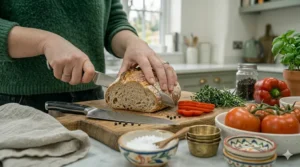
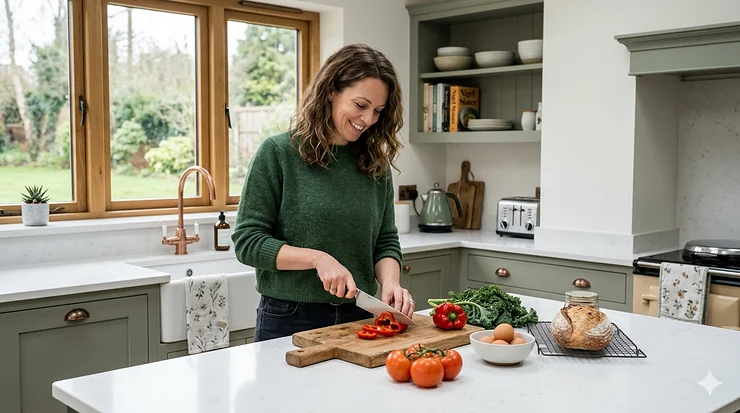
The best santoku knife doesn’t just cut food. It glides through it. The name itself comes from the Japanese san toku, meaning “three virtues” — a nod to the knife’s ability to slice, dice, and mince with equal confidence. Unlike the curved, rock-heavy motion of a Western chef’s knife, the santoku favours a clean up-and-down chop that many cooks find far more intuitive from day one. Shorter and lighter than most chef’s knives, it’s also a natural fit for the compact worktops that define most British kitchens.
In 2026, the UK market for quality kitchen knives has never been richer. Whether you’re after a no-fuss workhorse under £30 or a hand-forged Damascus showpiece that doubles as a conversation starter at dinner parties, there’s something for every cook and every budget. In this guide, I’ve researched and assessed seven santoku knives currently available on Amazon.co.uk — covering budget, mid-range, and premium options — to help you find the blade that’s genuinely right for you, not just the one with the flashiest marketing copy.
A quick note on what to expect: all products in this list are confirmed available on Amazon.co.uk. Most qualify for Prime next-day delivery if you need a knife before Sunday’s roast. Prices are given as ranges rather than exact figures, because Amazon pricing shifts more frequently than the British weather.
Quick Comparison: Best Santoku Knives at a Glance
| Knife | Blade Length | Steel Type | Price Range | Best For |
|---|---|---|---|---|
| Victorinox Swiss Classic | 17 cm | Swiss stainless steel | Under £30 | Budget buyers, beginners |
| Rockingham Forge Range | 17.5 cm | German stainless steel | Under £25 | Lightweight everyday use |
| Robert Welch Professional | 17 cm | German 1.4116 steel | £40–£55 | British-designed mid-range |
| ZWILLING Gourmet | 18 cm | Special formula stainless | £45–£65 | German engineering fans |
| Global G-80 (Fluted) | 18 cm | Cromova 18 (Japanese) | £55–£75 | Serious home cooks |
| Global G-46 (Classic) | 18 cm | Cromova 18 (Japanese) | £65–£85 | Long-term investment buy |
| SHAN ZU Damascus | 18 cm (7 inch) | Damascus layered steel | £50–£75 | Gift-buyers, aesthetes |
The table above tells a clear story: if you want proven Japanese engineering without crossing the £100 mark, Global dominates the upper-mid tier. For budget shoppers, both Victorinox and Rockingham Forge punch well above their price point. The SHAN ZU Damascus sits in interesting territory — a genuinely striking knife that looks like it costs twice as much, which makes it a perennially popular gift choice.
✨ Don’t Miss These Exclusive Deals!
🔍 Ready to upgrade your kitchen arsenal? Click on any highlighted product name in this article to check current pricing and availability on Amazon.co.uk. Prime members enjoy free next-day delivery on most of these picks!
💬 Just one click — help others make better buying decisions too! 😊
Top 7 Best Santoku Knives: Expert Analysis
1. Victorinox Swiss Classic Santoku Knife, 17cm — Best Budget Buy
If you had to recommend one knife to someone who’s never owned a decent blade in their life, this is it. The Victorinox Swiss Classic has quietly become one of the most popular santoku knives on Amazon.co.uk, and for good reason: it outperforms its price tag by a comfortable margin.
The 17 cm blade is made from Victorinox’s own Swiss stainless steel with a bevelled (Granton-style) fluted edge — those dimples you’ll notice along the blade aren’t decorative; they create tiny air pockets that stop sliced potatoes, cucumber rounds, and onion rings from clinging on and slowing you down. The ergonomic polypropylene handle comes in a cheerful range of colours (red, green, black, yellow) and is dishwasher safe, which matters for those of us who are honest enough to admit that hand-washing every single utensil after a busy week isn’t always going to happen.
In real-world terms, this knife is nimble enough for everyday veg prep and sharp enough out of the box to surprise you. It won’t hold an edge as long as a harder Japanese steel blade, but it sharpens back up easily with a basic honing steel — arguably more practical for casual cooks. UK buyers love it for its low maintenance approach. Lighter than most German knives, it’s comfortable for smaller hands too.
UK customer feedback on Amazon.co.uk is consistently positive, with reviewers noting the out-of-box sharpness and the pleasant balance for extended chopping sessions.
✅ Dishwasher safe — genuinely useful for busy British households
✅ Lightweight and comfortable for extended use
✅ Brilliant value; hard to beat at this price point
❌ Edge retention not as long as higher-hardness steel
❌ Plastic handle lacks the tactile satisfaction of wood
Price range: Under £30 | Value verdict: The most sensible knife purchase you’ll make this year.
2. Rockingham Forge Range 17.5cm Santoku Knife — Best Lightweight Pick
Rockingham Forge is a Sheffield-based brand, and that lineage matters. Sheffield has been synonymous with British cutlery craftsmanship for centuries — so there’s a certain pleasing symmetry in buying a Japanese-style blade from a company rooted in that tradition.
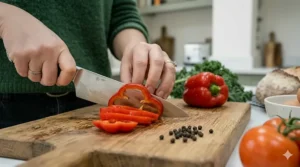
The Rockingham Forge Range Santoku sports a 17.5 cm German stainless steel blade with a clean, unfussy profile and a lightweight black polymer handle. And when I say lightweight, I mean it in the best possible way: this knife weighs next to nothing, which makes it genuinely tireless to use during long prep sessions. Chopping an entire mountain of vegetables for a Sunday roast? Your wrist will thank you.
The steel is serviceable rather than exceptional — it’s not going to achieve the eye-wateringly thin cuts you’d get from a 60+ HRC Japanese blade — but for the overwhelming majority of home cooks who just want to get through their weekly meal prep without drama, it more than holds its own. It sharpens easily and responds well to a standard pull-through sharpener, which most British kitchens already own.
This is genuinely the knife I’d recommend to someone setting up their first flat who has a tight budget and wants to cook properly from day one. It’s compact enough for a small kitchen drawer, and robust enough to handle everything from butternut squash to bunches of fresh herbs.
UK buyers on Amazon.co.uk highlight the manageable weight and the clean cuts on softer produce as standout features.
✅ Exceptionally lightweight — ideal for long chopping sessions
✅ Sheffield brand heritage; solid entry-level German steel
✅ Compact and easy to store in smaller British kitchens
❌ Not as sharp out of the box as pricier alternatives
❌ Handle finish less refined than mid-range options
Price range: Under £25 | Value verdict: An honest, unpretentious knife that earns its keep.
3. Robert Welch Professional Santoku Knife, 17cm — Best British-Designed Mid-Range
Robert Welch is the closest thing British kitchen design has to a national treasure. The Chipping Campden-based brand has been crafting award-winning cutlery since the 1950s, and the Robert Welch Professional Santoku is one of its strongest arguments for spending a little more than the absolute minimum.
The 17 cm blade is forged from German 1.4116 stainless steel — a workhorse alloy known for its balance of sharpness, durability, and corrosion resistance. At approximately 56–58 on the Rockwell hardness scale, it’s harder than budget stainless blades but less brittle than ultra-hard Japanese steels, which makes it more forgiving if you’re not particularly precious about cutting technique. The full tang construction means the steel runs the full length of the handle, giving the knife excellent balance and a confident, solid feel in the hand.
What sets this knife apart at its price point is the ergonomics. The handle is clearly designed by people who have actually used a knife for extended periods — the balance point sits naturally at the bolster, reducing wrist fatigue during long prep sessions. The blade profile is deeper than many santoku knives, giving good knuckle clearance if you favour a pinch grip.
For a British home cook who wants something designed with genuine care and backed by a credible brand with proper UK warranty support — this is the mid-range sweet spot.
Amazon.co.uk reviewers, including professional chefs, consistently praise the edge retention and overall balance.
✅ Award-winning British design with full-tang construction
✅ Excellent balance and knuckle clearance for pinch grip
✅ German 1.4116 steel: durable, easy to maintain, corrosion-resistant
❌ Slightly heavier than Japanese-style options
❌ Not dishwasher safe (hand-wash recommended)
Price range: £40–£55 | Value verdict: A thoughtfully engineered British knife at a very fair price.
4. ZWILLING Gourmet Santoku Knife, 18cm — Best German Engineering
If Global represents the Japanese school of knife philosophy, ZWILLING represents the German one — and that’s not a criticism. It’s a different ideology: thicker, more robust, slightly less acute an edge angle, built for everyday abuse from cooks who don’t want to be precious about their tools.
The ZWILLING Gourmet Santoku features an 18 cm blade made from ZWILLING’s special formula stainless steel with a laser-controlled edge. “Laser-controlled” isn’t marketing fluff here — the edge is machine-ground to a consistent 15-degree angle on each side, which gives you a reliably sharp out-of-box performance that the average kitchen sharpener can maintain without difficulty. The blade is ice-hardened (FRIODUR process), which improves its flexibility and corrosion resistance — both genuinely relevant when you’re cooking in a damp British kitchen.
The ergonomic plastic handle is noticeably comfortable, with a three-rivet design that looks professional without trying too hard. At 18 cm, the blade is the longest option in the budget-to-mid range here, which some cooks prefer for the extra reach when working through larger vegetables.
The key trade-off: ZWILLING’s steel, while excellent, runs softer than Japanese steels at around 55–58 HRC. It won’t hold an edge as long as a Global or a Damascus blade, but it’s substantially more resistant to chipping if you accidentally hit a hard spot in a carrot or tap the blade on the edge of your chopping board.
UK buyers frequently cite the out-of-box sharpness and the robust, trust-inspiring feel as highlights.
✅ Laser-controlled edge for consistent, reliable sharpness
✅ Ice-hardened steel — excellent corrosion resistance
✅ Long 18 cm blade; great knuckle clearance
❌ Softer steel means more frequent honing
❌ Plastic handle divides opinion aesthetically
Price range: £45–£65 | Value verdict: Dependable German quality with low-maintenance appeal.
5. Global G-80 Santoku Knife, 18cm Fluted Blade — Best for Serious Home Cooks
The G-80 is where we cross into genuine kitchen knife territory, and you’ll feel the difference the moment you pick it up. Global’s iconic all-stainless design — hollow handles filled with sand for perfect balance, no rivets, no dirt-trapping crevices — has been a fixture in professional kitchens since 1985, and the Global G-80 with its fluted (Granton) edge is arguably the most versatile interpretation of that formula.
The 18 cm blade is made from Cromova 18 stainless steel, hardened to 58–59 HRC. Harder than European equivalents, this means you’ll be doing less honing week-to-week, though you’ll want to use a ceramic sharpening rod rather than a traditional steel when the time comes. The fluted edge — shallow oval hollows along the blade face — does real work here, creating air gaps that prevent food from sticking. If you’ve ever been annoyed by potato slices or cucumber rounds clinging to your blade mid-chop, this is the solution.
The blade angle is ground to approximately 15 degrees on each side, noticeably finer than a Western chef’s knife. What this means in practice is laser-precise cuts — think paper-thin courgette rounds, immaculate julienned carrots, or sashimi-quality fish slices — though it also means you should treat this knife with respect. Don’t use it for bones or frozen food.
UK Amazon reviewers often describe this as a “life-changing” purchase, which is exactly the kind of hyperbole I’d usually dismiss — except they’re not wrong.
✅ Cromova 18 steel: exceptional sharpness and edge retention
✅ Fluted blade reduces food sticking significantly
✅ Seamless all-stainless design — easy to clean, hygienic
❌ Requires hand-washing only (no dishwasher)
❌ Hardened steel is more brittle — treat it with care
Price range: £55–£75 | Value verdict: The step-change upgrade that justifies every penny.
6. Global G-46 Santoku Knife, 18cm Classic Blade — Best Long-Term Investment
Think of the Global G-46 as the slightly older sibling of the G-80 — same Cromova 18 DNA, same impeccable Japanese craftsmanship, but with a plain (non-fluted) edge that performs slightly differently in the hand. Where the G-80’s fluted blade excels at releasing food cleanly, the G-46’s flat blade offers a fractionally more direct, powerful chop — making it the preferred option for anyone who regularly works through dense root vegetables like celeriac, swede, or large butternut squash.
The 18 cm blade is hand-finished in Japan to a 15-degree edge and hardened to 58–59 HRC. The balance point is at the bolster, giving the knife a satisfying, responsive feel — neither blade-heavy nor handle-heavy, just right. The hollow-handled design means the G-46 is considerably lighter than most European knives of comparable size, which makes extended prep sessions genuinely pleasurable rather than a wrist workout.
Here’s the honest assessment for UK buyers: the G-46 is a lifetime knife. Buy it once, learn to look after it (a quick hand-wash, a dry with a tea towel, occasional touches with a ceramic honing rod), and it will outlast most of the appliances in your kitchen. It’s available on Amazon.co.uk with Prime delivery, and Global’s UK warranty support is solid.
Reviewers on Amazon.co.uk describe it as a knife they’ve owned for a decade and still reach for every single day.
✅ Hand-finished in Japan — superb quality control
✅ Balanced, light, and tireless for extended use
✅ A genuine lifetime knife with excellent UK warranty support
❌ Plain edge requires careful technique to avoid food sticking
❌ Investment price point — not for the faint-hearted
Price range: £65–£85 | Value verdict: The best knife you’ll ever buy. Probably.
7. SHAN ZU Damascus Santoku Knife, 7 inch (18cm) — Best Premium Gift
Every kitchen has that knife — the one guests notice, the one that comes out for dinner parties, the one that makes you feel vaguely like a professional even when you’re just dicing onions in your pyjamas. The SHAN ZU Damascus Santoku is that knife.
The blade is constructed from 33 layers of Damascus-folded steel with a high-carbon core, producing that distinctive rippling pattern that’s become synonymous with premium kitchen cutlery. The maple wood handle adds warmth and tactility — this is a knife that looks handmade, because in meaningful respects, it is. The full-tang construction ensures balance and durability, and the package includes a gift box that makes it one of the most popular premium knife purchases on Amazon.co.uk, particularly around Christmas and birthdays.
Practically speaking: the Damascus steel construction delivers real-world performance, not just aesthetics. The high-carbon core holds a sharper, longer-lasting edge than standard stainless steel, while the surrounding softer layers provide resilience against chipping. The blade geometry favours precise, thin cuts. For the home cook who enjoys the ritual of cooking — who takes their time, who invests in their ingredients — this knife fits the philosophy.
Two caveats worth mentioning: Damascus knives require hand-washing (water left on the blade can affect the layered steel), and the wooden handle should be occasionally oiled with food-safe oil to prevent drying and cracking — particularly relevant in centrally heated British homes during winter.
UK buyers rate it extremely highly, with particular praise for the out-of-box sharpness and the gift presentation.
✅ Stunning Damascus pattern — the most visually striking knife on this list
✅ High-carbon core delivers excellent sharpness and edge retention
✅ Comes in a gift box — ideal as a present for keen cooks
❌ Requires careful maintenance — no dishwasher, regular oiling
❌ High-carbon steel can be prone to discolouration without proper care
Price range: £50–£75 | Value verdict: An indulgent buy that earns its keep in performance as well as aesthetics.
How to Keep Your Santoku Knife in Top Condition: A British Kitchen Guide
A good santoku knife isn’t like a cast-iron pan that you can neglect for months and revive with a wire brush. It needs a small amount of regular attention — and in the specific context of a British kitchen, there are a few care points that deserve particular mention.
The dishwasher is your knife’s enemy. It doesn’t matter what the packaging says about some knives being dishwasher-safe. The combination of high heat, aggressive detergents, and vibration dulls edges faster than almost anything else. Thirty seconds of hand-washing and a pat-dry with a tea towel is genuinely all these knives need after daily use.
British central heating is harder on wooden handles than many people realise. If you’ve invested in a knife with a wooden or maple handle — like the SHAN ZU Damascus — the dry, warm air of a centrally heated British home during the months between October and March can cause the wood to dry and crack over time. A light rub with food-safe mineral oil every couple of months keeps the handle in good condition and extends its life considerably.
Storage matters more than most UK cooks acknowledge. Rattling around loose in a kitchen drawer is how knives go blunt faster than anywhere else. A magnetic knife strip on the wall is the most practical solution for British kitchens with limited drawer space — it’s hygienic, saves worktop space, and keeps edges in better condition. A knife block works equally well if you have the surface area.
Sharpening strategy by knife type: For Japanese-steel knives (Global G-46, G-80, SHAN ZU), use a ceramic honing rod rather than a traditional steel. For European-steel knives (Victorinox, ZWILLING, Robert Welch), a standard honing steel works well for maintenance. A whetstone touch-up once or twice a year keeps any knife performing at its best, regardless of steel type. Which?’s independently tested guide to knife sharpeners is a useful reference if you’re deciding which sharpening tool to invest in.
Cutting surfaces: Wooden and plastic boards are kind to edges. Glass, ceramic, and stone surfaces will blunt any knife quickly — avoid them entirely. Most British kitchens have at least one plastic board; that’s a perfectly good everyday surface for santoku work.
Which Santoku Suits Your UK Kitchen Life? Three Real-World Profiles
The Busy Weeknight Cook in a Manchester Terraced House
Picture the scene: you’ve got 40 minutes between getting home and needing food on the table. The worktop is small, the kids are underfoot, and the chopping board is already half-covered with school bags. What you need is a knife that’s light, low-maintenance, and reliable without requiring any particular reverence. The Victorinox Swiss Classic or Rockingham Forge are your people. Both are forgiving, both handle everyday veg prep comfortably, and both can go in the dishwasher after a chaotic Tuesday.
The Serious Weekend Cook in a South London Flat
You spend Saturdays at the farmers’ market. You cook properly on weekends — long, involved meals, good ingredients, the kind of cooking that deserves a knife you actually enjoy using. Storage is tight (it’s London), so a magnetic strip on the splashback handles your collection. The Robert Welch Professional or ZWILLING Gourmet offers the step-up in quality you’re after, at a price point that doesn’t make you wince. If you’re ready to commit properly, the Global G-80 is the upgrade that changes the way you feel about chopping.
The Enthusiast Cook Anywhere in the UK
You already own a decent chef’s knife. You’ve watched enough YouTube videos about sharpening angles to understand what Rockwell hardness actually means. You want a santoku as your primary prep knife — something that will genuinely last and keep performing as your skills grow. The Global G-46 is the obvious recommendation, though it needs treating with respect. If aesthetics matter as much as performance, the SHAN ZU Damascus is the more romantic option and loses very little in practical terms.
How to Choose the Best Santoku Knife in the UK
Not all santoku knives are made equal, and the spec sheets don’t always tell the story. Here’s what actually matters when you’re making this decision:
1. Steel hardness (HRC rating): Higher Rockwell hardness (60+ HRC) means a sharper, longer-lasting edge but a more brittle blade that’s less tolerant of rough use. If you’re careful and cook on proper wooden or plastic boards, go higher. If you’re less precious about technique, 55–58 HRC German-style steel is more forgiving.
2. Blade length: 17–18 cm is the sweet spot for most UK home cooks. Longer than that and you’re fighting with smaller British worktops; shorter and you’ll struggle with anything large. If you’re frequently cooking for one or have particularly small hands, a 13–15 cm mini santoku like the Victorinox range is worth considering.
3. Handle material and grip: Polymer handles (Victorinox, ZWILLING) are practical, hygienic, and low-maintenance. Wooden handles (SHAN ZU Damascus) are tactile and beautiful but require occasional care. All-stainless handles (Global) are the most hygienic option and suit both smaller and larger hands with proper ergonomic shaping.
4. Granton (fluted) edge or plain edge? Granton edges — those oval dimples along the blade — reduce food sticking, which is genuinely useful when slicing potatoes, cucumber, or anything that tends to cling. If you’re unsure, go for the fluted version; you won’t regret it.
5. Maintenance commitment: Be honest with yourself. If you’re going to put your knife in the dishwasher regardless of what the instructions say, stick to a dishwasher-safe option like the Victorinox. There’s no point spending £70 on a Global if it’s going to go in with the plates.
6. Budget in full context: The upfront cost isn’t the only number. A £25 Rockingham Forge that you replace every three years costs more over a decade than a £75 Global that lasts thirty. Factor in the long-term value, especially for the mid-to-premium options.
Santoku vs Chef Knife: Which Is Better for British Home Cooks?
This is probably the most common question among people shopping for a new kitchen knife in 2026, and the honest answer is: it depends entirely on how you cook.
A Western chef’s knife — like the classic 20 cm versions favoured by professional European kitchens — has a curved belly that encourages a rocking motion. You keep the tip on the board, rock the heel up and down, and glide through herbs and onions with a fluid, efficient motion. It’s an excellent technique, but it takes a little time to learn, and it favours a longer blade.
A santoku, by contrast, has a flatter edge profile and a sheep’s foot tip (where the spine curves down to meet the edge, rather than coming to a sharp point). The cutting motion is more up-and-down, less rocking. Many British home cooks — particularly those who learned to cook from YouTube rather than professional training — find this instinctively easier to master from the start.
Practically, the santoku excels at vegetables, boneless meat, and fish. It’s slightly less suited to carving large joints or slicing bread, but frankly, those are jobs for a carving knife and a bread knife respectively. For the 80% of everyday prep — onions, garlic, courgettes, chicken breasts, herbs — the santoku handles it beautifully.
The shorter, lighter blade also fits British kitchen scales better. Most UK home kitchens have smaller worktops than those in American or Australian home-cooking programmes, and a 17–18 cm santoku simply manoeuvres more comfortably in that space than a 25 cm chef’s knife.
The verdict: if you’re starting from scratch, a santoku is probably the better first knife for most British cooks. If you already have a chef’s knife and want a second, complementary blade, a santoku fills in everything your chef’s knife doesn’t do as elegantly. For a deeper dive into how the two styles compare across different tasks, Which?’s tested kitchen knife reviews include head-to-head performance data from Global, Victorinox, and Robert Welch — brands that also feature prominently in this guide.
Common Mistakes When Buying a Santoku Knife in the UK
Buying on aesthetics alone. Damascus knives are undeniably beautiful, and that rippling blade pattern is enormously persuasive on a product page. But aesthetics should be a tiebreaker, not the primary criterion. Start with steel quality and handle comfort; let the looks be a bonus.
Overlooking blade length for your kitchen size. An 18 cm santoku is wonderful on a large kitchen island; it’s a bit of a squeeze on a typical British terraced-house worktop with a 30 cm cutting board. If your chopping board is on the smaller side, a 17 cm or 15 cm option will serve you better day-to-day.
Assuming expensive means better for your skill level. A £80 Global knife is genuinely superior to a £25 Victorinox — but only if you look after it properly. If you’re the sort of cook who throws everything in the dishwasher, a cheaper, dishwasher-tolerant blade will serve you better in practice. Match the knife to your actual habits, not your aspirational ones.
Ignoring steel type for kitchen conditions. High-carbon steel blades can discolour if left in contact with acidic foods (lemon, tomato) for extended periods or left wet. In a busy British household where knives sometimes don’t get washed immediately, a stainless or high-stainless option is the more practical choice.
Buying a single knife instead of the right knife. A santoku is an all-purpose prep knife, not an all-purpose kitchen knife. You’ll still want a bread knife for crusty sourdough and a paring knife for small tasks. The santoku works magnificently alongside those — it’s not meant to replace them.
FAQ: Your Santoku Knife Questions Answered
❓ What is the best santoku knife for a beginner UK cook?
❓ What is the difference between a santoku and a chef knife?
❓ Is a santoku knife good for cutting meat?
❓ What does Granton edge mean on a santoku knife?
❓ Can I put my santoku knife in the dishwasher?
Conclusion: The Best Santoku Knife Is the One You’ll Actually Use
The ideal knife is not necessarily the most expensive one. It’s the one that fits your cooking style, your kitchen, and — frankly — your level of enthusiasm for maintenance. A £25 Rockingham Forge that you use every day will make you a better cook than an £85 Global that sits in a drawer because you’re worried about blunting it.
That said, if you’re ready to invest in a knife that will genuinely transform your time in the kitchen, the Global G-80 is the standout recommendation at the mid-to-premium level. The Robert Welch Professional is the best mid-range buy for those who want British design credentials with German steel reliability. And for the budget-conscious, the Victorinox Swiss Classic remains, in 2026 as in 2016, one of the cleverest buys in kitchen cutlery.
All seven knives in this guide are available on Amazon.co.uk with Prime-eligible delivery. Whether you’re kitting out a new flat, replacing a tired old kitchen knife, or shopping for a gift for someone who actually cooks, there’s a best santoku knife on this list with your name on it.
✨ Don’t Miss These Exclusive Deals!
🔍 Click any product name in this guide to check the current price on Amazon.co.uk. Most picks on this list qualify for free next-day delivery with Prime — and at these prices, there’s no reason to put it off until next week.
Recommended for You
- German vs Japanese Chef Knife: 7 Best Picks for UK Kitchens 2026
- Heavy Duty Chef Knife: 7 Best UK Picks for Power Cutting (2026)
- Lightweight Chef Knife UK: 7 Best Picks That Won’t Wreck Your Wrist (2026)
Disclaimer: This article contains affiliate links. As an Amazon Associate, I earn from qualifying purchases. If you purchase products through these links, we may earn a small commission at no additional cost to you.
✨ Found this helpful? Share it with your mates! 💬🤗
