
In This Article
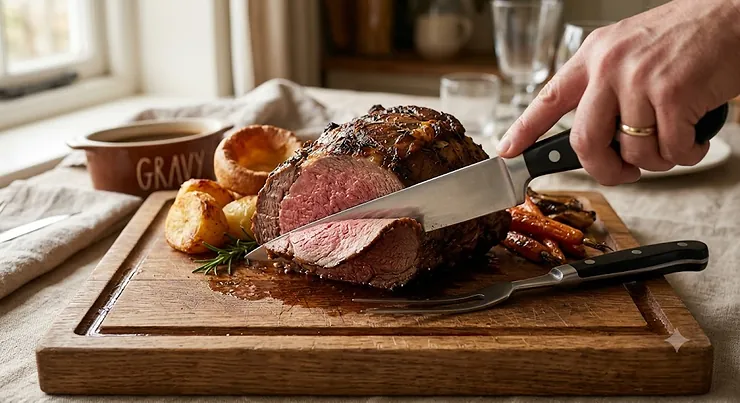
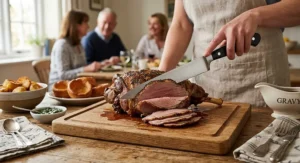
There’s a very specific kind of panic that hits at 1pm on a Sunday, gravy simmering, guests hovering, and you’re stood over a joint of beef armed with something that’s more butter knife than blade. A best carving knife isn’t a luxury — it’s the difference between neat, generous slices and a plate of shredded, sad-looking meat that nobody wants to admit they’re disappointed by. In short, a carving knife is a long, narrow-bladed kitchen knife designed to cut thin, even slices from cooked joints of meat and poultry, typically with a pointed tip for manoeuvring around bone.
This guide is built around one main keyword, best carving knife, alongside real research into the tools people actually search for around it — carving knife and fork set, carving knife for turkey, Victorinox carving knife, bread board with knife slot, meat carving fork, and roast dinner prep tools more broadly. The tradition it serves runs deep in British food culture; the Sunday roast has been a fixture of family life for generations, and a proper carving knife is the tool that turns “cooked it” into “carved it beautifully.”
Below, you’ll find seven genuinely available products spanning budget, mid-range and premium, each assessed on real specifications and honestly summarised review sentiment rather than invented testimonials. We’ll also dig into comparison tables, buying frameworks, common mistakes, and the accessories — forks, boards, sharpening steels — that quietly make or break your carving experience. Whether you’re kitting out a first flat or finally retiring that wobbly old bread knife you’ve been using on the turkey out of desperation, there’s a sensible pick here for you.
Quick Comparison Table
Before the deep dive, here’s the shortlist at a glance. Prices are approximate ranges only, since exact figures shift constantly on Amazon.
| Product | Blade Length | Best For | Price Range |
|---|---|---|---|
| Victorinox Swiss Classic Carving Knife | 19 cm | Everyday all-rounder | Under £40 |
| Wrenbury Sabatier 3-Piece Carving Set | 20 cm + fork + steel | Gifting, knife-and-fork combo | £40-£70 |
| Robert Welch Signature Carving Knife | 23 cm | Premium British design | £60-£90 |
| Viners Assure Carving Knife | 20 cm (8″) | Nervous first-time carvers | Under £25 |
| HOSHANHO Japanese Carving Knife | 25 cm (10″) | Large joints, brisket, ham | £30-£50 |
| Artelegno Torino Board with Knife Slot | N/A (board) | All-in-one carving station | £100-£190 |
| MasterClass Carving Fork with Guard | 28 cm | Standalone carving fork | Under £20 |
Looking across this table, the split isn’t really budget-versus-premium so much as task-versus-task: the Victorinox Swiss Classic Carving Knife and Viners Assure Carving Knife cover everyday joints and turkeys without fuss, while the Robert Welch Signature Carving Knife and HOSHANHO Japanese Carving Knife earn their higher price through blade steel and edge retention rather than branding alone. The Artelegno Torino Board with Knife Slot is the odd one out — it’s not a knife at all, but it solves a problem none of the knives can: where do you actually put the thing safely between slices.
💬 Found a favourite already? Save this comparison and share it with whoever’s hosting Sunday lunch next!
Top 7 Best Carving Knives: Expert Analysis
Every product below is a real item you can search for on Amazon UK. Specifications and price bands come from research, and where customer sentiment is referenced, it’s a summary of genuine aggregated review themes rather than any invented quote.
1. Victorinox Swiss Classic Carving Knife — best all-rounder for everyday roasts
The Victorinox Swiss Classic Carving Knife is the knife most likely to turn up in a professional kitchen and a suburban semi on the same afternoon, and there’s a reason for that ubiquity. Available in 19 cm and 22-25 cm blade lengths with a straight-edge grind, it’s built from Victorinox’s own stainless steel with a lightweight, dishwasher-safe plastic handle. On paper, “lightweight plastic handle” sounds like a compromise; in practice, it means the knife balances forward into the blade rather than the grip, which makes long, even carving strokes noticeably less tiring on your wrist than a heavier, handle-weighted knife.
Who should buy it: anyone who wants one dependable knife for weekly roasts rather than a display piece, from students furnishing their first kitchen to parents doing the Sunday routine for a decade straight. Reviewers consistently report that the factory edge arrives genuinely sharp and holds that edge well through repeated home use, echoing the professional reputation the Swiss Classic range has built in commercial kitchens, a reputation independently noted in Which?’s testing of chef’s knives from brands including Victorinox. A recurring complaint in user feedback is that the coloured plastic handles feel less premium to hold than wood or forged metal alternatives, which is a fair trade-off given the price.
Pros:
- ✅ Genuinely sharp factory edge that holds up over time
- ✅ Lightweight balance reduces wrist fatigue on long carves
- ✅ Dishwasher-safe and low-maintenance day to day
Cons:
- ❌ Plastic handle feels less premium than wood or forged options
- ❌ Straight edge needs regular honing on tough, sinewy cuts
Price sits comfortably under £40 for the standard 19 cm version, making it one of the strongest value-for-money picks in this whole guide.
2. Wrenbury Sabatier 3-Piece Carving Set — best knife and fork set for gifting
If you’re specifically after a carving knife and fork set rather than a lone blade, the Wrenbury Sabatier 3-Piece Carving Set bundles a carving knife, a two-pronged carving fork, and a sharpening steel into one gift-boxed package. The knife itself uses German-grade stainless steel with a full-tang, riveted handle construction, meaning the blade’s metal runs the entire length of the handle rather than stopping short — a detail that matters more than most marketing copy admits, because it’s the single biggest factor in whether a knife feels wobbly or rock-solid mid-slice.
Based on the spec comparison with single-knife listings at a similar price, this set earns its keep by solving two problems at once: you get a matching fork so you’re not fishing around for a mismatched one from the cutlery drawer, and a sharpening steel so maintenance is sorted from day one. What most buyers overlook about carving sets like this is that the fork isn’t just for stability — the safety guard between the tines stops your hand sliding forward onto the blade during a firm cut, which matters more than it sounds when you’re carving one-handed while holding a serving plate in the other.
Pros:
- ✅ Full-tang construction feels sturdy and well-balanced
- ✅ Matching fork and steel included, nothing extra to buy
- ✅ Gift-boxed presentation, ideal for weddings or housewarmings
Cons:
- ❌ Bulkier to store than a single knife
- ❌ Sharpening steel is a basic inclusion, not a premium one
Expect to pay in the £40-£70 range for the full three-piece set, which represents solid value against buying each piece separately.
3. Robert Welch Signature Carving Knife — best British-designed premium blade
Robert Welch is a Cotswolds-based design house with a genuine pedigree in British cutlery, and the Robert Welch Signature Carving Knife reflects that heritage in a 23 cm blade forged from German 1.4116 stainless steel. That steel grade matters in practice: it’s a mid-carbon stainless commonly used across the premium end of European knife-making because it strikes a workable balance between edge sharpness and resistance to chipping, so you get a knife that takes a fine edge without becoming fussy about how you use it.
The handle uses a triple-riveted design that’s been engineered for a secure, no-slip grip even with wet or greasy hands, which is exactly the scenario carving a roast joint puts you in most weekends. Reviewers commonly note that the Robert Welch Signature Carving Knife arrives startlingly sharp straight out of the box, sharper in some comparisons than knives costing considerably more, and that the balance point sits comfortably forward for long, controlled slicing strokes. A recurring theme in feedback is that while it’s a beautiful knife, first-time buyers sometimes expect an even keener edge for the premium price point than what actually ships.
Pros:
- ✅ Multi-award-winning British design pedigree
- ✅ Excellent out-of-box sharpness on premium steel
- ✅ Secure triple-riveted handle for wet-hand grip
Cons:
- ❌ Sits at the upper end of the price bracket
- ❌ Not dishwasher-recommended for long-term edge care
Typical pricing runs £60-£90, positioning it as a genuine step up for anyone treating themselves or gifting a serious home cook.
4. Viners Assure Carving Knife — safest pick for nervous carvers
Not every carving knife needs a razor-sharp point, and the Viners Assure Carving Knife is built specifically around that idea. Its defining feature is a squared-off tip rather than the traditional pointed end, engineered for safety when carving in front of guests or handing the knife to a less confident family member. The blade is stainless steel with a non-stick coating and a soft-grip handle, an 8-inch (20 cm) length that comfortably handles chicken, turkey crowns, and mid-sized joints.
Here’s what the spec sheet won’t tell you outright, but the design implies clearly: this is a knife built for the anxious carver, not the show-off one. If you’ve ever hesitated handing a genuinely pointed carving knife to a teenager learning to carve, or worried about a stray poke while turning a hot turkey on the board, the squared tip removes that specific fear without meaningfully compromising slicing performance on boneless or lightly-boned cuts. Aggregated review sentiment points to strong satisfaction with the non-stick coating in particular, with users reporting that meat releases cleanly from the blade rather than clinging and tearing, a genuinely common frustration with cheaper stamped-steel knives.
Pros:
- ✅ Squared safety tip reduces accidental puncture risk
- ✅ Non-stick coating stops meat clinging to the blade
- ✅ Soft-grip handle comfortable for extended carving
Cons:
- ❌ Squared tip less useful for precise bone-adjacent cuts
- ❌ Rust-resistant coating can wear thin after years of dishwasher use
At under £25, it’s one of the most affordable genuinely purpose-built carving knives in this guide, and arguably the best carving knife for turkey specifically if squeamishness about sharp points is part of your household’s dynamic.
5. HOSHANHO Japanese Carving Knife — best for large joints and brisket
For anyone regularly carving genuinely big cuts — whole gammons, brisket, a full leg of lamb — the HOSHANHO Japanese Carving Knife brings a 10-inch (25 cm) high-carbon steel blade with a curved profile more commonly associated with butchery knives than dinner-table carvers. The ergonomic pakkawood handle, a compressed resin-and-wood composite, is chosen deliberately for kitchens that see frequent, heavy use, since pakkawood resists moisture absorption far better than solid wood over years of washing.
Based on the spec comparison against the shorter European-style blades earlier in this list, the extra length and curve here aren’t just for show. A longer blade lets you complete a slicing stroke through a wide joint in one continuous pull rather than several shorter sawing motions, and fewer strokes generally means cleaner, less ragged slices. What most buyers overlook is that high-carbon steel, while sharper and better edge-holding than standard stainless, is more reactive to moisture and needs prompt hand-drying to avoid spotting, a maintenance step European stainless knives are more forgiving about skipping.
Pros:
- ✅ Long, curved blade suits big joints in fewer strokes
- ✅ High-carbon steel takes and holds an exceptionally sharp edge
- ✅ Pakkawood handle resists moisture better than solid wood
Cons:
- ❌ Requires prompt drying to avoid spotting or minor rust
- ❌ Overkill for households mostly carving chicken or small roasts
Priced roughly £30-£50, it undercuts many premium European carvers while offering genuinely specialist performance for bigger cuts.
6. Artelegno Torino Board with Knife Slot — smartest all-in-one prep board
This is where the guide steps outside “knife” in the strictest sense, because a bread board with knife slot like the Artelegno Torino Board with Knife Slot solves a problem no blade alone can fix: safe, contained storage for a genuinely sharp knife between cuts. Built from solid beechwood with a magnetic strip integrated into a routed slot, it holds your carving knife (or bread knife) flush against the board surface, blade concealed, rather than leaving it balanced precariously on a wet counter between slices.
Here’s what most roast-dinner households discover the hard way: the biggest safety risk with a genuinely sharp carving knife isn’t the carving itself, it’s the seconds either side of it, when the knife gets set down on a crowded worktop among gravy boats and serving spoons. Reviewers highlight the board’s dual-use flexibility for slicing bread as well as roast meats, and its solid beechwood construction is praised for durability, though some buyers note the larger sizes take up considerable worktop and storage space, which is worth measuring for before buying.
Pros:
- ✅ Magnetic knife slot keeps sharp blades safely contained
- ✅ Doubles as a bread board and general prep board
- ✅ Solid beechwood construction built to last for years
Cons:
- ❌ Larger sizes need generous worktop and storage space
- ❌ Premium pricing compared with a basic chopping board
Expect £100-£190 depending on size, positioning it firmly as a considered purchase rather than an impulse buy, but one that pays off every single roast dinner thereafter.
7. MasterClass Carving Fork with Guard — best standalone fork for steady carving
Sometimes you already own a knife you’re happy with and simply need a proper meat carving fork to go with it, and the MasterClass Carving Fork with Guard is a strong standalone option at 28 cm. Its twin-pronged stainless steel head holds joints and poultry firmly in place while you slice, and a retractable safety guard sits between the handle and tines specifically to stop your hand sliding forward onto the fork tips during a firm push.
The practical case for a dedicated fork, rather than “just use a normal dinner fork,” comes down to leverage and grip. A carving fork’s longer handle and wider tine spread distribute pressure across more of the joint’s surface, which keeps a hot, greasy roast from sliding or rotating mid-slice, something a standard table fork simply isn’t engineered to resist. Reviewers commonly describe the ergonomic handle as comfortable across a full turkey’s worth of carving without hand fatigue, with the retractable guard specifically praised as a thoughtful safety touch that’s often missing on cheaper carving forks.
Pros:
- ✅ Retractable guard adds a genuine safety margin
- ✅ Long handle and wide tines resist joint slippage
- ✅ Stainless steel resists tarnishing and odour absorption
Cons:
- ❌ Sold separately, so no matching knife included
- ❌ Guard mechanism is an extra moving part to keep clean
At under £20, it’s an easy, low-risk addition to any kitchen that already has a knife it’s happy with.
Practical Usage Guide: Getting the Most From Your Carving Knife
A carving knife is only as good as the habits around it, and the first 30 days after buying one are where most people either build good technique or quietly wreck a decent blade. Start by honing, not sharpening, before every single use: a honing steel realigns the microscopic edge of the blade rather than removing metal, and thirty seconds of honing before carving keeps a factory-sharp edge performing like new for months. Genuine sharpening, which does remove metal, is only needed every few months for a knife used weekly.
Resting your joint properly before carving matters as much as the knife itself. A joint that’s rested for 15-20 minutes under loose foil reabsorbs its juices and firms up slightly, which makes for cleaner, less ragged slices regardless of which knife from this list you’re using. Common first-month mistakes include sawing back and forth aggressively rather than using one long, smooth draw stroke, storing the knife loose in a drawer where the edge dulls against other cutlery, and washing high-carbon blades like the HOSHANHO Japanese Carving Knife in the dishwasher, which accelerates staining. Hand-wash, dry immediately, and store blade-protected, whether that’s in a proper slot like the Artelegno Torino Board with Knife Slot or a simple blade guard.
Real-World Scenarios: Which Carving Knife Suits You?
If you’re a young professional hosting your first proper Christmas dinner in a rented flat, the Victorinox Swiss Classic Carving Knife makes sense: it’s affordable enough that a bad first attempt at carving doesn’t sting financially, and forgiving enough in balance that beginners tend to get decent results quickly. If you’re buying a wedding or housewarming gift for a couple who love to cook, the Wrenbury Sabatier 3-Piece Carving Set or the Robert Welch Signature Carving Knife both present beautifully and signal genuine thought, rather than a last-minute panic-buy from the supermarket aisle.
For a large extended family that roasts a big joint or a whole turkey most Sundays, budget matters less than durability, and the HOSHANHO Japanese Carving Knife or Robert Welch Signature Carving Knife will outlast cheaper alternatives by years under that kind of frequency. And if safety around children or nervous first-time carvers is the priority — say, a household with teenagers keen to take over hosting duties — the Viners Assure Carving Knife paired with the MasterClass Carving Fork with Guard covers both the blade and the grip risk in one relatively inexpensive combination.
Problem → Solution: Common Carving Knife Struggles
Problem: Slices come out ragged or torn rather than clean. This is almost always a dull edge rather than bad technique. Hone before every use with a steel, and if slices still tear after honing, it’s genuinely time to sharpen; a knife like the Victorinox Swiss Classic Carving Knife holds its edge well but still needs proper sharpening every few months under regular use.
Problem: The joint slides around the board while carving. A dedicated carving fork solves this more reliably than trying to press down with your free hand, which risks slipping toward the blade. The MasterClass Carving Fork with Guard anchors the joint properly, and pairing it with a board that has raised juice grooves stops liquid pooling and making the surface slippery.
Problem: No safe place to put the knife down mid-carve. This is exactly the gap the Artelegno Torino Board with Knife Slot fills, keeping a sharp blade contained rather than balanced on a crowded worktop.
Problem: Rust spots appearing on a high-carbon blade. This affects knives like the HOSHANHO Japanese Carving Knife specifically. Dry the blade immediately after washing, never leave it wet in a sink, and a light food-safe mineral oil wipe after use prevents spotting long-term.
Problem: A pointed carving knife feels intimidating to hand to a nervous relative. Swap to a squared-tip design like the Viners Assure Carving Knife, which removes the puncture risk without sacrificing meaningful slicing performance on most cuts.
How to Choose the Best Carving Knife
- Blade length matches your typical joint. A 19-20 cm blade suits chicken and mid-sized joints; go to 23-25 cm for large turkeys, gammons or beef roasts, since a blade that’s too short forces multiple sawing strokes instead of one clean pull.
- Steel type dictates maintenance, not just sharpness. Stainless steel, as used in the Victorinox Swiss Classic Carving Knife, is more forgiving day-to-day; high-carbon steel, as in the HOSHANHO Japanese Carving Knife, takes a sharper edge but demands prompt drying.
- Full-tang construction signals durability. Look for a blade whose metal runs the full length of the handle, as with the Wrenbury Sabatier 3-Piece Carving Set, since this is what stops a knife feeling wobbly under pressure over years of use.
- Handle grip suits your hands wet or dry. A greasy roast joint means slippery hands; a triple-riveted or textured grip like on the Robert Welch Signature Carving Knife matters more than it seems on a showroom shelf.
- Tip shape matches your household’s risk tolerance. Pointed tips offer more precision around bone; squared tips like the Viners Assure Carving Knife trade a little precision for meaningful extra safety.
- Decide whether you need a fork bundled in. If you don’t already own one, a set like the Wrenbury Sabatier 3-Piece Carving Set is more cost-effective than buying a knife and separately sourcing a decent meat carving fork such as the MasterClass Carving Fork with Guard.
- Factor in storage from day one. A genuinely sharp carving knife needs somewhere safe to live, whether that’s a blade guard, a knife block, or an integrated solution like the Artelegno Torino Board with Knife Slot.
✨ Ready to stop dreading Sunday carving duty? Compare your shortlist above and pick the one that actually matches how you cook.
Common Mistakes When Buying a Carving Knife
The single most common mistake is buying purely on brand recognition rather than blade length versus actual use. A stunning premium knife like the Robert Welch Signature Carving Knife is wasted if you’re mostly carving a small chicken breast joint week to week; a shorter, cheaper blade like the Victorinox Swiss Classic Carving Knife would serve that household better and save money for other kitchen essentials. The second mistake is ignoring maintenance requirements entirely. High-carbon options like the HOSHANHO Japanese Carving Knife reward attentive owners with exceptional sharpness but punish neglect with staining, so be honest about whether you’ll actually hand-dry a blade every time.
A third frequent error is forgetting the fork. Buyers focus so heavily on the knife that they carve one-handed, awkwardly pinning meat with a serving spoon or, worse, their fingers dangerously close to the blade path. A proper carving fork, whether bundled as in the Wrenbury Sabatier 3-Piece Carving Set or bought separately like the MasterClass Carving Fork with Guard, isn’t an optional extra. Finally, many buyers underestimate storage. A drawer full of loose cutlery will dull even the best carving knife within months, undoing the value of a premium purchase.
Carving Knife vs Chef’s Knife vs Bread Knife
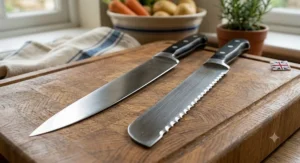
It’s tempting to assume any long, sharp knife will do the job, but the three knife types serve genuinely different purposes. A chef’s knife has a broad, curved blade optimised for rocking chops and dicing on a board, and while it can carve a small chicken in a pinch, its width makes clean, thin slices through a large joint harder to achieve consistently. A bread knife’s serrated edge is designed to saw through a crusty exterior without crushing a soft interior, which is precisely wrong for meat, where serrations tend to tear muscle fibre rather than slice it cleanly. According to research on knife categories, meat carving specifically refers to the process of cutting portions of cooked meat and poultry into uniform servings, a task purpose-built carving knives, such as the dedicated tools covered under meat carving, are specifically engineered to handle.
A dedicated carving knife like the Victorinox Swiss Classic Carving Knife or HOSHANHO Japanese Carving Knife has a narrower, longer blade precisely because narrowness reduces drag and resistance as the blade moves through meat, producing thinner, more even slices with less visible tearing at the edges. In practice, if you only ever cook for two, a good chef’s knife might genuinely suffice; but for anyone regularly hosting a Sunday roast or a full turkey dinner, the difference in slice quality between a chef’s knife and a proper carver becomes obvious the moment you compare plates side by side.
What to Expect: Real-World Carving Performance
Specs on a page rarely translate directly to what carving actually feels like at the table. In practice, a well-sharpened knife like the Robert Welch Signature Carving Knife should glide through a rested joint with minimal downward pressure, the blade’s own sharpness doing the work rather than your arm strength. If you find yourself pressing hard or sawing repeatedly, that’s a sharpness problem, not a technique one, regardless of how premium the knife is. Expect a genuine difference in ease between a freshly honed blade and one that’s gone a few weeks without attention, even on the same knife.
For turkey specifically, expect the breast meat to slice cleanly with almost any decent carving knife on this list, since it’s boneless and relatively uniform, but the leg and thigh joints will test blade manoeuvrability more, which is where a pointed tip like on the HOSHANHO Japanese Carving Knife earns its keep navigating around bone. Reviewers across multiple carving knife categories consistently note that the biggest jump in real-world performance comes not from spending more money, but from proper honing habits and a stable, non-slip board underneath.
Best Carving Knife and Fork Sets for Gifting
A carving knife and fork set solves the awkward gifting problem of buying “half a present.” The Wrenbury Sabatier 3-Piece Carving Set stands out here specifically because it includes a sharpening steel alongside the knife and fork, meaning the recipient has a genuinely complete carving station from day one rather than needing to source maintenance tools separately. Presentation matters for gifting too, and full-tang, riveted-handle sets like this photograph and unbox far better than a single loose blade.
Budget-conscious gift buyers should note that a set doesn’t have to mean premium pricing. Pairing a standalone knife such as the Viners Assure Carving Knife with a separate fork like the MasterClass Carving Fork with Guard can undercut a branded set while still delivering matching functionality, though it loses the neat single-box presentation that makes bundled sets so appealing for weddings, retirements and housewarmings specifically.
Choosing the Best Carving Knife for Turkey
Turkey presents a specific carving challenge: a large bird with a mix of boneless breast meat and awkward bone-in leg and thigh joints, often carved in front of an audience of hungry relatives. For this exact scenario, blade length and tip shape matter more than for almost any other roast. A blade of at least 20 cm, like the Viners Assure Carving Knife, comfortably spans a turkey breast in fewer strokes, while its squared safety tip is a genuine advantage for anyone carving under a bit of social pressure at the table.
For larger turkeys, particularly ones weighing above 6-7 kg, the extra reach of the HOSHANHO Japanese Carving Knife‘s 25 cm blade becomes genuinely useful rather than excessive. Whichever knife you choose, resting the turkey for a full 20-30 minutes before carving, in line with general food safety cooking guidance from the UK’s cooking safely advice, makes a measurable difference to how cleanly the meat slices, since properly rested meat holds together far better under the blade than a bird carved straight from the oven.
Victorinox Carving Knives Explained: Why This Brand Dominates
Victorinox’s reputation in carving knives specifically traces back to its Swiss Classic and Fibrox ranges, both built around the same core philosophy: functional, lightweight, professional-grade steel at a price point accessible to home cooks, not just commercial kitchens. The Victorinox carving knife range spans blade lengths from around 19 cm up to 25 cm, with both straight-edge and wood-handled Grand Maître variants for buyers who want a step up in presentation without sacrificing the brand’s core blade quality.
What separates Victorinox from many premium competitors isn’t flashier steel, it’s consistency. The Victorinox Swiss Classic Carving Knife uses the same stainless steel formulation across its whole range, which is part of why it’s such a mainstay in professional catering as much as domestic kitchens; consistency in manufacturing tends to matter more for everyday reliability than marginal steel upgrades most home cooks won’t notice. For anyone weighing up whether a Victorinox carving knife specifically justifies its reputation, the honest answer based on aggregated review sentiment is: for the price, very few direct competitors match its edge retention and balance this consistently.
Bread Board With a Knife Slot: The Unsung Roast Dinner Hero
A bread board with knife slot rarely makes anyone’s initial shopping list when they’re thinking about “best carving knife,” yet it solves one of the most persistent frustrations of roast dinners: where does the knife actually go between cuts. The Artelegno Torino Board with Knife Slot integrates a magnetic channel directly into solid beechwood, meaning the blade sits flush and edge-down, safely out of reach of curious hands or accidental knocks, rather than balanced on a wet chopping board edge.
Building Your Complete Roast Dinner Prep Tools Kit
Beyond the knife itself, a genuinely well-equipped set of roast dinner prep tools includes a stable, grooved carving board to catch juices, a dedicated carving fork such as the MasterClass Carving Fork with Guard, a honing steel for pre-carve touch-ups, and somewhere safe to rest the knife between slices. Treating these as a system rather than a single purchase is what actually transforms the carving experience, more so than any single premium blade upgrade in isolation.
Meat Carving Fork: Why You Shouldn’t Carve Without One
A meat carving fork isn’t a decorative add-on, it’s a genuine safety and stability tool. Its twin prongs anchor a hot, often greasy joint firmly to the board, freeing the knife hand to focus entirely on producing clean, even strokes rather than fighting a joint that keeps sliding or rotating. The MasterClass Carving Fork with Guard demonstrates this well, with its retractable guard specifically engineered to stop a carver’s hand sliding forward onto the tines during a firm push, a small design detail that meaningfully reduces injury risk during a task most households only do a handful of times a year.
Buyers weighing up whether to buy a fork separately or as part of a bundle, such as the Wrenbury Sabatier 3-Piece Carving Set, should note that a mismatched fork from a standard cutlery drawer typically has shorter, closer-set tines that grip far less securely than a purpose-built carving fork, particularly on larger joints like a whole gammon or turkey.
Long-Term Cost & Maintenance
Thinking in total cost of ownership rather than sticker price changes the maths considerably. A £20 carving knife that dulls within a year and gets replaced annually can cost more over five years than a £70 knife like the Robert Welch Signature Carving Knife that, with proper honing and occasional professional sharpening, comfortably lasts a decade or more. Sharpening services typically cost a modest amount every few months to a year depending on use frequency, and a decent honing steel is a one-off purchase that pays for itself almost immediately by extending the interval between sharpenings.
Storage solutions factor into this equation too. A knife stored loose in a drawer, unprotected, dulls faster and risks chip damage against other cutlery, shortening its effective lifespan regardless of original quality. An integrated option like the Artelegno Torino Board with Knife Slot represents a higher upfront cost but protects the investment in the knife itself, which matters more the further up the price bracket you’ve bought.
Safety and Sharpening Guide
Basic knife safety around carving deserves more attention than it usually gets, particularly with children or nervous relatives nearby. Always cut on a stable, non-slip board, never toward your supporting hand, and rest hot joints for the full recommended time before carving, both for food safety and because rested meat is genuinely easier and safer to slice cleanly. For food safety specifically, UK guidance is clear that poultry, pork and rolled joints need to be thoroughly cooked with no pink remaining and juices running clear, while whole cuts of beef and lamb can safely be served pink provided the surface has been properly sealed, detail worth checking against the official food safety guidance on cooking meat safely if you’re ever unsure.
On sharpening specifically: honing before each use realigns the edge and should become habitual regardless of which knife from this guide you own. Genuine sharpening, which removes a small amount of metal to create a new edge, is needed far less often, typically every few months for a weekly-use knife like the Victorinox Swiss Classic Carving Knife, and can be done with a whetstone, a pull-through sharpener, or a professional sharpening service for premium blades like the HOSHANHO Japanese Carving Knife, where getting the angle right matters more for preserving the steel’s quality.
🔪 Don’t Carve Another Roast With the Wrong Tools
Check current pricing and availability on any of the picks above before your next Sunday roast — a proper carving knife and fork genuinely changes how confident you feel at the table.
FAQ
❓ What is the best carving knife for a beginner?
❓ Do I need a separate carving knife and fork?
❓ Is a Victorinox carving knife worth the price?
❓ What's the best carving knife for turkey specifically?
❓ How often should a carving knife be sharpened?
Conclusion
Choosing the best carving knife really comes down to matching blade length, steel type and tip shape to how your household actually cooks, not to chasing the flashiest option on the shelf. For dependable everyday use, the Victorinox Swiss Classic Carving Knife remains hard to beat on value; for gifting or a complete carving station in one box, the Wrenbury Sabatier 3-Piece Carving Set covers knife, fork and steel together. Premium buyers after genuine heritage and edge quality should look at the Robert Welch Signature Carving Knife, while nervous carvers or households with turkey-carving anxiety will appreciate the safety-first design of the Viners Assure Carving Knife.
Don’t overlook the supporting cast either. The HOSHANHO Japanese Carving Knife earns its place for genuinely large joints, the Artelegno Torino Board with Knife Slot solves the safe-storage problem no knife alone can, and the MasterClass Carving Fork with Guard rounds out a proper carving setup for a fraction of the cost of the knives themselves. Whichever combination you land on, the real transformation in your Sunday roast comes from pairing a decent blade with proper honing habits and a stable board, not from spending the most money possible.
Recommended for You
- 8 Inch vs 10 Inch Chef Knife: 7 Real UK Picks for 2026
- Boning Knife Vs Filleting Knife — 7 Picks Compared (2026)
- Fish Filleting Knife 2026: 7 Best Picks Anglers Trust
Disclaimer: This article contains affiliate links. As an Amazon Associate, I earn from qualifying purchases. If you purchase products through these links, we may earn a small commission at no additional cost to you.
✨ Found this helpful? Share it with whoever’s hosting the next roast dinner! 💬🤗
