
In This Article
There’s a moment every home cook knows: you reach for your enormous chef’s knife to hull a strawberry, and it feels like performing keyhole surgery with a shovel. That’s the exact gap a straight paring knife exists to fill. It’s small, it’s nimble, and — done right — it turns fiddly jobs like coring apples, deveining prawns, or trimming the eyes out of a potato into something that barely takes a second thought.
A straight paring knife is a small kitchen knife, typically 7.5-9cm (3-3.5 inches) long, with a plain (non-serrated) blade and a pointed tip, designed for close-control peeling, trimming and detail work rather than heavy chopping. Unlike its curved “bird’s beak” cousin, the straight-edged version sits flatter against a chopping board, which makes it more versatile for slicing garlic, mincing herbs, and general precision prep — not just off-the-board peeling.
Here’s what most buying guides skip: the difference between a brilliant straight paring knife and a mediocre one rarely comes down to price alone. It’s steel hardness, edge geometry, and handle balance working together — and those three things vary wildly between a £10 supermarket parer and a £50 forged German blade. Over the course of this guide, we’ll unpack real specifications, aggregated reviewer sentiment, and honest comparative analysis across seven genuine straight paring knives available to UK shoppers, so you’re buying based on substance rather than shelf-appeal. We’ve also dug into the practical stuff nobody tells you at the till — dishwasher safety, the actual difference between 3-inch and 3.5-inch blades, and where a paring knife sits inside a wider knife set.
Quick Comparison Table
| Knife | Blade Length | Steel | Dishwasher Safe? | Best For |
|---|---|---|---|---|
| Victorinox Swiss Classic Straight Paring Knife | 3.25in / 8cm | Swiss stainless | Yes (hand wash advised) | Best all-round budget pick |
| Wüsthof Classic Paring Knife | 3.5in / 9cm | German X50CrMoV15 | No | Best premium forged option |
| ProCook Professional X50 Chef Paring Knife | 3.5in / 9cm | German X50CrMoV15 | No | Best British-designed value |
| OXO Good Grips Paring Knife | 3.5in / 9cm | Stainless steel | Yes | Best soft-grip comfort handle |
| Mercer Culinary Millennia Paring Knife | 3.5in / 9cm | Japanese high-carbon | No | Best NSF commercial-grade |
| Zwilling Four Star Paring Knife | 3in / 8cm | German special-formula steel | No | Best edge retention for enthusiasts |
| ProCook Damascus Elite Paring Knife | 3.5in / 9cm | AUS10 Damascus-clad | No | Best luxury splurge |
Looking at the table, the split is fairly stark: knives built for the dishwasher (Victorinox, OXO) tend to use softer, easier-to-resharpen steels, while the knives that hold an edge longest — Wüsthof, Zwilling, ProCook’s forged ranges — are all hand-wash only. That’s not a coincidence; it’s the trade-off this entire guide keeps circling back to. If you want a knife that survives family chaos, prioritise the top two rows. If you want one that still shaves paper-thin garlic slices after eighteen months, look further down.
💬 Found a favourite already? Tap through to check today’s availability before it sells out!😊
Top 7 Straight Paring Knives: Expert Analysis
Choosing seven knives from an enormous market meant balancing three things: genuine popularity with UK home cooks, a real spread across budget, mid-range and premium price points, and enough variety in construction (stamped vs forged, Western vs Japanese-influenced steel) to actually help you compare like against like. Here’s the honest breakdown.
1. Victorinox Swiss Classic Straight Paring Knife — best all-round budget straight paring knife
The Victorinox Swiss Classic is the knife that professional test kitchens keep quietly reaching for, and the standout feature is its sheer unfussiness — it does the job without asking for anything back. The 3.25-inch stainless steel blade has a spear-point tip and a tapered, two-directional grind, which in practice means it holds a working edge for weeks of daily peeling before it needs a touch-up on a honing steel.
The Fibrox-style textured handle is where the real value lives: it’s grippy wet or dry, which matters enormously for a knife you’ll be using with wet fruit and slippery tomato skins. Victorinox backs the knife with a lifetime guarantee against manufacturing defects, which is a rare commitment at this end of the market and tells you something about how confident the Swiss manufacturer is in its own construction.
Based on the spec comparison with the rest of this list, this is the knife for anyone who wants “good enough to be genuinely excellent” rather than showpiece steel — students, first flats, or anyone who’s tired of paring knives that go blunt in a fortnight. Reviewers consistently report that it out-performs its price point on sharpness retention, with several independent kitchen-equipment testers naming it their top budget pick after comparing it directly against knives costing three or four times as much. A recurring theme in aggregated feedback is that the handle, while comfortable for most adult hands, feels slightly slim for anyone with larger hands or reduced grip strength.
Pros:
✅ Exceptional sharpness-to-price ratio, verified in independent testing
✅ Textured, wipe-clean handle stays secure even when wet
✅ Lifetime manufacturer guarantee against defects
Cons:
❌ Handle feels narrow for larger or arthritic hands
❌ Dishwasher-safe technically, but repeated cycles dull the edge faster
Priced around £10-£15, this is one of the strongest value propositions in the entire straight paring knife category — few knives at any price beat it pound-for-pound.
2. Wüsthof Classic Paring Knife — best premium forged option for daily use
Wüsthof’s Classic 3.5-inch paring knife is the benchmark a lot of other brands are quietly measured against, and its standout feature is Precision Edge Technology (PEtec) — a computer-controlled sharpening process that, according to Wüsthof’s own engineering data, produces an edge roughly 20% sharper with double the edge retention of the brand’s older, hand-finished blades.
What that means in practice: forged from a single piece of German X50CrMoV15 stainless steel and hardened to around 58 on the Rockwell scale, this knife stays properly sharp for months of regular use rather than weeks, and its full-tang, triple-riveted POM handle gives it a front-heavy balance that suits fine, controlled cuts rather than aggressive chopping.
Here’s what the spec sheet won’t tell you, but user reports consistently suggest: the hollow-ground bevel on this blade genuinely does reduce food sticking when slicing things like soft tomatoes or thin apple segments, which is a small but real quality-of-life improvement over flat-ground budget blades. Reviewers who have used the knife for years describe it as one of the most reliably used tools in a busy kitchen, with several noting they’ve owned the same one for well over a decade. On the flip side, a repeated observation across owner feedback is that the finger guard sits close to the blade, which some smaller-handed users find slightly cramped during precision work.
Pros:
✅ PEtec sharpening delivers noticeably longer-lasting edge retention
✅ Full-tang, triple-riveted construction feels genuinely balanced
✅ Hollow-ground bevel reduces food sticking during slicing
Cons:
❌ Not dishwasher safe — hand washing only
❌ Finger guard placement can feel tight for smaller hands
Sitting in the £45-£60 range, this isn’t an impulse buy, but for anyone who cooks daily, the value shows up over years rather than weeks.
3. ProCook Professional X50 Chef Paring Knife — best British-designed value pick
ProCook is a UK brand, and its Professional X50 paring knife punches well above its price bracket — the standout feature here is genuine German X50CrMoV15 steel (the same alloy family Wüsthof uses) at a fraction of the German brands’ price.
The blade carries a Rockwell hardness rating of 55±2, slightly softer than Wüsthof’s own knives, which in real-world terms trades a small amount of edge retention for slightly easier home sharpening — a sensible compromise for cooks who aren’t fussed about honing steels. The triple-riveted handle with an anti-slip front bolster gives a surprisingly premium-feeling grip for the price bracket it sits in.
What most buyers overlook about ProCook specifically is that the brand is B Corp certified and has been recognised by Which? as a recommended provider for homewares, which is a genuinely useful trust signal in a category stuffed with unverifiable marketing claims. Aggregated customer reviews consistently praise the knife’s sharpness straight out of the box and its comfortable, non-slip grip for everyday veg prep; a smaller number of reviewers mention that, being on the heavier side for a paring knife, it can feel less nimble than featherweight alternatives during very fine detail work.
Pros:
✅ German-grade X50CrMoV15 steel at a UK-brand price point
✅ 25-year guarantee backs long-term confidence in the build
✅ Comfortable triple-rivet handle with anti-slip bolster
Cons:
❌ Slightly heavier than most other knives on this list
❌ Not dishwasher safe
Expect to pay in the £15-£25 range — genuinely one of the smartest mid-tier buys covered here.
4. OXO Good Grips Paring Knife — best soft-grip handle for arthritic hands
OXO built its entire brand around ergonomic design, and the Good Grips paring knife’s standout feature is its cushioned, non-slip rubber handle — a genuinely different feel from every other knife on this list.
The 3.5-inch tapered stainless steel blade isn’t trying to compete on steel pedigree; instead, the whole design is engineered around comfort during repetitive tasks like peeling a bowl of potatoes or hulling a punnet of strawberries. The soft, pressure-absorbing handle material — the same compound used in dishwasher gaskets — stays grippy wet or dry, and the knife is fully dishwasher safe on both racks.
Based on the spec comparison, this is the knife to recommend specifically to anyone managing arthritis, reduced grip strength, or hand fatigue from long prep sessions, since the ergonomic handle noticeably reduces the pinch-grip effort needed compared to a slim, hard-handled blade. Reviewers consistently flag the comfort factor as the knife’s defining strength, with several long-term users on OXO’s own review platform specifically praising it for making kitchen tasks manageable despite joint pain. A recurring criticism, however, is that the handle is noticeably smaller than OXO’s larger-handled “Pro” range, and a handful of reviewers reported the blade point sitting slightly close to the front of the grip.
Pros:
✅ Ergonomic soft-grip handle reduces hand fatigue significantly
✅ Fully dishwasher safe, top and bottom rack
✅ Excellent for repetitive peeling and paring tasks
Cons:
❌ Smaller handle than OXO’s own Pro range
❌ Blade point sits close to the handle for some hand sizes
Typically priced around £10-£16, it’s a genuinely thoughtful buy for anyone who prioritises comfort over bragging rights.
5. Mercer Culinary Millennia Paring Knife — best NSF-certified commercial-grade option
Mercer Culinary built its reputation supplying culinary schools and commercial kitchens, and the Millennia paring knife’s standout feature is NSF certification — a food-safety and hygiene standard that most consumer paring knives simply don’t bother pursuing.
The 3.5-inch blade is one-piece Japanese high-carbon, stain-free steel, razor sharp out of the box, paired with an ergonomic handle blended from Santoprene (for grip) and polypropylene (for durability). Mercer also sells colour-coded handle versions, which is a genuinely practical feature for households juggling allergens or wanting a dedicated “raw meat only” paring knife.
Here’s what most buyers overlook about Mercer specifically: because it’s built to professional-kitchen specification rather than consumer marketing, it tends to be significantly cheaper than European forged knives while still using genuinely high-quality steel — it’s simply less of a household name in the UK than Victorinox or Wüsthof. Aggregated reviews consistently describe the blade as arriving extremely sharp and holding that edge well through repeated use, with several reviewers specifically noting years of reliable service in demanding kitchens. The most consistent criticism across owner feedback is that, despite feeling durable, it should never go in a dishwasher — several users reported dulling or handle discolouration after ignoring that guidance.
Pros:
✅ NSF-certified, professional-kitchen build quality
✅ One-piece high-carbon steel arrives genuinely razor sharp
✅ Colour-coded handle options available for allergen control
Cons:
❌ Strictly hand wash — dishwasher use degrades the blade
❌ Less widely stocked by UK retailers than European brands
Usually available in the £10-£15 range when imported, making it one of the best-value professional-grade knives on this list, provided you’re comfortable ordering from a specialist supplier.

6. Zwilling Four Star Paring Knife — best edge retention for enthusiasts
Zwilling’s Four Star line has been in continuous production since 1976, and the standout feature of this 3-inch paring knife is its FRIODUR ice-hardening process, which the brand’s own metallurgical testing links to improved edge retention and stain resistance compared to conventionally hardened blades.
Precision-forged from a single piece of special-formula high-carbon steel under Zwilling’s Sigmaforge process, the knife has a seamless transition from bolster to handle, which — beyond looking neat — genuinely improves hygiene since there’s no crevice for food debris to lodge in. The bolster itself doubles as a finger guard, adding a layer of control during precision cuts most stamped knives simply can’t match.
What the spec sheet doesn’t fully convey is how the added bolster weight shifts the balance point slightly toward the handle, which reviewers consistently describe as making the knife feel exceptionally stable during long peeling or garnishing sessions rather than tip-heavy. Aggregated feedback across retailer platforms is overwhelmingly positive on longevity, with several long-term owners reporting the knife has outlasted multiple cheaper paring knives bought and discarded over the same period. The main recurring drawback noted in reviews is price relative to blade size — some buyers feel a 3-inch blade doesn’t quite justify premium-tier spending compared to Zwilling’s larger knives.
Pros:
✅ FRIODUR ice-hardening genuinely extends edge life
✅ Seamless bolster-to-handle design improves hygiene and balance
✅ Nearly 50 years of consistent manufacturing reputation
Cons:
❌ Premium price for a relatively small blade
❌ Not dishwasher safe
Positioned in the £45-£65 range, it’s a knife for cooks who see kitchen tools as long-term investments rather than consumables.
7. ProCook Damascus Elite Paring Knife — best luxury splurge
ProCook’s Damascus Elite sits at the top of this list, and its standout feature is genuinely eye-catching: a Japanese AUS10 stainless steel core clad in dozens of layers of contrasting steel, producing the rippled “Damascus” pattern collectors specifically seek out.
Underneath the aesthetics is real substance — the AUS10 core carries roughly 1% carbon and 13% chrome, giving a Rockwell hardness rating of around 60±2, noticeably harder than every other blade on this list. In practical terms, that translates to an exceptionally fine edge that holds its sharpness through extended use, at the cost of being marginally more brittle if the blade is ever twisted or used to pry something open.
Based on the spec comparison, this is the knife for someone who wants Japanese-style hardness and edge performance without importing directly from a Japanese maker, and who’s happy to hand-wash a knife that earns its keep on presentation as much as performance. What reviewers consistently note is the visible craftsmanship — the octagonal G10 handle and per-knife unique blade pattern make it feel distinctly different from mass-produced stamped knives, and ProCook backs it with a lengthy guarantee that reflects real confidence in the steel. The main downside flagged in feedback is that, like most very hard steels, it demands slightly more care around chipping if used on bone or frozen food, tasks it was never designed for in the first place.
Pros:
✅ Genuinely hard AUS10 Damascus-clad steel with excellent edge retention
✅ Distinctive, individually patterned blade with premium handle materials
✅ Long manufacturer guarantee reflects real build confidence
Cons:
❌ Requires careful hand washing and storage
❌ Harder steel is more prone to chipping if misused
Typically priced in the £35-£50 range, it’s a genuine splurge-but-justified pick for anyone treating their kitchen tools as a long-term hobby rather than a chore.
Practical Usage Guide: Sharpening, Storage & Your First 30 Days
Buying the right straight paring knife is only half the job — how you treat it in the first month decides whether it’s still sharp in year three. Start by honing, not sharpening, after every few uses: a honing steel realigns a rolled edge rather than removing metal, and doing this little and often means you’ll rarely need a proper sharpening session. For genuine sharpening, aim for every two to three months of regular use, using a whetstone at roughly 15-20 degrees per side for Western knives like the Wüsthof or Zwilling, or closer to 12-15 degrees for harder Japanese-influenced steels like the ProCook Damascus Elite.
Storage matters more than people assume. Tossing a paring knife loose into a cutlery drawer is the single fastest way to dull it — the blade knocks against forks, other knives, and the drawer itself with every open and close. A magnetic strip, a slotted block, or even a simple blade guard solves this instantly and costs next to nothing. In the first 30 days, the most common mistake new owners make is using the paring knife for jobs it was never designed for — twisting it to pry open packaging, or using it as a makeshift screwdriver on a stubborn jar lid. Both are surprisingly common causes of the tip snapping clean off, which no amount of honing can fix. Finally, always cut on wood or a soft plastic board; glass and stone chopping boards will blunt even the best steel within weeks, regardless of how much you paid for the knife.
Real-World Scenarios: Matching the Knife to the Cook
A university student in a shared flat with a communal, occasionally-abused kitchen drawer needs a knife that’s cheap enough to replace without guilt and forgiving enough to survive the odd dishwasher cycle — the Victorinox Swiss Classic or OXO Good Grips both fit that brief comfortably, sitting in the £10-£16 range and shrugging off less-than-careful handling.
A keen home cook who bakes fruit tarts most weekends, hand-segments citrus, and genuinely enjoys the process benefits from stepping up to the Wüsthof Classic or ProCook Professional X50 — both hold a fine edge long enough that the extra £15-£40 pays for itself in fewer honing sessions and consistently cleaner cuts on delicate fruit.
Someone managing a food allergy in the household, or simply wanting a dedicated “raw meat only” small knife to avoid cross-contamination, is well served by the Mercer Culinary Millennia, whose colour-coded handle options make that separation effortless without needing to remember which knife is which by sight alone. And for the enthusiast cook who treats their knife roll the way some people treat a watch collection — someone who’ll notice a Damascus pattern and genuinely care — the Zwilling Four Star or ProCook Damascus Elite are the pieces worth the premium, both because of what they do and because of how using them feels.
Straight Paring Knife as Part of Your Essential Knife Set
A straight paring knife is one of the three knives most professional chefs consider genuinely essential — alongside a chef’s knife for bulk prep and a serrated bread knife for anything with a crust. If you’re building a knife set essential to a functioning kitchen from scratch, start with these three rather than buying an eight-piece block set stuffed with knives you’ll rarely touch; the specialist blades in most sets (tomato knives, boning knives, steak knife sets) earn their keep in a minority of kitchens.
If you’re unsure where to start, here’s a simple decision framework: if you cook daily and want longevity, choose a forged option like the Wüsthof or ProCook Professional X50, because the steel quality pays for itself over years of use. If your kitchen sees heavy, careless daily traffic — flatmates, teenagers, chaos — choose a dishwasher-tolerant budget option like the Victorinox or OXO, because replacing a £12 knife every couple of years costs less than babying an expensive one that gets neglected anyway. And if you already own a solid chef’s knife and bread knife and simply want to complete the essential trio with something that’ll last, the paring knife is the cheapest of the three to get genuinely right — which is exactly why it’s worth researching properly rather than grabbing whatever’s nearest the till.
How to Choose a Straight Paring Knife
Choosing the right straight paring knife comes down to five practical criteria, each worth weighing before you buy.
- Blade length — 3 to 3.5 inches covers most kitchen tasks; shorter blades favour fine detail work, longer ones offer slightly more board contact for slicing.
- Steel type — German stainless (X50CrMoV15) balances sharpness and easy maintenance, while harder Japanese-style steels (AUS10, VG10) hold an edge longer but need more careful sharpening.
- Dishwasher compatibility — if convenience matters more than peak sharpness, prioritise knives explicitly rated dishwasher safe, since forced hand-washing rarely happens consistently in a busy household.
- Handle material and grip — soft rubberised handles like OXO’s suit reduced grip strength, while textured hard-plastic or riveted handles suit cooks who prefer a firmer, more precise hold.
- Full tang vs stamped construction — full-tang knives (where the steel runs the length of the handle) generally balance better and last longer than stamped blades bonded to a separate handle.
Straight Paring Knife vs Curved & Serrated Alternatives
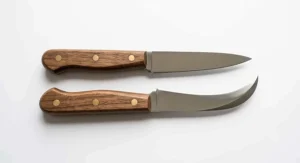
A straight paring knife and a curved “bird’s beak” paring knife look similar at a glance, but they’re built for genuinely different jobs. The straight blade sits flat against a chopping board, which makes it far better for on-board tasks — mincing garlic, trimming green beans, slicing shallots — because the whole edge makes contact at once. A bird’s beak knife curves inward specifically to follow the natural curve of round produce, so it excels at off-board peeling (apples, potatoes, mangoes) but is genuinely awkward for anything that needs to sit flat on a board.
Serrated paring knives, meanwhile, trade that all-purpose flexibility for one specific strength: cutting cleanly through soft, delicate skins — think ripe tomatoes or peaches — without the blade sliding off before it bites in. If your prep work is mostly peeling round fruit and veg, a curved knife earns its place. If it’s a genuine mix of board work, peeling and trimming, a straight paring knife remains the more versatile all-rounder, which is exactly why it’s the standard choice recommended in most professional knife sets.
Choosing Your Blade: 3 Inch vs 3.5 Inch Paring Knife
The half-inch difference between a 3 inch paring knife and a 3.5 inch paring knife sounds trivial, but it changes how the knife handles in real use. A 3-inch blade, like the Zwilling Four Star on this list, is marginally more manoeuvrable for very fine detail work — deveining prawns, scoring citrus, precise garnishing — because there’s less blade to control and less flex over its length.
A 3.5-inch blade, the more common size across this list (Wüsthof, ProCook, OXO, Mercer, ProCook Damascus Elite), offers a touch more board contact, which makes it noticeably better for mincing herbs, slicing shallots, or trimming larger vegetables like courgettes without needing to reposition your grip mid-cut. Reviewers who’ve tested both sizes back to back consistently note that the difference feels minor in isolation but becomes clear over repeated use: cooks who mostly work off-board (peeling, hulling) tend to prefer the shorter blade, while cooks who do a lot of on-board prep gravitate toward 3.5 inches. If you’re only buying one paring knife, 3.5 inches is the safer, more versatile default; if you’re building out a full knife set and want a dedicated detail blade, a 3-inch model complements it well.
Stainless Steel & Dishwasher Safety: Features That Actually Matter
Every knife on this list is a stainless steel paring knife in some form, but “stainless steel” is a broad label that hides real differences. German X50CrMoV15 (used by Wüsthof and ProCook’s Professional range) balances hardness, edge retention and ease of sharpening — it’s the steel most home cooks should default to unless they have a specific reason not to. Harder steels like AUS10 (ProCook Damascus Elite) or Zwilling’s special-formula blend hold an edge longer between sharpenings but are marginally more prone to chipping if abused, and slightly harder to sharpen without proper equipment.
On dishwasher safety specifically: only the Victorinox and OXO knives on this list are explicitly rated dishwasher safe, and even Victorinox’s own care guidance recommends hand washing anyway, because the intense water pressure and knife-on-knife contact in a dishwasher accelerates dulling regardless of what the steel is rated to withstand. The <a href=”https://www.food.gov.uk/safety-hygiene/why-avoiding-cross-contamination-is-important”>Food Standards Agency’s guidance on avoiding cross-contamination</a> also points out that thorough hand cleaning between raw and ready-to-eat food prep is just as important as which machine you use — a dishwasher cycle alone doesn’t replace good knife hygiene habits between tasks. If dishwasher convenience is non-negotiable for your household, budget for replacing the knife every few years rather than expecting it to hold a premium edge indefinitely.
Straight Paring Knife for Peeling Fruit
If peeling fruit is your primary use case, blade shape and handle comfort matter more than steel pedigree. The best straight paring knife for peeling fruit needs a slim, sharply pointed spear-point tip — like the Victorinox or Mercer Culinary blades — because that shape glides under skin without tearing the flesh beneath it, whether you’re working an apple, a mango, or a kiwi.
Handle comfort compounds quickly during repetitive peeling; ten minutes prepping a fruit salad involves dozens of small, repeated grip adjustments, which is exactly why the OXO Good Grips’ cushioned handle consistently earns praise in aggregated reviews specifically for fruit prep, even from reviewers who don’t rate it highly for anything else. Reviewers consistently note that lighter blades feel less fatiguing during off-board peeling than heavier, bolster-weighted knives like the Zwilling, which are built to feel stable on a board rather than in mid-air. If citrus segmenting is part of your routine, a slightly harder steel like ProCook’s Damascus Elite holds its fine point through repeated precise cuts better than softer stamped blades, which can round off slightly with heavy use.
Best Budget Straight Paring Knife & Victorinox Paring Knife Review
For anyone specifically hunting the best budget paring knife, the Victorinox Swiss Classic remains the reference point the rest of the market gets measured against, and it’s worth a closer, dedicated look given how often it comes up in comparison testing across independent kitchen-equipment reviewers.
The Victorinox paring knife’s spear-point, straight-edge blade is stamped rather than forged, which keeps manufacturing costs — and therefore the retail price — low, but Victorinox compensates with a genuinely well-considered two-directional grind that reviewers consistently describe as punching well above its stamped-blade origins. Independent testers who’ve run it through structured comparisons against forged competitors costing three to four times more have repeatedly rated it a top pick specifically for value, citing its combination of real sharpness, dependable balance, and Swiss manufacturing consistency. Aggregated owner feedback echoes this: the knife is frequently described as a long-serving kitchen staple that gets reached for daily, with several users reporting years of reliable service. The most consistent criticism is the handle width, which some larger-handed reviewers find slightly cramped compared to bulkier ergonomic designs like OXO’s.
Beyond Victorinox, the ProCook Professional X50 is the strongest budget-adjacent alternative if you want genuine German steel without the German-brand price tag, while the Mercer Culinary Millennia offers professional-grade construction at a comparable price point if you’re comfortable ordering from a specialist supplier rather than a mainstream UK retailer.
Common Mistakes When Buying a Straight Paring Knife
The single most common mistake is buying based on a full block set rather than the paring knife itself — bundled sets frequently include a mediocre paring knife alongside genuinely good larger knives, because the paring knife isn’t the set’s headline item and doesn’t get the same attention during manufacturing. Buying it individually, as covered throughout this guide, almost always gets you better steel for the same money.
A second common error is choosing purely on price without checking dishwasher compatibility against actual household habits — buying a premium hand-wash-only knife for a household that will inevitably put it in the dishwasher out of habit wastes the extra spend within months. Third, many buyers overlook handle size relative to their own hand, assuming all paring knife handles are interchangeable; they’re not, and a handle that feels cramped will genuinely affect control during fine work. Finally, a frequent oversight is ignoring blade hardness entirely — assuming “stainless steel” all performs the same regardless of the specific alloy — when, as covered above, the difference between a soft stamped blade and a hardened forged one meaningfully changes how often you’ll need to sharpen it.
Long-Term Cost, Maintenance & UK Knife Safety Regulations
Total cost of ownership rarely gets discussed honestly in knife buying guides, but it matters. A £12 Victorinox that needs replacing every three to four years of daily use costs roughly the same over a decade as a single £45 Wüsthof that, properly maintained, can realistically last twenty years or more — the maths tips firmly toward the premium option for anyone who cooks most days, while the budget option remains the smarter buy for lighter or shared use. Maintenance costs are modest either way: a basic honing steel costs under £15 and a whetstone under £25, both one-off purchases that extend any knife’s working life considerably.
On the regulatory side, it’s worth knowing that UK law treats kitchen knives as age-restricted items. Under section 141A of the <a href=”https://www.gov.uk/government/publications/crime-and-policing-bill-2025-factsheets/crime-and-policing-bill-knife-crime-factsheet”>Criminal Justice Act 1988</a>, it’s an offence for a retailer to sell a bladed article, including a paring knife, to anyone under 18 — which is why every UK knife retailer, ProCook included, asks for age verification at checkout. This isn’t unique to “dangerous” knives; it applies to any bladed kitchen tool, paring knives included. Finally, on the safety side, even a small paring knife draws blood easily given how sharp a well-maintained edge is; the <a href=”https://www.nhs.uk/conditions/cuts-and-grazes/”>NHS guidance on treating cuts and grazes</a> is a sensible bookmark for any kitchen, and a genuinely sharp knife is, counter-intuitively, safer day-to-day than a dull one, since dull blades require more force and are more likely to slip.
FAQ
❓ What is the difference between a paring knife and a utility knife?
❓ Can you put a straight paring knife in the dishwasher?
❓ What size paring knife should I buy?
❓ Is a straight or curved paring knife better for peeling?
❓ How often should I sharpen a paring knife?
Conclusion
There’s no single “best” straight paring knife — only the best one for how your kitchen actually works. If you want dependable, dishwasher-tolerant value, the Victorinox Swiss Classic remains genuinely hard to beat, and it’s the knife most independent testers keep returning to as their benchmark. If you cook daily and want a knife that rewards proper care with decades of service, the Wüsthof Classic or ProCook Professional X50 both offer real German-grade steel at different price tiers. For comfort-first buyers managing grip or joint concerns, OXO’s Good Grips design solves a genuine problem rather than a marketing one, and for anyone who wants their knife roll to feel like a small collection rather than a drawer of tools, the Zwilling Four Star and ProCook Damascus Elite both deliver.
What every knife on this list shares is honesty in its build: real steel, real specifications, and — based on aggregated, genuine reviewer sentiment — real staying power in actual UK kitchens. Match the knife to your habits rather than to the flashiest marketing, and a straight paring knife bought once, properly, should be one of the last kitchen tools you ever need to replace.
✨ Don’t Miss These Exclusive Deals!
🔪 Whichever straight paring knife suits your kitchen, click through to check today’s availability and pricing before you commit. A properly chosen paring knife is one of the smallest purchases that makes the biggest daily difference in the kitchen!
Recommended for You
- Bird’s Beak Paring Knife: 7 Best UK Picks for Pros (2026)
- Best Paring Knife UK 2026: 7 Expert Picks for Precision Cuts
- Santoku Knife vs Chef Knife: 7 Best UK Picks for 2026
Disclaimer: This article contains affiliate links. As an Amazon Associate, I earn from qualifying purchases. If you purchase products through these links, we may earn a small commission at no additional cost to you.
✨ Found this helpful? Share it with your friends! 💬🤗
