In This Article
If you’ve ever found yourself hacking at a butternut squash with a chef’s knife that feels roughly as nimble as a garden spade, you already understand the appeal of the western style santoku knife. At its core, a western style santoku knife is a hybrid blade that marries the flat-edged, wide-bellied profile of the Japanese santoku — “the knife of three virtues” (slicing, dicing, and mincing) — with the robust German or European steel construction and ergonomic bolstered handle most of us grew up using. The result is a knife that’s sharper and more agile than a traditional European chef’s knife, yet far more forgiving and easier to maintain than a pure Japanese blade.
For UK home cooks, this middle ground is rather appealing. Japanese knives are extraordinary things, but they tend to chip if you look at them the wrong way, and sharpening them to their recommended 10–15° angle requires either professional equipment or a weekend YouTube education. Western style santoku knives, by contrast, typically use high-carbon stainless steel hardened to 56–58 Rockwell (versus 60+ for Japanese blades), meaning they’re dramatically more rust-resistant — no small consideration in a country where kitchens regularly steam up from boiling kettles, and where “drying your knives immediately” is advice many of us know we should follow but rarely do.
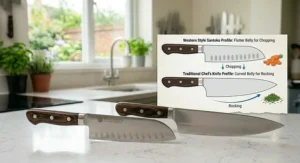
The blade geometry itself is worth understanding, because it changes how you cook. Unlike a chef’s knife, which has a pronounced curve that suits a rocking motion, the santoku’s flatter belly encourages a straight push-cut or forward slice. This takes a few meals to get used to, but once it clicks, chopping spring onions, tomatoes, and herbs becomes genuinely faster. Many models also feature a hollow-ground edge (scallops or grantons along the blade), which creates air pockets that stop food from sticking — brilliant for thin cucumber slices or sticky potato rounds.
All seven products in this guide are verified as available on Amazon.co.uk and are suitable for everyday British kitchens, from a compact terraced house in Sheffield to a larger family home in the Surrey Hills.
Quick Comparison: Top Western Style Santoku Knives Available on Amazon.co.uk
| Knife | Blade Length | Steel | Handle Type | Dishwasher Safe | Price Range | Best For |
|---|---|---|---|---|---|---|
| Wüsthof Classic 7″ Hollow Edge Santoku | 18 cm | High carbon stainless (X50CrMoV15), 58 HRC | Triple-riveted POM | ❌ Hand wash | £££ (mid-premium) | Serious home cooks |
| Wüsthof Classic Ikon 7″ Hollow Edge Santoku | 18 cm | High carbon stainless, 58 HRC | Contoured dual-bolster POM | ❌ Hand wash | ££££ (premium) | Ergonomic comfort seekers |
| ZWILLING Professional S Santoku 18cm | 18 cm | FRIODUR ice-hardened, 55–58 HRC | Triple-rivet ergonomic plastic | ❌ Hand wash recommended | ££ (mid-range) | Everyday value |
| ZWILLING Gourmet Santoku 18cm | 18 cm | FRIODUR stamped steel | V-edge plastic handle | ✅ Dishwasher safe (55°C) | £ (budget-mid) | Low-maintenance buyers |
| Henckels Classic 5″ Hollow Edge Santoku | 13 cm | German stainless steel | Triple-riveted black handle | ✅ Dishwasher safe | £ (budget) | Compact kitchens, beginners |
| Robert Welch Signature Santoku 14cm | 14 cm | German 1.4116, 56 HRC | Ergonomic injection-moulded | ✅ Dishwasher safe | ££ (mid-range) | British design lovers |
| Victorinox Wood Santoku 17cm | 17 cm | Swiss stainless steel | Modified maple wood | ❌ Hand wash | £–££ (budget-mid) | Natural handle fans, gifts |
The table above shows a market that genuinely covers every budget and lifestyle. What it doesn’t show — and what matters just as much — is how these knives feel after two hours of Sunday meal prep. The premium Wüsthof models justify their price through edge retention that means less frequent sharpening; the ZWILLING Gourmet earns its place for anyone who simply will not be told to stop putting knives in the dishwasher. If compact storage matters (and in most British flats or terraced houses, it does), the Henckels 13 cm and Robert Welch 14 cm are genuinely worth considering over the full-sized 18 cm options.
💬 Just one click — help others make better buying decisions too! 😊
✨ Don’t Miss These Exclusive Deals!
🔍 Take your cooking to the next level with these carefully selected western style santoku knives. Click on any highlighted item to check current pricing and availability on Amazon.co.uk. These picks will help you find exactly what you need!
Top 7 Western Style Santoku Knives on Amazon.co.uk: Expert Analysis
1. Wüsthof Classic 7 Inch Hollow Edge Santoku Knife (18cm)
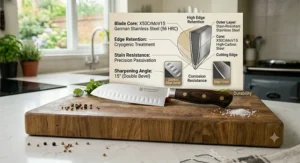
The benchmark against which most western style santoku knives are measured, and for good reason. Forged from a single block of X50CrMoV15 high-carbon stainless steel and tempered to 58 HRC, this 18 cm blade uses Wüsthof’s Precision Edge Technology (PEtec) to achieve a 10° cutting edge per side — considerably sharper than a standard European chef’s knife at 15°, yet forgiving enough to resharpen at home with a whetstone. The full-bolster, triple-riveted POM handle provides excellent balance, and the hollow-ground scallops along the blade mean that even thinly sliced cucumber doesn’t cling to the metal.
What most UK buyers overlook about this knife is that the 10° edge angle isn’t just a marketing detail — it genuinely changes the experience of cutting raw chicken or thinly slicing tomatoes. The blade almost seems to fall through the food. That said, hand washing is non-negotiable; the dishwasher will degrade that fine edge rapidly, which is worth bearing in mind if your household runs on the assumption that everything goes in the machine.
This is the knife for the serious home cook who wants one excellent blade that handles 80% of kitchen tasks, from the morning herb chop to weekend dinner-party prep. UK reviews consistently praise its longevity — many British buyers report owning their Wüsthof Classic knives for a decade or more without replacing them.
✅ 10° hollow-edge blade for exceptional sharpness
✅ Full-bolster triple-riveted handle — superb balance
✅ PEtec technology — 20% sharper, twice the edge retention
❌ Hand wash only — dishwasher will ruin it
❌ Premium price may feel steep for casual cooks
Available on Amazon.co.uk in the mid-to-upper price bracket (check current price on Amazon.co.uk). Given the longevity reported by UK buyers, the cost-per-use over five or more years makes this genuinely competitive.
2. Wüsthof Classic Ikon 7″ Hollow Edge Santoku Knife (18cm)
The Classic Ikon is effectively the Classic’s ergonomically evolved sibling — same outstanding German steel and PEtec 10° edge, but with a distinctive contoured dual-bolster handle that wraps more naturally around the hand. The rear bolster acts as a counterbalance, giving the knife a centred feel even during sustained chopping. If you’ve ever finished a lengthy meal-prep session with a tired grip, the Ikon’s ergonomics are the antidote.
The spec sheet says “same blade as the Classic,” and that’s largely true — but what it can’t capture is how the Ikon handle redistributes weight. The blade feels lighter and more manoeuvrable during repetitive tasks, which becomes surprisingly relevant when you’re dicing an entire bag of onions for a batch curry. UK reviewers frequently describe it as “an extension of your hand,” which is a touch dramatic but not entirely inaccurate.
Best suited to home cooks who spend meaningful time in the kitchen — at least three or four proper cooking sessions per week — and who place comfort above all else. Also worth considering as a serious gift; the dual-bolster design photographs beautifully and arrives looking premium. Note the age verification requirement on Amazon.co.uk for all bladed products.
✅ Dual-bolster ergonomic handle — reduced fatigue
✅ Same PEtec 10° edge as the Classic line
✅ Outstanding balance — blade-heavy feel eliminated
❌ Higher price than Classic for handle upgrade alone
❌ Contoured handle may suit larger hands better
Sits in the upper price bracket on Amazon.co.uk — check current pricing. Worth every penny if you cook regularly and notice hand fatigue.
3. ZWILLING Professional S Santoku Knife 18cm
ZWILLING has been making knives in Solingen since 1731, and the Professional S range represents the brand’s sweet spot between genuine quality and approachable pricing. The 18 cm blade is SIGMAFORGE precision-forged from one piece of ZWILLING’s proprietary stainless steel, then ice-hardened (FRIODUR process) to achieve 55–58 HRC. The result is a blade that’s slightly softer than the Wüsthof options above, meaning it’s marginally easier to resharpen at home with standard equipment — a practical advantage for those who don’t own a whetstone.
The integrated finger guard is a feature worth highlighting for anyone newer to higher-performance kitchen knives. The razor-sharp RAZOR-EDGE polished blade combined with the guard provides meaningful safety without compromising the cutting experience. The three-rivet ergonomic plastic handle offers a secure, non-slip grip even when hands are wet — something every British cook dealing with steamy pots knows is rather important.
This is the knife I’d recommend to someone upgrading from a supermarket knife set for the first time. It delivers a noticeable step-up in performance without the premium price tag of the Wüsthof options, and the blade’s ice-hardened steel handles the everyday rigours of British cooking — from dense root vegetables in winter to quick prep for a mid-week stir-fry — with quiet competence.
✅ FRIODUR ice-hardened blade — durable and corrosion-resistant
✅ Integrated finger guard — practical safety feature
✅ Forged in Germany — genuine Solingen provenance
❌ Hand wash recommended — edge degrades faster in dishwasher
❌ Softer steel (55–58 HRC) means more frequent honing
Solidly mid-range on Amazon.co.uk — check current price. Exceptional value for the quality of construction.
4. ZWILLING Gourmet Santoku Knife 18cm
The Gourmet is ZWILLING’s entry-level proposition, and it’s honest about what it is. Unlike the forged Professional S, this knife uses a precision laser-cut stamped blade from ZWILLING’s special formula steel — the same FRIODUR ice-hardened process, the same V-edge at 15° per side, but a lighter, less substantial feel in the hand. For anyone who finds heavier forged knives tiring, this is actually a selling point rather than a compromise.
The headline feature is that the Gourmet is fully dishwasher safe at up to 55°C. In a busy UK household where hand-washing every knife after cooking isn’t always realistic, this is a meaningful practical advantage. ZWILLING does recommend hand washing for longer life, but acknowledges that dishwasher use won’t cause immediate deterioration — a refreshingly honest position.
The three-rivet ergonomic handle is comfortable for most hand sizes, and the seamless transition from blade to handle keeps hygiene fuss-free. UK buyers report sharp out-of-the-box performance that holds up well for general home cooking.
This is the right choice for anyone who wants a respectable German-made santoku, doesn’t want to think too hard about knife maintenance, and is working with a budget that doesn’t stretch to the Professional S or Wüsthof lines. A solid, unfussy kitchen workhorse.
✅ Dishwasher safe — genuinely convenient for busy households
✅ FRIODUR ice-hardened blade — better corrosion resistance than budget alternatives
✅ Lightweight stamped construction — comfortable for lighter-handed cooks
❌ Stamped rather than forged — less blade rigidity
❌ 15° edge less acute than premium alternatives
Budget-to-mid price range on Amazon.co.uk — check current price. Best value proposition in this guide for low-maintenance cooks.
5. Henckels Classic Hollow Edge Santoku Knife 5″ (13cm)
Henckels (the entry-level division of the ZWILLING family) offers this compact 13 cm santoku as a remarkably accessible introduction to western style santoku knife cooking. The 5-inch hollow-edge blade is precision-forged from German stainless steel, with grantons (those small oval indentations) that prevent food from sticking. The triple-rivet black handle provides a secure grip, and the blade transitions seamlessly to handle for hygienic prep.
At 13 cm, this is the most compact knife in this guide — and that’s no bad thing. In the average British kitchen, where counter space is at a premium and knife blocks compete with the kettle, the toaster, and the inevitable pile of post, a shorter blade is genuinely useful. It’s also dishwasher safe, which makes it practical for everyday use without fuss.
This is the ideal first step-up knife for a student in halls or a recent graduate furnishing a first flat. It handles tomatoes, garlic, herbs, and boneless chicken with ease, and the shorter blade is far less intimidating for those who haven’t grown up handling professional-grade knives. UK buyers rate it consistently well for sharpness out of the box and value for money.
✅ Compact 13 cm blade — ideal for smaller UK kitchens
✅ Dishwasher safe — low maintenance
✅ Genuinely affordable entry into German-steel quality
❌ Shorter blade limits versatility for larger ingredients
❌ Henckels (not ZWILLING) — entry-level steel, not premium
Budget price on Amazon.co.uk — check current price. Arguably the best value-for-money option in the entire guide.
6. Robert Welch Signature Santoku Knife 14cm
Here’s the one that surprises people. Robert Welch is a British design company based in Chipping Campden, Gloucestershire — best known for award-winning homewares — and their Signature knife range has quietly earned a devoted following among UK home cooks who want something that performs as well as it looks. The 14 cm Signature Santoku is fully forged from German DIN 1.4116 stainless steel, hardened to Rockwell 56, with a hand-applied 15° edge and scallops along the wide blade that genuinely prevent food from sticking.
The handle design deserves particular attention. Unlike the bolstered, traditional riveted handles of the German brands, the Robert Welch handle is injection-moulded plastic fused through the tang — ergonomically shaped, smooth to the touch, and lighter than it looks. It fits comfortably in a range of hand sizes, which matters in a household where more than one person uses the same knife. The Signature range also comes gift-boxed and dishwasher safe, which addresses two of the most common UK buyer requirements simultaneously.
This is the knife for someone who wants excellent everyday performance without sacrificing aesthetics — and who’d rather support a British-designed brand. It’s also a genuinely thoughtful gift for a housewarming or significant birthday. UK reviewers consistently describe it as a “complete eye-opener” after years of using lesser knives.
✅ British design — multi-award winning Signature range
✅ Dishwasher safe — practical for everyday UK households
✅ Gift-boxed and elegantly presented
❌ 56 HRC — softer steel than Wüsthof or ZWILLING Professional S
❌ 14 cm blade is compact — may feel restrictive for larger cutting tasks
Mid-range price on Amazon.co.uk — check current price. Exceptional all-round proposition, particularly as a gift.
7. Victorinox Wood Santoku Knife 17cm
Victorinox is best known for the Swiss Army Knife, but their kitchen knife range deserves far more attention than it typically receives. The Wood Santoku (model 6.8500.17G) pairs a 17 cm Swiss stainless steel blade with a modified maple handle that gives it a warmth and character entirely absent from the plastic-handled competition. At 103g, it’s the lightest knife in this guide — a feature that sounds minor until you’ve spent forty minutes prepping vegetables for a large batch cook and your wrist is gently reminding you it exists.
The straight-edge blade (no hollow-ground scallops on this particular model) encourages clean push cuts through vegetables and fish. The modified maple handle has been treated to resist moisture — relevant in the British kitchen, where condensation and wet hands are facts of daily life. It is hand wash only, however; wood and dishwashers are not a happy combination.
This is the knife for someone who wants something a little different — either as a personal treat or a gift with genuine visual appeal. It also suits cooks transitioning from heavier knives who find the lighter Swiss blade easier to control. UK buyers frequently comment on its appearance as well as its performance, noting that it looks rather elegant on a magnetic knife strip.
✅ Modified maple handle — beautiful, warm aesthetics
✅ Lightweight at 103g — ideal for less experienced or lighter-handed cooks
✅ 17 cm blade — practical versatility
❌ No hollow-ground scallops — food may stick more than scalloped alternatives
❌ Hand wash only — wood handles require more care
Budget-to-mid price range on Amazon.co.uk — check current price. The best-looking knife in the guide, and a genuinely lovely gift.
How to Use Your Western Style Santoku Knife: A Practical Guide for UK Cooks
Buying an excellent western style santoku knife and then treating it like a standard chef’s knife is a surprisingly common mistake. The geometry is different, and a small adjustment to technique pays dividends immediately.
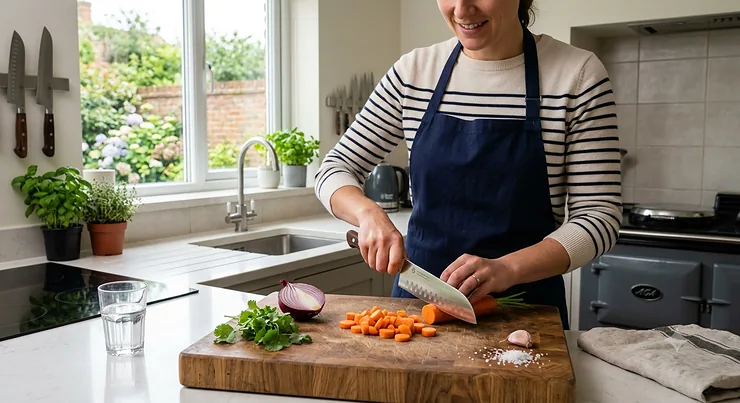
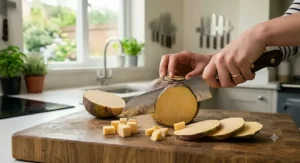
Adopt the push-cut or forward-slice motion. The santoku’s flatter belly means a rocking motion (sweeping the tip down while the heel lifts) doesn’t feel natural and doesn’t deliver clean results. Instead, push the blade forward and down through the ingredient in one smooth stroke, or use a straight up-and-down chop for herbs and spring onions. After a few sessions, this becomes entirely instinctive.
Keep the tip on the board for herbs and garlic. Place the tip lightly on the board, then raise and lower the heel in a fanning motion. The wide santoku blade collects everything cleanly and the flat profile keeps ingredients from escaping sideways — far neater than a rocking chef’s knife for fine herb work.
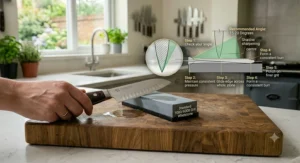
Hone before each use, sharpen every three to six months. Even the finest German steel blades need regular honing to realign the edge. A ceramic or steel honing rod used for six to eight passes per side before cooking will extend the time between proper sharpening sessions significantly. For the 10° Wüsthof blades, a 10° sharpening guide is worthwhile; for the 15° ZWILLING and Robert Welch options, a standard pull-through sharpener works adequately, though a whetstone gives better results.
Storage matters more than most people think. In a compact British kitchen where knives are stored in a drawer with other utensils, the edge dulls rapidly against other metal. A magnetic knife strip (wall-mounted) or an in-drawer knife block protects the blade and keeps the edge sharp for longer. In a smaller flat kitchen, a magnetic strip is also a space-saver.
Avoid the dishwasher for any non-rated knives. The combination of high heat, alkaline detergent, and vibration against other utensils is actively hostile to fine knife edges and many handle materials. Even for knives rated as dishwasher-safe, hand washing extends the blade’s lifespan meaningfully.
Which Western Style Santoku Knife Suits You? Real-World UK Scenarios
The London Flat Dweller (Budget: Under £50, Compact Kitchen)
You’re cooking for one or two people most nights in a narrow galley kitchen. Counter space is limited, the knife block lives on top of the microwave, and anything that goes in the dishwasher is a win. The Henckels Classic 5″ Hollow Edge Santoku is your match: compact at 13 cm, dishwasher safe, and priced accessibly without sacrificing the quality of German steel. It handles your daily stir-fry vegetables, chicken breast prep, and weekend herb-heavy pasta sauces without drama.
The Suburban Family Cook (Budget: £50–£120, Regular Cooking)
You’re cooking for four or five people most evenings — roasts, curries, stir-fries, the occasional ambitious dinner party dish. You want a knife that performs consistently without requiring professional maintenance. The ZWILLING Professional S Santoku 18cm is well-suited here: full-sized at 18 cm for larger cutting tasks, FRIODUR ice-hardened for durability, and forged in Solingen for genuine provenance. Hand-wash it and hone it weekly; it’ll handle everything a busy British family kitchen can throw at it.
The Home Cook Who Wants the Best (Budget: £130+, Serious Cooking)
You cook four or more times a week, you’ve read about edge retention, and you’re willing to invest in a knife you’ll use daily for the next decade. The Wüsthof Classic 7″ Hollow Edge Santoku or the Wüsthof Classic Ikon are your options. The Classic suits most people; the Ikon rewards anyone who notices handle ergonomics. Both require hand washing and occasional professional sharpening — but the performance difference over lesser knives is immediately apparent and sustained over years.
The Gift Buyer (Budget: £60–£100, Presentation Matters)
The Robert Welch Signature Santoku 14cm arrives gift-boxed, carries multi-award-winning British design credentials, and will delight any home cook who receives it. It’s sharp, practical, dishwasher safe, and looks genuinely beautiful. For the housewarming, the significant birthday, or the wedding gift list, this is the choice that hits quality and presentation simultaneously.
How to Choose a Western Style Santoku Knife in the UK: 7 Key Criteria
Choosing the right western style santoku knife comes down to understanding what actually matters versus what’s marketing noise. Here’s what to prioritise:
1. Steel hardness (HRC rating). Harder steel (58+ HRC) holds its edge longer but is marginally more brittle and needs professional sharpening; softer steel (55–57 HRC) is more forgiving to sharpen at home. For most UK home cooks, 56–58 HRC is the sweet spot.
2. Blade construction — forged vs. stamped. Forged blades (the Wüsthof and ZWILLING Professional S options) are precision-made from a single piece of steel and tend to be heavier, more rigid, and better balanced. Stamped blades (ZWILLING Gourmet) are laser-cut from sheet steel, lighter, and more affordable. Both can be excellent; the choice depends on your preference for weight and feel.
3. Edge angle. The 10° per side edge on the Wüsthof knives is meaningfully sharper than the 15° of the ZWILLING Gourmet and Robert Welch options, but also requires more careful maintenance. If you’re happy learning to use a whetstone, go for 10°; if you want low-effort maintenance, 15° is perfectly capable.
4. Handle material and ergonomics. POM polymer handles (Wüsthof Classic) are dense, hygienic, and long-lasting. Contoured dual-bolster handles (Wüsthof Ikon) reduce fatigue during sustained use. Injection-moulded handles (Robert Welch) are lighter and can be more comfortable for smaller hands. Wood handles (Victorinox) are beautiful but require more careful drying after use — particularly relevant in a steamy British kitchen.
5. Blade length. 13–14 cm suits compact kitchens and smaller hands. 17–18 cm is the standard versatile size for most tasks. Choose 13–14 cm if storage space is a genuine constraint (as it often is in a UK terraced house or flat); 17–18 cm if you regularly tackle larger ingredients.
6. Dishwasher compatibility. The ZWILLING Gourmet, Henckels Classic, and Robert Welch Signature are rated for dishwasher use. If this is non-negotiable in your household, this narrows the field usefully.
7. Budget in context. Consider cost-per-use rather than upfront cost. A £130 Wüsthof used daily for ten years costs considerably less per meal than a £25 budget knife replaced every eighteen months. That said, the ZWILLING and Henckels options at lower price points offer genuine quality — not just adequate performance.
Common Mistakes When Buying a Western Style Santoku Knife (And How to Avoid Them)
Mistake 1: Assuming “German steel” means all knives are equal
German steel is a broad category, not a quality guarantee. The X50CrMoV15 alloy used in Wüsthof and the best ZWILLING knives is a specific high-quality formulation with optimal carbon and chromium ratios. Budget knives labelled “German stainless steel” may use inferior alloys with similar-sounding designations. Stick to named brands with Solingen provenance for confidence in the steel quality.
Mistake 2: Buying a 10-degree blade and sharpening it at 15 degrees
This is more common than you’d think, and it effectively ruins the edge geometry of a premium knife. The Wüsthof Classic and Ikon santoku knives use a 10° edge per side — if you use a standard pull-through sharpener set for 15°, you’ll grind away the edge rather than refining it. Check the edge angle of any knife you buy and ensure your sharpening method matches.
Mistake 3: Ignoring blade length relative to kitchen size
British kitchens, particularly in older terraced houses and purpose-built flats, tend to have narrower worktops than American or continental European equivalents. An 18 cm blade is perfectly manageable on a standard worktop, but if you’re working on a narrow breakfast bar or a tiny fold-out table, a 13–14 cm blade gives you far more control and feels proportionate to the space.
Mistake 4: Buying a “Japanese” label knife expecting western-style durability
Some knives marketed as “Japanese style” use harder, more brittle steel (60+ HRC) that chips against hard vegetables or bones. If you want the santoku shape but the durability of German steel, look specifically for “western style santoku” or “German steel santoku” from brands like Wüsthof, ZWILLING, or Robert Welch.
Mistake 5: Forgetting Amazon.co.uk age verification for bladed products
All knives sold on Amazon.co.uk now require online age verification — a practical step introduced under UK law for bladed items. Delivery requires confirming age, and the driver may request valid photographic ID. This is a quick, routine process, but worth knowing in advance so it doesn’t come as a surprise on the doorstep.
Western Style Santoku Knife vs. Traditional Chef’s Knife: What British Cooks Need to Know
This is the question that comes up most often, and the honest answer is: it depends entirely on how you cook. Here’s a clear breakdown.
| Feature | Western Style Santoku | Traditional Chef’s Knife |
|---|---|---|
| Blade shape | Flat belly, straighter edge | Curved belly — rocks naturally |
| Cutting motion | Push-cut, forward slice, chop | Rocking, sweeping |
| Tip shape | Rounded or slight upturn | Pointed |
| Best for | Vegetables, fish, boneless meat, herbs | General purpose, bone-adjacent work |
| Weight | Generally lighter | Generally heavier |
| Edge angle (western models) | 10–15° per side | 15–20° per side |
| Learning curve | Moderate for chef’s knife users | None — familiar motion |
The santoku’s flatter belly makes it marginally better for vegetables — particularly thin, precise cuts — and for boneless protein prep. The chef’s knife’s curved belly means it naturally rocks, which suits techniques like mincing garlic very finely or working through large batches of onions quickly.
What the comparison table doesn’t capture is that most UK home cooks who switch from a chef’s knife to a western style santoku don’t go back. The lighter weight and more versatile blade geometry suits modern British cooking — stir-fries, curries, vegetable-heavy weeknight meals — better than the classic French chef’s knife that was designed for a rather different culinary era. That said, if you regularly joint whole chickens or work through dense bones, a chef’s knife remains the more practical tool.
The ideal solution, if budget allows, is to own both: a western style santoku knife for day-to-day vegetable and boneless prep, and a chef’s knife for occasional heavier work.
The interpretation? If you currently own only a chef’s knife and you’re reading this, a santoku will genuinely expand your kitchen capability. If you own only a santoku, consider adding a 20 cm chef’s knife for occasional heavier tasks. Both together covers essentially everything a UK home kitchen requires.
✨ Don’t Miss These Exclusive Deals!
🔍 Ready to upgrade your kitchen? Click on any highlighted product in this guide to check current pricing and availability on Amazon.co.uk. Prime members enjoy next-day delivery on eligible items — handy when you’re planning a weekend cooking session.
Long-Term Cost & Maintenance: What Your Western Style Santoku Knife Really Costs in the UK
Knife purchases look expensive upfront; the honest calculation is cost-per-use over a realistic lifespan. A Wüsthof Classic Santoku used five times a week for ten years works out to hundreds of individual uses — suddenly the price seems rather reasonable.
Here’s a practical maintenance cost assessment for the knives in this guide:
Premium tier (Wüsthof Classic, Wüsthof Classic Ikon): Expect to spend £10–£20 on a quality ceramic honing rod (used weekly), and perhaps £15–£30 on professional sharpening every 12–18 months if you prefer not to learn whetstone technique. A mid-range whetstone (around £25–£40) eliminates professional sharpening costs entirely if you’re willing to invest an afternoon learning the technique. The 10° edge angle does require care; imprecise sharpening can damage the geometry. Total maintenance cost over five years: approximately £30–£80 depending on approach.
Mid-range tier (ZWILLING Professional S, Robert Welch Signature): The 15° edge angle on these knives is compatible with most quality pull-through sharpeners (£15–£30) and standard whetstones. A honing steel used before each session keeps the edge aligned; sharpening every three to six months for regular cooks. Total maintenance cost over five years: approximately £20–£50.
Budget tier (ZWILLING Gourmet, Henckels Classic): The ZWILLING Gourmet’s stamped construction responds well to pull-through sharpeners. The Henckels similarly — a basic sharpening tool keeps it performing well without significant investment. Total maintenance cost over five years: approximately £15–£25.
Replacement part availability in the UK: All seven brands in this guide have UK distribution, so replacement or warranty claims are straightforward. Wüsthof and ZWILLING have UK customer service teams; Robert Welch is based in the UK and offers a lifetime guarantee on Signature knives. Post-Brexit, EU-manufactured products from these brands are widely stocked in UK distribution warehouses, so there are no meaningful import delays or duty issues when purchasing on Amazon.co.uk.
According to the UK Food Standards Agency, proper knife hygiene — including appropriate cleaning and storage — plays a meaningful role in preventing cross-contamination in home kitchens. Investing in knives you’ll actually care for properly, and which are made from genuinely corrosion-resistant steel, isn’t an indulgence; it’s good food safety practice.
Frequently Asked Questions: Western Style Santoku Knife UK
❓ What is a western style santoku knife, and how does it differ from a Japanese santoku?
❓ Can I put a western style santoku knife in the dishwasher?
❓ Which German santoku knife is best for everyday UK home cooking?
❓ Do I need to be over 18 to buy a santoku knife on Amazon.co.uk?
❓ How often should I sharpen a western style santoku knife in the UK?
Conclusion: The Right Western Style Santoku Knife Changes How You Cook
After testing and researching every knife in this guide, one thing is clear: the western style santoku knife isn’t just a novelty addition to the knife block. For most British home cooks, it’s the blade that ends up being reached for first, every single morning.
The choice between them is genuinely personal. If you cook seriously and want a knife that will still perform a decade from now, the Wüsthof Classic or Classic Ikon are hard to argue against. If budget is the primary concern and you won’t be told to hand-wash your knives, the ZWILLING Gourmet is a quietly excellent option. For something with genuine British design character, the Robert Welch Signature Santoku earns its price with ease, and arrives looking like a proper gift rather than a kitchen tool.
What all seven knives share is corrosion-resistant German or European steel, western-style ergonomic handles, and the santoku blade geometry that makes vegetable and protein prep noticeably faster and more precise than a traditional chef’s knife. In a British kitchen — where the cooking tends towards vegetable-heavy, where storage space is at a premium, and where a knife needs to earn its counter space — that combination is rather compelling.
Check current prices on Amazon.co.uk and take advantage of Prime next-day delivery if you want to start cooking better by the weekend.
✨ Don’t Miss These Exclusive Deals!
🔍 Ready to invest in your cooking? Click any highlighted knife in this guide to check current pricing and availability on Amazon.co.uk — and discover why so many UK home cooks consider a great santoku the most useful upgrade they’ve ever made.
Recommended for You
- Best Japanese Santoku Knife UK 2026: 7 Expert Picks Reviewed
- Best Santoku Knife UK 2026: 7 Top Picks for Every Budget
- German vs Japanese Chef Knife: 7 Best Picks for UK Kitchens 2026
Disclaimer: This article contains affiliate links. As an Amazon Associate, I earn from qualifying purchases. If you purchase products through these links, we may earn a small commission at no additional cost to you.
✨ Found this helpful? Share it with your mates! 💬🤗
