In This Article
There’s a peculiar kind of frustration that only tall cooks know. You’re standing at the worktop — six foot two, hands like a wicket-keeper — hunched over an eight-inch blade that makes you feel like you’re trying to chop a butternut squash with a penknife. Every rocking motion is cramped. Your knuckles graze the board. The whole experience is, frankly, a bit miserable.

The 10 inch chef knife for large hands is the answer to this problem. At 25.5 cm, the blade finally matches the reach and grip of a bigger cook — offering a longer cutting edge, a more natural rocking arc, and the kind of authority over large ingredients that shorter knives simply can’t provide. Whether you’re breaking down a whole shoulder of lamb, slicing through a celeriac the size of a football, or doing a marathon Sunday meal-prep session, the extra length earns its keep.
What exactly makes a 10 inch chef knife for large hands different from a standard cook’s knife? In short: proportion. The longer blade accommodates a wider hand span during the pinch grip, reduces the need to reposition when slicing large cuts, and generally feels less like a compromise tool in the hand of someone built for the job. According to food science research, a European chef’s knife was originally designed to slice and disjoint large cuts of beef — and at 25 cm-plus, it’s finally doing what it was always meant to.
This guide cuts through the noise (pun entirely intended) and presents the seven best 10 inch chef knives currently available on Amazon.co.uk, with honest commentary on who each one is actually for — not just a parade of specs dressed up as insight. We’ve covered every price bracket from sensible to splurge-worthy, and we’ll be straight with you when a knife isn’t worth its price tag.
Quick Comparison: 10 Inch Chef Knives at a Glance
| Knife | Steel Type | Weight | Handle | Best For | Price Range (GBP) |
|---|---|---|---|---|---|
| Wüsthof Classic 10″ | X50CrMoV15 German | ~250g | Triple-riveted POM | All-round home cook | £120–£150 |
| Wüsthof Classic Ikon 10″ | X50CrMoV15 German | ~230g | Double-bolster ergonomic | Pinch-grip enthusiasts | £150–£185 |
| Victorinox Fibrox Pro 10″ | X50CrMoV15 Swiss | ~175g | TPE Fibrox non-slip | Budget/professional prep | £35–£55 |
| Global G-16 25.5cm | CROMOVA 18 Japanese | ~210g | Hollow seamless steel | Japanese-style fans | £90–£115 |
| ZWILLING Pro 26cm | Special ZWILLING steel | ~240g | Curved bolster polymer | Ergonomic precision | £120–£160 |
| F.DICK Premier Plus 26cm | X50CrMoV15 German | ~245g | Seamless black composite | Professional kitchens | £80–£105 |
| Kai Shun Classic 25cm | VG MAX + 32-layer Damascus | ~195g | D-shape Pakkawood | Precision enthusiasts | £160–£210 |
What jumps out immediately from this table is how dramatically the weight varies — from the featherweight Victorinox at around 175g up to the Wüsthof Classic at 250g. That’s not a trivial difference over a two-hour Sunday roast prep. Budget buyers will also notice that the Victorinox Fibrox Pro delivers a 10-inch blade at a fraction of premium prices — and that deserves a proper explanation in the reviews below.
💬 Just one click — help others make better buying decisions too! 😊
✨ Don’t Miss These Exclusive Deals!
🔍 Take your kitchen prep to the next level with these carefully selected blades. Click on any highlighted item to check current pricing and availability on Amazon.co.uk. These picks will help you find exactly the knife you need!
Top 7 Ten Inch Chef Knives for Large Hands: Expert Analysis
1. Wüsthof Classic 10 Inch Chef’s Knife — The Benchmark German Workhorse
If there’s one knife that professional chefs and serious home cooks across Britain have been reaching for since before Nigella was a household name, it’s the Wüsthof Classic. This is the benchmark. Everything else on this list either aspires to beat it or carves out a different niche because it can’t.
The blade is forged from a single piece of X50CrMoV15 high-carbon stainless steel — hardened to 58 HRC — which means it holds a sharp edge well without becoming brittle. At 25.4 cm (10 inches) and roughly 250g, it has genuine heft in hand. That weight isn’t a flaw; it’s a feature. When you’re portioning a large joint of beef or splitting a dense pumpkin, the mass does a fair portion of the work for you. The full bolster protects your fingers and adds balance, and the triple-riveted POM handle is properly roomy for larger hands.
Who is this for? The serious British home cook who wants one great knife and wants it to last 20 years. It’s also the obvious choice for anyone who cooks large quantities — think whole roast chickens, family-sized Sunday joints, or meal-prepping for the week. UK customers on Amazon.co.uk consistently note its out-of-the-box sharpness and the satisfying solidity of the handle. One reviewed noted that even after six years of daily use, the edge still responds well to a honing steel.
The only real caveat is the price — you’re looking at £120–£150 range — and the full bolster, which makes sharpening on a whetstone slightly trickier until the knife has been ground down over time. Worth knowing if you’re a stone-sharpening devotee.
✅ Genuinely exceptional balance and weight
✅ Full-bolster design suits the pinch grip perfectly
✅ Hardened to 58 HRC for outstanding edge retention
❌ Full bolster complicates whetstone sharpening
❌ Commanding price point for occasional cooks
Price range: £120–£150 | Prime-eligible on Amazon.co.uk — a worthy long-term investment if you cook seriously at home.

2. Wüsthof Classic Ikon 10 Inch Chef’s Knife — The Ergonomic Upgrade
Same German steel, same Solingen pedigree as the Classic — but the Ikon takes a deliberate step in a more ergonomic direction. The handle is the story here. Where the Classic goes traditional triple-rivet, the Ikon deploys a double-bolster design with a curved, contoured handle that cradles your hand rather than simply receiving it. For cooks with larger palms or those prone to hand fatigue during long prep sessions, the difference is genuinely noticeable.
The blade geometry is largely identical to the Classic — forged X50CrMoV15 steel, 58 HRC, a broad belly for rocking — but the Ikon shaves a little weight off the handle section, bringing it in around 230g. Still a substantial knife, but slightly more nimble on fine work like mincing shallots or brunoise cuts. UK buyers on Amazon.co.uk frequently praise how the knife handles differently from competitors when using a proper pinch grip (thumb and forefinger on the blade spine, remaining fingers on the handle) — which is exactly the grip you want with a blade this size.
It’s around £150–£185, putting it at the premium end of German steel. The cream-coloured handle variant is elegant but worth keeping out of prolonged UV exposure, per Wüsthof’s own guidance — relevant in a well-lit British kitchen with south-facing windows.
✅ Double-bolster ergonomic handle reduces fatigue
✅ Brilliant for pinch-grip technique
✅ Slightly lighter feel than the Classic for fine work
❌ Most expensive Wüsthof option in this guide
❌ Light-coloured handle requires careful maintenance
Price range: £150–£185 | Available on Amazon.co.uk — the obvious choice for anyone who cooks for hours and prioritises ergonomics.
3. Victorinox Fibrox Pro 10 Inch Chef’s Knife — The Professional’s Workhorse Secret
Here’s a knife that deserves to knock some expensive ego off the block. The Victorinox Fibrox Pro is what professional kitchens across Britain — the kind that crack out 200 covers a night and wash knives roughly — actually use. Not because they can’t afford better. Because this knife is good enough that affording better is simply beside the point.
The stamped X50CrMoV15 Swiss steel blade is laser-tested and tapered, running 25.4 cm at a thinner profile than the forged German options. That thinner grind gives it remarkable out-of-the-box sharpness — sharper than the Wüsthof fresh from the box, in honest side-by-side use. It won’t hold that edge as long as a forged knife will, but it’s also trivially easy to resharpen, even with a pull-through sharpener. At around 175g, it’s the lightest knife in this roundup. For larger-handed cooks who find heavy German knives fatiguing, that’s a genuine selling point.
The Fibrox handle deserves a mention — it’s made from thermoplastic elastomer (TPE), meaning it’s genuinely non-slip even when wet and greasy. In a busy home kitchen, particularly in those chaotic moments involving roast chicken fat, that matters. UK reviewers consistently describe it as feeling “almost too light” initially before coming to appreciate how that reduces wrist strain. Prime-eligible on Amazon.co.uk at the £35–£55 range, it’s the single best-value 10 inch blade on this list by a mile.
✅ Exceptional sharpness straight from the box
✅ Lightest knife in this guide — reduces fatigue
✅ NSF-certified, non-slip TPE handle
❌ Stamped construction means slightly shorter edge retention
❌ Handle aesthetic isn’t for everyone — looks professional, not premium
Price range: £35–£55 | Prime-eligible on Amazon.co.uk — the smartest budget pick by quite a considerable distance.
4. Global G-16 Chef’s Knife 25.5cm — The Japanese Outlier
Every list like this needs a knife from Global, and here it is. The G-16 is the Japanese answer to everything the German school of knife-making represents — and it makes its point rather eloquently. Where Wüsthof and Zwilling go heavy and full-bolster, Global goes minimal. The blade and hollow handle are stamped from a single piece of CROMOVA 18 stainless steel — a proprietary Japanese alloy that Global developed specifically for their knives, hardened to 56–58 HRC with exceptional stain resistance.
The handle is where this knife divides opinion. There’s no bolster at all — the blade runs clean into a hollow, sand-filled steel handle that’s been dimpled for grip. At around 210g for the full knife, it balances differently from everything else on this list. The weight sits further back towards the handle, which some larger-handed cooks love (it reduces the sense of “blade heaviness”) while others find it takes adjustment. It’s worth noting that the lack of a finger guard means the pinch grip is almost mandatory on a knife this long — slide your fingers too far forward and there’s nothing to stop them continuing to the blade. Fine for experienced cooks; something to be aware of for novices.
Which? magazine has consistently rated Global among the best UK kitchen knives for sharpness, and the G-16 earns that in practice. UK buyers frequently note the knife’s ability to glide through large fish fillets and tomatoes without the blade dragging — a function of the finer grind angle typical of Japanese knives. At £90–£115 on Amazon.co.uk, it sits between budget and premium.
✅ Exceptional sharpness with Japanese steel geometry
✅ Seamless single-piece construction — hygienic and easy to clean
✅ Distinctive, elegant appearance; a proper kitchen statement piece
❌ No bolster — requires confident grip technique
❌ Can feel unbalanced to cooks accustomed to German-style knives
Price range: £90–£115 | Available on Amazon.co.uk — ideal for the experienced cook ready to embrace Japanese blade philosophy.
5. ZWILLING Pro 26cm Chef’s Knife — The Hybrid Innovator
Zwilling J.A. Henckels have been making knives in Solingen, Germany, since 1731. The Pro series represents their modern thinking — what happens when you take a classic German forged blade and explicitly design it around the way professional chefs actually hold a knife.
The blade is forged from Zwilling’s proprietary “special formula” steel (a high-carbon stainless formula hardened to 57 HRC) and runs a full 26 cm — the longest blade in this roundup. That extra length is worth appreciating: for tall cooks slicing large joints or working with very broad ingredients, those few millimetres genuinely add useful cutting travel. The real engineering story is the curved bolster. Rather than a flat bolster that stops your fingers at the blade, the Zwilling Pro’s bolster curves forward slightly, actively encouraging the professional pinch grip. It acts as an ergonomic guide rather than a barrier. Clever.
The polymer handle is comfortable in large hands and the balance feels forward-weighted — purposefully so, with the blade doing the work in cuts. UK Amazon customers note the knife feels “more European than competitors” with a heft and presence that makes light work of large prep tasks like breaking down a whole chicken or halving a large butternut squash. At £120–£160 on Amazon.co.uk, it’s comparable to the Wüsthof Classic but brings a modern ergonomic perspective.
✅ Innovative curved bolster promotes correct pinch grip
✅ Longest blade in this roundup at 26 cm
✅ 57 HRC — excellent everyday edge retention
❌ Slightly heavier feel won’t suit lighter-touch cooks
❌ The curved bolster takes a session or two to feel natural
Price range: £120–£160 | Available on Amazon.co.uk — an excellent choice for taller cooks who want German heritage with modern ergonomics.

6. F.DICK Premier Plus 26cm Chef’s Knife — The Professional’s Best Kept Secret
Friedrich Dick has been making professional knives in Deizisau, Germany since 1778. The Premier Plus range is their flagship: forged from a single piece of X50CrMoV15 steel, with a seamless transition from blade to bolster to full tang. It’s this seamless construction that makes the knife worth discussing — there are no crevices where bacteria or moisture can accumulate, which is partly why professional kitchen environments favour the design. In damp conditions — and British kitchens are rarely arid — this matters more than it sounds.
The blade runs 26 cm and is hardened to 56 HRC, which means it’s slightly softer than the Wüsthof but consequently very easy to maintain on a honing steel. The balance is traditional and German: slightly blade-heavy, with a full bolster that anchors larger hands naturally. The black polymer handle has a satisfying girth to it — meaningfully thicker than the Victorinox Fibrox — which suits cooks with large hands who find slim handles tiring during extended prep. F.DICK also employs a special hardening technique that reduces microfractures in the blade steel, reportedly extending the knife’s working life in professional environments.
At £80–£105 on Amazon.co.uk, the Premier Plus sits nicely in the mid-range — better than budget, meaningful savings versus the Wüsthof. UK buyers frequently comment that it’s the knife their professional chef friends swear by but never talk about in consumer media. That rings true: F.DICK punches well above its retail visibility.
✅ Seamless, hygienic construction — excellent for busy home kitchens
✅ Thicker handle suits large-handed cooks particularly well
✅ Mid-range price with professional-grade build quality
❌ Not as widely reviewed in UK consumer press — harder to find third-party opinions
❌ 56 HRC means slightly more frequent honing required vs Wüsthof
Price range: £80–£105 | Available on Amazon.co.uk — the insider pick for cooks who want professional provenance without premium branding premiums.
7. Kai Shun Classic 25cm Chef’s Knife — The Premium Japanese Precision Tool
And at the top of the market, Kai Shun. If the other six knives on this list are workhorses of varying quality and pedigree, the Shun Classic is a thoroughbred. Made in Seki, Japan — the knife capital of the world — it combines a core of VG MAX steel wrapped in 32 layers of hand-hammered Damascus cladding. The result is a blade that lands at around 61 HRC hardness, substantially harder than any German knife in this roundup.
What does 61 HRC mean in practice? It means the knife holds an incredibly fine edge for longer. It also means — and this needs to be said clearly — the steel is more brittle. You do not use a Shun Classic to chop through chicken bones or prise open a stubborn pumpkin rind. You use it for precise slicing of large fillets, elegant thin cuts of beef, or fine vegetable prep. At 25 cm and around 195g, it’s lighter than the German options and the D-shaped Pakkawood handle (note: designed for right-handed use; left-handers should look at the Shun Premier or Nagare ranges) moulds naturally to larger grips once you adjust to the Japanese hold.
Available on Amazon.co.uk in the £160–£210 range, this is a considered purchase — not for everyone, and frankly overkill if your daily cooking is a weeknight cottage pie and Sunday roast. But for the cook who takes precision seriously and wants a blade that genuinely makes knife work feel effortless, the Shun Classic earns every pound.
✅ VG MAX core at 61 HRC — exceptional sharpness and edge retention
✅ 32-layer Damascus cladding reduces food sticking
✅ Beautifully balanced at 195g — feels nimble despite the length
❌ Right-hand only design
❌ Brittle enough to chip on bones — demands careful use
Price range: £160–£210 | Available on Amazon.co.uk — for the precision-focused cook willing to invest in a genuinely elite tool.
How to Choose the Right 10 Inch Chef Knife for Large Hands in the UK
Buying a large chef’s knife is one of those purchase decisions that repays clear thinking. Here’s a straightforward framework:
1. Assess your grip style first. If you use a pinch grip (thumb and forefinger on the blade), a knife with a pronounced bolster — Wüsthof Classic, ZWILLING Pro — will feel natural immediately. If you hold the handle fully, you’ll want maximum handle girth: look at the F.DICK Premier Plus or Wüsthof Ikon.
2. Match your cooking habits to the blade weight. Heavy German knives (250g+) excel at high-force tasks: breaking down whole birds, splitting squash, jointing lamb. Lighter knives — Victorinox Fibrox, Global G-16, Kai Shun — perform better on precise, repetitive slicing where fatigue is the bigger enemy. Honest question: what does your actual Sunday prep look like?
3. Consider your sharpening setup. Harder Japanese steel (Kai Shun at 61 HRC) stays sharp longer but requires diamond whetstones and correct technique to resharpen. Softer German steel (Wüsthof at 58 HRC) responds to standard ceramic honing steels and is far more forgiving if you’re not yet confident with your sharpening. The Food Standards Agency recommends keeping kitchen knives properly sharpened as a food safety measure — a blunt knife requires more force and increases accident risk.
4. Factor in your kitchen size. A 26 cm blade needs a generous worktop and cutting board. For British kitchens — many of which are galley-style terraced house setups with limited counter space — even a large cutting board can feel crowded with a 10-inch knife in action. Make sure you have at least a 38 x 28 cm board to work with comfortably.
5. Set a realistic budget and stick to it. The Victorinox Fibrox Pro at £35–£55 genuinely competes with knives three times the price in everyday cooking. Budget shouldn’t mean disappointment here.
6. Think about maintenance realism. A £200 Kai Shun left languishing in a kitchen drawer (never a knife block) without regular honing will perform worse after six months than a £40 Victorinox given proper care. Be honest about how much attention you’ll give it.
Real-World Scenarios: Which Knife Suits Your Cooking Life?
The Weekend Roast Enthusiast in a Semi-Detached in Leeds
You cook seriously at weekends — a proper shoulder of pork, whole chickens, and the occasional intimidating celeriac situation. Your knives live on a magnetic strip above the hob. Budget: sensible, not extravagant. The Wüsthof Classic 10 inch is your knife. The heft handles Sunday joints without drama, the full bolster suits your grip, and it will outlast your kitchen worktop. At £120–£150, it’s a once-in-fifteen-years purchase.
The Home Chef in a London Flat Who Meal-Preps Four Days a Week
Counter space is limited, but you’re chopping a lot — vegetables, fish fillets, chicken thighs in bulk. You need speed and stamina more than brute force. The Victorinox Fibrox Pro 10 inch at £35–£55 is a revelation here. It’s light enough to use for an hour without wrist ache, sharp enough to speed through prep, and its Fibrox handle stays confident when wet. Clean up is a minute job.
The Experienced Cook Ready to Invest in a Serious Knife
You’ve been cooking properly for years. You maintain your knives correctly. You want something that elevates the experience as well as the result. The Kai Shun Classic 25cm at £160–£210 will do exactly that — provided you commit to its maintenance needs and keep it away from bones and frozen food. Used properly, it’s the finest cutting experience on this entire list.
Is a 10 Inch Chef Knife Too Big? What the Spec Sheet Won’t Tell You
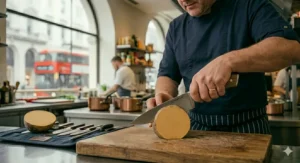
It’s a fair question — and the honest answer is: it depends on the cook, not just the kitchen. A 10 inch blade is absolutely the right tool for certain jobs and a slightly impractical one for others.
Where it earns its place: Breaking down large joints of meat. Slicing whole roasted chickens or pork loins. Chopping large, dense vegetables (butternut squash, celeriac, kohlrabi). High-volume vegetable prep where the longer cutting edge covers ground faster per stroke. For all of these, the 10 inch blade genuinely outperforms the more common 20 cm (8 inch) models.
Where it’s overkill: Peeling and trimming small vegetables. Precise fine-knife work like a delicate brunoise. Working in a cramped kitchen where the blade tip regularly threatens the backsplash. Chopping a single small onion feels, as one Amazon.co.uk reviewer memorably noted of their Wüsthof Ikon, “comically excessive.”
The ergonomic argument for people with large hands is genuinely compelling, though. When your hand span is substantially wider than average, a shorter blade places your knuckles uncomfortably close to the cutting board during the rocking motion. A 10 inch blade provides the vertical clearance that makes proper cutting technique actually comfortable. Research from occupational health studies on kitchen worker ergonomics confirms that poorly sized tools correlate with increased hand and wrist strain over time. A knife that fits your hand isn’t a luxury — it’s just correct engineering.
Common Mistakes When Buying a Large Chef Knife in the UK
Buying based on looks alone. Damascus cladding is beautiful. It’s also largely decorative on most mid-range knives, where it doesn’t affect the core steel’s performance. Buy for the steel specification and construction method first; let aesthetics be a tiebreaker.
Ignoring handle thickness. Most knife reviews obsess over blade steel and overlook handle girth. If you have large hands, a slim handle causes you to over-grip, which fatigues your forearm muscles faster. The F.DICK Premier Plus and Wüsthof Classic both offer handle profiles that suit larger palms; the Victorinox Fibrox and Global G-16 are thinner and work better for medium-large rather than very large hands.
Storing knives incorrectly. A £150 blade stored loose in a kitchen drawer will be dull and chipped within months. Invest in a magnetic strip, a knife block, or individual blade guards. In British kitchens where storage space is at a premium, a wall-mounted magnetic strip is often the most practical and compact solution.
Conflating “dishwasher safe” with “should go in the dishwasher.” The Victorinox Fibrox is technically dishwasher safe. That doesn’t mean it’s wise. Dishwasher detergent and the thermal cycling inside a British dishwasher will dull any blade significantly faster than hand washing. Hand-wash and dry immediately — always.
Buying the wrong size for your actual kitchen. It bears repeating: a 26 cm blade needs room. Measure your cutting board and your most-used worktop space before buying the longest option on this list.
Long-Term Care & Maintenance in the British Kitchen
A chef’s knife maintained well in a British kitchen faces a specific set of challenges — and they’re worth addressing properly rather than with vague “wash and dry” advice.
Humidity and storage. British kitchens — especially in older terraced or semi-detached houses — can carry significant ambient moisture. Even stainless steel knives benefit from being dried immediately after washing rather than left to drip-dry on a rack. Carbon steel knives (not on this list, but worth knowing) will rust in a British kitchen if not actively dried and lightly oiled. All the knives reviewed here are stainless and will tolerate normal British conditions, but a quick wipe before storage adds years to the blade life.
Honing vs sharpening. Honing (realigning the edge with a honing steel) should happen every few uses. Sharpening (removing steel to create a new edge) should happen a few times per year, depending on use. The Wüsthof and Zwilling models at 57–58 HRC respond to a standard ceramic honing rod. The Kai Shun at 61 HRC requires a diamond steel or whetstone. Do not hone a Japanese blade on a European-style grooved steel — you’ll micro-chip the edge.
Cutting boards matter enormously. Glass and ceramic boards destroy knife edges. Bamboo boards are harder than they look and not ideal for premium knives. Hardwood (oak, walnut, maple) or end-grain boards are the best surface for both edge retention and hygiene. If you’re investing in a 10 inch chef knife, a large cutting board — at least 40 x 30 cm — is the companion purchase that will protect that investment.
Features That Actually Matter (And Those That Don’t)
Matters: Steel hardness (HRC rating). Higher HRC means longer edge retention but more brittleness. 56–58 HRC is the sweet spot for most home cooks — manageable to maintain, genuinely sharp. 60–62 HRC suits precision cooks who treat knives carefully.
Matters: Full tang construction. Every knife on this list is full tang — the steel extends all the way through the handle. This affects balance, durability, and the feel of the knife under load. Half-tang or stick-tang constructions are common in budget knives and are meaningfully inferior for heavy use.
Matters: Handle ergonomics for large hands. Not enough reviews address this. Thicker, contoured handles (Wüsthof Ikon, F.DICK Premier Plus) suit genuinely large hands. Slim handles (Global, Victorinox) are more versatile across hand sizes but can cause over-gripping in very large palms.
Doesn’t really matter: Number of Damascus layers. Purely decorative above the functional cladding threshold. A 67-layer Damascus pattern on a budget knife is marketing. What’s underneath — the core steel grade and HRC — is what you’re actually buying.
Doesn’t really matter: Elaborate branding and packaging. Some knives at this price point arrive in elaborate presentation boxes. That’s a gift consideration, not a performance one. The Wüsthof Classic arrives without fanfare and cuts better than knives that come in velvet-lined cases.

FAQ: Ten Inch Chef Knives in the UK
❓ Is a 10 inch chef knife too big for the average UK kitchen?
❓ What's the best 10 inch chef knife for large hands on a modest budget?
❓ How often should I sharpen a 10 inch chef knife with regular home use?
❓ Can I put a high-carbon steel chef knife in my dishwasher?
❓ Is the Global G-16 suitable for someone with large hands who's new to Japanese knives?
Conclusion: The Right 10 Inch Knife for the Right Cook
A 10 inch chef knife for large hands isn’t just a longer blade. It’s a properly proportioned tool for a properly sized cook — and the difference in daily kitchen comfort is more significant than it sounds until you’ve actually experienced it. The cramped knuckles, the hunched posture, the constant repositioning: all of it disappears when your knife finally fits your hand.
Our top overall pick is the Wüsthof Classic 10 Inch Chef’s Knife — because it’s honest, durable, beautifully balanced, and will serve you reliably for two decades of serious cooking without drama. For budget-conscious buyers, the Victorinox Fibrox Pro 10 inch is a genuinely remarkable value proposition that will surprise you. And if you’re ready to invest in precision, the Kai Shun Classic 25cm is one of the finest cutting experiences available on the UK market.
Whatever your choice: buy once, buy right, maintain it properly, and keep it off the glass boards.
✨ Don’t Miss These Exclusive Deals!
🔍 Click any highlighted product to check current pricing and availability on Amazon.co.uk. These carefully selected blades cover every budget — from smart everyday tools to serious long-term investments. Find your perfect knife today!
Recommended for You
- Lightweight Chef Knife UK: 7 Best Picks That Won’t Wreck Your Wrist (2026)
- Best 8 Inch Chef Knife UK 2026: 7 Top Picks Reviewed
- Best Chef’s Knife UK 2026: 7 Top Picks for Every Budget
Disclaimer: This article contains affiliate links. As an Amazon Associate, I earn from qualifying purchases. If you purchase products through these links, we may earn a small commission at no additional cost to you.
✨ Found this helpful? Share it with your mates! 💬🤗
