
In This Article
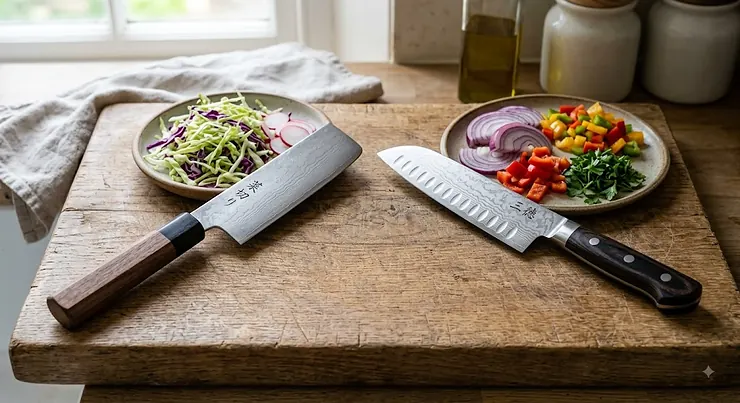
Stand in front of a well-stocked knife shop and you’ll spot them sitting side by side, looking almost like cousins who never quite agreed on a family photo pose. One has a squared-off, no-nonsense blade that looks like it means business. The other curves gently towards a rounded tip, like it’s trying to be diplomatic about the whole cutting thing. That’s the nakiri vs santoku knife dilemma in a nutshell, and it trips up more home cooks than any other Japanese blade comparison. In short: a nakiri is a dedicated vegetable knife with a flat, rectangular blade built for straight-down chopping, while a santoku is a general-purpose knife with a curved sheepsfoot tip that handles vegetables, fish and boneless meat with equal confidence.
This isn’t a purely academic question either. Get it wrong and you’ll either end up wrestling a specialist blade through a chicken breast (nakiri, don’t) or wondering why your santoku leaves the odd bit of onion clinging stubbornly to the board when a flat-edged blade would have sailed straight through. Below, we’ve researched seven real knives currently sold through amazon.co.uk, spanning honest budget picks through to knives that genuinely earn their premium price tags, alongside a full breakdown of blade shape differences, buying criteria and the kind of practical advice that doesn’t show up on a standard product listing. A santoku’s blade generally measures somewhere between 13 and 20 centimetres, built around a flat cutting edge that curves down towards a sheepsfoot-style point — a design detail that explains almost everything about how it behaves on the board, as we’ll get into shortly.
Whether you’re kitting out your very first proper knife roll or finally retiring that supermarket own-brand chef’s knife, this home cook knife guide will walk you through exactly which blade shape suits your cooking style, and which of the seven knives below deserves a spot on your worktop. For a deeper technical breakdown of the santoku’s design history, the Wikipedia entry on the santoku bōchō is a useful starting point.
Quick Comparison Table: Nakiri vs Santoku at a Glance
| Feature | Nakiri | Santoku |
|---|---|---|
| Blade shape | Flat, rectangular, squared tip | Curved sheepsfoot tip |
| Best for | Vegetables, herbs, precision dicing | All-purpose: veg, fish, boneless meat |
| Typical length | 5–7 inches (13–18cm) | 5–7 inches (13–18cm) |
| Cutting motion | Straight up-and-down push cut | Slight rock, push-and-pull |
| Beginner-friendly? | Very — hard to mis-cut | Very — most versatile single blade |
| Best For | Plant-forward cooks, meal-preppers | First-time Japanese knife buyers |
Looking at the table above, the real story isn’t which knife is “better” but which cutting motion matches how you actually cook. If your weekly shop is 80% vegetables and you batch-prep a lot of stir-fries or salads, the flat edge of a nakiri will out-perform a santoku on sheer speed and consistency. If you want one knife that can go from dicing an onion to portioning a chicken thigh without a second blade appearing, the santoku’s curved tip and all-rounder geometry earns its keep. Buyers building a first Japanese knife collection often end up owning both eventually — they’re genuinely complementary rather than competing tools.
💬 Found this comparison useful already? Bookmark this page — you’ll want to come back to the product picks below before you buy.🤗
Top 7 Nakiri & Santoku Knives: Expert Analysis
We’ve deliberately mixed budget, mid-range and premium options across both blade shapes, covering four santoku and three nakiri knives so you can compare like-for-like within your price bracket. Every knife listed below is a real, currently-sold product — no invented models, no fictional brands.
1. Tojiro DP Santoku — best value entry into real Japanese steel
The Tojiro DP Santoku is the knife that convinces sceptical home cooks that “proper” Japanese steel doesn’t have to cost a fortune. Its VG-10 core is sandwiched between softer stainless cladding layers, hardened to roughly HRC 60–61 — meaning it takes a genuinely keen edge and holds it far longer than typical Western stamped-steel santokus in the same price bracket. What most buyers overlook about this model is that the stainless cladding isn’t just cosmetic; it protects the harder VG-10 core from chipping while still letting the cutting edge stay thin and aggressive. This is the santoku we’d point a total beginner towards, precisely because it rewards good technique without demanding advanced whetstone skills to keep it working well. Reviewers consistently report that the riveted handle feels lighter and better balanced than its price would suggest, though a small but recurring theme in feedback is that the factory edge, while sharp, benefits from a quick strop before its first serious use. Pros:
- ✅ VG-10 steel core rare at this price point
- ✅ Lightweight, nimble balance for long prep sessions
- ✅ Holds an edge through weeks of daily home use
Cons:
- ❌ Thin handle can feel small for larger hands
- ❌ Stainless cladding shows fingerprints and smudges
Currently sitting in the affordable end of the market — think around £70-£90 on amazon.co.uk depending on stock — the Tojiro DP Santoku represents genuinely excellent value, particularly for anyone who’s never owned a Japanese knife before and wants to feel the difference without a big financial leap.
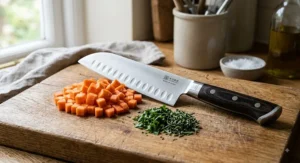
2. Kai Wasabi Black Nakiri — best budget-friendly true nakiri shape
The Kai Wasabi Black Nakiri brings over a century of Seki City knife-making heritage into a genuinely accessible package, and it’s the knife we’d recommend to anyone who wants to try the nakiri shape before committing serious money to the category. Its blade is made from Daido 1K6 high-carbon stainless steel, hardened to around 58 HRC, which sits a notch below premium VG-10 or VG-MAX knives but still comfortably outperforms typical supermarket cutlery on edge retention. Based on the spec comparison with pricier nakiris further down this list, what you’re sacrificing here is mostly aesthetics and a slightly shorter edge-holding window, not fundamental cutting performance — the flat profile and squared tip are present and correct. Reviewers frequently highlight the polypropylene-and-bamboo handle as surprisingly comfortable for an entry-level knife, with a common theme being that it feels far more “grown-up” in the hand than the price suggests, though a handful of buyers note the factory edge needs honing sooner than premium alternatives. Pros:
- ✅ Genuine Japanese-made blade under £45
- ✅ True flat nakiri profile, not a compromise shape
- ✅ Antibacterial polypropylene handle, easy to clean
Cons:
- ❌ Softer steel needs more frequent honing
- ❌ Not dishwasher safe, hand wash only
At roughly £30-£45, the Kai Wasabi Black Nakiri is the value pick of this entire round-up and a sensible first purchase for anyone testing whether the nakiri’s straight-chop motion actually suits their cooking style.
3. Wüsthof Classic Santoku 17cm — best hybrid German-Japanese engineering
The Wüsthof Classic Santoku is what happens when a 200-year-old Solingen forging house decides to interpret a Japanese blade shape through a German engineering lens, and the result is a genuinely distinctive hybrid. Forged from a single piece of chrome-molybdenum-vanadium steel and hardened to around 58 HRC using Wüsthof’s PEtec sharpening process, it trades the wafer-thin Japanese grind for a slightly thicker, more robust edge geometry — 14 degrees per side rather than the 10-degree angle typical of pure Japanese santokus. What that means in practice is a knife that shrugs off the odd accidental contact with a bone or a stubborn squash skin without chipping, at a small cost to outright slicing finesse. The hollow-edge grooves along the blade face reduce food sticking noticeably when working through starchy vegetables like potato, a detail Wüsthof itself notes was specifically engineered to help release cut items from the blade. Aggregated customer sentiment consistently praises the full-tang bolster balance and the fact it holds its edge through heavier daily use than lighter Japanese alternatives, though some reviewers note the extra heft takes a session or two to adjust to if you’re coming from a featherweight Japanese blade. Pros:
- ✅ Full tang, forged single-piece steel construction
- ✅ Hollow-edge grooves reduce food sticking
- ✅ Handles bone contact better than thinner blades
Cons:
- ❌ Heavier than pure Japanese santoku alternatives
- ❌ Wider 14° edge angle sacrifices some slicing finesse
Priced in the £100-£140 range, the Wüsthof Classic Santoku suits cooks who want German build quality and durability with a Japanese-inspired blade shape layered on top.
4. PAUDIN Nakiri — best budget pick with a striking Damascus-pattern finish
The PAUDIN Nakiri punches well above its price bracket on pure specification: a high-carbon stainless steel blade hardened to a claimed 62 HRC, finished with an etched Damascus-style pattern that makes it look considerably more expensive than it is. Here’s what the spec sheet won’t tell you outright: a claimed 62 HRC on a budget blade usually means the steel is harder but potentially more brittle than a mid-range knife tempered slightly softer for durability, so this is a knife that rewards careful use on a proper wooden or plastic board rather than glass or stone. For home cooks doing high-volume vegetable prep on a tight budget, that trade-off is entirely reasonable — you get genuine sharpness and a comfortable ergonomic handle without premium-knife pricing. Aggregated reviews consistently flag the out-of-box sharpness as a highlight, with several buyers specifically mentioning it as their first “proper” chef-style knife purchase, while a recurring criticism is that the handle-to-blade transition feels slightly less refined than pricier full-tang competitors. Pros:
- ✅ Genuinely sharp straight out of the box
- ✅ Eye-catching Damascus-pattern finish for the price
- ✅ Comfortable ergonomic grip for extended prep
Cons:
- ❌ Harder steel can be more prone to chipping
- ❌ Handle-blade join less polished than premium models
Typically found under £40 on amazon.co.uk, the PAUDIN Nakiri is a sound choice for students, first flats, or anyone who wants to trial the nakiri shape without much financial commitment.
5. Shun Classic Nakiri — premium pick for serious vegetable prep
The Shun Classic Nakiri is where the nakiri category hits its ceiling in terms of craftsmanship, and it’s worth understanding exactly what that premium buys you. At its core sits VG-MAX steel — Shun’s proprietary refinement of VG-10 with added chromium, cobalt and tungsten — hardened to a genuinely impressive 60-61 HRC and clad in 32 layers of Damascus stainless steel on each side. Based on the spec comparison with the budget nakiris above, the practical difference isn’t really about sharpness on day one; a well-honed budget blade can be just as keen fresh out of the box. The difference shows up over months, in how much longer the VG-MAX core holds that edge under daily onion, cabbage and root-vegetable duty before needing a proper resharpen. The D-shaped Pakkawood handle, hand-fitted and finished, is noticeably more contoured than anything in the budget tier, distributing weight so precisely that extended prep sessions feel less fatiguing on the wrist. Reviewers consistently single out the edge retention and the striking visual Damascus pattern as the standout features, with the most common criticism being that a knife this refined arguably deserves a dedicated whetstone rather than an electric sharpener to maintain properly. Pros:
- ✅ VG-MAX steel with genuinely superior edge retention
- ✅ 32-layer Damascus cladding, striking and functional
- ✅ Hand-fitted Pakkawood handle reduces prep fatigue
Cons:
- ❌ Premium price reflects craftsmanship, not just branding
- ❌ Best maintained with whetstone rather than pull-through sharpeners
Sitting in the £140-£180 range, the Shun Classic Nakiri is the knife for cooks who’ve already decided the flat-blade chopping style suits them and are ready to invest in a blade that’ll genuinely last decades with proper care.
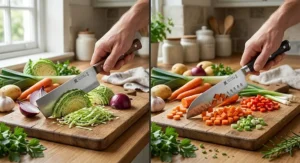
6. MAC Superior Santoku — best all-rounder for daily home cooking
The MAC Superior Santoku occupies a sweet spot that professional kitchens have known about for years: MAC’s proprietary steel, tempered to around 59-61 HRC, uses a thinner grind than the brand’s heavier Professional line, making this santoku noticeably nimbler for the quick chopping and slicing motions the shape is built around. What most buyers overlook about this model is that the thinner grind isn’t a durability compromise so much as a deliberate choice for exactly the tasks a santoku is meant to handle — fast, repetitive vegetable and protein prep rather than heavy bone work. The oval pakkawood handle is a genuinely comfortable shape for extended sessions, and the blade takes an edge quickly on a whetstone thanks to steel that’s forgiving rather than stubborn under the stone. Aggregated review sentiment is remarkably consistent here: home cooks repeatedly describe it as the knife they reach for daily once the “special occasion only” hesitation wears off, with edge retention and comfortable balance the two most-cited strengths, while a smaller number of reviewers wish MAC offered more handle colour or length options. Pros:
- ✅ Thinner grind ideal for fast santoku-style cuts
- ✅ Comfortable oval pakkawood handle for daily use
- ✅ Takes a keen edge quickly on a whetstone
Cons:
- ❌ Limited handle and length options available
- ❌ Thinner grind less suited to heavier cutting tasks
Typically priced in the £90-£120 range, the MAC Superior Santoku is the knife we’d recommend to a home cook who’s outgrown their starter blade and wants a genuine daily-driver upgrade without moving into flagship pricing.
7. Shun Classic Santoku — premium all-purpose Japanese knife
The Shun Classic Santoku shares its VG-MAX core and 32-layer Damascus cladding with its nakiri sibling above, but the sheepsfoot blade geometry shifts the whole personality of the knife towards versatility rather than specialism. Hardened to a similarly high 60-61 HRC, the thin, precise grind allows for a rocking motion in addition to straight push-cuts, meaning it handles herbs, fish fillets and boneless chicken thighs with the same confidence it brings to a pile of carrots. Here’s what the spec sheet won’t tell you: that curved sheepsfoot tip, first developed as a home cook’s alternative to the more specialist nakiri, exists specifically to give a rounded, less aggressive point than a Western chef’s knife — safer for less experienced hands while still allowing tip work when needed. Reviewers consistently praise the balance between the blade and the D-shaped Pakkawood handle, describing the knife as feeling like an extension of the hand rather than a tool being wielded, and the brand’s UK sharpening support programme is frequently cited as a reason buyers feel confident investing at this price point. The main recurring criticism echoes the nakiri version: this is a knife that rewards proper whetstone maintenance and slightly resents being left to a pull-through sharpener. Pros:
- ✅ Genuinely all-purpose — veg, fish and boneless meat
- ✅ VG-MAX steel matches premium nakiri edge retention
- ✅ Rounded sheepsfoot tip is safer for less experienced cooks
Cons:
- ❌ Premium pricing puts it beyond casual buyers
- ❌ Requires proper sharpening care to justify the cost
At around £140-£180, the Shun Classic Santoku is the natural “buy it for life” pick for anyone who’s decided they want one exceptional all-purpose Japanese knife rather than building out a full specialist collection.
Practical Usage Guide: Setting Up Your New Japanese Knife the Right Way
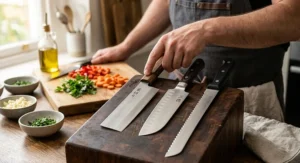
Buying the right blade is only half the job — how you treat it in the first month determines whether it lasts five years or fifteen. Start by giving any new knife, whether it’s the budget PAUDIN Nakiri or the premium Shun Classic Santoku, a proper wash in warm soapy water before first use to remove any protective oil coating from manufacturing. From there, invest in an end-grain wooden or soft plastic cutting board; glass, stone or bamboo composite boards will dull even the best VG-10 or VG-MAX edge within weeks. During the first 30 days, resist the urge to attack frozen food, bones, or hard squash skins with a nakiri specifically — its whole design assumes soft, yielding produce, and forcing it through resistance is the single most common cause of chipped edges we see reported in reviews. A weekly hone with a ceramic or steel rod keeps the edge aligned between proper sharpenings, and most Japanese-steel knives in this guide will hold a genuinely sharp edge for two to four months of regular home use before needing a whetstone session. Store your knife in a blade guard, magnetic strip, or knife block rather than loose in a drawer — blade-on-blade contact is a quietly common cause of premature dulling that rarely gets mentioned on product pages.
Real-World Scenarios: Which Knife Actually Fits Your Kitchen Life
Specs and steel grades only tell half the story — the more useful question is which knife matches how you actually cook on a Tuesday evening. If you’re a university student in a shared flat cooking mostly stir-fries, salads and quick vegetable-forward meals on a tight budget, the Kai Wasabi Black Nakiri or PAUDIN Nakiri covers nearly everything you’ll touch for well under £45, with enough performance to make cooking feel less like a chore. If you’re a busy parent cooking for a family most nights — chopping vegetables one minute, portioning chicken thighs the next — a santoku’s all-purpose geometry earns its keep far more than a specialist blade; the Tojiro DP Santoku offers real Japanese steel performance without premium pricing, while the MAC Superior Santoku suits anyone ready to treat their evening cooking as a proper daily ritual worth investing in. For the enthusiast home cook who already owns a solid Western chef’s knife and wants to add genuine Japanese precision for vegetable-heavy meal prep or dinner-party plating, the Shun Classic Nakiri and Shun Classic Santoku reward the investment with edge retention and balance that a casual cook simply won’t wear out.
What Is a Nakiri Knife? And What Is a Santoku Knife?
A nakiri knife is a Japanese vegetable knife with a flat, rectangular blade and a squared-off tip, designed for straight up-and-down push cuts rather than a rocking motion. A santoku knife is a general-purpose Japanese kitchen knife with a curved sheepsfoot tip, built to handle vegetables, fish and boneless meat equally well in one blade.
The name difference actually tells you most of what you need to know. “Nakiri” translates roughly to “leaf cutter,” a nod to its origins as a dedicated vegetable specialist dating back to Japan’s Edo period. “Santoku” means “three virtues” or “three uses,” referencing meat, fish and vegetables — the three ingredient categories it was designed in the mid-20th century to handle in a single blade. That’s not marketing spin; the santoku was developed in the 1940s specifically to fold the strengths of three traditional specialist blades — the deba for fish, the gyuto for meat, and the nakiri for vegetables — into one universal, general-purpose knife, which is precisely why it became the default “first Japanese knife” recommendation for so many Western home cooks.
Blade Shape Differences Explained: Where the Two Knives Actually Diverge
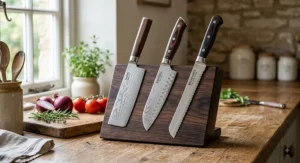
The single biggest blade shape difference between these two knives comes down to the tip and the spine curve. A nakiri’s cutting edge runs almost perfectly straight from heel to the squared-off front corner, meeting the cutting board flush along its entire length with every stroke. That flat contact is precisely why nakiris produce such uniform, clean cuts through cabbage, carrots and onions — there’s no curve to rock through, so every slice comes out the same thickness without extra wrist movement. A santoku, by contrast, has a gently curved spine that drops towards a rounded sheepsfoot point, giving the blade a slight belly that allows for a small rocking motion in addition to straight chopping. This curve is also what makes a santoku noticeably safer and less intimidating for less confident cooks — there’s no sharp point aimed at your fingers the way there is on a Western chef’s knife, but you still retain enough tip control to do detail work like trimming fat or deveining prawns. Blade height differs too: nakiris tend to run slightly taller from edge to spine, which gives your knuckles more clearance above the board — a small detail that makes a genuine difference during long prep sessions.
✨ Ready to feel the difference for yourself? Compare current prices on the picks above before they change.🤗
How to Choose Between a Nakiri and a Santoku
- Audit what you actually cook most. If vegetables dominate your weekly meals, lean nakiri; if your cooking is genuinely mixed between veg, fish and meat, lean santoku.
- Consider your cutting technique. Cooks who already chop with a straight up-down motion will adapt to a nakiri instantly; those who rock the blade slightly will prefer a santoku’s curve.
- Think about knife collection goals. If this is your only Japanese knife, a santoku’s versatility covers more ground; if you already own a chef’s knife or gyuto, a nakiri adds a genuinely complementary specialist tool.
- Match your budget to steel quality, not brand name. A budget nakiri with a true flat profile beats an overpriced “hybrid” shape that compromises on both fronts.
- Factor in hand size and comfort. Nakiris’ taller blade profile suits cooks who want more knuckle clearance; santokus’ lighter, more compact geometry suits smaller hands.
- Check maintenance expectations honestly. Harder Japanese steels (VG-10, VG-MAX) need whetstone care eventually — factor that time commitment into your decision now, not after you’ve bought.
- Read aggregated review themes, not star ratings alone. Look specifically for repeated comments about edge retention and handle comfort, which tell you far more than an average score.
Nakiri vs Santoku vs Chef’s Knife: A Fuller Japanese Knife Comparison
Zooming out for a proper Japanese knife comparison, it helps to place both blades against the Western chef’s knife most UK kitchens already own. A chef’s knife typically runs 20-25cm with a pronounced curved belly built entirely around a rocking motion — brilliant for mincing herbs and breaking down larger cuts of meat, but genuinely awkward for the flat, uniform vegetable slices a nakiri produces effortlessly. The santoku sits somewhere between the two: its straight-ish edge and rounded tip let it handle almost any ingredient with reasonable competence, while the nakiri stays laser-focused on vegetable work alone with its rectangular blade and squared profile. In practice, the chef’s knife wins on raw versatility and heavier tasks like breaking down a squash or portioning a whole chicken; the santoku wins on precision and lighter, faster prep; and the nakiri wins outright when vegetables are the entire job. If you’d like to see how these Japanese-style blades stack up against tested Western chef’s knives, Which?’s independent kitchen knife reviews are a genuinely useful, unbiased reference point. None of the three is objectively “best” — they’re each optimised for a slightly different cooking style, which is exactly why professional kitchens and serious home cooks tend to own more than one.
Common Mistakes When Buying a Nakiri or Santoku Knife
The most frequent mistake we see is buyers choosing based on looks alone — a stunning Damascus pattern doesn’t tell you anything about the steel hardness underneath it, and some budget knives use decorative etching purely for visual appeal rather than genuine layered construction. A second common error is assuming a longer blade automatically means better performance; both nakiris and santokus are deliberately compact (typically 13-18cm), and going oversized just makes the knife harder to control for the precise, repetitive cuts these shapes exist for. Third, buyers frequently underestimate maintenance requirements, purchasing a premium VG-MAX blade and then running it through a dishwasher or a cheap pull-through sharpener that grinds away the very edge geometry they paid extra for. Finally, plenty of first-time buyers pick a santoku when what they actually needed was a nakiri (or vice versa) simply because they didn’t know the shapes existed as distinct categories — hopefully this guide has already solved that particular mistake for you.
The Home Cook Knife Guide: A Buyer’s Decision Framework
If you cook vegetables more than four times a week and rarely touch raw meat or fish at the board, choose a nakiri, because its flat edge will out-perform any curved blade on the exact tasks you’re doing most. If your cooking is genuinely mixed — vegetables one night, chicken thighs the next, herbs scattered throughout — choose a santoku, because its all-purpose geometry means you’re not reaching for a second knife mid-recipe. If budget is your primary constraint, prioritise a true blade shape over a premium brand name; a well-made £35 knife with the correct geometry for your cooking style beats an £150 knife in the wrong shape for how you actually cook. And if you’re building a proper knife collection over time rather than buying just one blade, the sensible sequence is usually: a Western chef’s knife first for general heavy-duty work, then a santoku for daily precision, then a nakiri once you know vegetable prep is a big enough part of your cooking to justify a dedicated specialist.
Nakiri and Santoku Knives for Different Home Cooks
Beginners genuinely benefit most from a santoku’s forgiving, all-purpose nature — you won’t find yourself needing a second knife for basic weeknight meals, and the rounded tip is less intimidating than a pointed chef’s knife while you build confidence. Plant-forward and vegetarian cooks should lean hard into the nakiri category; the flat blade’s clean, uniform cuts through everything from cabbage to butternut squash genuinely change how enjoyable vegetable-heavy cooking feels day to day. Enthusiast home cooks who already own a solid all-rounder and want to level up their knife roll should look at the premium picks above — the Shun Classic Nakiri and Shun Classic Santoku — since the edge retention difference only really becomes apparent after months of consistent use, exactly the kind of buyer who’ll notice and appreciate it. Households with children in the kitchen learning knife skills should favour a santoku over a nakiri or a Western chef’s knife purely on safety grounds: the rounded, less aggressive tip reduces risk during supervised practice sessions without sacrificing genuine cutting performance.
Long-Term Cost & Maintenance: What You’re Really Paying For
The upfront price gap between the Kai Wasabi Black Nakiri at around £35 and the Shun Classic Nakiri at around £160 looks enormous until you factor in total cost of ownership over five years of regular use. Budget knives with softer steel (roughly HRC 56-58) typically need a full professional or whetstone resharpen every two to three months of daily use, at a typical UK sharpening service cost of £8-£15 per visit — that adds up to £160-£360 over five years just in upkeep. Premium VG-10 or VG-MAX blades, hardened to HRC 60-61, commonly stretch to four-to-six month intervals between proper resharpens, and both Shun and several other premium Japanese brands include sharpening services as part of ownership. Run the maths over a five-year window and the gap between “cheap knife plus frequent sharpening costs” and “premium knife with occasional maintenance” narrows considerably — though the budget route still wins for anyone who genuinely just wants an affordable, functional blade and doesn’t mind the extra upkeep visits.
Features That Actually Matter (And Those That Don’t)
Steel hardness (HRC rating) and edge angle matter enormously — they directly determine how sharp the knife gets and how long it stays that way, which is the entire point of the purchase. Handle material and tang construction matter too, since a full-tang, properly riveted handle affects balance and long-term durability far more than most buyers expect going in. What matters considerably less than the marketing suggests: the number of Damascus cladding layers beyond a certain point (32 layers looks stunning but performs functionally the same as 16 in terms of actual cutting), and blade length beyond the 16-18cm range, which mostly just makes these compact shapes harder to control. Granton edges (the little dimples along some santoku blades) genuinely help release sticky items like potato or cheese, but they’re a nice-to-have rather than a dealbreaker if the rest of the knife’s fundamentals are sound.
Safety, Sharpening & UK Knife-Buying Rules Home Cooks Should Know
Beyond the cutting technique itself, it’s worth knowing the legal basics around buying knives in the UK, particularly if you’re purchasing as a gift or for a household member. Under current UK law, retailers selling kitchen knives online are required to verify a buyer’s age before completing the sale, and delivery cannot be handed over to anyone under 18 — a rule that applies equally to budget nakiris and premium Shun blades alike, so don’t be surprised if amazon.co.uk or a specialist retailer asks for age confirmation at checkout. For a full breakdown of the current legislation, the government’s own guidance on buying and carrying knives in the UK is the most reliable source. On the sharpening side, always cut on a wooden or soft plastic board, never store a wet knife in a sealed sheath (moisture trapped against carbon-clad steel accelerates corrosion), and consider a proper whetstone once you’re comfortable with basic maintenance — pull-through sharpeners are convenient but tend to remove far more metal than necessary on higher-end Japanese steel.
Frequently Asked Questions
❓ Is a nakiri better than a santoku for a beginner?
❓ Can a nakiri knife cut meat?
❓ What is the difference between a nakiri and a usuba knife?
❓ How often should I sharpen my santoku or nakiri knife?
❓ Is a santoku knife dishwasher safe?
Conclusion: Making Your Nakiri vs Santoku Knife Decision
There’s no universal winner in the nakiri vs santoku knife debate, and honestly, that’s good news rather than a cop-out — it means the “right” answer is simply whichever blade matches how you actually cook. If your kitchen life revolves around vegetables, batch prep and clean, uniform cuts, a nakiri like the budget-friendly Kai Wasabi Black Nakiri or the premium Shun Classic Nakiri will change how enjoyable that daily chopping feels. If you want one knife that handles everything from a Tuesday stir-fry to Sunday’s roast prep without a second blade appearing, a santoku — whether that’s the value-driven Tojiro DP Santoku or the all-rounder MAC Superior Santoku — earns its place as the more flexible everyday tool. Either way, prioritise genuine blade geometry and steel quality over brand prestige alone, treat the knife properly from day one, and you’ll have a tool that outlasts most of the appliances in your kitchen.
✨ Don’t Miss These Exclusive Deals!
🔍 Take your kitchen prep to the next level with the carefully researched picks above. Click through to check current pricing and availability on amazon.co.uk. The right blade shape genuinely makes home cooking faster, safer and more enjoyable for you and your family!
Recommended for You
- Best Nakiri Knife 2026: 7 Top Japanese Picks Rated
- Best Vegetable Cleaver 2026: 7 Top Picks, Tested; Compared
- Chinese Cleaver Knife: 7 Top Picks for UK Cooks in 2026
Disclaimer: This article contains affiliate links. As an Amazon Associate, I earn from qualifying purchases. If you purchase products through these links, we may earn a small commission at no additional cost to you.
✨ Found this helpful? Share it with your friends! 💬🤗
