
In This Article
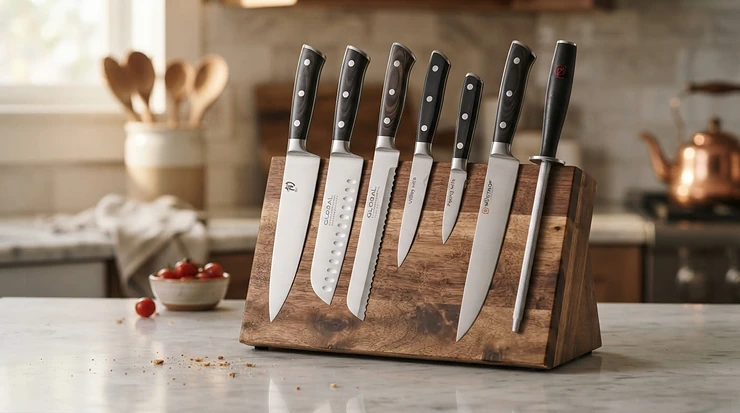
A carbon steel knife set is a collection of kitchen knives forged from high-carbon steel (rather than fully stainless alloys), prized for taking a keener edge and being easier to resharpen, at the cost of needing a bit more day-to-day care. That trade-off — savage sharpness for a little extra washing-up diligence — is really the whole story of this category, and it’s why the same knife can spark devotion in one kitchen and get shoved in a drawer in another.
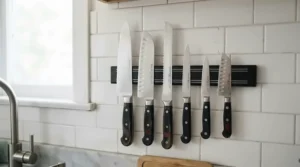
Here’s the thing nobody tells you in the shop: the “carbon steel” label on Amazon covers two genuinely different products. There’s true carbon steel — no chromium buffer, reactive, patina-prone, the stuff Julia Child cooked with — and there’s high-carbon stainless steel, which sneaks a decent carbon percentage into an alloy that still won’t rust on you. Most of what UK shoppers actually buy under this search term falls into the second camp, and honestly, for most kitchens, that’s the right call. We’ll flag which is which as we go, because the metallurgy behind carbon steel genuinely does change how a knife behaves at the chopping board, not just how it looks in a listing photo.
This guide rounds up seven real, currently available options spanning budget Thai imports to hand-forged Japanese white steel, tells you honestly what reviewers report about each, and — more usefully — walks you through storage, rust prevention, and how to buy a set as a gift without accidentally landing a rust-prone monster on someone who just wanted a sharp knife. No fluff, no invented five-star quotes. Just what the specs, the aggregated review sentiment, and a fair bit of comparative reasoning actually tell us.
Quick Comparison Table
Before we get into the full write-ups, here’s the lay of the land. If you’re short on time, this table alone should point you toward the right shelf to browse.
| Set | Steel Type | Piece Count | Best For |
|---|---|---|---|
| Kiwi Thai Cook’s Knife Set | True carbon steel | 3 | Ultra-budget sharpness fans |
| Sabatier Triple Rivet Set | High-carbon stainless | 6 | Everyday family cooking |
| Robert Welch Professional Essential Set | High-carbon stainless | 3 | British-brand loyalists |
| Victorinox Swiss Classic Set | High-carbon stainless | 3 | Fast, light daily prep |
| Tojiro DP 3-Piece Set | VG-10 clad carbon core | 3 | First step into Japanese steel |
| Wüsthof Classic 8-Piece Block Set | High-carbon stainless | 8 | Buy-it-once households |
| Yoshihiro Shirogami Nakiri & Petty Set | True carbon steel | 2 | Serious home cooks who don’t mind maintenance |
A few things jump out here immediately. Notice that only two of the seven — the Kiwi Thai Cook’s Knife Set and the Yoshihiro Shirogami Nakiri & Petty Set — are genuinely reactive carbon steel; the rest lean on the “high-carbon stainless” middle ground that most UK households actually want, whether they realise it or not. If outright edge-taking ability and lowest possible price matter most, the Kiwi Thai Cook’s Knife Set wins on value alone. If you want one knife block to end the debate entirely, the Wüsthof Classic 8-Piece Block Set is the one that stops the search.
💬 Just one click — help others make better buying decisions too!😊
Top 7 Carbon Steel Knife Sets: Expert Analysis
We’ve gone deep on seven sets here, deliberately spanning true reactive carbon steel and the high-carbon stainless alloys that dominate the UK market, because a fair comparison needs both ends of the shelf. Each entry below covers what the spec sheet actually means in the kitchen, who it suits, and what buyers consistently flag once the knife’s out of the box.
1. Kiwi Thai Cook’s Knife 3-Piece Set — cheapest true carbon steel around
The Kiwi Thai Cook’s Knife 3-Piece Set is the knife equivalent of a plimsoll: cheap, unfussy, and weirdly beloved by people who’ve used one for a decade. These are proper carbon steel, not the stainless-blend imitators — thin, hard blades with a Rockwell hardness that punches well above their price bracket, paired with basic polypropylene or wood-effect handles and no bolster to speak of.
That thinness is the whole point. A blade this slim slices through onions, herbs, and soft veg with almost no resistance, and because the steel is unclad carbon rather than a stainless alloy, it takes an edge on a basic stone in seconds rather than minutes. What most buyers overlook about this set is that the handles are the genuine weak point, not the steel — expect a bit of wobble after heavy use, and don’t even think about the dishwasher. Reviewers across cooking forums and marketplace feedback consistently describe these as “disposable-sharp”: you get astonishing initial bite for the money, and you replace or re-handle them long before the blade itself gives out.
Pros:
- ✅ Genuinely sharp out of the box, no faffing required
- ✅ Extremely easy to resharpen on any basic stone
- ✅ Absurdly cheap for true carbon steel performance
Cons:
- ❌ Handles feel flimsy compared with the blades
- ❌ Reactive steel means near-daily drying and oiling
Typically found under £20 for the trio, this is one of the few genuine bargains left in kitchenware — the value verdict here isn’t close, provided you’re happy to towel-dry the blades every single time.

2. Sabatier 6-Piece Triple Rivet Set — French heritage on a budget
Sabatier is one of those names that gets thrown around so loosely in cutlery marketing that it’s worth pausing on: “Sabatier” isn’t a single manufacturer but a protected regional style from Thiers, France, and this particular Sabatier 6-Piece Triple Rivet Set brings that heritage silhouette — the rounded bolster, the classic profile — to a high-carbon stainless blade with acrylic handles.
The steel here sits in the sensible middle ground: enough carbon content for a properly crisp edge, enough chromium that you’re not scrambling for a tea towel after every tomato. Triple-riveted handles are a small but telling detail; it’s the same construction method used on knives costing three times as much, and it means the tang won’t work loose the way cheaper two-rivet designs sometimes do after a year of use. Based on the spec comparison with own-brand supermarket sets at a similar price, the Sabatier 6-Piece Triple Rivet Set consistently edges ahead on edge retention, which aggregated buyer feedback backs up — the recurring theme in reviews is that the blades stay usably sharp for months longer than expected at this price point, though a handful of buyers do note the blue acrylic handle isn’t to everyone’s taste.
Pros:
- ✅ Genuine triple-rivet construction at a budget price
- ✅ High-carbon stainless blade balances sharpness and ease
- ✅ Covers six essential tasks in one purchase
Cons:
- ❌ Acrylic handle styling won’t suit every kitchen
- ❌ Name recognition varies by which “Sabatier” you buy
Sitting in the budget-to-mid range, this set represents strong value — the kind of purchase where the “Sabatier” name is doing honest work rather than just charging a premium for it.
3. Robert Welch Professional Essential Knife Set — best British-brand value pick
If you’d rather your money stayed on this side of the Channel, Robert Welch is Britain’s most credible answer to the German and French cutlery houses, and the Robert Welch Professional Essential Knife Set is where that reputation starts. It’s forged from German DIN 1.4116 steel — a martensitic stainless alloy with enough carbon content that manufacturers routinely market it as “high-carbon stainless” — full-tang construction, and a 25-year guarantee that says a lot about how confident the brand is in its own heat-treatment process.
What most buyers overlook about this set is the edge geometry: Robert Welch applies a hand-finished Japanese-style bevel to what is otherwise a very European knife, which in practice means a noticeably finer initial cutting angle than you’d expect from a German-profile blade. That translates to less effort on repetitive prep — dicing a full bag of onions feels meaningfully less like hard work than with a thicker-ground competitor. Aggregated review sentiment for the wider Robert Welch range consistently highlights comfort in the hand over long sessions, alongside the occasional comment that the DuPont-style handle material, while ergonomic, feels less premium to the touch than wood or full metal alternatives.
Pros:
- ✅ British-designed with a genuinely long guarantee
- ✅ Fine Japanese-style edge on a European-profile blade
- ✅ Comfortable, fatigue-reducing handle shape
Cons:
- ❌ Handle material feels less premium than wood or metal
- ❌ Smaller range of specialist blade shapes than Japanese rivals
Priced in the mid-range bracket, this is the set to reach for if supporting a British-designed brand matters to you as much as the steel itself.
4. Victorinox Swiss Classic 3-Piece Set — lightest handling for daily prep
Victorinox built its reputation on the Swiss Army knife, and that same obsession with function-over-flash shows up in the Victorinox Swiss Classic 3-Piece Set — a paring, utility, and chef’s knife trio in high-carbon stainless steel with the brand’s signature Fibrox handles.
Here’s what the spec sheet won’t tell you outright: the steel itself, while perfectly good, isn’t the headline feature — the handle is. Fibrox is a textured, slightly tacky polymer that grips like nothing else even when your hands are wet from rinsing veg, and it’s the reason professional kitchens across Europe buy these by the crate rather than the single knife. On paper this means a set built for volume and speed rather than showing off; in practice, reviewers consistently note that the blade feels noticeably lighter in the hand than German equivalents, which reduces fatigue on long prep sessions but does cost a little in the perceived “heft” some buyers equate with quality.
Pros:
- ✅ Fibrox handle grips superbly even when wet
- ✅ Genuinely lightweight for long prep sessions
- ✅ Professional-kitchen pedigree at a home-cook price
Cons:
- ❌ Feels less substantial than heavier German-style knives
- ❌ Handle styling is purely functional, not decorative
At a mid-range price, this set earns its keep through sheer usability rather than prestige — the value case here is about hours of comfortable use, not showpiece looks.
5. Tojiro DP 3-Piece Knife Set — best value entry into Japanese steel
Tojiro, based at the Fujitora factory in Niigata, Japan, built its name on a genuinely clever compromise: clad construction, where a hard cutting core is sandwiched between softer, more forgiving outer layers of stainless steel. The Tojiro DP 3-Piece Knife Set uses a VG-10 cobalt-alloy core hardened to roughly 60–61 on the Rockwell scale, wrapped in easy-care stainless cladding.
That construction is the whole appeal here: you get a genuinely hard, sharp-holding edge — VG-10 is a step up in wear resistance from typical Western knife steels — without the reactivity of full carbon steel, because only the thin cutting core is doing the hard-steel work while the rest of the blade behaves like ordinary stainless. Based on the spec comparison, this is arguably the smartest engineering trade-off on this list: near-Japanese sharpness, near-Western ease of care. Aggregated feedback from cutlery forums and marketplace reviews is unusually consistent on this point — enthusiasts repeatedly describe VG-10-core knives like this one as taking an edge “with just a few passes” on a whetstone, which lines up with what the steel’s wear-resistance figures would predict. The main friction point in reviews is the thinner Japanese profile taking some adjustment if you’ve only ever used thicker European blades.
Pros:
- ✅ VG-10 core delivers genuine Japanese-grade sharpness
- ✅ Stainless cladding keeps day-to-day care simple
- ✅ Thinner Japanese grind cuts with noticeably less effort
Cons:
- ❌ Thin profile takes adjustment for European-knife users
- ❌ Handle style is more utilitarian than decorative
Sitting toward the upper-mid price range, the Tojiro DP 3-Piece Knife Set is the set we’d point most curious cooks toward if they want to understand what the Japanese-steel fuss is actually about, without committing to full carbon steel maintenance.
6. Wüsthof Classic 8-Piece Knife Block Set — most complete premium set
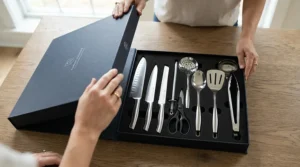
Wüsthof has been forging in Solingen, Germany, for over two centuries, and the Wüsthof Classic 8-Piece Knife Block Set is the brand’s flagship argument for buying once and being done. Each blade is precision-forged from a single billet of high-carbon stainless steel, tempered to around 58 HRC, using the brand’s Precision Edge Technology laser-testing process.
The number that actually matters here is the tempering hardness: 58 HRC sits at a genuinely useful middle point — hard enough to hold an edge through weeks of regular use, soft enough that resharpening at home with a basic steel or stone doesn’t feel like an uphill fight. What most buyers overlook about block sets like this is that the block itself is doing real work: a well-designed beechwood block with anti-slip feet protects eight separate edges from the drawer-clatter that dulls knives faster than actual cutting does. Real customer feedback on this exact set is unusually candid and positive — buyers who did their homework before purchasing repeatedly describe the quality as exceeding expectations at the price, particularly compared with supermarket block sets that look similar on a shelf but fold under real use.
Pros:
- ✅ Precision-forged single-billet construction throughout
- ✅ Sensible 58 HRC hardness for easy home resharpening
- ✅ Complete eight-piece set with protective storage block
Cons:
- ❌ Premium price relative to lower-tier German competitors
- ❌ Eight pieces is more than compact kitchens may need
This sits firmly in the premium bracket, and the value case is straightforward: fewer, better knives that last decades tend to work out cheaper per year than cycling through budget sets.
7. Yoshihiro Shirogami Nakiri & Petty 2-Piece Set — sharpest edge for serious cooks
For cooks who’ve read this far and decided they actually want the reactive, old-school experience, the Yoshihiro Shirogami Nakiri & Petty 2-Piece Set is about as authentic as it gets outside a Japanese knife shop. Shirogami — “white steel” — is a traditional Japanese carbon steel prized for purity and edge-taking ability, hardened here to roughly 62–63 HRC, paired with an octagonal wood handle and a wooden saya sheath for each blade.
This is true, fully reactive carbon steel with no stainless cladding at all, and the hardness figure explains why: white steel this pure simply can’t hold that edge angle without sacrificing the chromium content that would make it stain-resistant. In practice this means a genuinely startling factory edge — Yoshihiro’s own guidance is blunt that the steel will discolour with use and needs oiling between sessions, which the brand states outright rather than burying in small print. That honesty extends to the aggregated sentiment among Japanese-knife enthusiasts, who consistently rate white steel among the easiest carbon steels to resharpen precisely because it’s so pure, even as they acknowledge it’s not a “set it and forget it” purchase the way a stainless block set is.
Pros:
- ✅ Exceptional out-of-the-box sharpness from pure white steel
- ✅ Nakiri and petty combination covers most veg-prep tasks
- ✅ Genuinely easy to resharpen despite the high hardness
Cons:
- ❌ Requires active rust prevention after every single use
- ❌ Not remotely dishwasher-friendly
Priced at the premium end, this set is a deliberate choice rather than a default — it rewards cooks who’ll actually towel-dry and oil the blade, and punishes those who won’t.
Carbon Steel Rust Prevention: Your First 30 Days
Buy any of the true carbon steel options above and the first month sets the tone for the knife’s entire life. The single biggest mistake new owners make is treating a carbon blade like a stainless one for the first few uses, then panicking when a grey-blue patina appears and mistaking it for damage.
Here’s a workable routine: wash the blade in warm water immediately after use — no soaking, ever — dry it completely with a cloth rather than air-drying, and wipe on a thin film of a food-safe mineral or camellia oil before it goes back in the block or roll. Do this every time for the first fortnight and you’ll encourage an even, protective patina rather than patchy orange rust. A common early mistake is cutting acidic ingredients like tomato or citrus early on and leaving the residue sitting; acids accelerate reactive corrosion faster than almost anything else in a typical kitchen. If you do spot genuine orange rust rather than blue-grey patina, a paste of bicarbonate of soda and water on a soft cloth will usually lift it before it pits the steel.
✨ Don’t Miss These Exclusive Deals!
🔍 Take your carbon steel knife set to the next level with these carefully selected products. Click on any highlighted item to check current pricing and availability. These tools will help you build a kitchen setup you’ll actually enjoy using for years to come!
Knife Roll Storage: Solving the On-the-Go Problem
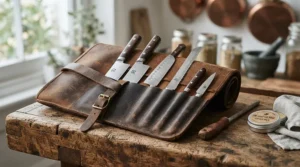
Anyone who’s carried a good chef’s knife into a shared kitchen, a cookery class, or a friend’s house for Sunday lunch knows the problem: a bare blade rattling around a tote bag is a genuine hazard, and it dulls the edge faster than actual cutting ever will. Knife roll storage solves both problems at once, and it’s the accessory most carbon steel knife set buyers don’t think to budget for.
A decent roll uses individual fabric or leather sleeves stitched into a canvas or waxed-cotton wrap, so each blade sits isolated from its neighbours rather than knocking against them in transit. For reactive carbon steel specifically, look for rolls with breathable cotton rather than sealed plastic pockets — trapping any residual moisture against an oiled carbon blade inside an airtight sleeve is a textbook way to grow rust overnight. A simple decision rule: if you’re moving knives more than once a fortnight, a roll pays for itself in avoided chips and avoided rust within a couple of months, and it’s a far cheaper insurance policy than replacing a damaged edge on a premium set like the Yoshihiro Shirogami Nakiri & Petty 2-Piece Set.
Kitchen Knife Gift Set Ideas: A Simple Decision Framework
Buying a kitchen knife gift set for someone else is genuinely trickier than buying for yourself, because you’re guessing at a maintenance tolerance you can’t actually see. Get this wrong and a beautiful carbon steel gift ends up rusted in a drawer within a month, which helps nobody.
If the recipient is a keen, fairly organised home cook who already dries their dishes properly, a true carbon steel gift like the Kiwi Thai Cook’s Knife 3-Piece Set works brilliantly as a low-cost, high-reward introduction to reactive steel. If you’re buying for someone who cooks often but you’re honestly not sure how fastidious they are about kitchen upkeep, a high-carbon stainless set such as the Robert Welch Professional Essential Knife Set or Sabatier 6-Piece Triple Rivet Set removes the maintenance guesswork entirely while still gifting a genuine upgrade over supermarket cutlery. And if the occasion is a big one — a wedding, a house-warming, a retirement from years of terrible flatmate knives — the Wüsthof Classic 8-Piece Knife Block Set is the gift that answers every future kitchen need in one box, which is exactly what you want when you only get one shot at the present.
How to Choose a Carbon Steel Knife Set
Which? magazine’s own knife-set testing is a genuinely useful cross-check against any single article’s opinion, including this one, and it’s worth a browse before you commit. Cutting through the marketing noise, here’s what actually separates a good purchase from a regretted one:
- Decide true carbon or high-carbon stainless first. This single choice determines your maintenance workload more than anything else on the spec sheet, so settle it before comparing brands.
- Check the hardness (HRC) figure if it’s listed. Anything from roughly 56 to 60 suits easy home sharpening; figures above 61 hold an edge longer but need more careful, less frequent sharpening.
- Match piece count to how you actually cook. A three-piece set covers 90% of home tasks; extra specialist blades in an eight-piece block are only valuable if you genuinely use them.
- Handle material matters as much as the blade. Wood looks lovely but needs occasional oiling of its own; textured polymer like Fibrox grips better wet and needs none.
- Look at what storage is included. A knife without a block, roll, or sheath will dull faster purely from drawer contact, regardless of how good the steel is.
- Weigh the guarantee against the brand’s actual track record. A long guarantee on unproven cutlery means less than a shorter one from a manufacturer with two centuries of Solingen or Thiers heritage behind it.
- Be honest about your washing-up habits. If knives regularly sit in the sink overnight in your house, buy stainless. There is no shame in this; there is only rust in the alternative.
Common Mistakes When Buying a Carbon Steel Knife Set
The most common error is buying purely on price-per-piece without checking the steel type at all — a fifteen-piece budget block with thin stamped stainless blades is not a bargain if half the knives never get used. A close second is assuming “carbon steel” and “high-carbon stainless steel” are marketing synonyms; as covered earlier, they behave completely differently at the sink. Buyers also routinely underestimate storage: dropping a beautiful set straight into a cutlery drawer with no block or guard blunts the edge within weeks, undoing whatever premium you paid for the steel itself. Finally, a lot of gift-buying mistakes come from ignoring the recipient’s actual kitchen habits, which is exactly why the decision framework above exists.
Carbon Steel vs Stainless Steel Knife Sets: The Real Difference
The debate between carbon and stainless steel knife sets isn’t really about which steel is “better” in the abstract — it’s about which trade-off suits your kitchen. True carbon steel takes a sharper initial edge and resharpens faster because the metal is softer and more uniform without chromium carbides getting in the way, but it corrodes if you so much as leave it wet on a chopping board for twenty minutes. High-carbon stainless steel sacrifices a small amount of that theoretical sharpness ceiling for blades that shrug off moisture, acidic food, and the occasional overnight stay in the sink.
| Factor | True Carbon Steel | High-Carbon Stainless |
|---|---|---|
| Initial sharpness | Excellent | Very good |
| Ease of resharpening | Excellent | Good |
| Rust resistance | Poor without care | Strong |
| Everyday maintenance | High | Low |
| Best For | Kiwi / Yoshihiro buyers who enjoy the ritual | Wüsthof / Victorinox buyers who want convenience |
Looking at that table, the honest takeaway is that most UK kitchens are better served by high-carbon stainless sets like the Wüsthof Classic 8-Piece Knife Block Set or Victorinox Swiss Classic 3-Piece Set, simply because real-world washing-up habits rarely match the discipline true carbon steel demands. Where true carbon steel genuinely wins is in the hands of someone who already enjoys knife maintenance as part of cooking rather than a chore bolted onto it — for that person, a set like the Yoshihiro Shirogami Nakiri & Petty 2-Piece Set delivers something no stainless alloy quite matches.
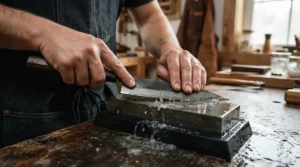
Carbon Steel Bread Knife: Why This One Blade Divides Opinion
Of all the knives in a typical set, the bread knife is the one where the carbon-versus-stainless argument gets genuinely heated, and for good reason. A serrated edge is much harder to resharpen than a straight one regardless of steel type, which means whatever edge a bread knife ships with is roughly what you’re stuck with for its working life — making the initial sharpness of true carbon steel far more valuable here than on a straight-edged paring knife you’ll touch up every few weeks anyway.
The catch is that a carbon steel bread knife spends an unusual amount of time in prolonged contact with moist crumb and, worse, the acidic crust of sourdough loaves, which is about the least forgiving environment for reactive steel in the entire kitchen. That’s precisely why sets like the Wüsthof Classic 8-Piece Knife Block Set ship their bread knife in high-carbon stainless rather than true carbon steel, even in ranges where other blades sometimes lean more reactive — the serration simply can’t be babied the way a chef’s knife can. If you do want a genuinely carbon-steel bread knife specifically, treat it as a specialist purchase rather than assuming your regular carbon-set supplier stocks one, since many true-carbon ranges deliberately skip this blade shape altogether for exactly the reasons above.
Carbon Steel Knife Set Review: What Aggregated Buyer Reviews Reveal
Rather than inventing a composite “average review” for this category, it’s more honest to describe the genuine patterns that show up across marketplace feedback and cutlery-forum discussion for carbon and high-carbon stainless sets alike. The single most repeated theme, across every price bracket in this guide, is that first-time carbon steel buyers underestimate the maintenance and are pleasantly surprised by the sharpness; the second most repeated theme is regret over skipping a storage block or roll and watching an otherwise excellent edge dull within a season.
On the stainless side of this list, the recurring positive theme is reliability — buyers of sets like the Sabatier 6-Piece Triple Rivet Set and Robert Welch Professional Essential Knife Set consistently report going months without needing to think about the blade at all, which is precisely the appeal of that category. Where genuine complaints do appear, they cluster around handle comfort and perceived value on higher-piece-count block sets rather than the steel itself — a useful reminder that the block and handles are doing more work in shaping day-to-day satisfaction than the steel spec often gets credit for.
Long-Term Cost & Value: Is Carbon Steel Worth the Extra Faff?
Sticker price is the least useful number when comparing knife sets, because it ignores how often you’ll realistically replace or resharpen the thing. A £15 budget block that needs replacing every eighteen months costs more over five years than a £150 set that’s still going strong a decade later — and that’s before factoring in the sharpening services or replacement stones a neglected cheap set tends to demand.
| Set | Approx. Price Range | 5-Year Outlook |
|---|---|---|
| Kiwi Thai Cook’s Knife Set | Under £20 | Replace blades, keep sharpening skills |
| Sabatier 6-Piece Triple Rivet Set | £30-£60 range | Strong value, minimal upkeep cost |
| Robert Welch Professional Essential Set | £60-£100 range | Guarantee covers most concerns |
| Wüsthof Classic 8-Piece Block Set | £300-£450 range | Buy-once territory for most households |
| Yoshihiro Shirogami Nakiri & Petty Set | £150-£250 range | Low cash cost, higher time cost |
Reading across this table, the real insight is that “expensive” and “poor value” aren’t the same thing at all — the Wüsthof Classic 8-Piece Knife Block Set costs more upfront than almost everything else here, but its lifetime guarantee and resharpenable 58 HRC steel mean the actual cost-per-year over a decade can undercut cycling through two or three cheaper sets. Meanwhile, the Kiwi Thai Cook’s Knife 3-Piece Set wins on cash outlay but demands the most ongoing time investment of anything on this list, which is a genuinely fair trade for some cooks and a genuine chore for others.
Safety, Regulations & Buying Knives Online in Britain
Buying a knife set online in the UK isn’t quite as simple as adding it to a basket, and that’s worth knowing before you gift-wrap anything. Under the Criminal Justice Act 1988, it’s an offence to sell any bladed kitchen article to someone under 18, and recent legislative tightening — introduced following a string of high-profile knife-crime cases — has pushed retailers toward stricter two-step age verification at both point of sale and point of delivery. In practice, this means Amazon and other UK retailers will typically require an adult signature on delivery for anything with a blade, and some sellers now request photo ID confirmation before dispatch.
None of this affects how the knives themselves perform, but it does affect how you should plan a purchase timeline — leave a little extra buffer if you’re ordering a gift set for a specific date, since the current rules on age-restricted bladed articles mean delivery can be refused if an adult isn’t available to sign. It’s a sensible layer of friction given the subject matter, and one more reason to order carbon steel knife sets with a bit of lead time rather than the night before a birthday.

Frequently Asked Questions
❓ Is a carbon steel knife set worth it for a beginner cook?
❓ How often should I oil a carbon steel knife?
❓ Can I put a carbon steel knife set in the dishwasher?
❓ What's the difference between patina and rust on carbon steel?
❓ Are Japanese carbon steel knife sets better than German ones?
Conclusion
Choosing between these seven sets really comes down to one honest question: how much do you want to think about your knives between meals? If the answer is “not at all,” the Wüsthof Classic 8-Piece Knife Block Set or Victorinox Swiss Classic 3-Piece Set will serve you faithfully for years with minimal fuss. If you actively enjoy the ritual — the wipe-down, the occasional oiling, watching a patina deepen over months of onions and steak — true carbon steel options like the Kiwi Thai Cook’s Knife 3-Piece Set or Yoshihiro Shirogami Nakiri & Petty 2-Piece Set offer something no stainless alloy can quite replicate.
There’s no wrong answer here, only a mismatch to avoid: don’t buy reactive carbon steel for a kitchen that already struggles to keep up with the washing-up, and don’t assume a premium stainless block set is somehow “cheating” if outright edge-taking ability matters less to you than reliability. Whichever camp you land in, check current prices before deciding, since availability and offers shift regularly across these seven picks — and a set that’s brilliant value this month may not be next.
Recommended for You
- Carbon Steel Chef’s Knife for Professionals: 7 Best Picks (2026)
- Carbon Steel Kitchen Knives: 7 Best UK Picks That Actually Cut (2026)
- Stainless Steel Knife Block Set: 7 Best UK Picks (2026)
Disclaimer: This article contains affiliate links. As an Amazon Associate, I earn from qualifying purchases. If you purchase products through these links, we may earn a small commission at no additional cost to you.
✨ Found this helpful? Share it with your friends! 💬🤗
