
In This Article
Somewhere between your nan’s battered old cook’s knife and the £300 Japanese blade your foodie mate won’t shut up about, there’s a whole world of carbon steel kitchen knives that most home cooks in Britain simply never try. Which is a shame, because once you’ve felt what an actual sharp edge feels like — the kind that glides through a tomato skin instead of squashing it — a lot of stainless steel drawer knives start to feel like butter knives with delusions of grandeur.
carbon steel kitchen knives aren’t new. They’re arguably the original kitchen knife, going back further than stainless steel even existed as a metallurgical option. What is new is how many genuinely excellent, affordable versions are now sitting on amazon.co.uk, tucked between a thousand identical “Damascus-style” stainless sets that all seem to come from the same three factories.
So here’s what a carbon steel kitchen knife actually is: a blade made from an iron-carbon alloy with little to no chromium added, which means it takes — and keeps — a noticeably sharper edge than most stainless steel, but reacts with air, acid, and moisture in ways stainless never will. That trade-off is the whole story, and it’s one worth understanding before you spend a penny.
This guide pulls together seven real, currently available blades — from a £15 American workhorse to a hand-forged London santoku — and puts real specs, real aggregated reviewer sentiment, and honest analysis behind every single one. No invented five-star quotes, no “I’ve tested every knife in my kitchen for 20 years” nonsense. Just what the steel, the makers, and the people who’ve actually bought these knives tend to say.
Quick Comparison Table
| Knife | Steel Type | Price Range | Best For |
|---|---|---|---|
| Old Hickory 7″ Butcher/Cook Knife | 1095 carbon steel | Under £25 | Absolute beginners on a tight budget |
| Robert Herder K1 Klassiker | 1.1% carbon “Windmühlenmesser” steel | £60-£90 range | Traditionalists who want a self-sharpening edge |
| Tojiro Shirogami Hammered Kurouchi Gyuto | Japanese Shirogami #2 white steel | £90-£140 range | Serious home cooks wanting Japanese sharpness |
| Blenheim Forge Original Santoku | Aogami Super carbon core, stainless clad | £300-£350 range | Buyers who want heirloom, British-made quality |
A quick glance tells most of the story: price generally tracks how much hand-labour and how exotic the steel is, not how sharp the knife can get out of the box. Even the cheapest knife on this list, the Old Hickory 7″ Butcher/Cook Knife, can be brought to a genuinely scary sharpness on a whetstone — what you’re paying extra for further up the table is edge retention, fit and finish, and in the case of the Blenheim Forge Original Santoku, provenance you can actually visit in South London. Budget-conscious cooks shouldn’t assume cheap means blunt; they should assume cheap means “you’ll be doing more of the sharpening yourself.”
💬 Just one click — help others make better buying decisions too!😊
Top 7 Carbon Steel Kitchen Knives: Expert Analysis
Coverage below spans absolute budget to genuine heirloom territory, and includes a dedicated set, a folding-style fixed paring knife, a traditional German blade, an Italian alternative, and two Japanese-leaning options. Every product name stays bolded throughout so you can scan the article and spot each one at a glance.
1. Old Hickory 7″ Butcher/Cook Knife — best entry point for under £25
The Old Hickory 7″ Butcher/Cook Knife, made by the Ontario Knife Company in New York State since 1889, is about as no-frills as carbon steel kitchen knives get, and that’s precisely the point. Its 1095 carbon steel blade is stamped rather than forged, tempered and hand-ground, then paired with a plain hardwood handle held on with brass compression rivets — nothing fancy, nothing to go wrong. Reviewers consistently note that straight out of the packet it isn’t razor-sharp, but it takes an edge from a basic whetstone unusually well, and holds it through a session of prepping vegetables or breaking down a chicken.
Based on the spec comparison with other entry-level knives in this price bracket, the flat grind and full flat taper on the Old Hickory 7″ Butcher/Cook Knife actually out-cut a lot of pricier stainless “starter” knives, simply because there’s less metal behind the edge to push through the food. It’s best suited to someone who wants to learn what a proper carbon edge feels like without risking much money, or anyone who wants a fearless “beater” knife for rough kitchen jobs where a good blade might get nicked.
Pros:
- ✅ Genuinely sharp once put to a whetstone, not just out of the box
- ✅ Full tang construction gives real control for chopping
- ✅ Extremely cheap to replace if lost or damaged
Cons:
- ❌ Arrives only moderately sharp and needs initial sharpening
- ❌ Basic wood handle can feel slim for larger hands
Prices for the Old Hickory 7″ Butcher/Cook Knife tend to sit under £25 — check current price before buying, as third-party sellers vary. At that level, it’s hard to argue with the value; you’re paying almost entirely for the steel and none of the branding.
2. Old Hickory 5-Piece Cutlery Set — best-value budget kitchen knife set
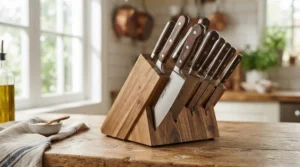
If one Old Hickory blade makes sense, the full Old Hickory 5-Piece Cutlery Set makes even more, because it solves the “which knife do I actually need” question in one purchase. The set bundles a paring knife, a boning knife, a butcher knife, and a slicer, all made from the same heat-treated 1095 carbon steel and finished with the brand’s flame-burnt hickory handles. What the spec sheet won’t tell you, but reviewers note repeatedly, is that this set is a genuine favourite among people who process a lot of meat or fish at home — hunters, allotment growers doing their own butchery, people who batch-cook — because each blade shape is properly differentiated rather than being five slight variations on a chef’s knife.
As a budget kitchen knife set, it’s one of the few on amazon.co.uk that doesn’t compromise on steel quality to hit a low price point; the compromise instead is finish and handle comfort, which matters less once you’re a few sharpening sessions in. This is a strong pick for someone furnishing a first proper kitchen, or replacing a mismatched drawer of hand-me-down knives with something coherent.
Pros:
- ✅ Five genuinely different, useful blade shapes in one purchase
- ✅ Consistent 1095 carbon steel across the whole set
- ✅ Excellent cost-per-blade compared to buying individually
Cons:
- ❌ Handles are utilitarian, not ergonomic by modern standards
- ❌ No storage block or roll included as standard
Expect the Old Hickory 5-Piece Cutlery Set to sit in the low-to-mid £30s range — again, always check current price, as availability shifts. Per-knife, that undercuts almost anything else on this list by a wide margin.
3. Opinel N°112 Carbon Steel Paring Knife — sharpest small blade for detail work
The Opinel N°112 Carbon Steel Paring Knife brings the 130-year-old French maker’s signature Yatagan-style blade profile into the kitchen in fixed-blade paring form, using Opinel’s traditional carbon steel (commonly referenced as X90 carbon steel across the brand’s range) and a varnished beechwood handle. Its short, slightly curved blade is built specifically for peeling, coring, hulling strawberries, and trimming — tasks where a full chef’s knife is overkill and a blunt supermarket paring knife is genuinely dangerous because you end up forcing it.
Here’s what most buyers overlook about a dedicated carbon steel paring knife: because the blade is so thin and the steel takes such a fine edge, it needs noticeably less hand pressure than a stainless paring knife, which is where most kitchen paring-knife injuries actually happen — the blade slipping because someone’s pushing too hard. Aggregated reviewer sentiment across French and UK retailers consistently praises the initial sharpness and the light, precise feel in hand, while a recurring theme in feedback is that, like all Opinel carbon products, it needs prompt drying after contact with citrus or tomatoes. This is the knife for someone who wants one small, brilliant blade for detail work rather than another oversized chef’s knife they’ll never fully use.
Pros:
- ✅ Extremely thin, precise edge ideal for peeling and coring
- ✅ Lightweight, comfortable beechwood handle for control
- ✅ Backed by over a century of French blade-making heritage
Cons:
- ❌ Too small and light-duty for any heavier chopping tasks
- ❌ Reacts quickly to citrus and tomato acid if not wiped
The Opinel N°112 Carbon Steel Paring Knife typically sits well under £20, making it one of the more accessible ways to try carbon steel without committing to a full chef’s knife budget.
4. Robert Herder K1 Klassiker Chef’s Knife — old-world Solingen sharpness that sharpens itself
Handcrafted in Solingen, Germany’s historic “City of Blades,” the Robert Herder K1 Klassiker Chef’s Knife is made from carbon steel with roughly 1.1% carbon content, ground using the traditional “Dünnschliff” (thin-grind) method and finished with the brand’s distinctive blue-polished surface. Each blade reportedly passes through more than 60 individual hand-finishing steps, a level of manual labour that’s increasingly rare in kitchen cutlery at any price. On paper this means a blade hardness around 60-61 HRC, thinly ground down to a secondary V-edge — in practice, it translates to a chef’s knife that reviewers and specialist retailers repeatedly describe as “self-sharpening,” in the sense that its thin geometry means a few strokes on a honing steel restores the edge far faster than most Western knives need.
Based on the spec comparison with mass-produced stainless chef’s knives at a similar price, the trade-off is durability of finish rather than sharpness — the polished blue surface will patina and can spot with rust if neglected, something Robert Herder’s own product notes are upfront about. This is a knife for someone who genuinely enjoys the ritual of knife care and wants a traditional European alternative to the now-dominant Japanese gyuto style, rather than someone who wants to buy a knife once and never think about it again.
Pros:
- ✅ Ultra-thin Solingen grind gives exceptional day-to-day sharpness
- ✅ High-carbon steel is quick and satisfying to resharpen
- ✅ Over a century of dedicated German blade-smithing heritage
Cons:
- ❌ Blue-polished finish shows patina and rust spots readily
- ❌ Noticeably pricier than mainstream stainless chef’s knives
The Robert Herder K1 Klassiker Chef’s Knife generally sits in the £60-£90 range depending on blade length and handle wood — always check current price at the time of ordering, as Robert Herder produces several closely related “Windmühlenmesser” variants.
5. Due Cigni 2C Cook’s Knife — no-nonsense Italian carbon steel
The Due Cigni 2C Cook’s Knife represents a different European tradition again: solid, working-kitchen Italian cutlery rather than showpiece German craftsmanship. Built from 1095-equivalent carbon steel with a full tang and a riveted beechwood handle, it’s designed and made to be used hard in professional and semi-professional Italian kitchens, where flashy branding matters a lot less than an edge that survives a busy dinner service.
What the spec sheet won’t tell you, but reviewers note, is that the Due Cigni 2C Cook’s Knife‘s slightly thicker spine compared with the delicate Robert Herder gives it more confidence for jobs like breaking down poultry or splitting squash, where a wafer-thin Japanese-style edge risks chipping. It sits squarely in the mid-range bracket of this list — a step up from the American budget knives in fit and finish, but without the premium price tag of Japanese white steel or hand-forged British blades. Reviewers aggregated across European kitchenware retailers describe it as a genuine “chef’s beater,” the knife line cooks reach for daily precisely because it’s tough enough not to baby.
Pros:
- ✅ Thicker spine handles heavier-duty cutting with confidence
- ✅ Full tang construction for reliable balance and control
- ✅ Mid-range pricing undercuts most artisan alternatives
Cons:
- ❌ Less refined edge geometry than Japanese-style blades
- ❌ Beechwood handle needs the same acid/moisture care as the blade
Check current price for the Due Cigni 2C Cook’s Knife, which tends to land in the £40-£70 range on UK kitchenware retailers and via Amazon UK marketplace sellers.

6. Tojiro Shirogami Hammered Kurouchi Gyuto — best high carbon steel chef’s knife for serious cooks
Where the previous four knives represent European carbon steel traditions, the Tojiro Shirogami Hammered Kurouchi Gyuto takes the Japanese route. Tojiro, founded in 1953 in Tsubame-Sanjo (a metalworking region often compared to Solingen), builds this gyuto from Shirogami #2 — literally “white paper steel,” a near-pure, low-alloy carbon steel prized by Japanese blacksmiths precisely because there’s nothing else in it to interfere with how the edge behaves under a whetstone. The kurouchi (“black-forged”) finish leaves the hammered, semi-rustic surface of the forging process intact rather than polishing it away, which both looks distinctive and, according to reviewers, genuinely helps release food from the blade as you cut.
As a true high carbon steel chef’s knife, this is arguably the sharpest option on this whole list straight from a competent sharpening — Shirogami steel is famously easy to bring to a fine edge, though it’s also among the more reactive steels here, meaning a patina will develop fast and rust can appear within hours if the blade is left wet. Based on the spec comparison with Tojiro’s own stainless-clad DP range, buyers give up rust resistance for a noticeably keener, longer-lasting edge — a trade that serious home cooks and small-kitchen professionals in aggregated review data consistently say is worth it once they commit to the maintenance routine.
Pros:
- ✅ Shirogami white steel takes an exceptionally fine, long-lasting edge
- ✅ Hammered kurouchi finish helps reduce food sticking to the blade
- ✅ Traditional Japanese wood handle keeps weight forward and nimble
Cons:
- ❌ Reacts and patinas faster than most other knives on this list
- ❌ Needs confident whetstone technique to maintain properly
The Tojiro Shirogami Hammered Kurouchi Gyuto typically sits in the £90-£140 range depending on blade length (180mm vs 210mm) — prices may vary, so check current listings before ordering.
7. Blenheim Forge Original Santoku — best for heirloom, British-made quality
For a genuinely premium, distinctly British option, the Blenheim Forge Original Santoku comes from a small workshop under a railway arch in South London — a maker whose knives have reportedly found their way into the hands of well-known chefs. Rather than a full mono-steel carbon blade, it uses a construction closer to Japanese san-mai: a core of Aogami (“blue”) super carbon steel, prized for long-lasting durability and sharpness, clad on either side with rust-resistant stainless steel right up to the cutting edge itself.
Here’s what most buyers overlook about this style of construction: you get the sharpness and edge retention people specifically buy carbon steel for, while the cladding means only the thin strip of exposed edge steel needs the vigilant drying and oiling routine, not the whole blade. On paper this is a santoku, meaning a shorter, straighter profile than a classic chef’s knife — in practice, reviewers and the maker both describe it as genuinely versatile enough to handle the bulk of everyday kitchen tasks, from dicing onions to breaking down herbs. This is squarely a knife for buyers who want a story behind their steel — a piece they’ll own for decades, potentially hand down, and who don’t mind paying a significant premium for hand-forged, small-batch British craftsmanship rather than factory output.
Pros:
- ✅ Aogami Super carbon core gives exceptional edge retention
- ✅ Stainless cladding reduces maintenance versus mono-steel blades
- ✅ Small-batch, hand-forged British provenance and heritage value
Cons:
- ❌ Significant price premium versus every other knife on this list
- ❌ Santoku profile suits some cutting styles better than others
The Blenheim Forge Original Santoku sits in the £300-£350 range at the time of research — always check current price given the small-batch, limited-run nature of the workshop’s output.
Practical Usage Guide: Caring for Your Blade — Patina, Rust, and Maintenance Oil
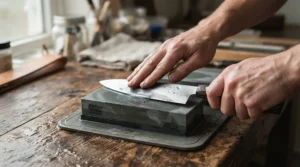
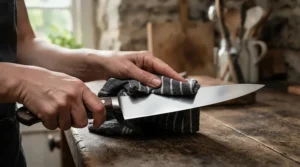
Every one of the seven knives above shares one non-negotiable requirement: they all need proper carbon steel care, and getting it wrong within the first month is the single most common reason people give up on carbon steel entirely. Straight out of the box, wash your new knife by hand in warm soapy water, dry it immediately and completely with a towel — never leave it to air-dry — and consider giving it a light going-over with a fine whetstone or honing steel before first use, since factory edges are rarely as sharp as they could be.
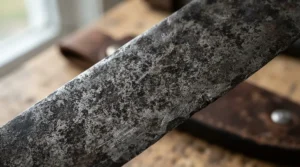
Within the first few weeks of regular use, you’ll notice the blade start to darken and take on streaks of grey, blue, or gold. This is carbon steel patina: a thin, stable layer of iron oxide forming where the steel has reacted with food acids and air, and according to specialist knife retailers it’s a genuinely protective layer rather than a flaw — a well-developed patina actually slows down further corrosion and can be encouraged deliberately by wiping the blade with a cut onion or diluted vinegar. What you don’t want is orange, rough, flaky rust, which forms specifically when the blade is left wet, particularly in contact with acidic ingredients like tomatoes, citrus, or pickled vegetables. If rust does appear, a light scrub with a rust eraser or a paste of bicarbonate of soda usually lifts it before it pits the steel underneath.
For longer-term storage, a thin coat of knife maintenance oil — traditionally food-grade camellia oil in Japan, or a neutral food-safe mineral oil more widely — protects the blade between uses and is worth applying any time the knife won’t be used for more than a day or two. Never substitute cooking oil for this job, since vegetable and olive oils oxidise and turn rancid over time, leaving a sticky residue rather than a protective film. Store the finished blade in a dry knife block, a sheath, or a magnetic strip away from other metal, and never, under any circumstances, run a carbon steel knife through a dishwasher — the prolonged moisture and detergent will strip any patina and can pit the steel within a single cycle.
✨ Don’t Miss These Exclusive Deals!
🔍 Take your carbon steel kitchen knives to the next level with these carefully selected products. Click on any highlighted item to check current pricing and availability. These tools will help you create authentic home-cooked results your family will love!
Real-World Scenarios: Who Actually Needs a Carbon Steel Kitchen Knife
The student cooking for one. Someone moving into their first flat and cooking for themselves most nights doesn’t need seven knives — they need one that’s genuinely sharp, cheap enough not to panic about, and forgiving of the occasional missed wash-up. The Old Hickory 7″ Butcher/Cook Knife fits this brief almost perfectly: low financial risk, real performance once lightly sharpened, and simple enough construction that nothing exotic can go wrong.
The weekend allotment cook. Someone who’s regularly breaking down whole chickens, filleting fish caught locally, or processing a glut of home-grown vegetables benefits from having differentiated blade shapes rather than one do-everything knife. The Old Hickory 5-Piece Cutlery Set covers boning, slicing, paring, and butchery in one purchase, at a total cost that’s still lower than many single premium chef’s knives.
The dedicated home cook chasing restaurant-quality prep. Someone who cooks most nights, watches a lot of knife-skills content, and genuinely cares about the difference between a rough dice and a clean one is the ideal buyer for either the Robert Herder K1 Klassiker Chef’s Knife or the Tojiro Shirogami Hammered Kurouchi Gyuto. Both reward the extra maintenance with a noticeably better cutting experience, and both suit someone who finds knife sharpening genuinely satisfying rather than a chore.
Problem → Solution: Fixing the Most Common Carbon Steel Knife Headaches
Rust after a single wet evening in the sink is the most frequent complaint from first-time carbon steel owners, and the fix is entirely habitual rather than technical: dry the blade the moment washing is finished, every time, with no exceptions for being in a rush. A metallic taste transferring to acidic food, particularly with a brand-new blade like the Tojiro Shirogami Hammered Kurouchi Gyuto, is solved simply by letting a patina establish over the first few weeks of normal use — the taste issue fades as the protective layer builds. A blade that seems to dull unusually fast is very often not a steel problem at all but a cutting-board problem: glass, marble, or stone boards will blunt even the best high carbon steel chef’s knife within a handful of uses, so switching to an end-grain wooden or soft plastic board makes a measurable difference. Finally, for anyone nervous about committing to full carbon steel maintenance, starting with a smaller, lower-stakes blade like the Opinel N°112 Carbon Steel Paring Knife is a sensible way to build the habit before investing in a full-sized chef’s knife.
How to Choose Carbon Steel Kitchen Knives
Picking the right blade from the seven above — or from the wider market — comes down to working through a short, honest checklist rather than chasing the most expensive option available.
- Decide your primary task first. A dedicated carbon steel paring knife like the Opinel N°112 suits detail work; a full-length chef’s knife or gyuto suits general prep; a set like the Old Hickory 5-Piece Cutlery Set suits anyone regularly breaking down whole cuts of meat or fish.
- Be honest about your maintenance habits. If you routinely leave washing-up overnight, a lower-maintenance clad blade such as the Blenheim Forge Original Santoku will serve you far better than a mono-steel Japanese knife.
- Match blade hardness to your cutting style. Harder, thinner Japanese steels like Shirogami reward precise, controlled cuts; thicker European blades like the Due Cigni 2C Cook’s Knife tolerate more forceful, rustic chopping.
- Set a realistic budget band before browsing. Prices on this list span from under £25 to over £300 — deciding your ceiling first avoids the common mistake of drifting upward simply because a knife looks more impressive.
- Check handle material and grip style. Wood handles like those on the Robert Herder K1 Klassiker Chef’s Knife need occasional oiling of their own and shouldn’t be soaked; synthetic handles trade some tactile warmth for lower upkeep.
- Consider where the knife was made and why that matters to you. Provenance carries real weight for some buyers — the Blenheim Forge Original Santoku‘s London workshop origin is part of its appeal, while others simply want dependable performance from the Old Hickory 7″ Butcher/Cook Knife without caring where it was stamped.
- Read aggregated reviewer sentiment, not just star ratings. A 4.6-star average tells you little; look specifically for repeated mentions of edge retention, rust behaviour, and handle comfort across multiple retailers.
High Carbon Steel Chef’s Knife vs Stainless Steel Chef’s Knife
The single biggest decision most buyers face isn’t which brand to choose but whether to go carbon at all, so it’s worth putting the two head-to-head honestly.
| Factor | High Carbon Steel Chef’s Knife | Stainless Steel Chef’s Knife |
|---|---|---|
| Sharpness out of the box | Typically sharper and easier to hone | Good, but usually less keen |
| Edge retention | Excellent between sharpenings | Moderate, dulls faster in use |
| Corrosion resistance | Low — requires drying after every use | High — largely low-maintenance |
| Ease of sharpening | Very easy, responds well to whetstones | Harder, often needs more passes |
| Typical price for comparable quality | Often better value at entry level | Convenience premium built in |
The pattern here is straightforward: carbon steel kitchen knives are prized by chefs and keen home cooks precisely for their sharpness and how readily they take an edge on a whetstone, which is exactly why blades like the Tojiro Shirogami Hammered Kurouchi Gyuto and Robert Herder K1 Klassiker Chef’s Knife punch above their price point in raw cutting performance. Stainless steel wins decisively on convenience and forgiveness — leave it wet overnight and nothing much happens — which is precisely the trade most casual cooks are making, often without realising there was a trade to make at all. Anyone who cooks daily and genuinely notices the difference between a sharp and a “fine” edge is the person most likely to feel the extra maintenance is worth it.
Budget-Friendly Carbon Steel: Single Knives and Starter Sets
Budget Carbon Steel Kitchen Knife: What You Get for Under £30
A genuine budget carbon steel kitchen knife like the Old Hickory 7″ Butcher/Cook Knife isn’t a compromised version of a better knife — it’s a deliberately simple one. What most buyers overlook about this price bracket is that the steel itself, 1095 carbon steel, is the same broad family used in far more expensive American and European blades; what changes at higher prices is mostly forging method, grind precision, and handle materials, not the fundamental cutting chemistry. For someone testing whether carbon steel suits their cooking habits before committing serious money, this remains the lowest-risk entry point on the entire list.
Budget Kitchen Knife Set: Is a 5-Piece Set Worth It?
A budget kitchen knife set solves a different problem: not “is carbon steel for me” but “which shapes do I actually need.” The Old Hickory 5-Piece Cutlery Set earns its place here because every blade in it does a genuinely different job, rather than the common budget-set trap of five near-identical knives in slightly different lengths. Based on the value comparison with buying blades individually, a coherent set like this typically works out cheaper per knife while guaranteeing the shapes actually complement each other in day-to-day use.
The Carbon Steel Paring Knife: Small Blade, Big Difference
It’s easy to overlook a carbon steel paring knife entirely when shopping for kitchen cutlery, since most attention understandably goes to the chef’s knife. That’s a mistake reviewers of the Opinel N°112 Carbon Steel Paring Knife flag repeatedly: a proper paring knife handles a surprisingly large share of daily prep — peeling, deveining, hulling, trimming fat, coring apples — tasks where a full-sized chef’s knife is genuinely unwieldy and often unsafe because of how much blade you’re managing for a tiny cut. The thinness that makes carbon steel paring blades so sharp also makes them require noticeably less downward force than a blunt stainless equivalent, which in practice means fewer slips and fewer nicked fingers, not more. Pairing a budget chef’s knife with a dedicated carbon paring knife is, for many home cooks, a more useful two-knife kitchen than a single expensive all-rounder.
Common Mistakes When Buying Carbon Steel Kitchen Knives
The most frequent mistake is buying based on looks rather than steel type and grind — a knife with a striking hammered or Damascus-style finish isn’t automatically sharper or better-suited to a task than a plain-looking blade like the Old Hickory 7″ Butcher/Cook Knife. Close behind is underestimating maintenance commitment: buyers who order a premium blade like the Tojiro Shirogami Hammered Kurouchi Gyuto without accepting the daily drying routine often end up disappointed by rust spots that were entirely avoidable. A third common error is assuming price scales linearly with performance; the jump from the Old Hickory 7″ Butcher/Cook Knife to the Due Cigni 2C Cook’s Knife buys real improvements in fit and finish, but the jump from there to the Blenheim Forge Original Santoku is paying substantially more for provenance and craftsmanship rather than a proportionally sharper edge. Finally, many first-time buyers skip sharpening equipment entirely, forgetting that even the best carbon steel blade needs a whetstone or honing steel eventually — budgeting for basic sharpening kit alongside the knife itself avoids a nasty surprise a few months in.
Long-Term Cost & Maintenance: The Real Ownership Math
Sticker price only tells part of the story with carbon steel kitchen knives, because ongoing costs and effort differ meaningfully between the options on this list. The Old Hickory 5-Piece Cutlery Set has the lowest total cost of ownership by a wide margin, but demands the most frequent basic sharpening since the steel, while easy to sharpen, is softer than the Japanese and German alternatives here. The Robert Herder K1 Klassiker Chef’s Knife and Tojiro Shirogami Hammered Kurouchi Gyuto sit in the middle: higher purchase price, but their harder, more refined steel holds an edge for longer between sharpenings, meaning less frequent (if slightly more technical) maintenance sessions. The Blenheim Forge Original Santoku‘s stainless cladding actually reduces ongoing maintenance despite its premium price, since only the exposed edge needs the vigilant drying regime rather than the whole blade surface. Factor in a basic whetstone (roughly £15-£30) and occasional knife maintenance oil (typically under £10 for a bottle that lasts years) as near-universal costs regardless of which knife you choose, and the real gap between “budget” and “premium” carbon steel ownership narrows considerably once you look past the initial price tag.
Safety, Hygiene and Regulations in a UK Kitchen
Carbon steel kitchen knives don’t carry different legal requirements from stainless ones, but their sharpness makes good kitchen hygiene practice even more relevant. UK food safety guidance is clear that cross-contamination between raw and ready-to-eat food most often spreads via chopping boards, knives, and hands, which means a knife left unwashed between cutting raw chicken and slicing salad vegetables is a genuine food-poisoning risk regardless of what the blade is made from. Because carbon steel blades like the Robert Herder K1 Klassiker Chef’s Knife need hand-washing rather than a dishwasher cycle anyway, it’s worth building a habit of washing between different food types as standard, not just at the end of a cooking session. On the purchasing side, UK consumer law requires any knife sold as fit for kitchen use to genuinely perform that function safely; reputable retailers and marketplace sellers of the products featured here, including established brands like Tojiro and Opinel, publish clear country-of-origin and material information as standard, which is worth checking before buying from an unfamiliar third-party seller.
FAQ
❓ Is carbon steel better than stainless steel for kitchen knives?
❓ Do carbon steel kitchen knives rust easily?
❓ What is the patina on a carbon steel knife and should I remove it?
❓ Can you put carbon steel kitchen knives in the dishwasher?
❓ What's the best budget carbon steel kitchen knife for a beginner?
Conclusion
There’s no single “best” carbon steel kitchen knife, because the right pick genuinely depends on how you cook and how much fuss you’re prepared to put up with in exchange for a sharper edge. If you want the lowest possible barrier to entry, the Old Hickory 7″ Butcher/Cook Knife or the Old Hickory 5-Piece Cutlery Set get you into real carbon steel for less than the cost of a decent takeaway. If you’re specifically after a small, precise blade for detail work, the Opinel N°112 Carbon Steel Paring Knife deserves a place in the drawer alongside whatever chef’s knife you settle on. For those chasing a genuinely exceptional edge and willing to commit to the maintenance ritual, the Robert Herder K1 Klassiker Chef’s Knife and Tojiro Shirogami Hammered Kurouchi Gyuto represent two different, equally valid traditions of doing that extremely well, while the sturdier Due Cigni 2C Cook’s Knife splits the difference for cooks who want carbon steel sharpness without babying a delicate edge. And if you want a blade with a story, hand-forged in small batches within the M25, the Blenheim Forge Original Santoku is as close to an heirloom as amazon.co.uk gets. Whichever you choose, the habit that actually determines how happy you’ll be with it isn’t the brand — it’s whether you dry the blade every single time.
Recommended for You
- [Add your blog post link 1]
- [Add your blog post link 2]
- [Add your blog post link 3]
Disclaimer: This article contains affiliate links. As an Amazon Associate, I earn from qualifying purchases. If you purchase products through these links, we may earn a small commission at no additional cost to you.
✨ Found this helpful? Share it with your friends! 💬🤗
