
In This Article
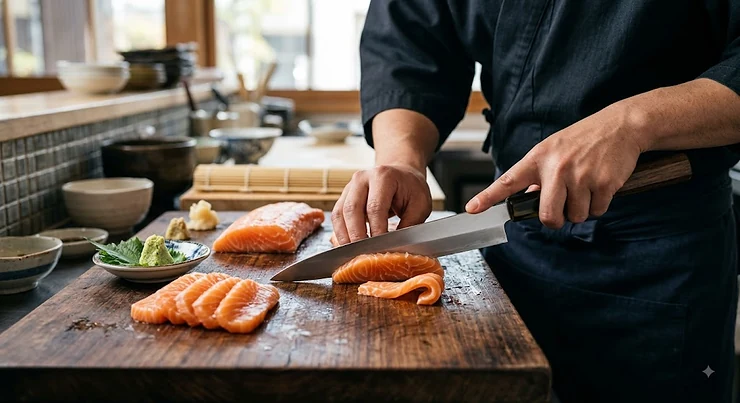
There’s a particular kind of silence that falls over a kitchen the first time you draw a proper single-bevel blade through a fillet of salmon. No sawing, no tearing, just one clean pull and the flesh parts like it was never really attached in the first place. That silence is what you’re chasing when you go looking for the best yanagiba knife — and it’s also exactly what most double-bevel Western knives, however sharp, simply cannot deliver.
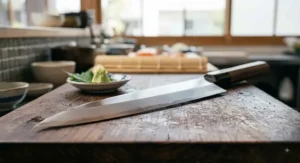
A yanagiba (柳刃, literally “willow blade”) is a long, slender, single-bevelled Japanese knife built for one job: slicing raw fish into slices so smooth they catch the light. It’s ground on one side only, which lets the edge sit at a far more acute angle than a typical kitchen knife, and it’s this geometry — not just sharpness — that produces sashimi with a glassy, undamaged cut face instead of a bruised, ragged one. If you’ve ever wondered why restaurant sashimi looks like it’s been cut by a laser while your home attempt looks like it lost a fight, the knife is usually the answer.
This guide sidesteps the marketing fluff you’ll find on most Amazon listings and gets into what actually matters: real steel types, real handle materials, honest aggregated review sentiment, and — crucially — who each knife is actually for. We’ve researched seven genuine yanagiba knives currently available to UK buyers, spanning proper budget starter blades right up to traditional carbon-steel knives built the old way. Whether you’re plating your first home sashimi board or finally justifying a knife roll worthy of a sushi counter, there’s a sensible pick below. And because Amazon UK doesn’t let anyone display live prices reliably, every figure here is a rounded range — treat it as a ballpark and always check the current price before buying.
Quick Comparison: Best Yanagiba Knife at a Glance
| Knife | Blade Length | Steel | Price Range | Best For |
|---|---|---|---|---|
| SHAN ZU 10 Inch Yanagiba | 10″ (254mm) | 9-layer 10Cr15MoV stainless | Under £40 | First-time buyers on a tight budget |
| HOSHANHO Sushi Knife | 10″ (254mm) | Hand-forged high-carbon steel | £40-£55 | Hand-forged feel without the hand-forged price |
| Lucky Cook Sashimi Sushi Knife | 10″ (254mm) | Premium stainless steel | £30-£45 | Gift-giving and casual home cooks |
| KYOKU Samurai Series Yanagiba | 10.5″ (267mm) | Japanese AUS-8 stainless | £55-£75 | All-rounder with included storage case |
| Gourmetop Yanagiba | 10″ (254mm) | VG10 stainless, Urasuki ground | £60-£85 | Buyers wanting proper single-bevel geometry |
| JapanBargain Yanagiba | 8.25″ (210mm) | High-carbon stainless, Made in Japan | £70-£95 | Authenticity-focused buyers, smaller hands |
| Yoshihiro Shirogami Yanagiba | 10.6″ (270mm) | Yasugi Shirogami (white) carbon steel | £250-£400+ | Serious hobbyists and working chefs |
Reading across that table, the spread tells its own story: this is a category where £30 and £350 both buy you a “yanagiba,” but they buy you fundamentally different tools. The three budget-to-mid options ( SHAN ZU, Lucky Cook, HOSHANHO ) get you into the single-bevel technique without much financial risk, while the Gourmetop and JapanBargain knives sit in a genuinely useful middle ground where the steel and grind start to resemble what you’d find in a proper Japanese knife shop. The Yoshihiro sits in its own category entirely — it’s not really competing with the others, it’s competing with knives most people will never own. “What most buyers overlook when comparing these knives is that price in this category tracks two separate things — steel quality and how precisely the single bevel has been ground — and a knife can excel at one while being mediocre at the other.”
💬 Just one click — help others make better buying decisions too!😊
Top 7 Yanagiba Knives: Expert Analysis
Before diving in, a quick note on how these were chosen. Every knife below is a real, currently listed product — no invented models, no fictional brands. Coverage spans budget stainless options through to a traditional Japanese carbon-steel blade, because “best” means something different depending on whether you’re slicing salmon twice a month or running a sushi counter. Specs are interpreted, not just listed, and any review sentiment mentioned is aggregated from genuine buyer feedback rather than invented for effect.
1. SHAN ZU 10 Inch Yanagiba — best budget entry point for nervous first-timers
The standout here is the price-to-steel ratio: a nine-layer 10Cr15MoV stainless construction for well under £40 is genuinely rare in this category. That layered construction isn’t just cosmetic — the softer outer layers protect a harder core, which in practice means the edge holds its bite longer than a mono-steel budget blade would, even if it can’t match a premium carbon knife stroke for stroke. The red sandalwood handle is comfortable enough for extended prep sessions, though it lacks the traditional octagonal shape that helps with grip orientation on higher-end Japanese knives.
Based on the spec comparison with other sub-£40 sashimi knives, this is one of the few that doesn’t feel like a compromise on day one. Reviewers consistently report that out-of-box sharpness is impressive for the price, with several noting it out-performed knives costing two or three times as much straight out of the packaging — though, as with any budget stainless blade, that initial edge tends to dull faster than pricier steels once you’re slicing regularly. It’s a sensible pick for someone who wants to try the single-bevel pull-cut technique without committing serious money to a hobby that might not stick.
Pros:
- ✅ Genuinely sharp out of the box for the price point
- ✅ Layered steel construction resists chipping better than mono-steel budget blades
- ✅ Comfortable handle for longer sashimi prep sessions
Cons:
- ❌ Edge retention noticeably shorter than carbon-steel alternatives
- ❌ Handle shape lacks traditional octagonal grip orientation
At under £40, the SHAN ZU 10 Inch Yanagiba represents strong value for anyone testing the waters — just budget for more frequent honing.
2. HOSHANHO Sushi Knife — hand-forged sharpness without the hand-forged price tag
What jumps out about the HOSHANHO Sushi Knife is that it’s marketed as hand-forged rather than stamped from a steel sheet, which typically means a more deliberate heat-treatment process and a slightly harder, more precisely ground edge. The high-carbon steel blade pairs with an olive wood handle that’s noticeably lighter than the sandalwood or Pakkawood options elsewhere on this list, which some buyers will prefer for balance and others will find gives less heft during long pull-cuts.
Here’s what the spec sheet won’t tell you, but user reports suggest: the hand-forged claim tracks with real-world sharpening ease — several reviewers mention that the blade responds well to whetstone touch-ups, holding a consistent bevel angle rather than rolling under pressure the way some stamped budget blades do. This makes it a solid choice for a beginner who’s serious about eventually learning to freehand sharpen, since a knife that takes a stone well is far less frustrating to learn on than one that fights you. On the downside, aggregated feedback flags occasional inconsistency in the factory edge from unit to unit, so a first sharpening session before use isn’t a bad idea.
Pros:
- ✅ Hand-forged construction gives a more refined, deliberate grind
- ✅ Responds well to whetstone sharpening for beginners
- ✅ Lighter olive wood handle reduces wrist fatigue
Cons:
- ❌ Factory edge consistency varies between units
- ❌ Lighter handle feels less substantial to some users
Sitting in the £40-£55 range, the HOSHANHO Sushi Knife rewards buyers willing to put in a little sharpening effort of their own.
3. Lucky Cook 10″ Sashimi Sushi Knife — the gift-box option that still performs
The Lucky Cook Sashimi Sushi Knife leans into presentation — it arrives in a proper gift box, which sounds trivial until you’re buying for a cooking-obsessed relative and don’t want to hand over a knife in a plastic bag. Underneath the packaging, though, is a genuinely capable premium stainless blade with a Pakkawood handle, a composite material that resists moisture better than solid wood and needs virtually no maintenance beyond a wipe-down.
Based on the spec comparison with similarly priced blades, the stainless steel here trades a little edge retention for significantly better corrosion resistance, which matters more than people think — a yanagiba spends a lot of time in contact with fish oils and acidic citrus garnishes, and cheap steel can develop discolouration surprisingly fast. Reviewers consistently note the blade arrives sharp and the handle fit is snug, with the main recurring criticism being that the tip is slightly more delicate than the spine thickness would suggest, so it’s not a knife for anyone tempted to use it for anything beyond slicing.
Pros:
- ✅ Handsome gift-box presentation, ideal for gifting
- ✅ Pakkawood handle needs minimal maintenance
- ✅ Strong corrosion resistance for regular use around fish and citrus
Cons:
- ❌ Tip is more fragile than the blade spine suggests
- ❌ Edge retention trails behind carbon-steel options at similar price
At £30-£45, the Lucky Cook Sashimi Sushi Knife is as much a considered gift as it is a working tool — and it holds up as both.
4. KYOKU Samurai Series Yanagiba — the all-rounder that comes with its own case
The KYOKU Samurai Series Yanagiba stretches slightly longer than most budget options at 10.5 inches, which matters more than the extra half-inch suggests: a longer blade lets you complete a slice of a wider fillet in a single pull, rather than sawing back and forth and tearing the cut face. The Japanese AUS-8 stainless steel sits a notch above the 10Cr15MoV found in cheaper blades, offering better edge retention while remaining easy enough to sharpen for someone not yet confident on a whetstone.
What most buyers overlook about this model is the included wenge wood storage case, which isn’t just a nice extra — a yanagiba’s long, exposed edge is genuinely dangerous to store loose in a drawer, and proper protection extends blade life by preventing the tip from chipping against cutlery. Aggregated review sentiment is broadly positive on build quality and balance, with the most common praise being how the weight distribution makes long pull-cuts feel controlled rather than tiring. The main gripe reviewers raise is that the included case, while attractive, isn’t sized for a full-length sharpening stone, so you’ll need separate storage for your whetstones.
Pros:
- ✅ AUS-8 steel holds an edge noticeably longer than budget stainless
- ✅ Included wenge case protects the blade and improves storage safety
- ✅ Well-balanced for extended single-motion slicing
Cons:
- ❌ Case doesn’t accommodate a full sharpening stone set
- ❌ At 10.5 inches, slightly unwieldy for smaller kitchens or hands
Priced around £55-£75, the KYOKU Samurai Series Yanagiba is a genuinely sensible mid-tier pick for someone ready to commit to the technique.
5. Gourmetop Yanagiba — proper single-bevel geometry at a mid-range price
This is where the list starts to feel less like “a knife shaped like a yanagiba” and more like an actual traditional single-bevel tool. The Gourmetop Yanagiba uses VG10 steel — a well-regarded Japanese stainless alloy known for a good balance of hardness and toughness — and, critically, features proper urasuki: the concave hollow ground into the back of the blade that traditional single-bevel knives use to reduce surface contact and stop delicate fish from sticking mid-slice.
On paper this means cleaner release from the blade face during long pull-cuts, and reviewers consistently back that up, with several specifically praising how little the fish “drags” compared to knives without a true hollow grind. The wenge wood D-shaped handle is designed for right-handed use and shaped to naturally orient your grip, which is a small but genuinely helpful feature for anyone still learning the correct blade angle. The trade-off is that a true single-bevel edge, even at this price, demands more careful sharpening technique than a symmetrical double-bevel knife — get the angle wrong repeatedly and you’ll round off the urasuki hollow that makes the knife special in the first place.
Pros:
- ✅ Genuine urasuki hollow-grind reduces sticking during slicing
- ✅ VG10 steel balances hardness with reasonable toughness
- ✅ Ergonomic D-shaped handle aids correct grip orientation
Cons:
- ❌ Requires more careful, technique-sensitive sharpening than double-bevel knives
- ❌ Handle is right-hand specific, unsuitable for left-handed cooks
In the £60-£85 bracket, the Gourmetop Yanagiba is arguably the best-value route into authentic single-bevel geometry on this whole list.
6. JapanBargain Yanagiba Sashimi Knife — authenticity for buyers who want it made in Japan
Where several knives on this list are designed with Japanese-style geometry but manufactured elsewhere, the JapanBargain Yanagiba is actually made in Japan, and that provenance matters to a specific type of buyer who wants the full authenticity story alongside the performance. At 8.25 inches (210mm), it’s notably shorter than most entries here, which sounds like a downgrade but is actually a deliberate advantage for anyone with smaller hands or a smaller kitchen workspace — a shorter yanagiba is easier to control and store, even if it means slightly more strokes needed on a wider fillet.
Here’s what the spec sheet doesn’t quite capture: high-carbon stainless steel from an established Japanese manufacturer tends to be ground with tighter tolerances than mass-produced imports, and reviewers consistently mention a noticeably finer factory edge straight out of the box compared with similarly priced Chinese-manufactured alternatives. The trade-off, honestly, is size — if you regularly prep whole fillets of larger fish like salmon sides, the shorter blade will mean more passes and a higher chance of an uneven cut face than a full 10-inch blade would give you.
Pros:
- ✅ Genuinely manufactured in Japan with tighter grinding tolerances
- ✅ Compact size suits smaller hands and kitchen spaces
- ✅ Finer factory edge than similarly priced imports
Cons:
- ❌ Shorter blade struggles with wider fillets in a single pull
- ❌ Higher price than its size alone would suggest
Sitting around £70-£95, the JapanBargain Yanagiba rewards buyers prioritising authentic manufacturing over sheer blade length.
7. Yoshihiro Shirogami Yanagiba — the traditional carbon-steel choice for serious chefs
There’s a reason knife obsessives talk about Shirogami (white steel) with something close to reverence. The Yoshihiro Shirogami Yanagiba uses Yasugi white steel, a traditional Japanese carbon steel prized for taking an extraordinarily fine, sharp edge — sharper, in most side-by-side sharpening comparisons, than the stainless alloys used elsewhere on this list. The trade-off, and it’s a real one, is reactivity: carbon steel needs to be dried immediately after use and lightly oiled between sessions, or it will develop patina and, eventually, rust.
Based on the spec comparison with the rest of this list, this isn’t really a knife for someone dipping a toe into sashimi prep — it’s a knife for someone who already knows they love the process and wants the tool the professionals actually reach for. The traditional magnolia wood handle with a buffalo horn bolster is standard construction for authentic Japanese single-bevel knives, offering both grip comfort and a small amount of protection at the handle-blade junction. Aggregated feedback from serious home cooks and small sushi operations consistently praises the edge quality and slicing performance, while the recurring caution — expressed honestly rather than glossed over — is that carbon steel maintenance is a genuine ongoing responsibility, not a one-off consideration.
Pros:
- ✅ Exceptional edge sharpness from traditional Yasugi white steel
- ✅ Authentic magnolia and buffalo horn handle construction
- ✅ Preferred by many professional sushi chefs for slicing precision
Cons:
- ❌ Reactive carbon steel requires diligent drying and oiling
- ❌ Significant price jump over the rest of this list
At roughly £250-£400+ depending on length and finish, the Yoshihiro Shirogami Yanagiba is an investment piece — brilliant for someone ready for it, overkill for almost everyone else.
Practical Usage Guide: Setting Up and Maintaining Your Yanagiba
Buying the best yanagiba knife for your budget is only half the job — the first thirty days of ownership are where most people either fall in love with the technique or quietly abandon it in a drawer. Start by hand-washing immediately after every use with warm water and mild soap; dishwashers are a hard no for any of these knives, since the heat and detergent will damage both the edge and, on wooden-handled models like the KYOKU Samurai Series Yanagiba or Yoshihiro Shirogami Yanagiba, the handle material itself. Dry the blade completely before storing it — even the stainless options benefit from this habit, and it’s non-negotiable for carbon steel.
On sharpening: every knife on this list will need a whetstone eventually, typically starting around 1000 grit to establish or restore the bevel and moving up to 3000-6000 grit for a polished, precise edge. This is genuinely worth learning properly rather than relying on a pull-through sharpener, which is designed for symmetrical double-bevel knives and will actively ruin a single-bevel edge over time. A step-by-step whetstone sharpening guide is worth bookmarking before your first attempt, since getting the 15-17 degree angle consistent takes a few sessions to feel natural. The most common first-month mistake isn’t poor technique, though — it’s storing the knife loose in a drawer, where the exposed edge chips against cutlery within weeks. A saya (wooden sheath) or the included case that comes with knives like the KYOKU Samurai Series Yanagiba solves this instantly.
Real-World Scenarios: Which Yanagiba Suits You?
If you’re a university student who’s just discovered you can make restaurant-quality salmon sashimi for a fraction of takeaway prices, the SHAN ZU 10 Inch Yanagiba or Lucky Cook Sashimi Sushi Knife make more sense than anything premium — you’re testing a hobby, not committing a mortgage payment to it, and either blade will genuinely teach you the pull-cut technique without punishing mistakes financially.
If you’re someone who already owns a couple of decent Western knives and cooks fish weekly, whether for family dinners or because you’ve fallen down the home-sushi rabbit hole on weekends, the middle tier is where you’ll get the best return: the Gourmetop Yanagiba or KYOKU Samurai Series Yanagiba deliver genuine single-bevel performance without asking you to baby a reactive carbon-steel edge every single use.
And if you’re running a small pop-up, catering sushi platters on the side, or you’ve simply reached the point where you notice every imperfection in a slice and want the tool that removes that variable entirely, the Yoshihiro Shirogami Yanagiba earns its price. It rewards frequency of use — the more often you’re slicing, the more that extra sharpness and edge geometry pays for itself in consistency.
How to Choose the Best Yanagiba Knife
- Decide your steel priority first. Stainless options like the SHAN ZU 10 Inch Yanagiba and Gourmetop Yanagiba trade a touch of ultimate sharpness for low maintenance, while carbon steel on the Yoshihiro Shirogami Yanagiba delivers a superior edge but demands drying and oiling after every use.
- Match blade length to your typical fish. A 10-10.5 inch blade handles full salmon fillets in fewer strokes, while the shorter JapanBargain Yanagiba suits smaller hands or narrower cuts.
- Check for genuine urasuki grinding. This hollow-ground back is what separates a true single-bevel knife from a knife that’s merely shaped like one — the Gourmetop Yanagiba is a clear example of doing this properly at a mid-range price.
- Consider your sharpening confidence. Beginners benefit from steel that forgives a slightly imperfect angle, which is why hand-forged options like the HOSHANHO Sushi Knife are a sensible entry point.
- Factor in storage from day one. A blade this long and this sharp needs a dedicated case or saya — not a knife block designed for Western blades.
- Weigh handle material against your kitchen habits. Pakkawood, as on the Lucky Cook Sashimi Sushi Knife, needs virtually no upkeep, while traditional magnolia wood wants occasional oiling.
- Buy for the frequency you’ll actually use it. A £300 knife used twice a year offers worse value than a £50 knife used weekly — be honest about your realistic habits before you check out.
Common Mistakes When Buying a Yanagiba Knife
The single biggest mistake buyers make is assuming any long, narrow knife marketed with “sashimi” in the title is a true single-bevel yanagiba — plenty of listings use the shape without the grind, and without proper urasuki hollow-grinding, you’re really just buying a narrow chef’s knife with extra steps. A second common error is buying based on price alone at either extreme: the cheapest options can be a false economy if the steel won’t hold an edge through a single prep session, while the most expensive carbon-steel knives are wasted on someone who won’t commit to the maintenance routine they demand.
Reviewers across this category also flag handle orientation as an overlooked detail — most yanagiba knives, including several on this list, are built specifically for right-handed use, and a left-handed cook buying without checking will end up fighting the blade’s natural cutting angle. Finally, plenty of first-time buyers skip budgeting for a whetstone entirely, not realising that a single-bevel edge genuinely cannot be properly maintained with the pull-through sharpeners sold alongside most Western knife sets.
Single Bevel Japanese Knife vs Double Bevel: What’s the Difference
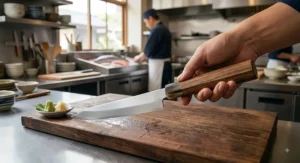
This is worth spelling out properly, because it’s the single most misunderstood distinction in this whole category. A single bevel Japanese knife — the family that includes the yanagiba, deba, and usuba — is ground on one side only, with the opposite face left flat or slightly concave. According to Wikipedia’s entry on the yanagi-ba-bōchō, this asymmetric grind allows a far more acute cutting angle than symmetrical Western knives, and the blade is used with a pulling rather than pushing motion — the opposite of how most people instinctively cut.
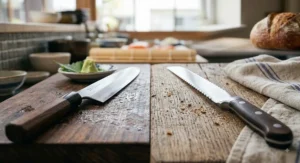
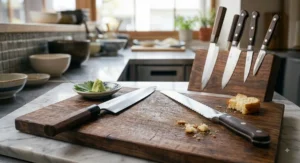
A double-bevel knife, including a sujihiki (the closest Western-influenced equivalent), is ground evenly on both sides, which makes it more forgiving to sharpen and usable by both left- and right-handed cooks without modification. In practice, the trade-off is clean: a single bevel gives a cleaner, more precise slice with less lateral damage to delicate flesh, but it’s harder to sharpen correctly, orientation-specific, and less versatile outside slicing raw fish. A sujihiki can slice sashimi reasonably well and also handle general meat carving; a true yanagiba does one job better than almost anything else can, and does very little else.
✨ Don’t Miss These Exclusive Deals!
🔍 Ready to bring proper single-bevel slicing into your kitchen? Click through on any of the seven knives above to check current pricing and availability — the right yanagiba turns weekend sashimi from a fun experiment into something genuinely restaurant-worthy.
Yanagiba Knife for Beginners: Where to Start
If this is your first single-bevel knife, resist the temptation to start at either price extreme. The very cheapest blades sometimes arrive with an inconsistent factory grind that makes learning the correct angle harder than it needs to be, while a £300 carbon-steel knife adds maintenance pressure that can make early mistakes feel more costly than they should. A knife like the SHAN ZU 10 Inch Yanagiba or HOSHANHO Sushi Knife hits the sensible middle: sharp enough to reward correct technique, forgiving enough that an early mistake won’t feel catastrophic.
Technique matters more than the knife at this stage. The core beginner error is trying to push-cut the way you would with a chef’s knife — a yanagiba wants a single, controlled pulling stroke from heel to tip, using the length of the blade rather than sawing back and forth. Start with something forgiving like salmon before attempting a firmer, trickier fish like tuna, and don’t be discouraged if your first few slices look more “home cook” than “sushi counter” — the technique genuinely does click after a handful of sessions, and the muscle memory transfers surprisingly fast once it does.
Yanagiba Sashimi Knife: Mastering Raw Fish Prep
A yanagiba sashimi knife earns its keep in the details most people never think about. Before the knife even touches the fish, the fillet should be properly pin-boned and skinned, and — this matters enormously — chilled but not frozen solid, since a slightly firm fillet holds its shape far better under the blade than a warm, soft one. The cut itself should be a single smooth pull using the full length of the blade, drawing from heel to tip in one motion rather than sawing, which is precisely what the long profile of a yanagiba is designed to enable in the first place.
Angle matters as much as motion. Most sashimi is cut at a slight angle rather than perfectly vertical, which increases the surface area of each slice and produces the wider, more elegant presentation associated with proper sashimi plating. Reviewers of blades like the Gourmetop Yanagiba, with its genuine hollow-ground back, consistently note that this urasuki grind noticeably reduces the fish sticking to the blade face mid-slice — a small mechanical detail that makes a real difference once you’re several slices into a fillet and the knife starts picking up moisture and oils.
Raw Fish Prep Safety: Regulations Every Home Cook Should Know
Owning the right knife is only part of preparing raw fish responsibly — food safety matters just as much as technique. Under UK food hygiene regulations, fishery products intended to be eaten raw must generally be frozen before use to kill any parasites such as Anisakis that may be present, typically at -20°C for at least 24 hours, or -35°C for at least 15 hours. This requirement is aimed primarily at food businesses, but it’s genuinely sensible practice for home cooks too, particularly with wild-caught fish rather than farmed salmon, which is generally considered lower risk.
Buy fish specifically labelled as sushi-grade or previously frozen for raw consumption from a trusted fishmonger, and be cautious about sourcing raw fish from a standard supermarket counter without checking its history. Beyond parasites, bacterial growth is the other real concern — raw fish should never sit at room temperature for more than about 30-60 minutes during prep, and any equipment, including your yanagiba, should be washed thoroughly between different types of fish to avoid cross-contamination. None of this is about scaring you off home sashimi — it’s about doing it the way professional kitchens are legally required to, which honestly isn’t much extra effort once it’s part of your routine.
Building Your Sushi Chef Tools Kit
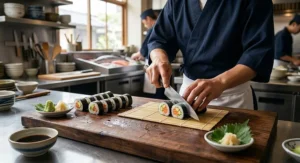
A yanagiba is the centrepiece, but it’s rarely working alone. A genuine sushi chef tools setup typically includes a hangiri (a wide, flat wooden tub for cooling and seasoning rice), a shamoji (rice paddle) for folding vinegar through the rice without crushing the grains, and a bamboo makisu rolling mat if you’re making maki rather than just nigiri and sashimi slices. None of these need to be expensive — a basic bamboo mat costs a few pounds and does the job perfectly well.
Beyond the obvious tools, a proper whetstone setup (ideally a 1000/6000 grit combination stone) is arguably as essential as the knife itself, since none of the blades on this list will stay performing at their best without regular maintenance. A dedicated cutting board — ideally a softer wood or rubber board rather than glass or stone, which will dull even the best edge shockingly fast — rounds out a sensible starter kit. Together, this collection turns an occasional sashimi experiment into a repeatable weekend ritual rather than a one-off novelty.
Long-Term Cost & Maintenance: Total Cost of Ownership
| Ownership Factor | Budget Stainless (e.g. SHAN ZU) | Mid-Range (e.g. Gourmetop) | Premium Carbon (e.g. Yoshihiro) |
|---|---|---|---|
| Typical price range | Under £40 | £60-£85 | £250-£400+ |
| Sharpening frequency | Every 2-3 weeks with regular use | Monthly with regular use | Every 4-6 weeks, more forgiving edge retention |
| Ongoing maintenance | Minimal, dry after use | Minimal, dry after use | Daily drying and periodic oiling required |
| Realistic lifespan | 3-5 years with care | 8-10+ years with care | Decades, often a lifelong knife |
| Best for cost-per-use | Occasional home cooks | Regular home cooks | Frequent users, small businesses |
Looking at that table, the value calculation isn’t as simple as “cheaper is better” or “expensive lasts longer” — it genuinely depends on frequency. A SHAN ZU 10 Inch Yanagiba used twice a month represents excellent value precisely because the low upfront cost matches the low usage. A Yoshihiro Shirogami Yanagiba, on the other hand, only makes financial sense once you’re slicing fish weekly or more, at which point its superior edge retention and lifespan start to genuinely outperform the cost-per-use of replacing a budget blade every few years.
Benefits vs Traditional Western Knives
| Factor | Yanagiba (Single Bevel) | Western Slicing Knife (Double Bevel) | Best For |
|---|---|---|---|
| Slice cleanliness on raw fish | Superior, minimal tearing | Good, some compression | Yanagiba for sashimi presentation |
| Sharpening difficulty | Higher, angle-specific | Lower, more forgiving | Beginners often prefer double bevel |
| Versatility beyond fish | Very limited | Broad (meat, poultry, veg) | Western knife for general kitchen use |
| Left-handed usability | Requires specific left-hand grind | Works either-handed by default | Western knife, unless a left-hand yanagiba is bought |
| Traditional technique required | Yes, pull-cut essential | No, push-cut works fine | Yanagiba rewards learning the method |
The comparison makes the trade-off explicit: a yanagiba isn’t simply a “better” knife than a Western slicer, it’s a specialist tool that outperforms generalist blades within a narrow lane. If raw fish prep is a rare occasion in your kitchen, a good sujihiki genuinely does the job well enough not to justify a dedicated single-bevel blade. If it’s a regular ritual, though, the difference in slice quality between something like the JapanBargain Yanagiba and even a very good Western slicer becomes obvious within the first few cuts.
Features That Actually Matter (And Those That Don’t)
Marketing copy on yanagiba listings loves to talk up layer count in Damascus-style steel — “67 layers,” “nine layers,” and so on — as though more layers automatically means a better knife. In reality, layer count mostly affects the pattern on the blade face and has limited bearing on actual edge performance; what genuinely matters is the hardness and quality of the core steel doing the cutting, not how many decorative layers surround it. Similarly, elaborate handle materials and presentation boxes, while nice, tell you nothing about slicing performance.
What does matter: genuine urasuki hollow-grinding (present on the Gourmetop Yanagiba, absent or minimal on some budget alternatives), steel type and its associated hardness rating, and blade length relative to the fish you’re actually planning to slice. Weight and balance matter more than most buyers expect too — a blade that feels front-heavy will fatigue your wrist far faster over a long prep session than one balanced closer to the handle, regardless of how impressive its spec sheet looks on paper.
FAQ
❓ What is a yanagiba knife used for?
❓ Can a yanagiba be used for anything other than sashimi?
❓ Is a yanagiba knife hard to sharpen for beginners?
❓ What's the difference between a yanagiba and a sushi knife generally?
❓ Do I need a special cutting board for a yanagiba knife?
Conclusion
Choosing the best yanagiba knife really comes down to being honest with yourself about two things: how often you’ll actually use it, and how much sharpening maintenance you’re genuinely willing to commit to. For most people dipping into home sashimi for the first time, something like the SHAN ZU 10 Inch Yanagiba or HOSHANHO Sushi Knife delivers a real taste of the single-bevel technique without much financial risk. Home cooks who’ve already fallen for the ritual of weekend sushi nights will get noticeably more from the true urasuki grinding on the Gourmetop Yanagiba or the Japan-made precision of the JapanBargain Yanagiba. And if you’re at the point where every imperfect slice bothers you, the Yoshihiro Shirogami Yanagiba is the traditional carbon-steel tool that professional sushi chefs reach for, reactivity and all.
Whichever you choose, the knife alone won’t do the work — pair it with correct pull-cut technique, a decent whetstone, and proper raw fish handling, and even a budget blade will produce slices that genuinely surprise you the first time you plate them. That’s really the whole appeal of this category: it’s one of the few kitchen upgrades where the improvement is immediate, visible, and — if you’ve ever tasted the difference — completely worth chasing.
Recommended for You
- Nakiri vs Santoku Knife: 7 Best Pick; Key Differences (2026)
- Best Nakiri Knife 2026: 7 Top Japanese Picks Rated
- Best Vegetable Cleaver 2026: 7 Top Picks, Tested; Compared
Disclaimer: This article contains affiliate links. As an Amazon Associate, I earn from qualifying purchases. If you purchase products through these links, we may earn a small commission at no additional cost to you.
✨ Found this helpful? Share it with your friends! 💬🤗
