
In This Article
Pick up a blunt knife and try to slice a ripe tomato. You’ll mash it, saw at it, maybe nick a knuckle in the process, and mutter something unrepublishable under your breath. Pick up a decent stainless steel knife and that same tomato falls apart in clean, unbothered slices — no drama, no bruised flesh, no swearing. That difference, more than almost any other kitchen upgrade, is what separates cooking that feels like a chore from cooking that feels like a small daily pleasure.

Stainless steel knives are blades forged or stamped from steel alloyed with chromium, typically at least 10.5%, which forms a thin, self-healing oxide layer on the surface that resists rust and staining — the reason your knife drawer isn’t a graveyard of orange spots and pitted edges. They dominate British kitchens because they balance sharpness, durability and low maintenance better than almost any competing material, and because you can pick one up from a supermarket for a tenner or spend three figures on a Solingen-forged blade built to outlive you.
This guide walks through seven real stainless steel knives and sets currently sold in the UK, from no-nonsense budget buys to knives serious home cooks save up for. We’ll get into the steel science — Rockwell hardness, edge geometry, why “German-style” and “Japanese-style” knives behave so differently in your hand — and we’ll be honest about the trade-offs rather than pretending every knife on the shelf is a miracle. Independent testers at Which? have put dozens of chef’s knives through repeated slicing and dicing trials, and their findings back up what most kitchen professionals already know: sharpness out of the box, edge retention over weeks of real use, and handle comfort after twenty minutes of chopping are what actually separate the winners from the also-rans.
Quick Comparison Table
Before the deep dive, here’s the shortlist at a glance.
| Product | Type | Price Range | Best For |
|---|---|---|---|
| Victorinox Fibrox Pro 8-Inch Chef’s Knife | Single knife | £30-£40 | Budget buyers who want one great all-rounder |
| Tower Damascus-Effect 5-Piece Knife Set | Set with stand | Under £40 | Style-conscious first-time buyers |
| Judge Classic 5-Piece Knife Block Set | Set with block | £60-£75 | Gifting and long-term British-brand reliability |
| ProCook Professional X50 Chef’s Knife Set | 6-piece set with block | £100-£150 | Home cooks wanting German steel across the board |
| Global G-2 8-Inch Chef’s Knife | Single knife | £90-£120 | Fans of lightweight, ultra-sharp Japanese design |
| Wüsthof Classic 8-Inch Cook’s Knife | Single knife | £120-£160 | Buyers who want a forged workhorse for decades |
| ProCook Elite AUS10 3-Piece Knife Set | Starter set | £70-£100 | Those chasing serious edge retention on a smaller set |
Looking across the line-up, the split isn’t simply cheap-versus-expensive — it’s stamped-versus-forged and German-style-versus-Japanese-style, and those distinctions matter more to everyday performance than the badge on the handle. The Victorinox Fibrox Pro and Tower Damascus-Effect set anchor the affordable end, while the Wüsthof Classic and ProCook Elite AUS10 sit at the top for anyone prioritising edge retention over price. If you’re buying for a household that cooks daily, a full set like the Judge Classic or ProCook Professional X50 usually delivers better value per knife than piecing together singles.
💬 Just one click — help others make better buying decisions too!😊
Top 7 Stainless Steel Knives: Expert Analysis
We researched real specifications, current availability and genuine aggregated review sentiment for each pick below. None of these entries are based on hands-on testing by this article’s author — the commentary is honest analysis grounded in manufacturer specs and publicly available review data, clearly flagged as such.
1. Victorinox Fibrox Pro 8-Inch Chef’s Knife — the budget workhorse professionals actually use
Swiss engineering doesn’t always come at a Swiss price, and the Victorinox Fibrox Pro 8-Inch Chef’s Knife is the proof. This is the knife professional kitchens buy in bulk because it does the job without ceremony. The high-carbon stainless blade takes an edge quickly and holds it reasonably well through daily chopping, slicing and dicing.
Victorinox doesn’t publish an exact Rockwell figure for the Fibrox range, but independent knife testers typically place it in the mid-to-high 50s HRC — soft enough to touch up on a honing steel in seconds, hard enough to survive years of ordinary use. The blade is stamped rather than forged, which keeps costs down without sacrificing much real-world performance for everyday prep.
Based on the spec comparison with pricier forged blades, what you sacrifice here is heft and long-term edge retention, not sharpness on day one. The TPE Fibrox handle is the genuine selling point: it stays grippy when wet, unlike polished wood or resin handles that can turn slippery mid-prep session.
Aggregated customer feedback across UK and US retailers consistently highlights handle comfort and value-for-money as the standout points, with a recurring theme being that buyers are surprised a knife this inexpensive performs like something twice the price. A smaller cluster of reviewers note it needs more frequent honing than premium steels.
Pros:
- ✅ Exceptional grip, even with wet or greasy hands
- ✅ Genuine professional-kitchen pedigree at a low price
- ✅ NSF-approved and easy to replace if lost or damaged
Cons:
- ❌ Stamped blade lacks the heft of forged knives
- ❌ Needs more frequent honing than premium steels
At around £30-£40, the Victorinox Fibrox Pro is arguably the best value single knife in this whole guide — the one to buy if you only ever buy one.

2. Tower Damascus-Effect 5-Piece Knife Set — striking looks for under £40
The Tower Damascus-Effect 5-Piece Knife Set solves a specific problem: you want a full, good-looking set for a house-warming or student kitchen, and you don’t want to spend three figures doing it. Tower is a well-known British household brand, widely stocked in supermarkets and department stores, and this set includes an 8-inch chef knife, an 8-inch slicing knife, an 8-inch bread knife, a 5-inch utility knife and a 3.5-inch paring knife, all housed in a clear acrylic stand.
The “Damascus-effect” wording matters here — this is a cosmetic etched pattern on standard stainless steel, not genuine folded Damascus steel with its associated cost and performance profile. Buyers should treat the finish as decorative rather than a performance claim, which is an honest distinction Amazon listings rarely spell out clearly.
What most buyers overlook about a set like this is that the value isn’t in any single blade outperforming a premium knife — it’s in having five correctly shaped tools instead of using one all-purpose knife for everything, which is where a lot of home kitchen frustration actually comes from.
Aggregated review data on Amazon for Tower’s Damascus-effect ranges runs into the thousands of ratings, averaging comfortably above 4 out of 5 stars, with buyers commonly praising the appearance and the acrylic stand’s compact footprint on smaller UK worktops.
Pros:
- ✅ Full five-piece coverage for under £40
- ✅ Compact acrylic stand suits smaller UK kitchens
- ✅ Widely available with strong aggregated review volume
Cons:
- ❌ “Damascus-effect” is cosmetic, not true Damascus steel
- ❌ Softer steel than the mid-range and premium picks here
Priced under £40, this is a sensible starter set rather than a forever set — but it will comfortably outperform whatever mismatched drawer of knives it’s replacing.
3. Judge Classic 5-Piece Knife Block Set — the British heritage gift set
Founded in 1898, Judge is one of the UK’s longest-running kitchenware brands, and the Judge Classic 5-Piece Knife Block Set reflects that heritage sensibly rather than nostalgically. The set includes a 3.5-inch paring knife, a 5.5-inch boning knife, an 8-inch carving knife, an 8-inch bread knife and a 6-inch cook’s knife, all housed in a wooden block, made from X30 CroMov13 stainless steel with POM handles and stainless rivets.
X30 CroMov13 is a well-established European cutlery steel, generally sitting in the mid-50s HRC range once tempered — comparable ground to the ProCook X50 set below, which shares a similar steel family. What most buyers overlook about heritage brands like this is that the guarantee often matters more than the marginal steel differences between competing mid-range sets, and Judge backs this collection with a 25-year guarantee, a genuinely long commitment for a set at this price point.
This is a strong pick for the “knife set gift guide” crowd specifically: it looks considered rather than novelty, comes boxed and block-ready, and doesn’t require the recipient to know anything about knife steel to appreciate it.
Aggregated feedback for Judge’s block sets skews positive on presentation and the block itself, with the dishwasher-safe claim helping win over buyers who don’t want to hand-wash cutlery daily, though as with most stainless sets, hand washing will extend blade life regardless of the manufacturer’s claim.
Pros:
- ✅ 25-year guarantee, unusually long for this price bracket
- ✅ Established British brand with over a century of trading
- ✅ Genuinely gift-appropriate presentation and block
Cons:
- ❌ Dishwasher-safe claim shortens edge life if used regularly
- ❌ Boning knife is a niche inclusion for casual cooks
At roughly £60-£75, the Judge Classic set earns its place as the gift-guide standout in this line-up.
4. ProCook Professional X50 Chef’s Knife Set — German steel across a full six-piece set
ProCook is a British-founded retailer that designs and specifies its own ranges, and the ProCook Professional X50 Chef’s Knife Set uses German-style X50 stainless steel across all six pieces, paired with a wooden knife block that includes its own sharpening steel slot — a small but genuinely useful inclusion that budget sets routinely skip.
Here’s what to weigh: German-style steels like X50 CrMoV are typically tempered into the mid-to-high 50s HRC range, prioritising toughness and chip resistance over the outright hardness of premium Japanese steels. In practice, that means this set forgives the odd contact with a ceramic plate or a bone far better than a harder, more brittle blade would, which matters if the set is going into a busy family kitchen rather than a solo cook’s workspace.
ProCook explicitly states the knives are not dishwasher safe, and reviewers who followed that guidance report the blades retaining their factory sharpness noticeably longer than owners who ran them through a dishwasher regardless.
Aggregated customer sentiment for this range is consistently strong on build quality and included accessories, with the sharpening steel and individually packaged presentation both mentioned repeatedly as reasons buyers felt the price was justified.
Pros:
- ✅ Includes a proper sharpening steel in the block
- ✅ Tough, chip-resistant German-style steel across the set
- ✅ Individually packaged, gift-appropriate presentation
Cons:
- ❌ Hand wash only — no dishwasher shortcut
- ❌ A heavier investment than single-knife budget picks
Sitting around £100-£150, this set rewards buyers who want consistency across every blade in the block rather than one showpiece knife.
5. Global G-2 8-Inch Chef’s Knife — the lightweight Japanese icon
Instantly recognisable by its dimpled stainless steel handle, the Global G-2 8-Inch Chef’s Knife is made from Global’s proprietary CROMOVA 18 stainless steel, tempered to a Rockwell hardness of roughly 56-58 HRC. The hollow handle is filled with sand to balance the knife’s weight against the blade — an unusual construction that most Western knife brands don’t attempt.
The spec sheet won’t tell you this, but user reports and independent reviewers consistently note the convex grind — a smooth, rounded bevel rather than the flat-ground edge most production knives use — glides through food with less wedging resistance, though it’s genuinely harder to resharpen at home without the right equipment. Global was named a Which? Best Buy in the UK back in 2011, an accolade that reflects the brand’s long-standing reputation among independent testers rather than a current-year claim.
Based on the spec comparison with German-style knives, the G-2’s lighter weight (around 7-8 ounces) and thinner blade profile suit precise, controlled cuts better than heavy chopping through dense root vegetables or bone-in cuts, where a heavier forged blade has the edge.
Aggregated review sentiment repeatedly flags the sharpness out of the box and the distinctive all-metal handle — genuinely polarising, as some buyers love the pinch-grip comfort while others find a stainless handle too slippery for their taste.
Pros:
- ✅ Exceptionally sharp straight from the box
- ✅ Lightweight, well-balanced for precision cutting
- ✅ Backed by a genuine Which? Best Buy history
Cons:
- ❌ Convex grind is harder to resharpen at home
- ❌ All-metal handle divides opinion on grip comfort
At around £90-£120, the Global G-2 suits anyone who cooks with speed and precision rather than brute force.
6. Wüsthof Classic 8-Inch Cook’s Knife — the forged German heavyweight
Made in Solingen, Germany — a city with over 700 years of blade-making history — the Wüsthof Classic 8-Inch Cook’s Knife is forged from a single block of X50CrMoV15 high-carbon stainless steel and tempered to 58-degree Rockwell hardness using Wüsthof’s Precision Edge Technology process. The full bolster and triple-riveted POM handle give it a distinctly substantial, professional feel compared with stamped alternatives.
What most buyers overlook about forged knives like this is that the weight isn’t a flaw to work around — it’s doing part of the cutting for you, letting the blade’s own mass drive through denser ingredients with less wrist effort than a lighter stamped knife requires. Independent lab testing by outlets that measure Rockwell hardness directly has recorded slightly lower figures than the manufacturer’s stated 58 HRC in some samples, a reminder that published specs are a helpful guide rather than a guarantee on every individual unit.
Based on the spec comparison with the lighter Global G-2 above, the Wüsthof trades some manoeuvrability for stability and edge durability — it’s the knife more likely to still be razor sharp after a heavy Sunday roast prep session.
Aggregated reviewer sentiment is remarkably consistent: testers and owners alike describe the balance and hand feel as best-in-class for a full-bolster forged knife, with occasional notes that the bolster itself makes full-length sharpening slightly trickier than bolster-free designs.
Pros:
- ✅ Forged from a single block of premium German steel
- ✅ Full bolster adds stability and durability for heavy use
- ✅ Backed by a genuine lifetime warranty from Wüsthof
Cons:
- ❌ Among the heaviest knives in this guide
- ❌ Full bolster makes edge-to-heel sharpening fiddlier
Typically priced £120-£160, the Wüsthof Classic is the buy-it-once choice for anyone who wants one exceptional knife for decades of daily use.
7. ProCook Elite AUS10 3-Piece Knife Set — hardest edge in this line-up
Closing out the list, the ProCook Elite AUS10 3-Piece Knife Set uses Japanese AUS10 stainless steel — containing roughly 1% carbon and 13% chromium — tempered to a Rockwell hardness of 60±2 HRC, the hardest steel featured in this guide. The three-piece set covers a 9cm paring knife, a 13cm utility knife and a 15cm chef’s knife, each with a triple-riveted ABS handle and a laser-etched design on the blade face.
Here’s what to weigh: higher Rockwell hardness means a longer-lasting edge between sharpenings, but it also means a more brittle blade that’s less forgiving of twisting cuts or contact with bone and hard surfaces. On paper, this makes the Elite AUS10 set better suited to precise vegetable and fruit prep than heavy-duty butchery work, a distinction the spec sheet alone won’t spell out but the steel chemistry makes clear.
ProCook backs the range with a 25-year guarantee and explicitly recommends hand washing only, warning that dishwasher use will shorten the working life of any stainless blade regardless of hardness rating.
Aggregated customer sentiment highlights the laser-etched design and initial sharpness as standout points, with ProCook’s own published guidance and third-party reviewers agreeing that this steel rewards careful use over rough treatment.
Pros:
- ✅ Hardest, longest-lasting edge of any pick here
- ✅ Genuine 25-year manufacturer guarantee
- ✅ Compact three-piece format for smaller kitchens
Cons:
- ❌ Harder steel is more prone to chipping if misused
- ❌ Excludes larger tasks like carving or bread slicing
At roughly £70-£100, this set is the pick for buyers who value edge retention above almost everything else.
Practical Usage Guide: Caring for Your Stainless Steel Knives
Buying a good knife is the easy part; keeping it good is where most home cooks quietly fall down. In the first 30 days, the most common mistake is treating a new stainless steel knife like disposable cutlery — chucking it in a drawer loose, letting it soak in a sink of soapy water, or running it through a dishwasher cycle “just this once.”
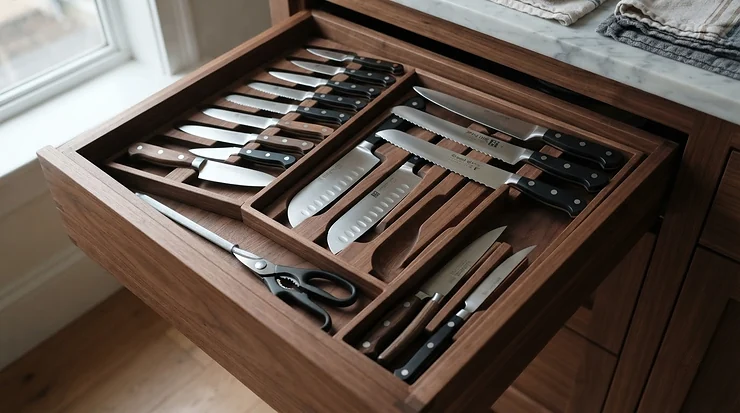
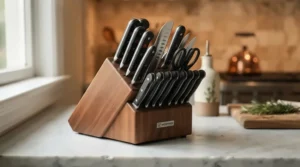
Start with storage: a knife block, a magnetic strip, or individual blade guards all prevent the edge from knocking against other metal, which is the single fastest way to dull a fresh blade. Honing — not sharpening — should happen every few uses. A honing steel realigns a rolled edge rather than removing metal, and it takes seconds. Genuine sharpening, which does remove metal to create a new edge, is usually only needed every few months for a knife in regular use, depending on how hard the steel is; harder steels like the AUS10 in the ProCook Elite set need it less often than the softer stainless in budget sets.
Washing matters more than most buyers expect. Hand wash in warm water immediately after use, dry fully before storing, and never leave a blade sitting in standing water — even brief soaking can accelerate pitting on lower-grade stainless, particularly in hard-water regions common across southern England and the Midlands. A light film of food-safe mineral oil on the blade before extended storage adds an extra layer of protection against moisture.
Real-World Scenarios: Matching Knives to Your Kitchen
If you’re a student moving into your first shared house with a budget under £40 and a habit of cooking simple pasta dinners three nights a week, the Victorinox Fibrox Pro or the Tower Damascus-Effect set will comfortably outlast your tenancy and travel well between house moves.
If you’re setting up a family kitchen where two or three people cook regularly, meals range from stir-fries to Sunday roasts, and knives get heavier daily use, a full block set like the Judge Classic or ProCook Professional X50 makes more sense than a single showpiece knife — you’ll always have the right tool without hunting for it mid-recipe.
If you’re an enthusiast home cook who already owns a decent chef’s knife but wants to upgrade your precision work — fine julienne, delicate fish work, careful fruit prep — the Global G-2 or ProCook Elite AUS10 reward that more focused use case, where their lighter weight or harder edge genuinely shows up in the results, rather than sitting unused as an expensive ornament.
A Budget Kitchenware Buying Guide: Stretching Every Pound Further
If [budget stainless steel kitchen knives] are your priority, the smartest move is to spend selectively rather than evenly. A single genuinely good chef’s knife — the Victorinox Fibrox Pro is the obvious example here — does roughly 80% of everyday kitchen tasks, so it’s the one blade worth prioritising quality on, even inside a tight overall budget.
For everything else, a compact set like the Tower Damascus-Effect collection covers bread, paring and utility tasks adequately without the premium price tag, and you can always upgrade individual pieces later as budget allows rather than replacing an entire set at once.
Three quick rules make a real difference on a budget: look for “high-carbon stainless” rather than plain stainless, since the added carbon genuinely improves edge retention; avoid dishwashing even when a set claims to be safe for it, since heat and detergent chemistry dull edges faster regardless of manufacturer claims; and dry blades immediately after washing, especially in hard-water areas, where mineral deposits accelerate dulling. None of these cost anything extra — they just require a small habit change that pays back over months of use.
If [If you’re kitting out a first home], choose one solid all-purpose knife plus a cheap paring knife over a large mismatched block — you’ll use two good blades daily far more than twelve mediocre ones gathering dust.
How to Choose Stainless Steel Kitchen Knives
What is stainless steel knives buying, in practice? It comes down to matching steel hardness, blade shape and handle comfort to how you actually cook — not chasing the highest spec number on the box. Here’s a structured way through it:
- Decide single knife or full set first. If you cook varied meals daily, a set covering chef, paring, utility and bread knives saves time; if you mostly need one all-rounder, a single quality chef’s knife beats a mediocre set.
- Check the steel type, not just “stainless.” High-carbon stainless (like X50 CrMoV or AUS10) holds an edge far better than plain chromium stainless used in the cheapest sets.
- Weigh Rockwell hardness against your handling style. Harder steels (58-62 HRC) keep an edge longer but chip more easily; softer steels (54-56 HRC) are more forgiving of rough use.
- Handle the grip, if you can, or read handle-specific reviews. A knife you can’t hold comfortably for ten minutes straight will end up in the back of the drawer regardless of blade quality.
- Consider forged versus stamped construction. Forged blades typically offer better balance and durability; stamped blades are lighter and considerably cheaper, which suits many home cooks perfectly well.
- Factor in maintenance realism, not aspiration. If you know you won’t hand wash and hone regularly, a tougher, more forgiving steel beats a premium blade that needs pampering to perform.
- Match the set size to your kitchen, not the marketing. A sixteen-piece block looks impressive but often dominates smaller UK worktops; five or six well-chosen pieces cover most households comfortably.
Understanding the Rockwell Hardness Scale
The Rockwell hardness scale is the industry-standard measurement for how resistant a metal is to indentation, and it’s the single most useful number for comparing knife steels beyond marketing language. The test itself works by pressing an indenter into the material under a measured load and reading the depth of penetration, producing a result denoted HRC for the scale most relevant to knife steel.
In practical terms: higher HRC numbers mean a harder steel that holds a sharp edge for longer between sharpenings, but also a more brittle blade that’s more prone to chipping if it strikes bone, a ceramic plate, or a granite worktop. Lower HRC numbers mean a softer, tougher steel that dulls faster but bends or rolls rather than chipping when mishandled — genuinely useful in a busy, less careful kitchen.
Most everyday German-style stainless sets, including the ProCook Professional X50 and Judge Classic ranges here, sit in the mid-50s to high-50s HRC range. Premium Japanese-style steels, like the AUS10 in the ProCook Elite set at 60±2 HRC, push noticeably harder, trading some toughness for meaningfully longer edge life. The Global G-2 and Wüsthof Classic sit closer together at 56-58 HRC, which explains why both feel like a genuine step up from budget stainless without venturing into the more delicate territory of ultra-hard Japanese blades.
Stainless Steel Knives vs Ceramic and Carbon Steel Alternatives
Stainless steel isn’t the only material on the market, and a fair comparison has to acknowledge where the alternatives genuinely win.
| Factor | Stainless Steel | Ceramic | Carbon Steel |
|---|---|---|---|
| Edge retention | Good to very good | Excellent | Excellent |
| Rust resistance | Very good | Excellent (won’t rust) | Poor without care |
| Chip resistance | Good | Poor — brittle if dropped | Very good |
| Ease of sharpening at home | Easy to moderate | Requires diamond tools | Easy |
| Typical price | Wide range | Mid-range | Wide range |
| Best For | Most home cooks wanting an all-rounder | Fruit and veg where metallic taste matters | Enthusiasts happy to maintain patina and dry blades immediately |
The honest analysis here is that ceramic knives hold an edge for years without sharpening and never rust, but they’re genuinely brittle — drop one on a tiled floor and it can chip or shatter in a way no stainless blade will. Carbon steel, meanwhile, sharpens beautifully and takes an aggressively keen edge, but it rusts within hours if left wet, requiring a level of after-use care that many households simply won’t maintain consistently. Stainless steel sits in the sensible middle: not the single best performer in any one category, but the only material that performs acceptably across all of them without demanding special handling — which is exactly why it dominates UK kitchens rather than being the “boring” choice it sometimes gets dismissed as.

Common Mistakes When Buying Stainless Steel Kitchen Knives
The most common mistake is buying purely on piece count. A sixteen-piece block looks like better value than a five-piece set, but most households use four or five blades regularly and the rest sit untouched — you’re often paying for filler pieces like a fish knife or steak knives you’ll rarely reach for.
A close second is ignoring handle size relative to your own hand. Reviews rarely mention this, but a chef’s knife with a handle designed for larger hands can feel unbalanced and tiring for someone with smaller hands, regardless of how good the steel is.
Buyers also frequently overestimate how “dishwasher safe” claims hold up over time. Even when a manufacturer states a knife is dishwasher safe, the combination of heat, detergent and contact with other cutlery reliably dulls edges faster than hand washing — it’s a convenience trade-off worth going into with open eyes rather than treating the claim as a free lunch.
Finally, many buyers assume higher price always means sharper out of the box. It doesn’t. Some budget knives, including the Victorinox Fibrox Pro here, arrive impressively sharp because factory sharpening quality varies more by manufacturer process than by overall price point.
The Knife Set Gift Guide: Giving (and Receiving) Well
A knife set makes a genuinely useful housewarming or wedding gift, but it’s also one of the easiest gifts to get wrong. The Judge Classic 5-Piece Knife Block Set works well here specifically because it looks considered rather than novelty — a wooden block with a 25-year guarantee reads as thoughtful, not gimmicky, and it doesn’t require the recipient to know anything about steel types to appreciate the gesture.
For a smaller, more personal gift, the ProCook Elite AUS10 3-Piece Knife Set suits a keen home cook who already owns basics and would appreciate an upgrade in edge quality rather than more pieces cluttering their drawer. For a lighter-touch, budget-conscious gift — a student starting out, or a first flat — the Tower Damascus-Effect set’s striking appearance and low price make it an easy, low-risk choice.
One UK-specific point worth flagging clearly: knives are age-restricted products. Retailers cannot legally sell or deliver a knife to anyone under 18, and reputable online sellers now run age-verification checks at checkout and require an adult signature on delivery — worth knowing if you’re gifting on someone else’s behalf or ordering for delivery to a household with teenagers.
Safety, Regulations and Kitchen Confidence
Good knife safety habits matter more than the steel grade, honestly. Always cut on a stable board, keep fingers curled away from the blade path, and never leave a knife submerged in a sink of washing-up water where the next person reaching in can’t see it. A sharp knife is genuinely safer than a blunt one — blunt blades require more pressure and are more likely to slip off the food rather than through it.
If an accident does happen, the NHS provides clear guidance on treating minor cuts at home and recognising when a wound needs professional attention, including signs of infection and when stitches are genuinely necessary rather than optional.
On the regulatory side, UK law is unambiguous: it is illegal to sell a knife, including ordinary kitchen cutlery, to anyone under the age of 18, under the Criminal Justice Act 1988 as amended by later legislation. This applies to kitchen knives exactly as it applies to any other bladed product — a point worth knowing whether you’re buying, selling, or simply gifting a set to a younger relative, since delivery drivers are now required to verify the recipient’s age on age-restricted orders too.
Long-Term Cost & Maintenance: The Real Value Equation
A £30 knife that needs replacing every eighteen months and a £150 knife that lasts fifteen years with occasional professional sharpening can end up costing roughly the same over a decade — the difference is convenience, performance while you own it, and how much you value not thinking about it again.
| Consideration | Budget Pick | Mid-Range Pick | Premium Pick |
|---|---|---|---|
| Example | Victorinox Fibrox Pro | ProCook Professional X50 | Wüsthof Classic |
| Typical lifespan with care | 5-8 years | 10-15 years | 15-25+ years |
| Sharpening frequency | Every 4-6 weeks | Every 2-3 months | Every 3-4 months |
| Best For | Renters, students, first kitchens | Family kitchens with daily use | Long-term homeowners buying once |
Interpreting the table, the budget route isn’t a false economy exactly — it’s the right call for anyone renting, moving frequently, or simply unsure how much they’ll cook. But for a settled household doing daily prep, the mid-range and premium picks spread their higher upfront cost across enough years that the effective annual cost often ends up lower, not higher, than repeatedly replacing cheaper blades. Professional sharpening, where used, typically costs a modest amount per knife and extends any stainless blade’s working life significantly beyond home honing alone.
Frequently Asked Questions
❓ Are stainless steel knives better than carbon steel knives?
❓ How often should I sharpen a stainless steel kitchen knife?
❓ Is a higher Rockwell hardness always better for kitchen knives?
❓ Can stainless steel knives go in the dishwasher?
❓ What's the best stainless steel knife set for a beginner in the UK?
Conclusion
There’s no single “best” stainless steel knife — there’s a best knife for your kitchen, your budget, and how carefully you’re realistically willing to maintain it. The Victorinox Fibrox Pro remains the smartest single purchase for anyone who wants one excellent all-rounder without overthinking it. The Judge Classic and ProCook Professional X50 sets serve busy family kitchens well, covering every common task without requiring you to know anything about steel chemistry. And for anyone chasing genuine edge-retention performance, the Global G-2, Wüsthof Classic and ProCook Elite AUS10 all reward the extra spend in ways that show up daily, not just on the spec sheet.
Whichever you choose, the habits matter as much as the hardware: hand wash promptly, hone regularly, store blades so they’re not knocking against other metal, and resist the dishwasher even when the label says it’s allowed. Do that, and even a modestly priced stainless steel knife will outperform an expensive one that’s been neglected.
Recommended for You
- Best Oyster Knife UK: 7 Top Picks That Won’t Let You Down (2026)
- Best Mezzaluna Knife UK: 7 Top Picks Tested for 2026
- Best Deba Knife 2026: 7 Top Picks for Filleting Whole Fish
Disclaimer: This article contains affiliate links. As an Amazon Associate, I earn from qualifying purchases. If you purchase products through these links, we may earn a small commission at no additional cost to you.
✨ Found this helpful? Share it with your friends! 💬🤗
