
In This Article
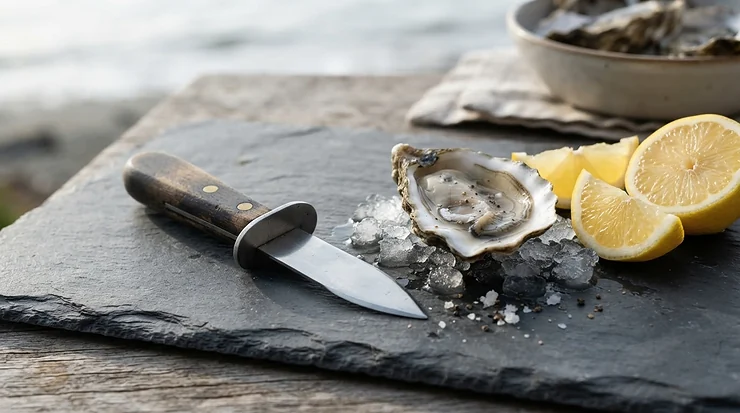
There’s a particular kind of humiliation reserved for the person who invites friends round for a New Year’s Eve seafood platter, cracks open a box of rock oysters with genuine confidence, and then spends the next twenty minutes losing a knife-fight with a mollusc. It happens more than anyone admits. The problem is almost never the oysters. It’s the tool. A best oyster knife isn’t a luxury gadget — it’s a short, blunt-tipped blade with a reinforced tip and a grippy handle, purpose-built to lever open a shell without snapping, slipping, or taking a chunk out of your palm along the way. Get the wrong one and every oyster becomes a wrestling match; get the right one and the hinge pops with a satisfying little click that feels almost too easy.
We’ve spent time digging through real product listings, aggregated review sentiment, and UK food-safety guidance to work out which oyster shucking knife actually earns its keep on a British worktop in 2026. This isn’t a rehashed spec sheet lifted from a listing page — it’s commentary on what those specs mean once you’re three oysters deep with cold hands and a towel wrapped around your palm. The common or European flat oyster and the ridged Pacific rock oyster both turn up on UK fishmonger slabs, and each shell shape genuinely changes which blade profile suits it best, as you’ll see below. Whether you’re after a no-nonsense single blade, a full oyster knife set with glove, or general seafood prep tools for your wider kitchen kit, there’s a pick further down that fits. And because shellfish carries real risks alongside the reward, we’ll also cover the shellfish safety gear worth having on hand before you crack open a single shell.
Quick Comparison Table
| Product | Style | Best For | Price Range |
|---|---|---|---|
| Victorinox Oyster Knife | New Haven, plastic handle | All-round reliability | £15-£20 |
| OXO Good Grips Oyster Knife | Bent tip, soft-grip | Wet, cold-hand shucking | £12-£18 |
| Mercer Culinary New Haven Bent Tip | Bent tip, poly handle | Catering-style speed | £15-£22 |
| Mercer Culinary Boston Style | Wide straight blade | Deep-cupped Pacifics | £15-£22 |
| Dexter-Russell Sani-Safe New Haven | Classic carbon-tip blade | Traditionalists & pros | £18-£25 |
| SPEENSUN Oyster Knife & Glove Set | Twin knife + glove kit | Beginners wanting full kit | £15-£25 |
| Lamapee Oyster Knife & Glove Set | French side-entry + glove | Budget starter sets | £14-£22 |
Looking at the spread above, the cheapest route into oyster shucking isn’t necessarily the safest one, which is exactly why the SPEENSUN Oyster Knife & Glove Set and Lamapee Oyster Knife & Glove Set earn their place — they bundle in cut-resistant protection that a standalone blade doesn’t. Meanwhile, the Dexter-Russell Sani-Safe New Haven sits at the top of the range not because it’s fancier, but because it’s the blade professional shuckers reach for shift after shift. If you only ever open a dozen oysters at Christmas, a single well-made knife like the Victorinox Oyster Knife or OXO Good Grips Oyster Knife will comfortably outlast the occasion.
💬 Found a comparison here that helped? A quick share helps other home cooks avoid the same shell-splitting mistakes.
Top 7 Oyster Knives: Expert Analysis
1. Victorinox Oyster Knife — Swiss precision at a sensible price
The standout here is simple: Victorinox built its name on tools that survive decades of hard use, and this oyster knife inherits that same over-engineered reliability. The blade measures roughly 166mm in total length with a stainless-steel construction and a black, slip-resistant plastic handle — dishwasher-safe, which matters more than it sounds once you’ve hand-washed a knife covered in briny oyster liquor three times in one evening. What that spec sheet doesn’t say outright is that the handle’s slightly flared shape stops your grip rotating mid-twist, which is precisely the moment most beginners lose control and the blade skids.
Based on the spec comparison against cheaper unbranded blades, the Victorinox Oyster Knife justifies its middling price through blade rigidity — a soft blade flexes under pressure and either bends permanently or shoots off the shell edge, which is how most kitchen cuts happen. Reviewers consistently report that the tip holds its point well over repeated use, and that the handle stays secure even when hands are cold and slightly damp, a common complaint levelled at bargain alternatives. It’s the knife we’d point a nervous first-timer towards, precisely because it forgives a slightly wrong angle of attack.
Pros:
- ✅ Rigid stainless blade resists bending under pressure
- ✅ Slip-resistant handle stays secure with wet hands
- ✅ Dishwasher-safe for easy post-shucking cleanup
Cons:
- ❌ No cut-resistant glove included in the box
- ❌ Blade tip is shorter than dedicated professional models
Sitting in the £15-£20 range, the Victorinox Oyster Knife represents strong value for anyone who wants a single, dependable blade rather than a bundled kit — check current price before ordering, as availability shifts.

2. OXO Good Grips Oyster Knife — best for cold, wet hands
OXO built its entire brand on ergonomic handles designed for arthritic or reduced-strength grips, and that heritage is obvious the moment you pick this one up. The soft, oval-profile handle is shaped specifically to sit in the palm without needing a white-knuckle grip, and the bent-tip blade angles slightly upward to help it slide under the shell’s hinge rather than skating across the flat top.
Here’s what most buyers overlook about a bent-tip design: it changes the angle of attack, meaning you’re prying rather than stabbing, which is a genuinely safer motion for beginners because the leverage works with the shell rather than against your own thumb. Aggregated review sentiment on this model consistently praises the non-slip grip specifically in wet conditions — a detail that matters far more for oyster prep than for almost any other kitchen task, given you’re working with a liquid-filled shell over a sink. A common complaint in user reviews is that the blade, while sturdy, isn’t quite stiff enough for the very largest, thickest-shelled Pacific oysters, where it can flex slightly under sustained pressure.
Pros:
- ✅ Ergonomic non-slip handle excels with wet or cold hands
- ✅ Bent tip design aids beginner-friendly prying motion
- ✅ Dishwasher-safe stainless steel blade
Cons:
- ❌ Blade can flex on very large, thick-shelled oysters
- ❌ Handle bulk makes it less suited to precision work
At around £12-£18, this is one of the more accessible entry points into proper shucking gear, and it’s a genuinely sensible pick for anyone whose hands tend to get cold at a winter seafood table.
3. Mercer Culinary New Haven Style Bent Tip Oyster Knife — catering-grade speed
Mercer supplies more culinary academies across North America than almost any other cutlery brand, and this 2¾-inch bent-tip blade is essentially the same tool trainee chefs learn to shuck with. The high-carbon, stain-free steel is engineered specifically for durability under repeated flexing rather than outright hardness, which in practice means it resists snapping rather than resists dulling — a trade-off that suits speed-shucking far better than a brittle, ultra-hard edge would.
What most home cooks won’t realise until they’ve worked through a full dozen is that a rounded blade tip, like Mercer builds into this model, is a deliberate safety feature rather than a design compromise. It reduces the risk of a serious puncture wound if the blade slips off the shell, while still being sharp enough at the edges to sever the adductor muscle cleanly. Reviewers who’ve used it in both home and semi-professional settings note the textured poly handle holds up well over months of hand-washing, though Mercer explicitly advises against dishwashing it, unlike the Victorinox and OXO models above — a maintenance detail that’s easy to miss at checkout.
Pros:
- ✅ Catering-grade steel built for repeated professional use
- ✅ Rounded safety tip reduces puncture risk if it slips
- ✅ Textured handle maintains grip through long shucking sessions
Cons:
- ❌ Not dishwasher-safe — hand wash only
- ❌ Slightly narrower blade than Boston-style alternatives
Expect this one to sit in the £15-£22 bracket, and if you’re the sort of host who ends up shucking three dozen oysters for a party rather than half a dozen for two, the extra durability earns its keep quickly.
4. Mercer Culinary Boston Style Oyster Knife — best for deep-cupped shells
Where the New Haven-style blade above is narrow and pointed, the Boston-style variant widens out, giving it more surface area to work along the shell’s edge once the hinge has popped. That widening matters more than it sounds: on deep-cupped oysters — the kind with a pronounced bowl shape rather than a flat profile — a narrow blade can struggle to sever the adductor muscle in one clean pass, forcing multiple attempts that risk spilling the liquor and mangling the meat.
On paper this means the Boston style trades a touch of hinge-piercing precision for better shell-clearing leverage once you’re inside. Based on the spec comparison with its New Haven sibling, we’d steer anyone regularly working with Pacific or Rock oysters — the deeper-shelled varieties common at UK fishmongers — towards this profile, while flatter native oysters suit the narrower blade better. Aggregated feedback echoes that logic: users report less resistance clearing the top shell once open, though a few note the wider blade takes slightly more practice to seat correctly into a tight hinge to begin with.
Pros:
- ✅ Wide blade clears deep-cupped shells more efficiently
- ✅ Same durable high-carbon steel as the New Haven model
- ✅ Comfortable poly handle with round, non-slip back
Cons:
- ❌ Steeper learning curve for hinge entry than narrower blades
- ❌ Hand-wash only, same as the New Haven variant
Priced similarly to its sibling at around £15-£22, this is the one to reach for if your usual order leans towards Rock oysters over natives.
5. Dexter-Russell Sani-Safe New Haven Oyster Knife — the professional’s workhorse
Dexter-Russell has supplied American fish markets and seafood counters for well over a century, and the Sani-Safe range is the direct result of decades of feedback from people who shuck for a living, not for a dinner party. The 2¾-inch blade uses a high-carbon stainless formulation specifically chosen to hold an edge through hundreds of oysters in a single shift, and the textured, polypropylene handle is moulded to prevent rotation even when soaked in brine for hours.
What the spec sheet won’t tell you, but professional reviewers consistently note, is that this knife rewards technique rather than brute force — its stiffness means a confident, controlled twist opens a shell cleanly, while an unpractised hard jab is more likely to skid than with the slightly more forgiving OXO model. That’s not a flaw so much as a personality trait: this is a tool built for people who shuck often enough to develop muscle memory, which is exactly why it’s the blade you’ll see behind most UK oyster bars and fishmonger counters. If you’re buying your first-ever oyster knife purely for one festive dinner, it may be overkill; if you’re the household’s designated shucker every Christmas and New Year without fail, it’s the one that will still be sharp in a decade.
Pros:
- ✅ Professional-grade steel holds an edge through heavy use
- ✅ Textured handle resists rotation even when brine-soaked
- ✅ Trusted by fishmongers and seafood counters across the industry
Cons:
- ❌ Less forgiving of imprecise technique than beginner-friendly models
- ❌ Typically the priciest single blade in this line-up, around £18-£25
Given the longevity reviewers consistently report, the value case here is less about the up-front price and more about cost-per-shuck over the years — more on that later in our long-term cost breakdown.
6. SPEENSUN Oyster Knife & Glove Set — best full starter kit
Rather than a single blade, this is a bundled oyster knife set with glove that pairs two shucking knives with a five-level food-grade, cut-resistant glove. The wood-handled knives are built with sturdier-than-average tips designed specifically to survive the twisting motion beginners tend to apply too aggressively before they’ve developed a lighter touch, while the included glove adds a genuine safety layer that none of the standalone blades above come with.
Here’s what most first-time buyers overlook when comparing a single premium knife against a set like this: the real risk in oyster shucking usually isn’t the blade dulling — it’s the supporting hand slipping while gripping a wet, hard shell. Aggregated review sentiment for this set is particularly strong on that exact point, with buyers repeatedly highlighting the glove’s grip and puncture resistance as the standout feature rather than the knives themselves, which are solid but unremarkable performers on their own merits. If you cannot verify hands-on durability testing over years of use, as with any newer entrant to the market, the safety-first bundling is still a legitimate reason to choose it over a lone blade, particularly for a household with more than one person shucking.
Pros:
- ✅ Includes a genuine 5-level cut-resistant glove
- ✅ Two knives cover both flat and bent-tip shucking styles
- ✅ Comfort wood handles suit longer shucking sessions
Cons:
- ❌ Individual knife blades are less refined than dedicated single models
- ❌ Bulkier packaging than a standalone knife purchase
At roughly £15-£25 for the full set, this works out as strong value once you account for the fact you’d otherwise be buying gloves separately — see our shellfish safety gear section below for why that’s not optional in our view.
7. Lamapee Oyster Knife & Glove Set — budget-friendly French-style set
The Lamapee set takes a different approach again, pairing a French-style side-entry blade with a Level 5 cut-resistant glove at one of the more accessible price points in this round-up. The side-entry design differs from the New Haven and Boston styles above in that the blade is meant to slide in from the side of the hinge rather than straight into its centre — a technique some French oyster bars favour for its slightly gentler angle of approach.
Based on the spec comparison against the SPEENSUN set above, the Lamapee kit trades a touch of blade refinement for an even lower entry price, which makes sense given its positioning as a genuine budget starter option rather than a semi-professional tool. Reviewers consistently note that the included glove is the set’s strongest feature, echoing the same pattern seen with SPEENSUN — buyers overwhelmingly cite the safety kit, rather than knife sharpness, as the reason for their purchase. What most first-timers won’t realise until they try it is that the side-entry technique genuinely does take a little longer to learn than a straight hinge-jab, so pair this set with a practice run on a few inexpensive oysters before hosting.
Pros:
- ✅ Genuinely low entry price for a knife-and-glove bundle
- ✅ Level 5 cut-resistant glove included as standard
- ✅ French side-entry style offers a gentler learning angle
Cons:
- ❌ Side-entry technique has a steeper initial learning curve
- ❌ Blade steel is softer than the premium single-knife options
Typically found in the £14-£22 range, this is the pick for someone dipping a toe into home shucking for the first time without wanting to commit to premium single-blade pricing just yet.
How to Shuck Oysters Safely: A Practical Setup & Technique Guide
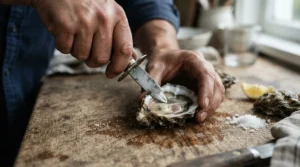
Buying the right knife solves half the problem; technique solves the rest, and it’s the half most listings skip entirely. Start by scrubbing the shells under cold running water with a stiff brush to remove grit and mud — skipping this step is the single most common reason grit ends up in the finished oyster. Next, discard anything that’s gaping open and won’t close when tapped; a dead oyster is a food-safety risk, not a bargain. Fold a thick tea towel or, better still, pull on your cut-resistant glove, and hold the oyster flat-side up with the hinge pointing towards you.
Locate the hinge — the small, dark, slightly recessed point where the two shells meet, a technique delicious. magazine’s own shucking guide describes in useful step-by-step detail — and work the tip of your best oyster knife in at a slight downward angle, applying steady pressure rather than a sharp stab. Twist firmly once you feel the tip seat itself; you’re aiming to pop the hinge, not force the whole shell apart in one violent motion. Once it gives, run the blade along the inside of the top shell to sever the adductor muscle, lift the top shell away, and then slide the blade underneath the oyster to free it from the bottom shell without spilling the liquor. In the first thirty days of practice, the most common mistake is rushing the hinge entry before the tip has properly seated — slow that first movement down and everything after it gets easier. Keep opened oysters on a bed of crushed ice or rock salt so they stay stable and chilled while you work through the rest of the batch.
Building the Perfect New Year’s Eve Seafood Platter
If you’re a home host planning a New Year’s Eve seafood platter for six to eight guests, the maths matters more than most recipes let on: budget roughly four to six oysters per person if they’re part of a wider spread, or eight to twelve if oysters are the star. Pair your freshly shucked oysters with a simple mignonette — shallots, red wine vinegar, and cracked pepper — plus lemon wedges and a small bowl of ice to nestle the shells into for presentation, a trick that also keeps them at a safe temperature far longer than a flat plate.
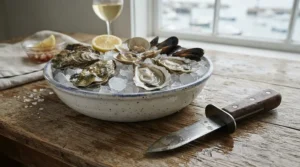
Timing is the part most first-time hosts underestimate. Shuck no more than 20-30 minutes before serving wherever possible, since oysters lose their briny liquor and start to dry out on the shell once opened, and never leave shucked oysters unrefrigerated on a party table for more than about two hours — a detail that matters even more at a long New Year’s gathering where food often sits out well past midnight. If you’re catering for a crowd, this is exactly where the SPEENSUN Oyster Knife & Glove Set or Lamapee Oyster Knife & Glove Set genuinely pull ahead of a single blade, since two knives mean two people can shuck simultaneously without one guest hogging the only tool in the kitchen while everyone else waits with a glass of fizz.
Common Oyster Shucking Problems (And How to Fix Them)
Problem: the blade won’t find the hinge. This is almost always an angle issue rather than a strength issue — reposition the oyster so the hinge is pointing directly at you and try a slightly steeper downward angle with the Victorinox Oyster Knife or Dexter-Russell Sani-Safe New Haven, both of which have pointed tips built for exactly this entry style.
Problem: the shell cracks instead of popping cleanly. Cracking usually means too much force applied too early. Ease off, let the tip do the work, and consider a bent-tip design like the OXO Good Grips Oyster Knife, which is engineered to pry rather than stab.
Problem: liquor keeps spilling before you can serve. Keep the oyster level throughout, not just at the final lift — tilt only once the top shell is fully removed, and always work over a bowl of crushed ice so any spillage is caught and the oyster stays chilled regardless.
Problem: hands keep slipping on wet shells. This is a grip problem, not a knife problem, and it’s the exact issue that shellfish safety gear like a cut-resistant glove is designed to solve — see the dedicated section below.
Problem: the knife tip is bending or blunting quickly. Cheap, unbranded blades often flex under repeated hinge pressure. A stiffer, catering-grade blade such as the Mercer Culinary New Haven Style Bent Tip Oyster Knife resists this far better over sustained use.
How to Choose the Best Oyster Knife: 6 Criteria That Actually Matter
- Blade rigidity. A knife that flexes under pressure either fails to pop the hinge or skids dangerously — prioritise stiffness over raw hardness.
- Tip shape. Pointed tips like the Victorinox suit hinge-first entry; bent tips like the OXO suit a prying motion that many beginners find more forgiving.
- Handle grip in wet conditions. Oyster shucking is a wet-hands job by definition, so test (or read reviews on) how a handle performs specifically when damp, not just dry.
- Whether safety gear is included. An oyster knife set with glove removes a second purchasing decision and closes the single biggest safety gap in home shucking.
- Dishwasher compatibility. Some models, like Mercer’s range, explicitly require hand-washing — factor that into your after-use routine before buying.
- Shell profile you’ll mostly open. Deep-cupped Pacific and Rock oysters favour wider Boston-style blades; flatter native oysters suit narrower New Haven profiles.
Common Mistakes When Buying an Oyster Shucking Knife
The single biggest mistake is buying on price alone without checking blade steel quality — a knife that bends on the third oyster of the evening is no bargain, however little it cost. A close second is assuming any kitchen paring knife will do the job; standard knives lack the reinforced, often rounded tip that prevents the blade punching straight through a resistant shell into your supporting hand. Buyers also frequently skip gloves entirely, treating them as an optional extra rather than the core safety layer they actually are — a mistake this guide’s shellfish safety gear section addresses directly below. Finally, many first-time buyers overlook maintenance requirements at checkout, only discovering after their first wash that a model needs hand-washing rather than the dishwasher-safe convenience they assumed.
Oyster Knife vs General Seafood Prep Tools
It’s tempting to assume a general set of seafood prep tools — crab crackers, lobster picks, fish scalers — will cover oyster shucking too, but the two jobs are mechanically different in ways that matter. Crab crackers and lobster picks are designed to break or extract from an already-opened shell; an oyster knife’s entire purpose is levering a sealed, tightly hinged shell open in the first place, which demands a short, rigid blade and a reinforced tip that general seafood tools simply don’t have. Attempting to use a fish filleting knife or a generic paring knife on an oyster hinge is one of the more common causes of kitchen injuries around festive seafood prep, precisely because those blades are thin and designed to flex, not to pry.
That said, a dedicated oyster knife absolutely belongs alongside a wider seafood prep tools kit rather than replacing it. If your festive spread includes crab, langoustines, or whole prawns alongside your oysters, you’ll still want crackers and picks for those — the best oyster knife in your kit is a specialist, not a generalist, and it’s worth budgeting for both rather than expecting one tool to multitask across shellfish types it wasn’t built for.
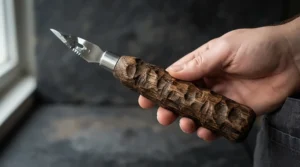
Shellfish Safety Gear: Cut-Resistant Gloves & Oyster Knife Sets Explained
Cut-resistant gloves rated at Level 5 (on the older EN 388 scale still commonly used on UK packaging) offer meaningfully higher puncture and slash resistance than a folded tea towel, which remains the traditional — and frankly outdated — method many home cooks still rely on. Both the SPEENSUN Oyster Knife & Glove Set and Lamapee Oyster Knife & Glove Set include gloves at this rating, and reviewers across both consistently cite the glove as the reason for purchase over the knives themselves, which tells its own story about where the real risk sits.
Safety gear matters even before the knife comes out, though. Raw oysters carry a genuine, well-documented food safety risk that has nothing to do with cutting yourself. Norovirus contamination in UK-grown oysters has been the subject of formal government research, and the Food Standards Agency’s own findings note that a substantial share of British oysters have historically tested positive for traces of the virus, with case numbers running into the hundreds annually across England alone — you can read the full FSA risk assessment on norovirus in oysters for the detailed findings. The practical takeaway for home hosts is straightforward: buy from a reputable, traceable supplier, keep shellfish properly chilled right up until shucking, and be aware that older people, pregnant women, young children, and anyone with a weakened immune system are advised to avoid raw or lightly cooked shellfish altogether. It’s also worth knowing that shellfish allergy is one of the more common food allergies and, unlike some others, is rarely outgrown — Anaphylaxis UK’s shellfish factsheet is a useful reference if you’re hosting guests whose allergy status you’re unsure of, since even steam or spillage from shellfish prep can occasionally trigger a reaction in sensitive individuals.
Oyster Knife for Different Users: Beginners, Home Entertainers & Pros
If you’re a complete beginner shucking for the first time this festive season, prioritise forgiveness over speed — the OXO Good Grips Oyster Knife or a bundled set like SPEENSUN Oyster Knife & Glove Set will get you through your first dozen with far fewer scares than a stiff professional blade. Home entertainers who host regularly, particularly around Christmas and New Year, benefit most from owning two knives so guests can help — the twin-knife SPEENSUN and Lamapee sets both solve this neatly without needing two separate purchases. Serious enthusiasts or anyone who’s found themselves shucking three or four times a month should look to the Dexter-Russell Sani-Safe New Haven or Mercer Culinary range, both of which reward the developed technique that comes with repetition and hold their edge far longer under sustained use.
Features That Actually Matter (And Those That Don’t)
Blade rigidity, tip shape, and handle grip in wet conditions genuinely change your shucking experience — these are worth paying attention to and, where relevant, worth paying a little more for. Included branding, decorative handle colours, and gift-box packaging, on the other hand, add nothing to actual performance and are largely marketing dressing on otherwise identical blades. Cut-resistant gloves are a genuine feature worth prioritising, not a gimmick; the same can’t be said for oversized “professional” branding on budget blades that use the same steel as unbranded alternatives at half the price. If a listing spends more words on its packaging than its blade steel, treat that as a mild red flag rather than a selling point.
Long-Term Cost & Maintenance of Your Oyster Knife
A well-made oyster knife is a genuinely long-term purchase — properly maintained, blades from Victorinox, Dexter-Russell, or Mercer can realistically last a decade or more of regular festive use, which puts the cost-per-shuck for a £20 knife used across ten Christmases at pennies per session. The maintenance itself is minimal: hand-wash where the manufacturer specifies it (Mercer’s range, notably), dry thoroughly before storing to prevent rust spotting on carbon-content blades, and periodically hone rather than aggressively sharpen the tip, since an oyster knife’s job is prying rather than slicing. Cut-resistant gloves included in sets like SPEENSUN or Lamapee typically have a shorter working life than the knives themselves, particularly with heavy use, so budget for eventually replacing the glove alone rather than the full set — most suppliers sell them separately once you know the sizing that fits.

FAQ
❓ What is the best oyster knife for beginners?
❓ Do I need a glove to shuck oysters?
❓ Can you use a normal knife to open oysters?
❓ How many oysters per person for a party?
❓ Are Dexter-Russell oyster knives dishwasher safe?
Conclusion
There’s no single best oyster knife for every household — the right pick depends on how often you’re shucking, how many hands will be sharing the job, and how much of a safety net you want built in from the start. For most home entertainers hosting an occasional New Year’s Eve seafood platter, a bundled oyster knife set with glove like the SPEENSUN Oyster Knife & Glove Set removes the biggest risk factor in one purchase. For anyone shucking often enough to develop real technique, the Dexter-Russell Sani-Safe New Haven or Mercer Culinary range rewards that investment with years of reliable service. And if you just want one dependable blade that won’t let you down on the night, the Victorinox Oyster Knife remains a genuinely hard combination to beat. Whichever you choose, pair it with proper shellfish safety gear and the food-safety basics covered above, and the next oyster you open should pop cleanly rather than fight back.
✨ Don’t Miss These Exclusive Deals!
🦪 Ready to stop wrestling with shells this New Year’s Eve? Click through on any of the picks above to check current pricing and availability before your next seafood platter — your fingers (and your guests) will thank you!
Recommended for You
- Best Mezzaluna Knife UK: 7 Top Picks Tested for 2026
- Best Deba Knife 2026: 7 Top Picks for Filleting Whole Fish
- Best Yanagiba Knife 2026: 7 Sashimi Blades Worth Buying
Disclaimer: This article contains affiliate links. As an Amazon Associate, I earn from qualifying purchases. If you purchase products through these links, we may earn a small commission at no additional cost to you.
✨ Found this helpful? Share it with your friends! 💬🤗
