
In This Article
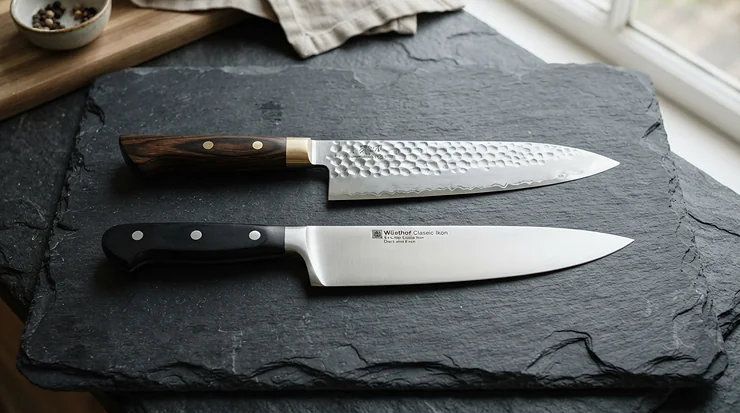
Here is a small kitchen heartbreak that plays out in British homes every week. Someone spends a Sunday rolling maki, reaches for the bread knife, and watches a lovely salmon fillet turn into a shredded mess. The fish isn’t the problem. The blade is. A proper VG-10 steel knife for sushi fixes that, and it does so without the orange rust freckles that carbon steel throws at you in a damp UK kitchen.
VG-10 is the sensible grown-up of Japanese blade steels. It is hard enough to hold a razor edge, stainless enough to survive a washing-up bowl, and forgiving enough to resharpen on a basic whetstone. That balance explains why a VG-10 steel knife for sushi turns up at every price point, from budget slicers to hand-finished flagships.
But “VG-10” on a listing is only half the story. Blade shape, bevel, cladding, length and handedness decide whether a knife glides or grinds. This guide covers seven real models and the honest trade-offs between them. It also settles the VG-10 vs Damascus steel knife question, tours the main Japanese knife steel grades, and weighs up santoku vs sushi knife for real kitchens. Finally, it walks through sashimi knife technique you can use tonight.
A note on method: specs come from retailer and maker listings, and review comments are only summarised where they genuinely exist. Prices are ranges at the time of research, so check current price on amazon.co.uk before buying. Availability shifts constantly.
Quick Comparison: 7 Top Picks at a Glance
| Product | Style | Construction | Price range | Best For |
|---|---|---|---|---|
| Keemake VG10 Yanagiba 10.5″ | Yanagiba slicer | VG10 stainless (limited published detail) | £35-£50 | Curious beginners testing long-slice sashimi |
| Tojiro DP Santoku 17cm | Santoku | VG10 core, soft stainless cladding | £80-£110 | First Japanese knife and all-round prep |
| Tojiro Gai Santoku 17cm | Santoku | VG10 core, 37-layer Damascus-style cladding | £120-£160 | Gifts and looks-plus-performance buyers |
| Sakai Takayuki 33-Layer VG10 Damascus Kengata Yanagiba 270mm | Tip-shaped slicer, double bevel | VG10 core, 33-layer hammered cladding | £280-£360 | Home cooks wanting a light, forgiving slicer |
| Sukenari VG-10 Yanagi 330mm | Traditional yanagiba, single bevel | VG-10, HRC 61-62 | Mid-to-high £300s | Long-stroke slicing and serious hobbyists |
| Masamoto VG-10 Hon Kasumi Yanagiba 270mm | Traditional yanagiba | VG-10 core welded to soft stainless | Check current price | Traditionalists wanting low-maintenance steel |
| Sakai Takayuki Honyaki VG-10 Shoryu 00201 | Yanagiba 27.5cm, single bevel | Honyaki-style, saya included | £480-£540 | Enthusiasts wanting a showpiece |
Looking at the table, the Tojiro DP Santoku 17cm is the sensible entry point if you want one knife that does everything reasonably well. If sashimi is the whole point, the Sakai Takayuki 33-Layer VG10 Damascus Kengata Yanagiba 270mm gives you a long blade without the single-bevel learning curve. The Keemake VG10 Yanagiba 10.5″ is the cheap experiment, but its thin published detail is the price of that low cost.
💬 Just one click — help others make better buying decisions too!😊
What Is a VG-10 Steel Knife for Sushi?
A VG-10 steel knife for sushi is a Japanese-style slicing or all-purpose blade with a cutting core of VG-10, a high-carbon stainless steel developed by Takefu Special Steel. It is typically hardened to around HRC 60-61, giving a very sharp, long-lasting edge that resists rust and suits raw fish, rolls and vegetables.
According to Wikipedia’s VG-10 entry, the steel contains roughly 1% carbon, 15% chromium, 1% molybdenum, 0.2% vanadium and 1.5% cobalt. Read that as a recipe. The carbon buys hardness, the chromium buys stain resistance, and the cobalt and vanadium help the edge last and stay tough. The name stands for “V Gold 10”, gold meaning quality.
Why does this matter for fish? Raw flesh is delicate. A dull or thick edge crushes fibres, so slices look ragged and taste slightly “off”. A hard, thin, sharp edge parts the flesh cleanly. VG-10 sits in a practical sweet spot: sharper and longer-lasting than ordinary stainless, tougher and easier to sharpen than many harder, more brittle alternatives.
One caution: “VG-10” tells you the steel, not the quality of the heat treatment or grind. Two knives with identical steel can cut very differently, which is why the product analysis below focuses on geometry and construction as much as the label.
Top 7 VG-10 Steel Knife for Sushi Picks: Expert Analysis
These seven span budget, mid-range and premium, and they cover both slicers (yanagiba) and all-rounders (santoku). Each entry turns specs into practical meaning and flags where information is thin.
1. Keemake VG10 Yanagiba 10.5″ — cheapest way into long-slice sashimi
The pitch is blunt: a roughly 27 cm single-purpose slicer in VG10 stainless for less than a decent takeaway for two.
The listing describes a 10.5-inch yanagiba-style blade in VG10 stainless. Length matters because a long blade lets you finish a fillet slice in one smooth draw, which is the foundation of sashimi knife technique. What the listing doesn’t clearly publish is weight, hardness or bevel geometry, so treat those as unknowns and confirm them with the seller.
Based on the spec comparison, this is a learning knife. It suits someone who wants to find out whether single-bevel slicing clicks before spending hundreds of pounds. It is less suited to anyone who needs documented heat treatment or a sheath.
The one public buyer comment verified at the time of research praised it as good value for fine fish slicing and home sushi. That is a single data point, so the honest summary is limited review depth.
Pros:
- ✅ Very low entry price for a yanagiba-style slicer
- ✅ Long 10.5″ blade suits one-draw slicing
- ✅ VG10 stainless shrugs off humid kitchens
Cons:
- ❌ Sparse published specs and heat-treatment detail
- ❌ Thin review base to draw firm conclusions from
Price range: roughly £35-£50 at the time of research; check current price and whether a UK seller ships it. Verdict: a good-value experiment, not a lifetime knife.
2. Tojiro DP Santoku 17cm — the benchmark all-rounder
If one blade has defined “my first proper Japanese knife” over the past decade, it’s the DP line from Tojiro, which some retailers now label Classic.
The Tojiro DP Santoku 17cm puts a VG10 core between two layers of softer 13%-chromium stainless, in a 17 cm blade weighing roughly 180-192 g depending on the listing. Hardness is quoted at 60 HRC by most listings, with one retailer stating 58 ±1. In practice the cladding makes the blade tougher and easier to sharpen than a solid VG-10 slab, while the hard core still does the cutting. At 17 cm it is short enough to control and tall enough to scoop vegetables.
A santoku won’t give you a yanagiba’s long single pull on sashimi. For maki fillings, cucumber batons, chicken, and cutting rolls with a damp wipe between cuts, though, it is the most versatile VG-10 steel knife for sushi prep here.
Reviewers on a European retailer’s page praise its slicing of dense vegetables, and one gift buyer was delighted. One user noted the factory edge was slightly uneven and reset it on stones, which is common at this price.
Pros:
- ✅ Proven VG10 core with forgiving cladding
- ✅ Light 180-192 g blade, easy to control
- ✅ Stainless and tolerant of busy kitchens
Cons:
- ❌ Factory edge may need a touch-up
- ❌ Santoku geometry can’t mimic a yanagiba pull cut
Price range: around £80-£110. Verdict: the strongest value on this list.
3. Tojiro Gai Santoku 17cm — Damascus looks over a genuine VG-10 core
This is the VG-10 vs Damascus steel knife debate in a single product.
The Tojiro Gai Santoku 17cm pairs a VG-10 core with 37-layer Damascus-style cladding. It is a 17 cm (6.7″) blade rated at 60-61 HRC and made in Tsubame-Sanjo, Japan. Read the specs carefully: the layered cladding protects the core and looks striking, but the edge performance comes from the VG-10 inside.
Compared with the plain Tojiro DP Santoku 17cm, you are largely paying for aesthetics and finish. A measurable cutting gain is not something the specs promise. That isn’t a criticism, since a beautiful knife you enjoy picking up gets used more, but be honest about what the extra money buys.
It makes an excellent gift for someone building a sushi kit, because it photographs well and carries no maintenance penalty beyond hand-washing.
I could not verify independent review sentiment for this specific model, so the Tojiro DP line’s reputation is the closest proxy. Don’t assume the two behave identically out of the box.
Pros:
- ✅ VG-10 core hardened to 60-61 HRC
- ✅ Eye-catching layered cladding pattern
- ✅ Handcrafted in Tsubame-Sanjo, Japan
Cons:
- ❌ Costs noticeably more than the plain DP
- ❌ Pattern adds no proven cutting advantage
Price range: around £120-£160. Verdict: pay for looks and gifting appeal, not for sharpness.
4. Sakai Takayuki 33-Layer VG10 Damascus Kengata Yanagiba 270mm — light, thin and forgiving
Long-slicer length without the hardest part of traditional yanagiba ownership: that is this knife’s selling point.
The Sakai Takayuki 33-Layer VG10 Damascus Kengata Yanagiba 270mm has a 270 mm blade, a slim 2.0 mm spine and roughly 186 g of weight. The cladding is 33-layer hammered, and listings describe a mahogany pakka-wood handle. One retailer lists the blade as double-edged, meaning double-bevel. Naming varies between retailers (kengata or kiritsuke-style), so verify the bevel description before ordering.
A double-bevel grind is easier to keep cutting straight, works for left- and right-handers, and sharpens more like a normal knife. The thin spine slices delicately, though it offers less rigidity than the 4 mm spines of traditional single-bevel yanagiba.
For home cooks who want yanagiba length without the single-bevel learning curve, this is the friendliest option here. Note that one retailer states no matching sheath exists, so budget for a blade guard.
A short customer comment on a US retailer’s page for the hammered version praises its cutting edge, but it offers little detail beyond that.
Pros:
- ✅ Double bevel keeps straight slices easier
- ✅ Light at about 186 g for 270 mm
- ✅ Works for both left- and right-handers
Cons:
- ❌ Not a traditional single-bevel yanagiba
- ❌ No suitable saya sheath per one retailer
Price range: around £280-£360. Verdict: you pay for approachability and a handsome finish.
5. Sukenari VG-10 Yanagi 330mm — long-stroke pro length
This one is built for people who slice whole fillets, not a couple of nigiri.
The Sukenari VG-10 Yanagi 330mm (13″) weighs around 247 g and is listed at HRC 61-62. It has a 100/0 single bevel and a magnolia octagonal handle with a buffalo-horn ferrule. No cover is included.
Translate that: 330 mm lets you pass through a large salmon side or a tuna block in one pull, and the extra mass does some of the work for you. HRC 61-62 sits at the high end for VG-10, so expect strong edge retention but less forgiveness if you twist the blade in the flesh. The 100/0 single bevel is traditional geometry, so confirm handedness before ordering.
Honestly, 330 mm is overkill in a small kitchen. For most British homes the 240-270 mm range is far easier to store and manoeuvre. This is for the committed hobbyist with the board space and the hunger for fillet-length strokes.
I could not verify buyer reviews for this specific length. For price context, a comparable 270 mm Sukenari VG10 yanagiba listed from a Finnish retailer at roughly €320 at the time of research.
Pros:
- ✅ Long pull cut handles whole fillets
- ✅ HRC 61-62 holds an edge well
- ✅ Traditional octagonal magnolia handle with horn ferrule
Cons:
- ❌ 330 mm is unwieldy in small kitchens
- ❌ No saya cover included
Price range: expect the mid-to-high £300s, so check current price. Verdict: a serious-hobbyist knife with pro proportions.

6. Masamoto VG-10 Hon Kasumi Yanagiba 270mm — tradition with stainless convenience
If you want the shape and feel of a traditional yanagiba without carbon steel’s rust anxiety, this is the one.
The Masamoto VG-10 Hon Kasumi Yanagiba 270mm has a VG-10 core forge-welded to soft stainless, rated 60-61 HRC. At 270 mm, listings give a 420 mm overall length, 4.2 mm spine, 33 mm blade height and roughly 170 g of weight. The maker positions it as its top stainless yanagiba, claiming cutting performance close to its high-carbon traditional blades with far easier upkeep.
Interpreting that, the 4.2 mm spine is considerably more rigid than the thin Sakai Takayuki 33-Layer VG10 Damascus Kengata Yanagiba 270mm. That rigidity helps you guide a dead-straight pull. The soft cladding also means you remove less hard steel when sharpening the bevel.
It suits cooks who respect tradition and want the form factor in a stainless package. A left-handed version is available from one retailer at roughly 50% extra, which is worth knowing early.
I could not verify buyer reviews for this model, and current UK pricing wasn’t confirmable. Check current price and stock before deciding.
Pros:
- ✅ Traditional forge-welded construction in stainless
- ✅ HRC 60-61 balances sharpness and sharpenability
- ✅ Four lengths from 240 to 330 mm
Cons:
- ❌ Left-handed versions cost roughly half again
- ❌ Premium pricing with variable UK availability
Price range: unverified at the time of research, so check current price. Verdict: a refined choice for traditionalists who want low maintenance.
7. Sakai Takayuki Honyaki VG-10 Shoryu 00201 — the flagship single-piece blade
At the top of this list sits a knife that is as much a statement as a tool.
The Sakai Takayuki Honyaki VG-10 Shoryu 00201 has a 27.5 cm blade, 41.5 cm overall length and weighs roughly 200 g. It is hollow-ground and one-sided. The “honyaki” label denotes single-piece construction rather than a laminate. The blade carries the “Shoryu” (flying dragon) engraving and comes with a traditional saya sheath. A 30 cm sibling, the 00202, weighs about 240 g.
Single-piece construction suits purists who dislike a seam between core and cladding, and the saya is a genuinely useful extra. The trade-off is that a fully hardened blade has no softer layer to absorb mistakes. A twist in the fillet or a clumsy board strike can chip it, so it rewards confident, careful technique.
For beginners it is overkill. For an enthusiast who already owns a decent slicer and wants a showpiece, it makes sense.
The retailer page carried only a single review, which isn’t enough to draw conclusions about durability.
Pros:
- ✅ Saya sheath included for safe storage
- ✅ Single-piece honyaki-style construction
- ✅ Long 27.5 cm pull for clean fillet slices
Cons:
- ❌ Premium price for a stainless blade
- ❌ Less forgiving of twisting or rough handling
Price range: around £480-£540 (one retailer listed it below a higher MSRP). Verdict: a collector’s choice with real use value.
VG-10 vs Damascus Steel Knife: What the Pattern Really Means
The VG-10 vs Damascus steel knife question confuses buyers because it sets two different things against each other. VG-10 is a steel grade. Damascus, on Japanese kitchen knives, is usually a cosmetic and protective layering: many layers of softer stainless wrapped around a hard core, which is very often VG-10 itself.
Take the Tojiro Gai Santoku 17cm: a VG-10 core with 37-layer Damascus-style cladding. The pattern sits on the outside. The cutting edge is VG-10. The Sakai Takayuki 33-Layer VG10 Damascus Kengata Yanagiba 270mm follows the same logic with 33 layers. Even “coreless” stainless Damascus exists, where steelmakers fuse VG-10 with VG-2 throughout, but that is a niche exception.
So what do the layers do? They add some toughness around the core, make the blade look gorgeous, and hide fingerprints. They don’t make the edge sharper. When comparing a plain Tojiro DP Santoku 17cm with a Damascus-clad model, the difference you can rely on is aesthetics and price, not guaranteed cutting performance.
The practical rule: ignore the pattern, interrogate the core. Ask what the core steel is, what the hardness is, how thin the grind is, and how well the edge is finished. If a seller proudly mentions Damascus but never names the core steel, treat it as a warning sign.
Japanese Knife Steel Grades: Where VG-10 Sits
Japanese knife steel grades fall into three loose families. Traditional carbon steels (white and blue steels such as Aogami No.2 and White No.2) take extreme edges but rust and stain. Stainless steels such as VG-10 trade a sliver of ultimate sharpness for easy care. Powder steels such as SG2 (also sold as R2) push hardness and refinement further.
VG-10 comes from Takefu Special Steel, whose original blade steel range also includes VG10W, a variant with 0.4% tungsten. It typically lands around 60-61 HRC. Knife shops note that VG-10 is usually forge-welded inside softer stainless, exactly the construction used on the Masamoto VG-10 Hon Kasumi Yanagiba 270mm.
| Steel | Type | Strength | Trade-off | Best For |
|---|---|---|---|---|
| VG-10 | Stainless | Sharp, rust-resistant, easy to sharpen | Not the very hardest | Home cooks and busy kitchens |
| White No.2 / Aogami No.2 | Carbon | Extremely keen edge, classic feel | Rusts and patinas, needs wiping | Purists |
| SG2 (R2) | Powder stainless | Hard, fine-grained, long edge life | Pricier, harder to sharpen | Enthusiasts |
| 5Cr15MoV | Entry stainless | Cheap, rust-resistant | Shorter edge life | Budget slicers like the Vogue Tsuki Series 9 Yanagiba (around £90-£110) |
Read the table as a trade-off map rather than a ranking. VG-10 wins on ease: it behaves well on modest whetstones and tolerates real-life neglect. Carbon steel can be sharper, but a single forgotten wipe-down after cutting citrus-marinated fish can leave spots. For most British homes, Japanese knife steel grades point to VG-10 as the low-regret option.
Santoku vs Sushi Knife: Which Do You Need?
A santoku (“three virtues”) is a short, tall, double-bevel all-rounder for meat, fish and vegetables. The classic sushi knife, the yanagiba, is a long, slender, single-bevel slicer built for one job: drawing cleanly through boneless fish. The santoku vs sushi knife decision hinges on what you cook most.
| Santoku (e.g. Tojiro DP Santoku 17cm) | Yanagiba (e.g. Sukenari VG-10 Yanagi 330mm) | |
|---|---|---|
| Typical length | About 17 cm | 24-33 cm |
| Bevel | Double, symmetrical | Traditionally single |
| Cutting motion | Push and chop | Long pull toward you |
| Best For | Veg, fillings, general prep | Sashimi, nigiri toppings, rolls |
| Learning curve | Gentle | Moderate to steep |
The analysis is straightforward. If your sushi nights involve plenty of rolls, pickled vegetables and cooked fillings, a santoku covers the ground and doubles as a daily driver. If you want sashimi that looks like it came from a counter, a long slicer gives cleaner, longer strokes that a short blade simply can’t replicate. A few makers suggest roughly 210 mm yanagiba for home use and around 300 mm for professionals, which supports the 240-270 mm sweet spot suggested here.
The most sensible two-knife kit is a santoku for prep plus a 240-270 mm slicer later. If you can only afford one VG-10 steel knife for sushi, buy the santoku and learn the pull stroke gradually.
How to Choose a VG-10 Steel Knife for Sushi
Choosing the right VG-10 steel knife for sushi is mostly about matching the blade to your habits. Work through these seven steps:
- Define your main task. Sashimi points to a yanagiba; rolls and prep point to a santoku. Buying for the wrong job is the most expensive mistake.
- Pick a length. Around 210 mm suits small kitchens, 240-270 mm suits most home cooks, and 300-330 mm suits fillet-length strokes.
- Choose single or double bevel. Single bevel (traditional) gives superb slicing but demands practice and sharpening skill. Double bevel is forgiving and works either hand.
- Check handedness. Many single-bevel knives are right-handed, and left-handed versions can cost around half again.
- Set a realistic budget. Under £50 is experimental, £80-£160 buys proven all-rounders, and £280 upward buys finish, length and refinement.
- Verify the steel claim. Ask for the core steel, hardness (HRC) and construction. A named core beats a vague “Damascus” label.
- Budget for care. A sheath or blade guard and a sharpening stone are part of the true cost.
Quick decision framework: if you cook varied meals and want one blade, choose the Tojiro DP Santoku 17cm. If you want sushi-bar slicing with minimal fuss, choose the Sakai Takayuki 33-Layer VG10 Damascus Kengata Yanagiba 270mm. If you are chasing traditional single-bevel authenticity, choose the Masamoto VG-10 Hon Kasumi Yanagiba 270mm.
Sashimi Knife Technique: The Pull Cut Explained
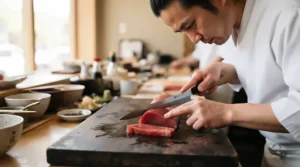
Good sashimi knife technique is mostly about restraint. The blade does the work, so your job is to guide it.
Prepare first. Keep the fish cold and the knife razor sharp. Wipe the blade with a clean damp cloth between slices to stop residue dragging through the next cut.
Position the knife. Place the heel of the blade at the far end of the slice, with the edge just touching the flesh. Your index finger rests lightly on the spine, with a relaxed grip.
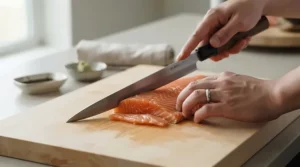
Pull, don’t saw. Draw the knife toward you in one continuous motion, using the full length from heel to tip. Avoid sawing back and forth, which shreds the surface. Don’t push down; let the weight and edge do the cutting.
Finish and release. Let the slice fall away to the side rather than lifting the knife. This is why a long blade like the Sukenari VG-10 Yanagi 330mm shines: it completes a thick fillet in a single stroke.
Match slice to fish. Firmer, fattier fish such as salmon suit thicker, rectangular slices roughly a centimetre thick. Delicate white fish suits thinner, angled cuts.
Using a double-bevel blade such as the Sakai Takayuki 33-Layer VG10 Damascus Kengata Yanagiba 270mm makes this easier to keep straight at first. With a single-bevel blade, the bevel itself guides the cut, but you must keep the back face flat and the angle consistent.
Sharpening and Care: Your First 30 Days
A VG-10 steel knife for sushi stays stainless, not self-maintaining. A simple routine keeps it cutting like day one.
After every use: rinse by hand, wipe dry and store the knife safely. Retailers consistently advise against the dishwasher, and the Sakai Takayuki Honyaki VG-10 Shoryu 00201 ships with a saya for exactly this reason.
Weekly (for regular use): feel the edge. If it skates on a tomato skin, it needs attention. A quick pass on a fine stone is far gentler than waiting for a full re-profile.
Sharpening basics: a combination whetstone (a coarser side for repairs and a finer side for finishing) suits VG-10 well. Single-bevel knives such as the Masamoto VG-10 Hon Kasumi Yanagiba 270mm are sharpened by laying the bevel flat on the stone, then lightly flattening the back face to remove the burr. Double-bevel blades like the Tojiro DP Santoku 17cm, listed with a roughly 12° edge, are sharpened more conventionally.
Common first-month mistakes:
- Cutting frozen fish or bones (makers warn this chips the blade).
- Leaving the knife wet in a drawer.
- Skipping the burr-removal step on a single-bevel stroke.
- Pressing hard instead of pulling.
If the factory edge feels a little uneven, as one Tojiro DP owner reported, a quick sharpening session usually fixes it.
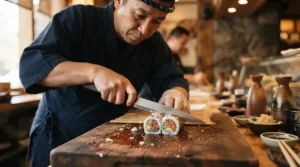
Problem → Solution Guide for Sushi Knives
Problem: torn, ragged slices. Usually a dull edge or a sawing motion. Fix it by sharpening and committing to one long pull, as in the technique section above.
Problem: rice sticking to the blade when cutting rolls. Starch clings to dry steel. Keep a damp cloth beside you and wipe between cuts. A taller blade such as the Tojiro DP Santoku 17cm gives your knuckles clearance over the board.
Problem: the knife drifts to one side. Single-bevel blades naturally pull slightly, so keep the back face flat and the pull consistent. If it’s frustrating, the double-bevel Sakai Takayuki 33-Layer VG10 Damascus Kengata Yanagiba 270mm is an easier starting point.
Problem: tiny chips in the edge. Often caused by twisting in the flesh or hitting bone and frozen centres. Avoid both, and for chips, a coarse stone repairs them. Highly hard blades such as the Sukenari VG-10 Yanagi 330mm (HRC 61-62) reward gentle handling.
Problem: spots or discolouration. VG-10 is stainless, not stain-proof. Wipe dry after salty or acidic ingredients and avoid long soaks.
Problem: no space for a 330 mm blade. Don’t force it. Drop to 240-270 mm.
Common Mistakes When Buying a VG-10 Steel Knife for Sushi
Buying length for show. A 330 mm blade looks impressive, but if your board is 30 cm wide, you’ll never use its full stroke. Be realistic.
Choosing pattern over steel. A glossy Damascus finish can distract from missing specs. Always find the core steel and the hardness.
Ignoring handedness. Single-bevel knives are usually handed. Ordering the wrong one is a costly error, especially since left-handed versions can cost roughly 50% extra.
Expecting a santoku to behave like a yanagiba. They are different tools, as explained in the santoku vs sushi knife comparison above.
Skipping the sharpening kit. Even the best VG-10 needs a stone eventually, and a premium knife on a neglected edge wastes money.
Trusting “VG-10” alone. The label doesn’t reveal heat treatment or grind. Sparse listings like the Keemake VG10 Yanagiba 10.5″ show why asking questions matters.
Cutting the wrong things. Frozen products and bones chip fine edges; keep them for a dedicated cleaver.
Long-Term Cost and Maintenance: Is Paying More Worth It?
Sticker price misleads. Divide it by use and the picture changes. A £100 knife used twice weekly for five years is roughly 520 uses, working out to around 19p each. A £500 knife on the same schedule lands around 96p per use. Neither is expensive, so the real question is whether the extra refinement is worth it to you.
VG-10 helps the maths because it is stainless, meaning its chromium content resists rust. That makes upkeep cheap: a stone, a cloth and a few minutes. Carbon alternatives can demand more vigilance.
| Tier | Example | Price range | Upkeep | Best For |
|---|---|---|---|---|
| Budget | Keemake VG10 Yanagiba 10.5″ | £35-£50 | Low, but may need initial tuning | Testing the waters |
| Mid | Tojiro DP Santoku 17cm | £80-£110 | Low, simple stone routine | Everyday home sushi |
| Premium | Sakai Takayuki 33-Layer VG10 Damascus Kengata Yanagiba 270mm | £280-£360 | Low to moderate | Sashimi fans |
| Flagship | Sakai Takayuki Honyaki VG-10 Shoryu 00201 | £480-£540 | Moderate, needs care | Enthusiasts |
Notice the pattern: price scales with finish, length and construction more than with raw cutting ability. The Tojiro DP delivers most of the practical benefit at a fraction of the cost, while the flagship pays for craft and presentation. Treat sharpening stones as part of the budget, not an afterthought.
Raw Fish Safety and UK Rules: What a Knife Can’t Fix
A great blade improves slices, not safety. Parasites such as Anisakis worms can occur in certain wild fish, and the Food Standards Agency’s freezing guidance explains that cooking kills them and that freezing is the alternative control for fish intended to be eaten raw or lightly cooked. It also notes that some exemptions exist for fish reared under particular conditions.
Those rules formally apply to food businesses, but the logic is useful at home. Buy fish from a reputable supplier that states it is suitable for raw eating, and ask how it was handled and frozen. Always check the FSA page for current requirements rather than relying on remembered figures.
Knife hygiene matters too. Use a clean board reserved for raw fish, wash the blade straight after use, and dry it thoroughly. A VG-10 steel knife for sushi resists rust, but residue left on the edge still invites bacteria. Never use the same unwashed knife and board on raw fish and ready-to-eat items.
Pregnant people, older adults, young children and those with weakened immunity are generally advised to avoid raw fish, so check NHS guidance if that applies to your household.
FAQ
❓ Is a VG-10 steel knife for sushi worth buying over a carbon steel yanagiba?
❓ What size yanagiba should a UK home cook buy?
❓ Can I cut frozen fish with a VG-10 steel knife for sushi?
❓ Do I need a whetstone for a Japanese sushi knife?
❓ Are left-handed sushi knives available?
Conclusion
Choosing a VG-10 steel knife for sushi comes down to matching the tool to your cooking. If you want one blade that handles fillings, vegetables and rolls, the Tojiro DP Santoku 17cm delivers proven performance at a friendly price. If the Tojiro Gai Santoku 17cm tempts you with its Damascus finish, enjoy it for the beauty, but remember the VG-10 core does the cutting.
For sashimi, the Sakai Takayuki 33-Layer VG10 Damascus Kengata Yanagiba 270mm is the gentlest route to a long slicer, while the Sukenari VG-10 Yanagi 330mm and Masamoto VG-10 Hon Kasumi Yanagiba 270mm reward committed technique. The Keemake VG10 Yanagiba 10.5″ is a low-risk experiment, and the Sakai Takayuki Honyaki VG-10 Shoryu 00201 is the showpiece.
Whichever you pick, remember that technique, sharpness and care matter as much as steel. Learn the pull cut, keep a stone handy, hand-wash and dry after use, and respect raw-fish safety rules.
Recommended for You
- VG-10 Steel Chef’s Knife: 7 Best Picks For UK Cooks (2026)
- Damascus Steel Knife Block Set: 7 Best Picks For UK Kitchens (2026)
- Damascus Steel Chef’s Knife: 7 Best UK Picks For 2026
Disclaimer: This article contains affiliate links. As an Amazon Associate, I earn from qualifying purchases. If you purchase products through these links, we may earn a small commission at no additional cost to you.
✨ Found this helpful? Share it with your friends! 💬🤗
