
In This Article
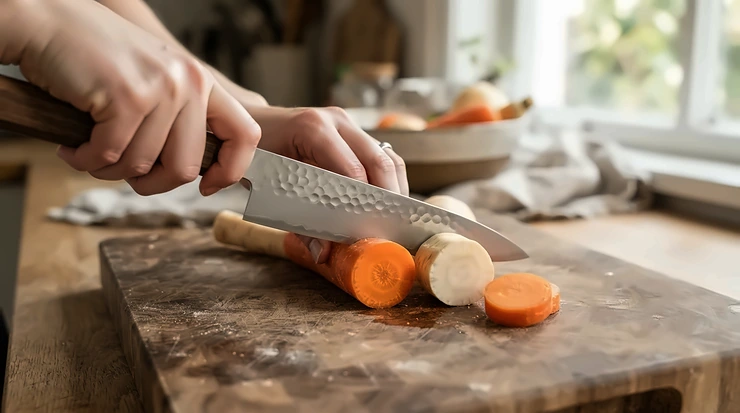
Here’s the dirty secret of the knife world: you don’t need to spend £200 to feel what a Japanese blade can do. A well-chosen affordable Japanese santoku knife glides through an onion with a whispering, effortless slice that makes your old supermarket block look faintly embarrassing.
That’s the promise. The catch? The market is a minefield. Slap “Japanese” on a listing and suddenly every stamped-steel blade from anywhere is a “samurai-grade chef’s knife”. So this guide sticks to Japanese-made options from Kai and Tojiro, two makers with real pedigree, and sorts them by what you actually cook.
First, a little grounding. The santoku, roughly “three virtues”, is a general-purpose kitchen knife that, according to Wikipedia’s santoku entry, emerged in Japan in the 1940s. It blended the jobs of the traditional meat, fish and vegetable knives into one. It’s shorter, lighter and flatter than a Western chef’s knife, and it’s built for crisp, controlled chopping rather than rocking.
I’ve also covered what most budget guides skip: an affordable Japanese nakiri knife (the vegetable specialist), a budget Japanese paring knife for fiddly jobs, a straight-talking look at santoku vs nakiri budget decisions, and a plain-English breakdown of affordable Japanese blade steel. That makes seven real knives, honest analysis, and review sentiment drawn from genuine retailer listings rather than invented praise.
One note on money: every price below is an indicative UK range at the time of research. Prices move, so check the current price and availability before you buy.
Quick Comparison: 7 Affordable Japanese Knives at a Glance
| Product | Type | Blade steel | Blade length | Indicative price | Best For |
|---|---|---|---|---|---|
| Kai Wasabi Black Santoku 16.5cm | Santoku | Daido 1K6 (~58 HRC) | 16.5cm | £40-£60 | First Japanese knife |
| Kai Seki Magoroku Shoso Santoku 16.5cm | Santoku | 1K6 or 5Cr15MoV (listings vary) | 16.5cm | £75-£85 | Hygiene-minded cooks |
| Tojiro DP Santoku 17cm | Santoku | VG10 core (~60 HRC) | 17cm | £100-£110 | Edge retention seekers |
| Kai Wasabi Black Nakiri 16.5cm | Nakiri | Daido 1K6 (~58 HRC) | 16.5cm | £50-£60 | Veg-heavy cooking on a budget |
| Tojiro DP Nakiri 17cm | Nakiri | VG10 core | 17cm | £85-£95 | Big squash and cabbage |
| Kai Wasabi Black Paring Knife 10cm | Paring | Daido 1K6 (~58 HRC) | 10cm | £45-£55 | Light, fiddly prep |
| Tojiro DP Paring Knife 9cm | Paring | VG10 core | 9cm | £60-£70 | One steel across the set |
Reading across the table, the Kai Wasabi Black Santoku 16.5cm is the cheapest route into a genuinely Japanese blade. The Tojiro DP Santoku 17cm earns its higher price with a VG10 core and more heft. Paring-knife shoppers should note that the two options differ more in steel than in size, which matters if you plan to sharpen them yourself.
💬 Just one click — help others make better buying decisions too!😊
What Is an Affordable Japanese Santoku Knife?
An affordable Japanese santoku knife is a general-purpose kitchen knife made in Japan, typically with a 14-18cm blade, a flat edge and a sheep’s-foot tip, sold at a modest price. In the UK, that usually means roughly £40-£110, using stainless steels such as Daido 1K6 or VG10 rather than premium powder steels.
So what makes it “Japanese” in practice? Mostly the edge. Japanese santoku blades are typically ground thinner and sharpened at a finer angle than Western chef’s knives. Retailer specifications for the knives in this guide put factory edges at around 12-15° per side. That fine edge slices tomatoes without crushing them, but it also asks you to treat the knife with a little respect.
Santoku versus the chef’s knife is a question of style. A chef’s knife invites a rocking motion, while a santoku prefers a quick, straight up-and-down chop. If you like that rhythm, you’ll feel at home within a week. If you don’t, a 16.5-17cm santoku still works fine with a gentle rock. Either way, you’re buying precision, not just a name.
Top 7 Affordable Japanese Santoku, Nakiri and Paring Knives: Expert Analysis
Seven knives, three jobs, one budget-conscious thread. Specs below come from retailer listings, and review comments are aggregated from real listings, with small review pools flagged honestly.
1. Kai Wasabi Black Santoku 16.5cm — lightest door into Japanese steel
Lighter than most smartphones, it’s the gentlest introduction to a thin Japanese edge you can buy without agonising.
The Daido 1K6 stainless blade is hardened to about 58 HRC and ground to roughly 15° per side, per retailer specifications, at around 140-150g overall. That means minimal wrist fatigue over a long prep session. With no bolster, the whole edge can be sharpened, so there’s no awkward metal lump blocking your stone.
Based on the spec comparison, this is a learner’s knife in the best sense. It’s sharp enough to reveal what you’ve been missing and forgiving enough that a first chip won’t break your heart. The trade-off is momentum: with so little mass, it won’t power through dense squash on weight alone, so you guide it rather than lean on it. The moulded handle is waterproof and crevice-free, but nobody will mistake it for walnut.
Review pools are thin. One European retailer serving UK buyers lists around 4.4/5 from four reviews, which is a hint, not a verdict. Across the wider Wasabi Black range, reviewers who write detail tend to mention sharpness, low weight and easy sharpening. I couldn’t verify detailed commentary specific to this santoku.
Pros:
- ✅ Genuine Japanese-made steel at an entry price
- ✅ Lightweight and fatigue-free for long prep
- ✅ No bolster, so the full edge sharpens
Cons:
- ❌ Handle feels plasticky next to wooden rivals
- ❌ Thin edge dislikes bones and frozen food
Expect roughly £40-£60 depending on retailer. For a first Japanese blade, the Kai Wasabi Black Santoku 16.5cm is strong value.
2. Kai Seki Magoroku Shoso Santoku 16.5cm — seamless all-stainless build
One piece, no seams, nowhere for last night’s garlic to hide.
At roughly 132-136g it’s the lightest santoku here after the Wasabi. It has a convex-ground blade and an 18-8 stainless handle with a diamond-shaped grip pattern. One honest flag: retailer listings disagree on the blade steel. Some cite 1K6 at 58 HRC and others 5Cr15MoV at about 56 HRC, so check the listing in front of you before buying.
Here’s the practical reading. A sealed, all-metal knife suits cooks who hate handles that swell or trap grime. A convex grind is sturdier than a wafer-thin edge, which tends to make it more tolerant of daily knocks than a fine-edged Tojiro, though it may not feel quite as whisper-fine out of the box. Metal handles can turn slippery with greasy hands, so that diamond texture does real work.
Review text is scarce. One UK-serving listing shows about 4.7/5 from three reviews, and another a single 5/5. Encouraging, but statistically tiny.
Pros:
- ✅ Seamless build with no grime traps
- ✅ Light, symmetrical handle suits left and right hands
- ✅ Sturdy convex edge tolerates daily use
Cons:
- ❌ Steel specification varies between listings
- ❌ Metal handle can feel slick when wet
Typically around £75-£85. The Kai Seki Magoroku Shoso Santoku 16.5cm is fair value if looks and hygiene matter, while the Wasabi wins on pure price.
3. Tojiro DP Santoku 17cm — VG10 core within reach
A VG10 core at a price that’s still within reach is the headline.
Three-layer construction wraps a VG10 core (about 60 HRC) in softer stainless cladding. The blade runs 17cm, stands roughly 4.6cm tall and weighs about 192g, with a factory edge near 12° per side according to retailer specs. Translation: a finer edge and more heft than the Kai options, which means cleaner slices through carrots and potatoes and extra knuckle clearance above the board.
The extra weight does some of the work for you, so this suits cooks who prep a lot of root veg. The VG10 core holds an edge longer than softer 1K6 steels, but harder steel brings more chip risk if you twist through bone or frozen food. UK retailers describe the balance point sitting near the bolster, which flatters a pinch grip.
One reviewer on a European retailer praised how the tall, narrow blade glides through big hard foods like potatoes, but reported a slightly sloppy factory grind that needed resetting. Another, a gift buyer, simply loved it. That’s two voices, so treat it as anecdotal.
Pros:
- ✅ VG10 core holds its edge longer
- ✅ Weighty enough for root vegetables
- ✅ Tall blade gives knuckle clearance
Cons:
- ❌ Factory edge may need a touch-up
- ❌ Harder steel chips if misused
Around £100-£110 is the top end of “affordable”, but the Tojiro DP Santoku 17cm delivers VG10 performance that’s hard to match at this level.
4. Kai Wasabi Black Nakiri 16.5cm — wide, flat, wallet-friendly
Think of a mini cleaver’s polite cousin: wide, flat and built for vegetables.
It shares the santoku’s Daido 1K6 steel at about 58 HRC, but with a squared-off, tipless profile roughly 4.8cm tall and a weight around 153g. That flat edge meets the board along its whole length, so each push cut finishes cleanly, with no stubborn uncut “tail” on a cucumber slice.
A nakiri earns its place if you cook plenty of cabbage, courgettes, peppers and herbs. The tall blade doubles as a scoop for sweeping chopped ingredients into the pan, a small thing you’ll appreciate by the third meal. With no tip, though, it’s useless for delicate jobs like trimming meat or coring a tomato, which is why it pairs best with a paring knife.
Six reviews appear on one UK-serving retailer listing, but I couldn’t verify the review text, so I won’t characterise sentiment.
Pros:
- ✅ Flat edge gives clean, full-contact cuts
- ✅ Tall blade scoops chopped veg neatly
- ✅ Light and easy to sharpen
Cons:
- ❌ No tip for fine or meat tasks
- ❌ Stock can be patchy at some retailers
Roughly £50-£60. As a second knife, the Kai Wasabi Black Nakiri 16.5cm offers good value.
5. Tojiro DP Nakiri 17cm — heavyweight for big veg
Where the Kai nakiri is nimble, this one is muscular.
It has a VG10 core, a 17cm blade about 4.5cm tall, and a weight near 200g over roughly 29.4cm overall. That’s meaningfully heavier than the Kai, and on a thin vegetable knife the weight turns into free downward force. Dense produce like butternut squash or celeriac suddenly feels less like a workout.
Based on the spec comparison, this suits cooks who tackle large veg regularly, such as families doing Sunday roasts or batch-cooking soups. The trade-off is fatigue over long sessions and a basic handle. VG10 also rewards patience on the whetstone: slower to sharpen than 1K6, but longer between sessions.
Nine reviews appear on one UK-serving listing. A buyer in Scarborough reported that it arrived well packed, felt very sharp and made light work of butternut squash, though they wished for a nicer handle. Fair, given the price tier.
Pros:
- ✅ VG10 core for lasting edge retention
- ✅ 200g weight helps with squash and cabbage
- ✅ Tall blade leaves ample knuckle room
Cons:
- ❌ Basic handle, according to one reviewer
- ❌ Heavier to wield for long sessions
Around £85-£95. The Tojiro DP Nakiri 17cm is a sensible upgrade if vegetables dominate your cooking.
6. Kai Wasabi Black Paring Knife 10cm — featherlight workhorse
At about 68g, you’ll forget you’re holding it, right up until the strawberry hull pops out in one clean twist.
The 10cm blade is just 2.5cm tall and around 1.7mm thick, in the same 1K6 steel at roughly 58 HRC and a 15° edge. The handle (about 12.7cm) is longer than the blade, which gives surprisingly comfortable leverage for peeling and trimming in the hand.
For a budget Japanese paring knife, this ticks the practical boxes: thin enough to glide under skins and light enough for delicate control. It isn’t for prying, cracking or cutting hard things on a board, because a thin blade this small chips when abused. Think of it as a scalpel, not a screwdriver.
One UK-serving retailer shows about 4.8/5 from four reviews. On another listing, reviewers describe it as well balanced, light, sharp and easy to sharpen, with one calling it their most-used knife. One comment flagged it as a bit fragile.
Pros:
- ✅ Ultra-light at around 68g
- ✅ Easy to sharpen at home
- ✅ Long handle gives comfortable control
Cons:
- ❌ Thin blade can feel delicate
- ❌ Dear for its size versus siblings
Typically around £45-£55, so shop around. The Kai Wasabi Black Paring Knife 10cm is a great low-cost partner for a santoku.
7. Tojiro DP Paring Knife 9cm — VG10 in miniature
Small blade, serious steel.
It has a 9cm blade about 2.2cm tall, roughly 1.7mm thick, weighing about 60g, with a VG10 core near 60 HRC and a factory edge around 12° per side per retailer specs. Retailer copy describes it as an everyday tool for peeling, garnishing and cutting fruit and veg, and that’s exactly where a compact VG10 edge shines.
The analytical take: buy this if you’re building a matching Tojiro set and want one steel family across the drawer. The harder core gives longer edge life on a blade that sees constant use, but it also means more careful sharpening and zero tolerance for twisting in tough skins. Compared with the Kai, you’re paying for retention and a refined finish, not for obvious day-one cutting differences.
The UK listing shows about 4.8/5 with six reviews, though I couldn’t verify the review text, so treat the rating as indicative only.
Pros:
- ✅ VG10 core holds an edge on small blades
- ✅ Compact 9cm length gives close control
- ✅ Matches Tojiro santoku and nakiri styling
Cons:
- ❌ Pricier than the Kai paring knife
- ❌ Harder steel needs careful sharpening
Around £60-£70. The Tojiro DP Paring Knife 9cm is worthwhile if you want matched steel, otherwise the Kai is the thrifty choice.
Side-by-Side Specs and Value
| Product | Weight | Blade height | Indicative price | Review pool I could verify | Best For |
|---|---|---|---|---|---|
| Kai Wasabi Black Santoku 16.5cm | ~140-150g | 4.6cm | £40-£60 | ~4.4/5 from 4 reviews | Beginners |
| Kai Seki Magoroku Shoso Santoku 16.5cm | ~132-136g | 4.5cm | £75-£85 | ~4.7/5 from 3 reviews | All-steel fans |
| Tojiro DP Santoku 17cm | ~192g | 4.6cm | £100-£110 | Few reviews found | Root-veg prep |
| Kai Wasabi Black Nakiri 16.5cm | ~153g | 4.8cm | £50-£60 | 6 reviews, text unverified | Budget veg cooks |
| Tojiro DP Nakiri 17cm | ~200g | 4.5cm | £85-£95 | 9 reviews, one verified | Squash and cabbage |
| Kai Wasabi Black Paring Knife 10cm | ~68g | 2.5cm | £45-£55 | ~4.8/5 from 4 reviews | Light trimming |
| Tojiro DP Paring Knife 9cm | ~60g | 2.2cm | £60-£70 | ~4.8/5, 6 reviews | Matched VG10 set |
Weight is the real dividing line here. The Kai knives cluster at the light end, while the Tojiro santoku and nakiri sit near 200g, which changes how they feel on dense vegetables. Review pools are small across the board, so use them as colour rather than proof, and let the specs guide your decision.
✨ Ready to Sharpen Up Your Kitchen?
🔍 Take your cooking to the next level with these carefully selected Japanese blades. Click any highlighted product name to check current pricing and availability. A good santoku and a sensible paring knife will transform your prep work and make cooking feel faster, neater and a lot more fun!
Affordable Japanese Blade Steel Explained
Steel is where “affordable” and “good” either meet or collide, so it’s worth decoding. Affordable Japanese blade steel mostly falls into two camps in this guide: softer, easy-to-sharpen stainless like Daido 1K6, and harder, longer-lasting VG10.
Start with VG10. According to Wikipedia’s VG-10 entry, it’s a cutlery-grade stainless steel containing roughly 1% carbon, 15% chromium, 1% molybdenum, 0.2% vanadium and 1.5% cobalt. It was developed by Takefu Special Steel Co. in Fukui Prefecture. In practice, the chromium keeps rust at bay, the carbon gives hardness, and the result is a blade that holds a fine edge for a long time. Tojiro pairs it with softer cladding and brings it to roughly 60 HRC in the DP range, per retailer information.
Then there’s 1K6, the stainless used across Kai’s Wasabi Black range at about 58 HRC. It’s slightly softer, which sounds negative but really isn’t. Softer affordable Japanese blade steel sharpens faster, forgives a clumsy first session on the stone, and tolerates a bit more abuse before chipping.
The blunt truth: most home cooks will enjoy either. If you like sharpening, choose 1K6. If you hate it, choose VG10 and sharpen less often. Whichever you buy, the biggest edge-killer isn’t steel, it’s your chopping board.
Santoku vs Nakiri Budget: Which Should You Buy First?
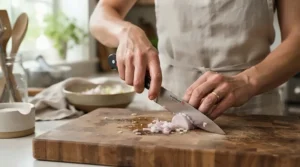
If your budget stretches to one knife, buy the santoku. If it stretches to two, the santoku-and-paring pairing usually beats santoku-and-nakiri. That’s the short answer to santoku vs nakiri budget decisions. The longer one depends on what you cook.
A santoku has a gently curved tip and handles meat, fish and veg. A nakiri, described on Wikipedia’s nakiri page as a traditional vegetable knife, has a squared-off blade built purely for produce. The santoku flexes, while the nakiri focuses.
| Feature | Santoku | Nakiri | Best For |
|---|---|---|---|
| Tip shape | Gently curved sheep’s foot | Square, tipless | n/a |
| Main strength | All-round prep | Clean push cuts on veg | n/a |
| Weak spot | Slightly less precise on veg | Poor for meat and detail | n/a |
| Budget entry point | £40-£60 | £50-£60 | n/a |
| Best For | Kai Wasabi Black Santoku 16.5cm, Tojiro DP Santoku 17cm | Kai Wasabi Black Nakiri 16.5cm, Tojiro DP Nakiri 17cm | One knife vs vegetable focus |
Looking at the table, the entry prices are strikingly close, which means the decision is about versatility rather than cost. Only buy the nakiri first if most of your cooking is vegetarian or veg-heavy. Otherwise, the santoku covers the broader job list, and a nakiri can join later as a luxury rather than a necessity.
Affordable Japanese Nakiri Knife: Is a Vegetable Specialist Worth It?
An affordable Japanese nakiri knife is worth it if you chop vegetables most days and enjoy that satisfying “clunk” of a flat edge meeting the board. It’s a niche tool, but a superb one in its niche.
The flat profile is the secret. Every cut finishes with the edge touching the board along its full length, so you get clean separation without drag or a half-cut slice hanging on. The tall blade also keeps your knuckles safely above the work and acts as a handy scoop. It’s the knife you didn’t realise you were missing until you chop red cabbage for coleslaw.
The trade-offs are real, though. No tip means no precise coring, no butchering, and no light carving. Thin nakiri blades also dislike twisting through hard squash seeds. For the money, I’d rate the Kai Wasabi Black Nakiri 16.5cm as the low-risk way to test whether you’ll use one, while the Tojiro DP Nakiri 17cm is the upgrade for those who already know they will.
A practical rule: if you can name three vegetable dishes you cook weekly, you’ll probably use a nakiri. If you struggle, wait.
Budget Japanese Paring Knife: The Small Blade That Does the Fiddly Work
A budget Japanese paring knife is the unsung hero of any set. The big santoku gets the glory, but the small blade peels, trims, hulls, segments and devein-tidies the odd jobs that make a meal feel finished.
A good paring knife should be light, thin and razor-sharp, and both options here deliver. The Kai Wasabi Black Paring Knife 10cm is the lightest at about 68g, with a handle longer than the blade for easy control. The Tojiro DP Paring Knife 9cm is slightly smaller and uses a VG10 core, which holds its edge longer but costs more.
The key question is steel versus price. On a blade that gets daily use for small jobs, the harder VG10 may justify itself over years. But if you’re new to sharpening, 1K6 is friendlier and easier to maintain at home.
Quick advice: match your paring knife to your santoku. Bought the Kai santoku? Choose the Kai paring knife for consistent steel and sharpening routine. Went for Tojiro? Same logic applies. It keeps your whetstone angle and technique simple.
How to Choose an Affordable Japanese Santoku Knife
Choosing an affordable Japanese santoku knife is easier with a short checklist. Work through these seven steps in order:
- Pick your blade length. A 16.5-17cm blade suits most boards and counters. Longer blades need space, shorter ones feel dainty for big vegetables.
- Choose your steel by lifestyle. Prefer easy sharpening? Go for 1K6. Want fewer sharpening sessions? Choose a VG10 core.
- Check the weight. Under 150g feels nimble, around 190g adds momentum through dense veg. Neither is wrong, but try to match your cooking.
- Inspect the handle type. All-steel handles are hygienic, moulded plastic is waterproof, and composite wood feels more traditional. Choose what feels secure with wet hands.
- Confirm genuine Japanese origin. Look for “Made in Japan” in the listing and a recognised maker such as Kai or Tojiro. Vague branding and implausibly low prices are red flags.
- Budget for sharpening. A knife is only as sharp as your last session, so factor in a basic whetstone and a hand-wash habit.
- Check returns and availability. Stock and prices change often, so confirm current price and delivery terms.
If you’d like a shortcut: for most beginners, the Kai Wasabi Black Santoku 16.5cm is the safe starting point, while the Tojiro DP Santoku 17cm suits those ready to spend a bit more for retention.
Practical Usage Guide: Your First 30 Days with a Japanese Knife
Buying the knife is the easy bit. Treating it well in the first month decides whether it stays sharp or ends up chipped in the drawer.
Week one: set up your station. Use a wooden or soft plastic board. Glass, stone and marble boards will dull any edge instantly. Learn the pinch grip, thumb and forefinger on the blade just ahead of the handle, with the other hand curled into a claw. It feels odd for a day, then natural.
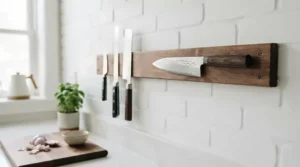
Week two: wash and store properly. Hand-wash with mild detergent, dry immediately, and avoid the dishwasher. Retailer specifications generally list these knives as not dishwasher safe, and thin edges hate clattering. Store the blade in a sheath, on a magnetic strip, or in a block, rather than loose in a drawer.
Weeks three and four: learn to maintain it. A fine ceramic honing rod can realign the edge between sessions. When tomatoes start fighting back, move to a combination whetstone, with a medium grit for sharpening and a finer grit to polish. Follow your knife’s factory angle (about 15° per side for the Kai Wasabi range, closer to 12° for the Tojiro DP, per retailer specs).
Common mistakes in the first 30 days:
- Twisting the blade through hard squash or bones
- Using the spine to crush garlic
- Leaving the knife wet on the board overnight
- Scraping chopped food off with the edge instead of the spine
Real-World Scenarios: Matching Knives to Real Kitchens
Specs only matter if they fit a real life. Here are three profiles, each with a budget, a kitchen and a cooking pattern.
Scenario 1: the flat-share cook. You’re a student or young professional cooking five nights a week on a tight budget in a compact kitchen. A Kai Wasabi Black Santoku 16.5cm plus a Kai Wasabi Black Paring Knife 10cm covers nearly everything for roughly £85-£115 combined. The light weight suits long prep after a day at work, and 1K6 steel forgives sharpening mistakes.
Scenario 2: the veg-heavy family. You batch-cook soups, roasts and curries for four, with a lot of root vegetables. The Tojiro DP Santoku 17cm and Tojiro DP Nakiri 17cm together run to around £185-£205 and give you heft, edge retention and the right shape for squash, cabbage and carrots. It’s a bigger spend, but over years of Sunday prep it breaks down to pennies per use.
Scenario 3: the gift buyer. You want a first-class present for a keen cook without spending silly money. A Kai Seki Magoroku Shoso Santoku 16.5cm looks smart, cleans easily and feels premium without the premium price. At around £75-£85, it’s a thoughtful, low-risk choice. Pair it with a whetstone for a complete gift.
The pattern is clear: spend more where you cut most. If it’s vegetables, invest in the nakiri. If it’s everything, invest in the santoku.
Long-Term Cost and Maintenance: What Will an Affordable Japanese Santoku Knife Really Cost?
Sticker price is only the start. A knife used five days a week for five years sees roughly 1,300 uses. Spread over that, a £50 knife costs around 4p per use, and a £100 knife around 8p. Neither is a lot, and both beat replacing a cheap blunt knife every couple of years.
The real running costs are sharpening gear and your time. A basic combination whetstone is typically a modest extra spend, and a ceramic honing rod is cheap too. Budget for them at purchase, because an unsharpened Japanese blade quickly loses its advantage.
| Tier | Products | Indicative range | What you gain | Best For |
|---|---|---|---|---|
| Entry | Kai Wasabi Black Santoku 16.5cm, Kai Wasabi Black Nakiri 16.5cm, Kai Wasabi Black Paring Knife 10cm | £40-£60 each | Light, sharp, easy to sharpen | Beginners |
| Mid | Kai Seki Magoroku Shoso Santoku 16.5cm, Tojiro DP Nakiri 17cm | £75-£95 | Seamless build or VG10 heft | Upgraders |
| Upper-budget | Tojiro DP Santoku 17cm, Tojiro DP Paring Knife 9cm | £60-£110 | VG10 retention and refinement | Long-term owners |
Looking at the tiers, the biggest jump in value comes from the entry level, since you gain genuine Japanese steel for relatively little. Spending more buys longer edge life and refinement rather than a dramatic leap in everyday cutting. For most home cooks, the sensible path is to start at entry level and upgrade only the knife you use most.
Knife Safety and UK Law: What Every Buyer Should Know
A razor-sharp knife deserves a little legal and practical awareness. This isn’t legal advice, but here’s the essential UK picture.
According to GOV.UK’s guidance on buying and carrying knives, it’s illegal to sell most knives to anyone under 18 and to carry most knives in public without a good reason. In Scotland, 16 and 17-year-olds can buy cutlery and kitchen knives. The guidance lists examples of good reasons, including taking knives you use at work to and from work. A court decides whether your reason is acceptable if you’re charged.
In practical terms, that means a kitchen knife belongs in your kitchen. If you need to transport one, for a cooking class or a friend’s house, wrap it securely, keep it out of reach in a bag or car boot, and don’t carry it loose in a pocket. The safest approach is simply to keep your Japanese blades at home.
At the board, safety is about technique. Use the claw grip, keep the board stable on a damp cloth, and never catch a falling knife. A sharp knife is actually safer than a blunt one, because it needs less pressure and slips less often.
FAQ
❓ Is an affordable Japanese santoku knife good enough for everyday cooking?
❓ What blade length should I choose for a small UK kitchen?
❓ Can I put a budget Japanese paring knife in the dishwasher?
❓ How often should I sharpen affordable Japanese blade steel?
❓ Do I really need a nakiri as well as a santoku?
Conclusion
An affordable Japanese santoku knife is one of the smartest small upgrades you can make to a UK kitchen. You don’t need a four-figure budget. You need a sensible shape, honest steel and a bit of care.
Here’s the short version. For a first Japanese knife, the Kai Wasabi Black Santoku 16.5cm is the easy, low-risk start. If you want a sealed all-steel body, the Kai Seki Magoroku Shoso Santoku 16.5cm is a handsome alternative. If edge retention matters most, the Tojiro DP Santoku 17cm is the quality pick of the group.
Add a nakiri only if vegetables rule your cooking, and choose between the Kai Wasabi Black Nakiri 16.5cm and the heavier Tojiro DP Nakiri 17cm accordingly. For the small jobs, the Kai Wasabi Black Paring Knife 10cm is the thrifty choice, while the Tojiro DP Paring Knife 9cm suits matched sets.
Remember the real lesson from the santoku vs nakiri budget debate: spend where you cut most, and budget for sharpening from day one. Do that, and even the cheapest knife here will outperform a block of unloved steel.
🔪 Your kitchen deserves a sharper start!
✨ Pick your santoku, click through to check current pricing and availability, and enjoy cooking with a blade that actually feels good in your hand. Happy chopping! 🥕
Recommended for You
- Japanese Chef’s Knife: 7 Proven Picks For UK Cooks (2026)
- VG-10 Steel Knife For Sushi: 7 Best UK Picks (2026 Guide)
- VG-10 Steel Chef’s Knife: 7 Best Picks For UK Cooks (2026)
Disclaimer: This article contains affiliate links. As an Amazon Associate, I earn from qualifying purchases. If you purchase products through these links, we may earn a small commission at no additional cost to you.
✨ Found this helpful? Share it with your friends! 💬🤗
