
In This Article
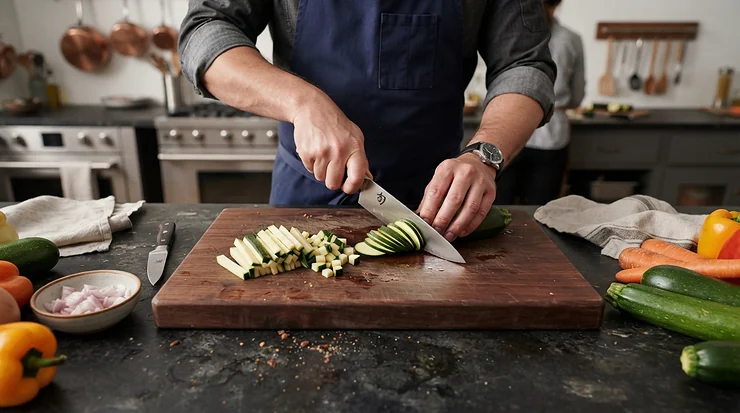
A Japanese nakiri knife is a rectangular, double-bevelled vegetable knife with a flat edge and a blunt tip, built for straight up-and-down cuts that meet the board along the entire blade. Its name translates roughly as “knife for cutting greens”, and as this overview of the nakiri bōchō explains, it has long been a home-kitchen tool in Japan, with a much thinner blade than a typical Western cleaver.
Here’s what most cooks discover too late. A curved chef’s knife is a brilliant all-rounder, but it spends half its life rocking, and rocking is a clumsy way to deal with a savoy cabbage. The flat profile of a Japanese nakiri knife removes the rocking altogether. Push down, glide forward, and the whole edge lands at once. No half-cut onion layers, no crushed tomato skins, no sawing.
That tidy geometry raises a few questions. Which steel? Which size? Do you really need to learn whetstone sharpening, or will a pull-through gadget do? Is nakiri vs usuba a choice a home cook should lose sleep over? And if you’re shopping for a Japanese knife gift set, what actually belongs in the box?
This guide answers all of it. Every knife below was assessed through manufacturer specifications, retailer listings and aggregated buyer commentary, not hands-on testing. You’ll get honest analysis rather than staged “I used it for a month” stories. Prices appear as ranges only, because they move constantly, so check current prices before you buy.
Quick Comparison: Japanese Nakiri Knife Picks at a Glance
Short on time? This table lines up all seven picks. Price ranges are indicative at the time of research and may vary.
| Knife | Core steel | Blade length | Price range | Best For |
|---|---|---|---|---|
| Tojiro Basic VG10 Nakiri 165mm | VG10 | 165mm | £50-£70 | Beginners on a budget |
| Tojiro DP VG10 Nakiri 165mm | VG10 | 165mm | £60-£90 | A first “proper” Japanese knife |
| Kai Seki Magoroku Redwood Nakiri 165mm | 1K6 stainless | Around 165-170mm | £75-£100 | Cooks who want easy touch-ups |
| Global G-5 Vegetable Knife 18cm | Cromova 18 | 180mm | £70-£100 | Hygiene-minded batch cooks |
| Miyabi Evolution Nakiri 16.5cm | FC61 | 165mm | £110-£150 | Western-handle fans wanting hard steel |
| Shun Classic Nakiri 16.5cm | VG-MAX | 165mm | £150-£200 | Gift-givers and design lovers |
| Masakage Yuki Nakiri 165mm | White #2 carbon, stainless-clad | 165mm | £140-£190 | Enthusiasts who enjoy sharpening |
Looking at the table, the Tojiro DP VG10 Nakiri 165mm offers the best balance of steel quality and price for most households, while the Tojiro Basic VG10 Nakiri 165mm undercuts it for anyone watching every pound. If you want the keenest edge and don’t mind a little care, the Masakage Yuki Nakiri 165mm justifies its premium. The upper tiers buy you hardness, finish and prestige more than raw slicing ability, which we unpack in the features section below.
💬 Just one click — help others make better buying decisions too!😊
Top 7 Japanese Nakiri Knife Picks: Expert Analysis
The seven knives below span budget, mid-range and premium. Each entry interprets the specs in practical terms and summarises genuine buyer sentiment where it could be found. Where reviews were scarce, I’ve said so rather than papering over the gap.
1. Tojiro Basic VG10 Nakiri 165mm — featherweight entry to VG10 steel
At around 138g, this is the lightest knife in the line-up, and that low weight is its whole personality. Tojiro lists a VG10 core clad in 18-8 stainless, 59-60 HRC, a 165mm blade standing 46mm at the heel, and a spine of just 1.6mm.
In practice, that skinny spine slips through carrots and daikon with less wedging than the thicker blades further down this list. The slightly softer hardness also makes it forgiving on a whetstone, a real bonus for beginners. The 50/50 grind is symmetrical, so left- and right-handers are treated equally.
Based on the spec comparison, this suits anyone who wants Japan-made steel without museum-piece anxiety. What the spec sheet won’t tell you is that a light blade rewards a light grip. Heavy-handed choppers may find the lack of heft odd at first.
Review data is thin: one US retailer page shows a 4.8 out of 5 average from only six reviews. That’s encouraging, but far too small a sample to be conclusive.
Pros:
- ✅ Lightweight 138g body reduces wrist fatigue
- ✅ Thin 1.6mm spine glides through dense veg
- ✅ VG10 core at an entry-level price
Cons:
- ❌ Very light feel won’t suit heavy chopping styles
- ❌ Few independent reviews to verify long-term durability
Typically in the £50-£70 range at the time of research, which is excellent value for a Japan-made VG10 knife.
2. Tojiro DP VG10 Nakiri 165mm — the sensible first “proper” Japanese knife
If you could only buy one Japanese nakiri knife and wanted no regrets, this is the safe bet. A specialist retailer likens the DP line to a dependable, mass-produced everyday car: nothing flashy, nothing unreliable.
Tojiro’s listing gives a VG10 san-mai blade with stainless cladding, 60-61 HRC, a 46mm heel height and a spine of roughly 1.9-2.0mm. It weighs around 204g and has a Western-style handle with a stainless bolster. That extra heft over the Basic gives the blade momentum through firm vegetables such as swede or butternut squash, while the bolster feels instantly familiar if you’re used to German knives.
My read: this is the model that lets you judge whether you actually enjoy nakiri-style cutting before spending premium money. The harder steel holds its edge noticeably longer than softer stainless blades, yet it’s still manageable on a standard stone.
Buyer feedback on a specialist retailer’s page praises price-to-performance, balance and comfort for smaller hands. The same retailer candidly warns that one or two tiny finishing imperfections can appear, though they’re fixable with fine sandpaper.
Pros:
- ✅ Familiar Western handle with stainless bolster
- ✅ 60-61 HRC VG10 holds a keen edge
- ✅ Solid weight helps with dense vegetables
Cons:
- ❌ Minor finish flaws occasionally reported
- ❌ Plainer looks than Damascus-clad rivals
Expect roughly £60-£90; strong value, so check current price.
3. Kai Seki Magoroku Redwood Nakiri 165mm — polished 1K6 blade, easy to touch up
Kai’s Seki Magoroku Redwood is the quiet traditionalist here: a highly polished blade, a rounded spine and a hardwood-style handle. Retailer listings put hardness at 58 HRC, in a 1K6 stainless steel, with a blade of around 165-170mm. The listed weight is roughly 180g, though sources vary.
That 58 HRC figure is the key. It’s softer than the VG10 and FC61 knives above, so the edge dulls sooner, but it also sharpens in minutes and tolerates clumsy technique better. For anyone planning to learn whetstone sharpening, that’s a feature, not a flaw. The polished, rounded spine also helps if you use a pinch grip for long prep sessions.
One caveat deserves flagging. Product listings are inconsistent about the grind: one specialist describes it as asymmetrical like a usuba, which would change how you sharpen it. Confirm the bevel with the seller before buying. It’s a useful reminder that the nakiri vs usuba line can blur in listings.
Review volume is negligible: a European retailer shows just two reviews, both five stars. That’s effectively no usable data.
Pros:
- ✅ Quick, forgiving touch-ups on a whetstone
- ✅ Polished rounded spine is comfortable to pinch
- ✅ Japan-made blade at a modest price
Cons:
- ❌ 58 HRC edge needs more frequent sharpening
- ❌ Very few verified reviews, plus inconsistent grind descriptions
Around £75-£100; fair value if you enjoy sharpening.
4. Global G-5 Vegetable Knife 18cm — seamless all-steel body, the longest blade here
The Global G-5 looks nothing like the others, and that’s deliberate. Designed by Komin Yamada, it’s a one-piece stainless knife in Cromova 18 steel, with a hollow, sand-filled handle fused to the blade. Retailers describe it as inspired by traditional usuba knives and made for straight up-and-down chopping.
Specs worth translating: 56-58 HRC, a 15° double-ground edge and an 18cm blade. The seamless handle means no joint where grime can lurk, which hygiene-minded cooks love. The long edge clears a large cabbage in fewer passes. The 15° angle is acutely sharp, though the softer steel will want more regular attention than the harder knives here.
On paper this suits big-batch cooks who prep for the whole family. One retailer’s buyers call it easy for vegetables and good quality for the money, while another notes the blade feels heavier than Global’s chef’s knife. Both observations fit the spec.
Pros:
- ✅ Seamless one-piece body leaves no crevices
- ✅ 18cm blade handles large veg in one pass
- ✅ Very sharp 15° edge
Cons:
- ❌ All-steel handles can feel slick when wet
- ❌ Softer 56-58 HRC edge dulls sooner
Roughly £70-£100; excellent for the right cook, so check current price.
5. Miyabi Evolution Nakiri 16.5cm — FC61 steel with a mirror finish
Made in Seki, the Miyabi Evolution Nakiri pairs FC61 fine-carbide stainless at 61 HRC with ice-hardened Friodur treatment and a mirror-polished blade. The handle is a triple-riveted POM design with a rounded spine and heel, and the maker recommends hand washing.
What does 61 HRC mean at the board? A fine, durable edge that stays keen through weeks of weeknight prep, with the trade-off that hard steel dislikes twisting or levering. Use it for push-cutting, not for prising apart a squash. The Western-style handle lets cooks used to German knives adapt without relearning their grip.
Frankly, this is the pick for someone who wants a Japanese blade but a Western feel in the hand. You pay a premium for finish and brand polish, so be clear that it’s the steel, not the shine, doing the real work.
Verified reviews were limited in my research. One buyer on a US retailer’s page says the nakiri does everything they want and should keep a good edge in a home kitchen. Treat that as one data point, not a consensus.
Pros:
- ✅ Hard FC61 steel keeps its edge longer
- ✅ Comfortable triple-rivet Western handle
- ✅ Handsome mirror-polished finish
Cons:
- ❌ Premium price for what’s a thin-data product
- ❌ Hard steel punishes twisting and prising
Around £110-£150; solid if the handle matters to you.
6. Shun Classic Nakiri 16.5cm — a 16° VG-MAX edge in Damascus cladding
The Shun Classic Nakiri is the knife people photograph before they use it. Its VG-MAX core is wrapped in 34 layers of stainless Damascus on each side, 68 in total. It’s hand-sharpened to 16° per side, rated at 60-61 HRC, and fitted with a D-shaped ebony PakkaWood handle.
The practical upshot is a keen, narrow edge that glides through onions, with Shun’s own materials claiming strong edge retention. Damascus cladding is mostly cosmetic, but it does protect the core and gives the blade a lovely flowing pattern. D-shaped handles generally favour right-handed grips, so left-handed cooks should handle one first if possible.
Based on the spec comparison, you’re paying for refinement and presentation as much as steel performance. That makes it an obvious gift candidate, and it’s the natural centrepiece of any Japanese knife gift set.
Buyer comments I found were enthusiastic but short on detail, which is a mild caution in itself. Nobody reported disappointment, yet few explained why they loved it.
Pros:
- ✅ Razor-keen 16° hand-sharpened edge
- ✅ Beautiful Damascus pattern, gift-worthy
- ✅ VG-MAX core with strong edge retention
Cons:
- ❌ D-shaped handle favours right-handers
- ❌ Priciest mainstream pick here
Roughly £150-£200; a premium buy, so check current price.
7. Masakage Yuki Nakiri 165mm — White #2 carbon core for enthusiasts
The Masakage Yuki Nakiri 165mm is the knife for people who find sharpening relaxing. It’s hand-forged by Yoshimi Kato in Echizen, with a Shirogami #2 carbon core clad in stainless steel and a frosty nashiji (pear-skin) finish. Retailers list a 165mm blade around 58mm tall, a 2.5mm spine and a weight of roughly 145-160g, depending on handle. One retailer quotes 62-63 HRC.
Here’s what that means for you. White #2 takes a wickedly fine edge, and the stainless cladding means only the exposed edge reacts, so wipe it dry after onions and tomatoes. The tall blade gives generous knuckle clearance, ideal for big-handed cooks.
A forum owner on the Kitchen Knife Fora reported feeling very happy with the purchase and noted that Yuki knives tend to cost less than similarly specified rivals. They also felt slight resistance when slicing with the tip and pulling back, which vanished once they switched to a down-and-forward push-cut. It’s a neat illustration of why vegetable prep technique matters.
Pros:
- ✅ White #2 core takes a very fine edge
- ✅ Tall blade gives excellent knuckle clearance
- ✅ Light, hand-forged craftsmanship
Cons:
- ❌ Reactive core needs wiping and drying
- ❌ Most demanding choice for total beginners
Roughly £140-£190; superb for enthusiasts, so check current price.
Here’s how the seven stack up on the details that shape daily use:
| Knife | Hardness | Approx. weight | Handle style | Care level | Best For |
|---|---|---|---|---|---|
| Tojiro Basic VG10 Nakiri 165mm | 59-60 HRC | 138g | Pakkawood, Western | Low | Beginners |
| Tojiro DP VG10 Nakiri 165mm | 60-61 HRC | 204g | Western with bolster | Low | Everyday cooks |
| Kai Seki Magoroku Redwood Nakiri 165mm | 58 HRC | Around 180g | Wooden, Japanese-style | Low-medium | Sharpening learners |
| Global G-5 Vegetable Knife 18cm | 56-58 HRC | Blade-heavy | All-steel, hollow | Low | Large-batch prep |
| Miyabi Evolution Nakiri 16.5cm | 61 HRC | Not listed | Triple-rivet POM | Medium | Western-grip lovers |
| Shun Classic Nakiri 16.5cm | 60-61 HRC | Not listed | D-shaped PakkaWood | Medium | Gift-givers |
| Masakage Yuki Nakiri 165mm | 62-63 HRC (one retailer) | 145-160g | Magnolia/wa-style | High | Enthusiasts |
The table shows a clear pattern: as hardness climbs, so does the care required. The Tojiro DP VG10 Nakiri 165mm and Tojiro Basic VG10 Nakiri 165mm sit in the sweet spot of easy maintenance and genuinely good steel. If you want the lightest feel, the Masakage Yuki Nakiri 165mm and Tojiro Basic VG10 Nakiri 165mm lead, whereas the Tojiro DP VG10 Nakiri 165mm suits cooks who prefer a little heft.
How to Choose a Japanese Nakiri Knife
To choose a Japanese nakiri knife, match the blade length, steel hardness and handle style to how often you cook and how much sharpening you’re willing to do. For most UK home cooks, a 165mm double-bevel blade with a stainless or stainless-clad core is the sensible starting point.
- Pick your length. The 165mm size is the most common worldwide and suits standard UK worktops and boards. Choose 180mm only if you regularly tackle whole cabbages.
- Decide your maintenance appetite. Stainless (VG10, FC61, VG-MAX) forgives neglect; carbon-cored blades reward care with a finer edge.
- Check the hardness. Around 58-60 HRC is easier to sharpen; 61 HRC and above holds an edge longer but dislikes twisting.
- Choose the handle. Western handles feel familiar; Japanese-style octagonal or D-shaped handles favour a pinch grip, and D-shapes often favour right-handers.
- Confirm the bevel. A true nakiri is double-bevelled. Single-bevel knives are usuba and need different sharpening.
- Budget for sharpening. Factor in a stone, as a razor edge is only as good as its upkeep.
- Read the thin print. Look at spine thickness and blade height. A thin spine slices cleaner; a taller blade protects your knuckles.
Nakiri vs Usuba: Which Japanese Vegetable Knife Suits a Home Cook?
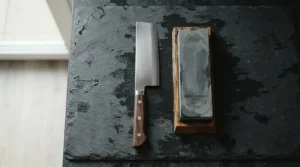
The nakiri vs usuba debate comes down to bevels. As the Wikipedia entry on the nakiri notes, a nakiri is sharpened on both sides while the professional usuba has a single-bevelled edge. Knivesandtools describes the usuba as even more precise, but also more technical to use and harder to sharpen yourself.
For home cooks, that settles it. A double-bevel Japanese nakiri knife tracks straight through a carrot without veering, and you can sharpen it symmetrically on a stone with no special training. An usuba shines for paper-thin katsuramuki peeling and decorative cuts, but it demands practice and a flat, well-maintained stone.
| Feature | Japanese nakiri knife | Usuba | Western chef’s knife |
|---|---|---|---|
| Bevel | Double (ryōba) | Single (kataba) | Double |
| Learning curve | Gentle | Steep | Gentle |
| Sharpening | Simple, symmetrical | Technical, one side | Simple |
| Cutting style | Straight push-cut | Precise push-cut | Rocking or push |
| Best For | Home vegetable prep, e.g. the Tojiro DP VG10 Nakiri 165mm | Professional and enthusiast chefs | All-purpose mixed prep |
The table makes the logic plain: the nakiri trades a little professional finesse for far easier ownership. If you want a vegetable specialist without the apprenticeship, one of the knives above beats an usuba for ninety-nine cooks in a hundred. A chef’s knife still wins when you’re switching between meat, fish and veg in one session, but for dedicated vegetable work, the Tojiro Basic VG10 Nakiri 165mm or Masakage Yuki Nakiri 165mm will feel quicker and tidier.
Japanese Knife Sharpening Stone: Grits, Types and What to Buy
A Japanese knife sharpening stone is simply a bonded abrasive block, usually a water stone, that removes steel to create a fresh edge. The grit number tells you how coarse it is: lower is rougher, higher is finer.
According to this whetstone guide from Chef Knives To Go, a 1000 grit stone is enough for regular cutting-edge work, 200-400 grit is reserved for chips or badly dull blades, and 3000-6000 grit finishes the edge. It also notes that Japanese kitchen knives are typically sharpened at 15-17° per side, narrower than Western knives, which preserves the thin geometry makers intended.
For most owners, a combination stone is the smart purchase. The King KDS 1000/6000 combination whetstone pairs a 1000 side with a 6000 side. One specialist retailer describes the 1000 side as suitable for knives up to 62 HRC, and says the 6000 side needs no soaking. That covers the Tojiro DP VG10 Nakiri 165mm, the Miyabi Evolution Nakiri 16.5cm and the Shun Classic Nakiri 16.5cm comfortably.
If you own the Masakage Yuki Nakiri 165mm, add a finer finishing stone later. For now, a good Japanese knife sharpening stone plus a flattening plate is the best investment after the knife itself.
Whetstone Sharpening a Nakiri: A Step-by-Step Guide
Whetstone sharpening feels intimidating until you’ve done it twice. Follow this routine on a double-bevel nakiri.
- Prepare the stone. Soak the 1000 side of your King KDS 1000/6000 combination whetstone for around 15 minutes. Sit it on a damp cloth so it can’t slide.
- Colour the bevel. Run a permanent marker along both edges. Where the ink vanishes, you’re actually sharpening.
- Find the angle. Aim for roughly 15°. Two stacked coins under the spine give approximately that, per the Chef Knives To Go guide. The Global G-5 Vegetable Knife 18cm is ground to 15° and the Shun Classic Nakiri 16.5cm to 16° per side, so match your angle accordingly.
- Work the burr. Use steady forward strokes along the whole edge until a tiny burr forms across the length, then flip and repeat.
- Refine. Alternate lighter strokes, then move to the 6000 side to polish and remove the burr.
- Test. Slice a tomato or sheet of paper. Rinse and dry knife and stone.
- Flatten the stone. Stones dish with use, so true them regularly. As this overview of sharpening stones explains, you can flatten a whetstone with sandpaper or a levelling stone.
A final warning: the Masakage Yuki Nakiri 165mm has a reactive core, so dry it thoroughly after sharpening. Practise whetstone sharpening on a cheap blade such as the Tojiro Basic VG10 Nakiri 165mm first, and the learning curve flattens quickly.
Vegetable Prep Technique: Getting the Most From Your Nakiri
Good vegetable prep technique starts with the motion. Keep the edge parallel to the board, push down and slightly forward, and let the blade drop through the food. Resist rocking; the whole point of a Japanese nakiri knife is that it doesn’t need to.
For onions, halve through the root, lay each half flat and slice with controlled push-cuts, then turn and cut across. For cabbage, quarter, core and shave thin ribbons in one confident stroke. The tall blade also scoops chopped food straight to the pan, which saves a second tool.
Pair the knife with a forgiving board. Wooden, rubberised and quality polyethylene boards protect the edge. Avoid glass or stone, which dull blades fast. Use a claw grip with your guiding hand, curling your fingertips so your knuckles ride the blade flat.
Hygiene matters too. Food Standards Agency guidance on chopping boards recommends separate boards for raw and cooked food and thorough washing between tasks. Keep a dedicated vegetable board, and your nakiri will thank you.
Finally, don’t force it. A sharp Japanese nakiri knife needs almost no pressure. If you’re pressing hard, the edge needs attention, not your arm.
Real-World Scenarios: Which Japanese Nakiri Knife Fits Your Kitchen?
Specs only matter when matched to a real cook. Here are three profiles with sensible pairings.
The flat-share student on a tight budget. You cook five nights a week and own one chopping board. The Tojiro Basic VG10 Nakiri 165mm gives you Japan-made steel for around £50-£70, and its soft-ish 59-60 HRC forgives rough early sharpening. Add a modest stone later.
The family cook batching Sunday prep. You chop for four, often under time pressure. The Tojiro DP VG10 Nakiri 165mm is the safe, sturdy choice, with the King KDS 1000/6000 combination whetstone completing a £100-£150 starter kit. If you prefer a big blade and an easy-clean body, the Global G-5 Vegetable Knife 18cm is the alternative.
The salad-obsessed enthusiast. You enjoy sharpening and want the finest edge. Choose the Masakage Yuki Nakiri 165mm, and commit to wiping the edge dry. Its 58mm height suits larger hands too.
For anyone buying to impress, the Shun Classic Nakiri 16.5cm and Miyabi Evolution Nakiri 16.5cm are the showpieces, though both deliver gains you’ll notice mostly in finish and edge retention rather than dramatic speed.
Japanese Knife Gift Set: How to Build One Worth Giving
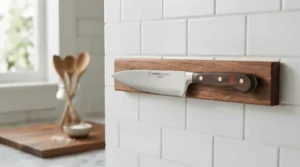
A thoughtful Japanese knife gift set beats a random block of mismatched blades. In my research, I didn’t find a verified, ready-made nakiri bundle that I’d recommend outright, so build your own instead. You’ll control quality and avoid padding.
A sensible three-part set looks like this. First, the knife: for a modest budget, the Tojiro DP VG10 Nakiri 165mm; for something showy, the Shun Classic Nakiri 16.5cm. Second, the stone: a King KDS 1000/6000 combination whetstone, or the King Whetstone Starter Set, which one UK-linked listing describes as including a 1000/6000 stone, angle holder, cloth and stable base. Third, a decent wooden or rubberised board.
Ask or observe handedness first. D-shaped handles on the Shun Classic Nakiri 16.5cm tend to favour right-handers, so a symmetrical Western handle like the one on the Miyabi Evolution Nakiri 16.5cm is safer if you’re unsure. A good Japanese knife gift set shouldn’t need an instruction manual, so add a short note about hand washing and dry storage. That tiny gesture protects the gift for years.
Features That Actually Matter (And Those That Don’t)
Marketing loves big numbers. Here’s what actually changes your cooking.
Matters: spine thickness and blade height. A 1.6mm spine, as on the Tojiro Basic VG10 Nakiri 165mm, slices cleaner than a 2.5mm one, while a 58mm blade like the Masakage Yuki Nakiri 165mm protects knuckles.
Matters: edge geometry. A 15-16° angle, as found on the Global G-5 Vegetable Knife 18cm and Shun Classic Nakiri 16.5cm, feels sharp, but only if you maintain it.
Matters moderately: hardness. Between 58 and 61 HRC is the usable window. Beyond that you gain edge retention but lose forgiveness.
Barely matters: Damascus patterns. They’re lovely, but cladding layers don’t make food slice better.
Barely matters: “ice-hardened” or proprietary steel names. Treat them as branding unless backed by hardness and geometry data.
Matters for hygiene: handle design. The Global G-5 Vegetable Knife 18cm is seamless; riveted handles on the Miyabi Evolution Nakiri 16.5cm need a proper rinse and dry.
Common Mistakes When Buying a Japanese Nakiri Knife
Even sensible buyers trip over the same hurdles. Here are the ones worth dodging.
Buying on looks alone. A beautiful blade that you’re afraid to wash isn’t a good everyday tool. Match care level to lifestyle.
Assuming harder is always better. At 61 HRC and above, the edge lasts but chips more readily if you twist, so a 58 HRC knife like the Kai Seki Magoroku Redwood Nakiri 165mm may actually serve a rougher cook better.
Ignoring the bevel. Because listings sometimes blur the line, confirm whether a knife is truly double-bevel before you buy. Mixing up nakiri vs usuba leads to botched sharpening.
Skipping the stone. Any Japanese knife loses its edge. A King KDS 1000/6000 combination whetstone is cheap insurance.
Expecting a meat cleaver. A nakiri isn’t for bones, frozen food or hard fruit stones, as Tojiro’s own care notes warn.
Using the wrong board. Glass and granite chew edges fast.
Forgetting handedness. D-shaped handles can feel awkward for left-handers.
Long-Term Cost & Maintenance: What a Japanese Nakiri Knife Really Costs
A cheap knife that dulls quickly costs more in frustration than a pricier one that lasts. Try cost-per-use: a £100 knife used five nights a week for five years is roughly 1,300 uses, or about 8p each. Even a £200 knife works out to around 15p per use, hardly extravagant.
| Knife | Price range | Maintenance level | Value verdict | Best For |
|---|---|---|---|---|
| Tojiro Basic VG10 Nakiri 165mm | £50-£70 | Low | Excellent starter value | Beginners |
| Tojiro DP VG10 Nakiri 165mm | £60-£90 | Low | Best all-rounder | Most households |
| Kai Seki Magoroku Redwood Nakiri 165mm | £75-£100 | Low-medium | Fair, easy to maintain | Sharpening learners |
| Global G-5 Vegetable Knife 18cm | £70-£100 | Low | Good for large-batch cooks | Big families |
| Miyabi Evolution Nakiri 16.5cm | £110-£150 | Medium | Premium for finish | Western-grip fans |
| Shun Classic Nakiri 16.5cm | £150-£200 | Medium | Showpiece value | Gifts |
| Masakage Yuki Nakiri 165mm | £140-£190 | High | Strong for enthusiasts | Hobbyists |
The table makes it clear that ownership cost sits mostly in the stone and your time. Budget roughly £25-£50 for a decent combination stone and flattening aid, and a sharpening session every few weeks for daily cooks. The Tojiro DP VG10 Nakiri 165mm and Tojiro Basic VG10 Nakiri 165mm deliver the lowest total cost, while the Masakage Yuki Nakiri 165mm costs more in attention than money.
FAQ
❓ Is a Japanese nakiri knife worth buying if I already own a chef's knife?
❓ What size Japanese nakiri knife is best for UK kitchens?
❓ Is a nakiri knife dishwasher safe?
❓ How much should I spend on a Japanese knife gift set?
❓ Which whetstone grit should I start with for a nakiri?
Conclusion
A Japanese nakiri knife isn’t a gimmick. It’s a focused tool that makes everyday vegetable work faster, tidier and genuinely more pleasant. For most cooks, the Tojiro DP VG10 Nakiri 165mm is the safest choice, offering good steel, a familiar handle and kind pricing. If you’re counting pennies, the Tojiro Basic VG10 Nakiri 165mm gets you into Japan-made VG10 for less, and the Kai Seki Magoroku Redwood Nakiri 165mm suits anyone keen to learn sharpening.
At the other end of the scale, the Global G-5 Vegetable Knife 18cm rewards big-batch cooks who value a seamless body, while the Miyabi Evolution Nakiri 16.5cm and Shun Classic Nakiri 16.5cm are polished, gift-ready options. For enthusiasts who adore whetstone sharpening and a razor edge, the Masakage Yuki Nakiri 165mm is the one to watch.
Whatever you choose, remember the three things that matter most: pick the right bevel, buy a sensible Japanese knife sharpening stone, and learn a clean push-cut. Master those and any knife on this list will outperform a drawer full of mismatched blades.
🔪 Ready to Upgrade Your Chopping Game?
🥕 Choose your favourite nakiri, pair it with a good stone and enjoy faster, cleaner prep tonight. Click any highlighted knife above to check current pricing and availability. Your vegetables, and your wrists, will thank you!
Recommended for You
- Affordable Japanese Santoku Knife: 7 Brilliant UK Picks (2026)
- Japanese Chef’s Knife: 7 Proven Picks For UK Cooks (2026)
- VG-10 Steel Knife For Sushi: 7 Best UK Picks (2026 Guide)
Disclaimer: This article contains affiliate links. As an Amazon Associate, I earn from qualifying purchases. If you purchase products through these links, we may earn a small commission at no additional cost to you.
✨ Found this helpful? Share it with your friends! 💬🤗
