In This Article
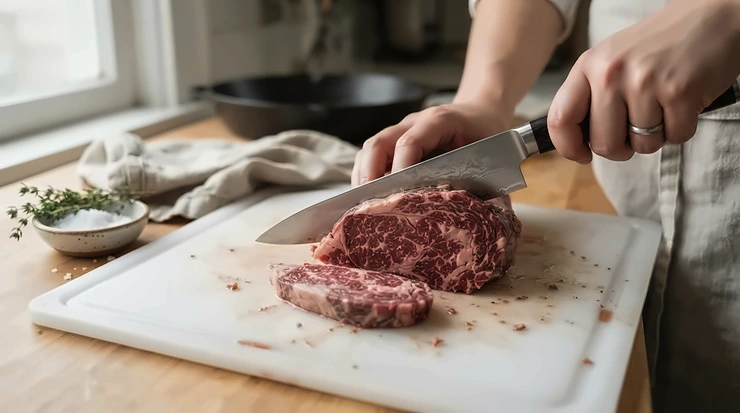
What is a Japanese chef’s knife? A Japanese chef’s knife is a thin, light, hard-steel all-rounder, usually a gyuto (literally beef knife), built for precise slicing, dicing and chopping. Compared with a Western blade it tends to have a flatter profile, a finer edge and harder steel, so it glides where heavier knives wedge.
Here’s what the shop assistant won’t tell you. The gap between a supermarket blade and a good Japanese chef’s knife isn’t a gap at all. It’s a different sport. America’s Test Kitchen’s gyuto testing found that the Japanese gyuto in its lineup ranged from 58 to 65 on the Rockwell scale, while the Western-style chef’s knives it had tested sat at roughly 55 to 58. Harder steel holds a finer edge for longer. The price you pay is a blade that dislikes being used as a crowbar.
This guide is built for British cooks. It profiles seven real knives, from a budget starter to a proper splurge, and it tackles the questions people keep searching for. Those include Japanese vs German kitchen knives, German vs Japanese blade angle, Japanese steel hardness, top Japanese knife brands, and whether a Japanese knife set review is worth reading before you buy a whole block.
One honesty note up front: I haven’t personally chopped onions with all seven. What follows is analysis of published specs, independent bench tests and aggregated review sentiment, and I flag where the evidence is thin. That way you can judge how much weight each claim deserves. Prices appear as ranges only, so always check the current price before buying.
Japanese Chef’s Knife Quick Comparison: 7 Picks at a Glance
Short on time? This table sorts all seven by steel, price range and the cook each suits best.
| Knife | Steel | Price range (check current price) | Best For |
|---|---|---|---|
| Kai Wasabi Black 20cm | Daido 1K6 stainless | Around £50-£70 | First-time buyers on a budget |
| Tojiro DP F-808 210mm | VG10 core, stainless clad | Roughly £70-£100 | Value hunters wanting a true gyuto knife |
| Global G-2 20cm | Cromova 18 stainless | Roughly £80-£120 | Cooks who love seamless, easy cleaning |
| MAC Professional MTH-80 200mm | AUS8, sub-zero tempered | Roughly £120-£170 | Upgraders leaving German knives behind |
| Kai Shun Classic 20cm | VG-MAX, Damascus clad | Roughly £150-£210 | Gift buyers and style-conscious cooks |
| Misono UX10 210mm | Swedish stainless | Around £200-£250 | Daily-use, pro-style workhorse seekers |
| Miyabi Birchwood SG2 20cm | SG2 powder steel | Above £300 | Enthusiasts happy to splurge |
Looking at the table, the Tojiro DP F-808 delivers the strongest steel for the money. If you’ve never touched a Japanese blade, though, the Kai Wasabi Black costs little enough that a wrong guess barely stings. The Miyabi Birchwood SG2 plays in a different league on edge geometry, but it demands care to match. Most UK kitchens will be happiest in the middle of the table.
💬 Just one click — help others make better buying decisions too!😊
Top 7 Japanese Chef’s Knives: Expert Analysis
Seven knives, budget to splurge, each judged on what its specs actually mean for real chopping.
1. Kai Wasabi Black — cheapest sensible way in
Think of the Kai Wasabi Black 20cm (model 6720C) as the learner’s permit of Japanese cutlery. It costs little, forgives plenty, and still shows you what thin steel can do. It’s made in Japan by Kai, the Seki company behind the Shun range.
The blade is Daido 1K6 high-carbon stainless at about 58 HRC, ground to roughly 15° per side and weighing only around 145g. In practice that means a light knife that won’t tire your wrist during a long prep session. The steel is also soft enough to touch up without drama. The handle is bamboo-powder polypropylene moulded permanently around the tang, so there are no seams for grime to creep into.
Based on the spec comparison, this suits someone who wants a Japanese chef’s knife without committing to whetstones on day one. The catch is that 58 HRC sits at the softer end of this lineup. Expect to refresh the edge more often than you would on a 61 HRC blade.
Review evidence is thin rather than negative. UK-facing retailer listings show only about seven reviews, and the one comment I could read praised value for money. That is nowhere near enough to call it a verdict.
Pros:
- ✅ Light 145g blade reduces wrist fatigue
- ✅ Seamless moulded handle is easy to keep clean
- ✅ Symmetrical grind suits left-handers too
Cons:
- ❌ Softer 58 HRC steel needs more frequent touch-ups
- ❌ Plastic handle lacks a premium feel
Around £50-£70, which makes it a low-risk entry point and strong value for beginners.
2. Tojiro DP F-808 — VG10 value benchmark
Specialist retailers tend to describe the Tojiro DP F-808 the way car reviewers describe a dependable family hatchback. It’s not glamorous, it’s mass-produced by a reputable maker, and it’s rarely a bad decision.
The 210mm blade is a three-layer san mai construction: a VG10 core wrapped in stainless cladding, hardened to around 60-61 HRC. Measured examples show a spine of about 1.7mm at the heel, thinning to roughly 1mm two centimetres from the tip, and a weight near 198g. That taper is the secret. A thin tip lets the knife part an onion’s layers without wedging, which is exactly what a gyuto knife is meant to do.
Here’s what to weigh. The steel is hard enough to hold an edge noticeably longer than a 56-58 HRC alloy, yet stainless enough for a busy sink. The Western-style handle feels familiar if you’re coming from German knives, though it’s plainer than the pricier options below.
On review sentiment, specialist sellers and reviewers repeatedly flag small cosmetic finishing flaws, such as rough spots on the spine or choil. These can be smoothed with fine sandpaper in minutes. Sharpness and value draw the praise. Treat all of this as reported experience, not a guarantee.
Pros:
- ✅ VG10 core at 60-61 HRC for the money
- ✅ Spine tapers to about 1mm near the tip
- ✅ Familiar Western-style handle
Cons:
- ❌ Minor finishing flaws on spine and choil
- ❌ Plain handle with little visual flair
Roughly £70-£100, which is excellent value and arguably the best steel per pound here.
3. Global G-2 — seamless steel, zero grime traps
The Global G-2 looks like nothing else on your board: one piece of stainless steel from tip to handle end, with no joins. It’s the most popular model in Global’s range, and it has been a design icon since Komin Yamada’s creation launched in 1985.
The blade is Cromova 18 stainless at 56-58 HRC with an acute 15° edge. That’s the lowest hardness in this guide, and for some cooks that’s a feature. The steel tolerates honing and the occasional misjudged cut without chipping, and the seamless build leaves nowhere for food to hide. The smooth steel handle can feel slick with greasy hands, though, so try gripping one before you commit.
America’s Test Kitchen’s Japanese gyuto spanned 58-65 HRC, so the Global G-2 sits at or just below the floor of that range. Think of it as a bridge. You get the lighter feel and fine angle of Japanese design with something closer to the toughness of a German blade. If you’re upgrading from a Western knife and fear chips, that’s a persuasive middle road.
Evidence here is mostly editorial and anecdotal. UK roundups keep featuring Global, and one long-time UK forum user describes a roughly 20-year-old 21cm Global as their most-used knife. That speaks to longevity, but it’s one voice.
Pros:
- ✅ Seamless one-piece build is hygienic and easy to clean
- ✅ Softer steel tolerates honing and rough treatment
- ✅ Light, nimble 15° edge
Cons:
- ❌ Edge fades sooner than harder steels
- ❌ Smooth steel handle can feel slippery
Roughly £80-£120, which is fair value as a design-led all-rounder.
4. MAC Professional MTH-80 — thin, tough all-rounder
The MAC Professional MTH-80 is the knife people keep recommending to friends who are quitting German blades. It’s a hybrid in spirit, with Japanese steel and a thin blade but a bolster and riveted handle that feel reassuringly Western.
The steel is AUS8 stainless, sub-zero tempered and advertised at 61 HRC, with a 15° edge per side. An independent lab measured about 14°. It weighs roughly 196g, and the blade carries shallow dimples that the maker says help starchy foods like potatoes release rather than cling. The bolster shifts balance towards the heel, which suits a pinch grip. It may complicate sharpening the last centimetre of the edge, so take a little care there.
Honestly, it’s tougher than it looks. AUS8 at 61 HRC is a sweet spot between edge life and resilience, which explains why so many first-time Japanese buyers land here.
A US dealer’s listing shows roughly 4.9 out of 5 across 60-plus reviews. Buyers repeatedly describe it as sharp out of the box and an easy first Japanese knife. Independent bench testing by Seattle Ultrasonics ranked its edge retention in the top five of 21 knives, with average food-cutting scores and some struggle with cheese. UK-specific review data was limited.
Pros:
- ✅ Top-five edge retention in one bench test
- ✅ Described as sharp straight from the box
- ✅ Bolster and weight feel familiar to Western-knife users
Cons:
- ❌ Average food-cutting results in the same test
- ❌ Bolster complicates sharpening near the heel
Roughly £120-£170, which is strong value for a first serious upgrade.
5. Kai Shun Classic — the polished crowd-pleaser
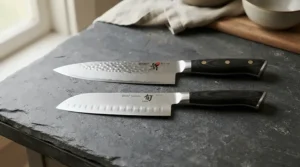
The Kai Shun Classic is the knife most likely to be unwrapped on Christmas morning, and that’s no insult. The Damascus ripple and the D-shaped PakkaWood handle make it the best-looking option here, and it’s handcrafted in Seki.
The core is VG-MAX, Kai’s tweaked evolution of VG10, at about 60-61 HRC. It’s hand-sharpened to 16° per side and clad in 69 layers of Damascus-style steel (34 either side of the core). The cladding is mostly about looks and a little toughness; the core does the cutting. One nuance worth knowing is that 16° is slightly wider than the 14° Wüsthof puts on its Classic range. Angle alone doesn’t decide sharpness. Hardness and blade thinness matter just as much.
The D-shaped handle favours a right-handed grip, so left-handers should check for a left-handed variant. As an analytical take, it’s ideal if you want one knife that works daily and still looks good on show.
Independent review data for this exact 20cm model was limited in my research. Retailers rate the range highly, but that’s marketing, not review evidence. One supporting signal: a newspaper test relayed by Knivesandtools placed the Shun Classic Santoku as runner-up in a UK chef’s knife group, which hints the range holds up.
Pros:
- ✅ VG-MAX core at 60-61 HRC
- ✅ Attractive 69-layer Damascus finish
- ✅ Handcrafted in Seki, Japan
Cons:
- ❌ D-shaped handle favours right-handers
- ❌ Premium over similarly performing steel
Roughly £150-£210, which is justified if looks and gifting matter. Otherwise the Tojiro DP F-808 comes close on steel for less.
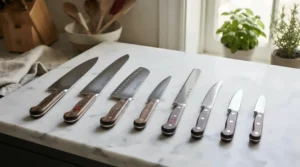
6. Misono UX10 — pro-kitchen workhorse, low fuss
The Misono UX10 has the reputation of a quiet professional favourite: no gimmicks, no Damascus, just very good stainless. Misono is a family-run Seki maker founded in 1935, billed as Japan’s oldest Western-style knife maker.
The 210mm blade uses Swedish stainless steel at about 59-60 HRC, weighs roughly 160-170g, and has a spine near 1.9mm at the heel. A nickel-silver bolster and pakkawood handle complete it. Retailers list a 70/30 asymmetric bevel, which means it’s tuned for right-handed use; some sellers offer a left-hand conversion.
Based on the spec comparison, the Misono UX10 suits someone who’ll use a knife daily and wants predictable behaviour. Hardness near 60 gives edge life that sellers compare with carbon steel, without the rust anxiety.
Review evidence is the thinnest in this guide. I found only two reviews on one retailer page (averaging 4.5), which is inconclusive. Epicurious has featured the knife editorially, according to a US retailer. A UK listing showed it sold out at the time of research, so check availability.
Pros:
- ✅ Swedish stainless balances sharpness and rust resistance
- ✅ Light blade with a well-controlled spine
- ✅ Left-hand conversion offered by some sellers
Cons:
- ❌ Right-hand-biased asymmetric bevel
- ❌ UK stock can be patchy
Around £200-£250, which is worth it for committed daily cooks and hard to justify for casual ones.
7. Miyabi Birchwood SG2 — razor-edged splurge
The Miyabi Birchwood SG2 is what happens when a German-owned company plays with Japanese ideas without a budget cap. It’s handcrafted in Seki, and Crown & Caliber’s June 2026 chef-panel roundup named it the best splurge Japanese chef’s knife.
The blade is SG2 micro-carbide powder steel, ice-hardened to 63 HRC, wrapped in 101 layers of Damascus and hand-honed to a 9.5-12° edge. That’s roughly half the angle of a traditional German factory edge, which means tomatoes simply surrender. The flip side is that 63 HRC steel is brittle in careless hands. Avoid bones, frozen food and twisting motions.
It suits hobbyists who own whetstones and treat their knives like instruments. If you’d rather chuck a knife in a drawer, spend less.
Review evidence is mostly US retailer feedback, where buyers describe it as razor sharp, beautiful and well balanced. I found no meaningful UK review pool and little independent long-term durability data. Enthusiasm is high, but the long-term picture is unproven.
Pros:
- ✅ SG2 at 63 HRC holds an edge exceptionally long
- ✅ 9.5-12° edge slices with minimal effort
- ✅ Striking 101-layer finish and birchwood handle
Cons:
- ❌ Hardness raises chip risk with careless use
- ❌ Price puts it beyond casual cooks
Above £300, often in the £300-£400 band. It’s a luxury, worth it only if you’ll sharpen on stones.
Spec Showdown: How the Seven Compare
| Knife | HRC | Edge / bevel | Handle | Best For |
|---|---|---|---|---|
| Kai Wasabi Black | 58 | About 15° per side | Moulded bamboo-powder polypropylene | Beginners |
| Tojiro DP F-808 | 60-61 | Even 50/50 double bevel | Laminated Western handle | Value-focused gyuto knife fans |
| Global G-2 | 56-58 | 15° | Seamless stainless steel | Easy-clean fans |
| MAC Professional MTH-80 | 61 | 15° (about 14° measured) | Riveted pakkawood, bolster | German-knife upgraders |
| Kai Shun Classic | 60-61 | 16° per side | D-shaped PakkaWood | Gifting |
| Misono UX10 | 59-60 | 70/30 asymmetric | Pakkawood, nickel-silver bolster | Daily pro-style use |
| Miyabi Birchwood SG2 | 63 | 9.5-12° | Birchwood | Stone-sharpening enthusiasts |
Looking at the numbers, the real divide isn’t price but hardness and edge angle. The Global G-2 and Kai Wasabi Black trade edge life for forgiveness, while the Miyabi Birchwood SG2 pushes both numbers to the extreme. For most households, the 59-61 HRC cluster (Misono UX10, Tojiro DP F-808, Kai Shun Classic and MAC Professional MTH-80) offers the best balance of sharpness and survivability.
Gyuto Knife Setup, Sharpening and Care: Your First 30 Days
Unbox it, wash it, dry it. That’s the whole ritual, and skipping it is how good knives die young.
Week one: build your station. Use a wooden, rubberised or good plastic board. Glass, stone and metal surfaces are edge-killers. Makers advise against bones, frozen food and hard fruit stones, and that applies to every knife in this guide. Hand wash and dry straight away, because dishwashers batter both edges and handles.
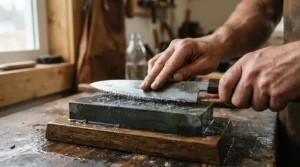
Honing differently. Kai says conventional sharpening steels are unsuitable for its high-hardness knives. Use a fine ceramic rod with feather-light pressure, or skip honing and go straight to a 1,000-grit whetstone. Match the factory angle: about 15° per side for most of these knives, 16° for the Kai Shun Classic, and a much shallower guide for the Miyabi Birchwood SG2.
Weeks two to four: learn the motion. A gyuto knife prefers a clean push or pull cut. Bolstered, curvier knives like the MAC Professional MTH-80 tolerate a little more rocking. Common first-month mistakes include levering through squash, scraping food with the edge instead of the spine, and storing the blade loose in a drawer. A magnetic strip or sheath fixes the last one.
As a rough guide, a light stone touch-up every month or two keeps a home-used edge keen. Harder steels may stretch that; softer ones like the Global G-2 may need it sooner.
✨ Don’t Miss These Hand-Picked Knives!
🔍 Take your home cooking to the next level with these carefully selected blades. Click on any highlighted item to check current pricing and availability. These tools will help you create restaurant-quality meals your family will love!
Real-World Scenarios: Matching a Japanese Chef’s Knife to Your Life
Specs mean little until they meet your kitchen. Here are three profiles, each with budget, environment and frequency of use.
The student in a shared flat. Budget around £60, one cramped worktop, cooking five nights a week. The Kai Wasabi Black fits. It’s light, cheap enough that a housemate’s mishap won’t cause a crisis, and its softer steel can be refreshed on a basic stone. The sealed handle copes with a messy sink.
The family cook at the weekend roast. Budget £100-£170, big boards, kids who occasionally load the dishwasher against your wishes. The MAC Professional MTH-80 is the safer bet, thanks to its bolster, mid-range hardness and Western feel. The Tojiro DP F-808 is the leaner alternative if you’d rather spend less. Either way, hand wash is non-negotiable.
The enthusiast with a whetstone habit. Budget £250 plus, cooking daily, happy to spend Sunday evening sharpening. The Misono UX10 rewards steady use, and the Miyabi Birchwood SG2 rewards patience and a light touch. If your cooking leans towards fine slicing of vegetables and fish, the 9.5-12° edge on the Miyabi Birchwood SG2 is hard to beat.
The pattern is simple. Match hardness to habits, and match price to how much upkeep you’ll genuinely do.
Problem → Solution: Fixing Common Japanese Chef’s Knife Headaches
Even a great Japanese chef’s knife throws up the occasional annoyance. Here are the usual suspects and practical fixes.
Problem: tiny chips in the edge. This usually follows contact with bone, a hard board or a twisting cut. Solution: stop cutting hard items with it and re-grind on a coarse stone. For chip-prone 61-63 HRC knives, keep a cheap, softer knife for squash and joints.
Problem: potatoes and cucumbers stick. Slices cling to flat blades. Solution: a dimpled blade like the MAC Professional MTH-80 helps according to its maker, and a lighter, wetter cut often fixes the rest.
Problem: the knife feels too light. Switching from German steel can feel odd. Solution: trust the edge rather than force the cut. If you miss weight, a bolstered knife such as the Kai Shun Classic feels more familiar.
Problem: rust speckles. Even stainless blades spot if left wet. Solution: dry immediately and scrub gently with a non-abrasive cream cleaner.
Problem: greasy hands, slippery handle. Smooth steel handles like the Global G-2 can slide. Solution: dry your hand, use a pinch grip, or choose a textured handle such as the pakkawood on the Misono UX10.
How to Choose a Japanese Chef’s Knife: 7 Steps
To choose a Japanese chef’s knife, match blade length to your board, steel to your maintenance appetite and handle to your grip. Then set a budget that covers a sharpening stone as well as the knife.
- Pick the length. America’s Test Kitchen found 210mm (about 8.2 inches) the best size for most home cooks. Step up to 240mm only if you have board space and larger hands.
- Match steel to upkeep. Stainless steels like VG10, VG-MAX and AUS8 forgive wet worktops. Carbon steels cut keenly but rust if left damp.
- Check hardness against your habits. 58-60 HRC suits forgiving use, 60-61 HRC suits careful cooks, and 63 HRC suits stone-sharpening hobbyists.
- Choose the handle. Western handles with bolsters feel familiar, while Japanese-style handles trim weight and reward precise grips.
- Mind the profile. A flatter belly favours push cuts, while a curved belly allows rocking.
- Check handedness. Asymmetric bevels (like the 70/30 Misono UX10) and D-shaped handles (like the Kai Shun Classic) favour right-handers.
- Budget for upkeep. Quality whetstones at UK retailers run from roughly £35 to £60 each, so plan for one.
Follow those seven steps and you’ll narrow the field fast.
Japanese vs German Kitchen Knives: The Honest Comparison
Japanese vs German kitchen knives isn’t a war so much as a trade-off between precision and tolerance. Which?’s chef’s knife guide summarises the split neatly: European-style knives normally use softer steel and are normally heavier than their Japanese counterparts. Both camps now borrow from each other, so the old stereotypes are blurring.
| Feature | Japanese chef’s knife | German-style chef’s knife | Verdict |
|---|---|---|---|
| Typical hardness | About 58-65 HRC (America’s Test Kitchen gyuto lineup) | About 55-58 HRC | Japanese keeps an edge longer |
| Typical edge | 15-16° per side common, 9.5-12° at premium end | About 14-15° on modern Wüsthof and Zwilling | Gap has narrowed |
| Weight and feel | Lighter, thinner | Heavier, thicker | Japanese is less tiring |
| Forgiveness | Harder but more brittle | More durable | German suits rough use |
| Sharpening | Whetstone preferred; steels often unsuitable | Honing steel works | German is easier |
| Best For | Precision cooks, e.g. Tojiro DP F-808 buyers | Heavy mixed prep | Depends on habits |
Looking at the table, a Japanese chef’s knife wins on cutting finesse and edge life, while a German one wins on forgiveness and low maintenance. The MAC Professional MTH-80 and Global G-2 are good middle-ground examples if you want the best of both. If you chop through chicken carcasses weekly, stay German. If you mostly slice vegetables, fish and boneless meat, go Japanese.
German vs Japanese Blade Angle: What the Degrees Really Mean
German vs Japanese blade angle is the most misunderstood spec in knife shopping. Angles are quoted per side, so a 15° edge is 30° inclusive. Older rules of thumb put Western factory edges at 20-22° and Japanese ones at 15-18°. That gap has largely closed.
Manufacturer figures relayed by review sites show Wüsthof grinding standard blades at about 14° per side (10° on Asian-style shapes) and Zwilling at about 15°. Kai grinds the Kai Shun Classic at 16°, while the Global G-2 and MAC Professional MTH-80 sit around 15°. Only premium blades like the Miyabi Birchwood SG2 go well below that, at 9.5-12°.
Here’s the twist. A Wüsthof edge at 14° is technically finer than a Kai Shun Classic at 16°. So why do Japanese knives still feel sharper? Because angle is only one ingredient. Harder steel supports a keener edge without rolling, and a thinner blade behind the edge reduces wedging. A fine angle on soft steel dulls quickly, which is why 14° German edges need regular steeling.
Practical takeaway: check the stated edge angle, but weigh it alongside hardness and blade thickness. When sharpening, keep to the factory angle with a guide. Shaving a few degrees off a knife not built for it invites chips.
Japanese Steel Hardness Explained: HRC, VG10, SG2 and Why It Matters
Japanese steel hardness is measured on the Rockwell C scale (HRC), which indicates resistance to denting. Higher numbers generally mean longer edge life but more brittleness. The seven knives in this guide span 56 to 63 HRC:
- Global G-2: 56-58 HRC (Cromova 18)
- Kai Wasabi Black: about 58 HRC (Daido 1K6)
- Misono UX10: 59-60 HRC (Swedish stainless)
- Tojiro DP F-808: 60-61 HRC (VG10 core)
- Kai Shun Classic: 60-61 HRC (VG-MAX)
- MAC Professional MTH-80: 61 HRC (AUS8)
- Miyabi Birchwood SG2: 63 HRC (SG2 powder steel)
VG-MAX is Kai’s proprietary upgrade of VG10, and SG2 is a powdered steel that can reach about 64 HRC. Powder steels hold edges for a very long time but suffer if you twist, pry or hit bone.
Features that matter, and those that don’t. Hardness between 58 and 61 HRC is more than enough for home cooking. Damascus layers are mostly decorative, and the core steel does the real work. Going beyond 62 HRC only pays off if you sharpen on stones and cut carefully.
In short, pick hardness to match your carefulness. The Tojiro DP F-808 and Misono UX10 hit the sweet spot, the Global G-2 forgives, and the Miyabi Birchwood SG2 rewards discipline.
Top Japanese Knife Brands: Who Makes What
The top Japanese knife brands cluster around two manufacturing hubs: Seki in Gifu and Tsubame-Sanjo in Niigata. Both have centuries-old blade-making traditions.
Kai (Seki, founded 1908) makes both the budget Kai Wasabi Black and the polished Kai Shun Classic. That gives you two price tiers from one maker. Tojiro, based in Tsubame-Sanjo, is widely seen as the value benchmark thanks to the Tojiro DP F-808.
Global, designed by Komin Yamada and made by Yoshikin, is the seamless-steel design icon behind the Global G-2. MAC supplies the dimpled, bolstered MAC Professional MTH-80, a long-time favourite of cooks moving from Western knives. Misono is the quiet pro option: a family-run Seki maker producing about 150,000 knives a year with around fifty workers, according to one specialist seller.
Miyabi is the odd one out. It’s German-owned but makes its knives in Seki, and Time Out London’s chef knife round-up describes it as a hybrid of both worlds. That hybrid quality shows in the Miyabi Birchwood SG2, which pairs Japanese edge geometry with a polished, internationally minded design.
Which brand suits which cook? Choose Kai or Tojiro if value is paramount, Global or MAC if you want a gentle transition from German knives, Misono if you want a workhorse, and Miyabi if you want a showpiece.
Japanese Knife Set Review: Should You Buy a Set?
A Japanese knife set review can look tempting, but I’d urge caution. I haven’t tested any specific set, and published set reviews often reward the packaging more than the cutting. Instead, here’s a framework for judging any set.
What a sensible set contains. The core kit is a chef’s knife, a paring knife and a serrated bread knife. Ranges like Shun Classic offer the chef’s knife (20cm), santoku (18cm), utility (15cm), paring (9cm) and bread knife (22cm) individually. Some Tojiro sets bundle a 180mm gyuto and a 120mm utility knife, which is closer to what most home cooks need.
The cost logic. In a 7- or 10-piece block, you may pay for pieces you’ll rarely touch. Buying a standalone Tojiro DP F-808 plus a cheap paring knife and a bread knife often delivers better steel where it matters.
What to check in a set review. Look for consistent steel across pieces, clear listing of hardness and edge angle, and honest comments on handle comfort. Be sceptical of reviews that never mention sharpening.
If you want a set, buy a small one from a single reputable maker. Otherwise, build your own around one strong Japanese chef’s knife.
Long-Term Cost, Maintenance and UK Knife Law
A knife’s real price is purchase cost plus upkeep. A good whetstone costs roughly £35-£60 at UK specialists, and a ceramic rod or guide adds little. Spread that over a decade and the numbers get friendly. A £150 knife used daily for ten years costs about 4p a day.
| Knife | Price band | Upkeep burden | Value verdict |
|---|---|---|---|
| Kai Wasabi Black | £50-£70 | Low; frequent touch-ups | Best entry value |
| Tojiro DP F-808 | £70-£100 | Low to medium | Best steel per pound |
| Global G-2 | £80-£120 | Low | Fair; design premium |
| MAC Professional MTH-80 | £120-£170 | Medium | Strong first upgrade |
| Kai Shun Classic | £150-£210 | Medium | Pay for finish |
| Misono UX10 | £200-£250 | Medium | Worth it for daily users |
| Miyabi Birchwood SG2 | Above £300 | High; needs stone skills | Luxury |
Looking at the table, the best long-term value sits at the top: the Tojiro DP F-808 and Kai Wasabi Black cost little to buy and little to maintain. The pricier knives earn their premium only if you’ll use and sharpen them regularly.
A quick UK law note. Under GOV.UK guidance on buying and carrying knives, carrying most knives in public without a good reason is illegal, and taking knives you use for work to and from work is one example of a good reason. A court decides case by case. If you carry a knife roll to a pop-up or catering job, keep it secured and be ready to explain why. This is general information, not legal advice.
FAQ
❓ Is a Japanese chef's knife worth it for a beginner cook in the UK?
❓ Can a gyuto knife go in the dishwasher?
❓ How can I tell a genuinely Japanese-made knife from a lookalike?
❓ What size Japanese chef's knife should I buy: 18cm, 21cm or 24cm?
❓ How often does a Japanese chef's knife need sharpening?
Conclusion
A Japanese chef’s knife won’t make you a better cook overnight, but it removes friction between you and the ingredients. Thinner blades, harder steel and finer edges turn chopping from a chore into something close to a pleasure.
If you’re unsure where to begin, the Kai Wasabi Black is the cheapest sensible entry and the Tojiro DP F-808 is the best value benchmark. Cooks leaving German knives behind will feel at home with the MAC Professional MTH-80 or the forgiving Global G-2, while the Kai Shun Classic wins on looks and gifting. The Misono UX10 suits daily pro-style use, and the Miyabi Birchwood SG2 is the dream upgrade for stone-sharpening enthusiasts.
Remember what the research showed. Hardness, edge angle and blade thickness work together, and a fine angle on soft steel won’t beat a well-made harder blade. Review evidence for several of these knives is thin, so lean on the specs and use the retailer’s returns policy as a safety net.
Whatever you pick, wash it by hand, use a proper board, and keep a stone or ceramic rod nearby. That small routine does more for your edge than any steel upgrade.
Recommended for You
- VG-10 Steel Knife For Sushi: 7 Best UK Picks (2026 Guide)
- VG-10 Steel Chef’s Knife: 7 Best Picks For UK Cooks (2026)
- Damascus Steel Knife Block Set: 7 Best Picks For UK Kitchens (2026)
Disclaimer: This article contains affiliate links. As an Amazon Associate, I earn from qualifying purchases. If you purchase products through these links, we may earn a small commission at no additional cost to you.
✨ Found this helpful? Share it with your friends! 💬🤗
